This video always used to air in between episodes of Degrassi on TeenNick so, needless to say, it has a lot of nostalgia appeal to me.
Enjoy!
This video always used to air in between episodes of Degrassi on TeenNick so, needless to say, it has a lot of nostalgia appeal to me.
Enjoy!
4 Shots From 4 Films is just what it says it is, 4 shots from 4 of our favorite films. As opposed to the reviews and recaps that we usually post, 4 Shots From 4 Films lets the visuals do the talking.
RIP, the great cinematography Robby Müller .
4 Shots From 4 Robby Müller Films

Paris, Texas (1984, dir by Wim Wenders)

Dead Man (1995, dir by Jim Jarmusch)

Breaking the Waves (1996, dir by Lars Von Trier)

24 Hour Party People (2002, dir by Michael Winterbottom)

Alfred Hitchcock wasn’t afraid to take chances. When the 3-D craze hit in the 1950’s, the innovative director jumped on the new technology to make DIAL M FOR MURDER, based on Frederick Knott’s hit play. The film is full of suspense, and contains many of The Master’s signature touches, but on the whole I consider it to be lesser Hitchcock… which is certainly better than most working in the genre, but still not up to par for Hitch.

Knott adapted his play for the screen, and keeps the tension mounting throughout. The story is set in London, and revolves around ex-tennis pro Tony Wendice, whose wife Margot is having an affair with American mystery writer Mark Halliday. Tony comes up with an elaborate plot to have her murdered by stealing a love letter Mark has written and blackmailing her, then setting up his old school acquaintance C.A. Swann, a man…
View original post 403 more words
 The year is 1943 and America is at war. All young men are expected to join the Marines and fight for their country but the Corps is not willing to accept just anyone. Marion (Jan-Michael Vincent) wants to continue a family tradition of service but, as his drill sergeant (Michael Conrad) puts it, Marion just is not pissed off enough to be a Marine. Marion is kicked out basic training and told to go home. He is given a blue uniform to wear on his jury so that anyone who sees him will know that he couldn’t cut it.
Ashamed of his failure and in no hurry to confront his family, Marion takes the long route home. While having a drink in California, he meets a Marine (Richard Gere) who did not get kicked out of basic training. Though not yet 30, this shell-shocked Marine already has a head of gray hair, which he says he got from the horrors of war. The Marine is due to return to the fighting in Europe but, upon meeting Marion, he sees a way out. When Marion gets drunk, the Marine knocks him out, switches uniforms with him, and goes AWOL.
When Marion comes to, he discovers that everyone that he meets now judges him by his new uniform. Strangers buy him drinks. Other servicemen try to pick fights with him. When he stops off in a small Colorado town, a local waitress (Glynnis O’Connor) falls in love with him and nearly everyone that he meets assumes that he must be a hero. Marion doesn’t exactly lie about his past. Instead, he simply allows people to believe whatever they want to believe about him. It seems like an idyllic situation until three prisoners from a nearby Japanese internment camp escape and the towns people expect Marion to help capture them.
Loosely plotted and sentimental, Baby Blue Marine is a dramatic version of Preston Sturges’s Hail The Conquering Hero. Though the film has a gentle anti-war message, it’s actually more about nostalgia for a simpler and more innocent time. If the film had been made at height of the Vietnam War, it might have been more angrier and more cynical. But, instead, this is one of the many post-Watergate films that wistfully looked back upon the past. When Marion settles into the town, he finds what appears to be a perfect and friendly home. Only the nearby internment camp and the town’s hysteria over the escape prisoners serve as reminders that things are never as ideal as they seem. Jan-Michael Vincent gives one of his best performances as the well-meaning Marion and actors like Richard Gere, Bert Remsen, Katherine Helmond, Dana Elcar, Michael Conrad, Bruno Kirby, and Art Lund all make strong impressions in small roles.
One of the few films to be produced by television mogul Aaron Spelling, Baby Blue Marine is not easy to find but worth the search.

by Harry Barton

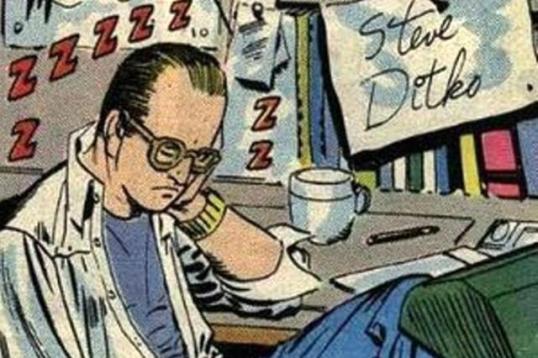
Okay, here’s the deal : I had this whole thing done — and probably done better — and I scrapped it. This now-meager memorial to the inimitable, irreplaceable Steve Ditko — artist, creator, visionary, iconoclast — initially had a soaring, elegiac title, was loaded with florid and heartfelt prose, and went into his work in excruciating, exacting detail.
It was a good piece. I liked it a lot. It took three-plus hours to whip it into shape. And then I shit-canned the whole thing and started over from scratch because I realized that’s not what Ditko would have wanted.
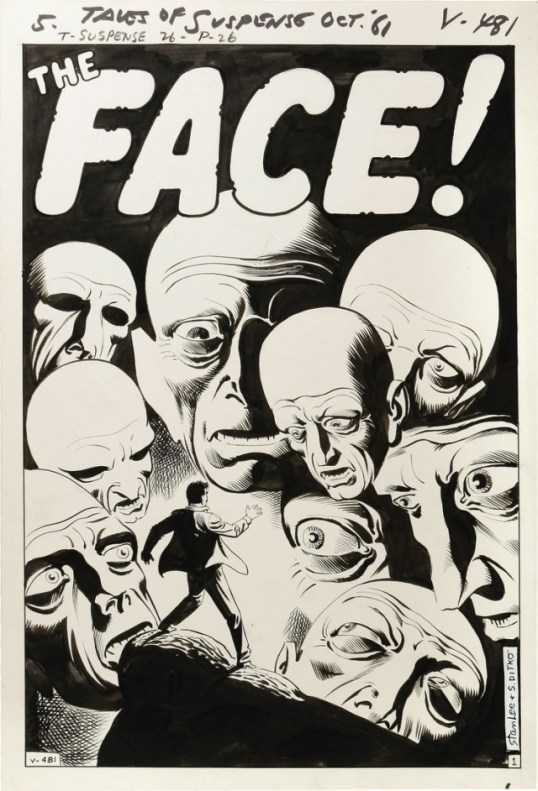
He was all about letting his work speak for itself, you see — that’s why he famously never gave interviews or appeared at conventions after 1968. That’s why he never wanted his photo taken. That’s why he headed for the exits at one publisher after another when he felt that…
View original post 1,168 more words
“(A) song I wrote in ten minutes almost as a challenge to myself. I thought, maybe I could write just a simple, almost formula song and make it mean something…”
That was how Elvis Costello described Everyday I Write The Book in an 1998 interview. The song went on to become one of Costello’s best-known compositions and the subsequent music video was a hit during the early days of MTV. Directed by Don Letts, the video features Elvis performing while Prince Charles haplessly attempts to woo Princess Diana (both of whom are played by celebrity lookalikes). Released just two years after their royal wedding and at a time when the story of Diana and Charles were still being held up as the ideal romantic fairy tale, this video proved to be prophetic in its portrayal of Charles and Diana’s marriage.
According to Costello, director Don Letts was solely responsible for the idea of using the royal lookalikes in the video. Letts is best known for his collaborations with The Clash. Not only did he direct several music videos for that group but he and Mick Jones later co-founded Big Audio Dynamite.
Yesterday, Elvis Costello announced that he would be cancelling the last six performances of his current tour because his battling what has been described as being “very aggressive cancer.” I know that I speak for a lot of music fans when I say that we’re all keeping Elvis in our thoughts and that we hope he makes a full recovery.


Self-Portrait of Steve Ditko
To many of us longtime comic book fans, Steve Ditko was an enigma.
We knew that, as the original artist on The Amazing Spider-Man and as the creator of Doctor Strange, Steve Ditko was responsible for much of Marvel’s early success. Though he would never make a cameo appearance in an MCU film and the mainstream media will probably always continue to act as if Stan Lee is solely responsible for every character in the Marvel Universe, true fans know that, without Steve Ditko, Benedict Cumberbatch would never have cast as spells as Doctor Strange and Tom Holland would never have swung through New York as everyone’s favorite web slinger.
We all knew of Steve Ditko’s talent but the man himself remained a mystery. He rarely gave interviews or made public appearances, saying that he preferred to let his work speak for itself. And what work it was! With Spider-Man, Ditko’s art captured not just the excitement of fighting criminals and saving the world but also the angst and anxiety of being young and overburdened. With Doctor Strange, Ditko brought magic, both literally and figuratively, to the Marvel Universe. Filling the pages with surrealistic images and out-of-this-world creations, Ditko kept Marvel relevant even as youth culture made the transition from the optimism of the Kennedy era to the drug-influenced psychedelia of the late 1960s.
Ditko left Marvel in 1966. The exact story of his departure are unknown. Perhaps, as a committed and outspoken Objectivist, Ditko chafed at the editorial restrictions that Marvel put on his work. While Stan Lee wanted to sell comics, Steve Ditko wanted to reach minds. After leaving Marvel, Ditko worked for several different companies, including Charlton and DC. (He even returned to Marvel in 1979 and regularly contributed freelance work to the company.) The best-known of his later creations was Mr. A, a reporter-turned-masked-vigilante who dispensed of criminals with uncompromising justice.
Despite his reputation for eccentricity, most people who worked with him described Ditko as being personable and cheerful. According to Charlton’s Frank McLaughlin, “He was a very happy-go-lucky guy with a great sense of humor at that time, and always supplied the [female] color separators with candy and other little gifts.”
On June 29th, Steve Ditko was found dead in his New York apartment. Rest in peace, Mr. Ditko. Thank you for sharing your imagination with us.
From The Amazing Spider-Man #33:


In Strange Tales, Ditko introduced my favorite of all of Marvel’s “cosmic” entities, Eternity:

And finally, the character who may have been closest to Ditko’s worldview, Mr. A:

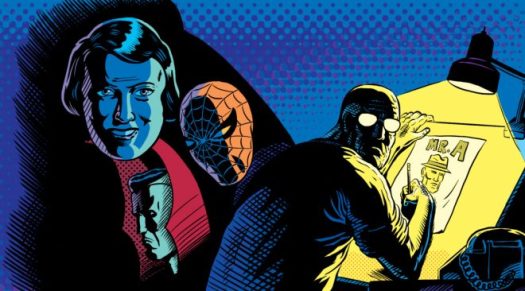
The world lost a true artistic visionary when Steve Ditko passed away at age 90. He had supposedly been dead two days before his body was found in his New York City apartment, an ignoble ending to one of comic book’s most unique artists, the man who co-created Spider-Man and Dr. Strange, two characters currently riding high in the Marvel Cinematic Universe. That their spiritual father should leave this mortal coil so anonymously is a tragedy, and a crying shame.
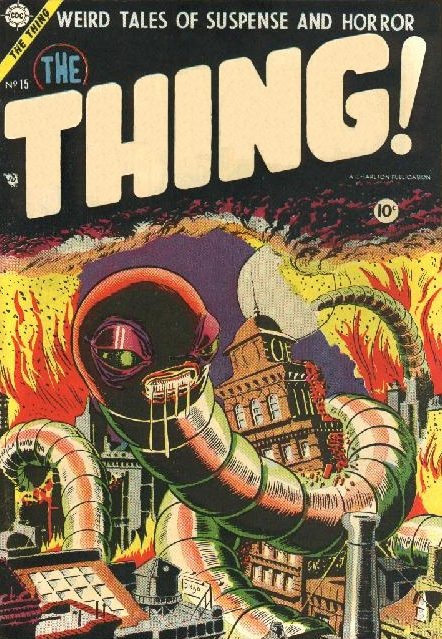
Ditko’s work will never be mistaken for a Jack Kirby or Neal Adams, or any of their myriad imitators. His art was deceptively simple, yet so complicated in its execution. He’s all angles and motion, with lots of empty spaces. His was a style all his own, a style that fans loved for its singularness. Ditko, after a post-war stint in the Army, entered the comics field in 1953, working…
View original post 475 more words
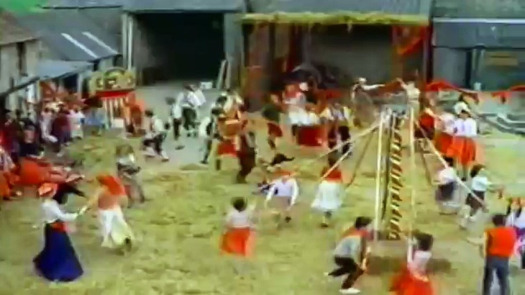
When this song came on my car radio last week, I immediately knew I had to do a “One Hit Wonders” post on it, so without any further ado, here’s Canadian New Wave pop rockers Men Without Hats doing their #3 smash dance hit “The Safety Dance”:
The band was led by singer/songwriter Ivan Doroschuck, who claimed he penned the bouncy tune in response to nightclubs banning pogo dancing, then a hot thing. At the time of recording the song and others for the album “Rhythm of Youth”, the group consisted of Ivan’s brothers Colin (guitars) and Stefan (bass), Allen McCarthy (keyboards/electronics), and Martin Cartier (percussion). The silly, Renaissance Fair-looking video got in heavy rotation on MTV (remember when they actually played music all day?), which aided it’s rise to the top of the pop charts.
Men Without Hats have gone through multiple personell changes over the years, with Ivan…
View original post 48 more words

 Through the Shattered Lens