Embracing the Melodrama Part II #37: Jennifer on My Mind (dir by Noel Black)


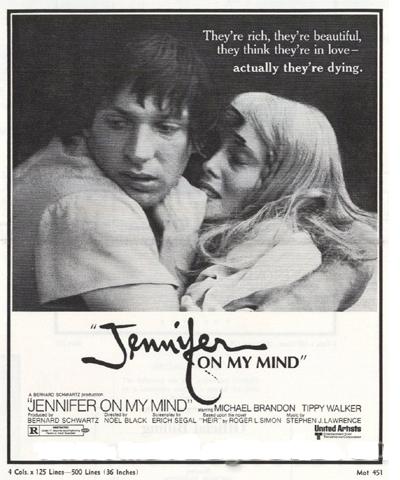
jommThe 1971 film Jennifer On My Mind opens with a lengthy montage of black-and-white photographs of immigrants arriving at Ellis Island.  These, the film tells us, are the men and women who came to America with nothing and who fought and struggled to have something.  The film itself deals with the grandchildren of those immigrants, who, as opposed to their ancestors, now have everything and who seem to be determined to reduce it all down to nothing.

24 year-old Marcus Rottner (Michael Brandon) would appear to have everything.  Following the death of his father, Marcus has inherited the fortune that his immigrant grandfather earned.  (The ghost of his grandfather shows up at one point and smokes a joint.)  Marcus will never have to work a day in his life, owns a nice apartment, and can go to Europe whenever he feels like it.  However, Marcus does have one problem: his girlfriend Jennifer (Tally Walker) just died of a heroin overdose in his living room.  Now, Marcus has to try to dispose of the body without anyone discovering what has happened.

The film alternates between showing Marcus’s attempts to get ride of Jennifer’s body and flashbacks to his romance with her.  We see how he first met Jennifer in Venice and how he fell in love with her.  Like Marcus, Jennifer comes from a rich family.  Her parents are alive but we never see them.  (Reportedly, scenes were filmed that featured Kim Hunter as Jennifer’s mother but they were cut after a disastrous preview.)  As she leaves Venice, Jennifer tells Marcus to visit her back in the states.

Which is just what Marcus does.  Marcus and Jennifer’s relationship plays out like a romantic comedy, except for the fact that Jennifer doesn’t really seem to care that much for Marcus.  After Jennifer jumps off a roof, Marcus takes her back to Venice and tries to recreate their earlier romance.  However, Jennifer just wants to go back to New York…

About ten minutes into the film, I nearly stopped watching Jennifer On My Mind.  Both Marcus and Jennifer seemed like such unlikable characters that I couldn’t imagine spending a full 90 minutes with them.  The fact that they were both rich and spoiled didn’t help.

But I kept watching because the first part of the film was set in Venice and I love Venice!  Watching those scenes reminded me of visiting Italy the summer after I graduated from high school.  It was a great time and, despite how I felt about Marcus and Jennifer, the film still brought back some nice memories.

However, then Marcus and Jennifer returned to New York and, since I don’t really care about New York the way that I care about Venice, I again found myself tempted to stop watching.  However, it was around this time that I started to realize that Michael Brandon was actually giving a pretty good performance in the role of Marcus.  So, I decided to keep giving the film a chance.

And then the ghost of Marcus’s grandfather showed up.  And then, the film gave us a scene of Jennifer hanging out with the two traveling “minstrels.”  And I thought to myself, “This is getting unbearably cutesy…”

But then, Robert De Niro showed up!  That’s right — Jennifer On My Mind is an early De Niro movie.  When Marcus hails a cab and asks for a ride to Long Island, the taxi driver is played by none other than Robert De Niro.  And while De Niro is only in the film for a few minutes, he totally steals those few minutes.  He plays a “gypsy” cab driver in this film and, as he drives Marcus to Long Island, he rambles about his sister, his drugs, and his fear of driving Marcus to see a bunch of “squares.”  De Niro is such an eccentric and energetic presence that he brings the whole film to life.

After De Niro’s scene, there was only 30 minutes left in the film and I thought to myself, “Okay, I can give this another 30 minutes…”

Written by Love Story‘s Erich Segal and directed by Pretty Poison‘s Noel Black, Jennifer On My Mind is an uneven but oddly watchable film.  If you’re looking for quirky love story … well, I really can’t recommend Jennifer On My Mind because it never really convinces you that Marcus and Jennifer are in love.  For the most part, their relationship seems to be one of convenience.  Jennifer wants drugs and Marcus can afford them.  Marcus wants a girlfriend and Jennifer is willing to pretend.  Instead, Jennifer On My Mind is more like a parody of true romance.  Marcus spends the entire film wanting Jennifer’s body and now that he has it, he has to find a way to get rid of it.

It’s undeniably uneven; for every scene that works, there’s another one that doesn’t.  But, at the same time, it’s undeniably watchable.  Plus, you get an early performance from Robert De Niro!

Jennifer On My Mind is currently available to viewed on Netflix.


Embracing the Melodrama Part II #36: WUSA (dir by Stuart Rosenberg)


wusaI recently saw the 1970 film WUSA on Movies TV.  After I watched it, I looked Joanne Woodward up on Wikipedia specifically to see where she was born.  I was surprised to discover that she was born and raised in Georgia and that she attended college in Louisiana.

Why was I so shocked?  Because WUSA was set in New Orleans and it featured Joanne Woodward speaking in one of the most worst Southern accents that I had ever heard.  A little over an hour into the film, Woodward’s character says, “What’s all the rhubarb?”  And while “What’s all the rhu…” sounds properly Southern, the “…barb” was pronounced with the type of harshly unpleasant overemphasis on “ar” that has given away many Northern actors trying to sound Southern.  Hence, I was shocked to discover that Joanne Woodward actually was Southern.

That said, her pronunciation of the word rhubarb pretty much summed up every problem that I had with WUSA.  Actually, the real problem was that she said “rhubarb” in the first place.  It came across as being the type of thing that a Northerner who has never actually been down South would think was regularly uttered down here.  And I will admit that WUSA was made 16 years before I was born and so, it’s entirely possible that maybe — way back then — people down South regularly did use the word rhubarb.  But, for some reason, I doubt it.  I know plenty of old Southern people and I’ve never heard a single one of them say anything about rhubarb.

As for WUSA, it’s a long and slow film.  A drifter named Reinhardt (Paul Newman) drifts into New Orleans and, with the help of an old friend who is now pretending to be a priest (Laurence Harvey), Reinhardt gets a job as an announcer at a right-wing radio station.  He reads extremist editorials that he doesn’t agree with and whenever anyone challenges him, he explains that he’s just doing his job and nothing matters anyway.

Reinhardt also gets himself an apartment and spends most of his time smoking weed with long-haired musician types, the exact same people that WUSA regularly denounces as being a threat to the American way.  Living in the same complex is Geraldine (Joanne Woodward), a former prostitute who has a scar on her face and who says stuff like, “What’s all the rhubarb?”  She falls in love with Reinhardt but finds it difficult to ignore what he does for a living.

Meanwhile, Geraldine has another admirer.  Rainey (Anthony Perkins) is an idealistic and neurotic social worker who is regularly frustrated by his efforts to do good in the world.  Reinhardt makes fun of him.  The local crime boss (Moses Gunn) manipulates him.  And WUSA infuriates him.  When Rainey realizes that WUSA is a part of a plot to elect an extremist governor, Rainey dresses up like a priest and starts carrying around a rifle.

Meanwhile, Reinhardt has been assigned to serve as emcee at a huge patriotic rally.  With Geraldine watching from the audience and Rainey wandering around the rafters with his rifle, Reinhardt is finally forced to take a stand about the people that he works for.

Or maybe he isn’t.

To be honest, WUSA is such a mess of a film that, even after the end credits roll, it’s difficult to figure out whether Reinhardt took a stand or not.

Anyway, WUSA is not a lost masterpiece and I really wouldn’t recommend it to anyone.  The film’s too long, there’s too many scenes of characters repeating the same thing over and over again, and neither Newman nor Woodward are particularly memorable.  (You know a movie is boring when even Paul Newman seems like a dullard.)  On the plus side, Anthony Perkins gives such a good performance that I didn’t once think about the Psycho shower scene while watching him.

As boring as WUSA is, I have to admit that I’m a little bit surprised that it hasn’t been rediscovered.  Considering that it’s about a right-wing radio station, I’m surprised that there haven’t been hundreds of pretentious think pieces trying to make the connection between WUSA and Fox News.  But, honestly, even if those think pieces were out there, it probably wouldn’t do much for WUSA‘s repuation.  According to the film’s Wikipedia page, Paul Newman called it, “the most significant film I’ve ever made and the best.”  Paul Newman’s opinion aside, WUSA is pretty dire.

Embracing the Melodrama Part II #35: Cindy and Donna (dir by Robert Anderson)


cindy-and-donna

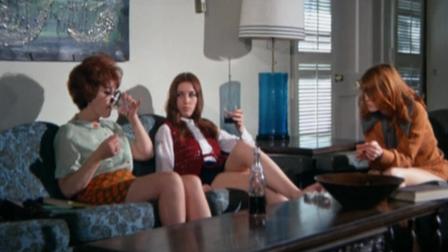
Mom, Donna, and Cindy

The 1970 film Cindy and Donna is yet another Crown International film about suburban malaise, out-of-control youth, hypocritical adults, and the difficulty of wearing a miniskirt without flashing the entire world.  In the grand Crown International tradition, it’s 65 minutes of nonstop sex and drugs, followed by 10 minutes of moralistic posturing and wrathful punishment.

Cindy and Donna tells the story of two half-sisters living in the suburbs.  Donna (Nancy Ison) is 17 and has several boyfriends.  Cindy (Debbie Osborne) is 15 and wishes that she had several boyfriends.  She both admires and resents her older sister.  Their mother (Sue Allen) spends most of her time drinking, which keeps her from noticing that her husband and Cindy’s father, Ted (Max Manning), is having an affair with a local stripper.

When the stripper leaves town, Ted gets drunk and ends up having sex with his stepdaughter, Donna.  Cindy happens to see this happen and, as a result, she decides that she’s going to stop worrying about being a good girl and instead, she’s just going to have a good time.  Soon, under the influence of her friend Karen (Cheryl Powell), Cindy is smoking weed and flirting with boys on the beach.  And, since this is a sexploitation film from 1970, marijuana leads to nymphomania.

Meanwhile, Ted is still trying to convince his stripper to come back home and Donna is posing for sleazy photographers and hey, it’s all a lot of fun, right?  No harm done, just a little experimenting, right?

THINK AGAIN!

This film is from 1970, after all.  And, as we all know from watching other films made around this time, there can be no pleasure without subsequent punishment.  Everyone’s fun is ruined when one of the sisters walks in on the other having sex with her boyfriend.

Needless to say, this all leads to someone getting tossed out into the street where they are promptly run over by a truck….

Plotwise, Cindy and Donna is your typical softcore exploitation film.  It’s better acted than most but otherwise, it’s fairly predictable.  And yet, I couldn’t help but enjoy it.  As I’ve stated many times in the past, I’m an unrepentant history nerd and everything about Cindy and Donna — from the clothes to the music to a few random comments about a protest on a college campus — screams 1970.  And, as a lover of melodramatic films, there was no way I couldn’t help but enjoy how every dramatic thing that possibly could happen in Cindy and Donna eventually did happen.

But, honestly (and perhaps surprisingly), the main reason that I enjoyed Cindy and Donna is because I’m the youngest of four sisters.  And, oddly enough, the sisterly dynamic between Cindy and Donna felt very honest and insightful.  Don’t get me wrong.  I’m not saying that Erin and I ever did anything close to what Cindy and Donna do in this film.  But still, once you removed the film’s more dramatic and sordid moments, there was so much about their relationship that felt real and true.

Like many films from Crown International Pictures, Cindy and Donna is available in a few dozen different Mill Creek compilations.   The next time that you’re feeling that you missed out on having a good time when you were in high school, watch Cindy and Donna and see what could have happened.

(Though, in all honestly, it probably wouldn’t have…)

CIP_Logo

Embracing the Melodrama Part II #34: Nightmares Come At Night (dir by Jess Franco)


nightmarescome2big For the past two weeks, I’ve been in the process of reviewing 126 cinematic melodramas.  Embracing the Melodrama Part Two started in 1927 with a look at Sunrise and now, 33 reviews later, we’ve finally reached the 70s.  And what else can I say about that other than to exclaim, “Yay!”

Seriously, a lot of good films were released in the 1970s.

We begin the 70s by taking a look at a film from the iconic and (to some people) infamous Spanish director Jess Franco.  Over the course of 54 years, director Jesus Franco Manera was credited with directing 203 films.  In all probability, the workaholic Franco directed a lot more than he’s been credited with.  As I wrote about Franco in my previous review of Female Vampire: “Among critics, Franco is usually either dismissed as a total hack (and/or pervert) or embraced as the living embodiment of the auteur theory.  Though no one’s quite sure how many films Franco has directed, Franco himself has estimated that he’s directed more than 200 films and, for the most part, he has financed and distributed them all on his own.  Franco has worked in every genre from thriller to comedy to hardcore pornography, but he is probably best known for directing low-budget, occasionally atmospheric erotic horror films.”

Now, I have to admit that I feel a little guilty about using a paragraph from an old review in a new review.  (And, as you may have noticed, I reviewed Female Vampire before Franco passed away in 2013.)  But, then again, it feels somewhat appropriate because Franco was famous for and unapologetic about taking bits and pieces of old and unfinished films and inserting them into new films.  That’s certainly the case with his 1970 film Nightmares Come At Night.

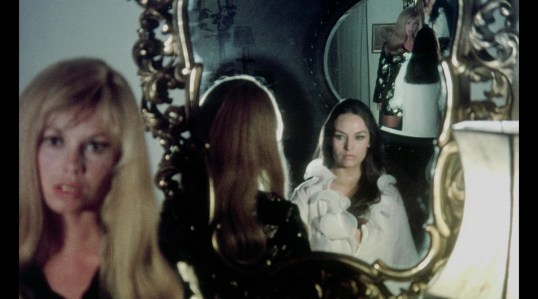
Nightmares Come At Night opens with Anna (Diana Lorys) living in an atmospheric mansion with her lover, Cynthia (Colette Giacobine).  Anna is haunted by frequent nightmares where she sees herself killing strange men with a spear.  Cynthia arranges for Anna to talk to an enigmatic doctor (Paul Muller).  Anna tells the doctor about how she was once a famous erotic dancer until she met Cynthia.  At this point, we get several lengthy flashbacks of Anna dancing in an oddly desolate club, all of which adds to the film’s ennui-drenched atmosphere.

Talking to the doctor doesn’t do Anna much good and she continues to have her nightmares except now the nightmares also seem to feature men giving lengthy monologues.  It soon becomes obvious that the neurotic Anna is being held as a virtual prisoner in the house by the dominating Cynthia.

(It’s a bit like a Lifetime movie, except everyone’s naked for 85% of the film’s running time.)

Meanwhile, we occasionally get shots of two people staring out of an unrelated window.  Eventually, we realize that they’re supposed to be Cynthia’s neighbors.  One of them is played by Franco’s frequent muse, Soledad Miranda.  (Miranda would tragically die in an automobile accident in 1970.)  Anyone who is familiar with Franco’s work will immediately notice that Miranda’s look in Nightmares was later duplicated by Lina Romay in Female Vampire.  The neighbors are obsessed with Anna.  As the film progresses, we discover that, when not looking out the window, they spend most of their time lying on a filthy mattress.  At one point, the camera zooms in for a close-up of the graffiti that’s been written on the wall over the mattress.

LIFE IS ALL SHIT, it reads.

To a certain extent, it’s pointless to say that Nightmares Come At Night is a disjointed film because almost all of Franco’s films were disjointed.  That’s actually what gave even the weakest of his films an odd and memorably dreamlike feel.  But Nightmares Come At Night is even more disjointed than usual.  That’s because Nightmares Come At Night was made out of a mix of footage shot for other films.  The scenes with Soledad Miranda were for an earlier, unfinished film.  Those scenes were combined with the footage of Anna, Cynthia, and the doctor.  The end result is a film that doesn’t necessarily much sense but you still have to admire Franco’s refusal to let any footage go to waste.

Ultimately, as with so many Franco films, Nightmares Come At Night is less about plot and all about atmosphere.  This is a film that is full of ennui and existential decadence.  It’s not one of Franco’s best films but, much like last year’s underrated California Scheming, it’s a bit of a minor existential classic when taken on its own terms.

(Please note: the trailer below is mildly NSFW.  Watch at your own risk.)

Jurassic World Adds To The Summer Action


JurassicWorld

Was there ever a need for a fourth film in the Jurassic Park franchise? For years many have tried to answer that and projects to get it up and running stalled for need of a director willing to sign on to a franchise that has been passed up by the superhero action tsunami that has hit pop culture.

It is now 2015 and we’re just months away from finally seeing the fruits of over a decade’s worth of labor to bring a fourth Jurassic Park film to the big screen. While it may still have Steven Spielberg attached as executive producer there’s no Joe Johnston anywhere near this fourth film. We have Carl Trevorrow taking the director’s chair with Chris Pratt and Bryce Dallas Howard taking on the lead roles.

Jurassic World is set to open it’s doors to the world on June 12, 2015 (took them long enough).

Embracing the Melodrama Part II #33: Reflections in a Golden Eye (dir by John Huston)


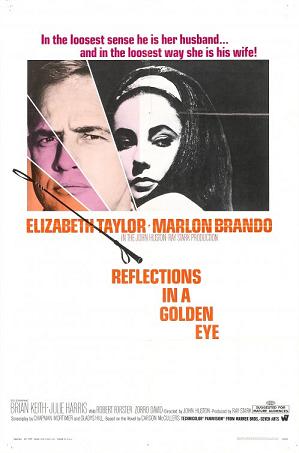
Reflections_in_a_golden_eyeFor the past two weeks, I’ve been reviewing, in chronological order, 126 cinematic melodramas.  I started in the 1920s with Sunrise and Wings and now, 33 reviews later, we have finally reached the end of the 1960s.  And what better way to end the 60s than by taking a mercifully brief look at the 1969 film, Reflections in a Golden Eye.

Now, before I get too critical of this film, I should acknowledge that there are some critics who absolutely love Reflections in a Golden Eye.  They think very highly of Marlon Brando’s performance as Maj. Weldon Penderton, a closeted homosexual who is stationed at a military base in the South.  They think that Elizabeth Taylor’s performance as Brando’s wife isn’t somewhat embarrassing.  And they think that the script isn’t overwritten and that director John Huston doesn’t try way too hard to prove himself worthy of the title auteur.  They feel that Reflections in a Golden Eye is a secret masterpiece that does not deserve to be known as an infamous flop.

I’m definitely not one of those people but they do exist.  There are some very respectable and intelligent critics who happen to love Reflections in a Golden Eye.

Well — vive la différence!

Earlier in this series, I pointed out that the 60s were not a great time for old school Hollywood directors trying to compete with both American television and European film.  It was a time when talented directors found themselves trying to keep up with the times and appeal to new audiences.  As a result, Joseph L. Mankiewicz ended up making Cleopatra.  Edward Dmytryk did The Carpetbaggers.  Elia Kazan directed The Arrangement.  William Wyler did The Liberation of L.B. Jones.  Stanley Kramer made RPM.  

And John Huston made Reflections in a Golden Eye.

This painfully slow film follows the affairs of six people on that Southern army base.  Brando is emotionally repressed and spend most of the movie mumbling in one of the worst Southern accents ever.  Taylor is obsessed with horses and spends most of the movie yelling in one of the worst Southern accents ever. Robert Forster is the object of Brando’s repressed desire, a soldier who likes to ride horses while naked and who is obsessed with sniffing Elizabeth Taylor’s underwear.  Brian Keith is in charge of the army base and is having an affair with Taylor.  Julie Harris is Keith’s suicidal wife.  Zorro David is Harris’s houseboy who, at one point, is nice enough to give this film a title by mentioning something about a golden eye.

What’s particularly insane is that Huston took the idea of making this film a reflection in a golden eye literally.  The entire film is tinted a sickly gold color.  Whenever the characters step outside, the sky looks like the sun has just exploded.  Whenever the characters are inside, they all look like they have jaundice.  On the one hand, you have to respect the fact that Huston so committed himself to potentially alienating the audience.  On the other hand, the yellow-tinting renders almost every image so grotesque that I actually found myself growing physically ill as I watched the film.

Watching Reflections in a Golden Eye, I could understand why The Godfather was such a huge comeback for Marlon Brando.  I wouldn’t necessarily say that Brando gives a bad performance here.  He’s watchable throughout the entire film.  But it’s still a performance that’s so strangely modulated (and which features a Southern accent that is just amazingly bad) that it ultimately distracts from the film itself.  If anything, Brando gives a performance that suggests what happens when a talented and eccentric man gets bored with what he’s doing.

(If you want to see a good Brando performance from 1969, see Burn.)

Reflections in a Golden Eye is a pretentious mess but fortunately, both Huston and American film would make a comeback in the 1970s.  We’ll start on that decade tomorrow.

http://www.youtube.com/watch?v=5U2NssXWO5Y

(Yes, this video is a spoiler but it’ll allow you to see the gold tinting.)

(The film was also released in an untinted version.)

Embracing the Melodrama Part II #32: The Sidehackers (dir by Gus Trikonis)


Sidehackers

Why the Hell am I reviewing The Sidehackers, a rather terrible film from 1969?

A lot of it is because The Sidehackers is famous for being featured in an episode of Mystery Science Theater 3000 and my boyfriend absolutely loves that show.  And, after I watched The Sidehackers, I viewed the Mystery Science 3000 version of the film.  Seriously, if any film deserves to be mocked by two robots and a possibly stoned space traveler, it’s The Sidehackers.

Another reason that I agreed to watch The Sidehackers is that it’s included in one of my many Mill Creek box sets and, as I’ve stated in the past, I always enjoy seeing what I can find hiding in those compilations.  Sometimes, you find a surprisingly good film.  And sometimes, you find The Sidehackers.

Finally, The Sidehackers is a Crown International production and, as of late, I’ve become a bit obsessed with seeing as many Crown International films as possible.

CIP_Logo

Anyway, The Sidehackers is one of those films that’s built around a sport that was probably never popular with anyone other than the guy who produced the film.  No, I’m not talking soccer.  I’m talking about sidehacking!

Let’s see if I can explain this.  You’re going to have to forgive my limited knowledge of just what the Hell this sport was all about.  Basically, sidehacking is a former of motocross where all the motorcycles have a sidecar attached to them.  So, when racing, one person steers the motorcycle and then his teammate stands in the sidecar and spends the entire race adjusting his body and providing balance whenever the motorcycle has to make a sharp turn.

Or something.

All I know is that it looks extremely silly and kinda stupid but everyone in The Sidehackers is just fascinated by it.  The Sidehackers features two full races and I have to admit that, as hard as I tried, I could not keep up with who was on which motorcycle or how much help the guy in the sidecar really was.  I found myself wondering why someone would decide they wanted to race as a part of a team instead of as an individual.  At one point, the film’s main character says that sidehacking is all about “teamwork” but seriously, who needs that crap?  Individual glory all the way!

Anyway, surly Rommel (Ross Hagen) is the greatest sidehacker in the world.  However, he makes a mistake when he agree to show cult leader J.C. (Michael Pataki) how to sidehack.  J.C. loves the sport but he can’t handle the fact that he’s not very good at it.  He gets jealous of Rommel and his amazing sidehacking skills. J.C.’s girlfriend, Paisley (Claire Polan) is also impressed with Rommel’s sidehacking.  It looks like this sidehack might end in tragedy!

(To be honest, I just like using the word “sidehack” and I will probably use it a few more times before this review ends.)

When he’s not busy sidehacking, Rommel likes to go on picnics with his wife Rita (Diane McBain) and think about how happy they are and how much they both love sidehacking.  It’s a life so perfect that an American Idol style ballad is heard whenever Rommel and Rita are together.  However, then Paisley claims that Rommel assaulted her so J.C. briefly abandons his sidehacking obsession so that he and his gang can beat up Rommel and murder Rita.

Rommel handles the tragedy not by sidehacking but by walking along the highway.  Rommel no longer cares about sidehacking.  Sidehacking is J.C.’s thing now.  Rommel, instead, is out for revenge.  He recruits a few random people from around town and they go off to kill sidehacking J.C. and his gang.

And it should be easy enough to accomplish all of this because it’s not like J.C. is a particularly intelligent murderous cult leader but since this film was made in 1969, it has to end on a down note.  Let’s just say that the film ends with a close-up of a dead body while the Sidehackers love theme plays on the soundtrack.

The Sidehackers is incredibly bad and pretty boring.  Michael Pataki deserves some credit for giving a good performance as J.C. but Ross Hagen is amazingly surly.  Even before Rita dies, Hagen seems to be in a generally pissed off mood.  If anything, I doubt Ross Hagen’s performance did much to increase the popularity of sidehacking.

I searched YouTube and most of the clips of The Sidehackers was taken from the Mystery Science Theater episode.  Unfortunately, those clips tends to make The Sidehackers look more interesting than it actually is.  I really wanted to find some sidehacking footage so you could see how stupid it really does look but unfortunately, I couldn’t find any.  However, I did find this clip of one of Rommel’s men telling a stupid joke that has nothing to do with sidehacking.

Enjoy!

Embracing the Melodrama Part II #31: Rachel, Rachel (dir by Paul Newman)


Original_movie_poster_for_the_film_Rachel,_RachelI recently saw the 1968 best picture nominee Rachel, Rachel on TCM and I have to say that, at first, I was rather underwhelmed by it.  Don’t get me wrong.  I thought it was well-acted.  I thought it managed to capture a lot of details of small town life.  I thought that, for a film made in 1968, it was surprisingly mature and nonjudgmental when it came to exploring feminine sexuality.  I was even more surprised to see a nearly 50 year-old movie that actually featured a sympathetic portrayal of a lesbian.  Just consider that the homophobic The Sweet Ride was released at the same time and you can see just how unusually progressive Rachel, Rachel was as far as this was concerned.

And yet, when I first watched Rachel, Rachel, it was difficult for me to connect with it.  And I really wasn’t sure why.  I mean, it is true that Rachel, Rachel is one of those films that moves at a very deliberate post but, trust me, I’ve seen and enjoyed many films that were a helluva lot slower than Rachel, Rachel.  But, for whatever reason, it took me two viewings to really appreciate Rachel, Rachel as a surprisingly sensitive character study.

The film is about Rachel (Joanne Woodward), a 35 year-old virgin who lives with her mother in a small Connecticut town.  Since the death of her stern and overbearing father, Rachel has lived with her mother.  She’s a withdrawn and meek woman who has frequent fantasies that veer between unrealistic happiness and nightmarish morbidity.  Her best friend, another unmarried teacher named Calla (Estelle Parsons), invites Rachel to a revival meeting and, for the first time in her life, Rachel actually allows herself to be openly passionate.  After the meeting, Calla suddenly kisses her.  Shocked, Rachel temporarily ends their friendship.

Even before the revival meeting, Rachel has run into Nick (James Olsen), a friend from high school who is in town to visit his family.  After getting kissed by Calla, Rachel ends up turning to Nick and losing her virginity to him.  Rachel believes that she’s in love with Nick and is soon fantasizing about their future children.  However, it’s obvious to everyone (except for Rachel) that Nick doesn’t quite feel the same way…

When I first saw Rachel, Rachel, I had a hard time relating to the character of Rachel.  I watched and, as much as I tried to be sympathetic, I still found myself wondering how anyone could possibly still be a virgin at the age of 35.  I mean, I understand that times were different and all but seriously!  I guess back then, people actually were serious about the whole “no sex before marriage” thing.  (That probably explains why people used to get married when they were 17.)  The film is full of largely silent flashbacks to Rachel’s youth and we see that she was raised in an emotionally repressed environment.  She was raised to wait for the right man to come along and, when he didn’t, Rachel eventually found herself as a 35 year-old virgin.

And, without getting too TMI here, let’s just say that I couldn’t relate to Rachel’s situation.

But, when I watched the film for a second time, I discovered that even if I don’t know what it’s like to be a 35 year-old virgin, a lot of Rachel’s experiences were, in their way, universal.  Consider the scene at the start of the film where Rachel fantasizes that everyone in town is staring at her as she walks down the sidewalk, all because her slip is showing.  Who hasn’t, at some point in their life, felt like everyone was staring at her and judging?  And, for that matter, who hasn’t had a Nick in their life?

Interestingly enough, Rachel, Rachel was the directorial debut of the iconic actor Paul Newman.  One thing that I’ve noticed about films directed by actors (especially first films) is that the actor-turned-director often seems to feel that he has to prove himself by indulging in as much showy cinematic technique as possible.  (And if you don’t understand what I mean, check out George Clooney’s Confessions of a Dangerous Mind.)  And, as much as I hate to admit it because I’ve never read one negative word about Paul Newman, I have to admit that Newman’s direction was one of the reasons why, at first, I found myself feeling detached from the film.

While Newman tells most of Rachel’s story in an admirably straight-forward way, he also included just a few too many arty flashbacks and fantasies.  Some of the fantasies — like the one at the start of the film that I mentioned two paragraphs ago — are handled well but others are distracting and they remind the viewer that they’re watching a film.  And Rachel, Rachel is a film that works best when it’s naturalistic.  Whenever it gets too self-consciously cinematic, it takes the viewer a few minutes to get sucked back into Rachel’s story.

But, and this is the important thing, Paul Newman also gets some great work out of his actors.  Judging from some other films in which I’ve seen him, James Olson was not a particularly good actor but he was great in Rachel, Rachel.  Estelle Parsons has been an overdramatic presence in a few films and a lot of tv shows but she’s great in Rachel, Rachel.  And then there’s Joanne Woodward, who was great in a lot of films, including Rachel, Rachel.  Newman and Woodward were married when they made Rachel, Rachel and were still married when Newman died 40 years later.  Newman reportedly directed Rachel, Rachel because he wanted Woodward to have a great role.  Woodward is on-screen throughout the entire film and Newman’s love for her is obvious in every frame.

Rachel, Rachel is a flawed and imperfect film but it’s still worth catching the next time that it shows up on TCM.

rachelrachel2

Embracing the Melodrama Part II #30: The Sweet Ride (dir by Harvey Hart)


The_Sweet_Ride_FilmPosterThe 1968 film The Sweet Ride takes the audience on a ride through Malibu and reminds us all that, in many ways, the 1960s sucked.

The Sweet Ride opens with actress Vicki Cartwright (Jacqueline Bisset) losing her top while swimming in the ocean.  While Vicki panics and tries to figure out how to get back to the beach without anyone seeing her breasts, she’s spotted by a surfer named Denny McGuire (Michael Sarrazin).  Denny hands her a towel and then leads her back to the beach house that he shares with aging tennis player Collie (Anthony Franciosa) and stoned musician Choo-Choo (Bob Denver).

The rest of the film is a 90 minute tour of California beach life in the late 60s.  Despite Collie’s cynical warning against falling in love, Denny does just that, despite the fact that Vicki refuses to tell him anything about her past or even where she lives.  Meanwhile, Collie spends his time hustling on the tennis court and the married Choo-Choo pretends to be gay in an attempt to get out of being drafted.  (Choo-Choo probably could have gotten out of the draft by pointing out that he appears to be 40 years old but the filmmakers decided to have him walk around with a poodle and speak in falsetto.  Just in case you had any doubt that this film was made in 1968…)  It’s a mix of comedy, romance, and drama and it’s features footage of some real bands performing in actual Malibu nightclubs and that’s a good thing for all of us history nerds.

And, since The Sweet Ride was made in 1968, the whole film gets progressively darker as it reaches its conclusion.  Choo-Choo does get drafted and it’s hard to believe he’ll survive a day in Viet Nam.  Collie’s perfect life is revealed to be an empty facade.  Denny realizes that his friends are all immature losers.  And Vicki ends up getting assaulted by a high-power studio executive (Warren Stevens).  It all leads to more violence, disillusionment, and general ennui.

For some reason, The Sweet Ride shows up on FXM fairly regularly.  It’s a strange film because it doesn’t really work and yet it’s also compulsively watchable.  It tries to be about everything and, as a result, it often feels like it’s about absolutely nothing.  And yet, somehow, it remains compelling…

Why is the film compelling despite itself?  It’s not because of the main characters, that’s for sure.  The boys in the beach house are probably some of the least likable film protagonists in cinematic history.  Anthony Franciosa gave some great performances in his career (check him out in A Face in the Crowd and Tenebrae) but Collie is such a smug jerk that you find yourself hoping that someone will just punch him in the face.  Meanwhile, Denny tends to come across like a weak-willed and obsessive stalker and Choo-Choo — well, Choo-Choo often seems to be a character in a totally different movie.  As for Vicki, her character pretty much exclusively exists to be victimized.

Ultimately, I think The Sweet Ride is watchable because it is such an imperfect time capsule.  If I wanted to know what it was like to be alive in the 60s, The Sweet Ride is one of the films that I would watch.  It’s not the best film ever made but it is a chance to look into the past.

(Incidentally, The Sweet Ride was directed by Harvey Hart, who also directed the underrated Shoot.)


“It Follows” That I Should Have Liked This Movie, But —


It-Follows-poster

A funny thing happened on the way to writer/director David Robert Mitchell’s 2014-lensed indie horror It Follows finding its way into the VOD dump-off land most contemporary scare flicks have reluctantly learned to call home : it got noticed. In fact, it got noticed a lot, and evidently by at least some of the right people, because on the basis of positive “buzz” alone, the aforementioned relegation to so-called “home viewing platforms” was quickly scuttled in favor of a limited theatrical release — which just as quickly became a wide theatrical release — which finally ended with this being one of the most-talked- about “supernatural thrillers” in years.

What I can’t figure out is, I’m sorry to say, is why.

it-follows-341

Don’t get me wrong — It Follows certainly isn’t bad by any stretch of the imagination, and I’m naturally disposed towards rooting for any sort of original horror film that tries to navigate its way through the contemporary morass of remakes and might-as-well-be-remakes because they’re based on concepts that were played out three or four decades ago, but by the time I got around to seeing this flick yesterday, the hype surrounding it was so all-consuming that my expectations were sky high. Maybe it’s not fair to expect any movie to live up to all that, much less a modest production out of Detroit like this one, but I like to think that I’m honest enough with myself (and, hopefully, with the rest of you) to recognize that my belief that this is just a more-stylishly-done-than-usual presentation of a rather poorly-thought-through, and in many cases bog-standard, story would be unchanged even without the profound sense of “well, that was a bit of a letdown” I left the theater with. I’m not holding Mitchell’s rave reviews against him by any stretch, nor is it fair to judge his work against a yardstick fashioned from others’ praise, but hey — I’m only human, and when I come out of a movie that most everyone else has gushed one superlative after another about feeling decidedly unimpressed, I’ve gotta wonder where the disconnect comes from. Am I really that hard to please, or is everyone else just that wrong?

I mentioned my feelings about the film in a horror and exploitation group I belong to on facebook, and a friend on there made an interesting observation — most of the more glowing reviews for It Follows have come from “establishment” critics (as in, those who routinely guffaw at the horror genre in general, when they even bother to pay attention to it at all), while hard-core “horror hounds” have been decidedly less enthusiastic. A quick bit of research on my part found this to be pretty true — sure, most of the “big” horror sites and publications have been effusive in their praise, but by and large the die-hards out there have been a lot more cool towards it.

My theory is pretty simple — they (as in, your major newspaper and magazine critics) haven’t seen this done a hundred times before, while we (as in, Mr. and Ms. horror aficionado) have. And therein lies the entire difference in perception.

1

To be sure, Michell has concocted a very stylish little number here — the cinematography and shot composition, the performances, and particularly the sound design are all top-notch. If you don’t watch a lot of horror flicks and are inclined to write the ones you haven’t seen off completely, you could be forgiven for being surprised that some of them are this well done. But when you do watch a lot of horror, and you see vastly superior fare like Starry Eyes garnering far less attention, well — you’re bound to wonder what all the fuss is about in this case.

Likewise, the central premise involving a young woman named Jay Height (played my Maika Monroe, who does a fantastic job) contracting the attention of some sort of malevolent entity after a casual sexual encounter “transmits” it to her might feel reasonably original to somebody who doesn’t “speak fluent horror,” but if you do, you’ll recognize it as a slapdash combination of Shivers-era Cronenbergian body horror and dime-a-dozen, regulation-issue “possession movie” tropes. Furthermore, the idea that sexual “promiscuity” (as in, being female and actually enjoying sex) equals death is the oldest card in the “slasher” movie hand, Mitchell just has the nerve to obfuscate it under a thick enough  layer of pretense that you can be swindled into believing he’s “deconstructing” the whole notion rather than reinforcing it. Trust me when I say he’s clearly doing the latter.

it-follows-movie

Another thing that bugged the shit out of me about It Follows is how flat-out pleased with its own supposed “cleverness” it is. Jay and her sister, Kelly (Lili Sepe) live in a house that’s pure 1970s throwback, and most of their friends drive cars that date to that era, but one member of their slacker clique has a flip-open plastic toy seashell that doubles as a Kindle-type device, while their mom has a fancy-ass modern refrigerator to go along with her Curtis Mathes console TVs and outdated brown shag carpeting. The streets and driveways of their suburban neighborhood seem to be populated with decidedly modern cars and SUVs and mini-vans, as well. This dichotomy of past and future might feel right at home in, say, a David Lynch film, or some other equally-channeled-from-the-subconscious story, but in a narrative as by-the-numbers as this one, it just feels like weirdness for its own sake, and a rather naked plea for attention that the filmmakers don’t trust you enough to get on the first pass, so they keep hammering the point home. Think of the scene in the thoroughly risible Juno where she takes a call in her bedroom on one of those old plastic hamburger-shaped phones and, afraid that you’ll miss how cool and “shabby-chic” the whole thing is, they actually have her say into the receiver “sorry, I can’t hear you so well — I’m talking to you on my hamburger phone,” and you”ll get what I’m driving at here.

The final major flaw in Mitchell’s little opus I feel the need to call attention to  is the fact  that he apparently hasn’t taken the time to think through how the whole “STD possession” thing works. The guy who gave Jay the “curse” admits he’s still being pursued by the ultra-slow-motion killer(s) after even after playing hide the salami with her, and in due course Jay herself can’t seem to shake it either after screwing some loser friend of hers in the hospital — even after it kills him. She finally seems to manage to lose her pursuers-from-beyond-the-grave when — spoiler alert! — she has sex with her long-suffering male friend/lap dog Paul (Keir Gilchrist, the second of the film’s pitch-perfect leads), but if this is supposed to be some heavy-handed metaphor for the idea that it’s true love that finally sends the spirits packing, I have to say it falls pretty flat, because when Jay finally relents to allowing Paul’s dream of getting his schlong inside her to come true, it feels more like a combination of pity fuck and resignation to pass it on to him just because she’s tired of being — you know — followed. Yeah, sure, he’s clearly over the moon about her, but she seems to have just finally “settled” for a guy who was convenient and cared about her. Talk about playing into the old “you can’t have everything you want, ladies” and “don’t aim for higher than your station in life” pieces of received “wisdom.”

The big denoument here comes when Paul concocts a totally lame-brained scheme to kill the “stalker force” in a public swimming pool — a plan that has disaster written all over it from the outset (disaster that’s only averted due to the fact that every single one  of the literally dozens of electrical appliances they toss into the drink doesn’t start shooting sparks; go figure that one out), but I’ll gave that a pass because stupid teenagers do a lot of stupid shit. I find it rather useful to mention,  though,  simply because it’s such a handy representation in microcosm for why the movie itself doesn’t work, much less live up to all those hyper-congratulatory blurbs we’ve been reading : it all sounds good on paper for about a minute, but ultimately can’t stand up to any sort of even semi-rigorous examination.