Shattered Politics #20: The Best Man (dir by Franklin J. Schaffner)


Best_man22234

“Does The Best Man Always Get To The White House?” asks the poster for the 1964 film, The Best Man.

Of course, nowadays, that question seems incredibly naive.  Of course the best man doesn’t always get to the White House!  Some of my friends are Republicans and some of my friends are Democrats and a lot of my friends are Libertarians but they all have one thing in common: the belief that at least half of the past 4 elections were won by the wrong man.

But, as anyone who has done their research can tell you, 1964 was a far different time from 2015.  In general, people had greater faith in both government and their elected leaders.  Ineffective leaders and corrupt authority figures were viewed as being the exception as opposed to the rule.  We’re a lot more cynical now and, when we see political movies from the early 60s, all of that optimism and idealism often make them feel very dated.

Another big difference between the middle of the 20th Century and today is that, when it came to presidential nominating conventions, there was actually the potential for some suspense regarding who would win the nomination.  Occasionally, it took more than one ballot for a candidate to be nominated.  Last minute deals often had to be made and convention delegates were actually selecting an ideology along with a candidate.  Political conventions were contests and not coronations.

Again, it’s obvious that times have changed and, as a result, a film like The Best Man, which may have seemed very provocative and shocking in 1964, feels a bit like an antique today.  That doesn’t mean that it’s a bad film.  In fact, The Best Man is an interesting time capsule of the way things used to be.

The Best Man takes place at a presidential nominating convention.  The party is not specified but it feels like a Democratic convention.  There are several candidates competing for the nomination but the two front-runners are former Secretary of State William Russell (Henry Fonda) and Senator Joe Cantwell (Cliff Robertson).

Much like the character that Fonda played in Advise & Consent, Russell is an intellectual, a calm and rational liberal. Much like Spencer Tracy in State of the Union, Russell is separated from his wife (Margaret Leighton) but the two of them are pretending to be a happy couple for the sake of the campaign.

Meanwhile, Joe Cantwell is a paranoid and ruthless opportunist, a former war hero who will do anything to win.  The only person more ruthless than Joe Cantwell is his brother and campaign manager, Don (Gene Raymond).

(For those who enjoy history, it’s interesting to note that John F. Kennedy was a war hero-turned-senator who had a ruthless brother who doubled as his campaign manager.)

Both Cantwell and Russell come to the convention hoping to get the endorsement of former President Art Hockstader (Lee Tracy).  While the pragmatic Hockstader cannot stand Cantwell personally, he also views Russell as being weak and indecisive.

However, both Russell and Cantwell have secrets of their own.  When Cantwell discovers Russell’s secret and threatens to leak it, Russell has to decide whether or not to reveal Cantwell’s secret.

The Best Man was based on a stage play by Gore Vidal and the actual film never quite escapes its theatrical origins.  And, in many ways, it feels undeniably dated.  But it’s still a well-acted film, one that will probably be best enjoyed by political junkies and students of history.  Before watching the movie, be sure to read up on the 1960 presidential election and then see if you can guess who everyone is supposed to be.

Shattered Politics #19: To Kill A Mockingbird (dir by Robert Mulligan)


To_Kill_a_Mockingbird_poster

So, I guess I should explain why I’m including the classic 1962 film (and best picture nominee), To Kill A Mockingbird, in this series of reviews of films about politicians.  After all, while To Kill A Mockingbird dealt with the issue of racism in Alabama in a surprisingly honest manner, it doesn’t feature any elected officials.  Nobody shows up playing Gov. Benjamin J. Miller or President Franklin Roosevelt.  Instead, this film is about a wise lawyer named Atticus (Gregory Peck), an innocent man named Tom (Brock Peters), a girl named Scout (Mary Badham) and her older brother Jem (Philip Alford), and a mysterious recluse named Boo (Robert Duvall).

However, if you’ve read Harper Lee’s wonderful novel, then you know that Atticus is not just the smartest man in Maycomb, Alabama.  He’s also a member of the Alabama state legislature and his political career is a fairly important subplot in the book, with him occasionally having to leave home so he can go down to Montgomery and help to write the budget.  (Incidentally, Harper Lee’s father actually was a member of the Alabama House of Representatives.)

In the film, no mention of Atticus being a member of the state legislature is made but I still choose to believe that he was.  Because, as played by Gregory Peck, Atticus Finch is exactly the type of man who you would want to think of as serving in government.  He’s wise, compassionate, and firm.  For much of To Kill A Mockingbird, he is literally the only sane adult in Maycomb.  He’s the only attorney willing to defend Tom Robinson when Tom is accused of raping a white girl.  When a mob shows up to lynch Tom, Atticus is the only adult willing to stand up to them.  (Fortunately, Jem also runs up and shames the mob by reminding them that she goes to school with their children.)  And, in court, it is Atticus who proves that Tom is innocent.

When Tom is still convicted, what makes it all the more devastating is that wise and compassionate Atticus doesn’t seem to be surprised as all.  If even Atticus feels that there is no hope for a black man to get a fair trial from an all-white jury, the film seems to be saying, then there truly is no hope.

Of course, the film is not just about Atticus.  It’s about Scout and Jem and their friend Dill (John Megna) and how the three of them grow up and learn the truth about their world.  Watching them from behind the closed doors of his house is the mysterious and reclusive Boo Radley.  When Boo shows up towards the end of the film, I always find tears in my mismatched eyes.  Boo is played, in his film debut, by Robert Duvall.  Duvall doesn’t say a word but he still makes an incredible impression as the shy and withdrawn Boo.

So, I may be cheating a lot by including To Kill A Mockingbird in this series of reviews.  Oh well.  Who am I to turn down a chance to rewatch it?  To Kill A Mockingbird is just a great film.


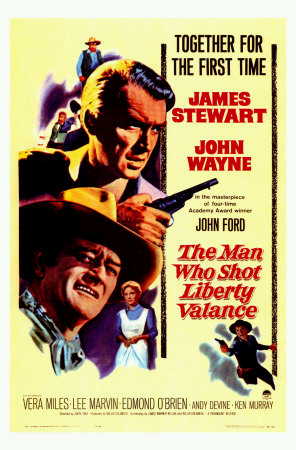
Shattered Politics #18: The Man Who Shot Liberty Valance (dir by John Ford)


The_Man_Who_Shot_Liberty_Valance“When the legend become fact, print the legend.” — Maxwell Scott (Carleton Young) in The Man Who Shot Liberty Valance (1962)

Though I understand and respect their importance in the history of both American and Italian cinema, I have never really been a huge fan of westerns.  Maybe its all the testosterone (“A man’s got to do what a man’s got to do…”) or maybe it’s all the dust but westerns have just never really been my thing.

However, I will always make an exception for The Man Who Shot Liberty Valance, which is not just a great western but a great film period.

But you already knew that.  It’s a little bit intimidating to review a film that everyone already knows is great.  I even opened this review with the exact same quote that everyone uses to open their reviews of The Man Who Shot Liberty Valance.  To a certain extent, I feel like I should have found a quote that everyone hasn’t already heard a thousand times but then again, it’s a great quote from a great film and sometimes, there’s nothing wrong with agreeing with the critical consensus.

The Man Who Shot Liberty Valance opens with a train stopping in the small western town of Shinbone.  The residents of the town — including newspaper editor Maxwell Scott (Carleton Young) — are shocked when Sen. Rance Stoddard (James Stewart) and his wife Hallie (Vera Miles) get off the train.  Sen. Stoddard is considered to be a front-runner to become the next Vice President of the United States.  Scott is even more shocked to discover why the Stoddards are in town.  They’ve come to Shinbone to attend the funeral of an obscure rancher named Tom Doniphon (played, in flashback, by John Wayne).

Sitting in the funeral home with Doniphon’s coffin (and having reprimanded the local mortician for attempting to steal Tom’s boots), Rance tells Scott why he’s come to pay respect to Tom Doniphon.  We see, in flashback, how Rance first came to Shinbone 25 years ago, an idealistic lawyer who — unlike most of the men in the west — refused to carry a gun.  We see how Rance was robbed and assaulted by local outlaw Liberty Valance (a wonderfully intimidating and bullying Lee Marvin), we discover how Rance first met Hallie while working as a dishwasher and how he eventually taught her how to read, and we also see how he first met Tom Doniphon, the only man in town strong enough to intimidate Liberty Valance.

At first, Rance and Doniphon had an uneasy friendship, epitomized by the condescending way Doniphon would call Rance “pilgrim.”  Doniphon was in love with Hallie and, when he attempted to teach Rance how to defend himself, he was largely did so for Hallie.  Rance, meanwhile, was determined to bring law and society to the west.

And, eventually, Rance did just that.  When Shinbone elected two delegates to the statehood convention in the territory’s capitol, Rance attempted to nominate Doniphon for the position but Doniphon refused it and nominated Rance instead, explaining that Rance understood “the law.”  When Liberty Valance attempted to claim the other delegate spot, Rance and Doniphon worked together to make sure that it instead went to newspaper editor Dutton Peabody (Edmond O’Brien).  And when Liberty Valance attempted to gun Rance down in the street, Rance shot him.

Or did he?

That’s the question that’s at the heart of The Man Who Shot Liberty Valance.  However, as a film, The Man Who Shot Liberty Valance is far less interested in gunfights than it is in politics.  Perhaps the most important scene in the film is not when Rance and Liberty meet out on that dark street.  Instead, it’s the scene at the statehood convention where the reformers (represented by Rance) and the cattlemen (represented by John Carradine) battle over who will be the territory’s delegate to Washington.  Between John Carradine orating, the horses riding in and out of the hall, Edmond O’Brien drinking, James Stewart looking humble, and John Wayne glowering in the background, this is one of the best political scenes ever put on film.

When Rance first arrives in the west, there is no political system in place.  With the exception of the ineffectual town marshal (Andy Devine), there is no law.  The peace is kept by men like Tom Doniphon and, oddly enough, by Liberty Valance as well.  (Whether he realizes it or not, Shinbone’s fear of Liberty has caused the town to form into a community.)  What little official law there is doesn’t matter because the majority of the Shinbone’s citizens can’t read.

When Rance arrives, he brings both education and the law.  He makes Shinbone into a town that no longer needs Liberty Valance but, at the same time, it no longer need Tom Doniphon either.  Hence, it’s Rance Stoddard who goes from dishwasher to U.S. Senator while Tom Doniphon dies forgotten.  Rance represents progress and unfortunately, progress often means losing the good along with the bad things of the past.

(It’s no coincidence that when Rance and Hallie return to Shinbone, the first person that they see is the former town marshal, who no longer wears a star and who, we’re told, hasn’t for years.  Time has passed by.)

It’s a bittersweet and beautiful film, one that features four great performances from Stewart, Wayne, Marvin, and Vera Miles.  Personally, I like to think that maybe Sen. Stoddard had a daughter who married a man named Smith and maybe they had a son named Jefferson who later made his way to the Senate as well.

It would be fitting.

Shattered Politics #17: Advise & Consent (dir by Otto Preminger)


Advise-&-Consent-(1)

In case you hadn’t heard, U.S. Sen. Barbara Boxer has recently announced that she’s retiring in 2016.  For the first time in decades, there’s going to be an open senate seat in California.  There’s been a lot of speculation about who might run for the seat and, for the most part, it’s all been the usual political suspects.  The state’s attorney general is running.  A few congresspeople might run.  Token billionaire Tom Steyer is thinking of getting into the race.

What disappoints me is that, as of right now, it doesn’t look like any celebrities are planning on running.  You know what would have made the Golden Globes perfect?  If George Clooney had announced his candidacy while accepting his Cecil B. DeMille award.  (At the very least, it might have given Amal something to smile about, as opposed to just sitting there with a condescending smirk on her face.  Seriously, what’s up with that?)  But even beyond George Clooney, there’s all sorts of celebrities who could run.  Charlie Sheen lives in California, after all.  Jeff Bridges might not be able to run in Montana but what about California?

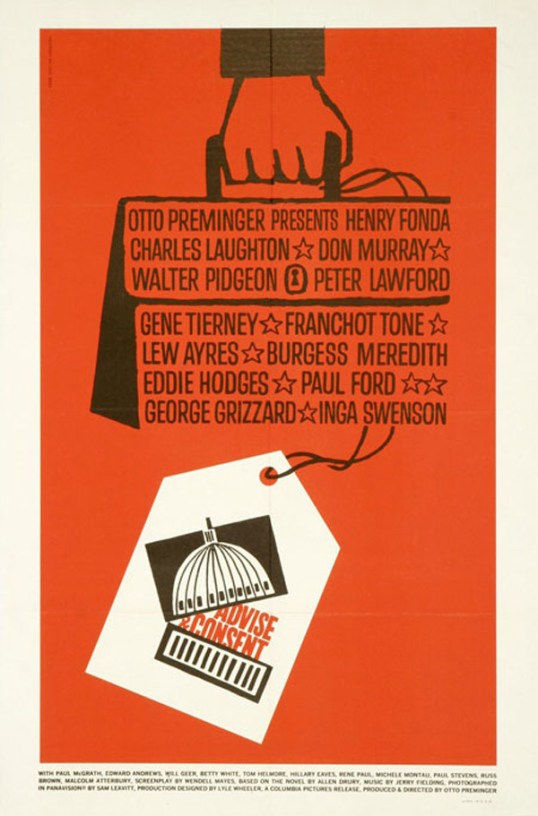
I was discussing this with a friend of mine who suggested that Betty White should run because who could vote against Betty White?  Speaking for myself, I could easily vote against Betty White but I do think there would be something appropriate about Betty White serving in the U.S. Senate.  After all, in 1962, she played a senator in Otto Preminger’s political epic, Advice & Consent.

White played Sen. Bessie Adams of Kansas and was only given a few minutes of screen time.  She’s one of many performers to show up in Advise & Consent‘s version of the U.S. Senate.

For instance, Walter Pidgeon plays Sen. Bob Munson, who is the Senate majority leader and, as a result, the closest thing that this sprawling film has to a central character.  His job is to make sure the President’s agenda is pushed through Congress.

And then there’s Peter Lawford, as Sen. Lafe Smith, who always has a different girl leaving his hotel room.  When Advise & Consent was made, Lawford was President Kennedy’s brother-in-law.  Interestingly enough, one of Kennedy’s former girlfriends — actress Gene Tierney — shows up in the film as well, playing Bob Munson’s lover.

George Grizzard plays Sen. Fred Van Ackerman, who is about as evil as you would expect someone named Fred Van Ackerman to be.  Grizzard gives one of the better performances in the film, which just goes to prove that it’s more fun to play an evil character than a good one.

Don Murray is Sen. Brigham Anderson, a senator who is being blackmailed by Van Ackerman’s lackeys.  Despite being happily married to Mabel (Inga Swenson), Anderson is leading a secret life as a gay man.  The scene where Anderson steps into a gay bar may seem incredibly tame today but it was reportedly very controversial back in 1962.

And finally, there’s Sen. Seabright Cooley.  You may be able to guess, just from his overly prosaic name, that Cooley is meant to be a southerner.  That, of course, means that he wears a white suit, is constantly fanning himself, and speaks in lengthy metaphors.  Sen. Cooley is played by Charles Laughton, who overacts to such a degree that I’m surprised that there was any oxygen left over for anyone else.

All of these senators have been tasked with deciding whether or not Robert Leffingwell (Henry Fonda) will be the next secretary of state.  Fonda, not surprisingly, is the epitome of urbane liberalness in the role of Leffingwell.  However, Leffingwell has a secret.  Back in the 1930s, Leffingwell was a communist.  When Sen. Cooley introduces a witness (Burgess Meredith) who can confirm this fact, Leffingwell offers to withdraw as the nominee.  However, the President (Franchot Tone) refuses to allow Leffingwell to do so.  Instead, with the help of Van Ackerman, he tries to pressure Anderson into supporting Leffingwell’s nomination.

This, of course, leads to melodrama and tragedy.

As far as literary adaptations directed by Otto Preminger are concerned, Advise & Consent is better than Hurry Sundown while being nowhere to close to being as good as Anatomy of a Murder.  It’s a film that is occasionally entertaining, often draggy, and, if just because of all the different acting styles to be found in the cast, always interesting to watch.

And, for what it’s worth, Betty White makes for a convincing senator.  So, perhaps the people of California should watch Advise & Consent before voting for Tom Steyer…

Quick Review: Paddington (dir. by Paul King)


paddington_character-poster-4Hello there, and Happy New Year!

When I was little, I owned a stuffed Paddington Bear. When I found out Heyday Films was working on a movie for the character, I immediately added it to my watch list. From the audience’s reaction, made up mostly of families and a few dates, it seemed to be well received. American audiences may not be familiar with Paddington, even though the Orange Marmalade eating bear has had tons of books, toys and cartoons in the UK over the last 50 years. He even has his own float in the Holiday parades we have here in New York City.

The movie, directed by Paul King, finds young Paddington (Ben Wishaw – Layer Cake, Skyfall) traveling to London after an Earthquake destroys his home in Darkest Peru. His Aunt and Uncle (played by Imelda Staunton and Michael Gambon, respectively) have told him of how wonderful London is, but he finds it’s not exactly as kind as he was led to believe. While Wishaw wouldn’t be my first through to voice Paddington, he fits the role quite well, giving the character a sense of polite innocence that’s spot on to how I recalled him.

The Brown family discovers Paddington and takes him in, in the hopes that they can locate the individual who discovered Paddington’s Aunt and Uncle during an expedition many years ago. When an evil taxidermist (played by Nicole Kidman in a turn that feels eerily similar to what she did in The Golden Compass) discovers Paddington, she makes it her goal to have him added to her collection.

Paddington’s supporting cast seems to either have former Harry Potter or Layer Cake stars. Downton Abbey’s Hugh Bonneville plays the overprotective Brown father. Sally Hawkins (Layer Cake, Godzilla) plays Mary, who helps Paddington along his trip. Weasley mom Julie Walters has a fun role as the house nanny, and finally, Doctor Who’s Peter Capaldi is the nosy next door neighbor that doesn’t take too kindly to having furry neighbors around town. It looks like everyone enjoyed themselves on the production, and seeing Capaldi play someone so odd was a little weird.

For young viewers, Paddington is a treat, with a focus on acceptance, family and the notion that sometimes one can hold on too tight to children in an effort to keep them safe. It might a gross out in some ways, depending on some of the scenes that include earwax licking and passing gas. Some may find the notion of a taxidermist a little scary, but my audience seemed to be okay with it. There are very few elements of violence – most of it the playful type found in films like Home Alone. Nicole Kidman may appear scary to some, but at it’s heart, Paddington tries to keep everything as accessible as it can for everyone.

Musically, Sigur Ros provides some great music that flows with the scenes, and the production itself moves almost in the same fashion as Alfonso Cuaron’s Harry Potter and the Prisoner of Azkaban, via the use of screen wipes and subtle season changes. The CGI for the film is done well, though I can’t say it’s very subtle. A casual view could probably spot what’s CGI and what isn’t, but since it’s for kids, they won’t really care.

Overall, it was fun to revisit Paddington. I didn’t have much in the way of expectations, but was a little amazed at how well it actually held up. I found myself smiling more often than I thought I would, honestly.

Shattered Politics #16: Ada (dir by Daniel Mann)


Ada_posterSouthern melodrama!

Speaking as a Southerner (well, a Southwesterner), I’ve always found in interesting that the rest of America loves to talk about how much they hate us but, at the same time, they also love books and movies set down here.  From the era of silent cinema to today with films like August: Osage County, people up north are obsessed with Southern melodrama.

It’s interesting because I’ve lived down south for most of my 29 years and there’s really not any more melodrama down here than there is anywhere else.  In fact, one of the main reasons that I enjoy watching Southern melodramas is because I enjoy seeing what the folks up north actually believe to be true.  I watch and I think to myself, “Northerners actually believe this shit.”  And then I laugh and laugh.

Take, for example, the 1961 film Ada.  Ada is pure Southern political melodrama.  (Admittedly, one of the best political films of all time — All The King’s Men — is a Southern melodrama but, to put it politely, Ada is no All The King’s Men.)

Ada tells the story of Bo Gillis (Dean Martin), a guitar-playing, singing sheriff who is running for governor of an unnamed Southern state.  Bo is running as a reform candidate but actually he’s just a figurehead for the wealthy and corrupt Sylvester Marin (Wilfred Hyde-White).  Bo is popular with the crowds, he has a great speech writer named Steve (played by the great character actor, Martin Balsam), and he has ruthless supporters who are willing to do anything to get him elected.  What he doesn’t have is a wife.  But that changes when he meets a prostitute named Ada (Susan Hayward) and marries her three weeks before the election.

At first, Sylvester demands that Bo get the marriage annulled.  Bo, however, refuses.  Fortunately, it turns out that the wife of Bo’s opponent is a drug addict.  Sylvester’s henchman Yancey (Ralph Meeker) leaks the news to the press and Bo is elected governor.

The only problem is that, once Bo is elected, he declares the he wants to run an honest administration and he starts to question Sylvester’s orders.  After the lieutenant governor is forced to resign, Ada lobbies to be appointed to the job.  Soon after Ada is confirmed, Bo is nearly blown up in his car.  While Bo is recovering, Ada serves as acting governor.  Will Ada be able to defeat Sylvester and convince Bo that she wasn’t responsible for trying to get him killed?

Watch and find out!

Or don’t.

Ada truly puts the drama into melodrama.  (It does not, however, bring the mellow.)  This is one of those films that’s full of overheated (yet strangely forgettable) dialogue and vaguely familiar character actors speaking in thick Southern accents.  Susan Hayward is so intense that you worry she might have killed a grip before shooting her scenes while Dean Martin spends most of the movie looking as if he’s waiting for the Rat Pack to show up and take him to a better party.

This is one of those films that you watch and you think to yourself, “Northerners actually believe this shit.”

And then you laugh and laugh.

Shattered Politics #15: Sunrise at Campobello (dir by Vincent J. Donehue)


Sunrise_at_Campobello_film

I can still remember that day like yesterday.

I was either 10 or 11 and I was at a big family gathering in Arkansas.  I was at my aunt’s house.  My great-grand uncle was sitting in a corner of the living room and watching the TV.  Because he was nearly blind, only an inch or two separated his face from the screen.  And, because he was almost deaf, the television was blaring.  When we first arrived, he was watching what sounded to be a cartoon but, after a few minutes, he changed the channel.

Apparently, whatever channel he was watching was showing a program about the Great Depression because my great-grand uncle snorted a little and yelled (not because he was mad but because he was deaf), “Some people like Roosevelt!  I say he was a dictator!”

That blew my young mind.  It wasn’t because I necessarily knew that much about Franklin D. Roosevelt, beyond the fact that he had been President.  Instead, it shocked me because that was the first time that I had ever heard anyone call a U.S. President a dictator.  It was the first time that I truly understoodd that not everyone shared the same opinions, especially when it came to politics and history.

Looking back, so many of the things that define me as a person — my skepticism about conventional wisdom, my mistrust of authority, and my tendency to dismiss “experts” — are the result of that day, that documentary on the Great Depression, and my great-grand uncle’s opinion of Franklin D. Roosevelt.

(Want to know why I hate it when the headlines of clickbait articles say stuff like, “Neil deGrasse Tyson gave his opinion on the movies and it was glorious?”  Blame me great-grand uncle.  Nobody was going to tell him FDR wasn’t a dictator.  Nobody’s going tell me what’s glorious.  I’ll make up my own mind.)

And, let’s face it — FDR is a controversial figure.  Most of what you read about Roosevelt is positive but if you glance under the surface, you realize that the legacy of the New Deal is far more ambiguous than most people are willing to admit.  You realize that there are serious questions about whether Roosevelt knew about the upcoming attack on Pearl Harbor.  You discover that Roosevelt wanted to reform the Supreme Court so that it would be a rubber stamp for the executive branch.  And, of course, his decision to run for a third term set up exactly the type of precedent that — if not for a constitutional amendment — could have been exploited by the wrong people.

And, yet, as ambiguous as his legacy may be, how can you not be inspired by FDR’s personal story?  He went from being a dilettante who was often dismissed as being an intellectual lightweight to being four-times elected President of the United States.  In between running unsuccessfully for vice president in 1920 and being elected governor of New York in 1928, Roosevelt was crippled by polio.  It’s always been a huge part of the Roosevelt legend that his battle with polio transformed him and made him into the President who led the country during the Great Depression and World War II.

It’s an inspiring story, regardless of what you may think of Roosevelt’s political ideology or his legacy of government intrusion.

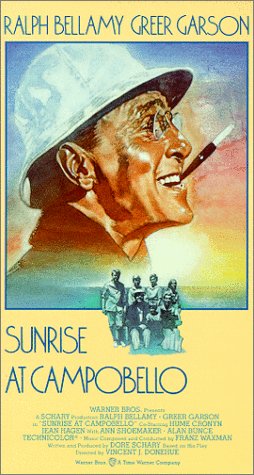
It’s also a story that’s told in our 15th entry in Shattered Politics, the 1960 film Sunrise at Campobello.  This film opens with FDR (played by Ralph Bellamy) as an athletic and somewhat shallow man who, while on a vacation with his family, is struck down my polio.  The film follows he and his wife, Eleanor (Greer Garson), as they learn how to deal with his new physical condition.  Throughout the film, Roosevelt remains upbeat and determined while Eleanor remains supportive and eventually — after being out of the public eye for three years — Roosevelt gets a chance to relaunch his political career by giving a nominating speech for Gov. Al Smith at the Democratic National Convention.

(A little bit of history that everyone should know: Al Smith was the first Catholic to ever be nominated for President by a major political party.)

Sunrise at Campobello is one of those films that tends to show up fairly regularly on TCM.  It’s a well-acted film with Ralph Bellamy and Greer Garson really making the aristocratic Roosevelts into sympathetic and relatable characters.  At the same time, whenever I’ve watched the film, I’ve always been struck by how long it seems.  (The movie itself is only 144 minutes, which means its shorter than the average Christopher Nolan flick but it’s one of those films that seems longer than it actually is.)  Sunrise at Campobello was based on a stage play and it’s directed like a stage play as well, with little visual flair and emphasis on dialogue and character.  The end result is a film that I can’t really recommend for the casual viewer but one that is, at the very least, interesting for students of history like me.

What Lisa Watched Last Night #110: Whitney (dir by Angela Bassett)


Last night, I watched the latest Lifetime biopic, Whitney.

Why Was I Watching It?

A movie about Whitney Cummings!?  How could I not watch…

Okay, okay — I knew, before I started watching, that it was a movie about Whitney Houston.  But I have to admit that my motives for watching were not exactly pure.  You see, after watching the Saved By The Bell movie, the Aaliyah movie, and the Brittany Murphy movie, I had every reason to believe that Whitney would be another unfortunate Lifetime biopic.  I was watching expecting the film to be a snarkfest, the type of thing that I could write a really sassy review about.

But — no.  Actually, it turned out to be pretty good.

What Was It About?

Whitney Houston (Yaya DaCosta) meets, falls in love with, and marries Bobby Brown (Arlen Escarpeta).  Many drugs are done and many songs are sung.

What Worked?

Whitney was probably a hundred times better than anyone was expecting.  Angela Bassett kept the story moving, Yaya DaCosta and Arlen Escarpeta both gave good performances as Whitney and Bobby respectively, and Deborah Cox — who provided Whitney’s singing voice — sounded great.  The final scene of Whitney singing while Bobby watched was surprisingly moving.

One thing that I did like was that Whitney did not indulge in any sort of tawdry or melodramatic speculation about Whitney’s death.  Even the film’s postscript stated that, even after her death, Whitney Houston continues to inspire new artists but it didn’t go into the details of her final days.  And why should it?  This film was about talent, music, and love.  It wasn’t about tabloid rumors.

What Did Not Work?

I’m sure some people were probably frustrated by the fact that Whitney did turn out to be a good, competently directed and acted film.  All the people who were watching specifically because they wanted to see an Aaliyah-style fiasco (and there were quite a few of them) were undoubtedly left disappointed.

And, of course, I’m sure some people really were hoping for a Whitney Cummings biopic…

On a more serious note, I did bother me a little that, though the movie was called Whitney, it actually seemed to be more about Bobby Brown than her.  Considering that the film basically presented Bobby as being a drug-free saint before he met Whitney and that it was followed by an hour-long interview with Bobby Brown, it was hard not to feel that Lifetime was basically presenting only one side of the story.

(Then again, Whitney Houston’s family refused to have anything to do with the movie so it’s possible nobody was around to present the other side.)

“Oh my God!  Just like me!” Moments

Well, unless I’m drunk and there’s a karaoke machine nearby, I can’t sing to save my life so I can’t really claim to be able to relate to Whitney’s talent.  However, I do have a weakness for guys who share my taste in movies.  For Whitney, it was Sparkle.  For me, it’s Suspiria.  So, I was able to watch that part of the movie and go, “Oh my God!  Just like me!”

Lessons Learned

Despite snarky rumors to the contrary, Lifetime can make good biopics.  (Of course, you and I already knew that, right?)

Shattered Politics #14: The Last Hurrah (dir by John Ford)


Last_Hurrah

Down here in Dallas, we have a county commissioner named John Wiley Price.  Even if you don’t live in Texas, you might have heard about him.  A few years ago, Price stormed out of a commissioners meeting while shouting, “All of you are white!  Go the Hell!”  It was a popular YouTube video for a while and attracted all of the usual type of comments that you see online.  It even made the national news.

Nobody down here in Dallas was surprised by Price’s outburst.  To us, that was just John Wiley being John Wiley.  For that matter, nobody was particularly surprised when it was reported that he was being investigated by the FBI.  Everyone always took it for granted that John Wiley Price was taking bribes and receiving kickbacks.  That’s just the way that things are done down here in Dallas, by politicians both white and black.  (Of course, most of the white politicians who do it don’t get publicly investigated by the FBI.)

Now, if you ask the majority of people in Dallas county what they think about John Wiley Price and they’ll probably say something negative.  I’ll admit that I would probably be among them.  But the thing is — John Wiley Price’s constituents love him.  John Wiley Price was first elected to the commissioner’s court before I was even born and, as long as he’s on the ballot, he will be reelected.  Even if Price is convicted on corruption charges, he will still be reelected.

I can still remember the night that it was announced that John Wiley Price was on the verge of being arrested by the FBI.  All across his district, emergency meetings were held in churches and ministers stood behind the pulpit and, while the TV cameras rolled, they called upon everyone to pray for John Wiley Price.  In Price’s district, he’s known as “our man downtown,” the idea being that John Wiley Price is standing up to the rich and white Dallas establishment and, if he makes some money for himself in the process, so be it.  As long as he’s doing right for the people who elected him, who cares how he does it?

And, as much as we may want to judge the John Wiley Prices of the world, the fact that of the matter is that he’s a part of a long American political tradition.  That political tradition is also the driving force behind today’s final entry in Shattered Politics.

First released in 1958 and directed by John Ford, The Last Hurrah tells the story of Frank Skeffington (Spencer Tracy), the mayor of an unnamed city in New England that’s obviously meant to be Boston.  Skeffington is the flamboyant head of a large and powerful (but, as the film makes clear, aging) Irish-American political machine.  He’s preparing to run for his fifth term for mayor, a campaign that he says will be his last.

Whether Frank Skeffington is a good mayor or not depends on who you ask.  The poor and the disenfranchised love him.  Skeffington, after all, is the son of Irish immigrants.  He was born poor.  His mother worked as a maid and was even fired by a member of the wealthy and influential Force family.  They know that Skeffington has had to cut corners and that he’s gone out of his way to reward his cronies but they also know that Skeffington is on their side.  Though the phrase is never used in the film, Skeffington is “their man downtown.”

Meanwhile, the wealthy and the upper class see Frank Skeffington as being a crook, a man who has run a corrupt administration and who uses class warfare to keep the city divided against itself and to make himself and his cronies rich.  Newspaper editor Amos Force (John Carradine) has thrown his considerable influence between Skeffington’s opponent, a wealthy but dull man named Kevin McCluskey.

Reporter Adam Caulfield (Jeffrey Hunter) is in an interesting position.  On the one hand, he is Skeffington’s nephew.  On the other hand, as a journalist, he works for Amos Force.  Skeffington invites Adam to follow and record his final campaign for posterity.

It’s interesting to compare The Last Hurrah to films like The Boss or All The King’s Men.  Whereas those two films came down squarely on the sides of the reformers, The Last Hurrah is firmly on the side of Frank Skeffington.  It presents Skeffington as being a sentimental figure, the type of old-fashioned, populist politician who won office by going out and meeting the people face-to-face and personally giving them a reason to vote for him.  As Skeffington himself points out, he’s the type of politician that will soon be made obsolete by television and modern campaigning.

And it’s impossible not to enjoy The Last Hurrah‘s refusal to pass judgment on its lead character.  It helps, of course, that Spencer Tracy plays Skeffington with a twinkle in his eye while all of his opponents are played by villainous and aristocratic character actors like John Carradine and Basil Rathbone.  Yes, the film says, Skeffington may have been corrupt but at least he wasn’t boring!

Finally, I enjoyed the film because all of the “good” guys were Irish Catholic and all of the bad guys most definitely were not.

So, with that last hurrah, we conclude Shattered Politics for today.  We’ll be back tomorrow, when we’ll start to get into the 1960s.

Sláinte!

Shattered Politics #13: The Fearmakers (dir by Jacques Tourneur)


The_Fearmakers_film_poster

Did you know that 75% of people are sick of hearing the results of polls about what people think about other polls?  It’s true!

Me, I first got sick of polls back in 2012.  That was when, every day, everyone on twitter would be talking about the result of another political poll.  A poll would come out showing that Obama was ahead of Romney in the presidential election and all of my Republican friends would immediately start tweeting about why the poll could not be taken seriously.  Then 2014 came along and polls started to show that the majority of American citizens did not approve of the job Obama was doing.  And all of my Democrat friends would immediately start tweeting about why those polls could not be trusted.

As for me, I was always more concerned with what the polls said over on Rotten Tomatoes.  Really?I would think.  Only 35% of critics gave California Scheming a good review?  67% of moviegoers want to see the new Transformers film?

Oh my God, I thought, those numbers have to be so fake…

Because, let’s face it.  The only time that we believe a poll is when we agree with it.  Otherwise, we assume that they’re either the result of subtle manipulation, selective interpretation, or just completely and totally untrue.

Believe it or not, this suspicion is not a new phenomena.  I’ve always felt that you can learn a lot about history by watching the movies.  That doesn’t mean that movies are historically accurate.  One need only read my review of Magnificent Doll to see that.  However, movies do reflect the culture and concerns of the time in which they were made.

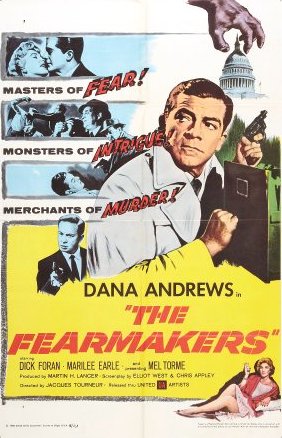
For instance, The Fearmakers was made in 1958 and it shows that not only has polling been around for a while but so has the fear of being manipulated by a fraudulent poll.

In The Fearmakers, Dana Andrews plays Alan Eaton.  Before the start of the Korean War, Alan owned one of the best and most respected polling firms in Washington D.C.  However, while serving in the army during the war, Alan was captured and held prisoner by the Chinese.  After years of being tortured and perhaps brainwashed, Alan is finally released.

He returns to an America that is far different from the country that he left.  For instance, while on a flight to Washington, D.C., he finds himself sitting next to a shifty scientist (Oliver Blake) who tries to convince Alan to support a group that believes in nuclear disarmament.  Even worse, once the plane lands, Alan discovers that he’s been forced out of his polling firm and that his partner has died under mysterious circumstances.

The firm’s new owner, the outwardly friendly, inwardly cold-hearted Jim McGinnis (Dick Foran), offers to hire Alan as a special consultant.  Alan is at first resistant but then he has a meeting with his old friend, Senator Walder (Roy Gordon).  Walder explains that he suspects that Alan’s old polling firm has been infiltrated by outside forces and that it might be using its polling to try to push communist propaganda on the American people.  Alan agrees to work for Jim and to help track down any and all subversives….

The Fearmakers is better than it sounds.  Beyond the fact that the story remains relevant in our poll-driven times, it was directed by Jacques Tourneur, who directed several atmospheric and intelligent horror films in the 30s and 40s.  He brings a similar atmosphere of doom to The Fearmakers.  Perhaps the film’s best scenes are the ones where Tourneur just focuses his camera on Andrews’s face while Alan struggles to understand the country to which he has returned.  As played by Andrews, Alan is troubled and hardly your typical hero.  You’re never quite sure how much of the film’s danger is real and how much of it is just the result of Alan’s own paranoia.

I first saw The Fearmakers on Netflix.  The next time you’ve got 84 minutes to kill, check it out.