AMV of the Day: Ship Happens


ugens-amv-ship-happens-800x450

What was one of the hobbies teens of any era enjoyed doing before, during and after school?

That is a question that could have many answers and all of them would be correct. Of late, the answer of “shipping” classmates, fictional characters and everything in-between has become such a cutthroat past-time amongst teens and those teen-at-heart that on-line wars have cropped up when certain people think their “ships” is the only OTP and everything else are non-canon and thus not worthy of mention or attention.

Yeah, I could barely understand what I just said there, but being a confessed otaku I know enough of this “shipping” and “OTPing” and all the other made up words people younger than I have created to help enhance their obsessi….enjoyment of anime, films and books.

This AMV perfectly illustrates the extent people go through to make sure everyone knows their pairings of characters is the one true one. I’ve studied wars which have started like this.

Anime: Azumanga Daioh, Code Geass – Lelouch of the Rebellion (TV), Cowboy Bebop, Death Note (TV), DragonBall Z: Movie 1 (Dead Zone), Durarara!! (TV), Evangelion Shin Gekijouban: Q (Movie), Free! – Iwatobi Swim Club (TV), Fruits Basket, Fullmetal Alchemist: Brotherhood (TV), Guilty Crown (TV), Kill La Kill (TV), Melancholy of Haruhi Suzumiya, The (TV), My Little Sister Can’t Be This Cute (TV), Naruto, Ouran High School Host Club (TV), Puella Magi Madoka Magica (TV), Sailor Moon, Shingeki no Kyojin : Attack on Titan, Steins;Gate (TV), Toradora! (TV), Trigun, Vampire Knight (TV)

Song: “I Ship It” by Not Literally

Creator: Vivifx

Past AMVs of the Day

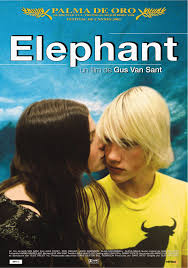
Back to School #62: Elephant (dir by Gus Van Sant)


http://www.youtube.com/watch?v=SC8ogZ4Jsuw

Gus Van Sant’s dream-like 2003 film Elephant is not an easy film to review.  Working with a non-professional cast and avoiding any easy answers or traditional narrative tricks (and indeed, the film ends with the fates of most of the characters still unknown), Elephant is ultimately a disturbing and nightmarish film.  It’s also an important film, one that examines the violence that runs through our current culture.

I’m one of the lucky ones.  I managed to get through all 12 years of my public education without ever getting shot at.  There’s quite a few people my age who can’t make the same claim.  I’d be lying if I said that I spent a lot of time in school obsessing over whether or not someone was going to start shooting but now, when I look back, I sometimes wonder how close I may have come.  One of the scarier things about the typical profile of school shooter is that we’ve all known somebody who fits it.  Sometimes, I can’t help but wonder if I just got lucky.  Maybe the guy who was planning on shooting up my school couldn’t get his hands on a gun.  Maybe, at the last moment, he changed his mind and decided to leave his gun in his locker instead of taking it out before the start of second period.  We come into contact with thousands of people over the course of our lives and we can never for sure what any of them are truly thinking or planning.

According to Wikipedia, there were a dozen school shootings in the U.S. during the time I was in high school.  Thankfully, none of them happened at my high school but, as I looked over the list, I couldn’t help but wonder why my classmates and I were spared the trauma of random violence while the students at Rocori High School in Cold Springs, Missouri were not.  Were we somehow better or more deserving than the students at Rocori?  Had they done something wrong or had we done something right?  Why were they forced to deal with violence while I was spared?  It all just seems so random.

And that’s the terrifying thing about random violence — it is, in the end, all so random.  We always tend to look for explanations afterward.  We try to assign blame and we try to come up with a reason because we know that, if we can explain random violence, then we can do something about it.  But, far too often, there are no reasons.

Elephant perfectly captures this randomness.  The film’s ensemble of characters spend what for many of them will be their final hours randomly wandering through their high school and their lives. Three mean girls eat lunch and then duck into toilet stalls where all three of them proceed to throw up.  John (John Robinson) searches for his drunk father (Timothy Bottoms) who may be wandering around the campus.  Awkward Michelle (Kristen Hicks) goes from her gym class to the library, little aware that she will soon be the first to be confronted by the gunmen.  Once the shooting starts, silent jock Bennie (Bennie Dixon) walks through the body-strewn halls, a potential hero until he is randomly shot.  The film is full of flash forwards and flashbacks, in which we see Alex (Alex Frost) and Eric (Eric Duelen) planning their rampage and we’re given clues as to their motives but we’re not given any answers.

Perhaps most memorable of all, at least to me, is the character of Eli (Elias McConnell), an aspiring photographer who gets one picture of Alex and Eric as they enter the library.  Up until that moment, the entire film has pretty much centered on Eli.  We’ve gotten to know him.  We’ve come to like him.  And yet, when Eli is shot, it happens almost as an afterthought.  One minute, he’s standing in the background and the next moment, he’s gone.  And we’re left to wonder if he survived or if it was even him who got shot.  Ultimately, what we realize is that, in that one split second, Eli ceased to be.  Even if he does survive being shot, he’ll never be the same person we saw earlier.  Even if he wasn’t shot, he’ll always be one of the students who went to that school.  In the end, we may have cared about Eli but none of that could stop the random violence.

Elephant is not an easy film to watch but then again, it shouldn’t be.  (If you want to read a bunch of comments from some people who just don’t get it, you can go read the simple-minded comments that some of them have posted over on the movie’s page at the imdb.) Elephant is a dark and troubling film, one that gave me nightmares after I saw it.  It’s a film so effective and powerful that one viewing is more than enough.

(Incidentally, one of Elephant‘s credited producers was JT Leroy, the pen name of Laura Albert whose books inspired a similarly difficult but powerful film, Asia Argento’s The Heart is Deceitful Above All Else.)

images

Back to School #61: The Battle of Shaker Heights (dir by Efram Potelle and Kyle Rankin)


Poster_of_the_movie_The_Battle_of_Shaker_Heights

“When you’re 17, every day is war.” — Tagline of The Battle of Shaker Heights (2003)

Anyone here remember Project Greenlight?  It’s a show that used to be on HBO and Bravo, in which Matt Damon and Ben Affleck would arrange for a director and screenwriter to get a chance to make their low budget feature film debuts.  The catch, of course, is that a camera crew would then follow the director as he (and all of the Greenlight “winners” were male) struggled to get the film made.  Mistakes would be made.  Money would be wasted.  Producer Chris Moore would randomly show up on set and start yelling.  In short, it was typical reality show drama with the catch being that the film itself would then be released in a theater or two.

Well, after being consigned to footnote status for the past nine years. Project Greenlight is coming back for a fourth season and a lot of people are pretty excited about it.  And why not?  I own the first two seasons of Project Greenlight on DVD and I’ve watched the third season on YouTube.  It’s a lot of fun, mostly because all of the directors, with the exception of season 3 winner John Gulager, turned out to be so incredibly inept.  (Gulager is one of the few Project Greenlight success stories — not only did his movie, Feast, come across as being made by a professional but he’s actually had a career post-Greenlight.)  It all makes for good televised drama.

However, it doesn’t necessarily make for a good movie.

Case in point: 2003’s The Battle of Shaker Heights.

The Battle of Shaker Heights is about a creepy 17 year-old named Kelly (played by the reliably creepy Shia LaBeouf).  His mother (Kathleen Quinlan) is an artist.  His father (William Sadler) is a former drug addict who, despite having been clean for 6 years, still has to deal with his son’s constant resentment.  Kelly is a high school outcast who spends all of his spare time thinking and talking about war.  Every weekend, he takes part in war reenactments.  At night, he works in a 24-hour grocery store where he doesn’t realize that he’s the object of Sarah’s (Shiri Appleby) affection.

(Why Sarah has so much affection for Kelly is a good question.  Maybe it’s the scene where he throws cans of cat food at her…)

At a reenactment of the Battle of the Bulge, Kelly meets and befriends Bart (Elden Hansen), which leads to him meeting Bart’s older sister, Tabby (Amy Smart).  Tabby is an artist, because the film isn’t imaginative enough to make her anything else.  (We’re also told that she’s a talented artist and it’s a good thing that we’re told this because otherwise, we might notice that her paintings are the type of uninspired stuff that you can buy at any county art fair.)  Kelly decides that he’s in love with Tabby but — uh oh! — Tabby’s getting married.  Naturally, she’s marrying a guy named Minor (Anson Mount).  Imagine how the film would have been different if his name had been Major.

As a film, the Battle of Shaker Heights is a bit of a mess.  It never establishes a consistent tone, the dialogue and the direction are all way too heavy-handed and on the nose, and Shia LaBeouf … well, he remains Shia LaBeouf.  In some ways, Shia is actually pretty well cast in this film.  He’s an off-putting actor playing an off-putting characters but the end of result is an off-putting film.

Of course, if you’ve seen the second season of Project Greenlight, then you know that The Battle of Shaker Heights had an incredibly troubled production.  Neither one of the film’s two directors were particularly comfortable with dealing with the more low-key human aspects of the story.  Screenwriter Erica Beeney was not happy with who was selected to direct her script and basically spent the entire production whining about it to anyone who would listen.  (Sorry, Erica — your script was one of the film’s biggest problems.  When you actually give a character a name like Minor Webber, it means you’re not trying hard enough.)  Finally, Miramax took the completed film away from the directors and re-edited it, removing all of the dramatic scenes and basically leaving a 79-minute comedic cartoon.

So, in the end, Battle of Shaker Heights is not a very good film.  But season two of Project Greenlight is a lot of fun!

Back to School #60: Crazy/Beautiful (dir by John Stockwell)


Oh, memories!

I don’t know if I can describe how much my girlfriends and I loved Crazy/Beautiful when it first came out in 2001.  We saw it in the theaters, we rewatched it when it came on cable, and after I bought it on DVD, we watched it at my house.  We loved the movie because we all dreamed of having a sensitive, hot boyfriend like Carlos Nunez (played by Jay Hernandez), who would love us no matter how obnoxious or bratty we may have been.  Even if we sometimes got annoyed with her, we still all related to out-of-control Nicole (Kirsten Dunst), who everyone in the world had given up on but who ultimately just wanted her father to pay as much attention to her as he did to his new wife and his new baby.  We liked the film because we wanted to be both crazy and beautiful.

And, of course, there was all the sex, all of it filmed in beautiful soft-focus with the camera always suggesting that it was showing more than it actually was.  Crazy/Beautiful was one of those films that made you feel grown up while still being very careful not to lose its PG-13 rating.

Yes, back in the day, I loved Crazy/Beautiful.

And you know what?

It may just be the nostalgia talking but I still love it.  I recently rewatched Crazy/Beautiful and, despite the fact that I was now watching as a “critic” as opposed to a 15 year-old with issues, I quickly fell under the film’s spell.  There’s just something about Crazy/Beautiful that I simply cannot resist.

It’s a beautiful film.  Director John Stockwell has made a career out of making movies about pretty people hanging out on pretty beaches and Crazy/Beautiful has a lot of both.  When Carlos, a responsible high school senior who lives in East Los Angeles and who is hoping to attend the U.S. Navy Academy, first meets Nicole, she’s doing community service by picking up trash on the beach.  What Carlos doesn’t find out until later is that Nicole is the daughter of U.S. Rep. Tom Oakley (played, somewhat inevitably, by Bruce Davison).  Nicole is haunted by her mother’s death and feels that her well-meaning but ineffectual father has abandoned her.  At first, her relationship with Carlos seems to be yet another part of her rebellion but soon, both she and Carlos are madly in love.

Can Carlos save Nicole from herself?  Can Nicole love Carlos without leading him down the path of self-destruction?  Will Nicole and her father ever reconnect?  Will … oh, who cares?  You already know the answers.  Crazy/Beautiful is less about the story and more about how the story is told.  Stockwell keeps the story moving along and fills the screen with colorful and romantic images that make Crazy/Beautiful into the perfect teenage daydream.  He also makes perfect use of the undeniable chemistry between Jay Hernandez and Kirsten Dunst.  Both of the stars give such good performances that you really do come to care about the characters that they are playing and hope that things work out for them.  Kirsten Dunst, in particular, gives a brave performance and doesn’t shy away from playing up Nicole’s abrasiveness.  It takes courage to play a character who can be unlikable.  It takes talent to make that unlikable character sympathetic and, fortunately, Kirsten Dunst shows a lot of both in Crazy/Beautiful.

CrazyBeautiful


Back to School #59: The Virgin Suicides (dir by Sofia Coppola)


the-virgin-suicides-the-virgin-suicides-189395_1020_576

For the past three and a half weeks, I’ve been taking a chronological look at some of the best, worst, most memorable, and most forgettable teen and high school films ever made.  We started with two films from 1946, I Accuse My Parents and Delinquent Daughters.  Therefore, it seems somewhat appropriate that we close out both the 90s and the 20th Century by taking a look at a film about both delinquent daughters and accusatory parents.  That film is Sofia Coppola’s 1999 directorial debut, The Virgin Suicides.

Much like Wes Anderson, Sofia Coppola seems to divide viewers and, in many ways, for the exact same reasons.  You either get her films about upper class ennui or you don’t.  Everyone seems to love Lost in Translation but viewers and critics seem to be far more polarized when it comes to rest of her films.  It seems the people either love them or hate them.  Well, you can count me among those who love her films.  (Yes, even Somewhere.)  To me, Sofia Coppola is one of the most consistently interesting filmmakers working today and the dismissive reaction that many (mostly male) critics have towards her films has little do with her talent and much more to do with her gender and her last name.

So there.

In The Virgin Suicides, Coppola tells the story of the five Lisbon sisters.  They live in an upper middle class suburbs in the 1970s.  Their parents — math teacher Ronald (James Woods) and his wife (Kathleen Turner) — are devoutly Catholic and very protective.  The Lisbon sisters are rarely allowed to leave the house and, as a result, the neighborhood boys are obsessed with them.  (Though the film centers on four unnamed boys, there’s only one narrator, voiced by Giovanni Ribisi,  who continually refers to himself as being “we,” as if all four boys are telling the story in the same voice.)  When the youngest Lisbon daughter commits suicide, Ronald and his wife become even more protective.

At the start of the school year, the oldest daughter, Lux (Kirsten Dunst), meets and starts to secretly date the wonderfully named Trip Fontaine (Josh Hartnett).  Lux is even allowed to attend the homecoming dance with Trip but, after she breaks curfew, Mrs. Lisbon reacts by pulling Lux and her sisters out of school and basically making them prisoners in their own home.

(In one of the film’s best moments, we flash forward to see present day Trip talking about his date with Lux. Needless to say, Trip did not age well.)

With the Lisbon sisters even more isolated, the neighborhood boys become even more obsessed with them.  One day, the boys get a note from the girls, asking for their help in escaping.  The boys go to meet the girls, leading the film to its haunting conclusion…

Full of themes of sin, sexuality, repression guilt, redemption, and martyrdom, The Virgin Suicides is one of those films that you don’t have to be Catholic to appreciate but it probably helps.  James Woods, Josh Hartnett, and Kirsten Dunst all give good performances while Sofia Coppola fills the movie with dream-like and sensual images, all designed to challenge the viewer’s perception of whether or not we’re watching reality or just the idealized memories of someone still struggling to comprehend a mystery from the past.

The Virgin Suicides is the perfect movie to end with the 90s on.

1

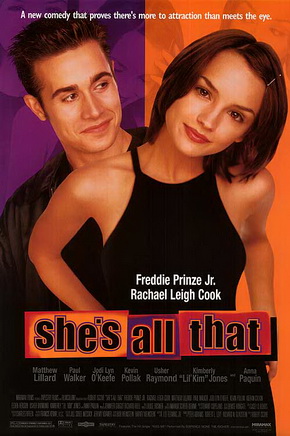
Back to School #58: She’s All That (dir by Robert Iscove)


Shes_All_That

She’s All That, a 1999 high school-set adaptation of My Fair Lady, has a lot to answer for.

When I, as an impressionable 13 year-old first saw this film, I left the theater believing that high school would be full of random, fully choreographed dance-offs.  That, after all, is what happened towards the end of She’s All That.  After watching as handsome jock Zack (Freddie Prinze, Jr.) spent almost the entire movie changing Laney (Rachael Leigh Cook) from an artist into a Prom Queen, the great prom dance-off made for the perfect climax.

I mean, just check it out:

Imagine how disappointed I was, once I finally did reach high school, to discover that it was actually nothing like She’s All That.  There were no big dance numbers for no particular reason.  I went to five different proms and none of them were ever as much fun as the prom at the end of She’s All That.

So thank you, She’s All That, for getting my hopes up.

As for the rest of the film, it’s a guilty pleasure in much the same way as Never Been Kissed.  I was recently doing some research over at the imdb and I was surprised to discover just how many films Freddie Prinze,Jr. made between 1999 and 2002.  For the most part, they’ve all got rather generic names.  What’s funny is that I probably saw most of them because, back then, I would get excited over almost any PG-rated movie that featured a cute guy and had a hint of romance about it.  But, with the exception of She’s All That, I can’t really remember a single one of them.  But you know what?  Freddie Prinze, Jr. may not be a great actor and his films may have basically all been the same but he had a certain something that, when you were 13 or 14, made him the perfect crush.  There was a hot blandness to Freddie Prinze, Jr. that prevented him from being compelling but did make him the perfect star for a film like She’s All That.

Along with featuring that prom dance-off and being the epitome of a Fredde Prinze, Jr. movie, She’s All That is also remembered for featuring Rachael Leigh Cook as one of the most unlikely ugly ducklings in the history of the movies.  Rachael plays Laney and the entire film’s starting off point is that Zack has made a bet with Dean (Paul Walker, as handsome here as he was in Varsity Blues) that he can turn Laney into a prom queen.  However, it should be a pretty easy bet to win because all Laney has to do is let her hair down, start wearing makeup, and stop wearing her glasses.

Myself, I’m severely myopic.  Usually, I wear contact lenses but occasionally, I may be running late or may not feel like putting my contacts in or maybe I just want to try a different look.  So, occasionally, I’ll wear my glasses and I have to say that, other than a few guys who always make “hot librarian” jokes, everyone pretty much treats me the same regardless of whether I’m wearing my glasses or not.  I do have to admit though that, when I take off my glasses and dramatically let my hair down, I always say that I’m having a She’s All That moment.

Anyway, She’s All That is okay.  I like it but I don’t love it and, to be honest, the film’s main appeal is a nostalgic one.  Freddie Prinze, Jr. and Paul Walker both look good, Rachael Leigh Cook and Jodi Lynn O’Keefe will keep the boys happy, and Matthew Lillard has a few good scenes where he plays an obnoxious reality tv celeb.

And there’s always that dance number!

shes-all-that-dork-outreach-program-rachael-leigh-cook-freddie-prinze-jr

Back to School #57: Never Been Kissed (dir by Raja Gosnell)


Never_Been_Kissed_film_poster

The 1999 romantic comedy Never Been Kissed is a definite guilty pleasure of mine, and that’s not just because of the fact that James Franco has a small role in it.  Never Been Kissed is a genuinely sweet movie that might not be extremely realistic but is still enjoyable.

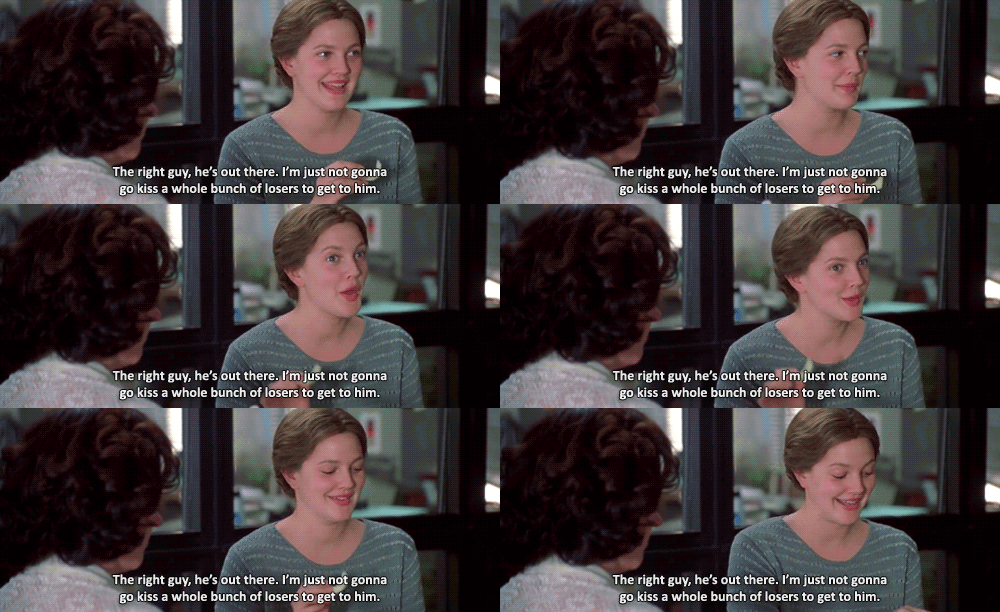
Never Been Kissed requires a certain amount of suspension of disbelief, largely because Josie Gellar, the character who has” never been kissed,” is played Drew Barrymore.  Oh, it’s not that Josie hasn’t ever been kissed.  Instead, it’s that she’s never gotten the type of kiss that every girl dreams of getting.  She’s never been kissed by someone who she was truly in love with.  She’s never had the type of romance that everyone dreams of having (especially when they’re in high school).

However, Josie is about to get a chance to find that kiss.  Josie works for a newspaper and her editor (John C. Reilly) has just assigned her to go undercover at a local high school.  Unfortunately, Josie was traumatized by her experiences the first time that she went to high school.  (She wrote a poem for a boy, he responded by asking her to prom and then throwing eggs at her.)  On her first day as a “student,” Josie finds that she is just as unpopular as the last time but now she’s also absolutely out-of-touch with her classmates.  Fortunately, she’s befriended by Aldys (Leelee Sobieski) and, soon, Josie has finally managed to find a place with the Denominators, a group of intelligent students.

Unfortunately, hanging out with the good kids isn’t producing the type of stories that Josie’s editor wants.  He orders Josie to reject Aldys and to befriend the school’s mean girls.  After her brother, Rob (David Arquette), also enrolls in high school, he helps Josie to become the most popular girl in the school.  Soon, Josie is no longer hanging out with Aldys and has been asked to go to the prom by the loathsome Guy Perkins (Jeremy Jordan).

However, Josie has fallen in love with her English teacher, Sam (Michael Vartan).  Sam likes Josie too but, of course, he thinks that she’s a student.  Will Josie tell the truth and risk losing Sam?  Will she be able to maintain her cover even when she discovers that her new friends are planning to humiliate Aldys?  Will Josie ever truly be kissed?

Well, you can probably guess all the answers.  Nothing really surprising happens in Never Been Kissed but it’s still a likable film.  For the most part, the actors all do a good job with their stock roles and David Arquette, especially, is hilarious as a professional slacker who thrives in high school precisely because he’s never bothered to grow up.  (Of course, by the end of the film, his new high school girlfriend is wanting to know what he’s planning on doing with his life after he graduates….)  At no point is the film in any way realistic but it’s still an enjoyable way to spend 110 minutes of your life.

Never

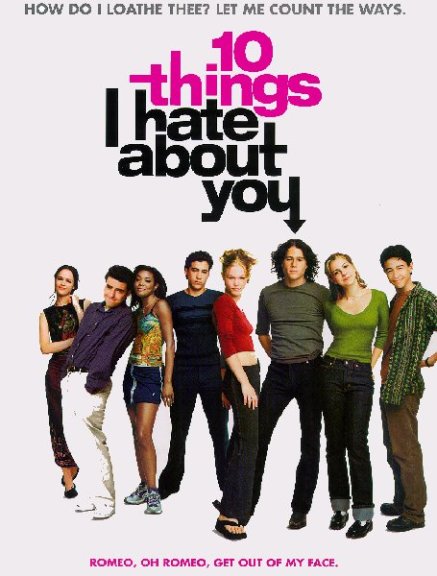
Back to School #56: 10 Things I Hate About You (dir by Gil Junger)


10_things_i_hate_about_you_final_poster

A few nights ago, my sister Erin and I watched the 1999 high school-set romantic comedy 10 Things I Hate About You for like the hundredth time.  Seriously, we love this movie so much and, in fact, just about everyone that we know seems to love it as well.  10 Things I Hate About You is one of those films that brings people together.  If you like this movie, I’ll probably like you.

(Want to see true displays of spontaneous sisterhood?  Go to Girlie Night at the Alamo Drafthouse when they’re showing 10 Things I Hate About You.  You will walk out of the movie with a hundred new best friends.)

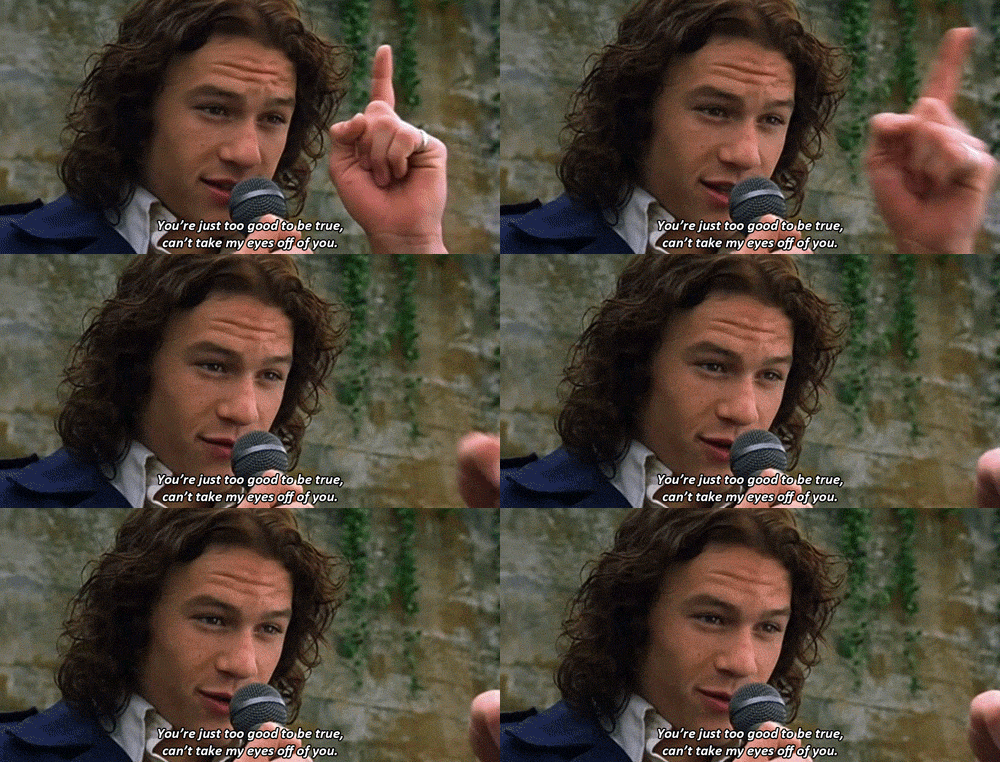
Why do people love 10 Things I Hate About You?  There’s a lot of reasons.  I love Heath Ledger singing Can’t Take My Eyes Out Of You.  I love watching Joseph Gordon Levitt at his most adorable.  I love that it’s a film about two sisters, largely because I have three older sisters and there is so much about the scenes between Kat (Julia Stiles) and Bianca (Larisa Oleynik) to which I could relate.  I love the film’s quirky sense of humor and its unapologetically big heart.  I love the way the film’s script expertly balances cynicism with sentimentality and humor with warmth.  I love the fact that movie takes in place in beautiful houses and features beautiful people wearing beautiful clothes.  What Erin and I especially love about this film is that, as played by Julia Stiles, Kat is just a kickass chick.

flawless-queen-kat-stratford-16681703

Of course, there’s a reason for that.  Much as how the superficially similar Clueless was adapted from Jane Austen’s Emma, 10 Things I Hate About You is adapted from Shakespeare’s play The Taming of the Shrew.  Oddly enough, Shakespeare’s plays seem to translate well into stories about high school.  Maybe it’s because his characters are so often motivated by jealousy, romance, and — it must be said about some — by pure stupidity.  10 Things I Hate About You is definitely one of the best of the teen Shakespeare films.

Taking place at an upper class high school, 10 Things I Hate About You opens with Cameron James (Joseph Gordon-Levitt) arriving for his first day at Padau High School and quickly befriending the only slightly less adorable Michael Eckman (David Krumholtz).  Cameron wants to ask out the beautiful and innocent Bianca (Larisa Oleynik) but Bianca’s overprotective father (played by Larry Miller) has decreed that Bianca can only date if her older sister Kat (Julie Stiles) is also dating.  The problem is that all of the boys at school are scared of the outspoken Kat.

So, Cameron convinces the hilariously vapid male model Joey Donner (Andrew Keegan) to pay the school rebel, Patrick Verona (Heath Ledger, so handsome and charismatic and sexy), to ask Kat out on a date.  Joey, you see, wants to date Bianca as well but Cameron is sure that he can win Bianca away from Joey…

Yes, it’s all a little bit complicated but then again, Shakespeare often is.  For that matter, so is high school.

10 Things

What matters is that all of this leads to a collection of classic scenes and classic dialogue.  What’s my favorite scene from 10 Things I Hate About You?  There’s so many that it’s difficult to narrow it down to just one.  There’s the huge party where Joey continually strikes a pose and a drunk Kat ends up dancing on a table.  There’s the wonderful scene where Patrick serenades Kat.  Or how about when Kat reads the poem that gives the film its title.  But for me, my favorite scene is that one where, after spending nearly the entire film as rivals, Kat and Bianca finally talk to each other as sisters.  Bianca demands to know why Kat won’t go to the prom.  Kat tells Bianaca about her own previous history with Joey.  It’s a low-key and heartfelt scene, wonderfully played by both Larisa Oleynik and Julia Stiles, and I love it just because I’ve had similar conversations with all of my sisters.

planet-loser

I suppose this is where I should make some clever comment about having “10 things I love about 10 Things I Hate About You” but actually, there’s more like a 100 things I love about 10 Things I Hate About You.

This movie makes me happy every time I see it.

And, really, what else can you ask a film to do?

tumblr_ms08c08EbP1sezoa7o1_250


Back to School #55: Varsity Blues (dir by Brian Robbins)


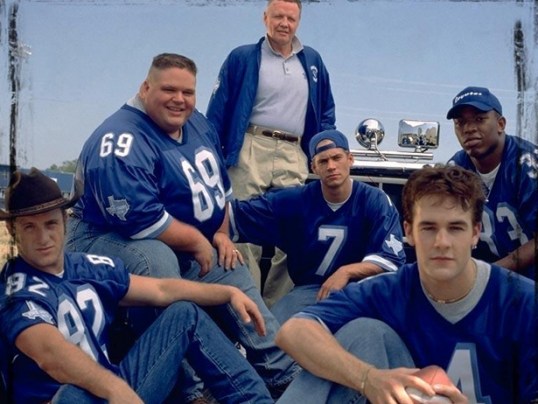
james-van-der-beek-varsity-blues-e1358953220340

“I don’t want your finger.”

Bleh!

The 1999 high school football film Varsity Blues has been showing up on cable fairly regularly lately and, seeing as how I’m currently in the process of reviewing 80 of the best, worst,  most memorable, and most forgettable high school films of all time, I decided that I might as well watch the whole thing.

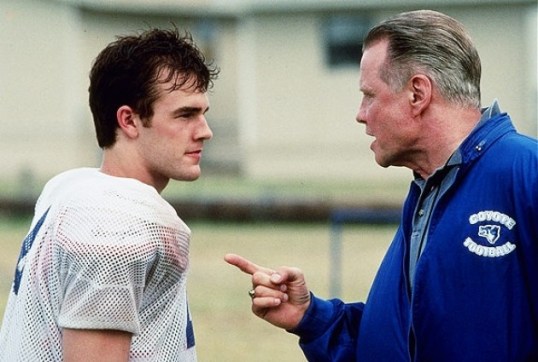
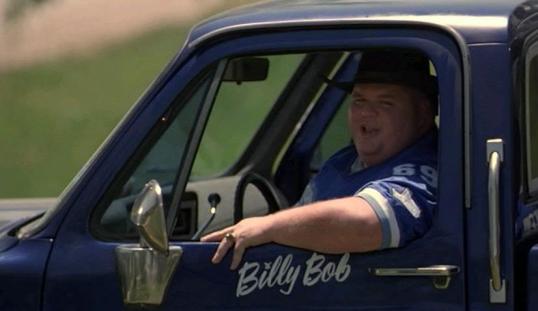
Don’t get me wrong. I had seen bits and pieces of it over the years.  I knew that it was set in Texas.  I knew Jon Voight played a fanatical football coach.  I knew that James Van Der Beek played an idealistic quarterback who clashed with the coach.  I knew that there was a fat guy named Billy Bob, mostly because every time an out-of-state director makes a film about Texas, there’s a fat guy named Billy Bob.  I knew about as much as one could learn from that episode of The Office where Michael Scott shows the film during “Movie Monday.”

"I don't want your truck."

“I don’t want your truck.”

But I had never seen the whole film so I decided, why not?  After all, I had already decided to review several other Texas-set high school films — The Last Picture Show, Dazed and Confused, Dancer, Texas, and Rushmore.  And hey those films were all good so maybe Varsity Blues would be good too!

Bleh.

One of the big clichés about Texas is that the entire state is obsessed with football.  (The other big cliché, of course, is saying that “everything is bigger in Texas.”  As if being a tiny state like Vermont is somehow preferable…)  I’ve always found the whole “Texas worships football” thing to be amusing because I’m a Texas girl and I don’t know a thing about football.  People tend to talk about Texas and football as if there aren’t any fanatical football fans in New York or California.  Ultimately, of course, it has little do with football and everything to do with the fact that the rest of the country loves to hate my home state.  If Vermont was known for being obsessed with football, there’d probably be thousands of articles about the “proud history of Vermont football.”  But since it’s Texas, we end up with movies like Varsity Blues.

"I don't want your painfully obvious at social commentary."

“I don’t want your painfully obvious attempt at social commentary.”

Anyway, Varsity Blues tells the story of Mox (James Van Der Beek), who is a backup quarterback for the championship-winning West Caanan High School football team.  However, Mox isn’t just your average jock.  For one thing, he’s seen reading Kurt Vonnegut’s Slaughterhouse Five.  (It’s indicative of this film’s approach to characterization that we never learn whether Mox actually understands or even likes Slaughterhouse Five.  We’re just supposed to be impressed by the fact that he owns a copy of the book.)  Mox wants to leave Texas to go to an Ivy League school.  He doesn’t want to play under the legendarily abusive Coach Kilmer (Jon Voight).  (How evil is Kilmer?  So evil that he poses for pictures like the one above.)   And Mox resents the pressure put on him by his football-crazed father.  (“You throw that fucking pigskin!” his dad shouts at one point.)  As Mox puts it, “I don’t want your life!” and the line is just hilarious because Van Der Beek’s attempt to sound like a Texan is hilarious.

(Tip for actors: If you can’t do the accent, don’t try.  Because I guarantee, if I ever meet James Van Der Beek, I’m going to tell him that his accent sucked and then I’m going to laugh and laugh.  It probably won’t do much for his self-image.  Sorry, James.)

"I don't want James Van Der Beek's career."

“Get me on Hawaii 5-0 because I don’t want James Van Der Beek’s career.”

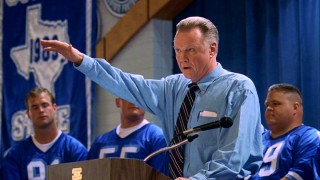
Anyway, when star quarterback Lance (Paul Walker) is injured, Mox is suddenly the team’s starting quarterback.  And you know what?  Mox is going to play the game his way!  Soon, he is standing up the cartoonishly evil Coach Kilmer and challenging small town Texas’s obsession with high school football.

And here’s the thing: this is a film that wants to have it both ways.  It wants to challenge the philosophy of winning at all costs and it also pretends to be about the unfair pressure that high school athletes are put under.  But you better believe that the film ends with Mox leading his team to victory.  And it’s not so much that Mox wins as much as it’s the fact that you know the film would never have the courage to actually have Mox lose.  The film wants to be celebration of rebellion but, ultimately, it’s just a standard sports film.

And, even beyond that, it’s just not a very good film.  I was shocked, when I checked with the imdb, to discover that Varsity Blues was actually filmed in Texas because the film feels like it was made in California.  It has no authentic Texas flavor to it.  What it does have is some of the worst fake accents that I’ve ever heard in my life.

Mox may not want his father’s life but I don’t want this stupid film.

varsitybluesheader

“Well, we don’t want your review!”

Back to School #54: Rushmore (dir by Wes Anderson)


rushmore-play

It’s an understatement to say that Wes Anderson’s films tend to divide viewers.  It seems like critics either love his excessively stylized and quirky vision or else they dismiss him as being a pretentious, overrated, and overly concerned with the problems of the rich and the suburban.  Even among the writers here at the Shattered Lens, there are conflicting opinions.  Leon the Duke gave Moonrise Kingdom a rave review.  On the other hand, I know that Ryan The Trashfilm Guru is not particularly a fan of Anderson’s films.

Myself, I always find it usually takes me a while to warm up to an Anderson film.  With the exception of The Fantastic Mr. Fox, I always seem to find myself somehow both impressed and slightly disappointed after seeing an Anderson film for the first time.  Perhaps it’s because Anderson is such a highly praised director with such a recognizable style that I always tend to go into his film with my expectations set way too high.  And so, I often times end up watching the latest Anderson film and thinking about how much I loved the film’s production design and some of the performances but often times feeling that, narratively, there was something missing.  On first viewing, Anderson’s trademark quirkiness can be overwhelming.  Usually it’s not until a second or third viewing that I really start to appreciate an Anderson film for something more than just the way it looks.  Eventually, I came to love Moonrise Kingdom and The Grand Budapest Hotel but it took me a while.

However, there is an exception to every rule.  And, as far as my reaction to Wes Anderson’s films are concerned, 1998’s Rushmore is that exception.  Rushmore is a film that I have unquestionably loved since the very first time I saw it.  Maybe it’s because, while Rushmore is undeniably quirky, that quirkiness doesn’t overwhelm the human aspect of the film’s story.  Maybe it’s because Rushmore — along with Bottle Rocket — is the most identifiably Texan of all of Anderson’s films.  Or maybe it’s just because Bill Murray gives such a great performance.

Seriously, Bill Murray makes any movie better.

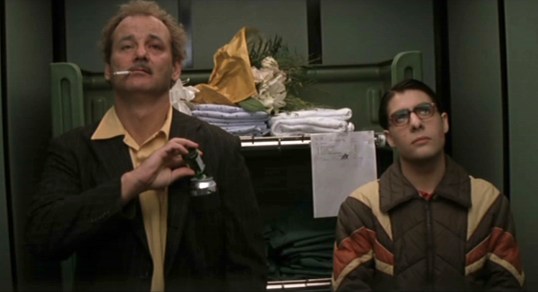
02-rushmore-max-and-mr-blume

Rushmore is named after Rushmore Academy, a private school in Houston.  (Rushmore is quite obviously based on St. Mark’s, which is perhaps the most exclusive private school down here in Dallas.  Owen Wilson, who collaborated on Rushmore‘s script with Anderson, was expelled from St. Mark’s in the 10th Grade.)  15 year-old Max Fischer (Jason Schwartzman, who gives a sympathetic performance as a potentially off-putting character) loves attending Rushmore.  He’s involved in a countless number of extracurricular activities and has written and directed several plays, the majority of which are based on films from the 70s.  (We see his stage version of Serpico and it’s hilarious.)

tumblr_mcasy9Qj4S1r5l2jyo1_400

Unfortunately, Max has a few problems.  For one thing, unlike most of his peers, he’s not rich.  He tells everyone that his father (Seymour Cassel) is a neurosurgeon but actually, he’s a barber.  Even more seriously, Max spends so much of his time starting clubs and writing plays that he doesn’t ever bother to study.  Max is on the verge of flunking out and, despite numerous warnings from Dr. Guggenheim (Brian Cox), he refuses to do anything to improve his grades.

Instead, Max is more interested in pursuing a crush he has on an older teacher, the widowed Rosemary Cross (Olivia Williams).  What Max doesn’t realize is that his mentor, industrialist Herman Blume (Bill Murray), also has a crush on Ms. Cross.

rushmore02

While Max may be the film’s main character, Herman Blume is, without a doubt, the film’s heart.  Blume is a Viet Nam vet (“You were in the shit?” Max asks.  “Yes, I was in the shit,” Blume replies) who has literally gone from rags to riches.  And now that he is rich, he finds himself living an empty life with a wife who doesn’t respect him and two sons who are total idiots.  When Blume starts to mentor Max and pursue Ms. Cross, he starts to care about living once again.

rm61

Meanwhile, Max attempts to impress Ms. Cross by building an aquarium on the school’s baseball field.  This leads to Max getting expelled and having to enroll in a public school.  (Max continues to wear a suit and tie, even after being expelled.)  However, Max then discovers that Blume has been seeing Ms. Cross and soon, the mentor and the student become rivals…

And a lot of other stuff happens but you know what?  I’m not going to tell you what because if you haven’t seen Rushmore, you need to see it and discover all of this for yourself.  You won’t be sorry!

It may be named after the school but Rushmore is ultimately about how love and our dreams make life worth living.  For Max, Rushmore is his fantasy ideal, a world that he loves because it provides him a sanctuary from the harshness of the real world.  When Mr. Blume says, about Ms. Cross, “She’s my Rushmore,” we understand exactly what he means.  But, and this is what distinguishes Rushmore from so many other films about quirky love triangles, is that Ms. Cross is just as independent and important a character as Max and Mr. Blume.  Blessed with excellent performances from Seymour Cassel, Brian Cox, Jason Schwartzman, Olivia Williams, and especially Bill Murray, Rushmore is one of Wes Anderson’s best films.

rushmore-1999-movie-poster1