The latest pick for the Daily Grindhouse should delight fellow site contributor Lisa Marie. I say this because I know of no one else who loves all things Jean Rollin as much as she does. I also picked this particular grindhouse flick because it has the lovely Brigitte Lahaie in it. Those who know need no explanation as to why that coulnts a lot in my pick and for those not in the know will just have to figure it out themselves.
I picked Jean Rollin’s Le Raisins de la Mort (also known as The Grapes of Death) because the title just spoke to me. A zombie (or at least zombie-like) flick with the word “raisins” in the title. What’s not to love and, not to continue repeating myself, it has the lovely Brigitte Lahaie in it even if for just a supporting role. A role that definitely shows her best front, sides and back (I’m a guy so sue me).
If there was ever a reason Jean Rollin has my undying props it’s for always finding a reason to cast Brigitte Lahaie in his films. Now, if Steven Soderbergh can just follow his lead and just keep casting Sasha Grey in all his future films then he’ll have my undying support as well.
This particular grindhouse pick definitely doesn’t make for a good way to promote France’s great wine traditions and their fabulous vintages. What it does promote is France’s own particular take on the zombie genre of the 70’s. Where zombie flicks were always seen as American and Italian provinces of the horror scene other countries had their hand in pushing the genre, but France (with some help from Rollin himself) added their own spin on it by shamelessly (one I applaud and am thankful for) keeping the lovely female performers in them in differing modes of undress.
For that I just have to say one thing: Vive la France!
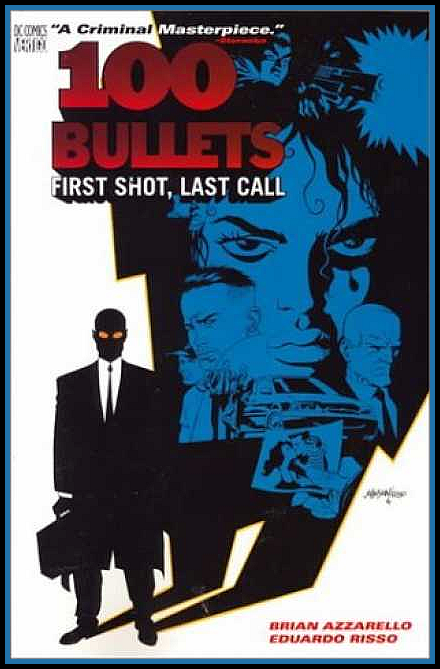
I missed out on the initial release for 100 Bullets, but I’ve since rectified that problem.
Brian Azzarrello’s 100 Bullets continues the long line of excellent mature comic titles from DC Comic’s Vertigo line. Azzarrello’s hardboiled, crime-thriller noir series brings to mind classic detective-noir works by Hammett, Spillane and Chandler. It’s a more complex continuation of the hyper-noir series Frank Miller began with his Sin City series. I’ve heard people say that this series was better than Sin City and to some respect it was. The stories in each issue contained in this first volume (issues 1 through 5) were abit more complex in nature and execution than Miller’s more simple noir tales. The five stories in this collected volume also laid the basic groundwork for what’ll turn out to be one long-running series lasting exactly 100-issues. Where Sin City‘s simplicity in its storytelling and artwork lay its strength, it’s in the complexities in the tales and the detailed, but economical artwork that 100 Bullets shined through.
In First Shot, Last Call we’re introduced to the gamemaster of the tale: Agent Graves. Looking like an ever-present government agent who has seen all that life has thrown at him and ready for more, Agent Graves picks a recently paroled Latino lass by the name of Dizzy Cordova with a proposition. He offers Dizzy an attache case with a gun and 100 bullets that’re untraceable and definite proof that certain individuals caused her heartache and grief that has ruined her life. He only offers her the attache case, its content and the proof within. The choice is Dizzy’s to make on what she should do with what’s offered her. This set-up and premise is the beauty of 100 Bullets. The story’s basically a morality tale of choices offered to the characters. Will they use the offer to exact vengeance and get away with it scott-free, or will they refuse the offer and live on with their life. The choice of revenge really doesn’t bring back lost time and loved ones and only feeds the need for retribution. Agent Graves doesn’t really force Dizzy’s hand, but a supporting character knowledgable of the offer does — for his own agenda not yet known — prods, pushes and guides her to picking the more primal choice. Dizzy’s choice in the end was both understandable and in the end inevitable.
The second story arc deals with Lee Dolan who also has had his life turned upside-down by people unknown to him. His life and family taken away by the stink of a child pornography accusation in the past. Agent Graves makes him the same offer of the attache case and its untraceable 100 bullets. Dolan’s reaction to this offer is different from that of Dizzy’s, but in the end his ultimate choice doesn’t give him the same resolution and new life path that Dizzy made. It’s a tribute to Azzarrello’s great writing that the decision both Dizzy Cordova and Lee Dolan made were understandable when taken into context of their personalities and yearning to fix the problem that led them to their current state in their lives.
To complement Azzarrello’s words perfectly were Eduardo Risso’s artwork. It would be a misnomer to say that Risso’s art style was minimalist like those of Frank Miller’s woodcut-engraving style for Sin City or Mike Mignola’s chiasroscuro-style for his Hellboy series. There’s a sense of the cinematic in Risso’s work. The scenes were always drawn with a mind for action even when it’s just people standing around. Risso has quite the filmmaker’s eye in how he’s drawn 100 Bullets which just adds to its noirish feel. The characters and environment were drawn not to scale and real-world proportion, but just enough not to look cartoonish. I would agree that there’s an abundance for cleavage on the women drawn, but Risso doesn’t do it gratuitously. Instead he uses this detail to showcase the sexuality of the strong female characters. It paints the female characters like Dizzy Cordova and Megan Dietrich with a sense of both strength and sensuality without pandering to the teenage boy demographic. Plus, he gives these ladies their own personality and character with how he draws them. Dizzy truly has the Latina sensual curves while Megan has the icy-cold Aryan beauty that serves her well.
100 Bullets: First Shot, Last Call was a great discovery and a wonderful beginning to a very mature, intelligent and hardhitting comic series. Congratulations must got to its creator Brian Azzarrello for writing such great characters and memorable stories. I can’t forget the work of his artist and partner-in-crime, Eduardo Risso. Risso’s artwork has stamped themselves in my mind as the only way to see 100 Bullets in. Both Azzarrello and Risso complement each other well and their continued collaboration right up to the end of the series helped make this series one of the best of the past decade.
1) Scream and Scream Again — This is actually a pretty good British horror film from 1970. It even has a political subtext for those of you who need your horror to mean something. I love the whole “swinging” vibe of the trailer.
2) The Spook Who Sat By The Door — This 1973 film apparently used to be something of a legend because it was extremely difficult to see. It was sold, obviously, as a blaxploitation film but quite a few people apparently saw it as being a blueprint for an actual revolution. I’ve never seen this movie though, believe it or not, I did find a copy of the novel it was based on at Half-Priced books shortly after I first saw this trailer. I bought the book but I haven’t read it yet.
3) The Black Gestapo — This is another one of those old school blaxploitation trailers that, to modern eyes, just seems so wrong. I’ve actually seen this film. It’s surprisingly dull, to be honest.
4) Sunset Cove — This one of the many trailers that I first came across on one of Synapse’s 42nd Street Forever compilations. I’ve never seen the actual film and probably never will as apparently it’s like the uncut version of Greed — lost to the ages. That’s okay because the film really does look really, really bad. However, the trailer fascinates me because it has got such an oddly somber tone to it. Just from the narration and one or two of the clips shown, you get the feeling that this movie ends with the National Guard gunning down a lot of teenagers while the tide comes in. However, I think that might just be my own overactive imagination. The film was apparently directed by Al Adamson who, in the mid-90s, was apparently murdered and buried in wet cement.
5) Autopsy — This 1975 Italian classic is one of my favorite examples of the giallo genre. I can’t recommend it enough. This is one of the most intense and disturbing films ever made. The trailer’s pretty good too.
6) Visiting Hours — I don’t know much about this movie, other than it appears to be a slasher film from the early 80s. I’m posting it here for one reason and one reason only — the skull.
Hi. I came across this old commercial for Crystal Meth on YouTube earlier this year and it has really stuck with me. I have a fear that this is another one of those things that everyone else on the planet has already seen but oh well. Better late than never.
It’s debatable just how effective this commercial is, to be honest. Because while I don’t think anyone would say it’s necessarily a good thing to get hooked on meth, that little jingle is so freaking catchy. I have to admit that I recently found myself singing it while I was cleaning the kitchen. Also, and admitedly a lot of this has to do with me being OCD, it’s hard for me to really see the downside of having the cleanest house on the street. So, no, the commercial did not sell me on meth. But it did make me want to go clean the house.
Finally, I can’t end this post without including Sin33’s remix of the Meth Song.
In 1978, just based on what I’ve read, everyone in America was regularly doing huge amounts of cocaine. Whether you were in a disco or at a PTA meeting, you knew that eventually someone would produce a small mirror covered with white powder. President Carter even snorted it during that year’s State of the Union speech. Sure, some people used gold spoons and others had to make do with a one dollar bill but, in the end, cocaine brought all Americans together as a nation and helped the country heal after the trauma of Watergate.
It also contributed to some the year’s best films. Days of Heaven, Superman, The Deer Hunter, Coming Home, Grease, Animal House, Interiors, Halloween, Midnight Express, Convoy, Go Tell The Spartans, and An Unmarried Woman; these were all films fueled by the Peruvian Headache Powder.
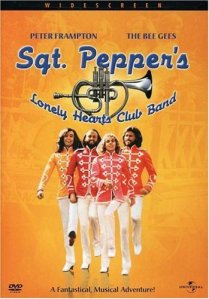
However, no discussion of 1978 cocaine-fueled films would be complete with mentioning Sgt. Pepper’s Lonely Hearts Club Band. Featuring songs originally performed by the Beatles and starring the Bee Gees, Peter Frampton, and a whole bunch of other people that my mom liked, Sgt. Pepper’s is a film that, quite honestly, should just be retitled 1978.
Plotwise — oh God, do I really have to try to describe the plot? Seriously, this could take forever. I mean, the film isn’t quite two hours long but a lot of stuff happens and really the only connection between any of it is that these odd cover tunes of classic Beatles songs keep popping up in the weirdest places. Okay, let me try to get this all into one paragraph —
There’s a small town called Heartland that is very small and simple but it’s also the home of the legendary Sgt. Pepper who, throughout history, has maintained world peace by playing his magic instruments. But then Sgt. Pepper dies and apparently turns into a gold weather vane. His magic instruments are given to the mayor of Heartland, Mr. Kite (George Burns, who also narrates the entire movie). The world is in mourning. But then one day, the Henderson Brothers (the Bee Gees) decide to form a new Sgt. Pepper’s Lonely Hearts Club Band and they invite Sgt. Pepper’s grandson, Billy Shears (played by Peter Frampton) to be their lead singer. Heartland rejoices and George Burns has a surprisingly sweet scene where he sings Fixing A Hole.
Anyway, the new band is such a hit that the owner of a record company invites them to come to Los Angeles and record an album. Billy says goodbye to his girlfriend, Strawberry Fields (Sandy Farina) and then joins the Hendersons in a hot air balloon which promptly leaves for California. En route, the balloon collides with an airplane but nobody is seriously injured.
In Los Angeles, they meet the record company owner and it turns out that he’s played by Donald Pleasence. (It’s interesting to think that Pleasence filmed this and Halloween around the same time.) Pleasence proceeds to sing the creepiest version of I Want You ever heard. I’d include a clip of the performance but Pleasence manages to go on for a good ten minutes, repeating “I want you,” in an odd little voice while staring at Peter Frampton.
The boys sign a contract with Pleasence. Billy Shears is led astray by Lucy and her band, the Diamonds. (Guess which song they get to sing.) Somehow, this allows Mean Mr. Mustard to steal Sgt. Pepper’s magic instruments. Mr. Mustard drives around in a yellow van and he’s assisted by two female robots who, at one point, sing She’s Leaving Home in their electronic, robot voices.
The band is informed that the instruments have been stolen. Outraged, they jump back in their hot air balloon and quickly start a recovery operation. It turns out that Mean Mr. Mustard has given the instruments to three separate villains.
The first villain is Dr. Maxwell Edison who uses his silver hammer to turn old people into boy scouts. This may sound ludicrous and silly but fortunately, Maxwell is played by Steve Martin. His cameo is one of the highlights of the film, if just because he seems to be one of the few people who actually enjoyed himself on set.
The second villain is the Reverend Sun. He brainwashes people or something. I’ve seen this movie a few times and I still can’t quite figure out what Reverend Sun’s deal is. When I first saw this movie, I got excited because I thought that Tom Savini was playing Rev. Sun. Then I forced my sister Erin to watch the movie and she told me I was stupid because Rev. Sun was obviously being played by Frank Zappa. Well, I did some reasearch and discovered that we’re both stupid. That’s neither Savini nor Zappa. It’s Alice Cooper.
The final villains are played by a very young (and very, very hot!) Aerosmith. Here, they are called the Future Villain Band and oh my God, Joe Perry…this film needed a lot more Joe Perry. I mean, it’s understandable that Steve Tyler gets most of the screen time and young Steve actually looks pretty good in a Mick Jagger sort of way but Joe Perry…Oh. My. God. Anyway, Aerosmith does a cover of Come Together and Joe Perry circa 1978 was just so freaking gorgeous, oh my God. Eventually, Frampton and the Bee Gees come along and ruin things by getting into a fight with Steve Tyler which leads to the camera constantly cutting away from Joe Perry who is really, really, really hot and all kinds of sexy in this movie. They should have just called this movie Joe Perry. Oh. My. God.
Uhmm, where was I? Oh yeah — so, anyway, eventually the weather vane comes to life and suddenly, Sgt. Pepper’s a black man who sings Get Back and ends up magically resetting the past and turning Mean Mr. Mustard into an altar boy or something like that. Oh, and the Bee Gee who looks like a New Age healer ends up singing my favorite Beatles song, A Day in the Life.
Finally, it appears that every single person on the planet shows up in the film’s final scene where a huge group of “stars” show up and sing the film’s title tune one last time. In the end credits, these people are listed as being “Our Guests At Heartland.” Doing some research (i.e., looking the thing up in Wikipedia), I’ve discovered that these folks were apparently all pop cultural icons in the 70s. I didn’t recognize a single one of them but I’m sure they probably all snorted a lot of cocaine.
(And, by the way, Joe Perry does not get to return for the finale so bleh on you, movie.)
For some reason, this movie kept showing up on Starz last November and that’s where I first discovered it. The first time I saw it, I came in right at the start of Steve Martin’s cameo and the film itself was so just plain weird that I had to jump on twitter and let the world know what I was watching. (Actually, it doesn’t take much to make me jump on twitter and tell the world what I’m doing.) As a result, I soon discovered that, apparently, I was the only person on the planet who didn’t know about this film.
Sgt. Pepper’s Lonely Hearts Club Band is really a pretty bad movie. The plot tries way too hard, the pacing is terrible with some scenes lasting forever and others ending before they really start, and Frampton and the Bee Gees are all distinguished by an utter lack of charisma. The youngest Bee Gee appears to be cheerfully stoned throughout the entire movie while the other two (and Frampton) are trying way too hard to act.
And yet, the film fascinates me. After I saw it the first time, I forced my sister to watch it with me a second time. I then watched it again on my own. Finally, I went down to the local Fry’s and nearly did a happy little dance when I found it on DVD. I’ve watched it since several times. Whenever I’m depressed, it always cheers me up.
What’s the appeal? Some of it is definitely the whole “so-bad-its-good” thing. Actually, that’s probably most of it. Another thing fascinating thing is how literally the filmmakers choose to interpret the Beatles lyrics. Considering the fact that the Beatles themselves were rather open about the fact that a lot of their lyrics were simply nonsense and word games, it’s interesting to try to understand logic behind trying to force them into a coherent storyline. (This is also the appeal of 2007’s Across The Universe, which is technically a better movie than Sgt. Pepper’s but isn’t half as fun to watch.) For instance, Billy Shears isn’t in the film because he’s an interesting character. Instead, he’s just here because — 10 years earlier — either John Lennon or Paul McCartney choose to toss the name into a song. We’re never quite sure what Mean Mr. Mustard’s dastardly motivation is beyond the fact that the filmmakers had the rights to his song. If nothing else, the film is an interesting example of what happens when people try to create a novel out of somebody else’s short story.
However, I think the main appeal of Sgt. Pepper’s is the appeal of 1978. Watching the movie, you feel almost as if you’re literally sitting beside the cast at Studio 54, watching as everyone snorts a line. I think that, for future historians, this film may very well turn out to be a cinematic Rosetta Stone.
Then again, maybe it really is just so bad that it’s good.
I finally came across an AMV which does a great job at melding song and images from the romantic-comedy anime series, Toradora!. This series is just getting it’s North American release and I saw the first episode (subtitled of course….don’t believe in dubbing) while over at this summer’s Anime Expo 2010 in LA. To say that the series put it’s romantic-comedy hooks into me would be an understatement. It helped that one of the characters sounded just like one of my favorite anime characters ever. I speak of the very awesome Manabi from the slice-of-life series from a few years back, Gakuen Utopia Manabi Straight!which also happens to be my favorite series ever. EVER.
For the past year or so one particular song has been used over and over again by AMV creators that it’s gotten to the point I’ve tired of hearing it. I’m talking of the song Fireflies by the group Owl City. So, it was a surprise that when I came across this Toradora!-based AMV using this Owl City song and I wasn’t bored by it. The song definitely fit well with the images the AMV’s creator (SweetMina93 on YouTube).
The AMV definitely has spoilers but it matters not as I’ve seen the whole series already, but even those who haven’t should still watch it even if they already know what happens. The joy sometimes is not the surprise of how things turn out but the journey the characters take to get to their destination. So, while I make this post I’ve been watching this AMV over and over for the past couple hours and I can’t stop.
I see that as a sign of a well-done and catchy AMV. Now, I must go back to watching the AMV for another hour or more.
yandere: A Japanese anime/manga character archetype, a character that is loving, sweet & gentle that can suddenly switch to brutal psychotic or deranged behavior
Why the quick brief lesson in Japanese anime/manga terms?
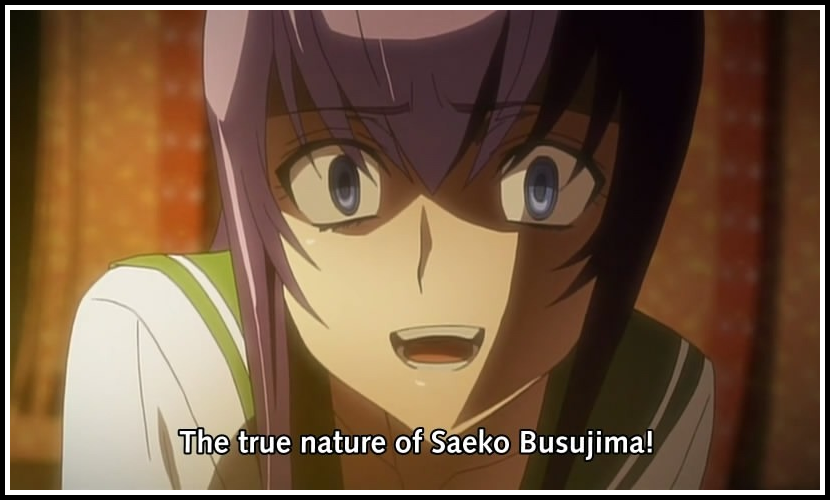
This brief lesson is due to the nature of episode 9 for Madhouse’s anime tv series adaptation of the horror manga title, Highschool of the Dead. This latest episode finally unleashed the dark secret one of the coolest characters in the series has been keeping to herself. For those who have been reading the manga on a regular basis already know of this secret, but for those whose experience of this title is only the anime this episode will open up Busujima Saeko.
The bokken wielding senior-class in the group has been one of the most level-headed in the group surviving since episode 1. Saeko never seems to panic and has shown to be expertly skilled in dispatching the unending stream of zombies with her wooden sword. Outside of the gun otaku himself, Kohta Hirano, she seems to be the one character in the group who has adapted well to the sudden and apocalyptic change in the world around them.
This episode puts her and Takashi Komuro (who is starting to gather quite the harem of hotties) on the run to find a way to the safety of Takagi Saya’s parents’ fortress compound. During their time running from the zombies to find a safe passage Saeko and Komuro get into all sorts of troubles with Saeko getting wet in more ways than one during their run. It’s during this time away from the rest of the group that we learn of Saeko’s penchant for just a bit of sadism.
A past encounter in her early highschool years convinced Saeko that she enjoys inflicting pain on those weaker than herself. This revelation becomes a huge 180 degrees from her earlier behavior. Out of the outside facade of being the cool-headed, elder student who never panics lies the heart of a sadistic yandere who has enjoyed killing “Them” with impunity. The changes in the world has allowed Saeko to indulge in her sadistic tendencies and maybe she’s in the right as it has helped her and her group survive the apocalypse, so far. Even Komuro has accepted this side of Saeko and sees it as a necessary evil in the days ahead.
The episode also hints at what could become a major love triangle (or is it quadrangle) as the relationship between Saeko and Komuro may have turned a particular intimate turn (before the scene faded to black). This episode has deftly laid the groundwork in what could become this series’ version of School Days and Higurashi no Naku Kuru ni. This new development in the series should quiet some of the nitpickers and naysayers (who still continue to watch despite their constant bitching about the series’ heavy fanservice) who wish for more character development and storytelling minus the constant oppai and pantsu shots.
One thing for sure, the anime has begun to take some liberties with details from the manga. This episode has changed the order of certain events and even changed the circumstances of how certain things occur. With four more episodes left in the season the question now is whether the series first season will end caught up to the manga (currently on chapter 26 or 27) or will it end on a cliffhanger that combines chapters 14-16 of the manga. Here’s to hoping that it’s the latter that way we get a follow-up season.
1) Graveyard Shift — This is a Canadian film from 1986. Ever since I first saw it on DVD last year, this has been one of my favorite vampire films. It’s an atmospheric, strangely well-acted film that is just trashy enough to remain interesting.
2) Panorama Blue — I’ve never seen this movie and apparently, it’s a lost film of some sort. The trailer can be found on one of the 42nd Street Forever compilation DVDs. Apparently, this is some sort of pornographic epic. I just enjoy the trailer even though I wouldn’t be caught dead on a roller coaster. (They’re scary!)
3) Zombi 3 — This film is credited to Lucio Fulci but he actually only directed about 60% of it before he was fired and replaced by Bruno Mattei. This trailer deserves some sort of award because it manages to make an amazingly boring film look exciting and almost fun.
4) Rolling Thunder — Another film that I’ve never seen (and another trailer that I first found on a 42nd Street compilation). This is an effectively moody trailer. As a Texan, I also like the fact that Rolling Thunder apparently not only takes place in Texas but was also actually shot there with actual Texans in the cast. And I love the ominous yet casual way that Tommy Lee Jones delivers the “I’ll get my gear,” line.
5) Angel — This is a trailer from the early 80s. This is another one of those trailers that I love because it’s just so shamelessly sordid and trashy.
6) Hitch-Hike — Okay, quick warning — this trailer is explicit. Not as explicit as many grindhouse trailers but it’s still explicit enough that some people might find it objectionable. It’s certainly not safe for work though why are you visiting this site from work anyway?
However, all that taken into account, it’s still a very good trailer for a very good movie, 1977’s Hitch-Hike. Not only is it a nicely cynical little thriller, but it features not only another iconic psycho performance from David Hess but also a brilliant lead performance from Franco Nero. I will also admit right now that if I ever got my hands on a time machine, the first thing I would do would be go back to 1977 and give Franco Nero a hummer. Seriously.
Okay, I’ve said too much. Just watch the trailer and enjoy one of Ennio Morricone’s best scores.
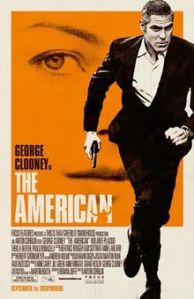
Earlier today, I had the misfortune to sit through the just released movie The American.
The title character, as played by George Clooney (who also produced the film), is an aging assassin. He’s done some bad, bad things and, as a result, he has some bad, bad people after him. So, he hides out in an isolated, Italian village. He makes friends with the local priest, engages in some shady business of some sort with a mysterious woman (Thekla Reuten), and of course falls in love with the proverbial hooker with a heart of gold (Violante Placido). The whole time, the American is aware that his days are numbered and that he can trust no one.
And who really cares?
Director Anton Corbijn appears to be trying to do an homage to the noir-influenced French New Wave of the late 50s and 1960s but he seems to have forgotten that Jean-Luc Godard’s and Francois Truffaut’s films were usually as entertaining as they were intellectually stimulating. (This, of course, is something that Godard forgot as well.) As a result, The American often feels like a parody of an art film. Every scene drips with great importance and all the actors play their roles like they’re in a passion play but, in the end, it’s just a lot of pretension that ultimately adds up to nothing.
As a movie, the American is pretty to look at but I lost interest in it fairly early. Corbijn tries to create an atmosphere of ennui but the end result is simply dull. Clooney attempts to give a restrained performance full of self-loathing and paranoia but he’s miscast in the part. George Clooney the producer doesn’t seems to realize that Clooney’s essential shallowness is the key to his appeal. George Clooney comes across as the perfect one-night stand, the epitome of fun-while-it-lasted but nothing to regret once he’s gone. Whenever Clooney attempts to suggest anything suggesting any greater depth — like in this film — he simply seems lost.
Speaking of lost, so was I as I watched this dull, boring movie. I’m sure some will embrace this film but for me, I’ll pass.
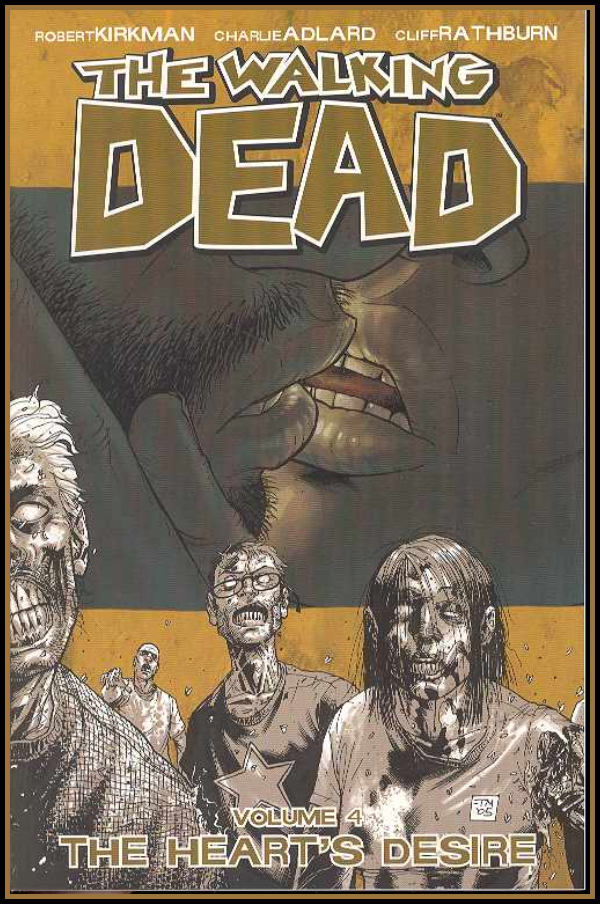
I’ve loved and obsessed over Kirkman’s The Walking Dead series and the previous three collected volumes have not disappointed at any level. This fourth volume collects issues 19 through 24 and is appropriately titled The Heart’s Desire. We pick up from the cliffhanger that ended the third volume (Safety Behind Bars) as Dexter gives Rick and his group a choice that bodes nothing but death either way he chooses: stay and be shot or leave and take their chances with the zombies outside the fences.
The book starts things off with a bang as Rick realizes that Dexter’s success in getting guns of his own has let loose a bigger set of problems as zombies from a locked wing of the prison was accidentally let out. What happens next as Rick’s group and Dexter’s group fight to stay alive shows a new side to Rick that surprised me alot. It puts a new wrinkle on Rick’s rule of “you kill, you die” and will have long-reaching ramifications deeper in the story. It is also in this heart-pounding sequence that a new face is added to the mix in the form of a female survivor whose mode of survival, to say the very least, is interesting.
The rest of the book really deals less with the zombies but the emotional consequences of many of the characters’ actions from the very start of the series all the way to point of this volume. I can fully understand the disappoint many fans have with the direction the series took with all the drama and sopa opera kind of twists nd turns of the heart, but I think people fail to realize that Kirkman is writing about the human condition rather than just about zombies. Sure I got abit impatient with all the emotional crisis and the meltdowns by almost everyone involved, but I can also understand why they’ve been acting the way they have. I think if Kirkman had written abit more of zombies and death in this part of the series people wouldn’t be complaining much.
Kirkman himself has already admitted that zombies wasn’t what the story was all about, but just a part of it. With the group in relatively safety within the secured fences of the prison and some sort of artificial normalcy starting to come back to the group he needed a way to continue the conflicts that make for good drama. What else but let the pent-up emotional baggage everyone has been carrying since issue 1 to finally come to boil. Part of me didn’t fully enjoy this new arc in the series, but not enough to be disappointed with the end result. Hell, even with all the drama Kirkman still came up with one of the best fight scenes in the series a la Carpenter’s They Live and South Park’s “Cripple Fight” episode.
The Heart’s Desire was not as great as the previous three collected volumes in the series, but it still told a good story though with a bit more drama than most fans of the book were willing to take. I myself enjoyed the book enough that it wasn’t a waste and I was a bit surprised and shocked at the observation Rick finally made and shared with everyone at the end of the volume. I know that after all the emotional trials and tribulations everyone in the series went through in The Heart’s Desire and how the arc ended there’s nothing left but up for the series.



 Through the Shattered Lens