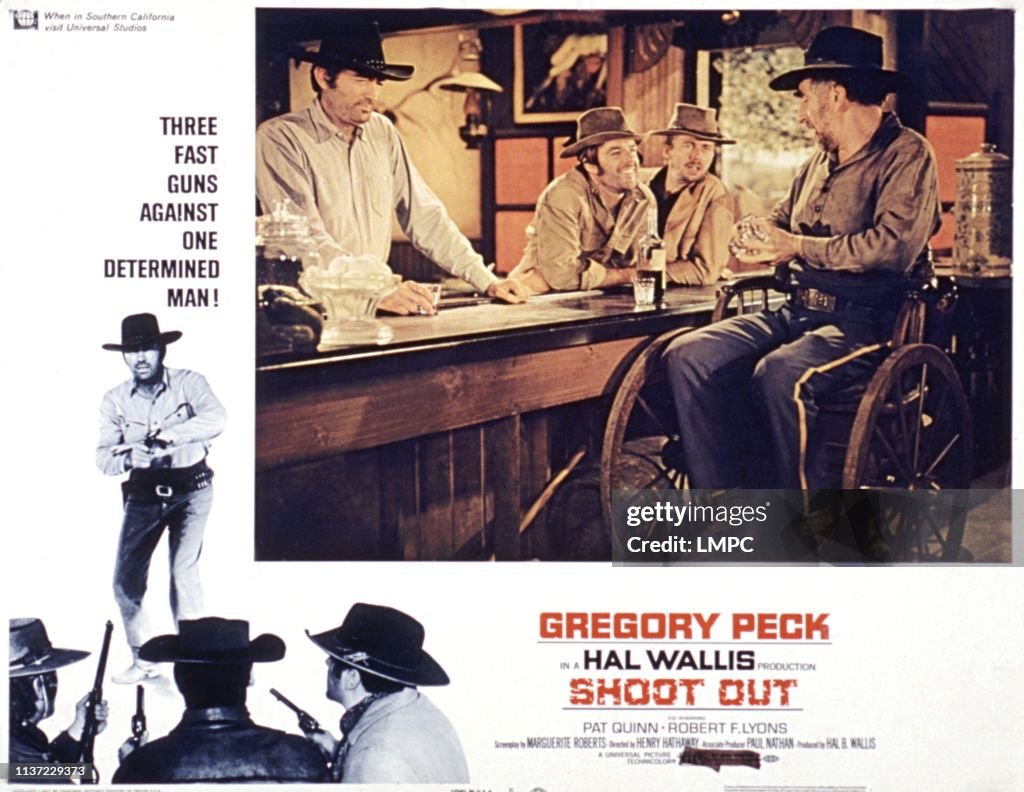
Brad reviews SHOOT OUT (1971), starring Gregory Peck & Robert F. Lyons! 


After serving a stretch at the Canon City penitentiary, Clay Lomax (Gregory Peck) gets out with only one thing on his mind… revenge on his former partner Sam Foley (James Gregory), who shot him in the back during a bank robbery, leaving him to take the rap. Foley isn’t a fool, though, so he’s hired a trio of young punks, Bobby Jay (Robert F. Lyons), Skeeter (John Davis Chandler), and Pepe (Pepe Serna) to surveil Lomax and let him know if he’s heading to his home in Gun Hill with payback on his mind. These guys are about as crazy as it gets, and they make two major mistakes. First, they kill Lomax’s friend Trooper (Jeff Corey) who lets him know where Foley is with his dying breath. Second, they kidnap the prostitute Alma (Susan Tyrell) just because they want to treat her like crap and have fun with her, which turns out to be a dumb move. Interrupting Lomax’s quest for revenge, he finds himself being forced to care for a young child named Decky (Dawn Lyn), who just may be his daughter with a lady back in Kansas City who used to be his “friend.” Looking after Decky, and then meeting and falling for the widow Juliana Farrell (Patricia Quinn), Lomax is soon facing off against his most dangerous foe, the crazed Bobby Joe, as he attempts to protect all these new people that he loves so he can move on with his life. But is it all too late?!!

I love westerns, but I must admit that I’m not the biggest fan of director Henry Hathaway’s SHOOT OUT. Hathaway has directed some of my favorite actors and movies, like Charles Bronson’s debut film with Gary Cooper, YOU’RE IN THE NAVY NOW (1951), along with the Jimmy Stewart film CALL NORTHSIDE 777 (1948) and John Wayne’s Oscar winning TRUE GRIT (1969). Unfortunately, it seems his best years are behind him, and he would only direct one more film after this, the less than excellent black action film HANGUP (1974). This isn’t exactly Gregory Peck’s best work either. Coming nine years after his Oscar winning performance in TO KILL A MOCKINGBIRD (1962), this is definitely not even close to that kind of level. Don’t get me wrong, I do enjoy his turn as Lomax when he’s the wronged outlaw looking for revenge, but I don’t really care at all for his part as the reluctant father figure trying to deal with the six-year-old Decky. I found Dawn Lyn to be more annoying than cute in the role, and this storyline distracted me from the revenge plot that I actually enjoyed. As a co-host of the “This Week in Charles Bronson Podcast,” we had the opportunity to interview Robert F. Lyons, who plays the bad guy, Bobby Jay Jones. I specifically asked him about this film and what it was like working with Gregory Peck. While he enjoyed working with Peck, his response about the film itself was telling…. “The work in there is not my work.” If you’ve watched much of the excellent actor’s work before, you can immediately understand what he means. Lyons goes so over-the-top as the spying outlaw Bobby Jay Jones, that his performance is inconsistent with the bulk of his career. Lyons told us that his performance was orchestrated by Hathaway in a way that he disagreed with, and he essentially disowns his work in the film. You can see a similar vibe with his “gang” that includes the actors John Davis Chandler and Pepe Serna. 

While I’m not a huge fan of the overall direction of the storyline or the focus of some of the main performances in SHOOT OUT, I am appreciative of the genre and the classic western stars that Hathaway cast in supporting roles. I especially enjoy seeing Jeff Corey in the small but pivotal role as the wheelchair bound Trooper, Paul Fix as the train brakeman who delivers Decky and a stack of cash to Lomax, and Arthur Hunnicutt as the ranch owner who barters with Lomax over the price of a pony. Hunnicutt is a particular favorite of mine although his role here is very small. Nominated for an Oscar for his performance in Howard Hawks’ THE BIG SKY (1952), Hunnicutt is from the small town of Gravelly, Arkansas, which is not far from where my own family is from. He even attended the same college that I graduated from, the University of Central Arkansas, which was known as the Arkansas State Teachers College when he (and my dad) went there. And then there is the setup of the revenge scenario at the beginning and the final showdown at the end, classic staples of the western genre. These are enjoyable and satisfying moments as Lomax settles his scores and the bad guys get their comeuppance.

Overall, SHOOT OUT is best enjoyed by fans of old school westerns and star Gregory Peck. It veers aways from the best storylines of the genre and wastes a lot of time with uninteresting melodrama, but it does offer us another chance to see some of our great character actors doing what they do. That means something to me. 

I’ve included our podcast episode with Robert F. Lyons below. He discusses SHOOT OUT at around the 1:00:30 mark.
I Watched Flashing Spikes (1962, Dir. by John Ford)


When infielder Bill Riley (Patrick Wayne) makes an error that costs his team the game, sports columnist Rex Short (Carleton Young) claims that he witnessed Bill being paid off by Slim Conway (James Stewart).  Slim is a former player who was banned from Major League Baseball after he was accused of taking a bribe from a gambler.

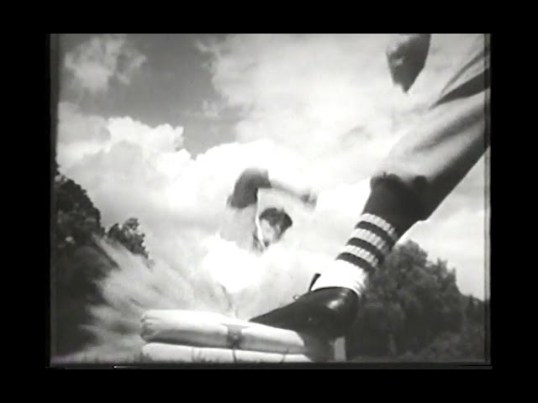
Most the movie is a flashback, showing how Bill first met Slim when Slim was playing for a barnstorming team of former major leaguers.  That was my favorite part of the movie.  Slim and a collection of old, worn-out men stumble out of their bus and even though they might move a little slower and they might need to stretch a little more before swinging a bat, they still show up a cocky team made up of young local players.  Even after the crowd nearly riots when they realize that Slim is one of the players, the old players keep their cool and their eye on the game.  After Bill spikes Slim while sliding into home plate, Bill apologizes.  Slim remembers the young man’s humility and, working with one of the few friends that he has left in the game, Slim helps Bill get his chance in the Majors.

Usually, when my sister yells at me to come watch something because “it’s got baseball!,” I’m prepared for it turn out to just be a movie with one scene of someone holding a bat.  I’m glad that she called me to come watch Flashing Spikes with her because it really is a good and loving celebration of my favorite game.  Even after Slim is treated so unfairly by the press, the League, and even some of the fans, he never stops loving the crack of the bats and the cheers of the crowd.  Flashing Spikes is unabashedly pro-baseball and Slim stands in for every player who was ever unfairly railroaded out of the game by scandal mongers like Rex Short.

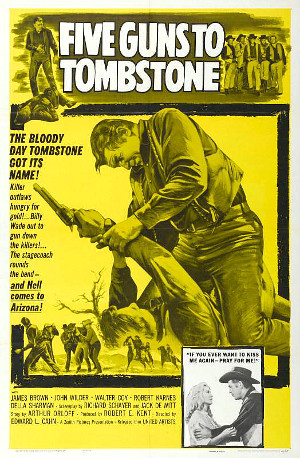
Five Guns To Tombstone (1960, directed by Edward L. Cahn)


Outlaw Matt Wade (Robert Karnes) escapes from prison and rejoins his old gang.  They ride out to Tombstone, Arizona, stopping off at the ranch of Matt’s brother, Billy Wade (James Brown).  Billy used to be an outlaw but eventually he hung up his guns, settled down, got married, and now he’s raising Matt’s teenage son, Ted (John Wilder).  Ted, who thinks that his father has just been paroled, is excited to see Matt but Billy doesn’t want Ted being led into a life of crime.  When Matt and the gang rob a bank, they frame Billy for the crime.  With the townspeople looking to lynch him and Ted drifting towards the wrong path in life, Billy has no choice but to pretend to be a part of the gang until he can dig up the evidence to clear his name.

If this sounds familiar, thank you for reading yesterday’s review of Gun Belt.  Released seven years after Gun Belt, Five Guns To Tombstone tells the exact same story as Gun Belt and, in many case, it features the exact same dialogue.  The only difference is that some of the names have been slightly changed.  The gang leader in Gun Belt was named Ike Clinton.  In this Five Guns To Tombstone, his name is Ike Garvey.  Billy Ringo becomes Billy Wade and Wyatt Earp because Marshal Sam Jennings.  Otherwise, it’s pretty much the exact same film.

Which one is the better film, Gun Belt or Five Guns To Tombstone?  Both films have plenty of two-fisted, gun-slinging action and a good cast of western character actors but I’d probably have to give the edge to Five Guns To Tombstone because John Wilder is more convincing in the role of the outlaw’s son than Tab Hunter was in Gun Belt.  Tab Hunter was young and callow and annoying but John Wilder is the type of confused kid that anyone could relate to.

Five Guns To Tombstone was one of the 9 films that Edward L. Cahn directed in 1960.  As with most of Cahn’s films, the action seems rushed but that’s appropriate for the story that Five Guns To Tombstone is telling.  (It’s also understandable.  When you’re directing 9 films a year, you don’t have the luxury of taking your time.)  Like Gun Belt, this is hardly a classic but western fans should enjoy it.

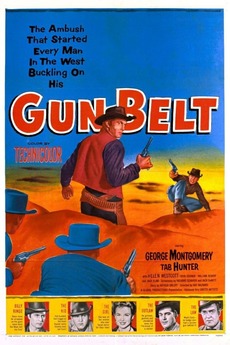
Gun Belt (1953, directed by Ray Nazarro)


Outlaw Matt Ringo (John Dehner) escapes from prison and reunites with his old gang.  Riding out to Tombstone, Matt tracks down his son, Chip (Tab Hunter).  Chip is now living with his uncle, Billy Ringo (George Montgomery).  Billy was once a member of Matt’s gang but he’s gone straight, he’s given up his guns, and he now has a ranch of his own.  Billy tries to keep the naive Chip from idolizing his father but Chip is bored with life on the ranch.  Matt not only works to turn Chip against his uncle but he also frames Billy for a bank robbery.  With the town convinced that Billy has returned to his outlaw ways, Billy has no choice but to reach out to the most honest lawman in town, Wyatt Earp (James Millican).

The most interesting thing about this western is the way that it blends real people, like Wyatt and his brother Virgil (Bruce Cowling), with characters who were obviously fictionalized versions of the participants in the gunfight at the OK Corral.  The Ringos are obviously based on Johnny Ringo who, as anyone who has seen Tombstone has seen you, never went straight in real life.  Meanwhile, the head of the gang is named Ike Clinton.  Did someone misspell Ike Clanton’s name while writing the script or was the name really changed for some unknown reason?  Ike Clanton wasn’t around to sue over the way he was portrayed in the movie.

Beyond the mix of a little truth with a lot of fiction, Gun Belt is a traditional western with bad outlaws and upstanding lawmen and a naive cowpoke who has to decide whether he wants to follow the path of good or evil.  George Montgomery has the right presence to be a believable as both a retired outlaw and rancher and James Millican brings quiet authority to the film’s version of Wyatt Earp.  Western fans will be happy to see Jack Elam in the role of one of the gang members.  The only really false note is provided by Tab Hunter, who comes across as very young and very callow and not believable at all as someone who could work on a ranch or successfully pursue a career as a professional lawbreaker.

Seven years after it was released, Gun Belt was remade as Five Guns To Tombstone.

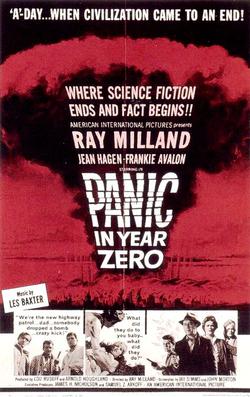
A Movie A Day #328: Panic in Year Zero! (1962, directed by Ray Milland)


The year is 1962.  Lights flash over California and the news on the radio is bad.  What everyone feared has happened.  Atomic war has broken out and the world is about to end.  Refugees clog the highways as a mushroom cloud sprouts over Los Angeles.  This is year zero, the year that humanity will either cease to exist or try to begin again.
Harry Baldwin (Ray Milland) and his family were among the lucky ones.  They were camping in the mountains when the war broke out.  Harry does not hesitate to do what he has to do to make sure that his family survives.  Harry alone understand that this is a brand new world.  When a local storekeeper refuses to allow Harry to take any goods back to his family, Harry takes them by force.  While his wife (Jean Hagen) worries about whether or not her mother has survived in Los Angeles, Harry’s teenage son and daughter (Frankie Avalon and Mary Mitchel) try to adjust to the harshness of their new situation.  Harry may now run his family like a dictator but his instincts are proven correct when the Baldwins find themselves being hunted by three murderous, wannabe gangsters (Richard Bakalyan, Rex Holman, and Neil Nephew).  This is year zero.

As both a director and an actor, Ray Milland does a good job of showing what would be necessary for a family to survive in the wake of a nuclear apocalypse.  Milland doesn’t shy away from showing Harry as being harsh and violent but he also makes a good case that Harry has no other choice.  Everyone who tries to hold on to their humanity is either killed or sold into slavery.  What sets Panic In Year Zero! apart from so many of the other nuclear war films that came out in the 60s is that, instead of focusing on an anti-war message or calling for disarmament, Panic In Year Zero! seems to argue that end of the world is inevitable and only those who prepare ahead of time are going to survive.  Get a gun and make sure you know how to use it before it is too late to learn, the movie seems to be saying.  That the movie is probably correct in its pessimistic view of humanity makes it all the more powerful.  Panic in Year Zero! is a little-known but gritty and effective film about the end of the world


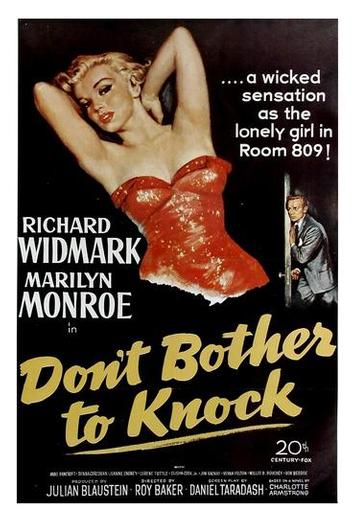
Lisa Cleans Out Her DVR: Don’t Bother To Knock (dir by Roy Ward Baker)


(I am currently attempting to clean out my DVR.  I recorded the 1952 film Don’t Bother To Knock off of FXM on April 3rd.)

Welcome to the McKinley Hotel in New York City!  The McKinley is a nice place, though it’s no Grand Budapest Hotel.  Presumably, the McKinley was named after the late President William McKinley.  While I’m sure that McKinley would have appreciated the gesture, I don’t know how he would feel about all the melodrama that’s occurring behind closed doors.

For instance, there’s Lyn Lesley (Anne Bancroft, making her screen debut).  Lyn sings in the hotel bar and, though she might seem to be cynical and tough, she actually has a big heart.  In fact, she cares so much about humanity that she broke up with her longtime boyfriend, Jed Towers (Richard Widmark), because he doesn’t seem to have a heart at all.  Of course, she broke up with Jed by sending him a letter.  When Jed checks into the hotel and tracks her down in the bar, he has questions about their breakup and he wants answers that won’t require any reading.  She tells him that he’s not capable of caring about anyone so why should she waste her time on him?  Then she sings a love song because that’s her job.

As for Jed, he’s kind of a jerk in the way that most men tend to be in movies from the 1950s.  He’s an airline pilot who served overseas during World War II and spent a year living in England.  He’s tough and he’s cynical and now, he’s single.  He’s also got a room in a hotel for the night.

And then there’s Peter and Ruth Jones (Jim Backus and Lurene Tuttle), who have a function to attend in the hotel ballroom but who don’t have anyone to look after their ten year-old daughter, Bunny (Donna Corcoran).  Fortunately, the hotel’s elevator operator, Eddie (Elisha Cook, Jr.), has a niece named Nell (Marilyn Monroe).  Nell is quiet and shy and needs the money.  She’ll be more than willing to babysit!

Of course, the only problem with Nell is that she’s a little unstable.  This becomes obvious when she’s left alone with Bunny and promptly says that, if Bunny isn’t careful, something bad might happen to one of her toys.  Inside the apartment, Nell is impressed by all the pretty things owned by Ruth.  She tries on her jewelry.  She sprays her perfume in the air.  She puts on Nell’s negligee and looks at herself in the mirror.  Eddie is not amused when he discovers what Nell’s been doing.  If she wants all of this stuff, he tells her, she needs to marry someone rich.  That’s not bad advice but the only problem is that Nell is currently single.  She’s been single ever since her boyfriend died in a plane crash.  In fact, Nell was so upset by his death that she even tried to commit suicide afterward.

From his room, Jed has a direct view of Nell trying on Ruth’s clothes.  When he and Nell spot each other, Nell invites him over.  She tells Jed that she’s a guest at the hotel and that Bunny is her daughter.  Jed can immediately tell that there’s something strange about Nell.  Nell, meanwhile, thinks that Jed is her dead boyfriend.  Meanwhile, Bunny is helpless in her room…

Clocking in at a brisk 72 minutes, Don’t Bother To Knock feels less like a movie and more like a one-act play or maybe even an adaptation of an old television production.  (After watching the movie, I was shocked to discover that it was based on neither.)  Seen today, it’s mostly memorable for featuring Marilyn Monroe’s first true starring role.  After appearing in small roles in several films (including All About Eve), Don’t Bother To Knock was not only Marilyn’s shot at stardom but also her first dramatic performance.  Reportedly basing her performance on her troubled mother, Marilyn is sympathetic and almost painfully vulnerable.  Her scenes with Elisha Cook, Jr. are especially charged, full of a subtext that will probably be easier for modern audiences to spot than it was for audiences in 1952.  Marilyn gave an incredibly poignant performance and she is the main reason to watch Don’t Bother To Knock.

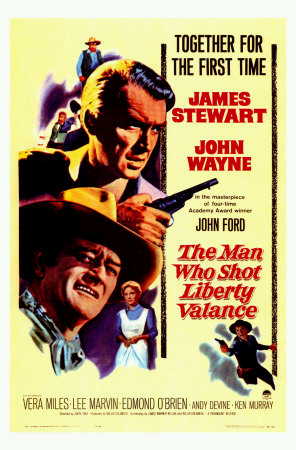
Shattered Politics #18: The Man Who Shot Liberty Valance (dir by John Ford)


The_Man_Who_Shot_Liberty_Valance“When the legend become fact, print the legend.” — Maxwell Scott (Carleton Young) in The Man Who Shot Liberty Valance (1962)

Though I understand and respect their importance in the history of both American and Italian cinema, I have never really been a huge fan of westerns.  Maybe its all the testosterone (“A man’s got to do what a man’s got to do…”) or maybe it’s all the dust but westerns have just never really been my thing.

However, I will always make an exception for The Man Who Shot Liberty Valance, which is not just a great western but a great film period.

But you already knew that.  It’s a little bit intimidating to review a film that everyone already knows is great.  I even opened this review with the exact same quote that everyone uses to open their reviews of The Man Who Shot Liberty Valance.  To a certain extent, I feel like I should have found a quote that everyone hasn’t already heard a thousand times but then again, it’s a great quote from a great film and sometimes, there’s nothing wrong with agreeing with the critical consensus.

The Man Who Shot Liberty Valance opens with a train stopping in the small western town of Shinbone.  The residents of the town — including newspaper editor Maxwell Scott (Carleton Young) — are shocked when Sen. Rance Stoddard (James Stewart) and his wife Hallie (Vera Miles) get off the train.  Sen. Stoddard is considered to be a front-runner to become the next Vice President of the United States.  Scott is even more shocked to discover why the Stoddards are in town.  They’ve come to Shinbone to attend the funeral of an obscure rancher named Tom Doniphon (played, in flashback, by John Wayne).

Sitting in the funeral home with Doniphon’s coffin (and having reprimanded the local mortician for attempting to steal Tom’s boots), Rance tells Scott why he’s come to pay respect to Tom Doniphon.  We see, in flashback, how Rance first came to Shinbone 25 years ago, an idealistic lawyer who — unlike most of the men in the west — refused to carry a gun.  We see how Rance was robbed and assaulted by local outlaw Liberty Valance (a wonderfully intimidating and bullying Lee Marvin), we discover how Rance first met Hallie while working as a dishwasher and how he eventually taught her how to read, and we also see how he first met Tom Doniphon, the only man in town strong enough to intimidate Liberty Valance.

At first, Rance and Doniphon had an uneasy friendship, epitomized by the condescending way Doniphon would call Rance “pilgrim.”  Doniphon was in love with Hallie and, when he attempted to teach Rance how to defend himself, he was largely did so for Hallie.  Rance, meanwhile, was determined to bring law and society to the west.

And, eventually, Rance did just that.  When Shinbone elected two delegates to the statehood convention in the territory’s capitol, Rance attempted to nominate Doniphon for the position but Doniphon refused it and nominated Rance instead, explaining that Rance understood “the law.”  When Liberty Valance attempted to claim the other delegate spot, Rance and Doniphon worked together to make sure that it instead went to newspaper editor Dutton Peabody (Edmond O’Brien).  And when Liberty Valance attempted to gun Rance down in the street, Rance shot him.

Or did he?

That’s the question that’s at the heart of The Man Who Shot Liberty Valance.  However, as a film, The Man Who Shot Liberty Valance is far less interested in gunfights than it is in politics.  Perhaps the most important scene in the film is not when Rance and Liberty meet out on that dark street.  Instead, it’s the scene at the statehood convention where the reformers (represented by Rance) and the cattlemen (represented by John Carradine) battle over who will be the territory’s delegate to Washington.  Between John Carradine orating, the horses riding in and out of the hall, Edmond O’Brien drinking, James Stewart looking humble, and John Wayne glowering in the background, this is one of the best political scenes ever put on film.

When Rance first arrives in the west, there is no political system in place.  With the exception of the ineffectual town marshal (Andy Devine), there is no law.  The peace is kept by men like Tom Doniphon and, oddly enough, by Liberty Valance as well.  (Whether he realizes it or not, Shinbone’s fear of Liberty has caused the town to form into a community.)  What little official law there is doesn’t matter because the majority of the Shinbone’s citizens can’t read.

When Rance arrives, he brings both education and the law.  He makes Shinbone into a town that no longer needs Liberty Valance but, at the same time, it no longer need Tom Doniphon either.  Hence, it’s Rance Stoddard who goes from dishwasher to U.S. Senator while Tom Doniphon dies forgotten.  Rance represents progress and unfortunately, progress often means losing the good along with the bad things of the past.

(It’s no coincidence that when Rance and Hallie return to Shinbone, the first person that they see is the former town marshal, who no longer wears a star and who, we’re told, hasn’t for years.  Time has passed by.)

It’s a bittersweet and beautiful film, one that features four great performances from Stewart, Wayne, Marvin, and Vera Miles.  Personally, I like to think that maybe Sen. Stoddard had a daughter who married a man named Smith and maybe they had a son named Jefferson who later made his way to the Senate as well.

It would be fitting.

Shattered Politics #14: The Last Hurrah (dir by John Ford)


Last_Hurrah

Down here in Dallas, we have a county commissioner named John Wiley Price.  Even if you don’t live in Texas, you might have heard about him.  A few years ago, Price stormed out of a commissioners meeting while shouting, “All of you are white!  Go the Hell!”  It was a popular YouTube video for a while and attracted all of the usual type of comments that you see online.  It even made the national news.

Nobody down here in Dallas was surprised by Price’s outburst.  To us, that was just John Wiley being John Wiley.  For that matter, nobody was particularly surprised when it was reported that he was being investigated by the FBI.  Everyone always took it for granted that John Wiley Price was taking bribes and receiving kickbacks.  That’s just the way that things are done down here in Dallas, by politicians both white and black.  (Of course, most of the white politicians who do it don’t get publicly investigated by the FBI.)

Now, if you ask the majority of people in Dallas county what they think about John Wiley Price and they’ll probably say something negative.  I’ll admit that I would probably be among them.  But the thing is — John Wiley Price’s constituents love him.  John Wiley Price was first elected to the commissioner’s court before I was even born and, as long as he’s on the ballot, he will be reelected.  Even if Price is convicted on corruption charges, he will still be reelected.

I can still remember the night that it was announced that John Wiley Price was on the verge of being arrested by the FBI.  All across his district, emergency meetings were held in churches and ministers stood behind the pulpit and, while the TV cameras rolled, they called upon everyone to pray for John Wiley Price.  In Price’s district, he’s known as “our man downtown,” the idea being that John Wiley Price is standing up to the rich and white Dallas establishment and, if he makes some money for himself in the process, so be it.  As long as he’s doing right for the people who elected him, who cares how he does it?

And, as much as we may want to judge the John Wiley Prices of the world, the fact that of the matter is that he’s a part of a long American political tradition.  That political tradition is also the driving force behind today’s final entry in Shattered Politics.

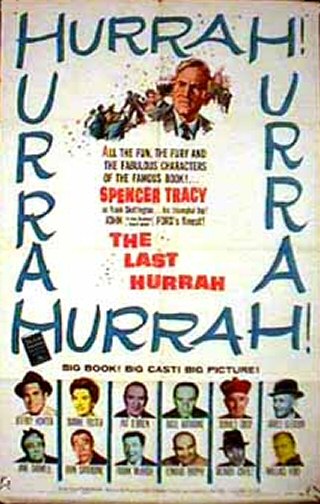
First released in 1958 and directed by John Ford, The Last Hurrah tells the story of Frank Skeffington (Spencer Tracy), the mayor of an unnamed city in New England that’s obviously meant to be Boston.  Skeffington is the flamboyant head of a large and powerful (but, as the film makes clear, aging) Irish-American political machine.  He’s preparing to run for his fifth term for mayor, a campaign that he says will be his last.

Whether Frank Skeffington is a good mayor or not depends on who you ask.  The poor and the disenfranchised love him.  Skeffington, after all, is the son of Irish immigrants.  He was born poor.  His mother worked as a maid and was even fired by a member of the wealthy and influential Force family.  They know that Skeffington has had to cut corners and that he’s gone out of his way to reward his cronies but they also know that Skeffington is on their side.  Though the phrase is never used in the film, Skeffington is “their man downtown.”

Meanwhile, the wealthy and the upper class see Frank Skeffington as being a crook, a man who has run a corrupt administration and who uses class warfare to keep the city divided against itself and to make himself and his cronies rich.  Newspaper editor Amos Force (John Carradine) has thrown his considerable influence between Skeffington’s opponent, a wealthy but dull man named Kevin McCluskey.

Reporter Adam Caulfield (Jeffrey Hunter) is in an interesting position.  On the one hand, he is Skeffington’s nephew.  On the other hand, as a journalist, he works for Amos Force.  Skeffington invites Adam to follow and record his final campaign for posterity.

It’s interesting to compare The Last Hurrah to films like The Boss or All The King’s Men.  Whereas those two films came down squarely on the sides of the reformers, The Last Hurrah is firmly on the side of Frank Skeffington.  It presents Skeffington as being a sentimental figure, the type of old-fashioned, populist politician who won office by going out and meeting the people face-to-face and personally giving them a reason to vote for him.  As Skeffington himself points out, he’s the type of politician that will soon be made obsolete by television and modern campaigning.

And it’s impossible not to enjoy The Last Hurrah‘s refusal to pass judgment on its lead character.  It helps, of course, that Spencer Tracy plays Skeffington with a twinkle in his eye while all of his opponents are played by villainous and aristocratic character actors like John Carradine and Basil Rathbone.  Yes, the film says, Skeffington may have been corrupt but at least he wasn’t boring!

Finally, I enjoyed the film because all of the “good” guys were Irish Catholic and all of the bad guys most definitely were not.

So, with that last hurrah, we conclude Shattered Politics for today.  We’ll be back tomorrow, when we’ll start to get into the 1960s.

Sláinte!