Retro Television Reviews: The Day The Earth Moved (dir by Robert Michael Lewis)


Welcome to Retro Television Reviews, a feature where we review some of our favorite and least favorite shows of the past!  On Sundays, I will be reviewing the made-for-television movies that used to be a primetime mainstay.  Today’s film is 1974’s The Day The Earth Moved!  It  can be viewed on YouTube!
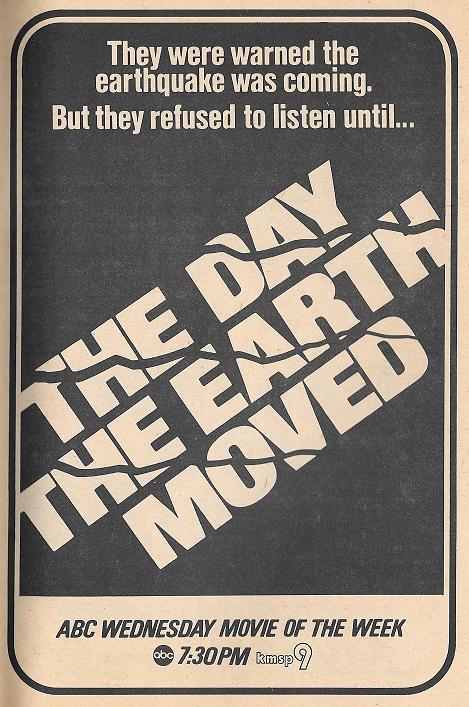
Sitting in the middle of the Nevada desert, there’s a town called Bates.

Bates was once a thriving community but the years and the hot Nevada winds have not been kind to it.  Now, it consists of only a  few buildings and a speed trap.  Judge Tom Backsler (William Windom) is the most powerful man in this tiny community and he’s determined to return Bates to its former glory.  His plan is to open up a Christmas park and to remake Bates as “Santa Claus’s home away from the North Pole.”  In order to raise the money for that project, he and the police run an aggressive speed trap.  When pilot and photographer Steve Barker (Jackie Cooper) is caught in the speed trap, it turns out that he doesn’t have enough money to pay his fine.  So, his car is impounded and he’s put to work, sweeping up the dust and helping to get the Christmas park ready to open.

With the help of friendly little townsgirl, Steve is finally able to escape from Bates and return to his job.  He works with his wife, Kate (Stella Stevens), and his best friend, Harley (Cleavon Little), as surveyors.  When someone wants to buy a stretch of the Nevada desert, Steve and Harley fly over the land and take pictures.  Looking over the latest batch of pictures, Steve deduces that not only is there going to be an earthquake but it’s going to destroy the town of Bates!  Can Steve return to the town that once held him prisoner and convince the townspeople to leave with him before disaster hits!?

In many ways, The Day The Earth Moved is a standard made-for-TV disaster flick.  Only Steve and Kate realize what’s about to happen and they struggle to get anyone else to believe them.  Indeed, it seems like the world is almost conspiring to keep them from warning everyone about the incoming earthquake.  The film’s story checks off all of the expected disaster movie plot points.  That said, the town of Bates itself — with its gigantic Santa Claus standing in the middle of the desert — is a nicely surreal location and the repeated shots of a deserted farm being gradually destroyed by minor tremors achieve a certain ominous grandeur.  Jackie Cooper and Stella Stevens are believable as a husband and wife who love each other despite the fact that they’re often very annoyed with each other.  To the film’s credit, William Windom’s character is not portrayed as being a cardboard villain but instead as someone who simply wants to give his neighbors some place decent to live.  The Day The Earth Moved is predictable but well-done.

Of course, the main reason anyone will have to watch this film will be for the earthquake.  Unfortunately, this is where viewers will run into a common problem that has afflicted many made-for-TV movies.  The low-budget earthquake is just not that impressive.  For all the scenes of people yelling, it’s always pretty obvious that the camera is doing most of the shaking.  But you know what?  It’s a made-for-TV movie from 1974.  Cut it some slack and just go with it.

Horror on TV: Ghost Story 1.5 “The Summer House” (dir by Leo Penn)


On tonight’s episode of Ghost Story, Carolyn Jones and Steve Forrest play a couple who spend their summers in a vacation home that appears to be haunted as well.  This was one of Carolyn Jones’s final roles.

This episode originally aired on October 13th, 1972.  Director Leo Penn is perhaps best known as the father of actors Sean and Chris Penn.

Space Rage (1985, directed by Conrad E. Palmisano)


Space Rage is a mix of science fiction and the old west.

In what the movie insists is the far future, a sadistic and notorious criminal named Grange (Michael Pare) is a captured after robbing the Bank of the Moon. As his punishment, he’s sent to a prison planet called Botany Bay. Despite the name, the entire prison is a desert. (Maybe they named it after the doomed colony from Star Trek II: The Wrath of Khan.) The prison is run by Gov. Tovah (William Windom), who uses the prisoners as slave labor in his mines. Grange doesn’t want to work as a miner so he plots his escape. There’s only one shuttle that goes from Botany Bay to Earth and Grange plans to be in control of it.

Two men are determined to stop Grange and his partners from escaping the planet. Walker (John Laughlin) is a young bounty hunter who is haunted by he death of his wife. The Colonel (Richard Farnsworth) is a former policeman who is haunted by nightmares of his time on Earth. Working together, the inexperienced Walker and the crusty, old Colonel try to thwart Grange’s plans.  Grange has an itchy trigger finger and is willing to kill anyone to get what he wants.  Grange may be quick on the draw but the Colonel might be even quicker.

Space Rage starts out as a western before becoming a prison film before then concluding as a Mad Max rip-off, with everyone chasing each other through the desert in intergalactic dune buggies.  The movie is only 75 minutes long but due to a repetitive soundtrack and some less than inspired dialogue, it often feels longer. The Botany Bay is too obviously Southern California to be an effective setting and neither Michael Pare nor John Laughlin seem to be invested in their roles. Not surprisingly, the film’s greatest strength is Richard Farnsworth, playing another no-nonsense veteran tough guy and doing what a man has to do to keep Earth safe.  His presence alone does not make Space Rage worth watching but it definitely helps.  It’s a good thing he was out there looking out for us.

TV Review: Night Gallery 1.6 “They’re Tearing Down Tim Riley’s Bar/The Last Laurel)


The first season of Night Gallery came to a conclusion on January 20th, 1971.  Though the first season was undoubtedly uneven, it did end on a high point.  The first segment in the 6th episode, They’re Tearing Down Tim Riley’s Bar, is widely considered to be the best episode of Night Gallery and one of Rod Serling’s best teleplays.  It also brought Night Gallery one of it’s few Emmy nominations when it was nominated for Outstanding Single Program of the year.  (It lost to The Andersonville Trial, a theatrical adaptation that was produced for PBS.)

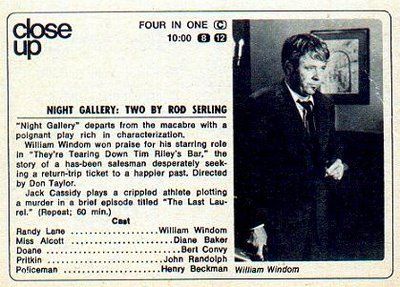
They’re Tearing Down Tim Riley’s Bar (dir by Don Taylor, written by Rod Serling)

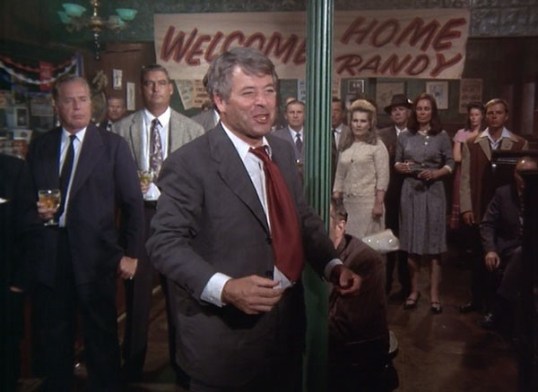
They’re Tearing Down Tim Riley’s Bar tells the story of Randy Lane (William Windom).  In 1945, Sgt. Randy Lane returned home from serving in World War II, a war hero who had a wonderful future ahead of him.  He had just gotten married.  He had just gotten a good job at an up-and-coming company called Pritzker Plastics.  When he came home, the first place he went was Tim Riley’s Bar, where his father and the other bar patrons toasted him and told him to look forward to the future.

Twenty-five years later, the middle-aged Randy Lane is looking at his life and asking, “Is this as good as it gets?”  He’s now a sales director at Pritzker Plastics but his boss (John Randolph) doesn’t appreciate him, his assistant (Bert Convy) is plotting to steal his job, and the only person who seems to care about him is his sympathetic secretary (Diane Baker).  Randy’s wife died in 1952, while Randy was out of a sales call.  Randy now lives alone.  Even his neighborhood bar — Tim Riley’s Bar — has closed and been abandoned.  With the bar schedule to be torn down, Randy wonder what happened to all of the promise and happiness of the past.

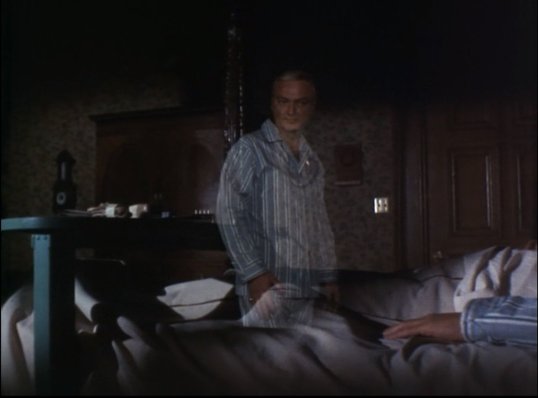
When Randy goes by the deserted bar and looks through the front window, he’s shocked to see all of his old friends and his father waving at him.  But when Randy rushes into the bar to join them, he discovers the bar is deserted.  Later, Randy is at work when suddenly, he sees Pritzker Plastics the way it was back in 1948.  Even later, when he enters his house, he finds himself standing in a hospital hallway in 1952, once again getting the news that his wife has died.

In many ways, They’re Tearing Down Tim Riley’s Bar is an atypical Night Gallery segment.  Though there are hints of the supernatural throughout the story, it’s hardly a work of horror.  Instead, it’s a rather melancholy meditation on aging, disappointment, and regret.  Is the past forever lost?  Can things ever be as good as they once were?  These are the questions that are raised in this well-directed and well-acted segment.

The Last Laurel (dir by Daryl Duke, written by Rod Serling)

Clocking in at 8 minutes, The Last Laurel is yet another segment about a bitter man (in this case, Jack Cassidy) who suspects that his wife (in the case, Martine Beswick) is cheating on him with his doctor (in this case, Martin E. Brooks) so he teaches himself a supernatural skill in order to get revenge.  In this case, it involves astral projection.  Not surprisingly, it ends with a twist that’s pretty much dependent on one of the characters doing something extremely stupid.

The Last Laurel is well-acted but predictable.  It’s not bad but, especially when compared to something like They’re Tearing Down Tim Riley’s Bar, it feels rather insubstantial.  It feels like filler.

The first season of Night Gallery came to an end with an excellent episode.  Starting tomorrow — season 2!

Previous Night Gallery Reviews:

  1. The Pilot
  2. The Dead Man/The Housekeeper
  3. Room With A View/The Little Black Bag/The Nature of the Enemy
  4. The House/Certain Shadows on the Wall
  5. Make Me Laugh/Clean Kills And Other Trophies
  6. Pamela’s Voice/Lone Survivor/The Doll

Everyone’s Crazy: Committed (1991, directed by William A. Levey)


After her lover and employer commits suicide, nurse Susan Manning (Jennifer O’Neill) needs a new job so she applies at an experimental mental hospital that is known as the Institute.  The director of the Institute, Dr. Magnus Quilly (William Windom), explains to her that he cures his patients by allowing them to live out their fantasies in a controlled environment.  He asks Susan is she’s prepared to “commit” herself to being a nurse.  Susan says that she is and signs the papers that Dr. Quilly hands to her.

Too late, Susan discovers that Dr. Quilly didn’t hand her an employment contract.  Instead, Susan has just signed her own commitment papers and is now a patient at the Institute!  Dr. Quilly tells her that, as he does with all of his patients, he will allow her to live out her fantasy of being a nurse.  After discovering than an electrified fence makes it impossible to escape, Susan starts working as a nurse but she soon discovers that she is not the first person to be tricked into working at the Institute and that almost all of her predecessors died under mysterious circumstances.

Committed is one of many films about what happens when the lunatics literally take over the asylum.  (This is a plot that was first used by Edgar Allan Poe in The System of Dr. Tarr and Professor Fether.)  The film is hurt by its low-budget but veteran B-movie director William A. Levey does a good job playing up the claustrophobia of being trapped in one location and Committed features eccentric performances from actors like Robert Forster, Ron Pallilo, and Sidney Lassick.  Committed asks, “Who is actually sane in an insane world?” and answers, “Everyone’s crazy!”

The best thing about Committed is that it stars Jennifer O’Neill, a beautiful model-turned-actress who found brief stardom when she appeared as the war bride in Summer of ’42.  Though O’Neill’s career never lived up to the promise of her first film, she was a better-than-average actress and she’s pretty good in Committed.  Both she and the film keep it deliberately ambiguous about whether or not Susan is really a nurse or if her whole backstory is just something that she’s fantasized.

Committed is a well-made B-movie from the golden age of straight-to-video thrillers and late night HBO premieres.  Despite a low-budget, this movie shows the good work that a cast and a director can do when they’re fully committed.

Horror on TV: The Twilight Zone 3.14 “Five Characters In Search Of An Exit”


TheTwilightZoneLogo


Tonight’s episode of The Twilight Zone is another one of those existential stories of dread that I love so much. An army officer wakes up to find himself trapped in a cylindrical room. He has no idea how he got in there. He can’t even remember his name. All he knows is that 1) there doesn’t appear to any way out and 2) he’s trapped with four others; a hobo, a clown, a bagpiper, and a ballet dancer.


The officer wants to escape but, as his fellow prisoners explain to him, existence is pain.


This episode originally aired on December 22nd, 1961.


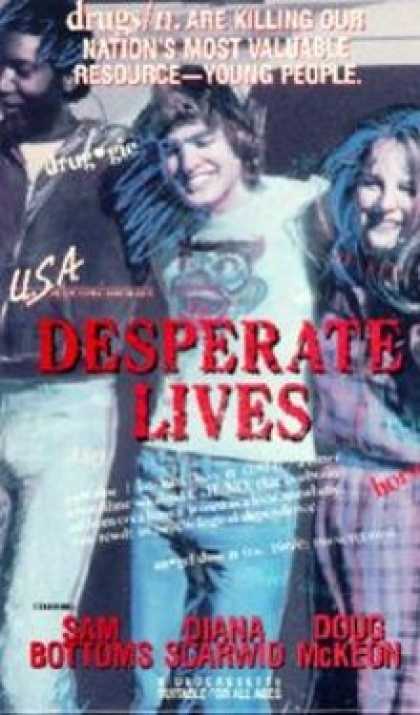
Embracing the Melodrama Part II #66: Desperate Lives (dir by Robert Michael Lewis)


DL-cov2YouTube, my old friend, you have failed me.

For the longest time, the 1982 anti-drug melodrama Desperate Lives has been available for viewing on YouTube.  I first watched it two years ago, after I read an online article about a scene in which a teenage Helen Hunt takes PCP and jumps through a window.  And, when I watched it, I was stunned.  I knew that the film was going to be over-the-top and silly, largely because it’s hard to imagine how a film featuring a teenage Helen Hunt taking PCP could be anything other than that.  But, even with my experience of watching over the top message movies, nothing could have quite prepared me for Desperate Lives.

So, I figured, for this review, that I’d say a few snarky words about Desperate Lives and then I’d just add something like, “And you can watch it below!”  And then I would embed the entire movie and all of y’all could just click on play and watch a movie on the Lens.

Unfortunately, Desperate Lives has been taken off of YouTube.  I assume the upload violated some sort of copyright thing.  And really, it’s kinda stupid because seriously, Desperate Lives is one of those films that really deserves to be seen for free on YouTube.

Oh well.  You can still watch a video of Helen Hunt jumping through that window.  The video below also features some additional elements from Desperate Lives.

For instance, you get to see Diana Scarwid playing the angriest high school guidance counselor in the world.  Scarwid knows that students like Helen Hunt are using drugs and that her fellow faculty members are turning a blind eye to everything’s that’s happening.  From the minute she first appears on screen, Scarwid is shouting at someone and she doesn’t stop screaming until the film ends.

And you also get to see Doug McKeon, playing Helen Hunt’s brother.  McKeon goes for a drive with his girlfriend, who has just taken PCP herself.  As their car goes flying off a mountain, she says, “Wheeee!”

In the video below, you also get to see that the only reason Helen Hunt used drugs was because her boyfriend begged her to.  That’s a scenario that seems to show up in a lot of high school drug films and it’s strange because it’s something that I’ve never actually seen happen or heard about happening in real life.  In fact, in real life, most users of hard drugs are actually very happy to not share their supply.

Unfortunately, the video below does not feature any scenes of Sam Bottoms as the world’s most charming drug dealer and that’s a shame because he gives the only good performance in the entire film (sorry, Helen!).

Even worse, the video doesn’t include any scenes from the film’s memorably insane conclusion, in which Scarwid searches every single locker in the school and then interrupts a pep rally so she can set everyone’s stash on fire in the middle of the gym.  Making it even better is that all the students are so moved by Scarwid’s final speech that they start tossing all of the drugs that they have on them into the fire.

Which means that the film essentially ends with the entire school getting high off of a huge marijuana bonfire.

No, that scene cannot be found in the video below.  But you can find Helen Hunt jumping through a window so enjoy.

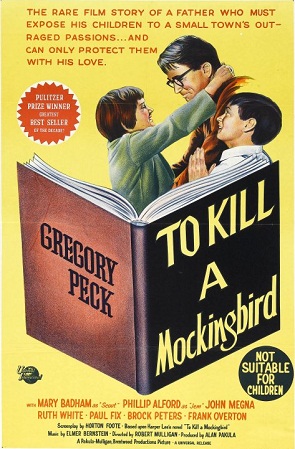
Shattered Politics #19: To Kill A Mockingbird (dir by Robert Mulligan)


To_Kill_a_Mockingbird_poster

So, I guess I should explain why I’m including the classic 1962 film (and best picture nominee), To Kill A Mockingbird, in this series of reviews of films about politicians.  After all, while To Kill A Mockingbird dealt with the issue of racism in Alabama in a surprisingly honest manner, it doesn’t feature any elected officials.  Nobody shows up playing Gov. Benjamin J. Miller or President Franklin Roosevelt.  Instead, this film is about a wise lawyer named Atticus (Gregory Peck), an innocent man named Tom (Brock Peters), a girl named Scout (Mary Badham) and her older brother Jem (Philip Alford), and a mysterious recluse named Boo (Robert Duvall).

However, if you’ve read Harper Lee’s wonderful novel, then you know that Atticus is not just the smartest man in Maycomb, Alabama.  He’s also a member of the Alabama state legislature and his political career is a fairly important subplot in the book, with him occasionally having to leave home so he can go down to Montgomery and help to write the budget.  (Incidentally, Harper Lee’s father actually was a member of the Alabama House of Representatives.)

In the film, no mention of Atticus being a member of the state legislature is made but I still choose to believe that he was.  Because, as played by Gregory Peck, Atticus Finch is exactly the type of man who you would want to think of as serving in government.  He’s wise, compassionate, and firm.  For much of To Kill A Mockingbird, he is literally the only sane adult in Maycomb.  He’s the only attorney willing to defend Tom Robinson when Tom is accused of raping a white girl.  When a mob shows up to lynch Tom, Atticus is the only adult willing to stand up to them.  (Fortunately, Jem also runs up and shames the mob by reminding them that she goes to school with their children.)  And, in court, it is Atticus who proves that Tom is innocent.

When Tom is still convicted, what makes it all the more devastating is that wise and compassionate Atticus doesn’t seem to be surprised as all.  If even Atticus feels that there is no hope for a black man to get a fair trial from an all-white jury, the film seems to be saying, then there truly is no hope.

Of course, the film is not just about Atticus.  It’s about Scout and Jem and their friend Dill (John Megna) and how the three of them grow up and learn the truth about their world.  Watching them from behind the closed doors of his house is the mysterious and reclusive Boo Radley.  When Boo shows up towards the end of the film, I always find tears in my mismatched eyes.  Boo is played, in his film debut, by Robert Duvall.  Duvall doesn’t say a word but he still makes an incredible impression as the shy and withdrawn Boo.

So, I may be cheating a lot by including To Kill A Mockingbird in this series of reviews.  Oh well.  Who am I to turn down a chance to rewatch it?  To Kill A Mockingbird is just a great film.


Horror on TV: Night Gallery 2.22 “The Caterpillar/Little Girl Lost”


caterpillar1


For tonight’s televised horror, we have an episode of Night Gallery that was originally broadcast on March 1st, 1972. This episode tells two stories, one about government manipulation and then another about an earwig. The one about the earwig features a great performance from Laurence Harvey, who was dying of cancer while shooting this episode and who stopped taking his painkillers so that he could better portray his character’s suffering. Along with Harvey’s performance, The Caterpillar also features an absolutely perfect ending.


Enjoy!