First of all, I’d like to thank Kellee Pratt of Outspoken and Freckled for inviting me to participate in the 31Days of Oscar Blogathon. It’s cool to be part of the film blogging community, and even cooler because I get to write about THE FRENCH CONNECTION, a groundbreaking movie in many ways. It was the first R-Rated film to win the Academy Award for Best Picture, and scored four other golden statuettes as well. It also helped (along with the Clint Eastwood/Don Siegel DIRTY HARRY) usher in the 70’s “tough cop” genre, which in turn spawned the proliferation of all those 70’s cop shows that dominated (KOJAK, STARSKY & HUTCH, BARETTA, etc, etc).
The story follows New York City cops Jimmy “Popeye” Doyle and his partner Sonny “Cloudy” Russo as they investigate a large shipment of heroin being brought in from France. The detectives focus on Sal Boca, a small time hood…
A new feature that I thought was a nice way to introduce not just our readers, but also fellow site writers to some films we love, admire and think worthy of checking out.
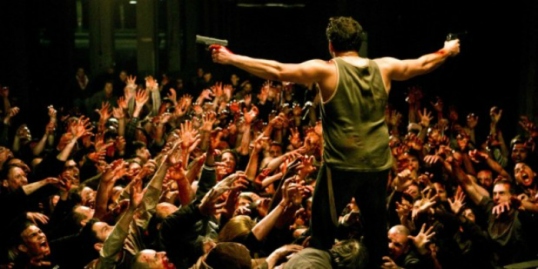
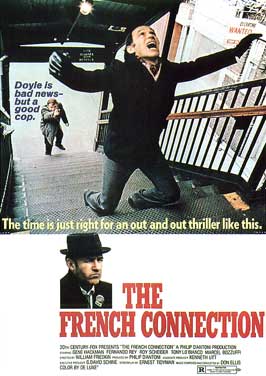
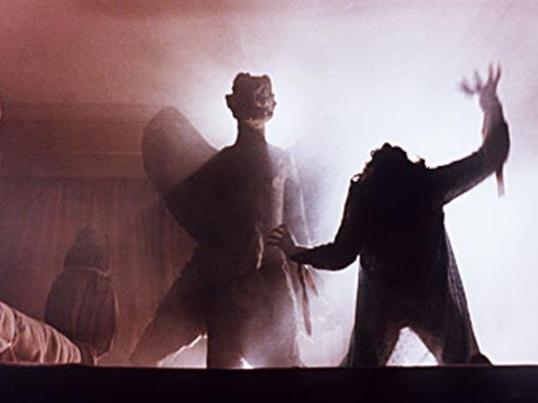
It won’t be any sort of review or recap of what the film is about, but just a simple, single shot from the film itself that the individual writer considers an worthy and interesting glimpse of the film.
To start off “4 Shots From 4 Films” here’s the first 4 shots. Moving forward it will be just 4 screenshots and the title of the film they belong to.
Earlier today, thanks to Netflix, I watched the 1971 best picture winner, The French Connection.
Based on a true incident, The French Connection is the story of two NYPD detectives, the reasonable and serious Buddy Russo (Roy Scheider) and his far more hyperactive partner, Popeye Doyle (Gene Hackman). When we first see them, Doyle is dressed as Santa Claus and they’re both chasing a drug dealer through the streets of New York. When they eventually catch up with the dealer, Russo plays good cop while Doyle plays batshit insane cop. That’s a pattern that plays out repeatedly over the course of the film. Russo suggests caution. Doyle blindly fires his gun into the shadows. Russo is sober. Doyle is frequently drunk. Russo is careful with his words. Doyle is a casual racist who never seems to stop talking. The one thing that Russo and Doyle seem to have in common is that they’re both obsessed with catching criminals.
The French Connection is also the story of Alain Charnier (Fernando Rey), a suave and always impeccably dressed French businessman. Charnier has a plan to smuggle several millions of dollars of heroin into the United States by hiding it in a car that will be driven by an unsuspecting (and rather vacuous) French actor named Henri Devereaux (Frederic de Pasquale). Working with Charnier is a low-level mafia associate named Sal Boca (Tony Lo Bianco) and a lawyer named Joel Weinstock (Harold Gray).
(Incidentally, Weinstock’s chemist is played by an actor named Patrick McDermott, who also played Susan Sarandon’s abusive hippie boyfriend in Joe. The French Connection was McDermott’s third film and also his last. I point this out because McDermott totally steals his one scene in The French Connection. When one considers both his performance here and his work in Joe, it’s strange and unfortunate that McDermott’s cinematic career ended after just three films. According to a comment left on the imdb, he later ran a health food store in Nebraska.)
When Doyle and Russo just happen to spy Sal hanging out with a group of mobsters at a local club, they decide (mostly on a whim) to investigate what Sal’s up to. They notice that Sal drives a car that he shouldn’t be able to afford. Will they discover how Sal is making his money and will they be able to stop Charnier from smuggling his heroin into the United States?
Well…let’s just say that The French Connection was made in 1971. That’s right, this is one of those films where everything is ambiguous. Neither Russo nor Doyle are traditional heroes. Neither one of them is foolish enough to believe that their actions will make a difference. Instead, they seem to view it all as a game, with Doyle and Russo as the win-at-any-cost good guys and the French as the bad guys. And, indeed, it’s interesting to note that, when the police do make their move against Charnier, it’s the people who work for him who suffer the worst punishments.
I have to admit that, as a civil libertarian, Doyle is the type of cop who should make my skin crawl. He’s an obsessive bigot, the type who runs into the shadows with his gun drawn and blindly firing. When I watched The French Connection, a part of me wanted to get offended and say, “It’s none of your business why Sal has an expensive car!” But I didn’t. In fact, I was rooting for Doyle the whole time. The French Connection is probably one of the best cast films of all time. Hackman gives such a good performance that, while you can’t overlook Doyle’s flaws, you can accept them. Meanwhile, Rey is so sleazy and smug in the role of Charnier that you really don’t care about his rights. You just want to see him taken down.
(That said, if I ever got hold of a time machine and went back to New York in 1971, I’d rather be arrested by Russo than Doyle. Doyle seems like he’d be the type to grope while frisking.)
Seen today, it’s a bit odd to think of The French Connection as being a best picture winner. It has nothing to do with the film’s quality. The film’s performances remain strong. William Friedkin’s documentary-style direction is still compelling and he makes the decay of 1970s New York oddly beautiful. Instead, it’s the fact that The French Connection essentially tells a very simple story that, when seen today, feels very familiar. It’s a cop film and it includes every single cliché that we’ve come to associate with cop films. (Russo and Doyle even have a supervisor who yells at them for not doing things by the book.) But, what you have to realize is that the majority of those clichés were invented by The French Connection. If imitation is the sincerest form of flattery, then The French Connection is probably one of the most flattered film ever made.
And what better way to end this review than by sharing The French Connection‘s most influential scene? In the scene below, Doyle chases a commuter train that happens to be carrying one of Charnier’s associates.
The previous “Song of the Day” was Polymorphia and comes courtesy of one Krzystof Penderecki. Why stop a good thing and go with someone else for the latest one when Penderecki continues to bring in the horror.
“Kanon For Orchestra and Tape” was also used in William Friedkin’s The Exorcist and one could tell just from listening to it that it fit perfectly. Like Polymorphia, this particular piece uses the string section to help create that encroaching dread and horror while adding some nontraditional sounds to keep the listener off-balance.
Just listening to this piece one could be made to believe that there is a Hell and the Devil’s just waiting to get out and play.
A couple weeks ago site music writer necromoonyeti wrote up quite an article about what just makes a piece of music a “horror music”.
Using some of what necromoonyeti wrote about I decided to look at some horror and non-horror films with music that evokes that sense of terror and horror that sometimes come from music that we wouldn’t associate with such emotions. It’s a much more difficult task than one would think. Yet, while I didn’t find one of those non-traditional pieces of horror music I did come across one that I should’ve used in this segment a long time ago.
The latest “Song of the Day” is a piece of disturbing music titled “Polymorphia” by Polish composer Krzysztof Penderecki.
This musical composition has been used in two classic horror films (some would say some of the best in their genre) to help build the sense of horror and dread for the audience. The two films in question would be William Friedkin’s The Exorcist and Stanley Kubrick’s The Shining. I know that in the former it more than added to that film’s creeping dread from the moment the song came on. It made one feel like Hell itself was about to break through the screen. It’s that sense that one’s skin was sensing something evil was afoot.
I found a particular youtube video that used this song and the chosen imagery to great effect. I dare anyone to watch the video, listen to the music in a dark room and in the middle of the night while alone.
Killer Joe, the latest film from William Friedkin (who, 40 years ago, won an Oscar for directing The French Connection), is rated NC-17 for “graphic disturbing content involving violence and sexuality, and a scene of brutality.” That, more than anything, was why I wanted to see Killer Joe. I wanted to see just how extreme a film starring Matthew McConaughey could possibly be. However, I also knew that the NC-17 rating would mean that I would have to show my ID before being allowed to have my mind corrupted. See, I might be 26 years old but most people seem to assume that I’m 17. That is, until I speak. At that point, they usually realize that they’ve guessed incorrectly and decide that I’m actually 15.
Sure enough, when me and my BFF Evelyn bought our tickets to see Killer Joe earlier this week, I was asked to show my ID. Smiling my sweetest smile, I held up my driver’s license. I was expecting that the ticker seller would just glance at the ID and then say, “Thank you,” but instead, he literally appeared to be studying my picture. His eyes shifted from the license to me and back to the license. I was starting to get nervous because, after all, it’s not like I was trying to get through airport security. I just wanted to see a forbidden movie.
Behind me, I heard Evelyn say, “That looks like a fake to me.”
“Ha ha,” I cleverly replied.
Evelyn responded with, “I don’t trust her. Maybe you guys should strip search her…”
Finally, the ticket seller looked away from my driver’s license and, as he handed me my ticket, he told us that the theater’s management had instructed him to make sure that we understood that we were about to see an explicitly violent film. He also told us that there were free donuts available at the concession stand. That was nice of him.
So, after all that, I finally got to see the forbidden film Killer Joe and you know what? Killer Joe earns its NC-17 rating, not so much because it’s any more exploitive than any other mainstream film released this year but because it’s actually honest about being an exploitation film. Killer Joe may be playing in the arthouses but it’s a grindhouse film and proud of it.
Killer Joe takes place in my hometown of Dallas (though it was filmed in New Orleans) and it features perhaps the sleaziest group of losers that you’ll find on a movie screen this year. Chris (Emile Hirsch) is a drug dealer who lives with his mother and who moves, talks, and thinks with the scrambled energy of a meth addict. His father Ansel (Thomas Haden Church) is an affably stupid alcoholic who lives in a trailer park with his second wife, Sharla (Gina Gershon, who gives a ferociously good performance here) and his daughter, 16 year-old Dottie (Juno Temple). Dottie is a spacey girl who is given to sleep walking and who doesn’t appear to be quite all there. Chris is creepily overprotective of her and, though it’s never implicitly stated, it quickly becomes obvious that there’s a rather disturbing subtext to her relationship with both Chris and her father.
Chris has managed to get into debt with some local criminals but he’s got a plan. As he explains to Ansel, his mother has got a sizable life insurance policy and if she dies, the money will go to Dottie. Chris and Ansel hire a hitman to carry out the murder for them. That hitman is Joe (Matthew McConaughey, giving the performance of his career), a demonic charmer who always dresses in black and who has a day job as a homicide detective. When Chris and Ansel explain that they don’t have the money to pay him in advance, Joe agrees to take Dottie as a retainer.
Soon, Joe is living in the trailer park with Dottie, Chris is getting brutally beaten up every time he goes out in the daylight, and the murder doesn’t seem to be any closer to actually happening. When Joe finally does make his move, it all leads to a lot of very brutal violence, a series of betrayals, and a very disturbing scene involving a drumstick from Kentucky Fried Chicken. As I said before, Killer Joe earns that NC-17.
William Friedkin, who has had a rather uneven career, dives right into the film’s sordid atmosphere. The majority of the film takes place in that Hellish trailer park and Friedkin perfectly captures the feeling of a society made up of people who are trapped by their own lack of intelligence, imagination, and status. There’s been a lot of films made about white trash but Killer Joe gets it right, creating an all too believable Hell where everyone can afford to buy a pit bull but not a decent suit (or, in the case of Dottie, a bra). When the violence does come, Friedkin doesn’t shy away from showing it nor does he try to pretend that violence doesn’t have consequences. When people get hurt in Killer Joe, they stay hurt.
Matthew McConaughey is a wonder as Killer Joe. Whereas many actors would tend to go overboard with such a psychotic character (and you’d be justified in expecting McConaughey to go overboard as well), McConaughey is actually rather restrained for most of the film. The power of his performance comes from the fact that, while everyone else is going crazy, McConaughey is subdued and steady. It’s only when he speaks to Dottie that we get a few clues of just what exactly it is that lurks beneath Killer Joe’s coolly professional manner. It’s only towards the end of the film that McConaughey allows his performance to get a bit more showy but, by that point, the entire film has gone to such an extreme that Joe still seems almost sensible.
Killer Joe, however, is not a perfect film. Though the film is set in North Texas (and, in fact, the Texas-setting is pretty important to the film’s overall plot), it was filmed in Louisiana. Speaking as someone who has lived in both of those fine states, trust me when I say that, visually, there’s a huge visual difference between Texas and Louisiana. (Evelyn and I shared a laugh when we spotted Palm Trees in the film’s version of Dallas.)
While the clumsy use of Louisiana as a stand-in for Texas probably won’t be noticeable to anyone outside of the Southwest, a far more noticeable problem with Killer Joe is that the film is based on a stage play and, despite some efforts to open up the action, the film still basically feels rather stagey. This is the type of movie where people tend to deliver semi-poetic monologues about their childhood at the drop of a (cowboy) hat. To a certain extent, the staginess made it easier to handle the film’s violence (and perhaps that was Friedkin’s intention) but, at other times, it just caused the action to drag.
Ultimately, Killer Joe is a film that I would recommend with reservations. It’s definitely not for everyone and I don’t know that it’s a film that I’ll ever want to sit through again (seriously, I’ll be surprised if I ever manage to eat another drumstick) but it is a movie worth seeing. If nothing else, it’s the closest were going to get to a true grindhouse film this year.
When I first read Arleigh’s idea that we devote October to reviewing horror films, I knew immediately that there was no way I could let the month pass without saying a few words about one of the true classics of the horror genre, the 1973 best picture nominee The Exorcist.
Based on an equally scary novel by William Peter Blatty and directed by William Friedkin, The Exorcist is one of those films that has become so iconic that even people who have never seen it know what the movie is about. Chris McNeil (Ellen Burstyn) is an agnostic actress who is shooting a film about student protestors on a college campus. Her 12 year-old daughter, Regan (played by the future Grindhouse queen Linda Blair), spends her time playing with a Ouija Board and talking to her friend “Capt. Howdy.” Unfortunately, Capt. Howdy is actually a Sumerian demon who proceeds to posses Regan. Soon, Regan is levitating, cursing, and masturbating with a crucifix. After trying (and failing with) all the conventional methods of treatment, Chris desperately turns to the God she doesn’t believe in and tries to convince a troubled priest (Jason Miller) to perform an exorcism on Regan. Unfortunately, this priest has begun to question his faith and he fears that he might not be strong enough to “cure” Regan. An elderly priest (Max Von Sydow) is called in to help with the exorcism and, faster than you can say, “The power of Christ compels you,” the two priests are locked in mortal combat for Regan’s soul.
The ultimate test of any horror films is whether or not it’s still unsettling even after you already know what’s going to happen and when all the evil is going to come jumping out of the shadows. In short, the test is whether or not the film holds up to repeat viewings. This is a test that The Exorcist easily passes. I’ve seen this film enough times that I now know exactly when Linda Blair’s head is going to do that 360 degree turn and I now know exactly when to divert my eyes so I don’t have to see possessed Regan puking on the priests. (For all the terrible physical manifestations of Regan’s possessions, it’s always the vomiting that gets to me.) Most of the film’s “shock” sequences aren’t that scary any more because we’ve all seen far worse. However, watching this film remains, for me, a truly unsettling experience. This is due largely to director William Friedkin. Today’s aspiring filmmakers could learn a lot from Friedkin because, for all the attention the film’s grotesque effects received, Friedkin actually devotes more time to setting up the situation and establishing a palpable atmosphere of doom. This is a film full of grainy, almost gray images, the perfect visual suggestion of a world that has perhaps been abandoned by its God. It takes more than an hour before Ellen Burstyn meets Jason Miller and Max Von Sydow doesn’t show up until the final 30 minutes of the film. At first, it seems as if the movie itself is moving slowly but, by the end of it, you realize that what Friedkin has done is that he’s sucked us into the reality of his film. For all the special effects and metaphysical concerns, The Exorcist almost feels like a documentary. He’s also helped by a talented cast that makes the situation feel real, regardless of how extreme things may get. I’ve read that a lot of people decided they needed to be exorcised after seeing this film and I can understand why.
The Exorcist is a film that benefits from debate and it’s also one that is open to multiple interpretations. Quite a few critics have argued that the Exorcist is actually a very reactionary film in that Regan’s possession can be seen as a metaphor for adolescent rebellion and her exorcism is actually more about the establishment regaining control than any attempt to save her eternal soul. I actually think this interpretation is pretty much spot on correct though I also don’t think the filmmakers were intentionally trying to deliver that message. Instead, I think that the Exorcist — like all great films — is simply filled with the subtext of its time. While the filmmakers may have unintentionally created a document of then-contemporary fears, I think the film is even more interesting as an argument about the origin of sin and evil.
Ultimately, for a horror film to be truly timeless, it has to do more than just scare you. The supernatural and/or otherworldly forces have to serve as more than just a cinematic threat; they have to stand-in for our own universal fears and concerns. The Exorcist attempts to answer one of the most basic questions: why is there evil in the world and why do people sometimes behave in such terrible ways? For all of the film’s notoriety, the answers it provides are surprisingly simple. Evil is because of the devil and people behave the way they do because they’re not individually strong enough to resist the lure of sin. The only way to defeat the world’s demons is through sacrifice, suffering, and martyrdom. You don’t have to come from a Catholic background to “get” the Exorcist but it helps. (To be honest, it probably helps even more to be a “fallen” Catholic like me because wow, this movie really knows how to exploit all that lingering guilt.) Thanks to this film, it sometimes seems the only time that priests (and Catholicism in general) are portrayed positively in the movies is when they’re exorcising someone (which, contrary to popular belief, doesn’t really happen all that much). Fortunately, you don’t have to agree with the answers provided by the Exorcist in order to find both the questions and the film itself to be intriguing.



 Through the Shattered Lens