Retro Television Review: St. Elsewhere 1.1 “Pilot”


Welcome to Retro Television Reviews, a new feature where we review some of our favorite and least favorite shows of the past! On Fridays, I will be reviewing St. Elsewhere, a medical show which ran on NBC from 1982 to 1988.  The show can be found on Hulu!
When I started reviewing Homicide, Jeff suggested that I should also review St. Elsewhere because the two shows shared a similar sensibility and a lot of behind-the-scenes personnel.  (Homicide showrunner Tom Fontana started out as a writer on St. Elsewhere.)  Apparently. a few characters from St. Elsewhere would eventually cross-over to Homicide.  Since I’m planning on soon reviewing two shows that were descended from HomicideOz and The Wire — it only seemed right to also review a show that was Homicide’s ancestor.

Though the show aired largely before my time, St. Elsewhere is definitely a show that I have heard about.  Everyone who follows American pop culture has either read about or seen the show’s infamous final episode and knows about the Tommy Westphall Universe Hypothesis.  Obviously, I can’t get into it now because that would be a spoiler but we’ll discuss it when the time comes!

For now, let’s start at the beginning, with the pilot!

Episode 1.1 “Pilot”

(Dir by Thomas Carter, originally aired on October 26th, 1982)

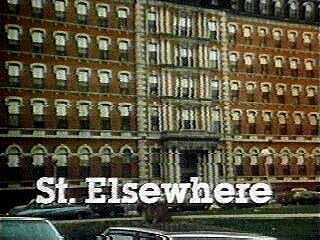
St. Eligius is a hospital in Boston that has obviously seen better days.  From the outside, it looks old.  On the inside, the hallways have the dim and dull look of a building that hasn’t been renovated in over ten years.  As Dr. Mark Craig (William Daniels, long before he played Mr. Feeney on Boy Meets World) angrily puts it, the hospital gets no respect in Boston.  It’s seen as being a “dumping ground” for patients who can’t afford anything better.  Dr. Craig is world-renowned heart surgeon whose wealthy patients have donated what few improvements the hospital has seen over the past few years.  (“All of our clocks now read the same time!” Dr. Craig brags at one point.)  But not even Dr. Craig can change the hospital’s reputation as being secondary to Boston General.

There are actually a few good things about St. Eligius.  For one thing, a young Denzel Washington is on staff, playing resident Phillip Chandler.  Denzel doesn’t get to do much in the pilot but still, his presence fills the viewer with confidence.  St. Eligius is also home to a world-renowned liver specialist, Dr. Daniel Auschlander (played by Norman Lloyd, who also worked with Hitchcock and Orson Welles).  Auschlander has liver cancer but the hospital chief-of-staff, Dr. Donald Westphall (Ed Flanders), assures everyone that Auschlander will probably “out live us all.”  (And he was right, to an extent.  Norman Lloyd lived to be 106 years old before passing away in 2021.  Ed Flanders died, tragically by suicide, in 1995.)  St. Eligius is a teaching hospital and the residents want to make a good impression by keeping their patients alive.  That’s always a good thing.

At the same time, how secure can you feel when Howie Mandel is one of the residents?  Mandel plays Dr. Wayne Fiscus, who wears a baseball cap and acts …. well, he acts a lot like Howie Mandel.  Like Washington, Mandel doesn’t do a lot in the pilot.  He does get a subplot where he apparently has sex in the morgue with goth pathologist Cathy Martin (Barbara Whinnery) but otherwise, we don’t see him treating a patient or anything like that.  Still, it’s a bit jarring to see Howie Mandel as a doctor.  I would not necessarily want him for my doctor because he’s to be easily distracted.  Maybe he’ll change my mind as the series progresses.

Speaking of sex, Dr. Ben Samuels (David Birney) has gonorrhea and spends most of the pilot approaching doctors and nurses and informing them of his conditions and suggesting that they might want to get tested themselves.  That’s not exactly the best way to be introduced to a character but it also lets us know that this show is not just going to be about dedicated doctors who spend all of their time worrying about their patients and making amazing medical discoveries.  Instead, this show is also about doctors who get venereal diseases.  Has anyone checked on Fiscus in the morgue?

(That said, Dr. Samuels does get a scene where he saves the life of a woman who was injured in a terrorist bombing, as if the show does want to make sure that we know that he can do his job, even if he is spreading VD through the hospital.)

The majority of the episode follows Dr. Jack Morrison (David Morse), a first-year resident who has been working several 24-hour shifts and who complains, at one point, that he hasn’t seen his wife for days.  Dr. Morrison gets upset when a surgeon wants to operate on one of his patients, a 15 year-old girl named Sandy (Heather McAdams).  Morrison believes that surgeons always want to cut into somebody.  Morrison gets even more upset when Sandy’s mother requests that Sandy be transferred to Boston General, which has a reputation for being a better, more modern hospital.  In fact, Morrison is so upset and exhausted that he forgets to file a death certificate for a patient who dies during the night.  As a result, it’s believed that the patient, who has a reputation for being violent, has gone missing and is stalking the hospital.  Dr. Annie Cavanero (Cynthia Sikes) spends the entire episode looking for a dead man, which at least gives her an excuse to visit every ward and introduce the viewers to the members of the show’s ensemble cast.

Having lost my mom to cancer and now my Dad to Parkinson’s, I was hesitant about reviewing St. Elsewhere.  (Actually, I was hesitant about reviewing any medical show.)  When my Dad was in the hospital, I felt like I couldn’t get anyone to give me a straight answer about his condition and I often felt the doctors were talking down to me.  To be honest, my worst conflicts were with the nurses, one of whom told me that I would have to “lose the attitude” before she would explain why my father had been moved to the Delirium Ward.  (It didn’t help that, at the same time my Dad was in the hospital, there was a huge storm that left us without power for a week.)  At the same time, there were other doctors who were helpful.  The staff at the rehab center that my dad was sent to were also wonderful.  I have my regrets about agreeing to hospice care but the nurse who was assigned to my Dad was very empathetic and totally understanding whenever I asked her for a cigarette.  (Under normal circumstances, I don’t smoke because I have asthma but seriously, the stress was killing me.)  I’m bitter and angry about a lot of what happened but I’m also thankful for the small moments of kindness.

Watching a show set in a hospital was not easy for me but the pilot of St. Elsewhere appealed to me with its mix of melodrama and humor.  There was a quirkiness to it that I appreciated.  William Daniels made me laugh with his annoyed rant about how little respect the hospital received.  Most of all, I cared about whether or not Dr. Morrison would still be alive at the end of his shift.  David Morse’s performance won me over.  He’s the type of doctor that I would want to have.  Well, actually, I’d probably want Denzel to my doctor but Dr, Morrison could assist.  Just keep Dr. Howie Mandel away from me.  Nothing against him but he seemed to be having way too much fun at the hospital….

Most importantly, the show ended with a cat.

Next week, the drama continues at St. Elsewhere!

Retro Television Reviews: Sarah T — Portrait of a Teenage Alcoholic (dir by Richard Donner)


Welcome to Retro Television Reviews, a feature where we review some of our favorite and least favorite shows of the past!  On Sundays, I will be reviewing the made-for-television movies that used to be a primetime mainstay.  Today’s film is 1975’s Sarah T — Portrait of a Teenage Alcoholic.  It  can be viewed on YouTube!

In 1975, two years after shocking audiences in and receiving an Oscar nomination for The Exorcist, Linda Blair played Sarah Travis.  Sarah is fourteen years old.  She has a high IQ.  She lives in a nice suburban home.  She has an older sister named Nancy (Laurette Sprang) and she makes a good deal of money working as a babysitter.  Sarah lives with her mother, Jean (Verna Bloom) and her stepfather, Matt (William Daniels).  She misses her father, a chronically unemployed artist named Jerry (Larry Hagman).  Jerry is the type who will complain about how no one is willing to give him a chance while he’s day drinking early in the morning.  Jerry’s an alcoholic.  That’s one of the many things that led to Jean divorcing him.  (Matt is fairly regular drinker as well but it soon becomes apparent that he can handle his liquor in a way that Jerry cannot.  Matt has a glass of Scotch after work.  Jerry has his daughter by a slushy so he can pour his beer in the cup.)  Jean is always quick to keep Sarah from drinking.  When someone offers her a drink at a party, Jean replies that Sarah only drinks ginger ale.

Of course, the name of this movie is Sarah T. — Portrait of a Teenage Alcoholic so we already know that Jean is incorrect about that.  When we first meet Sarah, she is fourteen and she’s been regularly drinking for two years.  She’s even worked out a system where she gets liquor delivered to the house and then tells the deliveryman that her mother is in the shower but she left the money for the booze on the dining room table.  Like many alcoholics, Sarah has become very good at tricking people and hiding her addiction.  Of course, Sarah doesn’t think that she’s an alcoholic but …. well, again, just check out the title of the film.

When Sarah goes to a party with Ken (Mark Hamill, two years before Star Wars), the handsome captain of the school’s swim team, she ends up having too much to drink.  Nice guy Ken not only takes her home but also takes the blame, telling Jean and Matt that he was the one who gave Sarah the alcohol.  Jean, convinced that this is the first time that Sarah has ever gotten drunk, forbids her from spending any more time with Ken.  In the morning, Jean comments that Sarah will probably have a terrible hangover and maybe that’s punishment enough.  The joke, of course, is on Jean.  Sarah doesn’t even get hangovers anymore.

Soon, Sarah’s grades start to slip and she starts to skip class so that she can drink.  Still blaming Ken for all of Sarah’s problems, Jean finally takes Sarah to a psychologist, Dr. Kitteridge (Michael Lerner).  Dr. Kitteridge announces that Sarah is an alcoholic and recommends that she start attending A.A. meetings.  Sarah does go to one meeting, in which she meets a surprisingly cheerful 12 year-old alcoholic.  However, Sarah still has a way to go and so does the movie.  I mean, we haven’t even gotten to the scene where Sarah begs a group of older boys to give her the bottle of wine that they’re clumsily tossing in the air.  By the end of the film, she’s even managed to hurt poor, loyal Ken.

Myself, I hardly ever drink.  Some of that is because, like Sarah, I’m the daughter of an alcoholic and a child of divorce and I’ve seen firsthand how difficult it can be to live with an addiction.  (My Dad has been sober for five years and I am so proud of him!)  Of course, another reason why I hardly ever drink is because my tolerance for alcohol is amazingly low.  I get drunk off one sip of beer.  Long ago, I realized my life would be a lot easier and simpler if I just didn’t drink and so I don’t.  Watching the film, I wondered if I was watching what my life would have been like if I had gone the opposite route.  Would I have ended up like Sarah T?

Probably not.  Sarah T is one of those films that was obviously made with the best of intentions but it just feels inauthentic.  A lot of that is due to the performance of Linda Blair, who often seems to be overacting and trying too hard to give an “Emmy-worthy” performance.  There’s not much depth to Blair’s performance and, as a result, the viewer never really buys into the story.  At her worse, Blair brings to mind Jessie Spano shouting, “I’m so excited!” during that episode of Saved By The Bell.  (Blair was far better served by B-movies like Savage Streets, in which she got to kick ass as a vigilante, than by films like this.)  As well, the film’s portrayal of A.A. is so cheerful, upbeat, and positive that it almost felt like a Disney version of InterventionWho are all of these happy addicts? I wondered as I watched the scene play out.

Because I’ve been a bit critical of his acting abilities in the past, I do feel the need to point out that Mark Hamill gives the best performance in this film.  He plays Ken as being a genuinely decent human being and it’s hard not to sympathize with him as he gets in over his head trying to deal with Sarah.  If Blair plays every emotion on the surface, Hamill suggests that there’s a lot going on with Ken.  Deep down, he knows that he can’t help Sarah but he still feels like he has to try.  Though Blair may be the star of the film, it’s Hamill who makes the biggest impression.

As a final note, this film was directed by Richard Donner, who is best-known for directing The Omen, Superman and Lethal Weapon.  This was Donner’s final made-for-TV film before he moved into features.  There’s nothing particularly special about Donner’s direction of Sarah T.  If anything, the film’s pacing feels a bit off.  Fortunately, just as Linda Blair would get to prove herself as one of the queens of exploitation cinema and Mark Hamill would go on to achieve immortality as Luke Skywalker, Donner would get plenty of opportunities to show himself to be one of Hollywood’s premier, big budget maestros.

As for Sarah T., I would recommend watching it on a double bill with Go Ask Alice.

6 Shots From 6 Films: Special Richard Brooks Edition


4 (or more) Shots From 4 (or more) Films is just what it says it is, 4 (or more) shots from 4 (or more) of our favorite films. As opposed to the reviews and recaps that we usually post, 4 (or more) Shots From 4 (or more) Films lets the visuals do the talking.

109 years ago today, Richard Brooks was born in Philadelphia, Pennsylvania. He would go on to become an iconoclastic director, making films that challenged taboos and often dealt with the social issues that most mainstream Hollywood filmmakers refused to touch. With In Cold Blood, he launched the entire true crime genre. With Elmer Gantry, he was one of the first American directors to examine how religion became a big business. Throughout his long career, Brooks was a consistent opponent of bigotry, censorship, and hate. As one of the few independent directors to regularly work and achieve prominence during the studio era, he was a trailblazer for many today’s best directors.

In honor of the date of his birth, it’s time for….

6 Shots From 6 Richard Brooks Films

Blackboard Jungle (1955, dir by Richard Brooks, DP: Russell Harlan)
Cat On A Hot Tin Roof (1958, dir by Richard Brooks, DP: William Daniels)
Elmer Gantry (1960, dir by Richard Brooks, DP: John Alton)
In Cold Blood (1967, dir by Richard Brooks, DP: Conrad Hall)
Bite The Bullet (1975, dir by Richard Brooks, DP: Harry Stradling, Jr.)
Looking for Mr. Goodbar (1977, dir by Richard Brooks, DP: John A. Fraker)

Film Review: Ladybug Ladybug (dir by Frank Perry)


Long before he played the long-suffering Mr. Feeney on Boy Meets World, William Daniels made his film debut as another school principal in the 1963 film, Ladybug Ladybug.

In Ladybug Ladybug, Daniels plays Mr. Calkins and he’s got a lot more to worry about than just some unstable student with an unhealthy fixation on a girl that he’s gaslighted into loving him.  No, Mr. Calkins has to deal with the very real possibility that a nuclear war might break out at any second.  One day, when an imminent nuclear attack warning signal goes off, no one can be sure whether or not it’s real or if it was an accident.  However, Mr. Calkins takes no chances.  He dismisses school for the day and tells all of the students to go home.

However, there’s a problem.  The school is in a rural area and most of the students live several miles away.  Because it’s early in the day, there aren’t any school buses running.  The children will have to walk home.  To make sure that the kids get to safety, they’re divided into groups.  A teacher is assigned to each group, tasked with keeping the children calm and making sure they reach their houses.

It’s a long walk and the countryside is deathly quiet.  Some of the children talk about what’s going to happen if there really is a war.  Others, being too young to understand the seriousness of the situation, treat it all like a game.  As each child reaches their house, they have to deal with parents who are more concerned about why their child has come home early than the fact that there might be a war about to break out.

Back at the school, Mr. Calkins and a few remains teachers wait.  One teacher tries to clean up her classroom, all the while realizing that there’s a chance that the classroom will never be used again.

And we, the viewers, keep waiting for a bomb to drop or, at the very least, some sort of clarification about what’s really happening.  We wait in vain.  The film’s ending is harrowing but, at the same time, ambiguous.  Is the world ending or are the children going to wake up in the morning and head back to school?  It all depends on how you interpret the film’s final few moments.

Of course, by the time we reach that ending, a group of children has already taken cover in a bomb shelter.  Unfortunately, their self-appointed leader has decided that there’s not room for all the children, which means that one girl ends up getting kicked out.  Wandering around outside, she finds an old refrigerator to hide in.  Your heart sinks as you watch her climb in and close the door behind her….

Ladbybug Ladybug is a grim film.  At times, it runs the risk of being a bit too grim.  The film definitely gets across its point but it’s so relentlessly depressing that it’s a bit difficult to sit through.  Of course, Ladybug Ladybug was filmed around the same time as the Cuban Missile Crisis so, for many viewers in 1963, the film was less an allegory and more just a record of the feelings and fears that they had to deal with every single day.  Towards the end of the film, when one of the children desperately starts to yell, “Stop!  Stop!  STOP!,” he was undoubtedly speaking for an entire generation that grew up under the shadow of mutually assured destruction.

Ladybug Ladybug was one of the many nuclear war-themed films to be released in the early 60s.  One could easily imagine it as being a companion piece to Fail Safe.  While President Henry Fonda is debating whether or not to sacrifice New York, the children are simply trying to get home.

Kolchak: The Night Stalker 1.4 “The Vampire” (dir by Don Weis)


On tonight’s episode of Kolchak….

Kolchak is on assignment in Los Angeles and he’s shocked to discover that the town is turning into a city of vampires!  This episode is a sequel to the made-for-TV movie that first introduced to Carl Kolchak to the world.  Not only does this episode feature a vampire but it also features the great character actor, William Daniels.  William Daniels is one of those actors who plays astonishment quite well so his scenes with Kolchak are a lot of fun.

This episode originally aired on October 4th, 1974.

Enjoy!

An Olympic Film Review: Blades of Glory (dir by Josh Gordon and Will Speck)


All good things must come to an end and the Winter Olympics have done just that.  Tonight, here in the States, NBC will wrap up their coverage of the Games and they’ll broadcast the Closing Ceremonies.  As NBC tends to do, they’ll pretend that they’re broadcasting live but the truth of the matter is that the Winter Games are over and now we’ll have to wait two years for the far-less exciting Summer Games.

I enjoyed the Winter Olympics this year.  I was one of those obsessive people who would watch all of the recaps at one in the morning.  Medal-wise, Norway dominated with a total of 39 medals.  The United States came in fourth with only 23 medals but that’s still 22 more medals than Latvia got!  (Just kidding, we love you, Latvia!)  Overall, though, it was a pretty good Olympics.

That said, there were a few things missing.

For instance, no one attempted to recreate JFK’s affair with Marilyn Monroe on ice.  I thought that was definitely a missed opportunity.

There weren’t any frantic chase scenes.  No mascots were injured over the course of the Olympics.  I guess we should be happy about that, all things considered.  Still, it’s hard not to feel that this break with Olympic tradition left something lacking in the games.

Finally, none of the skating routines featured the risk of decapitation.  Again, I guess this is a good thing.  I mean, we really don’t want to see anyone lose their head, especially not when the games are being broadcast across the world.  But again, it was hard not to feel that lack of the Iron Lotus was unfortunate.

In short, the Winter Olympics may have been good but they were nothing like the 2007 film, Blades of Glory. 

Blades of Glory tells the story of two very different ice skaters.  Jon Heder is Jimmy McElroy, who was adopted by a hyper-competitive, kinda creepy millionaire (William Fichtner) and practically raised to become a gold medalist.  Will Ferrell is Chazz Michael Michaels, who is a hard-drinking, hard-living, sex addict.  Jimmy is all about technical perfection.  He’s a non-threatening, almost child-like celebrity, the type who has earned himself his own obsessive stalker (Nick Swardson).  Chazz is, on the other hand, is a self-styled rock star, as well as being something of an idiot.  In 2002, when they both tie for the gold, they get into an argument that 1) leads to a mascot getting set on fire, 2) brings shame upon the “World Winter Games,” and 3) leads to them getting banned from men’s single competition.

But, as Jimmy’s stalker figures out, that doesn’t mean that they can’t compete in pair skating!  The former rivals may loathe each other but it’s either that or a future of skating in cheap ice shows and working in retail!  Under the guidance of their burned-out coach (Craig T. Nelson), Jimmy and Chazz learn to work together.  And what better way to win the gold than to do an extremely dangerous maneuver that could potentially lead to one of them losing his head?

However, not everyone is happy to see Chazz and Jimmy return to competition.  The reigning champions — Straz and Fairchild Van Waldenberg (Amy Poehler and Will Arnett, who were still married when they played creepy siblings in this film) — have no intention of allowing themselves to be upstaged.  And if that means using their younger sister (Jenna Fischer) to try to drive a wedge between Chazz and Jimmy, so be it…

So, obviously, Blades of Glory is not a serious look at the world of ice skating.  The plot is really just an excuse to highlight the absurdity of putting people who clearly don’t belong there on the ice.  This is another Will Ferrell comedy where the majority of the laughs come from the absolute dedication that Ferrell brings to playing an almost absurdly stupid human being.  Ferrell has the ability to deliver even the most nonsensical of dialogue with total sincerity and conviction.  In Blades of Glory, he’s well-matched by Jon Heder, who brings his own odd style to the role of Jimmy.  If Ferrell is all about aggressive stupidity, Jon Heder is all about impish stupidity and it becomes surprisingly compelling to see whose stupidity will ultimately win it.

While it never quite reaches the highs of Anchorman, Blades of Glory is still a funny movie.  It made me laugh and that’s always a good thing.

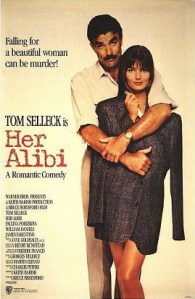
A Movie A Day #255: Her Alibi (1989, directed by Bruce Beresford)


Tom Selleck is Phil Blackwood, a best-selling mystery author who is suffering from writer’s block.  Paulina Porizkova in Nina, a beautiful Romanian who has been accused of murder.  When Phil sees Nina being arraigned in court, it is love at first sight.  He provides her with a false alibi and invites her to stay with him while he writes a book based on her case.  At first, Phil thinks that she is innocent but he soon has his doubts, especially after Nina shows off her skills as a knife thrower.

1989 was a strange year for Australian director Bruce Beresford.  On the one hand, he directed Driving Miss Daisy, which went on to win the Oscar for the best picture.  On the other hand, he also directed Her Alibi, a disjointed comedy that feels like an extended episode of Magnum P.I.  (Even Sellecks’ narration feels like a throwback to his star-making role.  But if Phil is a best-selling writer, why does his narration sound so clunky and clichéd?)  Her Alibi is a predictable film, not really bad but just very bland.  It tries to duplicate the style of a classic screwball comedy but it lacks the bite necessary to make much of an impression.  On the plus side, the great William Daniels was given a few good lines as Phil’s caustic agent and Paulina Porizkova was absolutely beautiful.  The scene where Nina gives Phil a haircut almost makes the movie worth it.

One final note: When watching Her Alibi, be sure to pay attention to the scene where Phil holds up his latest novel.  The book is so thin that it looks like it is only 20 pages long, at the most.

Confessions of a TV Addict #1: It’s a Bird… It’s a Plane… No, It’s CAPTAIN NICE (NBC-TV 1967)


gary loggins's avatarcracked rear viewer

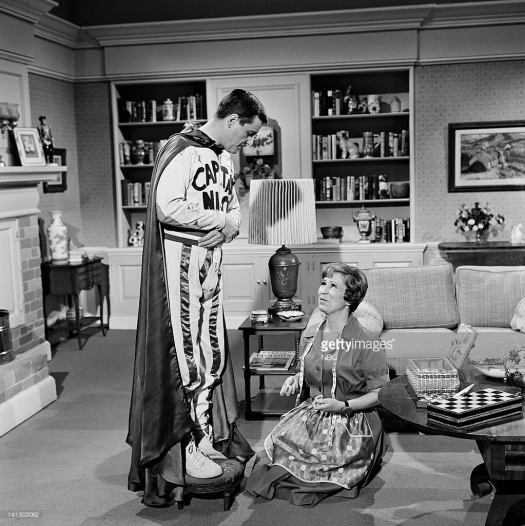
Yes, that’s distinguished actor William Daniels in those long-johns as CAPTAIN NICE, which aired Monday nights on NBC-TV for eight months and fifteen episodes during the height of the superhero camp craze in 1967. Similar in theme to MISTER TERRIFIC on rival CBS, I preferred this one as a kid because of it’s MAD Magazine-level of jokes and gags – which ain’t a bad thing, in my book! The silly superhero series was created by Buck Henry, who also (along with pal Mel Brooks ) was responsible for another campy sitcom, the 60’s spy spoof GET SMART!

Mild -mannered chemist Carter Nash works for the Big Town Police Department, and invents a super-secret super-formula that transforms him into Captain Nice. His domineering mother (Alice Ghostley) sews him up a super-suit and tells him to go out and fight crime like a good boy. Carter’s got all the powers of Superman, except he’s a bit…

View original post 303 more words

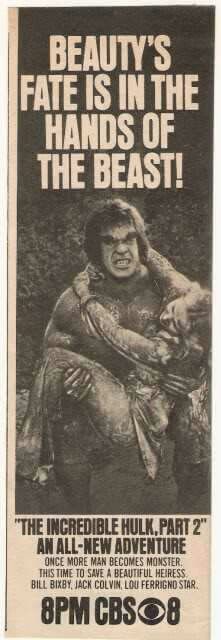
A Movie A Day #145: The Incredible Hulk: A Death In The Family (1977, directed by Alan J. Levi)


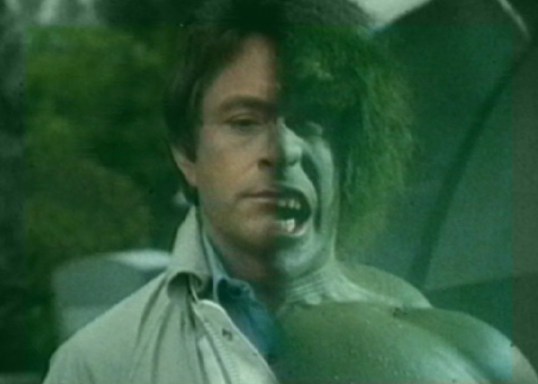
Following the events of The Incredible Hulk and with the world convinced that he is dead, Dr. David Banner (Bill Bixby) is hitchhiking his way across California, hoping to reach a hospital where research is being done on the effects of gamma radiation.  When he stops off in an orange grove, he spots a young, crippled woman named Julie (Laurie Prange).  When Julie faints, David carries her back to her mansion.  It turns out that, after the mysterious death of her father, Julie stands to inherit millions.  David suspects that her doctor (played by William Daniels) may be poisoning her and he gets a job working on the grounds of her mansion.  At first, David thinks that his biggest problem is going to be the head groundskeeper (Gerald McRaney), who is jealous of David’s relationship with Julie.  But, actually, it’s Julie’s stepmother (Dorothy Tristan) that David has to watch out for.  When David tries to protect Julie and a bitter hermit (John McLiam) from the stepmother’s evil plans, he soon finds himself being pursued through the swampland by both men with guns and tabloid journalist Jack McGee (Jack Colvin).  They are all making David Banner angry and they’re about to discover that they wouldn’t like David Banner when he’s angry.

This was the second pilot for The Incredible Hulk.  It aired a week after the first pilot and, like that one, it was also given a theatrical release in Europe.  While the first movie established David Banner’s backstory and explained why he transformed into the Hulk whenever he bumped his head on a door frame or twisted his ankle, A Death in The Family is more typical of the series that would follow.  Like every subsequent episode, A Death In The Family opens with David Banner finding an odd job and ended with him walking down the road with his thumb stuck out.  In between, Banner helps a special guest star.

Watching the second pilot, it’s easy to see why CBS took a chance on The Incredible Hulk even though, at the time, comic book adaptations were considered to be a risk.  Both Bill Bixby and Lou Ferrigno really throw themselves into playing Banner and his alter ego and the show takes the idea seriously.

There’s nothing special about the pilot’s story.  The stepmother and the doctor are obviously guilty from the start.  But the plot (and the 90 minute running time) does allow for four appearances by the Hulk.  David Banner even gets attacked by a grizzly bear, which brings the Hulk right out.  David Banner always had the worst luck with wild animals and barbed wire.  The Hulk, though, just throws the grizzly bear over into the next pond.  The bear is not harmed.  The Hulk may have been angry but he was never really dangerous.

Finally, for the record, Death In the Family featured the first of many aliases that David Banner would assume over the next four years.  This time, he’s David Benton.

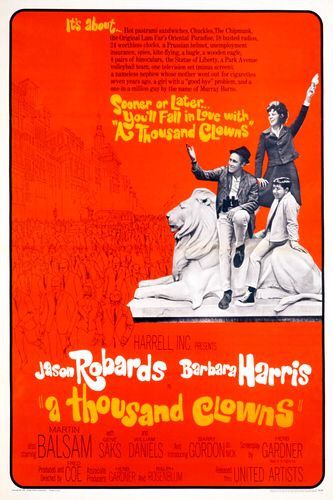
Lisa Reviews An Oscar Nominee: A Thousand Clowns (dir by Fred Coe)


thousand_clowns

The 1965 film A Thousand Clowns is one of the most annoying films to ever be nominated for best picture.

I know what you’re thinking.

Really, Lisa — even more annoying than Extremely Loud and Incredibly Close?

Well, no.  No movie is as annoying as Extremely Loud and Incredibly Close.  In fact, even if it didn’t particularly work for me, I can kind of understand why A Thousand Clowns was apparently a box office success in 1965.  To be honest, part of my annoyance with the film comes from the fact that not only can I understand why other people would love it but I probably would have loved it if I had been alive to see it when it was first released.  A Thousand Clowns isn’t an awful film but to say that it has not aged well is a bit of an understatement.

It tells the story of Murray Burns (Jason Robards).  Murray lives in a cluttered New York apartment with his 12 year-old nephew, Nick (Barry Gordon).  Seven years ago, Nick’s mother abandoned him with Murray.  Murray views Nick as being his own son.  Nick worships his Uncle Murray.  Murray randomly sings Yes, Sir, That’s My Baby.  Nick picks up on the habit and is soon wandering around and humming Yes, Sir, That’s My Baby.  By the end of A Thousand Clowns you will be so freaking sick of hearing that song.  (Fortunately, Murray never sings Send In The Clowns.  The film dodged a bullet on that one.)

Murray’s a nonconformist, the type who starts his day by standing outside and mocking everyone who is getting ready to go to work.  Murray used to have a job.  He was a TV writer.  He wrote jokes for a detestable entertainer known as Chuckles The Chipmunk (played by noted Broadway director Gene Saks).  Five months ago, Murray quit his job.  He’s now unemployed and proud of it.  He swears that he will never again sacrifice his freedom for a paycheck.  He raises Nick to take the same attitude towards life.

Two social workers, Albert (Williams Daniels) and Sandra (Barbara Harris), show up at Murray’s apartment.  They say that unless Murray gets a job and proves that he’s a good guardian, Nick will be taken away from him.  Murray explains that he’s a nonconformist and that he’s raising Nick to reject anything conventional.  Albert is offended.  Sandra is charmed.  Soon, Sandra and Murray are going for bike rides through New York City.  Murray sings Yes, Sir, That’s My Baby some more…

And it all sounds good but the film just didn’t work for me.  First off, I’ve actually experienced what it’s like to grow up with a frequently unemployed father and, sorry, it’s not all studio apartments and cheerful trips to Central Park.  Secondly, A Thousand Clown‘s message of carpe diem might have seemed groundbreaking in 1965 but today, it just seems like a cliché.  I mean, everyone claims to be a nonconformist today.

Watching the film, it’s hard not to feel that it doesn’t really play fair.  It’s easy for the film to always portray Murray as being enlightened when the only people who ever disagree with him are humorless strawmen.  Albert is a self-righteous prig while Chuckles The Chipmunk is a heavy-handed caricature, the type of TV star who could only be created by a writer who is resentful that more people are watching TV than reading his latest masterpiece.  Martin Balsam appears as Murray’s brother, Arnold, and gets a chance to defend his decision to lead a normal, conventional life.  When it comes to the brothers, the film obviously want us to side with Murray but instead, you feel more sympathy for Arnold, largely because Martin Balsam was such an authoritative actor that your natural tendency is to assume that he must know what he’s talking about.  It’s interesting to note that it was Balsam, as the voice of mainstream conformity, that won the film’s only Oscar.

Jason Robards was not even nominated, though his performance is often better than the material.  He and Barbara Harris have a sweet chemistry, even though Harris is stuck playing a rather demeaning role.  (When we first meet Sandra, she is dating Albert and assuming that he’s correct about anything.  Then she falls for Murray and assumes that he is the one who is correct about everything.  What the film never bothers to really explore is what Sandra herself thinks about anything.)  But then you’ve got Barry Gordon, who, in the role of Nick, comes across as being a bratty know-it-all weirdo.  Nick is so obnoxious that it undercuts the movie’s claim that Murray deserves to be his guardian.

Also not nominated, despite the film winning a best picture nomination, was the director, Fred Coe.  (Nominated in his place were William Wyler for The Collector and Hiroshi Teshigahara for The Woman In The Dunes.)   His omission is less surprising than that of Jason Robards.  If you didn’t know that A Thousand Clowns was based on a stage play, you’d guess it after watching the first ten minutes of the film.  Despite a few shots of Murray and Sandra in New York City, A Thousand Clowns never breaks free of its stage origins.  Taking place on largely one set, it feels rather confining for a film meant to celebrate nonconformity.

As I said, I didn’t care much for A Thousand Clowns but I can understand why it was probably a hit with 1965 audiences.  Murray’s a transitional figure, standing between the Beats and the Hippies.  With America’s confidence shaken by the Kennedy assassination and growing social unrest, I’m sure a lot of people wanted to drop out of society just like Murray.  To be honest, a lot of people feel like that right now.  I just hope that, if you do decide to follow Murray’s example, you’ll sing something less annoying than Yes, Sir, That’s My Baby.

A Thousand Clowns was nominated for best picture but it lost to a film that Murray probably would have hated, The Sound of Music.