The Unnominated #17: Honkytonk Man (dir by Clint Eastwood)


Though the Academy of Motion Picture Arts and Sciences claim that the Oscars honor the best of the year, we all know that there are always worthy films and performances that end up getting overlooked.  Sometimes, it’s because the competition too fierce.  Sometimes, it’s because the film itself was too controversial.  Often, it’s just a case of a film’s quality not being fully recognized until years after its initial released.  This series of reviews takes a look at the films and performances that should have been nominated but were, for whatever reason, overlooked.  These are the Unnominated.

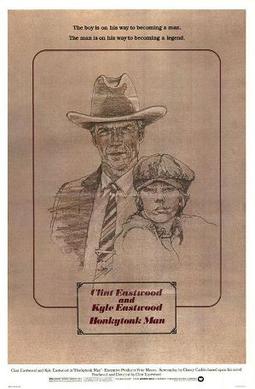
1982’s Honkytonk Man was a Clint Eastwood film that I had never heard of, until I came across it on Prime.  I decided to take a chance and I rented it.  I’m glad that I did because it turned out to be one of Eastwood’s best films.

Clint stars as Red Stovall, a country singer turned farmer during the Great Depression.  Kyle Eastwood stars as Red’s nephew, 14 year-old Whit “Hoss” Wagoneer.  When Red gets an opportunity to perform at the Grand Old Opry, he decides to head for Tennessee.  Since Red is dying of tuberculosis and barely knows how to drive a car, he is accompanied by Grandpa Wagoneer (John McIntire) and Whit.  Whit may be young but he knows how to drive and soon, he’s driving Red and Grandpa across the country.  When a highway patrolman (Tim Thomerson) stops them, he says that Whit is too young to drive.  After watching a speeding Red struggle to keep the car in the right lane, the patrolman pulls up beside them and says, “Let the kid drive.”

Honkytonk Man features an unexpected performance from Eastwood.  Typically, we think of Eastwood’s characters as being the epitome of cool.  Red is definitely not that.  Red is a screw-up, someone who gets arrested while trying to steal chickens and who frequently gets conned by those that he meets during his journey.  When the car breaks down in Arkansas, Red is too busy drinking to remember to catch the bus to Tennessee.  He spends the night with a hitchhiker named Marlene (Alexa Kernin).  The next morning, Whit wakes Red up and informs him that he only has a few minutes before the next bus leaves.  Marlene announces that she’s pregnant.  “HOLD THE BUS!” Red yells as he hastily puts on his clothes.

That said, Whit loves his uncle and the two Eastwoods, Clint and Kyle, both give excellent performances in Honkytonk Man.  In fact, his performance here is probably the best that Clint Eastwood has ever given.  Clint plays with his own image here.  Initially, the film almost feels like a satire of Clint’s hypermasculine persona.  (There is one scene where Eastwood handles a gun but it doesn’t play out the way that you might expect it to.)  But, as the film progresses and Red’s illness grows worse, we start to understand Red and his way of looking at the world.  Red is flawed but he loves his nephew and he loves music and, in the end, what’s important is not whether or not his song were recorded but instead that he spent his final days with Whit.  The film may start out as a comedy but it ultimately becomes a meditation on aging and how one faces the inevitability of death.

As a director, Eastwood takes his time.  He lets the movie play out slowly, with the casual pace of country story.  It’s a film full of wonderful performance and beautiful visuals and it more than earns our patience.  Wisely, Eastwood the director realizes that this story really isn’t about Red.  The story is about Whit (or Hoss, as he asks to be known) and his experiences with his uncle.  Whit worships his uncle but he also comes to learn that the most important thing is to be able to respect yourself.  In this film, Clint Eastwood knows the story that he’s telling and he knows exactly how to tell it.

Honkytonk Man went unnominated as far as the Oscars are concerned.  In the year when the well-intentioned but dramatically inert Gandhi dominated the awards and the nominations, Honkytonk Man was forgotten.  That’s a shame.
Previous Entries In The Unnominated:

  1. Auto Focus 
  2. Star 80
  3. Monty Python and The Holy Grail
  4. Johnny Got His Gun
  5. Saint Jack
  6. Office Space
  7. Play Misty For Me
  8. The Long Riders
  9. Mean Streets
  10. The Long Goodbye
  11. The General
  12. Tombstone
  13. Heat
  14. Kansas City Bomber
  15. Touch of Evil
  16. The Mortal Storm

Film Review: High Plains Drifter (dir by Clint Eastwood)


In 1973’s High Plans Drifter, Clint Eastwood plays …. The Stranger.

No, not the Man With No Name.  The Stranger has a name but he chooses not to share it.  That said, when one person says that he doesn’t even know the Stranger’s real name, the Stranger replies, “Yes, you do.”  The Stranger appears to emerge from the heat of the desert, riding into the small mining town of Lago and gunning down the three bullies that the townspeople hired to protect them after the murder of their town marshal.  With no other option, the townspeople accept the Stranger as the town’s new protector.

The Stranger is drawn to the town and the townspeople but he doesn’t seem to particularly like any of them, with the exception of Mordecai (Billy Curtis), the dwarf that the Stranger appoints as the town’s new sheriff.  The townspeople, the majority of whom are cowardly and motivated by greed, aren’t particularly likable themselves.  The Stranger rules the town like a dictator, kicking everyone out of the hotel so that he can have it for himself and ordering that every building in the town be painted red.  Over the town’s welcome sign, he paints one word: “Hell.”  When the townspeople see how well the Stranger can shoot, they celebrate in the belief that they’ll always be safe.  The Stranger responds by leaving town just as three sadistic outlaws, led by Stacey Bridges (Geoffrey Lewis), approach.  The Stranger may be looking for revenge on Bridges but he also seems as if he wants to make the town suffer for its sins as well.

Much as with the case of The Man With No Name, the Stranger is not motivated by kindness or any sort of concern for the safety of the townspeople.  He often shows a cruel-streak when it comes to dealing with the cowardly townspeople.  He doesn’t attack unless he’s attacked first but once you’re on his bad side, he’ll gun you down without a hint of emotion.  When the Stranger sleeps, he is haunted by nightmares of the previous marshal (played by Buddy Van Horn, Clint Eastwood’s stunt double) being murdered by Bridges and his men while the townspeople stood by and did nothing.  We learn that the townspeople, worried that it might be bad for their business interests, didn’t even give the late marshal a decent headstone after his death.  One woman mentions that spirits can’t rest unless they have a proper marker….

Getting the idea?

High Plains Drifter is probably the closest that Eastwood has ever come to making a supernatural horror film.  The Stranger may or may not be a vengeful ghost (the movie leaves that for you to decide) but he turns the small town of Lago into his own personal version of Hell and, when he attacks the men who killed the marshal, he moves with the ruthless determination of a slasher villain.  The scene where Bridges and his men ride into the town is like a filmed nightmare.  This is a dark film, one in which Eastwood’s Stranger is not the hero because he’s particular heroic but just because everyone else in the film is so bad.

This was also Eastwood’s second film as a director (following Play Misty For Me) and also the first of many westerns that Eastwood would direct.  The imagery is often haunting, all the more so because some of the most violent scenes take place in broad daylight.  The scenes where the Stranger seems to materialize out of the desert’s heatwaves perfectly capture the mythology of the old west and its “heroes.”  Eastwood gets good performances out of his ensemble cast and, even more importantly, he shows that Eastwood the director had a perfect understanding of Eastwood the actor.  As the Stranger, Eastwood says more with a snarl or a half-smile than most actors could say with a multi-page monologue.

High Plains Drifter is violent, often disturbing, and ultimately unforgettable.

Film Review: After Hours (dir by Martin Scorsese)


Directed by Martin Scorsese, 1985’s After Hours opens in an office.  This isn’t the type of office that one might expect a Scorsese movie to open with.  It’s not a wild, hedonistic playground like the office in The Wolf of Wall Street.  Nor is it a place where an aging man with connections keeps his eye on the business for his friends back home, like Ace Rothstein’s office in Casino.  Instead, it’s a boring and anonymous office, one that is full of boring and anonymous people.  Scorsese’s camera moves around the office almost frantically, as if it’s as trapped as the people who work there.

Paul Hackett (Griffin Dunne) works in the office, at a job that bores him but presumably pays him enough to live in New York.  Paul is not a typical Scorsese protagonist.  He’s not a fast-talker or a fearsome fighter.  He’s not an artist consumed by his own passion or an amoral figure eager to tell his own story.  Instead, he’s just a guy who wears a tie to work and who spends his day doing data entry.  He’s a New Yorker but he doesn’t seem to really know the city.  (He certainly doesn’t know how much it costs to ride the subway.)  He stays in his protected world, even though it doesn’t seem satisfy him.  Paul Hackett is not Travis Bickle.  Instead, Paul is one of the guys who would get into Travis’s cab and, after spending the drive listening to Travis talk about how a storm needs to wash away all of New York’s sin, swear that he will never again take another taxi in New York.

One day, after work, Paul has a chance meeting with a seemingly shy woman named Marcy (Rosanna Arquette).  Marcy lives in SoHo, with an artist named Kiki (Linda Fiorentino) who sells plaster-of-Paris paperweights that are made to look like bagels.  Marcy gives Paul her number and eventually, Paul ends up traveling to SoHo.  He takes a taxi and, while the driver is not Travis Bickle, he’s still not amused when Paul’s last twenty dollar bill blows out the window of the cab.

Paul’s trip to SoHo doesn’t goes as he planned.  Kiki is not impressed with him.  Marcy tells him disturbing stories that may or may not be true while a search through the apartment (not cool, Paul!) leads Paul to suspect that Marcy might have disfiguring burn scars.  Paul decides to end the date but he then discovers that he doesn’t have enough change on him to take the subway home.  As Paul attempts to escape SoHo, he meets a collection of strange people and finds himself being hunted by a mob that is convinced that he’s a burglar.  Teri Garr plays a sinister waitress with a beehive hairdo and an apartment that is full of mousetraps.  Catherine O’Hara chases Paul in an ice cream truck.  Cheech and Chong play two burglars who randomly show up through the film.  John Heard plays a bartender who appears to be helpful but who also has his own connection to Marcy.  Even Martin Scorsese appears, holding a spotlight while a bunch of punks attempt to forcibly give Paul a mohawk.  The more that Paul attempts to escape SoHo, the more trapped he becomes.

Martin Scorsese directed After Hours at a time when he was still struggling to get his adaptation of The Last Temptation of Christ into production.  If Paul feels trapped by SoHo, Scorsese felt trapped by Hollywood.  After Hours is one of the most nightmarish comedies ever made. It’s easy to laugh at Paul desperately hiding in the shadows from Catherine O’Hara driving an ice cream truck but, at the same time, it’s impossible not to relate to Paul’s horror as he continually finds himself returning again and again to the same ominous locations.  In many scenes, he resembles a man being hunted by torch-wielding villagers in an old Universal horror film, running through the shadows while villager after villager takes to the streets.  Paul’s a stranger in a strange part of the city and he has absolutely no way to get home.  I think everyone’s had that dream at least once.

Paul is not written to be a particularly deep character.  He’s just a somewhat shallow office drone who wanted to get laid and now just wants to go home.  Fortunately, he’s played by Griffin Dunne, who is likable enough that the viewer is willing to stick with Paul even after Paul makes some very questionable decisions and does a few things that make him a bit less than sympathetic.  Dunne and John Heard keep the film grounded in reality, which allows Rosanne Arquette, Linda Fiorentino, Catherine O’Hara, and especially Teri Garr to totally play up the bizarre quirks of their character.  Teri Garr especially does a good job in this film, revealing a rather frightening side of the type of quirky eccentric that she usually played.

Scorsese’s sense of humor has been evident in almost all of his films but he still doesn’t get enough credit for his ability to direct comedy.  (One need only compare After Hours to one of Brian De Palma’s “comedies” to see just how adroitly Scorsese mixes laughs and horror.)  After Hours is one of Scorsese’s more underrated films and it’s one that everyone should see.  After Hours is a comedy of anxiety.  I laughed while I watched it, even while my heart was racing.

Retro Television Reviews: Sarah T — Portrait of a Teenage Alcoholic (dir by Richard Donner)


Welcome to Retro Television Reviews, a feature where we review some of our favorite and least favorite shows of the past!  On Sundays, I will be reviewing the made-for-television movies that used to be a primetime mainstay.  Today’s film is 1975’s Sarah T — Portrait of a Teenage Alcoholic.  It  can be viewed on YouTube!

In 1975, two years after shocking audiences in and receiving an Oscar nomination for The Exorcist, Linda Blair played Sarah Travis.  Sarah is fourteen years old.  She has a high IQ.  She lives in a nice suburban home.  She has an older sister named Nancy (Laurette Sprang) and she makes a good deal of money working as a babysitter.  Sarah lives with her mother, Jean (Verna Bloom) and her stepfather, Matt (William Daniels).  She misses her father, a chronically unemployed artist named Jerry (Larry Hagman).  Jerry is the type who will complain about how no one is willing to give him a chance while he’s day drinking early in the morning.  Jerry’s an alcoholic.  That’s one of the many things that led to Jean divorcing him.  (Matt is fairly regular drinker as well but it soon becomes apparent that he can handle his liquor in a way that Jerry cannot.  Matt has a glass of Scotch after work.  Jerry has his daughter by a slushy so he can pour his beer in the cup.)  Jean is always quick to keep Sarah from drinking.  When someone offers her a drink at a party, Jean replies that Sarah only drinks ginger ale.

Of course, the name of this movie is Sarah T. — Portrait of a Teenage Alcoholic so we already know that Jean is incorrect about that.  When we first meet Sarah, she is fourteen and she’s been regularly drinking for two years.  She’s even worked out a system where she gets liquor delivered to the house and then tells the deliveryman that her mother is in the shower but she left the money for the booze on the dining room table.  Like many alcoholics, Sarah has become very good at tricking people and hiding her addiction.  Of course, Sarah doesn’t think that she’s an alcoholic but …. well, again, just check out the title of the film.

When Sarah goes to a party with Ken (Mark Hamill, two years before Star Wars), the handsome captain of the school’s swim team, she ends up having too much to drink.  Nice guy Ken not only takes her home but also takes the blame, telling Jean and Matt that he was the one who gave Sarah the alcohol.  Jean, convinced that this is the first time that Sarah has ever gotten drunk, forbids her from spending any more time with Ken.  In the morning, Jean comments that Sarah will probably have a terrible hangover and maybe that’s punishment enough.  The joke, of course, is on Jean.  Sarah doesn’t even get hangovers anymore.

Soon, Sarah’s grades start to slip and she starts to skip class so that she can drink.  Still blaming Ken for all of Sarah’s problems, Jean finally takes Sarah to a psychologist, Dr. Kitteridge (Michael Lerner).  Dr. Kitteridge announces that Sarah is an alcoholic and recommends that she start attending A.A. meetings.  Sarah does go to one meeting, in which she meets a surprisingly cheerful 12 year-old alcoholic.  However, Sarah still has a way to go and so does the movie.  I mean, we haven’t even gotten to the scene where Sarah begs a group of older boys to give her the bottle of wine that they’re clumsily tossing in the air.  By the end of the film, she’s even managed to hurt poor, loyal Ken.

Myself, I hardly ever drink.  Some of that is because, like Sarah, I’m the daughter of an alcoholic and a child of divorce and I’ve seen firsthand how difficult it can be to live with an addiction.  (My Dad has been sober for five years and I am so proud of him!)  Of course, another reason why I hardly ever drink is because my tolerance for alcohol is amazingly low.  I get drunk off one sip of beer.  Long ago, I realized my life would be a lot easier and simpler if I just didn’t drink and so I don’t.  Watching the film, I wondered if I was watching what my life would have been like if I had gone the opposite route.  Would I have ended up like Sarah T?

Probably not.  Sarah T is one of those films that was obviously made with the best of intentions but it just feels inauthentic.  A lot of that is due to the performance of Linda Blair, who often seems to be overacting and trying too hard to give an “Emmy-worthy” performance.  There’s not much depth to Blair’s performance and, as a result, the viewer never really buys into the story.  At her worse, Blair brings to mind Jessie Spano shouting, “I’m so excited!” during that episode of Saved By The Bell.  (Blair was far better served by B-movies like Savage Streets, in which she got to kick ass as a vigilante, than by films like this.)  As well, the film’s portrayal of A.A. is so cheerful, upbeat, and positive that it almost felt like a Disney version of InterventionWho are all of these happy addicts? I wondered as I watched the scene play out.

Because I’ve been a bit critical of his acting abilities in the past, I do feel the need to point out that Mark Hamill gives the best performance in this film.  He plays Ken as being a genuinely decent human being and it’s hard not to sympathize with him as he gets in over his head trying to deal with Sarah.  If Blair plays every emotion on the surface, Hamill suggests that there’s a lot going on with Ken.  Deep down, he knows that he can’t help Sarah but he still feels like he has to try.  Though Blair may be the star of the film, it’s Hamill who makes the biggest impression.

As a final note, this film was directed by Richard Donner, who is best-known for directing The Omen, Superman and Lethal Weapon.  This was Donner’s final made-for-TV film before he moved into features.  There’s nothing particularly special about Donner’s direction of Sarah T.  If anything, the film’s pacing feels a bit off.  Fortunately, just as Linda Blair would get to prove herself as one of the queens of exploitation cinema and Mark Hamill would go on to achieve immortality as Luke Skywalker, Donner would get plenty of opportunities to show himself to be one of Hollywood’s premier, big budget maestros.

As for Sarah T., I would recommend watching it on a double bill with Go Ask Alice.

Horror on The Lens: Where Have All The People Gone? (dir by John Llewellyn Moxey)


For today’s horror on the lens, we have a 1974 made-for-TV movie about what happens when a family comes down from the mountains and discovers that everyone’s disappeared.

“Where have all the people gone!?” is the obvious question and it’s also the title of this film.  Our own Jedadiah Leland reviewed this movie back in March and he described it as being “effectively creepy.”  I watched it with my friends in the Late Night Movie Gang a few months later and we described as being perhaps the best Peter Graves film we had seen since we watched that one where everyone was a clone.

So, after those recommendations, how can you not watch Where Have All The People Gone?

Enjoy!

https://www.youtube.com/watch?v=39GjSbiMzXY&t=1s

Where Have All The People Gone? (1974, directed by John Llewellyn Moxey)


Steve Anders (Peter Graves) and his teenage children, David (George O’Hanlon, Jr.) and Deborah (Kathleen Quinlan), are exploring a cave in the mountains of California when they experience a sudden earthquake.  After managing to escape from the cave and meeting a man who tells them about how there was a bright flash of light in the sky before the earthquake, the three of them come down from the mountain and discover that there does not appear to be anyone around.  Instead, where people once stood, there are now only piles of clothes and white dust.  Where have all the people gone?

As the Anders try to make their way back home to Malibu, they discover that the entire world has changed.  Towns are completely deserted and once friendly animals are now viscous and hostile.  While Steve tries to keep his children from giving up hope, he also tries to find the answer to the question, where have all the people gone?

This film, which is only a little over an hour long, was made for NBC.  Though the film’s short running time can sometimes make it feel rushed, Where Have All The People Gone? is still a effectively creepy movie from made-for-television specialist John Llewellyn Moxey.  Though it’s always difficult to accept an actor like Peter Graves as being anyone other than Peter Graves, he actually did a pretty good job playing the confused father and there are some good scenes where both of his children deal with thing in their own way.  (David refuses to get emotional.  Deborah does the opposite.  Only Steve understands the importance of mixing emotion with reason.)  When they do finally find another survivor, she’s played by Verna Bloom and the scene where they come across her sitting in her car, apparently catatonic, is really well-handled.

Though the film does eventually explain where all the people have gone, it still has an unsatisfying, open-ended ending.  It wouldn’t surprise me if this film was meant to be pilot for a potential televisions series because it ends with the promise of future adventures.  A weekly tv series would have allowed the Anders family to find more survivors and more angry animals but instead, the story ends with everyone still unsure as to what type of world they’re about to inherit.

If you’re one of those who is stuck inside right now, Were Have All The People Gone? is reasonably diverting and is available on YouTube and Prime.

A Movie A Day #148: Badge 373 (1973, directed by Howard W. Koch)


In this cop film, Robert Duvall plays Eddie Ryan, a tough New York detective who gets suspended from the force when he is accused of tossing a Puerto Rican suspect off of a roof.  Eddie’s innocent but, because he spends all of his time talking about how much he hates Puerto Ricans and using Archie Bunker-style racial slurs, everyone assumes that he is guilty.  Eddie is suspended from the force but then his former partner is killed while investigating an operation to smuggle guns to, you guessed it, Puerto Rico.  Suspended or not, Eddie is going to track down the man who killed his partner.  If that puts everyone from his girlfriend, Maureen (Verna Bloom), to NYC pedestrians in danger, that’s just the way it has to be.

Robert Duvall as an action star?  Duvall was only 41 when he starred in Badge 373 but it is still strange to see America’s greatest character actor jumping out of windows and chasing suspects.  Badge 373 was one of the many cop films made in the wake of Dirty Harry and The French Connection and the film is actually credited as being “inspired by the exploits of Eddie Egan.”  Egan also served as the inspiration for Gene Hackman’s Popeye Doyle in The French Connection. Duvall is good in the role but he is almost a little too good.   Hackman played Doyle with a twinkle in his eye that suggested his casual racism was just a part of his streetwise persona.  Duvall is so grim and determined as Eddie Ryan that there is never any doubt that he hates everyone just as much as he says he does.

(Just as he did in The French Connection, the real-life Eddie Egan has a role in Badge 373.  He plays Eddie Ryan’s supervisor and best friend.)

Like most of the cop films that came out immediately after The French Connection, the highlight of Badge 373 is an extended chase scene.  In this one, Eddie escapes from the gun smugglers by hijacking a city bus.  The only problem is that Eddie isn’t sure how to drive a bus and Duvall acts the hell out of his struggle to figure out how to switch gears.  It’s worth the price of admission.

Back to School Part II #9: National Lampoon’s Animal House (dir by John Landis)


NATIONAL-LAMPOONS-ANIMAL-HOUSE

You know what?  I’m going to start this review with the assumption that you’ve already seen the classic 1978 college comedy, National Lampoon’s Animal House.  At the very least, I’m going to assume that you’ve heard of it and that you know the general details.  Animal House was not only a huge box office success but it’s also one of the most influential films ever made.  Almost every comedy released since 1978 owes a debt to the success of Animal House.  Just as every subsequent high school film was directly descended from American Graffiti, every college film features at least a little Animal House in its DNA.

So, with that in mind, who is your favorite member of Delta House?

toga

Most people, I think, would automatically say Bluto (played by John Belushi) and certainly, Bluto is the best known and perhaps best-remembered member of the cast.  As played by Belushi, Bluto is the film’s rampaging ID and he’s such a force of nature that, whenever I rewatch Animal House, I’m surprised to be reminded of the fact that he’s not really in the film that much.  He’s present for the parties, of course.  He imitates a zit and starts a food fight.  He gives a rousing speech, in which he reminds the members of the Delta House that America didn’t give up after “the Germans bombed Pearl Harbor!”  He destroys a folk singer’s guitar and I personally love the scene where he tries to cheer up a despondent pledge by smashing a beer bottle over his head.  But really, Bluto is used very sparingly and he’s one of the few members of the ensemble not to get his own subplot.  Bluto’s great but he’s not my favorite member of Delta House.

Hoover

Believe it or not, my favorite member of Delta House is Robert Hoover (James Widdoes).  Hoover is the president of Delta House and, when we first meet him, he seems like he’s way too clean-cut to be in charge of the “worst house” on campus.  But then, as the film progresses, we discover that Hoover may not be as openly crazy as everyone else but he’s definitely a Delta.  Just watch him in the Toga party scene.  Just look at him in the picture that shows up during the closing credits.  It took me a while to realize that Hoover, the future public defender, was giving the camera the finger.  Hoover may look uptight but he’s secretly a wild man!

animal-house 1

One of the things that I love about Animal House is that it truly is an ensemble film.  There’s not a weak performance to be found in the entire movie.  No matter how wild or over-the-top the humor gets, the entire cast commits to their roles and, as a result, they keep this movie grounded.  You actually find yourself caring about whether or not they get kicked off campus.  You truly believe that the members of Delta House have been friends for years but, even more importantly, you believe the same thing about their rivals at Omega House.  For that matter, it may be easy to make fun of Dean Wormer (John Vernon, setting the template for all evil deans to come) but you never doubt that he’s been in charge of Faber College for years and that he’s planning on being in charge for years to come.  As played by the deep-voiced and sinister-looking Vernon, Wormer becomes every unreasonable authority figure.  When he explains the concept of super secret probation, he does so with a smug pleasure that is practically chilling.  When he mentions that the members of Delta House can now be drafted, the smile on his face is terrifying.

Wormer

You know who else gives a really good performance in Animal House?  Donald Sutherland.  At the time, Sutherland was the biggest star in the film.  He was offered either a percentage of the grosses or a flat fee.  Sutherland thought the film would flop, took the flat fee, and missed out on millions as a result. Sutherland plays Prof. Jennings, an English teacher who, in the only scene actually set in a classroom, desperately tries to get his bored students to pay attention to him.  There’s something so poignant about the way Jennings begs his students to turn in their papers.  “I’m not joking,” he sputters, “this is my job!”

Jennings

Jennings turns out to be free thinker.  He turns Boone (Peter Riefert), Katie (Karen Allen), and Pinto (Tom Hulce) onto marijuana.  There’s an anachronistic peace sign hanging in his apartment (Animal House takes place in 1963) but no matter.  Far worse is the fact that he temporarily breaks up Boone and Katie!  Everyone knows those two belong together!

Bluto and Flounder

You know who else doesn’t get enough credit for his performance in Animal House?  Stephen Furst.  He plays Flounder, a new pledge.  Flounder is just so enthusiastic about everything and he doesn’t even seem to be upset when Wormer tells him, “Fat, drunk, and stupid is no way to go through life.”  I love the enthusiastic way that Furst delivers simple lines like, “What’s my Delta Chi name?” and “Brother Bluto!  Brother D-Day!  What are you doing here!?” My favorite Flounder moment comes when he accidentally gives a horse a heart attack.  Technically, it shouldn’t be funny but it is because Furst, Belushi, and Bruce McGill (playing the role of D-Day) so thoroughly throw themselves into their roles.  For that matter, the horse did a pretty good job too.

Boone and Otter

But that’s not all!  How can I praise the ensemble of Animal House without mention Tim Matheson, who plays Otter, the future Beverly Hills gynecologist?  Or what about Kevin Bacon, playing Omega pledge Chip Diller?  This was Bacon’s first role and who can forget him shouting, “Thank you, sir, may I have another!” while being initiated into Omega House?  Or how about James Daughton and Mark Metcalf, as the two leaders of Omega House?  They were villains truly worth hissing!

Omega House

And yes, I know that a lot of the humor in Animal House is not politically correct but who cares?  It’s a hilarious movie, one that is full of good actors at their absolute best.  Yes, they’re all a bunch of privileged sexists blah blah blah, but I’d still party with the Delta House.  They know how to have fun and, even if they did wreck the Homecoming Parade, they had a good reason!

parade

And so is the movie.  Every time I see Animal House, I feel good about the world.  In 1978, The Deer Hunter was named best picture by the Academy.  Well, you know what?  With all due respect to that long epic about the tragedy of America’s involvement in the Vietnam War,  all the Oscars should have gone to Animal House!

Animal-House-e1349570128550

In conclusion … SING IT!

Let me t-t-tell you ’bout some friends I know
They’re kinda crazy but you’ll dig the show
They can party ’till the break of dawn
at Delta Chi you can’t go wrong

Otter, he’s the ladies man
Every girl falls into his hands
Boon and Katy playing “Cat and Mouse”

and Mrs. Wormer, she’s the queen of the
ANIMAL HOUSE

ANIMAL HOUSE

ANIMAL HOUSE

That Pinto he’s a real swell guy
Clorette was jailbait but he gave her a try
Chip, Doug, and Greg, they’re second to none
They studied under Attila the Hun

Mr. Jennings has got his wig on tight
Flouder’s left shoe’s always on his right
Babs and Mandy are having a pillow fight
With D-Day, Hoover, Otis Day and the Knights

DO THE BLUTO

Come on baby, dance with me
Maybe if we do the Bluto
We will get an “A” in lobotomy

DO THE BLUTO
DO THE BLUTO

DO THE BLUTO
DO THE BLUTO

Aw, come on!
Let me tell ya
Dean Wormer tried to shut us down
But he fell and he broke his crown
He didn’t know about the Delta spunk
He came in handy when we were short a skunk

At the

ANIMAL HOUSE

5650948_std

Shattered Politics #27: Medium Cool (dir by Haskell Wexler)


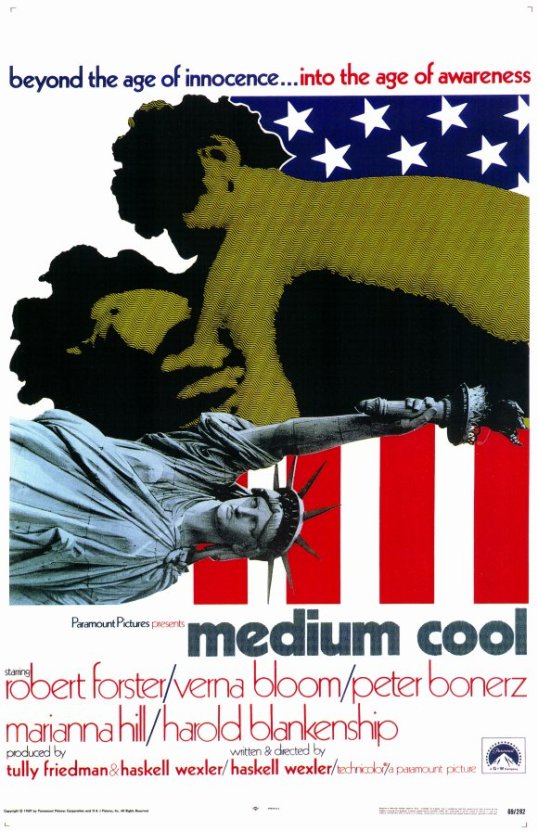
Film_Poster_for_Medium_CoolFor the past few days, I’ve been chronologically reviewing 94 films about politicians and, to a lesser extent, politics.  Four days ago, I started in on the 60s by taking a look at Sunrise at Campobello, one of the most traditional-minded and pro-American movies ever made.  And now, I’m closing out the decade by taking a look at 1969’s Medium Cool, a film that is — in style, ideology, and content — the exact opposite of Sunrise at Campobello.

I should admit that I’m cheating a bit by including Medium Cool in this series of reviews.  When I first started Shattered Politics, I said that I would be reviewing films about politicians.  While Medium Cool is a fiercely political film, there are few elected officials to be seen on screen.  That said, it was shot during the infamous 1968 Democratic National Convention and, as such, the politicians are present regardless of whether or not they’re seen.

Plotwise, the film follows a news cameraman, John (Robert Forster), and his sound guy (Peter Bonerz) as they go around Chicago, searching for stories.  Along the way, they interview the disturbingly cheerful owner of a gun club (played, in his film debut, by Peter Boyle), several people who volunteered on Robert Kennedy’s presidential campaign, and, in one of the film’s best and most awkward scenes, a group of Black Panthers.

Throughout the first half of the film, John remains detached from the stories that he covers.  He’s more concerned with getting the footage and getting a good soundbite than in really listening to what anyone is saying.  (In many ways, he’s like a less sociopathic version of the character played by Jake Gyllenhaal in Nightcrawler.)  It’s not until John discovers that his station is sharing his footage with the FBI that John finally starts to show some political awareness.  Unfortunately, he also shows some anger and ends up losing his job as a result.

Now unemployed, John meets Eileen (Verna Bloom), a single mother who has recently moved to Chicago from West Virginia.  Now that he’s free from the detachment of his job, John actually starts to develop feelings for both Eileen and her son, Harold (Harold Blankenship).  When Harold runs away, Eileen and John search Chicago for him.  Unfortunately, their search happens at the same time as the 1968 Democratic Convention.  While John and Eileen search, the Chicago police are busy beating protestors in the street.

(The video below is long, but worth watching, as is the entire film.)

Now, I know that, in the past, I’ve been critical of many of the counter culture films of the late 60s and early 70s, describing their politics as being shallow, trendy, and faux Leftist.  (And if you doubt me, read my reviews of Getting Straight, Zabriskie Point, and R.P.M.)  However, Medium Cool is an exception to those films, in that it actually works.  Medium Cool was directed by famed cinematographer, Haskell Wexler.  Wexler began his career shooting documentaries and, in many ways, that’s exactly what Medium Cool is.  Though Robert Forster may be an actor, many of the people that he interviewed in the film were not.  When he talks to the former Kennedy campaign workers, he’s talking to actual volunteers and getting their true feelings, as opposed to something written for them by an out-of-touch screenwriter.  When we see John and Eileen trying to survive the violence outside the Democratic Convention, we’re also seeing Robert Forster and Verna Bloom attempting to do the same thing.  The protestors being attacked were real.  The cops doing the attacking were real.  The violence was real.

And, considering that Medium Cool was released 46 years ago, the issues raised by the film are still real.  When the Black Panthers suspiciously view John and his sound guy, we’re reminded of the protestors in Ferguson demanding that the national media get out of their way.  When we see the protests outside the 1968 Democratic Convention, how can we not compare them to the protests that we still see every day?  When the cops line up in military precision and we hear that orders must be followed, are we watching Medium Cool or are we watching CNN?

During one of Medium Cool‘s better known moments, an off-screen voice is heard to shout, “Look out, Haskell!  It’s real!,” warning director Haskell Wexler that the violence he’s filming is actually happening.  And that’s a warning that’s still appropriate and relevant today.  We may be watching from the safety of our homes but it’s still real.

(Of course, it should be mentioned that, according to Wexler himself, “Look out, Haskell!  It’s real!” was actually added to the scene in post production.)

It’s perhaps indicative of how much American culture changed in the 60s that a decade that started with Ralph Bellamy playing Franklin D. Roosevelt would end with Medium Cool.  Fortunately, Medium Cool gives us plenty of evidence about how that change happened.