“You want to put some kind of explanation down here before you leave? Here’s one as good as any you’re likely to find. We’re bein’ punished by the Creator…”— John “Flyboy”
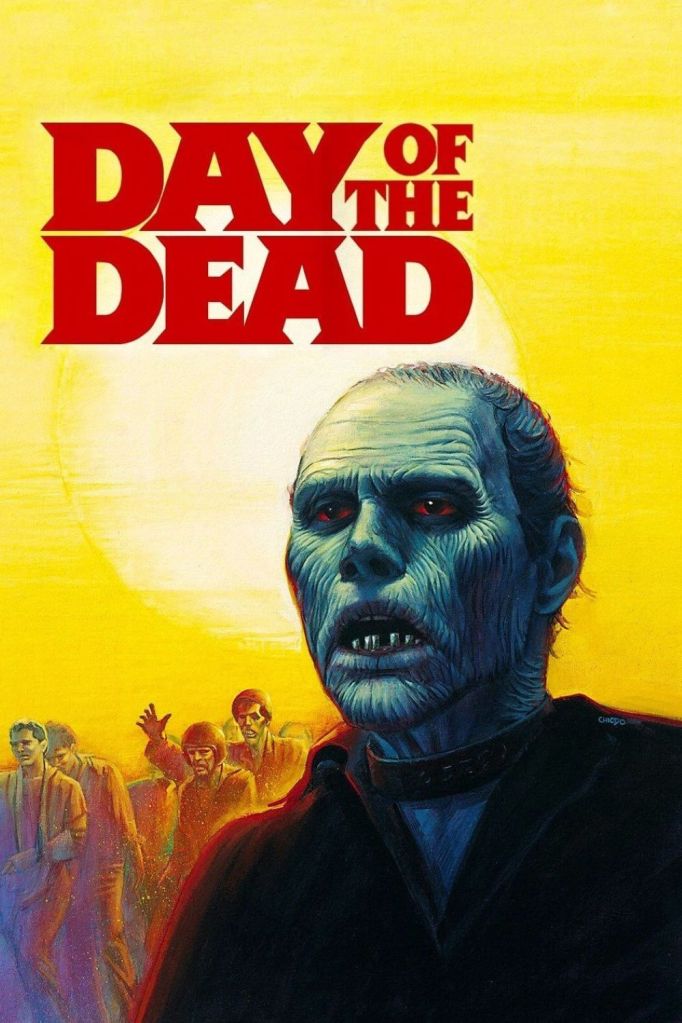
George A. Romero’s 1985 film Day of the Dead stands as an unflinching and deeply cynical meditation on the collapse of society amid a relentless zombie apocalypse, intensifying thematic and narrative complexities first introduced in Night of the Living Dead (1968) and Dawn of the Dead (1978).
Originally, Romero envisioned the film as an epic, describing it as “the Gone with the Wind of zombie films.” His screenplay featured above-ground scenes and a more expansive narrative, but budget cuts halved the original $7 million budget to $3.5 million, forcing a drastic paredown. While much grandiosity was lost, the trimming resulted in a tighter narrative and heightened the nihilistic tone, deepening the film’s focused exploration of humanity’s darkest aspects during apocalypse.
Set after civilization has collapsed, Day of the Dead places viewers in the suffocating confines of a missile silo bunker in Florida, where scientists and soldiers struggle for survival and solutions amid encroaching undead hordes. The claustrophobic atmosphere—born partly from the abandonment of Romero’s broader original sequences—intensifies the tension between the hopeful scientific pursuit of salvation and the harsh pragmatism of military authority. These competing ideologies escalate into authoritarian violence, embodying the fractured microcosm of a dying society.
Within this claustrophobic world, a third group—composed of characters Flyboy and McDermott—emerges as a stand-in for the rest of humanity. They observe the scientists and soldiers—institutions historically symbols of security and innovation—but witness how these deeply entrenched ways of thinking only exacerbate problems instead of solving them. This third faction characterizes humanity caught between rigid orders and doomed pursuits, reflecting Romero’s broader commentary on societal stagnation and fragmentation.
Central to this conflict are Dr. Logan, or “Frankenstein,” a scientist obsessed with controlling the undead through experimentation, and Captain Rhodes, the hardened soldier who believes survival demands ruthless control.
Logan’s controversial research seeks to domesticate and condition zombies, notably through his most celebrated subject, Bub—the undead zombie capable of rudimentary recognition and emotion—challenging assumptions about humanity and monstrosity.
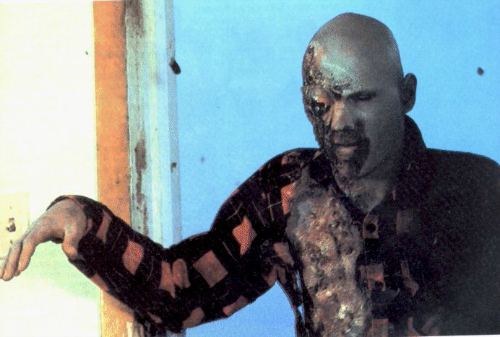
Here the film benefits greatly from the extraordinary practical effects work of Tom Savini, whose contributions on Day of the Dead are widely considered his magnum opus. Savini’s makeup and gore effects remain unsurpassed in zombie cinema, continually influencing horror visuals to this day. Drawing from his experience as a combat photographer in Vietnam, Savini brought visceral realism to every decomposed corpse and violent injury. The close-quarters zombie encounters showcase meticulous practical work—detailed wounds, biting, and dismemberment—rendered with stunning anatomical authenticity that predates CGI dominance.
Bub, also a masterclass in makeup and animatronics, embodies this fusion of horror and humanity with lifelike textures and movements that blur the line between corpse and creature, rendering the undead terrifyingly believable.
The film captures the growing paranoia and cruelty as resources dwindle—food, ammunition, and medical supplies—and the fragile social order begins to shatter. The characters’ mounting desperation illustrates Romero’s thesis that humanity’s real enemy may be its own incapacity for cooperation.
The moral and social decay is vividly portrayed through characters like Miguel, whose mental breakdown sets destructive events in motion, and Rhodes, whose authoritarian survivalism fractures alliances and moral compass alike. Logan’s cold detachment and experiments push ethical boundaries in a world on the brink.
Romero’s direction combines claustrophobic dread with stark psychological terror, further amplified by Savini’s effects. The cinematography’s low lighting and tight framing create an oppressive environment, while graphic violence underscores a world irrevocably broken. The unsettling sound design—moans, silences, sudden outbreaks—immerses viewers in a relentless atmosphere of decay and fear.
Romero described Day of the Dead as a tragedy about how lack of human communication causes chaos and collapse even in this small slice of society. The dysfunction—soldiers and scientists talking past each other, eroding trust, spirals of paranoia—serves as a bleak allegory for 1980s America’s political and cultural fragmentation. Failed teamwork, mental health crises, and fatal miscommunication thrive as the bunker metaphorically becomes a prison of fractured humanity.
Though not as commercially successful as its predecessors, Day of the Dead remains the bleakest and most nihilistic entry in Romero’s Dead series. Its overall grim tone, combined with mostly unlikable characters, establishes it as the most desolate and truly apocalyptic film of the series. The characters often appear fractured, neurotic, and unable to escape their own destructive tendencies, making the story’s world feel even more hopeless and devastating.
Far beyond a simple gore fest, Day of the Dead serves as a profound social critique infused with psychological depth. It explores fear, isolation, authority abuse, and the ethical limits of science, reflecting enduring anxieties about society and survival. The film’s unsettling portrayal of humanity’s failings, embodied in broken relationships and moral decay, presents a harsh reckoning with what it means to be human when humanity itself is the ultimate threat to its own existence. This thematic complexity, combined with Romero’s unyielding vision and Savini’s unparalleled effects, crafts a chilling and unforgettable cinematic experience.
“When the dead walk, señores, we must stop the killing… or lose the war.”
In 1968, horror cinema was irrevocably changed by the emergence of George A. Romero’s vision, signaling the beginning of a transformative era for the genre. Romero, who had spent much of his early career making industrial and educational films, shifted gears dramatically by crafting Night of the Living Dead, an independent film that did more than just scare audiences—it shattered the conventions of horror. This was a film that rejected the glossy, Gothic monsters of studios like Universal and Hammer, replacing them with raw, unvarnished depictions of human decay and social collapse. The fear Romero invoked was no longer supernatural; it was born from human frailty and social upheaval.
Night of the Living Dead introduced audiences to an entirely new kind of monster: the zombie, not as a mystical or alien infection, but as the reanimated corpse of an ordinary person. This change was more than cosmetic. It shifted the source of horror from “the other” to a reflection of ourselves. Death itself had become weaponized, turning friend into foe in the most visceral way imaginable. The infection was no longer a far-off fantasy but an internal threat. Although the word “zombie” was scarcely spoken in Romero’s first three Dead films, the concept solidified into the cultural lexicon, haunting audiences with the idea that anyone—even the people closest to us—could become the enemy.
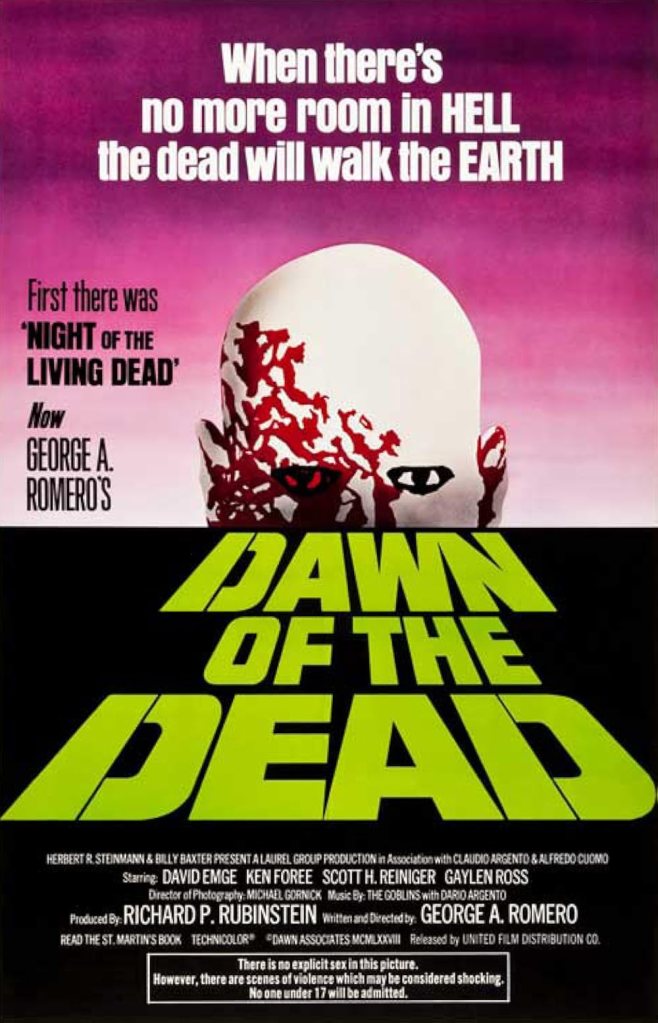
Despite the landmark impact of Night of the Living Dead, it would take a decade before Romero was able to produce its sequel. The first film’s shocking violence and disturbing social commentary made Hollywood studios wary of financing a continuation. However, a breakthrough came when Italian horror maestro Dario Argento learned of Romero’s plans and offered to co-finance Dawn of the Dead under the condition that he would receive European distribution rights and be allowed to edit a version for his audience. This international collaboration proved pivotal, allowing Romero to create what many consider not just a sequel but a towering masterpiece of horror cinema.
Released in 1978, Dawn of the Dead solidified Romero’s reputation as a visionary filmmaker willing to confront uncomfortable truths. The Motion Picture Association of America refused the film an R-rating due to its graphic content, and Romero opted to release it unrated to avoid association with the X-rating, which was then primarily linked to pornography. While this restricted the number of theaters willing to show the film, it did not hinder its success. The movie drew large audiences hungry for a horror story that dared to depict society’s unraveling with brutal honesty.
From its opening, Dawn of the Dead confronts viewers with the chaos midst societal collapse rather than building toward it. Traditional authority figures—news anchors, government officials, police—are portrayed as overwhelmed, often ineffective, and sometimes themselves sources of danger. The film’s opening sequence, set inside a frenzied television newsroom, captures this chaos vividly; reporters and producers struggle to maintain composure while the world outside falls apart. This scene encapsulates one of Romero’s central themes: the erosion of trust in institutions during extreme crisis. As media credibility falters, survivors are left in an informational vacuum, further imperiling their ability to cooperate or find sanctuary. This mistrust resonates strongly today, echoing recent real-world crises where institutional failure has worsened public panic and political division.
A critical early sequence—the tenement raid—brilliantly illustrates the film’s social complexity. The conflict here stems not only from the undead but from a clash of cultures: the low-income inhabitants hold tightly to their traditions, especially the respect and mourning of their dead, while the government, scientists, and law enforcement—detached “outsiders”—seek to destroy the infected bodies coldly as threats. This refusal to recognize the residents’ humanity and cultural practices sparks a brutal firefight, symbolizing the broader breakdown of social cohesion. Romero uses this conflict to show that the apocalypse is fueled as much by misunderstandings and institutional coldness as by the undead threat itself.
Within this crumbling world, the film centers on four survivors who become our guides through Romero’s apocalyptic landscape: Roger (Scott Reiniger) and Peter (Ken Foree), two disillusioned Philadelphia SWAT officers who desert after that violent raid; Stephen (David Emge), a helicopter pilot; and Fran (Gaylen Ross), a television producer. These characters represent the fractured remnants of a society that once clung to institutions but is now adrift. Their escape from Philadelphia aboard a stolen news helicopter is less a triumphant flight than a retreat into uncertainty.
Their destination is a suburban shopping mall near Monroeville, Pennsylvania. The mall, abandoned but intact, quickly becomes their fortress. Clearing out the zombies inside and barricading the doors seems like a triumph—an oasis amid apocalypse. The survivors revel in a surreal form of luxury that stands in stark contrast to the danger outside. For a time, they indulge in consumer comforts previously unattainable: fine clothes, gourmet food, and even jewelry. This phase is both a coping mechanism and a critique. Romero uses the mall setting as a dark mirror to American consumer culture. The shoppers turned zombies wander these halls as if drawn by habit, herding toward the very symbols of consumption that once defined the pre-apocalyptic world.
Romero’s critique extends beyond consumerism run amok; he exposes consumerism itself as a new religion for America. In the 1970s, as economic and social uncertainties shook the nation, megamalls emerged as the new temples of worship where consumer habits became ritualistic acts of devotion. The film’s setting drives home this analogy—the mall is not simply a marketplace but a sacred space where the rituals of buying and consuming provide meaning and identity. The zombies’ relentless, automatic wandering through the mall’s stores reflects a zombified devotion to these rituals, implying that consumerism has replaced spiritual and community values, offering hollow salvation in its place.
This portrayal is not accidental but deliberately satirical. The mall is a gilded cage, symbolizing consumerism’s dominance over American identity. Even in the apocalypse, the survivors replicate the rituals of capitalism, clinging to items of superficial value and meaning. The zombies’ mindless shuffling through stores like Woolworth’s and the food court underscores this grotesque cycle. Romero’s message is sharp: consumerism is a kind of death, a trance that distracts from and perhaps accelerates societal decay. The film implies that in America, the line between life and death blurs within the walls of the shopping mall because it is there that life’s priorities have long been warped.
While consumerism forms a visible backdrop, Dawn of the Dead probes deeper, exposing a darker undercurrent: humanity’s inherent violent nature as the real engine of destruction. The undead are monstrous and fearful, but they lack the complexity and self-destructiveness of the living. Throughout the film, Romero presents violence not as a rare failing but as a baseline condition of human behavior. The survivors themselves struggle to suppress impulses of aggression, paranoia, and selfishness that grow more toxic over time.
Roger’s reckless bravado during their clearing of the mall leads to a fatal bite from a zombie, making his death a metaphor for the cost of unchecked aggression. The living kill as readily as the dead, but with purpose and calculation that is often more destructive. The raiding biker gang that ultimately invades the mall appears as a harsh symbol of this self-inflicted violence. Unlike the zombies, whose threat is instinctive, the bikers wield cruelty consciously, plundering and destroying the survivors’ fragile sanctuary. Their incursion shatters any illusion of security and exposes the futility of individualistic survival strategies when cooperation is absent.
The unraveling of the survivors’ cohesion over the course of the film underscores one of Romero’s most bleak insights: humanity’s greatest enemy is itself. Even small groups that depend on trust and unity quickly fragment amid fear and scarcity. Despite the severity of their predicament, the four protagonists are often consumed by petty grievances, distrust, and self-preservation. Romero suggests that unless cooperation becomes a collective imperative, survival is impossible. The dead multiply endlessly, but it is the living who ensure society’s demise by turning against each other first.
Romero’s Dawn of the Dead also marks the cinematic arrival of Tom Savini, whose pioneering make-up effects would forever transform horror filmmaking. Savini and members of his team not only crafted many of the film’s grisly effects but also played some of the biker gang antagonists, blending artistry and performance. While the gore in Dawn can appear somewhat garish or cartoony on film, largely due to lighting effects and the practical limits of makeup technology at the time, Savini’s work set the standard for modern horror effects. His techniques and vision became the bedrock of the gore genre, influencing decades of horror cinema thereafter. His legacy continued as he later directed the 1990 remake of Night of the Living Dead, bringing Romero’s seminal vision to a new generation with his signature effects sensibility.
Ken Foree’s portrayal of Peter anchors the film emotionally; his performance balances toughness with vulnerability, capturing a man grappling with the collapse of law and societal norms while striving to retain his humanity. Scott Reiniger’s Roger provides a volatile contrast—impulsive, reckless, and ultimately tragic—as his aggression leads directly to his downfall. David Emge’s Stephen and Gaylen Ross’ Fran round out the core survivors, expressing pragmatism, grief, and the desperate need for connection as their world crumbles. Their dynamic interactions highlight Romero’s warning: human connection in times of extremity is fragile and fraught, undermined by fear and mistrust.
Romero’s expert use of sound and music further elevates the film. The eerie muzak playing through the mall’s PA system contrasts sharply with the groans of the undead and sudden bursts of violence, creating a haunting dissonance between normalcy and chaos. This effective sound design emphasizes the thematic conflict between consumerist detachment and encroaching apocalypse.
Beyond its horror, Dawn of the Dead serves as a time capsule of late-1970s American socio-political anxieties. America was reeling from the disillusionment of Vietnam, shaken by the Watergate scandal, and grappling with urban decay and economic malaise. The film vividly captures this zeitgeist: a society where institutions are distrusted, violence is normalized, and consumerism both numbs and destroys. Romero’s criticism extends to Cold War paranoia, reflected in his depiction of apocalypse not as a sudden cataclysmic event but a slow, grinding decline fueled by human self-destruction.
Romero’s directing style—unpolished at times but unflinching—adds authenticity to the film’s grim message. His use of long takes, handheld camera work, and naturalistic performances grounds the supernatural in the everyday, making the horror tangible. The bleak humor sprinkled throughout, such as the zombies’ fascination with the mall’s siren and muzak, darkens the tragedy with satirical bite.
Dawn of the Dead does not offer easy hope. Its ending—marked by betrayal, destruction, and resignation—echoes Romero’s worldview: humanity’s baser instincts, left unchecked, will always undermine salvation. Yet, in this stark vision lies an ironic beauty: survival is not only about killing or hiding but the recognition of our shared flaws and the possibility, however slim, of striving beyond them.
In conclusion, Dawn of the Dead remains a masterpiece of horror, combining groundbreaking practical effects, compelling performances, and incisive social commentary to create a film that is as relevant today as it was nearly fifty years ago. Romero’s work challenges viewers to confront the monsters within us all and questions whether human nature’s violent and consumerist impulses might prove more lethal than any undead army. Its enduring legacy lies not just in its scares but in its profound understanding of societal collapse and the fragile bonds that sustain civilization.
First released in 1980, Maniac stars Joe Spinell as Frank Zito.
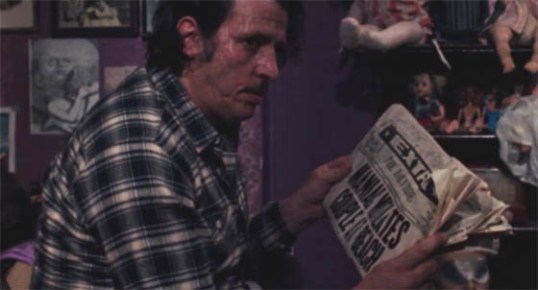
Frank lives in a run-down New York apartment. The grimy walls are covered with pictures that appear to have been cut out of magazines. The sheets on the bed look like they haven’t been washed in over a year and, for that matter, the sweaty and greasy Frank Zito looks like he could definitely use a shower as well. Frank lives alone but he has several blood-stained mannequins. He talks to the mannequins, cooing about how he just wants them to be nice to him and to stop abusing him. Just looking at the apartment, one can imagine the nauseating odor of sweet, blood, and who knows what else that seeps out whenever Frank Zito opens his door.
Frank Zito is also a murderer. The majority of the film is taken up with scenes of him stalking his victims. One extended sequences features him stalking a nurse through a subway station. Another scene features a rather nightmarish moment in which Frank, in slow motion, jumps on the hood of a car and shoots a man point blank with a shotgun. (The man is played by Tom Savini, who was also responsible for the film’s gore effects.) An innocent model is killed after Frank breaks into her apartment. “I just want to talk to you,” he says and maybe he actually believes that at first.
Frank has a chance meeting with a glamorous and beautiful photographer named Anna (Caroline Munro, playing a role that was rejected by Daria Nicolodi). Somewhat improbably, Anna is charmed by the socially awkward Frank and even agrees to go out with him. She’s touched when Frank shows up at the funeral of the model that he killed. “She didn’t have many friends,” Anna tells Frank.
Meanwhile, at the cemetery, Frank’s fate awaits….
Maniac is one of the most infamous and controversial grindhouse films ever made. The film’s atmosphere and the bleak visuals are the equivalent of being forced to look at New York while wearing glasses that somebody found floating in the sewer. The deaths are drawn out and Savini’s gore effects are disturbingly convincing. It’s a nearly plotless film about a man who hates women and what makes it scary as opposed to just exploitive is the fact that there are men like Frank Zito out there. Joe Spinell, who was one of the great character actors of the 70s, appeared in everything from The Godfather to Taxi Driver to Rocky but, in the end, it’s his performance as Frank Zito that he seems to be destined to be most-remembered for. Spinell is frightening, convincing, and disturbing as Frank Zito. Spinell was planning on doing a sequel before his untimely death, at the age of 52, in 1989.
(Spinell was a hemophiliac who bled to death after slipping in the shower. According to Maniac director William Lustig, when the police entered Spinell’s apartment, the first thing they saw was a huge amount of blood. The second thing they saw was a life-like replica of Spinell’s head sitting on top of the television. The head was a prop from Maniac and so convincing that the police originally assumed someone had broken into the apartment and decapitated him. Spinell’s death not only prevented him from playing Frank Zito for a second time but also kept him from reprising his role as Willie Cicci in The Godfather Part III.)
Maniac is not an easy film to defend but, if I had to, I would point out that Frank Zito is portrayed as being an unsympathetic loser throughout the entire film. He’s not some evil genius like Hannibal Lecter. He’s not a nonstop quip machine like Freddy Krueger. He’s not even enigmatic or superhuman like Michael Myers or Jason Voorhees. Instead, he’s a pathetic loser who can’t even win an argument with the voices in his head. Horror films all too often glorify or make excuses for serial killers. (Just look at all of the Ted Bundy films.) Maniac does not present Frank Zito as being anything other than a pathetic and twisted man and, as such, it’s probably one of the most realistic portrayals of a serial killer to be found on film. Frank Zito is not meant to be glorified, though I’m sure that went over the heads of more than a few people who saw this film when it first opened. It’s an ugly film but it’s about an ugly subject. It’s exploitive but ultimately it’s on the side of Zito’s victims.
The film was an early directorial credit of William Lustig, who worked as a production assistant on Dario Argento’s Inferno in order to see how Argento deal with shooting on location in New York. It was while working on Inferno that Lustig met Daria Nicolodi and offered her the part of Anna in Maniac. (Anna’s last name is D’Antoni, a clear nod to Nicolodi’s Italian roots.) Nicolodi was disgusted by the script and turned it down. (Caroline Munro accepted the role and was reunited with her Starcrashco-star, Joe Spinnell. Interestingly enough, even after all of the controversy created by Maniac, Munro and Spinell went on to co-star in The Last Horror Movie.) Lustig based his serial killer on David “Son of Sam” Berkowitz and named him after director Joe Zito, who would go on to direct Friday the 13th — The Final Chapter.
For all the controversy that has dogged Maniac over the years, it’s easy to forget that the film itself is surprisingly well-directed and acted. Caroline Munro bring some much needed class to the proceedings, even if the script requires her character to make some truly dumb decisions. And Joe Spinell was simply horrifying as Frank Zito. It’s not a pleasant film and if you ever find yourself in a home where the owner has a Maniac poster on the wall, I would suggest leaving immediately. It is, however, a landmark of grindhouse filmmaking.
In the 1985’s The Ripper, a straight-to-video, regional production, Richard Hartwell (Tom Schreier) is a college professor who teaches a class on Jack the Ripper. He discusses Jack the Ripper films, though he does at one point accidentally say that Murder By Decree starred Christopher Lee as Sherlock Holmes. (Lee did play Mycroft Holmes in The Private Life of Sherlock Holmes). He talks about some of the conspiracy theories that surround the Ripper. He encourages his students to try to move beyond the version of Jack the Ripper that’s been sold to them by Hollywood. Some of his fellow professors think that it’s a strange class and I kind of agree. I mean, can you really do an entire semester on just Jack the Ripper?
One day, while shopping at an antique store with his girlfriend, Carol (Mona Van Pernis), Richard comes across an antique ring. Even though the ring is way too big and kind of gauche, Carol loves it. Richard decides to secretly buy it for her. Unfortunately — and this is quite a coincidence considering Richard’s profession — the ring once belonged to Jack the Ripper. And, by putting the ring on his finger, Richard is allowing Jack the Ripper to come back to life in 80s Oklahoma!
Soon, local women are being murdered in ways that duplicate the grisly crimes of Whitechapel. The police suspect that it might be one of Richard’s students. When Richard sleeps, he’s haunted by dreams about the crimes, with the Ripper always appearing in the shadows. When the Ripper is finally revealed, it turns out that he’s …. TOM SAVINI!?
Well, kind of. Tom Savini does appear as Jack the Ripper towards the end of the film. Reportedly, he flew from Philadelphia to Oklahoma and shot his big scene in one day. For the rest of the film, though, the Ripper was played by a stand-in who was always either seen from behind or seen standing in the darkness with his face usually obscured. The few glimpses we do get of the stand-in’s face, it’s obvious that he looks very little like Tom Savini. (He does have a mustache and a beard but they both look like they were pasted on.) When Savini does actually play the Ripper, he seems slightly embarrassed by the whole thing. Tom Savini has always been a pretty good actor but, in The Ripper, he’s not given much to do other than glower at the camera with an evil look on his face. There’s little of the humor that Savini has brought to other roles and that’s a shame because Tom Savini can be a very charming actor when he’s allowed to poke fun at his image.
That said, I have to admit that I have a weakness for low-budget, regional films. In this case, it helps that I’ve spent enough time in Oklahoma, as both a visitor and an occasional resident, that I felt like I could immediately recognize almost every location in the film. There’s a DIY-charm to the film, one that is evident in both the stiff but likable performances and the gore effects, which are occasionally effective and occasionally rather cheesy. (A decapitation scene manages to be both.) Savini, I should mention, did not work on the special effects. This is a silly, nonsensical horror film that runs about 20 minutes too long but it’s just such a product of its time and place (i.e., Oklahoma in the mid-80s) that it’s rather fascinating as a time capsule. I mean, this may be the only Jack the Ripper film to feature an aerobics montage. It doesn’t get more 80s than that!
In 1990, long-time friends George Romero and Dario Argento collaborated on Two Evil Eyes, anthology film that was based on the writings of Edgar Allan Poe. An Italian-American co-production, Two Evil Eyes featured two stories. The first was directed by George Romero, while the second was directed by Argento.
The Facts In The Case of Mr. Valdemar
(Dir by George Romero)
The first story is Romero’s, a modernized version of The Facts In The Case of M. Valdemar.
Jessica Valdemar (Adrienne Barbeau) is the 40 year-old wife of 65 year-old, Ernest Valdemar (Bingo O’Malley). Jessica only married Ernest for her money and, now that he’s on his death bed, she and her lover, Dr. Robert Hoffman (Ramy Zada), have hypnotized to him to do and say whatever they tell him to say and do. Even though Ernest is essentially comatose, the hypnosis allows them to force Ernest to sign his name to legal documents and to tell his suspicious attorney (E.G. Marshall) that he indeed wants to leave all of his money to Jessica.
When Ernest dies while under the influence of hypnosis, Jessica and Robert attempt hide his body in the basement. But is Ernest really dead? Jessica is convinced that she hears groaning from the basement and she wonders if the hypnosis has somehow left Ernest in limbo, between life and death. Robert thinks that Jessica is being foolish but it turns out that she’s not. After much paranoia and betrayal, one conspirator is dead and the other is a part of the living dead.
Usually, I like Romero’s work but this one didn’t work for me. From the flat cinematography to the shallow performances, this film felt more like an episode of a television show than anything else. Perhaps if it had been a stand-alone film, Romero could have found a way to make the material a bit more cinematic. (The story’s final shot, of blood dripping on a hundred dollar bill, is the film’s strongest moment and the part that feels the most Romeroesque.) But as a shortened chapter of an anthology film, it fell flat.
The Black Cat
(Dir by Dario Argento)
The Dario Argento segment is based on several different Poe stories. While the majority of the story is taken from The Black Cat, it also contains elements of Annabel Lee, Telltale Heat, The Pit and the Pendulum, and Buried Alive. Though this segment doesn’t really work, it’s obvious that Argento is a fan of Poe’s work and, for other Poe fans, there’s a lot of fun to be found in all of the Poe references that Argento sneaks into his story.
Harvey Keitel stars as Rod Usher, a crime scene photographer who loves his work a bit too much. He’s excited about the fact that his book of photography is about to be published. He’s less happy about the fact that his girlfriend, Annabel (Madeleine Potter), has adopted a black cat that is constantly glaring at Rod. Rod is eventually driven mad by both the cat’s apparent hatred of him and the fact that the cat itself keeps showing up no matter how far he goes to get rid of it. (This film features violence against a cat, which I hated. But it also featured a cat getting revenge and I appreciated that.) Eventually, Rod’s paranoia leads to violence and murder.
Look, this is a film about a guy who has an obsessive hatred of a cat. Obviously, this is not a film that I’m going to enjoy because I love cats. That said, I can still judge the film on its merits, even if it’s not for me on a personal level. While Argento is able to build up a good deal of tension and suspense in this film, the overall film doesn’t work because Harvey Keitel, supremely talented actor that he is, was totally the wrong choice for Rod Usher. Keitel, who reportedly did not get along with Argento during filming, gave a self-indulgent performance that featured a lot of bellowing. It’s as if Keitel is trying to compete with the constantly moving camera. The problem is that a star of a film like this has to be the director and Keitel’s histrionics take the viewer right out of the story.
Considering all of the talent involved, Two Evil Eyes is a disappointment.
In the future, America is overrun by crime. Mad Dog Burne (Richard Grieco) and his brother, Little Henry (Randy Vasquez) escape from California death row. Mayor Eleanor Grimbaum (Susan Tyrell) wants the Burne brothers captured and she wants to be able to show the voters that she’s tough on crime. When brave police officer Alyssa Lloyd (Nicole Eggert) is killed by Mad Dog Burne’s gang, she is brought back to life in cyborg form by Prof. Crowley (Bruce Abbott) and, after a training montage, she is let loose on the streets as a police-backed vigiliante.
The Demolitionist owes an obvious debt to Robocop, with Nicole Eggert miscast as an expressionless cyborg who launches a one-woman/one-machine war on crime. The main problem is that The Demolitionist has none of Robocop‘s wit or its subversive subtext. Nicole Eggert is no substitute for Peter Weller and Richard Grieco is no Kurtwood Smith. “Booker’s a good cop!” I said whenever Grieco showed up.
The only interesting this is about the cast, which is full of horror veterans. Jack Nance plays the prison priest who counsels the Burne brothers before they escape their scheduled executions. Reggie Bannister plays the warden. Sarah Douglas plays a surgeon. Joseph Pilato is one of Mad Dog’s followers. And playing Mad Dog’s second-in-command is none other than Tom Savini. Finally, the city’s most popular journalist is played by Heather Langenkamp!
The Demolitionist demolishes almost the entire town but she still can’t come up with any way to make this stale Robocop rip-off feel fresh.
As some of our regular readers undoubtedly know, I am involved in a few weekly live tweets on twitter. I host #FridayNightFlix every Friday, I co-host #ScarySocial on Saturday, and I am one of the five hosts of #MondayActionMovie! Every week, we get together. We watch a movie. We tweet our way through it.
Tonight, for #ScarySocial, I will be hosting 1981’s The Prowler!
That’s right! It’s the most ruthless slasher film ever made, with special death effects from the great Tom Savini!
If you want to join us on Saturday night, just hop onto twitter, start the film at 9 pm et, and use the #ScarySocial hashtag! The film is available on Prime, Tubi, and a few other streaming sites. I’ll be there co-hosting and I imagine some other members of the TSL Crew will be there as well. It’s a friendly group and welcoming of newcomers so don’t be shy.
The following was posted on 4/6/2007 from my LiveJournal on Grindhouse (which is celebrating it’s 15th Anniversary). I’ll admit I respect Death Proof a bit more now than I did back then:
Gotta write fast. Have to jump into shower and head for work.
I got into the movie theatre at about 8pm, and spent the hour talking with a pair of film students from the School of Visual Arts. At 9 (an hour before the movie), the rest of the sold out crowd appeared. I was officially 3rd in line. Sweet. 🙂 I didn’t my preferred seat (the single one on the right reserved for patrons coming in with someone in a wheelchair), but did get a seat in the empty row (meaning I could stretch my legs, even better).
The short of it: Grindhouse is paying one low price for 2 bad movies, on purpose. You get 3 great built in trailers, and two mini movies. Between the two mini movies, I loved “Planet Terror” (the Rodriguez one) more than “Death Proof” (The Tarantino film), simply because Death Proof had too much of Tarantino’s conversational style that all of his films have. It’s like you’re listening to a conversation that absolutely doesn’t tie itself to any of the storyline’s major points. It’s just “cool” stuff, but I literally almost fell asleep until Kurt Russell showed up on screen. I think that if one knows to expect this from Tarantino, it comes across better. It’s like watching both Kill Bill volumes back to back. The first one’s cool and action packed, and the second one has some action (the chase scene alone in Death Proof had me wondering how they did that), but is so slow before getting there, you want to sigh.
Being a Charmed Fan, it was great to see Rose McGowan again, and there were so many cameos to laugh at. Fergie has a cameo, and Michael Biehn’s (“Hicks” from Aliens, Navy Seals) even in this. Where did they dig up these guys?
Grindhouse is easily a party film. I’d go see it again in the theatre, but I don’t see myself getting the DVD. It takes you back about a good 30 years, and does that really well. There are missing reels, serious jump cuts in the film and the sound sometimes cuts out. 🙂 In that sense, it’s really beautiful. The audience laughed and applauded, though there were some that at the end were like “Man, that sucked.” In the 60’s and 70’s, Grindhouse movies were pretty bad. I guess it’s like watching one of those old Hammer films, mixed in with a cheap horror flick. You have to walk into this movie not expecting “The Departed” for it to work. Just have fun with what you’re seeing and remember, this is what your parents sometimes saw in the movies (it should be noted that my parents went to something of a Grindhouse once – the movie they went to see was Night of the Living Dead. The other movie that was in the show was John Carpenter’s “Halloween”, which freaked my Dad out).
The music in particular is really great. Robert Rodriguez, Chingon, and a few friends come up with a sound for Planet Terror that’s in essence a John Carpenter like sound. If you have access to the Itunes Music Store, give it a listen (I bought it). Plus, if you’re a fan of some of the older movies out there, you’ll find references to some of Carpenter’s films in there (for example, one of the songs from “Escape from New York” is actually used in the film). The same occurs with the soundtrack from “Creepshow” – The story with the drowned couple. There are also tons of older Tarantino/Rodriguez references in there. One fellow actually yelled out a line, word for word, from what was on screen. It took me a second to realize the line came from “From Dusk Till Dawn”. Sweet.
The in betwen trailers are absolutely fantastic. If I were to get the DVD, it would probably be for this reason alone. You can tell that Rob Zombie, Edgar Wright (Shaun of the Dead) and Eli Roth (Hostel) really had fun with their pieces.
So, Grindhouse is worth seeing in theatre at least once with a bunch of friends, but know what you’re walking into. The movie can get gross at times and no young kid should even be brought near to this (we got carded to actually get into the theatre, and a Weinstein Rep. was on hand after the film to let us take surveys). Also before the movies, one of the teaser trailers is for Rob Zombie’s “Halloween”. I haven’t been so excited for a horror film like this since Zack Snyder’s version of “Dawn of the Dead”. This looks really good, and I’m wondering what Michael Myers is going to look like when someone like Tyler Mane (Sabretooth from the first X-Men movie) is playing him. That’s going to be creepy.
Among some horror fans, the 1981 film, The Burning, has long had a reputation for being one of the best of the many films to come out of the early 80s slasher boom.
I have to admit that the first time I saw it, my thought process went something like this: Oh great, more campers …. I can’t wait to see all of these people die …. God, these campers are annoying …. Thank God I never went to summer camp …. Wait, is that Jason Alexander …. when is the killer going to show up …. oh hey, that is Jason Alexander …. if I wanted to sit through a bunch of silly summer camp hijinks, I wouldn’t have gone searching for a horror film …. goddammit, was it really necessary for Jason Alexander to moon the camera …. wow, this movie is boring …. I don’t know who said this was scary but seriously …. oh God, now it’s turning into a movie about rafting …. I’ve about had it …. this movie is so bor–OH MY GOD WHAT THE HELL JUST HAPPENED! AGCK! THERE GO HIS FINGERS OH MY GOD….
Seriously, The Burning is a film that requires a bit of patience. You got to sit through a lot of silliness before you actually get to the horror but once you do …. oh my God! It’s intense. The killer in The Burning is Cropsy, a former groundskeeper who was set on fire by a bunch of campers years ago. Now, he’s everyone’s worst nightmare — a madman with gardening shears. It takes a while for Cropsy to really get into the spirit of things. In fact, for a good deal of The Burning, no one is even talking about Cropsy, which is always a mistake when you’re trying to make a movie about a killer in the woods. A young camper named Alfred (Brian Backer) keeps thinking that he see Cropsy sneaking around the camp but nobody believes him, largely because Cropsy doesn’t ever do anything to let people know that he’s back and ready to demonstrate how gardening tools can be used as an instrument of revenge.
However, once Cropsy actually gets going, he is terrifying! The Burning is a good example of the type of horror movie that was made before the Nightmare on Elm Street series introduced the idea that killers could not only talk but also tell a lot of corny jokes. Cropsy doesn’t speak. Crospy doesn’t joke. All Cropsy does is kill. What makes Cropsy especially disturbing is that — much like the killer in The Prowler — he seems to get a lot of joy out of killing as brutally as possible. He’s not Jason or Michael, killers who killed because that’s all they knew how to do. Cropsy plots and calculates and hides and is basically everyone’s campfire nightmare come to life.
Now, as I said before, it does take Cropsy a while to get started. And we do end up spending a lot of time watching campers do stupid things. Yes, Jason Alexander is one of the campers. He not only has hair but I think he’s supposed to be a teenager in this film. He was 21 when the film was shot and he looks like he’s about 35. He delivers his lines in such a way that it’s impossible not to think of The Burning as being a lost episode of Seinfeld where George Costanza goes camping. On the plus side, he does get some vaguely funny lines, which is more than his co-stars get.
Speaking of co-stars, keep an eye out for Holly Hunter. She was dating Jason Alexander at the time (as well as rooming with Frances McDormand) and she makes her film debut as one of the campers. She gets one line. “What if they don’t come back?” It’s a good question. What if they don’t? (Cue dramatic music!)
Anyway, The Burning is a slasher film that requires some patience but when it needs to be scary, it gets the job done. (The gore effects are by the one and only Tom Savini and yes, they are shocking and a bit disturbing. If you’ve ever wanted to know what losing four fingers at once would look like, this is the film for you.) It’s a bit too padded for its own good but Cropsy is an effective villain and the movie actually catches you by surprise regarding who survives and who doesn’t. Amazingly, there was never a sequel to The Burning. Personally, I don’t think it’s too late. I want to see Jason Alexander return to the camp and finish Cropsy off, once and for all!




 Through the Shattered Lens