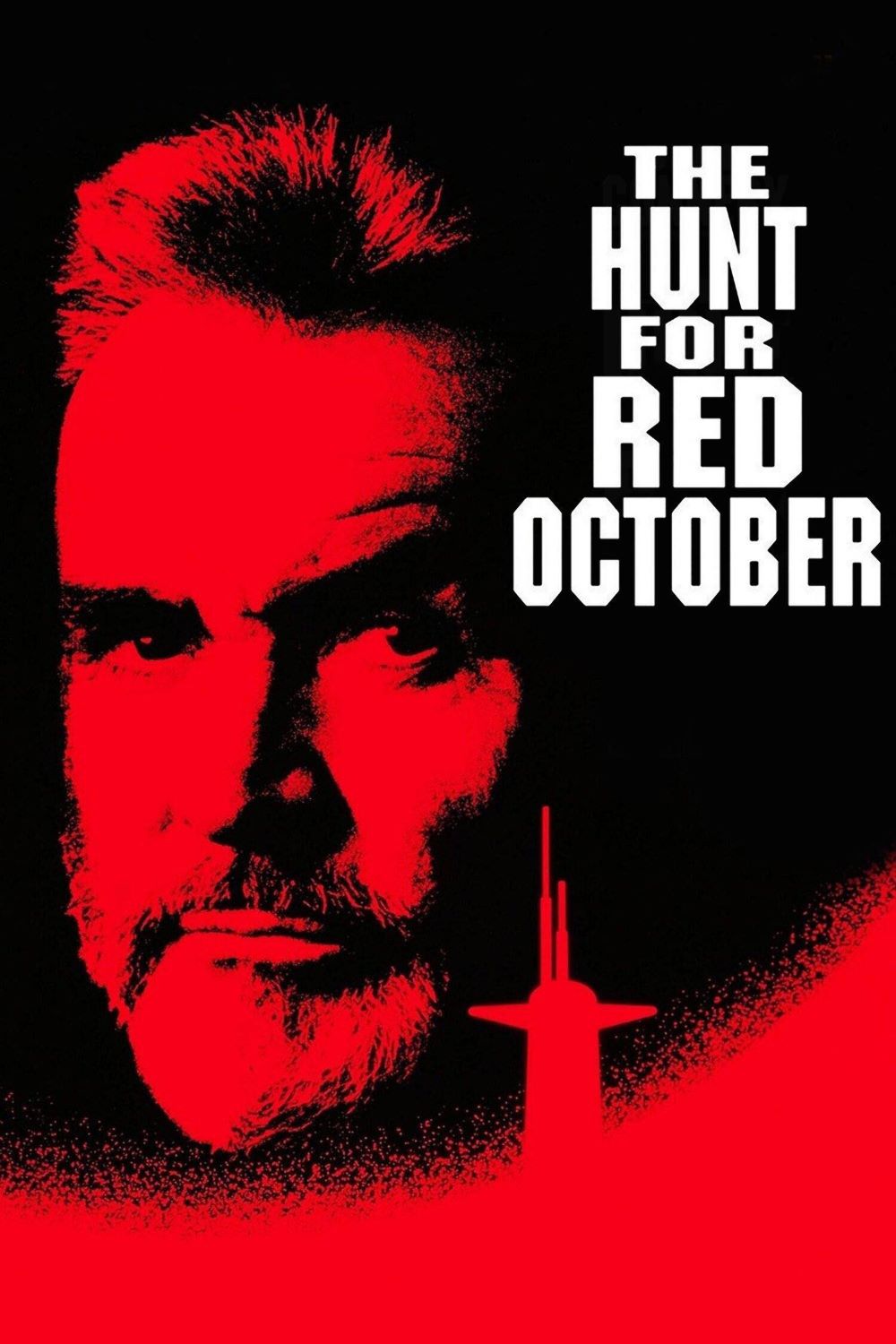
Review: The Hunt for Red October (dir. by John McTiernan)


“I’m a politician. Which means that I am a cheat and a liar, and when I’m not kissing babies, I’m stealing their lollipops.” — Dr. Jeffrey Pelt, National Security Advisor

The Hunt for Red October glides into the tail end of Cold War cinema like a stealthy sub cutting through midnight swells, packing a smart mix of spy intrigue and nail-biting underwater showdowns that keep you locked in from the opening credits. Directed by John McTiernan, fresh from helming Die Hard, this 1990 adaptation of Tom Clancy’s doorstopper novel smartly distills pages of naval geekery into a taut, propulsive thriller where Soviet skipper Marko Ramius—Sean Connery in full brooding mode—pilots the formidable Red October, a behemoth sub with a hush-mode propulsion system that ghosts past detection like a shadow in fog.

McTiernan shines in wrangling the script from Clancy’s tech-heavy tome, slicing through the babble to propel the story with crisp momentum and unrelenting suspense, turning potential info-dumps into pulse-quickening beats that hook casual viewers and sub nerds alike. The premise grabs fast: Ramius’s bold maneuvers ignite a transatlantic frenzy, with U.S. and Soviet forces locked in a paranoid standoff over what looks like an imminent crisis. That ’80s-era distrust simmers perfectly here, crammed into a runtime that pulses with fresh urgency decades later, amplified by those dim-lit sub corridors in steely teal tones that squeeze the air right out of the room.

Alec Baldwin embodies Jack Ryan as the reluctant brainiac from CIA desks, sweaty and green around the gills yet armed with instincts that cut through official noise like a periscope through chop. Pulled from family downtime—teddy bear in tow—he injects everyday stakes into the global chessboard, proving heroes don’t need camo or cockiness, just smarts and stubbornness. Connery’s Ramius dominates as a haunted vet with a personal chip on his shoulder, steering a tight-knit officer corps including Sam Neill’s devoted second-in-command, their quiet bonds hinting at deeper loyalties amid the red menace.

Standouts fill the roster seamlessly: James Earl Jones lends gravitas as the steady Admiral Greer backing Ryan’s wild cards; Scott Glenn commands the American hunter sub with laconic steel; Jeffrey Jones brings quirky spark to the sonar savant whose audio tricks flip the script on silence. The dialogue crackles with shorthand lingo and understated jabs, forging a crew dynamic that’s as pressurized as the hull plates, pulling you into hushed command post vibes without a whiff of cheesiness.

​​

McTiernan elevates the genre by leaning on wits over blasts—thrilling pursuits deliver without dominating, letting mind games and split-second calls drive the dread, all while streamlining Clancy’s minutiae into seamless propulsion. Gadgetry gleams without overwhelming: the sub’s whisper-quiet tech sparks clever cat-and-mouse in hazard-filled depths, ramping uncertainty to fever pitch. Pacing builds masterfully from war-room skepticism—Ryan battling brass skepticism—to heart-in-throat ocean dashes, every frame taut as a bowstring. Practical models and effects ground the peril in gritty tangibility, no digital gloss, evoking Ice Station Zebra‘s frosty traps but streamlined into a relentless machine that dodges the older film’s drag. It’s a clinic in balancing spectacle and smarts, where tension coils from isolation’s cruel math: one ping too many, and it’s lights out.

On the eyes and ears front, the movie plunges into submersed nightmare fuel—consoles pulsing crimson in battle stations, scopes piercing mist-shrouded waves, silo bays looming like sleeping leviathans. McTiernan tempers his action flair for thinker-thrills; Basil Poledouris’s great orchestral score surges with iconic power through the chases—those brooding horns, choral swells, and rhythmic pulses echoing engine throbs have etched into legend, pounding your chest like incoming cavitation and elevating every dive. Audio wizardry seals the immersion: hull groans, ping echoes, bubble roars craft a metallic tomb where errors echo eternally. Flaws peek through—early scenes drag with setup chatter, foes skew broad-stroked—but the core hunt erases them, surging to a sharp, satisfying close that nods to Ryan’s budding legend without overplaying the hand.

’90s tentpole lovers and thaw-era history fans find a benchmark here, as the film plays the long con of trust amid torpedoes, fusing bombast with nuance that reboots chase in vain. It bottles superpower jitters spot-on—frantic commands clashing with strike debates—yet softens adversaries via Connery’s world-weary depth and Neill’s subtle conviction. Endless rewatches uncover gems: crew hints dropped early, sonar hacks foreshadowing real tech leaps. Baldwin’s grounded Ryan—chopper-barfing, suit-clashing, chaos-navigating—earns triumphs the hard way, contrasting Das Boot‘s bleak grind with upbeat ingenuity that feels won, not waved. Poledouris’s motifs linger post-credits, a symphonic anchor boosting replay pulls.

Endurance stems from mastering sub-horror’s essence: solitude sharpening choices, where flubs invite apocalypse. Ramius embodies defector realism—war-weary idealist mirroring history’s turncoats—while Clancy’s specs (sub classes, velocities) anchor without anchoring down. McTiernan sidesteps flags; zero flag-waving, pure operator craft in dodges and climactic finesse that blends brains with boom. Quirks delight—the premier’s bluster, aides’ cool calculus—padding a 134-minute gem that exhales you surfacing, amped. Expands on score’s role too: “Hymn to Red October” choral rise mirrors Ramius’s quiet rebellion, threading emotional undercurrents through mechanical mayhem, a Poledouris hallmark outlasting the film.

Bottom line, The Hunt for Red October captivates via cerebral kick—shadow games in fluid physics, intellect over muscle, audacious plays punking empire folly. Sparks post-view chin-strokes on allegiances and risks. Connery’s gravelly “One ping only, Vasily” endures as gold; storm-watch it, trade sofa for sonar station—raw thrill spiked with savvy. Sub saga staple? This silent stalker nails every target.

Retro Television Review: Miami Vice 3.6 “Shadows In The Dark”


Welcome to Retro Television Reviews, a feature where we review some of our favorite and least favorite shows of the past!  On Mondays, I will be reviewing Miami Vice, which ran on NBC from 1984 to 1989.  The entire show can be purchased on Prime!

This week, Crockett loses it!

 Episode 3.6 “Shadows In The Dark”

(Dir by Christopher Crowe, originally aired on October 31st, 1986)

Crockett and Tubbs are assigned to work with Lt. Ray Gilmore (Jack Thibeau) in investigating a series of burglaries.  The burglar has broken into several houses.  Each time, he eats whatever meat is in the house, he draws a picture on the wall, and then he steals a pair of pants.  Gilmore is convinced that the burglar is working his way towards doing something even more serious and deadly.

Crockett and Tubbs soon discover that Gilmore is suffering from intense burnout.  Years spent getting inside the minds of burglars and working nights have left Gilmore angry and erratic.  When Gilmore finally snaps and starts shooting an icebox, Crockett and Tubbs assume that the investigation is over.  Instead, Castillo informs them that, with Gilmore now committed to a mental hospital, they will now be in charge of the investigation.

Soon, Crockett finds himself becoming just as obsessed as Gilmore.  He starts staying up late.  The few instances in which he does sleep, he’s woken up by intense nightmares.  Crockett becomes obsessed with the mysterious burglar, to the extent that Castillo and the rest of the Vice Squad start to worry that he’s losing his mind.  In the end, Crockett does manage to figure out what house the Shadow (Vincent Caristi) will be targeting next.  Both the Shadow and Crockett break into the house at the same time, leaving the homeowner terrified as the two men fight.

“I’m a cop!  I’m a cop!” a desperate and wild-eyed Crockett shouts at her while holding up his badge.

This was a dark episode, one that played out more like a mini-horror movie than a typical episode of Miami Vice.  (Appropriately, this episode aired on Halloween and was clearly made with the scary season in mind.)  While I do think Crockett’s descent into madness happened a bit too quickly, I can’t deny that Don Johnson did a great job as the unhinged Sonny Crockett.  When he desperately yelled “I’m a cop!,” it was obvious that he was trying to convince himself as much as the poor woman who owned the house.  Though this episode was definitely a showcase for Don Johnson, Edward James Olmos did get plenty of opportunities to employ the Castillo stare as Crockett grew more and more unstable.  Finally, Vincent Caristi was truly frightening as the Shadow.

Interestingly enough, the episode’s plot is similar to Manhunter, which came out earlier that year.  The episode even features a scene where Crockett, Tubbs, and Gilmore visit a former burglar so that they can get his insights on their current prey.  (Manhunter, of course, was the first film to feature Dr. Hannibal Lecter being consulted about a serial killer.)  Miami Vice‘s  producer and creator, Michael Mann, directed Manhunter and, though he didn’t direct this episode, it’s clear that Shadow In The Dark was meant to be a bit of an homage to the film.

Season three has, so far, been a bit uneven but this was a good and offbeat episode.

Late Night Retro Television Reviews: Nightmare Café 1.4 “The Heart of Mystery”


Welcome to Late Night Retro Television Reviews, a feature where we review some of our favorite and least favorite shows of the past!  On Mondays, I will be reviewing Nightmare Café, which ran on NBC from January to April of 1992.  The entire show is currently streaming on YouTube!

This week, a dying detective is allowed a chance to solve one last case.

Episode 1.4 “The Heart of Mystery”

(Dir by John Harrison, originally aired on March 20th, 1992)

This week’s episode of Nightmare Café is the first to largely focus on a guest star.  While Jack Coleman and Lindsay Frost do play roles in this week’s episode and Robert Englund’s Blackie actually gets to do more than usual, the majority of the episode is still dominated by Timothy Carhart as Detective Stan Gates.

One dark night, Stan chases a young thief (played by Alfonso Quijada) into a dark alley.  When the thief pulls a gun on him, Stan explains that he’s a police officer and he’s not trying to take the thief to jail.  He explains that he knows the young man is on drugs and is not in full control of his actions.  He asks the young man to give him the gun.

Meanwhile, in the nearby Nightmare Café, a bored Frank and Fay are playing a game of Clue.  (Colonel Mustard did it.)  Stan walks into the café and asks for a cup of coffee.  Robert Englund’s Blackie suddenly appears sitting in a booth and eating from a bag of popcorn.  He introduce himself to Stan and then leads Stan over to a window.  Looking through the window, Stan can see himself and the thief in the alley.  The thief has fired the gun and the bullet appears to be suspended in the air.  Blackie explains that the café has slowed down time to give Stan the chance to solve one last case before the bullet hits and kills him.

The case involves the death of Charlotte Bening (Laura Mae Tate), a wealthy woman with whom Stan was in love.  One night, when Stan was investigating a break-in at her mansion, Stan fired his weapon at what he believed to be the burglar.  Someone hit him from behind, knocking him out.  When Stan woke up, he discovered that the person who was actually shot was Charlotte!  While the police ruled it an accidental shooting, Stan was convinced that someone specifically set him up.  Could it have been Charlotte’s brother, a frustrated artist named Philip (Denis Forest, who also appeared in last week’s episode of Friday the 13th)?  Or could it have been …. well, there is no one else, actually.  The great Lochlyn Munro does make a brief appearance as one of Charlotte’s more aggressive suitors but he’s only onscreen for a few minutes.  There’s not much suspense to this mystery.

That said, I did enjoy this episode of Nightmare Café, which not only pays homage to film noir but which also features Robert Englund at his quippy best as he passive-aggressively pushes Stan into solving the case.  Fay does briefly leave the café so that she can pretend to be the producer of a true crime series and interview some of the people who knew Charlotte and Stan but, for the most part, this episode is centered around Timothy Carhart and Robert Englund and both of them carry things nicely.  Though the episode’s format probably confused those who, on the basis of the previous three episode, didn’t realize that Nightmare Café was originally envisioned as being an anthology series, The Heart of Mystery holds up very well.

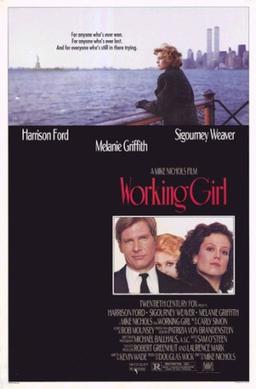
Lisa Reviews An Oscar Nominee: Working Girl (dir by Mike Nichols)


(With the Oscars scheduled to be awarded on March 4th, I have decided to review at least one Oscar-nominated film a day.  These films could be nominees or they could be winners.  They could be from this year’s Oscars or they could be a previous year’s nominee!  We’ll see how things play out.  Today, I take a look at the 1988 best picture nominee, Working Girl!)

Welcome to the 80s!

Yes, Working Girl is definitely a film of its time.  It’s a film that’s obsessed with big things: big dreams, big offices, big money, and big hair.  It’s a movie where the heroes talk about hostile takeovers and where everyone’s dream is to eventually to be an executive on Wall Street.  You know all of those people who claim that The Big Short is the greatest movie ever made?  I can guarantee that the majority of them would totally hate every character in Working Girl.  Working Girl is such a film of the past that it even features Alec Baldwin doing something other than bellowing at people.  In fact, Baldwin’s actually sexy in Working Girl.  It was strange to see him in this film and realize that he was the same actor who currently spends all of his time picking fights on twitter and defending James Toback.

Of course, Alec Baldwin has a relatively small role in Working Girl.  He plays Mick Dugan, the type of blue-collar guy who gives his girlfriend lingerie for her birthday (“I just wish you would get me something that I could wear outside,” she says as she tries it on) and who then proceeds to cheat on her while she’s off at work.  From the minute we first meet Tess McGill (Melanie Griffith), we know that she deserves better than Mick.

Tess is a professional administrative assistant.  She’s just turned 30 but she’s not ready to give up her dreams and settle for a life of fighting off coke-snorting executives and coming home to some guy like Mick.  (Speaking of early performances from infamous actors, one of the coke-snorting executives is played by Kevin Spacey.)  Tess has got a bachelor’s degree in Business.  As she puts it, she has a “mind for business and a bod for sin.”

She’s also got a new boss, an up-and-coming executive named Katharine Parker (Sigourney Weaver).  It turns out that Katherine is 29 years old.  (“I’ve never worked for someone younger than me before,” Tess says as Katherine gives her a condescending smile.)  Katharine encourages Tess to think of her as being a mentor.  If Tess has any ideas for investments, she should feel free to bring them to Katharine.  Of course, when Tess does so, Katharine claims that her bosses shot the idea down.  It’s only after Katharine breaks her leg in a skiing accident and is laid up in Europe that Tess discovers that Katharine has actually been stealing her ideas and not giving her any credit for them.

What is Tess to do?  Well, she does what any of us would do.  She passes herself off as an executive and presents her idea to Jack Trainer (Harrison Ford) herself.  Jack is impressed with the idea but he’s even more impressed with Tess.  Of course, complicating things is that Jack was once in a relationship with Katharine and Katharine still thinks that she’s going to eventually marry Jack.  And, of course, there’s the fact that Tess is lying about actually being an executive…

Working Girl is a frequently amusing film, elevated by performances of Melanie Griffith and, in the role of Tess’s best friend, Joan Cusack.  Add to that, Harrison Ford is remarkable non-grouchy as Jack Trainer and Sigourney Weaver appears to be having the time of her life playing a villain.  Even as I laughed at some of the lines, here was a part of me that wished that the film had a bit more bite.  At times, Working Girl tries too hard to have it both ways, both satirizing and celebrating Wall Street culture.  In the end, the film works best as a piece of wish-fulfillment.  It’s a film that says that not only can you win success and Harrison Ford but you can get your bitchy boss fired too.

Despite being a rather slight (if likable) film, Working Girl was nominated for Best Picture of 1988.  However, it lost to Rain Man.

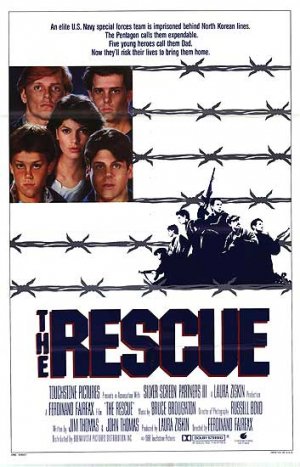
A Movie A Day #140: The Rescue (1988, directed by Ferdinand Fairfax)


A group of Navy SEALs enter North Korea on a mission to destroy a submarine that has fallen into Kim Il-sung’s hands.  They destroy the submarine but are captured before they can safely cross the border back into South Korea.  With the SEALs facing a show trial and probable public execution, Admiral Rothman (James Cromwell) draws up a plan to rescure them.  The U.S. government, not wanting to escalate the situation, shoots down the plan.  (Americans giving up?  Is Carter still president?)  However, Rothman’s nerdy son, Max (Marc Price), gets a hold of the plan.  Before you can say “Why didn’t anyone else think of this?”, he and the children of the SEALs are sneaking into North Korea and rescuing their fathers!
This is a pure 1980s film.  Like Red Dawn, it shows that America is such a great country that even our teenagers are stronger than the average well-armed communist.  Of the actors playing the rescuers, the best known is Kevin Dillon.  He plays the rebel who smokes cigarettes and rides a motorcycle.  Though their relationship may be strained, his father (Edward Albert) is still happy when Dillon suddenly shows up in North Korea.  Soon, father and son are working together to blow up America’s enemies.  This movie’s about as dumb as they come and it’s another example of Hollywood presenting North Korea as just being the junior varsity version of China but it’s also undeniably entertaining, especially if you don’t care about things like plausibility.  Watch it the next time that Kim Jong-un threatens to blow you up.  Who needs Chuck Norris when you’ve got Kevin Dillon?


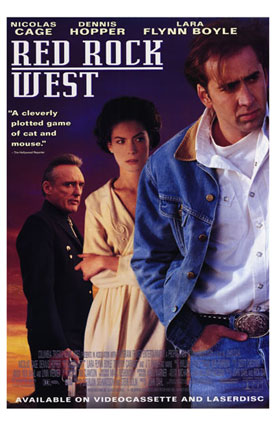
A Movie A Day #90: Red Rock West (1992, directed by John Dahl)


The place is Red Rock, a little town located in the middle of nowhere Wyoming.  When a man from Texas (played by Nicolas Cage) wanders into his bar, the owner, Wayne (J.T. Walsh), assumes that the man is Lyle From Dallas, the semi-legendary hit man who Wayne has hired to kill his wife, Suzanne (Lara Flynn Boyle).  Wayne gives the man half of his payment in advance and promises the other half after Suzanne is dead.  What Wayne doesn’t realize is that Lyle From Dallas is not actually Lyle From Dallas.  Instead, he is a drifter named Michael who has just recently lost his job.  Michael takes Wayne’s money but, when he sees Suzanne, he tells her that Wayne wants her dead.  Suzanne responds by offering to pay Michael to kill Wayne.  Michael mostly just wants to leave town but his every effort is thwarted, with him continually only managing to get a mile or two out of town just to then find circumstances forcing him to once again pass the Red Rock welcome sign.  Meanwhile, the real Lyle From Dallas (Dennis Hopper) has shown up and he is pissed.

Red Rock West is a clever and energetic neo noir that plays out like the child of a marriage between the Coen Brothers and David Lynch.  Like the Coens’ Blood SimpleRed Rock West is a violent movie that is full of twist and turns and features characters who are often confused and rarely understand what is actually going on.  From David Lynch, it borrows both Twin Peaks‘s Lara Flynn Boyle and Blue Velvet‘s Dennis Hopper.  Red Rock West was made when Nicolas Cage still gave a damn and it also shows why, during his short career, J.T. Walsh was everyone’s favorite duplicitous character actor.  Hopper is his usual crazy self and Boyle is a sultry and sexy fatale.  Red Rock West is one of the best neo noirs of the 1990s.