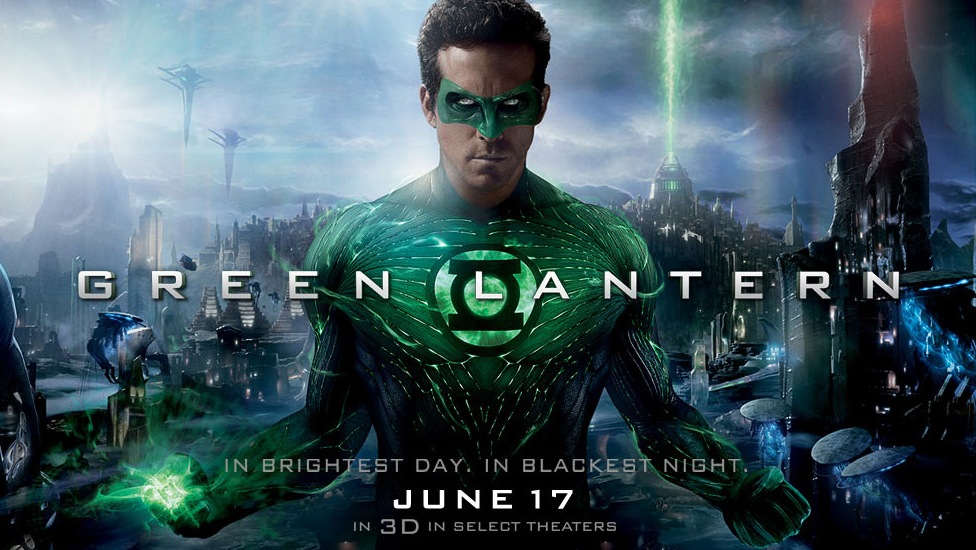
The WonderCon 2011 exclusive trailer and footage was a major step in creating major buzz and hype for Warner Brothers’ and DC Entertainment upcoming superhero film Green Lantern. With just a little over a month left before the film premieres the second (most likely the final trailer for the film) trailer has been released and whatever doubts early marketing and ads the film seemed to give rise to have gone away with this final release.
Green Lantern is sort of the Iron Man of the DC Comics pantheon in that he’s one of the more powerful characters in that universe, but he never got to the level of iconic status as Superman and Batman. There’s a reason why the only DC comic characters to have sustained any sort of film franchise have been Superman and Batman. The Green Lantern character was never about fighting evil on Earth. His fight was always on a much more cosmic-scale and this trailer shows that the danger in the Green Lantern is cosmic in scale even. The last superhero to attempt such a concept story-wise was the Fantastic Four sequel with Silver Surfer and Galactus. That didn’t turn out as well as many hoped it would. Here’s to hoping that Green Lantern will succeed where the Fantastic Four sequel failed.
Green Lantern is set for a June 17, 2011 release. It will come out in both 2D and 3D (RealD and IMAX 3D).
With the recent passing of director, Sidney Lumet, I decided to watch one of Lumet’s best-known films, the 1976 best picture nomineeNetwork.
Network tells the story of Howard Beale (played by Peter Finch). Howard is a veteran news anchor at a fictional television network. Because his ratings are in decline, Howard is fired. Howard reacts to this by announcing that he will commit suicide at the end of the next broadcast. Ironically, so many people tune in to see Howard kill himself that his ratings improve and Howard gets to keep his job under the watchful eyes of news director Max Shumacher (William Holden) and network executive Dianne Christiensen (Fay Dunaway).
At the same time, Max and Dianne are adulterous lovers. The course of the film’s narrative finds Max abandoning his wife (Beatrice Straight) and Dianne, who is described as a “child of the tube,” enthusiastically trying to produce an early reality television show starring a group of Marxist revolutionaries. They do this under the paranoid eyes of network president Frank Hackett (Robert Duvall) and Frank’s boss, the corrupt Arthur Jenson (Ned Beatty).
However, Howard Beale isn’t just an over-the-hill news anchor. He’s actually a seriously mentally ill man who hears voices and who starts to see himself as some sort of messiah. Eventually, this leads to a disheveled Howard giving a crazed speech in which he encourages viewers to yell, “I’m as mad as Hell and I’m not going to take it anymore!” Yes, this is the famous scene that is always used whenever some pompous media jackass wants to criticize the current state of television. Even though I think it’s one of the most overrated scenes in history, here it is:
Anyway, after this scene, Dianne starts to promote Howard as the “Mad Prophet of the Airwaves” and Max gets all outraged over how the news no longer has any integrity (bleh, Max is kinda full of himself) and eventually, Howard’s mad rantings get the attention of Arthur Jenson who has plans of his own for Howard. The whole thing eventually ends on one of those rather dark notes that’s impressive the first time you watch it but just seems more heavy-handed and clumsy with subsequent viewings.
As you might be able to tell from my review, I almost felt as if I was watching two different movies when I watched Network. For the first hour, the movie is a sharp and clever satire on the media. The characters are sharply drawn, the performance are full of nuance, and even the villainous Dianne is allowed a bit of humanity. And then, Howard gives his famous “mad as Hell” speech and the entire freaking film pretty much just falls apart as suddenly, all the characters start to act like cartoons. The film’s satire becomes so heavy-handed that you actually find yourself wanting to watch something mindless and brainless just because you know it would piss off self-righteous old Max. The actors stop acting and instead concentrate on shouting. Whatever humanity Dianne had been allowed suddenly vanishes and she just becomes yet another stereotypical “castrating bitch.” Max gets to spend a lot of time telling her why she’s worthless and it pretty much all comes down to the fact that 1) she’s under 40 and 2) she has a vagina. (Never mind the fact that Max has abandoned his wife, apparently men are allowed to be assholes.) By the time the 2nd half of the film ends, you don’t care about whatever the film’s message may have been. You’re just happy that everyone has finally shut up.
As I sat through the second half of this film, it soon became apparent to me why Aaron Sorkin has continually cited Network‘s screenwriter Paddy Chayefsky as a major influence. Chayefsky won an Oscar for writing Network and he’s constantly cited as one of the greatest screenwriters of all time but, quite frankly, his script isn’t that good. Much like Sorkin’s work, you’re aware of the screenplay not because of what the characters say but because they say so much. This is the type of film that is often wrongly called prophetic by bitter old men. This is largely because the script itself was written by a bitter old man. The only true insight one gets from this movie is the insight that the old will always view the young and the new as a threat.
And yet, even as the second half of the film collapses around us, Network still holds our attention. We’re still willing to stick around to see how all of this ends (and keep an eye out for a 17 year-old Tim Robbins who made his uncredited film debut at the end of Network). This has nothing to do with anything written by Paddy Chayefsky and everything to do with the direction of Sidney Lumet. I once read somewhere that you can’t make a good film out of a bad script. I’m not sure who said that though it has a definite William Goldman sound to it. Well, if nothing else, Network proves that this is not always the case.
To me, there is no more fitting tribute to Sidney Lumet than to say that he somehow managed to create something worthwhile out of Network.
I posted just recently that Warner Brothers and DC Entertainment had been dropping the ball when it came to promoting their upcoming superhero action-adventure film slated for this summer blockbuster season. Green Lantern had its first teaser released around November of 2010 and the reception to that trailer was lukewarm at best and dismissal of the film at it’s most vocal.
It’s been almost 4 months since that disastrous attempt at promoting what would be Warner Brothers’ biggest film of the 2011. It looks like Warner Brothers and those in charge of promoting their films may have just learned a valuable lesson in releasing promotion materials when footage needed to spice it up for the target audience is not ready.
WonderCon 2011 at San Francisco has become Green Lantern central as the studios in charge of the film have released not just a kickass official theatrical poster for the film, but a 9-minute sizzle reel for those lucky enough to get a seat in the film’s panel at the Esplanade Ballroom at Moscone Center South. For those who weren’t able to see that 9-min footage the people at Warner Brothers have been gracious enough to release an abridged 4min and 3 second version into the interwebs for everyone to witness.
Even just looking at this abridged version of the WonderCon-exclusive footage has helped in dispelling much of my apprehension towards the success and workability of this film as a live-action blockbuster. The footage goes a long way in setting the tone of the film. Green Lantern has always been part of the cosmic tapestry of the overall DC Universe and the filmmakers seem to have found a way to show that epic cosmic side of the character and do it without making it look cheesy (though some of the CGI effects on the non-human members of the Green Lantern Corps could still use much tuning up).
Except for the part where Jordan is trying to figure out the Green Lantern oath in his living room the footage seems very serious in tone with little comedic beats like the teaser. I would hope that the film does have some comedic beats to it since this is Ryan Reynolds and early Hal Jordan wasn’t always the serious, gloomy gus he turned out later on in his Green Lantern run.
Green Lantern is slated for a June 17, 2011 release.
Steven Spielberg’s War of the Worlds shows that he hasn’t lost his touch when it comes to creating blockbuster spectacle. While he has spent much of the 2000’s creating dramatic films (The Terminal, Catch Me If You Can and Munich) he hadn’t made a film which spoke epic in both spectacle and themes. He had made two unique films with sci-fi themes with A.I. and Minority Report, but still they lacked the size and oomph of Spielberg’s past blockbusters. It took him remaking for the current generation a classic sci-fi story to bring us back the Spielberg many grew up with. His take on H.G. Wells tale of aliens invading Earth was both grandiose in it’s set-up, but he was also able to deftly weave a very personal story within the larger scheme of the narrative.
Working from David Koepp and Josh Friedman’s adaptation of the classic H.G. Wells novel, Spielberg goes back to his roots as a maker of thrillers that first showed his talents as a director. War of the Worlds has its spectacular CG moments when the alien Tri-Pods first rise up and out of the ground to the look of awe and fear from people witnessing the event. Spielberg begins the film’s unrelentless tension from these scenes and never lets go. Once the Tri-Pods start unleashing their death-rays on the populace and whatever else is in their way the film starts moving at breakneck speed. It’s these same apocalyptic scenes of the alien’s extermination of humans that has prompted critics (both positive and negative) to bring up Spielberg’s use of 9/11 imagery. From the clouds of ash and floating pieces of clothes to the sight of people running in panic as destruction rains upon them from out of nowhere.
Some critics have labeled Spielberg’s film as exploiting the horror of 9/11 and its aftermath, yet when a film like 28 Days Later use the same imagery and themes these same critics applaud the director of this film as daring. Its an unfair criticism of Spielberg and just shows how some people just seem to use the events of 9/11 as a crutch. Yet, it is this same use of people vaporised into nothing but ash and clothng that adds to the tension and horror. It is easy to use blood and gore to bring up a feel of horror, but Spielberg one up’s this and forgo grand guignol scenes. His technique actually brings an inhuman and alien quality to the death and destruction on the screen. From the moment the aliens arrive Spielberg lets us know that this is a war that has not been seen on Earth.
Spielberg and his writers have stuck pretty close to what Wells’ wrote in the original novel, but have decided to look at the story through the eyes of a father and his son and daughter. This gives the film a more personal, disjointed and chaotic feel. There’s no scenes of the government powerbrokers debating and deciding how best to combat the aliens and their machines. No scenes of scientists trying to figure out how best to fight and get through the aliens’ defenses. In fact, War of the Worlds is the anti-Independence Day. What we get instead is a story of a man and his children trying to just survive the apocalypse occuring around them as best as they can. This choice by Spielberg and his writers to go this route is best shown in a scene where Tom Cruise’s character with his kids run into a convoy of military vehicles heading towards the frontline. We see Humvees, M1A2 Main Battle Tanks and other assorted military hardware and hundreds of soldiers. We can hear the sound of the battle just over the ridge of a hill, but just like Cruise’s character we do not actually see the battle happening. We hear snippets of commands and reports from the soldiers around Cruise. Spielberg could’ve easily panned the camera up over the ridge to see how the battle was progressing, but he stays his hand focuses instead on the dad and his family. It’s easier to go the route that Bay or Emmerich would take and show the sturm und drang, but that wasn’t the story Spielberg was trying to tell.
ILM’s work in creating the alien Tri-Pods and the subsequent terraforming the aliens begin were some very good work from an FX company with a history of impressive work. The Tri-Pods kept the original H.G. Wells description from the novels but gave them a modern take. While the George Pal version of the alien ships remain classic sci-fi icons these new Tri-Pods in Spielberg’s War of the Worlds definitely conveyed alien menace and destruction the moment they began to come out of the ground. It was a joy as a sci-fi fan to actually see that Spielberg and the writers decided to show just how menacing the alien invaders were in the way they began to terraform the planet to suit their needs. It definitely put a new definition to the term “the blood is life”.
The acting is what you expect from a Spielberg/Cruise collaboration. Cruise is actually very believable as a loser father who seem to look at his kids as more of a hindrance and a scheduled paternal duty than something he actually enjoys and looks forward to. Some of the best scenes Cruise has in the film are quiet ones between him and his daughter (played by Dakota Fanning) where he realizes that he really doesn’t know his daughter that well and can’t even remotely figure out how to calm her down and make her feel safe. When his daughter asks him to sing her a lullaby, the look of incomprehension at not knowing any showing on Cruise’s face is just brilliant. The one misfire in terms of characters in the film is Tim Robbins. The sequence in the film where they meet up with his paranoid and slowly going nuts character is actually very good in terms of ratcheting up the tension, but Robbins’ performance was more funny than anything else. Spielberg had created such a doom and gloom atmosphere that Robbins’ character’s appearance ruins it abit.
One other thing which kept me from calling this film an outright great film are the kids of Cruise’s character. While the performances by Dakota Fanning as the daughter and Justin Chatwin as the son were quite good the way they were written left them annoying and baffling. Either the daughter was a shrieking and emotional mess or the son was written as a rebellious teen who wanted to get into the fight despite knowing he was his sister’s lone protector to begin the film. It made Cruise’s character seem less of an unattentive father and boor, but more of a parent who tried his best with children who defied and talkbacked at every turn. If the writers just made the kids even remotely sympathetic it definitely would’ve rounded out their characters as real people.
Overall, I think Spielberg’s War of the Worlds succeeds in what it set out to do despite some flaws with some of the characters. It entertains and it also shows that when it comes to blockbuster filmmaking he is still the master and everyone else just pretenders to his throne. As for the ending that some think as being short, abrupt and just a tad deus ex machina in execution, well I suggest they read or reread the book again. The ending fit the film perfectly. If the film was an all-out blast to the senses then a different one may be a better fit, but for the type of story Spielberg decided to film the ending made sense in its execution.


 Through the Shattered Lens