The Dallas-Ft. Worth Film Critics Love Birdman!


Dallas is my home -- deal with it, haters!

And finally, one last group of critics announced their picks for the best of the year today.  The DFW Film Critics, who represent my hometown but have somehow failed to offer me membership (and what’s going on with that!?), today announced that — in their opinion —

Birdman is the best film of 2014!

(I know that some people will probably be surprised that the DFW Film Critics did not pick Boyhood — a film that was made in, based in, and basically about Texas — for best picture.  Personally, I suspect that if Boyhood had been set in North Texas — as opposed to the Houston area and Austin — it probably would have won.)

Check out the winners below!

Best Film: Birdman

Best Actor: Michael Keaton for Birdman

Best Actress: Reese Witherspoon for Wild

Best Supporting Actor: J.K. Simmons for Whiplash

Best Supporting Actress: Patricia Arquette for Boyhood

Best Director: Alejandro G. Inarritu for Birdman

Best Foreign Language Film: Force Majeure

Best Documentary: CitizenFour

Best Animated Film: The LEGO Movie

Best Cinematography: Birdman

Best Original Score: Interstellar

The Russell Smith Award: Boyhood

Top Ten Films of the Year:

Birdman

Boyhood

The Imitation Game

The Theory of Everything

The Grand Budapest Hotel

Whiplash

Gone Girl

Selma

Wild

Nightcrawler

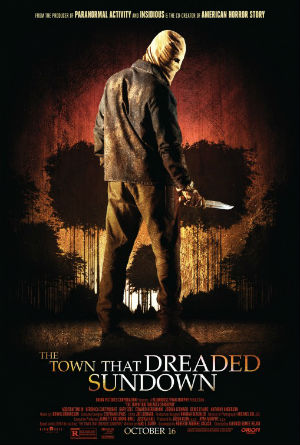
Film Review: The Town That Dreaded Sundown (dir by Alfonso Gomez-Rejon)


The_Town_That_Dreaded_Sundown_(2014_film)_poster

The Town That Dreaded Sundown is the latest classic horror remake.  In this case, it’s a remake of a 1976 docudrama about a real-life serial killer who, shortly after World War II, haunted the streets of my former hometown of Texarkana, Texas.  (You can read my review here.)  The original was a low-budget but effectively creepy little film that was shot on the streets of Texarkana and was full of authentic Texas atmosphere.  (It helped that it was directed by Charles B. Pierce, a Texarkana native, as opposed to some jerk from up north.)  What made the film all the more haunting was the fact that — in both the movie and in real life — the Phantom Killer was never captured.

So, how does the remake compare?

*Sigh*

(For the record, I’m not only signing but I’m also massively rolling my mismatched,  heterochromatic eyes.)

Listen, I will give this film credit for attempting to be something more than just your usual horror remake.  It actually does have a fairly clever premise.  Instead of retelling the original story, the remake of The Town That Dreaded Sundown begins with a bunch of people in present-day Texarkana sitting around and watching the original film.  There’s even an eccentric character named Charles B. Pierce, Jr. (Denis O’Hare) who we are told is the son of the original director.  It’s a clever idea, one that wisely acknowledges the effectiveness of the original film while also commenting on the continuing mystery surrounding both the identity and the fate of the Phantom Killer.

And, when someone dressed like the original Phantom Killer starts to murder young couples in Texarkana, we — just like the characters — are left to wonder whether it’s the spirit of the Phantom or if it’s someone imitating the murders from the original film or whether it’s something else altogether.

That’s certainly the question faced by Jami (Addison Timlin), who survives being attacked by this new Phantom but then grows obsessed with trying to discover who he is.  Addison Timlin gives a really good performance here.  She’s likable and sympathetic, the perfect “final girl.”

In fact, the entire film is well-cast.  Anthony Anderson is a lot of fun as a cocky Texas Ranger while Gary Cole and Joshua Leonard do good work as members of local law enforcement.  Denis O’Hare, who I will always think of as being Russell on True Blood, brings a certain dissipated nobility to his role.  The victims are all sympathetic and the killer is creepy.

But, with all that in mind, I was disappointed with the remake of The Town That Dreaded Sundown.  The reason the original film worked is because it was made by a member of the Texarkana community.  Charles B. Pierce knew the town and he understood why the Phantom Killer continued to haunt the citizens.  What his movie lacked in technical polish, it made up for in authenticity.

Though the remake features a narrator and duplicates the original’s obsession with letting us know whether each scene is taking place on the Texas-side or the Arkansas-side of the town, there’s still absolutely nothing authentic about it.  Whereas the original was filmed entirely on location, the remake was mostly filmed in Shreveport with only three days devoted to getting some location footage of downtown Texarkana.  As someone who has lived in both Shreveport and Texarkana, allow me to assure you that you can totally tell the difference.

The remake was produced by Ryan Murphy (of Glee and American Horror Story fame) and the film really does feel like a lesser season of American Horror Story.  It’s a film that has so little use for subtlety (just check out Edward Herrmann going totally overboard as a hypocritical preacher) that its creepy moments are totally smothered by all the heavy-handed cartoonishness that surrounds them.

Ultimately, the remake fails because it has no feel for or understanding for my homestate.  It was made by people who obviously know nothing about Texas or Arkansas beyond what they’ve seen in other movies produced, directed, and written by other northerners.

The 1976 Town That Dreaded Sundown worked because it was authentic.  Despite a few good ideas, the remake is just too generic to do justice to the original.


Back to School #53: Dancer, Texas Pop. 81 (dir by Tim McCanlies)


dancer-texas-pop-81-movie-poster-1998-1020196368

Dancer, Texas Pop. 81 is a 1998 film about a small town in West Texas that only has a population of 81 citizens.  Just from my own experience of telling people about how much I happen to like this movie, I get the feeling that only 81 people may have actually seen it.  But no matter!  Regardless of how many people have actually seen it, Dancer, Texas is one of my favorite films about my home state.

Dancer starts out with a scene that is so quintessentially Texan that it might as well appear next to Texas in the dictionary.  Four teenagers — all of whom are scheduled to soon graduate from high school — sit out in the middle of the highway.  The road seems to stretch on forever.  The land around them is empty.  If you’ve ever been to West Texas, you know what type of land I’m talking about.  It’s the type of land where you feel like you can see forever.  In the far distance, we see a pair of headlights.

“Car’s comin'” one of them drawls, knowing that they’ve got at least another 15 minutes before that car ever gets anywhere near the tiny town of Dancer, Texas.

These four teenage boys make up 80% of the graduating class of Dancer’s high school and all four of them are planning on leaving town and heading for Los Angeles.  Keller (Breckin Meyer) is their leader, the big dreamer who can’t wait to get out of the state.  Terrell Lee (Peter Facinelli) is the son of the only rich man in town and he’s being pressured by his mother to stay in Dancer and to learn the oil business.  John (Eddie Mills) is the simplest of the four and also the most reluctant about leaving.  He simply wants to be a farmer and he can’t understand why his taciturn father refuses to say anything to keep him from leaving town.  And finally, there’s Squirrel (Ethan Embry), who is the weird one.  Every group needs a weird one and Squirrel is weird even by the usual standards of small town oddness.

Not much happens in Dancer, Texas.  That goes for both the film and the town.  Over the course of two days, all four of the boys are forced to decide whether they really want to leave or if they actually want to stay.  Adding an extra poignancy to their decision is the fact that there literally is no chance that life in Dancer is ever going to change.  Dancer is as it has always been and always will be.  Deciding to stay means staying forever.  And, as the film shows, that’s okay for some people and terrible for others.

I really like Dancer, Texas.  Yes, it does move at its own deliberate pace and yes, a few scenes do tend to get a bit too obvious in their sentimentality (just to name two of the complaints that I saw from some commenters over at the imdb).  Meyer, Facinelli, and Mills all give such wonderfully natural performances that it makes you all the more aware that Embry seems a bit out-of-place.  But, ultimately, none of that matters.  Dancer, Texas is one of the most honest and sincere films that I’ve ever seen and it’s a film that does my home state proud.

Lisa’s Rating: 8 out of 10

211

Back To School #11: The Last Picture Show (dir by Peter Bogdanovich)


Monday is the first day of school down here in Dallas so it seems only appropriate that this latest entry in our Back to School series should be a look at one of those most quintessential Texas films ever made, the 1971 best picture nominee, The Last Picture Show.

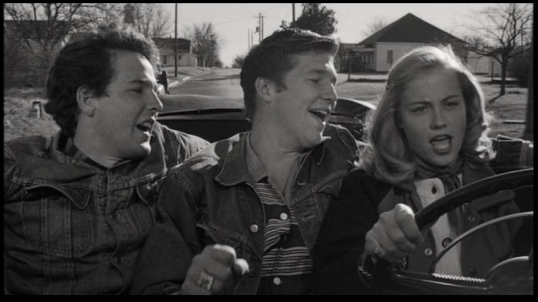
Directed by Peter Bogdanovich and based on a novel by Larry McMurtry, The Last Picture Show takes place in 1951 and tells the story of two high school seniors, best friends Sonny Crawford (Timothy Bottoms) and Duane Jackson (Jeff Bridges, reminding us once again why everbody loves him).  Sonny and Duane live in the rural town of Anarene, Texas.  With little to look forward to in the future, beyond perhaps getting a job working in the oil fields, Sonny and Duane are both intent on enjoying their final year of high school.  Sometimes, that means driving down to Mexico for the weekend.  Sometimes, it means going to the only theater in town and seeing a movie.  Most of the time, however, it means hanging out in a pool hall owned by the strict but fatherly Sam (Oscar winner Ben Johnson).  Often times they are accompanied by the intellectually disabled Billy (Sam Bottoms), who responds to everything with a blank smile and spends most of his spare time wandering around with a broom, futilely trying to sweep the dusty streets.

last-picture-show

The charismatic and impetuous Sonny is dating the beautiful and self-centered Jacy Farrow (Cybil Shepherd), who is the daughter of the wealthiest woman in town.  Jacy knows that her cynical mother (Ellen Burstyn) is having an affair with an oil worker named Abilene (Clu Gulager) but she’s more concerned with her own future.  Even though she’s dating Sonny, Jacy still accepts an invitation from the awkward Lester Marlow (played by a memorably goofy Randy Quaid) to attend a naked indoor pool party.  At the party, she meets Bobby Sheen (Gary Brockette), who is rich and will be able to provide her with the future that Duane never will.  However, Bobby tells Jacy that he isn’t interested in her because she’s a virgin.  If nothing else, this gives Jacy a reason to stay with Duane, at least until after they have sex.

Meanwhile, the far more sensitive Sonny ends up having an affair with Ruth Popper (Cloris Leachman, who won an Oscar for her performance in this film), the wife of the high school football coach.  It appears that Sonny truly cares about Ruth but then he finds himself being tempted by none other than his best friend’s girlfriend…

Sonny and Ruth

At heart, The Last Picture Show really is basically a small town soap opera, a Texas version of Peyton Place.  The difference between the two films — beyond the fact that The Last Picture Show just happens to be a 1oo times better than Peyton Place — is that The Last Picture Show doesn’t take place in a beautiful, idealized small town.  Instead, the town of Anarene is a believably bleak location, one that will be familiar to anyone who, like me, grew up in the American southwest.  A good deal of the success of The Last Picture Show is due to the fact that it was actually filmed on location in Archer City, Texas.

(Nothing annoys me more than when I see the mountains of California in the background of a movie that’s supposed to be taking place in North Texas.  We don’t have mountains up here.  For the most part, we don’t even have hills.  The land is flat.  You can see forever, if you know where to look.)

Of course, you can’t talk about The Last Picture Show without talking about Robert Surtees’s stunning black-and-white cinematography.  Not only does the black-and-white remind us that this is a film about a fading way of life but it drives home the fact that Sonny and Duane don’t have much to look forward to.  Growing up in Anarene means they are destined for lives without color or excitement.  In the end, can you really blame them for occasionally acting before they think?

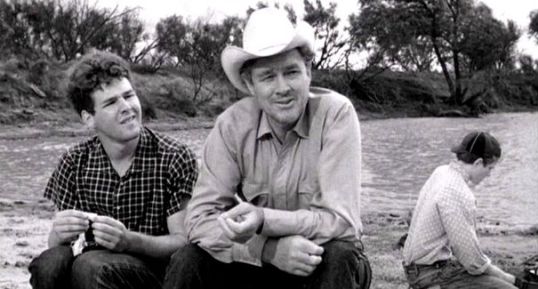
Ben Johnson

Ultimately, the success of The Last Picture Show is due to a lot of things.  This was Peter Bogdanovich’s second film as a director and he did such an excellent job here that he’s basically spent the rest of his career trying to live up to this one film.  (That said, Bodganovich also left his wife for Cybill Shepherd — despite the fact that his wife was the one who suggested that he make this film and cast Cybill in the first place!  Don’t worry though — Polly Platt got her revenge by having a far more successful career than her ex-husband and she even produced Say Anything, a film that we will soon be looking at.)  The screenplay, by McMurtry and Bogdanovich, is full of sharp dialogue and memorable characters.  As for the performers, this is probably one of the best acted films ever made.  Jeff Bridges and Timothy Bottoms play off each other well, Cybill Shepherd is the epitome of casual destructiveness, and Ben Johnson is brilliantly cast as the film’s moral center.  My favorite performance comes from Ellen Burstyn, who delivers every line with just the right combination of contempt and ennui.

Ellen Burstyn in The Last Picture Show

Ellen Burstyn in The Last Picture Show

If you’re a Texan, The Last Picture Show is one of those films that you simply have to see.  And if you don’t enjoy it and if you don’t relate to at least a few of the characters (I related to Jacy, though I like to think that I’m a lot nicer in the way I treat people), then you’re not a real Texan.

It’s as simple as that.

the-last-picture-show-poster


Lisa’s Homestate Reviews: Texas and Bernie


I recently realized something while I was working on my autobiography.  By the time I turned 12, I had really been around!

When I was growing up, my family moved around a lot.  By the time that my mom, my sisters, and I moved back to Texas for the final time, I had lived in a total of 6 states: Texas, Arkansas, New Mexico, Oklahoma, Colorado, and Louisiana.  Whenever I’m asked which one of those six states was my favorite, I always say — without a moment of hesitation — Texas.  Don’t get me wrong — those other five states are all wonderful but I’m a Texas girl.  It’s where I was born, it’s where the majority of my family lives, and it’s where I attended and graduated from college.  I love traveling and I love seeing the world but, in my heart, I know that I’ll always return to Texas.

Unfortunately, the rest of America rarely seems to love my homestate as much as I do.  It never ceases to amaze me how many people — who have obviously never even been here! — consider themselves to be an expert on Texas.  They talk about George W. Bush.  They talk about the Kennedy assassination.  They talk about Rick Perry and Ted Cruz.  They talk about oil.  They talk about guns.  They talk about these things as if a state as huge and populous as Texas can be defined by only a few issues or citizens.  That may be true of a tiny state like Vermont but there’s a lot more variety to Texas than any outsider will ever be able to understand.

Movies rarely get Texas right.  I’ve lost count of the number of films that have tried to portray north Texas as being a desert or having mountains.  And don’t even get me started on how terrible most actors sound when they try to imitate our accent!  Fortunately, Texas has its own set of native filmmakers, true artists who are capable of making movies that both criticize and celebrate Texas without descending to the level of elitist caricature.  One of the best of them is Richard Linklater and 2012’s Bernie is one of his best films.

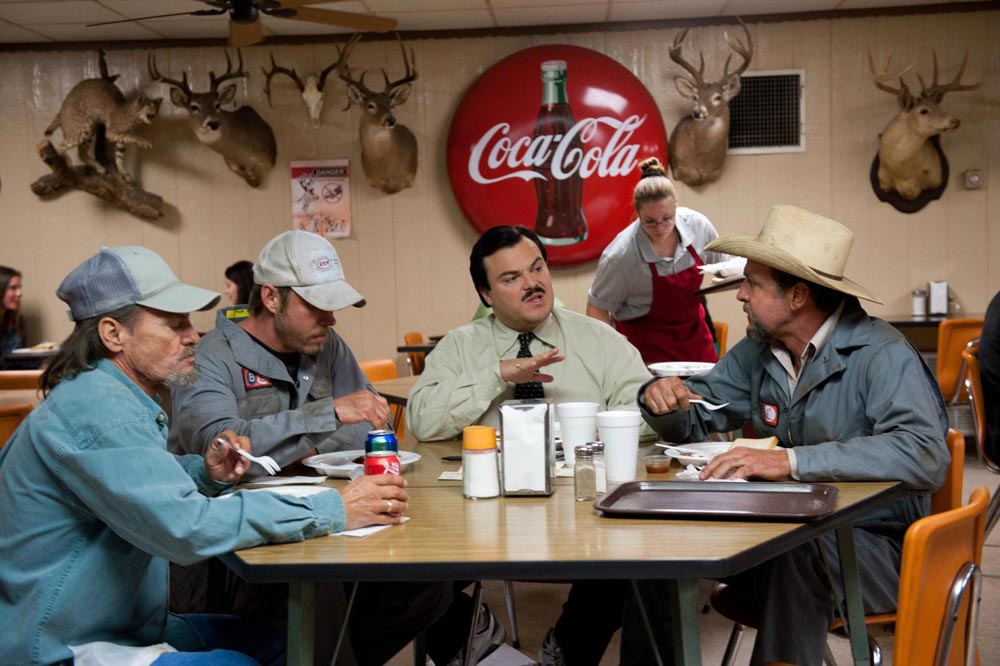
Bernie tells the true story of Bernie Tiede.  In 1996, Bernie (played, quite well, by Jack Black) was perhaps the most popular citizen of Carthage, Texas.  Along with being the leader of the church choir (which is always an important position in small town Texas), Bernie was also an assistant funeral director who was known for always saying exactly the right thing to a grieving family.  As a 38 year-old bachelor, Bernie was also the center of a lot of small town gossip, especially after he became the constant companion of the town’s richest (and, some would say, meanest) woman, 81 year-old Marge Nugent (played, in the film, by Shirley MacClaine).

When Bernie announces that Marge has had a stroke and is currently away in a hospital, the people of Carthage have no reason to doubt him.  Since Marge was usually such an unpleasant person to be around, most are just fine with not having to deal with her personally.  They’re even happier when Bernie suddenly starts to donate large sums of money to his neighbors, local businesses, and the church.

However, Marge’s accountant has his doubts about Bernie’s claims.  With the help of Marge’s previously estranged family, he convinces the local police to search Marge’s house.  That’s where they discover Marge’s body in a freezer, dead as a result of being shot four times in the back with an armadillo gun.  A tearful Bernie confesses to the murder, saying that Marge was just so mean to him that he eventually snapped.

District Attorney Danny Buck Davidson (played by a hilariously slick Matthew McConaughey) charges Bernie with first degree murder but soon discovers that — despite the fact that Bernie has confessed — it might not be so easy to get a conviction.  The people of Carthage may have hated Marge but, even more importantly, they absolutely loved Bernie.  Danny Buck is forced to file a motion to move the trial to nearby San Augustine County (which is, as the film correctly points out, the squirrel-hunting capitol of the world) and the citizens of Carthage wait to see if their most beloved citizen is convicted of murder.

Bernie was one of my favorite films of 2012 but I have to admit that, when it came to write this review, I was a little worried about rewatching it.  If there’s anything that often suffers upon repeat viewing, it’s quirkiness and Bernie is nothing if not quirky.  However, I’m happy to say that Bernie was just as effective on a second viewing as it was on the first.  Jack Black’s performance remains the best of his career and, in the role of Marge, Shirley MacClaine deftly brought to life a type that should be familiar to anyone who has ever lived in a small town.  When I first saw the film, it seemed like Matthew McConaughey occasionally went a bit overboard in the role of Danny Buck Davidson but, on a second viewing, it was obvious that, as flamboyantly as McConaughey played the role, he never allowed Danny Buck to become a caricature.  The film’s unique structure — which is made up of a combination of scenes with actors and interviews with the actual citizens of Carthage — also held up surprisingly well.  Those interviews are the key to the film’s success because, otherwise, it’s doubtful that anyone would believe that this story actually happened.

But ultimately, I think the reason that Bernie worked the first time I saw it and why it continued to work when I watched it again is because Richard Linklater is from Texas.  Can you imagine if an outsider had come down here and tried to make a movie out of the story of Bernie Tiede?  It probably would have ended up being one of the most condescending movies ever made, full of actors from up north trying to sound Texan.  And that would have been a shame because Bernie is a uniquely Texan story and, as such, it’s a story that could only be properly told by someone who knows the state.

Don’t get me wrong.  There’s definitely some pointed humor to be found in Bernie‘s portrayal of life in small town Texas.  The sequence where various citizens of Carthage are asked whether or not Bernie was gay (“That dog don’t hunt,” one woman says after explaining that Bernie couldn’t be gay because he led the church choir) is just one example.  But the difference between Linklater’s approach and the approach that one might expect from a non-Texan is that Linklater allows the citizens of Carthage to have their dignity even as he pokes some gentle fun at them.  As a native Texan, Linklater portrays our state — flaws and all — honestly, without any of the elitist posturing that we’ve come to expect from northern filmmakers.

And, as a result, Bernie is one of the best films ever made about both Texas and small town life.

As for the real life Bernie Tiede, he was released from prison in May of this year, under the condition that he live with Richard Linklater in Austin.

Bernie

Bernie and friends

The Daily Grindhouse: The Town That Dreaded Sundown (dir. by Charles B. Pierce)


Down here in Texas, we love our legends and the Phantom Killer is one of the most haunting.  In 1946, as American soldiers were returning from World War II and the country was looking forward to a future of peace and prosperity, an unknown killer stalked the moonlit streets of my former hometown of Texarkana, Texas.  (Technically, of course, Texarkana is located in both Texas and Arkansas.  In Texas, it’s usually assumed that the killer had to be from the Arkansas half of the town.)  From February until May, he attacked 8 people and killed 5 of them.  He stalked lovers who were parking at night and those that survived said that he hid his face underneath a white mask.  Despite the best efforts of both the Texas Rangers and the Texarkana police, the Phantom Killer was never captured and his reign of violence ended just as mysteriously as it began.

(My personal theory is that he ended up moving to California where he later became the Zodiac killer because, seriously, the two cases are so disturbingly similar.  Eventually, he left California and moved to Ohio and, living under a false name, he killed himself in 2002. )

When you read the facts of the Phantom Killer’s murder spree (not to mention all of the rumors and urban legends that have sprung up around the case), the main thing that jumps out at you is just how much it all truly does sound like a low-budget horror film.  Therefore, it’s not surprising to discover that, in 1976, the case served as the basis for just that.  What is surprising is just how effective The Town The Dreaded Sundown is.

The film was directed by Charles B. Pierce, an independent filmmaker who was based in Arkansas.  Pierce had previously directed The Legend of Boggy Creek, a “documentary” that was about the mysterious Bigfoot-like creature who is rumored to live in Fouke, Arkansas.  (Fouke, incidentally, is a town that my family briefly called home though none of us ever saw or heard any Bigfoots wandering about.)  Using the money that he made off of the Boggy Creek film, Pierce wrote, directed, and produced The Town The Dreaded Sundown.

Using the same technique that made The Legend of Boggy Creek such a success, Pierce filmed The Town That Dreaded Sundown on location in Texarkana and, along with established actors like Ben Johnson, Andrew Prine, and Tina Louise Dawn Welles, Pierce cast the film with local citizens.  When seen on screen, it’s obvious that these citizens are not professional actors.  However, what they may lack in talent they make up for authenticity.  (If nothing else, The Town That Dreaded Sundown is a rare Texas-set film in that it doesn’t feature any yankees butchering the dialect.)  The fact that the film is narrated by a grim-sounding narrator only adds to the film’s documentary-like feel.

Admittedly, the film does take some liberties with the story of the Phantom Killer but what’s important is that it’s accurate when it matters.  The film gets the basic facts correct and even the most outlandish of embellishments (such as a scene where the killer uses a trombone to kill one of his victims) don’t detract from the film’s power to frighten and disturb.  If nothing else, these feel like the type of details that one might spontaneously mention while telling an old ghost story.  Unlike a lot of “true crime” films, The Town The Dreaded Sundown never devotes too much time to trying to figure out the killer’s motives or drop hints as to his identity.  Instead, the film emphasizes the fact that the Phantom Killer could never be understood and was never stopped.  He simply existed, a malevolent force of evil.  This makes the film far more effective than it would have been if Pierce had spent the movie trying to explain that which can not be explained.

Unfortunately, The Town That Dreaded Sundown has never been released on DVD but it does show up occasionally on TCM.  Keep an eye out for it!

An Afternoon In Tornado Alley


As some of our more regular readers may know, I was born, raised, and still live in the part of the country known as Tornado Alley.  Yesterday afternoon, we had about a thousand tornadoes all on the ground at once.  Well, maybe not a thousand.  More like six.  But still, it was scary!  I was at work in downtown Dallas when the storm began and I spent almost the entire afternoon in my boss’s office, watching the tornadoes on his TV while the building trembled with each crash of thunder.   As soon as it was reported that one tornado had finally gone away, another one would suddenly be reported on the other side of town.  As the hours passed, I heard about and saw footage of tornadoes ripping through towns like Arlington, Forney, Lancaster, and Mesquite and I found myself wondering how long it would be before they found my home in Richardson.

Fortunately, despite the six tornadoes, none of them hit downtown Dallas and, though they came way too close, they also missed us in Richardson.  I did panic a bit when I first got home and I couldn’t find our cat Doc but eventually, he turned up hiding underneath Erin’s bed.  He gets scared of thunder.  My sister Melissa actually saw the tornado that hit Arlington but, thank goodness, it didn’t hit her house.

Anyway, this may stretch the definition of entertainment, but here’s a few Texas tornado videos that I’ve found on YouTube.

The video comes from outside of Forney, which is the town that was hit the hardest yesterday.

Here’s another one from outside Forney.

When the tornadoes first hit Forney, I was at work in downtown Dallas.  My boss and I were in his office, watching the footage that is featured in this video.  Essentially, a storm tracker named Jason was on the phone with our favorite local weatherman Larry Mowery and Jason suddenly starts going, “Oh my God, it’s hit the high school!  OH MY GOD!  OH MY GOODNESS!  THE HUMANITY!”  It was a bit like that famous audio of that reporter watching the Hindenburg explode.  Anyway, a few minutes later, as can be seen in the video below, Jason calmed down (a little, at least) and let us all know that actually the tornado did not hit the high school.

This next video was shot by a guy named Vincent Tang who was apparently sitting on the roof of his home in Lancaster, Texas and filming the whole thing while it went on and, unfortunately, providing his own running commentary.  I know that some people online love this guy’s commentary (mostly because he kind of prays at one point and pandering to God is always the easiest way to get lots of fans online — well, that and thong pics.) but I find it to be kind of annoying which is why I always mute it before I watch.

And seriously, why would you get on your roof in the middle of a tornado?

Finally, here’s the footage that everyone’s been talking about: one of the tornadoes hits a truck stop and sends a bunch of semi flying through the air.  As scary as this footage might look right now, just imagine watching it while you’re sitting in a fourth floor office with warning sirens going off all around you.  Agck!

Fortunately, we all survived and the sky is nice and clear today.  As for me, I’m working on a new script: The Towering Tornado.  I’m thinking either Jennifer Lawrence or maybe Aubrey O’Day can play me.  It’ll be great!

Don’t Mess With Texas, Texters!


Okay, quick warning: If you’re from Vermont, this post might upset your sensitive, crunchy gronola soul.  So, I’m warning you now so you don’t have to waste your time getting all offended, spitting up your maple syrup all over your framed, autographed picture of Howard Dean, and leaving angry comments about the death penalty and Jerry Jones. 

Anyway, I may have mentioned here that the American public is in desperate need of education when it comes to proper movie-going etiquette.  Whether its people texting and talking during the movie (which, by the way, starts the minute the first trailer starts to play out on-screen), bringing their annoying, shrill-voiced little children to movies that clearly are not appropriate for them, hanging their smelly, ugly feet over the seat (and audience member) in front of them, or showing up late for a movie and loudly going, “Where do you want to sit?”, the American public seriously needs to learn how to go to the movies.

And, on the basis of this PSA, the Alamo Drafthouse in Austin, Texas is exactly where those lessons need to be taught.

Amen!

The Regal Keystone Park 16, R.I.P.


Earlier this week, I discovered that, without warning, the Regal Keystone Park 16 had closed its door for good.

The Regal was not my favorite movie theater in the Dallas/Ft. Worth metroplex.  That honor would have to be jointly awarded to the Dallas and Plano Angelikas.  In fact, if anything, the Regal was somewhat trashy.  It was located right off of Central Expressway (which meant that traffic both entering and leaving theater was insane) and it sat directly across the street from a free clinic.  Whenever I went to the Regal, I was always very much aware of the constantly patrolling police cars.  There always seemed to be something dramatic happening at the apartments across the street from the theater. 

Despite the police presence, I could always count on being accosted by one at least one homeless person.  Most of the time they would just ask for money though other times they just wanted to tell me about who was actually in charge of the world.  Most of the time, it seemed to be the Vatican.  I would smile politely and hope they were too busy ranting to notice the St. Vitus medal around my neck.

One of the few times I actually made the mistake of going to the Regal by myself, I was greeted in the parking lot by a bearded, foul-smelling man who was about a foot taller than me and who outweighed me by over a hundred pounds.  He started walking towards me as soon as I got out of my car and even though I quickened my pace, he quickly caught up to me.  Walking less than a couple of inches behind me, he loudly asked me if I liked to perform a certain sexual act.  He kept following me, asking me this all the way to the theater doors but he didn’t step inside the theater after me.  The whole time this was going on, the parking lot was filled with other filmgoers who heard what the man asked and saw how quickly I was walking away from him.  Not one of them said a word or, as far as I know, even called the police.  That’s the type of theater that the Regal was.

(Incidentally, I called the police as soon as I got inside the theater.  I’m not sure what happened exactly but the man wasn’t there when I left two hours later.  The movie I saw, by the way, was Lakeview Terrace, starring Samuel L. Jackson.)

Still, I’m going to miss going to the Regal.  For one thing, it was close to where I live now and it was close to where I lived previously.  So, even if it was by default, it was kind of my theater.  As trashy as the outside was, the inside was usually pretty clean.  Plus, I went enough times that I got to know — at least on a visual level — most of the people who worked there.  For instance, there was the elderly gentleman who — no matter what time of day I went to the Regal — always seemed to be working behind ticket table.  Usually, he’d end up giving us tickets to the wrong movie but he seemed like a nice old man and he always had a smile ready for me whenever he saw me stepping through the front doors.  I’m going to miss him.

No, the Regal wasn’t perfect but it’s a place where I spent a lot of hours and I’ve got a lot of memories of that place.  To an extent, I’m not surprised that it closed its doors.  It was, obviously, located in a terrible neighborhood and often times it did so little business that me and whoever I had come with would end up watching our movie in an empty theater.  That’s good for those of us who like to have sex while watching movies but, as a question of simple economics, it’s not a formula for success.  Still, I would have liked a chance to say goodbye.

On Friday, me and my sister Erin drove down to the old Regal, specifically to take some pictures for this little memorial.  Unfortunately, no sooner had Erin take a few pictures before we were confronted by some fat asshole in a golf cart who wanted to know why we were taking pictures. 

To be honest, I have issues with authority on a good day and Friday was not, at that point, a very good day.  So, as Erin put the lens cap back on her camera, I sensibly replied, “I really don’t think that’s any of your fucking business.”

“Some people take pictures because they want to case a place before they rob it,” Mr. Fascist-On-A-Golf-Cart replied.

At this point, Erin had unlocked her car and was attempting to lead me over to it.  However, as I retreated, I politely replied, “Your mother sucks cock in Hell, Karras.”

That shut the pig up.  I’m still wondering if he realized I was merely quoting The Exorcist or if he thought maybe I actually was possessed.

Anyway, the pictures in this post were all taken by Erin Nicole Bowman on Friday and I thank her for both helping me pay tribute to the Angelika and for keeping me out of jail.

Here, in alphabetical order, is as complete a list as possible of every film I saw at the Regal Keystone Park 16, starting with Iron Man on June 10th, 2008 and ending with Secretariat on October 12th, 2010.

Adventureland

The American

An American Carol

The Black Waters of Echo’s Pond

The Blind Side

The Book of Eli

Brothers

Burn After Reading

Changeling

Clash of the Titans

The Crazies

The Curious Case of Benjamin Button

The Dark Knight

Despicable Me

Drag Me To Hell

Eat Pray Love

The Expendables

Everybody’s Fine

The Fantastic Mr. Fox

Funny People

Get Him To The Greek

Get Low

The Happening

How To Train Your Dragon

The Informant!

Inglorious Basterds

Invictus

Iron Man

Iron Man 2

Lakeview Terrace

The Last Exorcism

Legion

Let Me In

The Losers

The Lovely Bones

Machete

The Men Who Stare At Goats

Ninja Assassin

The Other Guys

Paranormal Activity

Prince of Persia: The Sands of Time

Public Enemies

Resident Evil: Afterlife

Robin Hood

Salt

Scott Pilgrim Vs. The World

Secretariat

Sherlock Holmes

Shutter Island

Splice

Star Trek

Taken

The Town

Toy Story 3

Tropic Thunder

Twelve

Up

Wall Street: Money Never Sleeps

Wall-E

Watchmen

The Wolf Man

Zombieland

Regal Keystone Park 16, R.I.P.

6 Trailers For Labor Day


Let’s celebrate Labor Day with the latest installment of Lisa Marie’s Favorite Exploitation Trailers.

1) Graveyard Shift — This is a Canadian film from 1986.  Ever since I first saw it on DVD last year, this has been one of my favorite vampire films.  It’s an atmospheric, strangely well-acted film that is just trashy enough to remain interesting.

2) Panorama Blue — I’ve never seen this movie and apparently, it’s a lost film of some sort.  The trailer can be found on one of the 42nd Street Forever compilation DVDs.  Apparently, this is some sort of pornographic epic.  I just enjoy the trailer even though I wouldn’t be caught dead on a roller coaster.  (They’re scary!)

3) Zombi 3 — This film is credited to Lucio Fulci but he actually only directed about 60% of it before he was fired and replaced by Bruno Mattei.  This trailer deserves some sort of award because it manages to make an amazingly boring film look exciting and almost fun. 

4) Rolling Thunder — Another film that I’ve never seen (and another trailer that I first found on a 42nd Street compilation).  This is an effectively moody trailer.  As a Texan, I also like the fact that Rolling Thunder apparently not only takes place in Texas but was also actually shot there with actual Texans in the cast.  And I love the ominous yet casual way that Tommy Lee Jones delivers the “I’ll get my gear,” line.

5) Angel — This is a trailer from the early 80s.  This is another one of those trailers that I love because it’s just so shamelessly sordid and trashy.

6) Hitch-Hike — Okay, quick warning — this trailer is explicit.  Not as explicit as many grindhouse trailers but it’s still explicit enough that some people might find it objectionable.  It’s certainly not safe for work though why are you visiting this site from work anyway? 

However, all that taken into account, it’s still a very good trailer for a very good movie, 1977’s Hitch-Hike.  Not only is it a nicely cynical little thriller, but it features not only another iconic psycho performance from David Hess but also a brilliant lead performance from Franco Nero.  I will also admit right now that if I ever got my hands on a time machine, the first thing I would do would be go back to 1977 and  give Franco Nero a hummer.  Seriously.

Okay, I’ve said too much.  Just watch the trailer and enjoy one of Ennio Morricone’s best scores.