14 Days of Paranoia #6: The Player (dir by Robert Altman)


1992’s The Player tells the story of Griffin Mill (Tim Robbins).

It’s not easy being Griffin Mill.  From the outside, of course, it looks like he has the perfect life.  He’s a studio executive with a nice house in Hollywood.  He’s young.  He’s up-and-coming.  Some people, especially Griffin, suspect that he’ll be the president of the studio some day.  By day, he sits in his office and listens to pitches from respected screenwriters like Buck Henry.  (Henry has a great idea for The Graduate II!)  During the afternoon, he might attends dailies and watch endless takes of actors like Scott Glenn and Lily Tomlin arguing with each other.  Or he might go to lunch and take a minute to say hello to Burt Reynolds.  (“Asshole,” Burt says as Griffin walks away.)  At night, he might go to a nice party in a big mansion and mingle with actors who are both young and old.  He might even run into and share some sharp words with Malcolm McDowell.

But Griffin’s life isn’t as easy as it seems.  He’s constantly worried about his position in the studio, knowing that one box office failure could end his career.  He fears that a new executive named Larry Levy (Peter Gallagher) is after his job.  Two new screenwriters (Richard E. Grant and Dean Stockwell) keep bugging him to produce their downbeat, no-stars anti-capitol punishment film.  His girlfriend (Cynthia Stevenson) wants to make good movies that mean something.  Even worse, someone is sending Griffin threatening notes.

It doesn’t take long for Griffin to decide that the notes are coming from a screenwriter named Dave Kahane (Vincent D’Onofrio).  Griffin’s attempt to arrange a meeting with Dave at a bar so that Griffin can offer him a production deal instead leads to Griffin murdering Dave in a parking lot.  While the other writers in Hollywood mourn Dave’s death, Griffin starts a relationship with Dave’s artist girlfriend (Great Scacchi) and tried to hide his guilt from two investigating detectives (Whoopi Goldberg and Lyle Lovett).  Worst of all, the notes keep coming.  The writer, whomever they may be, is now not only threatening Griffin but also seems to know what Griffin did.

After spend more than a decade in the industry wilderness, Robert Altman made a critical and commercial comeback with The Player.  It’s a satire of Hollywood but it’s also a celebration of the film industry, featuring 60 celebrities cameoing as themselves.  Everyone, it seems, wanted to appear in a movie that portrayed studio execs as being sociopathic and screenwriters as being whiny and kind of annoying.  The Player both loves and ridicules Hollywood and the often anonymous men who run the industry.  Largely motivated by greed and self-preservation, Griffin may not love movies but he certainly loves controlling what the public sees.  In the end, only one character in The Player sticks to her values and her ideals and, by the end of the movie, she’s out of a job.  At the same time, Griffin has a social life that those in the audience can’t help but envy.  He can’t step out of his office without running into someone famous.

The Player is one Altman’s most entertaining films, with the camera continually tracking from one location to another and giving as a vision of Hollywood that feels very much alive.  Tim Robbins gives one of his best performances as Griffin Mill and Altman surrounds him with a great supporting cast.  I especially liked Fred Ward as the studio’s head of security.  With The Player, Altman mixes melodrama with a sharp and sometimes bizarre comedy, with dialogue so snappy that the film is as much a joy to listen to as to watch.  That said, the real attraction of the film is spotting all of the celebrity cameos.  (That and cheering when Bruce Willis saves Julia Roberts from certain death.)  Altman was a director who often used his films to explore eccentric communities.  With The Player, he opened up his own home.

Previous entries in 2025’s 14 Days Of Paranoia:
  1. The Fourth Wall (1969)
  2. Extreme Justice (1993)
  3. The Lincoln Conspiracy (1977)
  4. Conspiracy (2007)
  5. Bloodknot (1995)

Film Review: After Hours (dir by Martin Scorsese)


Directed by Martin Scorsese, 1985’s After Hours opens in an office.  This isn’t the type of office that one might expect a Scorsese movie to open with.  It’s not a wild, hedonistic playground like the office in The Wolf of Wall Street.  Nor is it a place where an aging man with connections keeps his eye on the business for his friends back home, like Ace Rothstein’s office in Casino.  Instead, it’s a boring and anonymous office, one that is full of boring and anonymous people.  Scorsese’s camera moves around the office almost frantically, as if it’s as trapped as the people who work there.

Paul Hackett (Griffin Dunne) works in the office, at a job that bores him but presumably pays him enough to live in New York.  Paul is not a typical Scorsese protagonist.  He’s not a fast-talker or a fearsome fighter.  He’s not an artist consumed by his own passion or an amoral figure eager to tell his own story.  Instead, he’s just a guy who wears a tie to work and who spends his day doing data entry.  He’s a New Yorker but he doesn’t seem to really know the city.  (He certainly doesn’t know how much it costs to ride the subway.)  He stays in his protected world, even though it doesn’t seem satisfy him.  Paul Hackett is not Travis Bickle.  Instead, Paul is one of the guys who would get into Travis’s cab and, after spending the drive listening to Travis talk about how a storm needs to wash away all of New York’s sin, swear that he will never again take another taxi in New York.

One day, after work, Paul has a chance meeting with a seemingly shy woman named Marcy (Rosanna Arquette).  Marcy lives in SoHo, with an artist named Kiki (Linda Fiorentino) who sells plaster-of-Paris paperweights that are made to look like bagels.  Marcy gives Paul her number and eventually, Paul ends up traveling to SoHo.  He takes a taxi and, while the driver is not Travis Bickle, he’s still not amused when Paul’s last twenty dollar bill blows out the window of the cab.

Paul’s trip to SoHo doesn’t goes as he planned.  Kiki is not impressed with him.  Marcy tells him disturbing stories that may or may not be true while a search through the apartment (not cool, Paul!) leads Paul to suspect that Marcy might have disfiguring burn scars.  Paul decides to end the date but he then discovers that he doesn’t have enough change on him to take the subway home.  As Paul attempts to escape SoHo, he meets a collection of strange people and finds himself being hunted by a mob that is convinced that he’s a burglar.  Teri Garr plays a sinister waitress with a beehive hairdo and an apartment that is full of mousetraps.  Catherine O’Hara chases Paul in an ice cream truck.  Cheech and Chong play two burglars who randomly show up through the film.  John Heard plays a bartender who appears to be helpful but who also has his own connection to Marcy.  Even Martin Scorsese appears, holding a spotlight while a bunch of punks attempt to forcibly give Paul a mohawk.  The more that Paul attempts to escape SoHo, the more trapped he becomes.

Martin Scorsese directed After Hours at a time when he was still struggling to get his adaptation of The Last Temptation of Christ into production.  If Paul feels trapped by SoHo, Scorsese felt trapped by Hollywood.  After Hours is one of the most nightmarish comedies ever made. It’s easy to laugh at Paul desperately hiding in the shadows from Catherine O’Hara driving an ice cream truck but, at the same time, it’s impossible not to relate to Paul’s horror as he continually finds himself returning again and again to the same ominous locations.  In many scenes, he resembles a man being hunted by torch-wielding villagers in an old Universal horror film, running through the shadows while villager after villager takes to the streets.  Paul’s a stranger in a strange part of the city and he has absolutely no way to get home.  I think everyone’s had that dream at least once.

Paul is not written to be a particularly deep character.  He’s just a somewhat shallow office drone who wanted to get laid and now just wants to go home.  Fortunately, he’s played by Griffin Dunne, who is likable enough that the viewer is willing to stick with Paul even after Paul makes some very questionable decisions and does a few things that make him a bit less than sympathetic.  Dunne and John Heard keep the film grounded in reality, which allows Rosanne Arquette, Linda Fiorentino, Catherine O’Hara, and especially Teri Garr to totally play up the bizarre quirks of their character.  Teri Garr especially does a good job in this film, revealing a rather frightening side of the type of quirky eccentric that she usually played.

Scorsese’s sense of humor has been evident in almost all of his films but he still doesn’t get enough credit for his ability to direct comedy.  (One need only compare After Hours to one of Brian De Palma’s “comedies” to see just how adroitly Scorsese mixes laughs and horror.)  After Hours is one of Scorsese’s more underrated films and it’s one that everyone should see.  After Hours is a comedy of anxiety.  I laughed while I watched it, even while my heart was racing.

Two Scenes From Young Frankenstein (In Memory of Teri Garr)


Today, everyone was saddened to hear about the passing of actress Teri Garr.  The veteran actress and dancer, who was best-known for her comedic performances but who also showed that she could handle drama, was 79 years old.

Since this is October, it seem fitting to share two scenes from 1974’s Young Frankenstein, featuring Teri Garr as Inga.


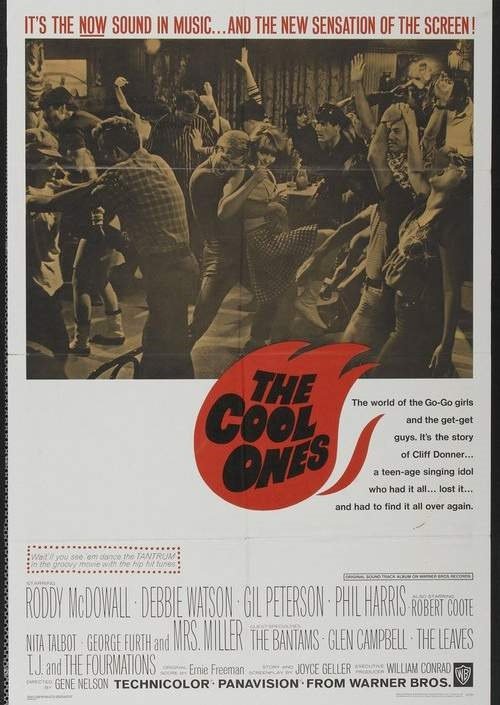
Film Review: The Cool Ones (dir by Gene Nelson)


The year is 1967 and who are The Cool Ones?

They’re the kids, of course!  They’re the wild and crazy kids who go to Palm Beach and who listen to rock music and who wear open vests and short skirts and who are all doing the latest dance!  You may see that this movie was made in 1967 and you might assume that this is going to be a film about hippies, like Psych-Out.  But no, these kids aren’t hippies.  Instead, they’re the 1967 equivalent of the clean-cut teens who used to appear in beach party movies and 1950s rock and roll films.

The kids are all dancing the Tantrum!  What’s the Tantrum?  It’s a dance that was created by accident.  Hallie Rogers (Debbie Watson) was a dancer on an American Bandstand-style show but, when she realized that the show’s producers lied to her about eventually allowing her to sing on the show, she threw a fit.  She grabbed the microphone of special musical guest Glen Campbell and attempted to turn his performance into a duet.  When security showed up to drag her off the set, she struggled with them.  Those watching the show assumed that Hallie had just created a new dance called The Tantrum.

After getting fired from the show, Hallie goes to a club, where she witnesses a performance by a former teen idol named Cliff Donner (Gil Peterson).  After Hallie fights off an obnoxious wannabe beatnik who refuses to accept that she doesn’t want to dance with him (Go, Hallie!), Cliff immediately recognizes her as the creator of the Tantrum.  Hallie wants to be a star.  Cliff once was a star.  Maybe they can work together!

Fortunately, the owner of club, Herbert Krum (Robert Coote), just happens to be the older brother of Tony Krum (Roddy McDowall), a notoriously egocentric rock promoter.  How egocentric is Tony?  Well, he’s played by Roddy McDowall and, even by the standards of a typical Roddy McDowall character, Tony is eccentric.  Tony demands that Herbert prove that they’re actually brothers.  He cries when he discovers that his psychiatrist is pregnant.  He’s given too sudden moods swing and sudden bursts of inspiration, the majority of which involve Tony holding up his finger and shouting, “Ah ha!”  Tony has a plan.  He can make Cliff and Hallie into superstars by convincing the world that they’re in love with each other!  He can even get them their own TV show!

However …. what if Cliff and Hallie actually are in love?  Unfortunately, Cliff has some paranoia issues of his own and he’s convinced that Hallie is only pretending to love him so that she can become a star.  Will Cliff and Hallie finally end up together and free from the manipulative hand of Tony Krum?

As you may be able to guess just from reading the plot description, The Cool Ones is an extremely silly film.  The plot makes little sense and Tony Krum is such an over-the-top character that it becomes impossible to take anything involving him seriously.  That said, The Cool Ones is also an incredibly fun movie and it’s obvious that Roddy McDowall had so much fun playing Tony that it’s impossible not to enjoy watching him dig into the role.  The Cool Ones is a big, flamboyant, and colorful film, the type of movie that represents less what the 60s were and more what we wish they were.  Admittedly, Gil Peterson is a bit of stiff in the role of the self-righteous Cliff but Roddy McDowall and Debbie Watson bring so much energy to the film that it doesn’t matter that Cliff doesn’t seem like he would be a cool one is real life.  The music is airy and fun, the dance scenes are entertaining and energetic, and the whole film is just like a pop art time capsule.  The Cool Ones is a cool way to spend 90 minutes.

Music Video of the Day: Ghostbusters by Ray Parker Jr. (1984, dir. Ivan Reitman)


I wish the literal video for this was still up. Oh, well.

All these years later, I still don’t have any idea why she goes into that house. I guess we are supposed to believe she lives there with these two kids that miss their cue?

These other kids nail it.

Despite finding lists of all the celebrities in this video, I have no idea who this guy is that Ray Parker Jr. becomes for this bit.

I also wonder why she didn’t see him while turning away from the moving table to go to the window.

In the window is footage of the movie that has aged horribly. Parker Jr. is blue screened in there for this famous shot.

He ain’t afraid of no ghost. A lawsuit on the other the hand, that’s a different matter. I hope this music video doesn’t remind me of a Huey Lewis & The News video as well.

Now Ray Parker Jr. stands creepily outside of her window.

This is looking familiar.

Chevy Chase can call Ghostbusters if he has a ghost problem…

but what about if he gets stuck in Benji again?

Who can he call then?

I knew this looked familiar.

Do You Believe In Love by Huey Lewis & The News (1982)


Do You Believe In Love by Huey Lewis & The News (1982)

I’m sure it’s a coincidence. I just find it humorous to see that considering the lawsuit saying that this song ripped off, to one extent or another, the Huey Lewis & The News song I Want A New Drug. The scene above is from the video that helped kick off their career on MTV and set the tone for their future videos since it was such a success despite being ridiculous. Is the riff in You Crack Me Up…

sound like the same riff from Johnny And Mary by Robert Palmer?

Or is it just me?

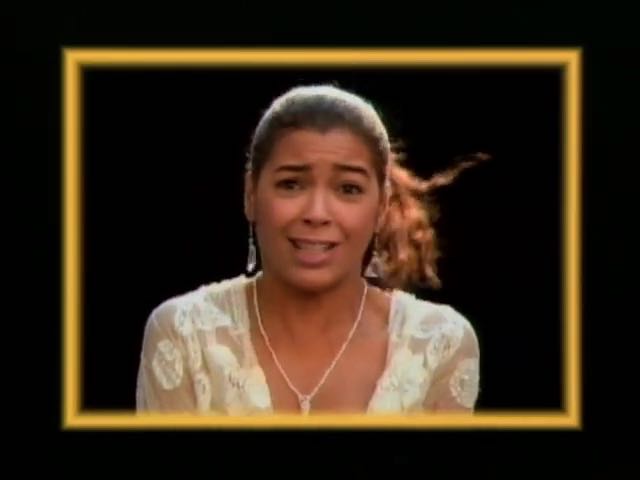
What a feeling. Thanks for making that one easy, Irene Cara.

Something tells me that Cindy Harrell was hired by someone who saw the movie Model Behavior (1982), which she was in.


Model Behavior (1982, dir. Bud Gardner)


Model Behavior (1982, dir. Bud Gardner)

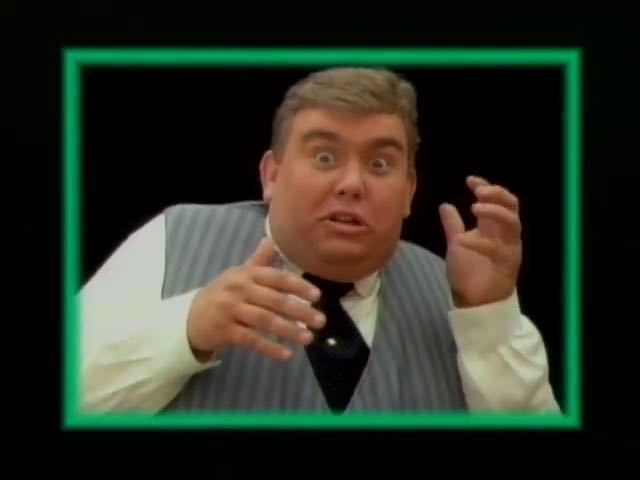
From what I’ve read, they just showed up on the set of a movie Candy was shooting to try and get him to make this cameo appearance.

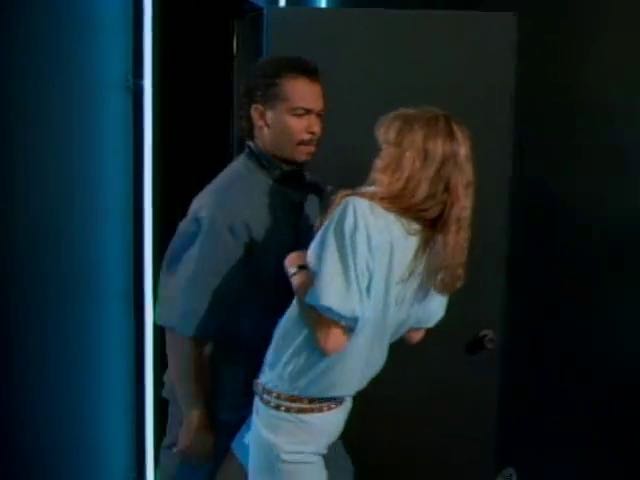
Ray Parker Jr. rising from the top of the stairs like he’s Michael Myers come to kill her. Why?

Or at least scare her. It’s probably a reference to Gozer.

Melissa Gilbert. I have no idea what she’s doing here. I’ve only seen an episode or two of Little House On The Prairie, so I guess there could have been some episodes with ghosts. Some of these cameos feel like they happened because the celebrities were involved with NBC.

Speaking of cameos I can’t explain, it’s former baseball player Ollie Brown.

Boundaries!

I do like that for the majority of the shot it looks like she should be falling over but isn’t.

More people that Parker can summon for some reason.

Don’t worry about them.

Pose for the featured image of this post.

Thank you.

Jeffrey Tambor.

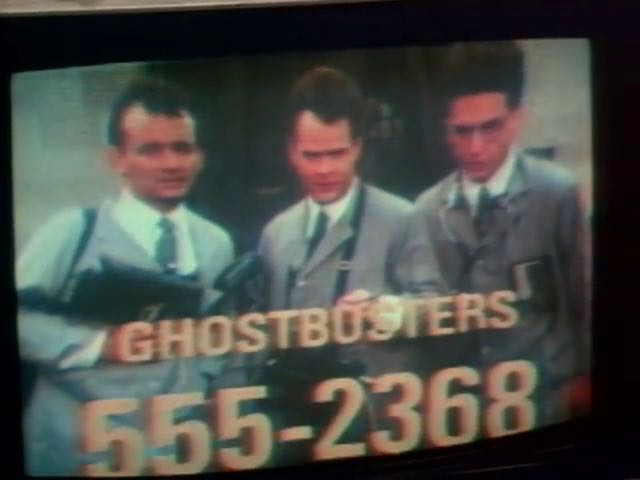
Is it 555-5555…

or 555-2368 as you showed earlier?

George Wendt apparently got in trouble with the Screen Actors Guild for his appearance in this video. I’ll link to the article with that information at the end.

Senator Al Franken.

Now we get a series of confusing cameos.

Danny DeVito. I think this is only the second music video he has ever been in. The other one was for the song Billy Ocean did for The Jewel Of The Nile (1985).

Carly Simon for some reason. She would go on to do the theme song to Working Girl (1988) with Sigourney Weaver. Maybe they were friends. I don’t know.

Umm…one more thing. Have you tried calling the Ghostbusters? No clue as to why Peter Falk is here.

The breakdancing was improvised. So was Parker Jr. pushing Bill Murray around.

I think Teri Garr has one of the best cameos.

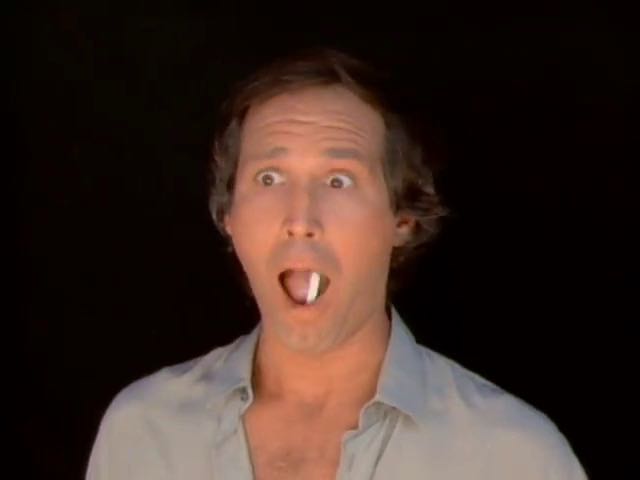
Don’t swallow that cigarette, Chevy.

Fun fact: In European and other non-US markets, the “no” sign was flipped.

If you want to read some more information about the video, then follow this link over to ScreenCrush where they have a write-up on the video with information from people who worked on the video.

According to mvdbase, Ivan Reitman directed, Keith Williams wrote the script, Jeff Abelson produced it, Daniel Pearl shot it, and Peter Lippman was the production manager.

If you ever get a chance to watch the literal music video for this, then do so. I doubt it will surface again though seeing as this music video almost didn’t get an official release because of the issues surrounding all the cameos.

Enjoy!

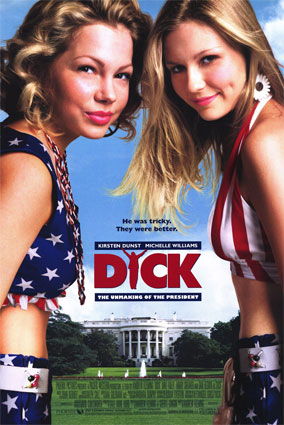
Shattered Politics #64: Dick (dir by Andrew Fleming)


Theatricalposterdick

I wouldn’t necessarily say that I love Dick but I still think it’s a pretty good film.  (Ha ha, see what I did there?)  Of course, to really appreciate this 1999 comedy, it helps to know a little something about political history.  For instance, it helps to know that the Dick of the title is President Richard Nixon (played here by a hilariously paranoid Dan Hedaya).  In 1973, as the result of his attempt to cover up White House involvement of a burglary at the Watergate Hotel, Nixon became the first President to resign from office.

A lot of the credit for Nixon’s downfall was given to two reporters for the Washington Post, Bob Woodward and Carl Bernstein (played, in this film, by Will Ferrell and Bruce McCulloch).  While Woodward and Bernstein investigated the Watergate break-in, they were reportedly fed information by a highly placed informant who was referred to as being Deep Throat.  For years, the identity of Deep Throat was a closely held secret.  Countless books were written that speculated as to who Deep Throat may have been.  (In the film All The President’s Men, he was played by Hal Holbrook.)  Finally, in 2005, it was revealed that Deep Throat was a FBI agent named Mark W. Felt, who was upset because he was passed over for a promotion.

And, quite frankly, that’s kind of a disappointing solution.  When you think about someone who brought down the government, you hope that he or she will turn out to be something more than just a disgruntled employee whose previous work consisted on running counter intelligence operations against domestic political activists.

In fact, it’s hard not to wish that, perhaps, Deep Throat could have been two 15 year-old girls who just happened to stumble across one of the biggest political scandals in American history.

Well, fortunately, this is the theory proposed in Dick.  Betsy (Kirsten Dunst) and Arlene (Michelle Williams) are two friends who, one night in 1972, sneak out of Arlene’s apartment so that they can mail a fan letter to singer Bobby Sherman.  While doing so, they happen to stumble across the Watergate burglars and get a good look at White House aide G. Gordon Liddy (Harry Shearer).

The next day, while on a field trip to the White House, the two girls are spotted by Liddy.  Liddy arranges for them to be pulled to the side and questioned by chief-of-staff H.R. Haldeman (Dave Foley), who determines that the girls barely know who Nixon is and that they don’t understand what they witnessed.  However, before Haldeman can send the girls on their way, Nixon himself enters the office and complains about how poorly planned the break-in was.

This leads to an unlikely relationship between Nixon and Betsy and Arlene.  Hoping to win their loyalty (and their silence), Nixon arranges for them to be his official dog walkers.  Betsy and Arlene, meanwhile, still don’t have the slightest idea of what’s going on.  They accidentally bring pot cookies to the White House (which Nixon particularly enjoys) and Arlene even develops a mad crush on Nixon.

But, of course, Nixon eventually shows his true colors and Betsy and Arlene take down the government….

In many ways Dick is a one-joke film, in which Betsy and Arlene regularly find themselves blissfully unaware while history literally unfolds around them.  But it’s actually a pretty clever joke and it’s also a very plausible one.  People are often unaware that anything important is happening when it’s actually happening.  Often times, it’s only in retrospect that historical moments are seen to be truly historical.  And, ultimately, Watergate itself is such a bizarre scandal that it’s the perfect moment in history to be reinterpreted as a comedy.

Dick is ridiculous enough to be funny but plausible enough to be memorable.