Horror on TV: Ghost Story 1.2 “The Concrete Captain” (dir by Richard Donner)


In the 2nd episode of Ghost Story, an important lesson is learned.  If you’re going to bury a sea captain, do not bury him in concrete because his spirit belongs to the ocean.  Upset his spirit and he’ll basically ruin whatever hopes you have of bringing tourists to the seashore!

This episode stars Gena Rowlands and Stuart Whitman and it was directed by none other than Richard Donner.  Donner, of course, would go on to direct such films as The Omen, Superman, and Lethal Weapon.

Enjoy!

(Despite the weird thumbnail, this video should work if you click play.)

Cleaning Out The DVR: An American Dream (dir by Robert Gist)


Loosely based on a novel by Norman Mailer, the 1966 film, An American Dream, tells the story of Stephen Rojack (Stuart Whitman).  Rojack’s a war hero, a man who has several medals of valor to his credit.  He’s married to Deborah (Eleanor Parker), the daughter of one of the richest men in the country.  He’s an acclaimed writer.  He’s got his own television talk show in New York.  He’s been crusading against not only the Mafia but also against corruption in the police department.  He has powerful friends and powerful enemies.  You get the idea.

He’s also got a marriage that’s on the verge of collapse.  Deborah calls Rojack’s show and taunts him while he’s on the air.  When Rojack goes to her apartment to demand a divorce, the two of them get into an argument.  Deborah tells him that he’s not a hero.  She says he only married her for the money and that she only married him for the prestige.  She tells him that he’s a lousy lover.  Being a character in an adaptation of a Norman Mailer novel, the “lousy lay” crack causes Rojack to snap.  He attacks Deborah.  The two of them fight.  Deborah stumbles out to the balcony of her apartment and it appears that she’s on the verge of jumping.  Rojack follows her.  At first, he tries to save her but then he lets her fall.  She crashes down to the street, where she’s promptly run over by several cars.  The cars then all run into each other while Rojack stands on the balcony and wails.  There’s nothing subtle about the first 15 minutes of An American Dream.

Actually, there’s nothing subtle about any minute of An American Dream.  It’s a film where everything, from the acting to the melodrama, is so over-the-top and portentous that it actually gets a bit boring.  There’s no relief from the screeching and the inauthentic hard-boiled dialogue.  When a crazed Rojack starts to laugh uncontrollably, he doesn’t just laugh.  Instead, he laughs and laughs and laughs and laughs and laughs and …. well, let’s just say it goes on for a bit.  It’s like a 60s version of one of those terrible Family Guy jokes.

Anyway, the police don’t believe that Deborah committed suicide but they also can’t prove that Rojack killed her.  Meanwhile, within hours of his wife’s death, Rojack meets his ex-girlfriend, a singer named Cherry (Janet Leigh).  Rojack is still in love with Cherry but Cherry is also connected to the same mobsters who want to kill Rojack.  Meanwhile, Deborah’s superrich father (Lloyd Nolan) is also on his way to New York City, looking for answer of his own.

An American Dream is a very familiar type of mid-60s film.  It’s a trashy story and it’s obvious that the director was trying to be as risqué as the competition in Europe while also trying to not offend mainstream American audiences.  As such, the film has hints of nudity but not too much nudity.  There’s some profanity but not too much profanity.  Rojack, Deborah, and Cherry may curse more than Mary Poppins but they’re rank amateurs compared to the cast of Who’s Afraid of Virginia Woolf?  It’s an unabashedly melodramatic film but it doesn’t seem to be sure just how far it can go in embracing the melodrama with alienating its target audience so, as a result, the entire film feels somewhat off.  Some scenes go on forever.  Some scenes feel too short.  The whole thing has the washed-out look of an old cop show.

All of that perhaps wouldn’t matter if Stephen Rojack was a compelling character.  In theory, Rojack should have been compelling but, because he’s played by the reliably boring Stuart Whitman, Rojack instead just comes across as being a bit of a dullard.  He’s supposed to be a charismatic, two-fisted Norman Mailer-type but instead, as played by Whitman, Rojack comes across like an accountant who is looking forward to retirement but only if he can balance the books one last time.  There’s no spark of madness or imagination to be found in Whitman’s performance and, as a result, the viewer never really cares about Rojack or his problems.

Noman Mailer reportedly never saw An American Dream, saying that it would be too painful to a bad version of his favorite novel.  In this case, Mailer made the right decision.

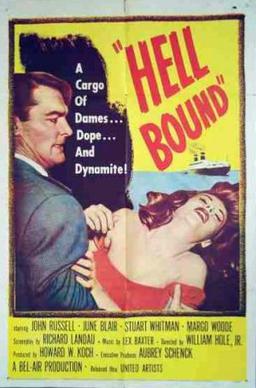
30 More Days of Noir #7: Hell Bound (dir by William J. Hole, Jr.)


Like so many film noirs, 1957’s Hell Bound opens with a narrator.  As we watch scenes of a group of thieves robbing a Naval ship of World War II narcotics, the narrator explains to us what each criminal is doing and how their plot will hopefully lead to them getting rich.  Again, this is something we’ve seen in a countless number of film noirs.  What makes Hell Bound unique is that the narration keeps going long after one would expect it to stop.  And the expected cops and federal agents are never introduced….

That’s because we’re watching a film within a film!  Jordan (John Russell) has made and produced the film himself, all to convince a gangster named Harry Quantro (Frank Fenton) to support his plan to …. well, to rob a Naval ship of narcotics.  Jordan promises that the real-life theft will go just as smoothly as the theft in the movie!  And, it must be said, Jordan’s movie was really well-made.  He hired actors and everything.  Harry agrees to give Jordan his backing on the condition that Jordan use Harry’s girlfriend, Paula (June Blair), in the operation.  That, of course, means that Jordan won’t be able to use his own girlfriend, Jan (Margo Woode).  That’s going to be awkward.

Anyway, Jordan starts to assemble his crew and they’re the typical film noir collection of misfits.  One of the more fun things about Hell Bound is that it’s full of odd and eccentric characters, the types who would you actually expect to find trying to rob the U.S. Navy of narcotics in the 1950s.  My favorite character was the blind drug dealer named Daddy (Dehl Berti).  He has the perfect attitude for someone who had the luxury of not having to see the damage caused by his professions.

Of course, there’s no such thing as a perfect plan.  Whenever you get a bunch of criminals together to pull off the perfect heist, there’s bound to be some betrayals and some paranoia.  We’ve all seen the ending of Goodfellas and we all know what the piano coda from Layla means.  Complicating matters is that a big part of the scheme requires Paula to fake being an ambulance nurse and that means that she’s going to have to work with an honest ambulance driver named Eddie Mason (Stuart Whitman).  Eddie is a good, working class guy who just wants to help people and make the world a better place.  How can Paula go through with her part of the plan when she’s got Eddie looking at his hands and saying that he wants to use them to be a healer!?

I really liked Hell Bound.  I wasn’t expecting much from it but it turned out to be a really effective and clever 50s film noir.  Clocking in at 70 minutes, it doesn’t have any time for excess padding or anything else.  As soon as the film-within-a-film comes to an end, it jumps right into the action and it doesn’t let up.  Add to that, you’ve got John Russell giving a tough and gritty performance as the wannabe criminal mastermind and then you’ve got Stuart Whitman managing to make his self-righteous character likable and June Blair doing a great job as the femme fatal.  Hell Bound is bit of an unsung classic, a tough and gritty film noir that packs a punch.


Horror Film Review: Night of the Lepus (dir by William F. Claxton)


There’s really only one lesson to be learned from the 1972’s Night of the Lepus.

There is absolutely no way to make a rabbit look menacing.

Oh sure, you can film them in slow motion.  And you can add a lot of weird sound effects and you can do a lot of extreme close-ups to make them look bigger than they actually are.  You can do a lot of stuff as a part of your effort to make a rabbit into a scary monster but you’ll pretty much be wasting you time.  Rabbits are simply not intimidating.  There’s a reason why the idea of a killer rabbit was so funny in Monty Python and The Holy Grail.

Now, don’t get me wrong.  I’m enough of country girl that I know the damage that wild rabbits can do.  They eat crops.  They eat bark.  They chew on irrigations lines.  If you’re a farmer or even just someone who wants to maintain a nice garden, you know that rabbits can be a nuisance.

However, that doesn’t change the fact that there’s nothing really menacing rabbits.  Rabbits are cute and, for the most part, they’re fairly timid.  They’re aware that, in the brutal world of nature, they’re designated prey and, as a result, they try to stay out of the way.  Rabbits are shy and they hop around and there’s absolutely nothing frightening about them.

(We actually have quite a few rabbits in my neighborhood.  It’s not unusual for me to see one hopping through the front yard.  Whenever I go for a run in the early evening hours, it’s not unusual for me to see several rabbits hopping through a nearby park.)

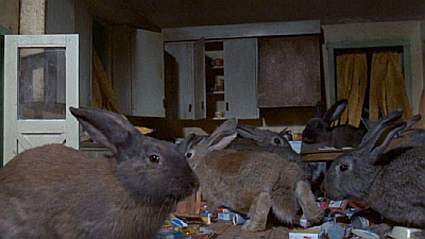
Night of the Lepus is a strange film that attempts to make rabbits frightening.  It takes place in the southwest and it features a bunch of mutated, giant rabbits who hop around the desert in slow motion and who savagely kill everyone that they meet.  The plot makes it sound like a spoof but Night of the Lepus takes itself very seriously, which needless to say is a mistake.  It even opens with documentary footage that’s designed to make sure that we understand that rabbits are actually very dangerous.  It’s all very odd and you have to wonder why, out of all the wild animals in the southwest, the filmmakers decided to go with the least intimidating creature possible.  I mean, there are coyotes and Gila monsters in the desert.  Imagine having a giant coyote coming at you.  That would be scary!

Instead, we get giant rabbits, attacking a cast of actors who definitely deserved better.  Stuart Whitman, Janet Leigh, Rory Calhoun, DeForest Kelly, they’re all talented actors and, in this film, they’re reduced to fighting a bunch of giant rabbits.  No one comes across particularly well, though just about everyone in the cast does manage to keep a straight face.  Still, the problem is that the rabbits are just too damn cute.  Even after they’ve killed half the cast, you still don’t want anything to happen to them.  When Whitman and Calhoun opened fire on a group of rabbits and killed a few of them, I actually found myself getting mad at the humans.  Leave the rabbits alone! I thought.  You humans have had your chance!  This the land of rabbits now!

Anyway, Night of the Lepus is silly but it’s kind of fun, just because the giant rabbits are cute.  They’re kind of like the giant guinea pigs that attacked South Park a few seasons ago.  They’re murderous but they’re adorable!


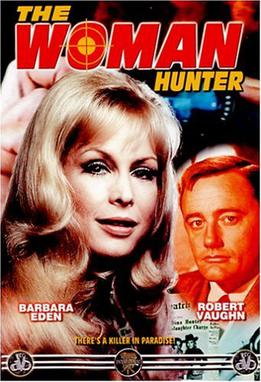
The Woman Hunter (1972, directed by Bernard L. Kowalksi)


Recovering from a traffic accident and having being recently acquitted on charges of vehicular manslaughter, wealthy socialite Diane Hunter (Barbara Eden) heads down to Acapulco with her businessman husband, Jerry (Robert Vaughn).  Diane wants to get away from the publicity of her case and relax but all Jerry seems to care about is business.  When she meets another American named Paul Carter (Stuart Whitman), Paul presents himself as being an artist.  But as Paul seems to be growing more and more obsessed with Diane and Jerry, Diane becomes convinced that Paul may have more sinister motives.  Is Diane right or is she having another breakdown?

The Woman Hunter is a quickly paced made-for-TV thriller that would probably have worked better if the two men in Diane’s life had been played by different actors.  Stuart Whitman and Robert Vaughn were both good actors but they were also so often cast in villainous roles that, as soon as they appear, everyone will know better than to trust either one of them.  The film’s big twist can be guessed just by the fact that Robert Vaughn is playing Diane’s husband.

Whitman seems bored with his role while Vaughn does his usual sleazy businessman routine.  He’s good at it but it’s a role that he played so often that it’s impossible to be surprised when it’s revealed that he’s less than trustworthy.  Barbara Eden gives a good performance and is really the main reason to watch this movie.  After being typecast as a genie in a bottle, Eden goes out of her way in The Woman Hunter to show that she was capable of doing so much more and, for the most part, she succeeds.  She’s sexy, sympathetic, and does just a good enough job portraying Diane’s mental instability that it does at least seem believable that she could be imagining all of the danger around her.  (Or, at least, it would be believable if the men in her life weren’t all portrayed by veteran screen villains.)

The Woman Hunter is forgettable but it was shot on location in Acapulco so at least everyone involved got a nice trip out of the deal.

The TSL’s Grindhouse: Private Wars (dir by John Weidner)


The 1993 action film, Private Wars, tells the story of a neighborhood, a big evil businessman, and one drunk private investigator who likes to shoot things.

The big evil businessman is Alexander Winters (played by Stuart Whitman).  Winters is so evil that he probably spends at least three hours every night practicing his smirk.  He’s the type who will plot someone’s death and then laugh about it just to make sure that it’s understood that he’s totally evil.  Winters wants to build a new business complex but there’s a neighborhood sitting on the land that he wants to use and no one’s willing to move.

However, Winters has a plan to bring about change.  If the people in the neighborhood won’t move voluntarily, he’ll just make them flee for their lives.  Winters pays off some local gangs to create trouble in the neighborhood.  Soon, stores are exploding and windows are getting broken and obscene graffiti is showing up on walls.  Everyone in the neighborhood keeps going to the community center and debating what to do.  You have to wonder why the gangs are wasting their time vandalizing storefronts when they could have just blown up the community center and taken out every who was in their way.

Eventually, the community decides to hire someone to teach them how to defend themselves.  After auditioning a series of ninjas and other wannabe soldiers of fortune, the community hires Jack Manning (Steve Railsback).  Why do they hire Jack Manning?  Well, he’s a friend of one of the community leaders.  He’s also an alcoholic who shoots his car whenever the engine starts giving him trouble.  How exactly anyone could look at Jack — who is not only almost always drunk but also a bit on the short and scrawny side — and think that he could protect the neighborhood is an interesting question that the film doesn’t really explore.

Anyway, the community is soon fighting back, which turns out to be a lot easier than anyone imagined.  Eventually, Jack ends up in jail as a result of Winters’s corruption but fortunately, it’s while in jail that Jack meets a few guys who all have mullets and who all come back to the neighborhood to help Jack out when a bunch of ninjas try to take over the streets.  Winters may have ninjas but Jack has a bunch of petty criminals who look they’re all heading to a hockey game in Toronto.  It’s a fair fight.

To be honest, the main thing that I will always remember about Private Wars was just how unnecessary Jack eventually turned out to be.  For all the money that he was apparently being paid, he really doesn’t do much.  I guess he does teach people in the neighborhood the techniques of self-defense but the film is so haphazardly edited that it’s hard to be sure of that.  It’s entirely possible that everyone already knew how to fight but they were just hoping Jack would do it for them.  Watching the film, it’s easy to get the feeling that the folks in the community center took one look at Jack and said, “Well, shit …. I guess we gotta do this ourselves.”  Even the final confrontation between Jack and Winters is resolved by a third character.  Imagine Roadhouse if Patrick Swayze spent the whole movie sitting at the bar and you have an idea what Private Wars is like.

Private Wars is really silly but, possibly for that very reason, it’s also occasionally fun in its own stupid way.  If nothing else, Stuart Whitman and Steve Railsback appeared to be enjoying themselves.  The movie’s on YouTube.  I watched it last Monday as a part of the #MondayActionMovie live tweet and I enjoyed myself.

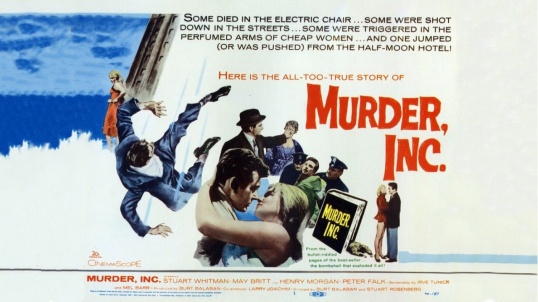
An Offer You Can’t Refuse #17: Murder, Inc. (dir by Stuart Rosenberg and Burt Balaban)


We all know the famous line from The Godfather.  “I’m going to make him an offer he can’t refuse.”  Of course, everyone also knows that “It’s not personal.  It’s strictly business.”  There’s another line that’s almost as famous: “One lawyer with his briefcase can steal more than a hundred men with guns.”  That line comes from Mario Puzo’s novel.  It’s never actually used in the film though it’s certainly present as a theme.

The idea of organized crime essentially being a huge corporation is hardly a new one.  In fact, it’s become a bit of a cliche.  Nearly every gangster film ever made has featured at least one scene where someone specifically compares their illegal activities to the day-to-day business of politicians and CEOs.  However, just because it’s a familiar analogy, that doesn’t make it any less important.  It’s hard not to think of organized crime as being big business when you consider that, in the 30s and the 40s, the mafia’s assassination squad was actually known as Murder, Inc.

Murder, Inc. was formed in Brooklyn, in the 30s.  It was founded and initially led by a man named Lepke Buchalter.  Lepke was a gangster but, because he was Jewish, he couldn’t actually become a made man.  However, he used that to his advantage when he created Murder, Inc.  The organization was largely made up of non-Italians who couldn’t actually become official members of the Mob.  The major mafia families would hire Murder, Inc. to carry out hits because they knew that, since none of the members were made men, they wouldn’t be able to implicate any of the families if they were caught by the police.

It was a good idea and Lepke and his band of killers made a lot of money.  Of course, eventually, the police did catch on.  A member of the organization by the name Abe Reles was eventually arrested and agreed to be a rat.  Lepke went to the electric chair.  Reles ended up falling out of a window.  Did he jump or was he thrown?  It depends on who you ask.

19 years after Reles plunged from that window and 16 years after Lepke was executed, their story was told in the 1960 film, Murder, Inc.  Lepke was played by David J. Stewart while Reles was played by Peter Falk.  The film is told in a documentary style, complete with a narrator who delivers his lines in a rat-a-tat-tat style.  We follow Reles as he goes to work with Lepke and as he harasses a singer (Stuart Whitman) and his wife (May Britt), forcing them help him carry out a murder and then allowing them to live in a luxury apartment on the condition that they also let Lepke hide out there.  (It’s probably not a surprise that a professional killer wouldn’t turn out to be the best houseguest.)  Eventually, a crusading DA (Henry Morgan) and an honest cop (Simon Oakland) take it upon themselves to take down Murder, Inc.

To be honest, there’s not a whole lot that’s surprising about this film but it’s still an entertaining B-movie.  The black-and-white cinematography and the on-location filming give the film an authentically gritty feel.  The action moves quickly and there’s enough tough talk and violent deaths to keep most gangster aficionados happy.  The best thing about the film is, without a doubt, Peter Falk’s portrayal of Abe Reles.  Falk is magnetically evil in the role, playing Reles as a man without a soul.  Even when Reles finally cooperates with the police, the film leaves no doubt that he’s only doing it to try to save himself.  Falk plays Reles like a tough guy who secretly knows that his days are numbered but who has convinced himself that, as long as he keeps sneering and threatening people, the rest of the world will never figure out that he’s been doomed all the time.  The more people he kills, the higher Reles moves up in the corporation and the more he tries to take on the look of a respectable member of society.  But, no mater how hard he tries, Reles always remains just another violent thug.  Falk was deservedly Oscar-nominated for his performance in this film, though he ultimately lost the award to Spartacus‘s Peter Ustinov.

Murder, Inc. may be a low-budget, B-movie but it’s also a classic of gangster cinema.  It’s an offer you can’t refuse.

Previous Offers You Can’t (or Can) Refuse:

  1. The Public Enemy
  2. Scarface
  3. The Purple Gang
  4. The Gang That Could’t Shoot Straight
  5. The Happening
  6. King of the Roaring Twenties: The Story of Arnold Rothstein 
  7. The Roaring Twenties
  8. Force of Evil
  9. Rob the Mob
  10. Gambling House
  11. Race Street
  12. Racket Girls
  13. Hoffa
  14. Contraband
  15. Bugsy Malone
  16. Love Me or Leave Me


Psycho-Killer: Peter Falk in MURDER INC. (20th Century-Fox 1960)


gary loggins's avatarcracked rear viewer

American filmgoers have had a long love affair with the gangster movie. The Pre-Code era was riddled with rat-a-tat-tat tommy gun action from Warner Brothers, MGM, and the other studios, helping to make stars out of Edward G. Robinson , James Cagney , Clark Gable , and a host of movie tough guys. Things quieted down once the Code was strictly enforced, but the gangster was still around, sometimes in comedy masks as likeable lugs, deneutered yet always lurking on-screen in some capacity.

By the late 1940’s, film noir introduced us to a darker vision, one seething with murderous rage. Cagney in WHITE HEAT, Robinson in KEY LARGO , and virtually everything Lawrence Tierney was in showed us gangsters were no “swell guys”, but anti-social psychopaths. The 50’s saw the gangster relegated mainly to ‘B’ status, just another genre to pit the good guys against the bad guys. Then in…

View original post 568 more words

Film Review: Mean Johnny Barrows (dir by Fred Williamson)


“Dedicated to the veteran who traded his place on the front line for a place on the unemployment line. Peace is Hell.”

— the end credits of Mean Johnny Barrows (1976)

“He’s not that mean.”

— Me, while watch Mean Johnny Barrows

Who is Johnny Barrows?  As played by blaxploitation star Fred Williamson, Johnny Barrows is a former football great who later served in Vietnam and won several silver stars.  As a soldier, he killed an untold number of people but he is always quick to explain that he wouldn’t do the same thing as a civilian.  Even after the war ended, Johnny remained in the army, teaching new recruits.  He was good at his job but, one day, a racist officer decided to play a stupid trick on Johnny.  During a training exercise, that officer put a live landmine out on the training grounds.  After defusing the mine, Johnny promptly punched the officer.  The result?  A dishonorable discharge and the lesson that peace is Hell.

Johnny returns to Los Angeles and discovers that the country he fought for isn’t willing to fight for him.  Because of his dishonorable discharge, Johnny can’t find a good job.  Because he can’t find a job, he can’t afford a place to live.  Johnny stays on the streets.  His only friend is a self-described philosophy professor (Elliott Gould, in an amusing cameo) who teaches Johnny all about soup kitchens.

When Johnny steps into an Italian restaurant and asks for food, he is shocked to discover that the owner, Mario Racconi (Stuart Whitman), knows who he is.  Mario says that he played against Johnny in a high school football game.  (Perhaps Johnny’s shock is due to the fact that Mario appears to be at least ten years older than him.)  Mario gives Johnny something to eat and even offers him a job.  Realizing that the work is mob-related, Johnny says that he’s not interested.  He’s not going to break the law…

And here’s where we run into a problem with the film’s title.  The film is entitled Mean Johnny Barrows but, so far, he’s been almost painfully nice.  Then again, Mild Johnny Barrows doesn’t have much of a ring to it.

Anyway, Johnny does try to stay out of trouble.  He even manages to land a demeaning job cleaning the toilets at a gas station.  But his boss (R.G. Armstrong) is a real jerk and Johnny has his dignity, no matter how much the world wants to take it away from him.  Finally, Johnny agrees to work with the Racconi Family.  Not only does he become friends with Mario but he also falls for Mario’s girlfriend, Nancy (Jenny Sherman).

Unfortunately, not all Mafia families are as kind-hearted and generous as the Racconi Family.  The Da Vinci family wants to flood Los Angles with drugs.  It’s all the master plan of Tony Da Vinci (Roddy McDowall).  Tony is eager to prove himself to his father and what better way to do that than to smuggle heroin?  Tony also loves flowers because … well, why not?  Anyway, when the Racconis object to Tony’s scheme, a mob war erupts.  Nearly all of the Racconis are killed.  It looks like it’s time for Johnny Barrows to put on his white suit, pick up a gun, and get vengeance for his surrogate family.

There are some pretty obvious problems with Mean Johnny Barrows, not the least of which is the casting of Roddy McDowall — perhaps the least Italian actor in the history of cinema — as a ruthless mafioso.  After having starred in several successful blaxploitation films, Fred Williamson made his directorial debut with Mean Johnny Barrows.  Williamson’s inexperience as director shines through almost every minute of Mean Johnny Barrows.  Though he does well with the action scenes, there are other parts of the film where Williamson doesn’t even seem to be sure where he should point the camera.  With almost every role miscast, the performances are pretty inconsistent but Williamson gives a good performance (it’s obvious that he understood his strengths and weaknesses as an actor) and Elliott Gould is an entertaining oddity as the Professor.

If anything saves the film, it’s that Williamson’s anger at the way America treats its veterans feels sincere.  The heart of the film is in the first half, which details Johnny’s struggle to simply survive from one day to the next.  Even if Williamson’s direction is often shaky, the film’s rage is so authentic that you do get caught up in Johnny’s story.  The film ends on a properly down note, suggesting that, for men like Johnny Barrows, there is no hope to be found in America.

To quote the film’s theme song: Peace is Hell.

http://www.youtube.com/watch?v=54GPAQxTwo4

Lisa Reviews An Oscar Nominee: The Longest Day (dir by Ken Annakin, Andrew Marton, Bernhard Wicki, Gerd Oswald, and Darryl F. Zanuck)


As my sister has already pointed out, today is the 73rd anniversary of D-Day.  With that in mind, and as a part of my ongoing mission to see and review every single film ever nominated for best picture, I decided to watch the 1962 film, The Longest Day!

The Longest Day is a pain-staking and meticulous recreation of invasion of Normandy, much of it filmed on location.  It was reportedly something of a dream project for the head of the 20th Century Fox, Darryl F. Zanuck.  Zanuck set out to make both the ultimate tribute to the Allied forces and the greatest war movie ever.  Based on a best seller, The Longest Day has five credited screenwriters and three credited directors.  (Ken Annakin was credited with “British and French exteriors,” Andrew Marton did “American exteriors,” and the German scenes were credited to Bernhard Wicki.  Oddly, Gerd Oswald was not credited for his work on the parachuting scenes, even though those were some of the strongest scenes in the film.)  Even though he was not credited as either a screenwriter or a director, it is generally agreed that the film ultimately reflected the vision of Darryl F. Zanuck.  Zanuck not only rewrote the script but he also directed a few scenes as well.  The film had a budget of 7.75 million dollars, which was a huge amount in 1962.  (Until Steven Spielberg’s Schindler’s List, The Longest Day was the most expensive black-and-white film ever made.)  Not only did the film tell an epic story, but it also had an epic length.  Clocking in at 3 hours, The Longest Day was also one of the longest movies to ever be nominated for best picture.

The Longest Day also had an epic cast.  Zanuck assembled an all-star cast for his recreation of D-Day.  If you’re like me and you love watching old movies on TCM, you’ll see a lot of familiar faces go rushing by during the course of The Longest Day.  American generals were played by actors like Robert Mitchum, Robert Ryan, Henry Fonda, and John Wayne.  Peter Lawford, then the brother-in-law of the President of the United States, had a memorable role as the Scottish Lord Lovat, who marched through D-Day to the sounds of bagpipes.  When the Allied troops storm the beach, everyone from Roddy McDowall to Sal Mineo to Robert Wagner to singer Paul Anka can be seen dodging bullets.  Sean Connery pops up, speaking in his Scottish accent and providing comic relief.  When a group of paratroopers parachute into an occupied village, comedian Red Buttons ends up hanging from the steeple of a church.  When Richard Beymer (who is currently playing Ben Horne on Twin Peaks) gets separated from his squad, he stumbles across Richard Burton.  Among those representing the French are Arletty and Christian Marquand.  (Ironically, after World War II, Arletty was convicted of collaborating with the Germans and spent 18 months under house arrest.  Her crime was having a romantic relationship with a German soldier.  It is said that, in response to the charges, Arletty said, “My heart is French but my ass is international.”)  Meanwhile, among the Germans, one can find three future Bond villains: Gert Frobe, Curt Jurgens, and Walter Gotell.

It’s a big film and, to be honest, it’s too big.  It’s hard to keep track of everyone and, even though the battle scenes are probably about an intense as one could get away with in 1962 (though it’s nowhere near as effective as the famous opening of Saving Private Ryan, I still felt bad when Jeffrey Hunter and Eddie Albert were gunned down), their effectiveness is compromised by the film’s all-star approach.  Often times, the action threatens to come to a halt so that everyone can get their close-up.  Unfortunately, most of those famous faces don’t really get much of a chance to make an impression.  Even as the battle rages, you keep getting distracted by questions like, “Was that guy famous or was he just an extra?”

Among the big stars, most of them play to their personas.  John Wayne, for instance, may have been cast as General Benjamin Vandervoort but there’s never any doubt that he’s playing John Wayne.  When he tells his troops to “send them to Hell,” it’s not Vandervoort giving orders.  It’s John Wayne representing America.  Henry Fonda may be identified as being General Theodore Roosevelt II but, ultimately, you react to him because he’s Henry Fonda, a symbol of middle-American decency.  Neither Wayne nor Fonda gives a bad performance but you never forget that you’re watching Fonda and Wayne.

Throughout this huge film, there are bits and pieces that work so well that you wish the film had just concentrated on them as opposed to trying to tell every single story that occurred during D-Day.  I liked Robert Mitchum as a tough but caring general who, in the midst of battle, gives a speech that inspires his troops to keep fighting.  The scenes of Peter Lawford marching with a bagpiper at his side were nicely surreal.  Finally, there’s Richard Beymer, wandering around the French countryside and going through the entire day without firing his gun once.  Beymer gets the best line of the film when he says, “I wonder if we won.”  It’s such a modest line but it’s probably the most powerful line in the film.  I wish The Longest Day had more scenes like that.

The Longest Day was nominated for best picture of 1962 but it lost to an even longer film, Lawrence of Arabia.