College student David Blake (Dirk Benedict) gets a job working as an assistant to Dr. Carl Stoner (Strother Martin). Dr. Stoner is an expert on reptiles and he is very concerned that man will not be able to survive if the Earth suffers any sort of environmental change. When he hires David, he only has two requirements for the young man. David is not to date Stoner’s daughter, Kristina (Heather Menzies) and David has to take an injection every day of a serum that will protect him from snake venom, or so Carl says.
What David doesn’t know is that Carl is a damn liar and his plan for saving humanity is to turn people into Snakemen! Snakes can survive anything so why wouldn’t human want to be more like them? Soon, David’s face is getting scaly and Kristina is discovering what really happened to her father’s previous assistant.
Sssssss tries to take its story seriously and the snake makeup is cool and creepy but the movie itself moves too slowly. It makes the mistake of worrying about convincing us that the story is plausible when it should just be focusing on snake action. There are some good scenes, like when Kristina tracks down David’s predecessor and Strother Martin is convincing as the mad scientist. If you thought Strother Martin was just capable of playing outlaws and corrupt cops, this movie may surprise you. I also liked the ending, which only seems ambiguous. It’s easy to see what’s going to happen after the end credits roll.
Richard Zanuck and David Brown produced this film. It did well enough at the box office that they decided to produce another nature-gone-mad movie. That one was named Jaws.
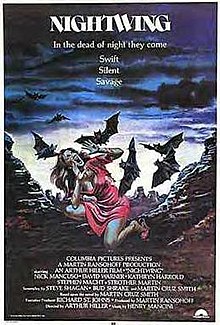
Cattle and humans are dying in New Mexico at an alarming rate. Scientist Phillip Payne (David Warner) thinks that the local bat population has become infected with the plague. Deputy Youngman Duran (Nick Mancuso) thinks that the bats may be attacking because of a curse that was cast by a Hopi medicine man. Meanwhile, the corrupt tribal chief (Stephen Macht) just wants to sell the land to an evil land developer (Ben Piazza) and be done with it. Dr. Anne Dillion (Kathryn Harrold) tries to spread the word about the bats but the authorities don’t want the bad publicity. They’ve never seen Jaws. And, finally, a group of missionaries camp in the desert with no idea what’s about to swoop down on them.
I don’t know about you but I would never think of missing an Arthur Hiller horror movie! While many directors in the 70s proudly wore the auteur and rebel label, Arthur Hiller went the opposite route. He oversw conventional, Hollywood productions, the best known of which was Love Story. Arthur Hiller was so mainstream that he eventually served as President of the Academy. This is all to say that Arthur Hiller directed some good films and he directed some bad films but, with his total lack of any sort of personal vision, he was absolutely the wrong director to do a horror movie. Hiller’s direction is flat. He’s not mean-spirited enough to enjoy the bat attacks and instead, he focuses on the debate over whether white developers should be buying native land, as if the people watching this movie are going to be watching for the human drama. By the end of the film, the bats have almost been abandoned and the movie turns into an action film, with a group of survivors fighting off Stephen Macht’s security force.
The most interesting thing about Nightwing is catching Strother Martin, the veteran western actor who memorably talked about a failure to communicate in Cool Hand Luke, as an ex-missionary. Otherwise, the film pales in comparison to The Birds and Wolfen, the two films which it must resembles in theme and action.
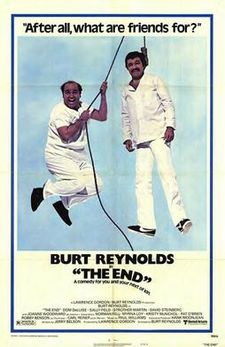
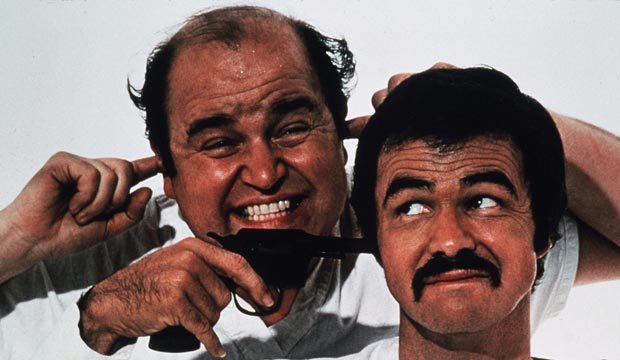
That is the theme of The End, which is probably the darkest film that Burt Reynolds ever starred in, let alone directed. Burt plays Sonny Lawson, a shallow real estate developer who is told that he has a fatal blood disease and that, over the next six months, he is going to die a slow and painful death. After seeking and failing to find comfort with both religion and sex, Sonny decides to kill himself. The only problem is that every time he tries, he fails. He can’t even successfully end things. When he meets an mental patient named Marlon Borunki (Dom DeLuise), he hires the man to murder him. Marlon is determined to get the job done, even if Sonny himself later changes his mind.
Yes, it’s a comedy.
The script for The End was written by Jerry Belson in 1971. Though Belson also worked on the scripts for Spielberg’s Close Encounters of the Third Kind and Always, he was best-known for his work on sitcoms. (Belson was an early collaborator of Garry Marshall’s.) The End was originally written with Woody Allen in mind but when Allen passed on it to concentrate on directing his own movies about death, the script spent five years in limbo. Reynolds later said that, when he eventually came across The End, he knew he had to do it because it was the only script that reflected “my strange sense of comedy.” United Artists was uncertain whether there was much box office potential in a film about a self-centered man dying and they required Reynolds to first make the commercially successful Hooper before they would produce The End.
The End was made for 3 million dollars and it went on to gross 40 million. That the film was a box office success is a testament to the late 70s starpower of Burt Reynolds because it’s hard to think of any other mainstream comedy that goes as much out of its way to alienate the audience as The End does. While watching The End for the first time, most viewers will probably expect two things to happen. First off, Sonny will learn to appreciate life and be a better person. Secondly, it will turn out that his fatal diagnosis was incorrect. Instead, neither of those happen. Sonny is going to die no matter what and he never becomes a better person. What’s more is that he never even shows any real interest in becoming a better person. The film’s signature scene comes when Sonny prays to God and offers to give up all of his money if he survives, just to immediately start backtracking on the amount. It’s funny but it’s also a sign that if you’re looking for traditional Hollywood sentiment, you’re not going to find it here.
Burt not only stared in The End but he also directed it and, as was usually the case whenever he directed a film, the cast is a mix of friends and Hollywood veterans. Sally Field plays Sonny’s flakey, hippie girlfriend while Robby Benson is cast as a young priest who fails to provide Sonny with any spiritual comfort. Joanne Woodward plays his estranged wife and Kristy McNichol plays his daughter. Myrna Loy and Pat O’Brien play his parents. Norman Fell, Carl Reiner, and Strother Martin play various doctors. The movie is stolen by Dom DeLuise, playing the only person who seems to care that Sonny’s dying, if just because it offers him an excuse to kill Sonny before the disease does. DeLuise was a brilliant comedic actor whose talents were often underused in films. The End sets DeLuise free and he gives a totally uninhibited performance.
Despite DeLuise’s performance, The End doesn’t always work as well as it seems like it should. Though Reynolds always said that this film perfectly captured his sense of humor, his direction often seems to be struggling to strike the right balance between comedy and tragedy and, until DeLuise shows up, the movie frequently drags. As a character, the only interesting thing about Sonny is that he’s being played by Burt Reynolds. That is both the film’s main flaw and the film’s biggest strength. Sonny may not be interesting but, because we’re not used to seeing Burt cast as such a self-loathing, self-pitying character, it is interesting to watch a major star so thoroughly reveal all of his fears and insecurities.
If you’re a Burt Reynolds fan, The End is an interesting film, despite all of its flaws. Burt often described this as being one of his favorite and most personal films. It’s a side of Burt Reynolds that few of his other films had the courage to show.
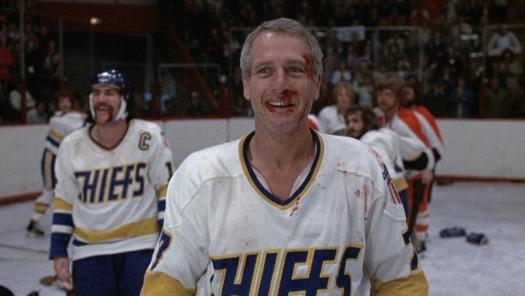
Hockey fans are excited about this year’s Stanley Cup Finals between the Boston Bruins and the St. Louis Blues, so I figured now’s the time to take a look at the quintessential hockey movie, George Roy Hill’s SLAP SHOT. Hill and star Paul Newman, who’d previously collaborated on BUTCH CASSIDY & THE SUNDANCE KID and THE STING, reunited for this raucous, raunchy sports comedy about a failing minor league hockey team who reinvent themselves as a hard-hitting goon squad.
Newman plays Reg Dunlap, an aging rink rat now the player-coach for the Chiefs, a dying franchise in a dying mill town. The team is on a massive losing streak, and attendance is at an all-time low. Two-bit GM Joe McGrath (Newman’s COOL HAND LUKE antagonist Strother Martin) is trying to sell the Chiefs, and things look bleak until Dunlap begins taunting his opponents and the rink violence escalates. Enter a…
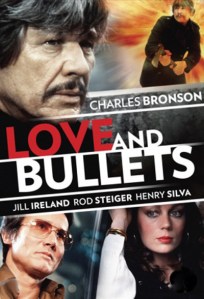
Joe Bomposa (Rod Steiger) may wear oversized glasses, speak with a stutter, and spend his time watching old romantic movies but don’t mistake him for being one of the good guys. Bomposa is a ruthless mobster who has destroyed communities by pumping them full of drugs. Charlie Congers (Charles Bronson) is a tough cop who is determined to take Bomposa down. When the FBI learns that Bomposa has sent his girlfriend, Jackie Pruit (Jill Ireland), to Switzerland, they assume that Jackie must have information that Bomposa doesn’t want them to discover. They send Congers over to Europe to bring her back. Congers discovers that Jackie does not have any useful information but Bomposa decides that he wants her dead anyway.
Love and Bullets is an uneasy mix of action and comedy, with Bronson supplying the former and Ireland trying to help out with the latter. Not surprisingly, the action works better than the comedy. Because Charlie is an American in Switzerland, he is not allowed to carry a gun and he is forced to resort to some creative ways to take out Bomposa’s assassins. Unfortunately, the scenes where Charlie and Jackie fall in love are less interesting, despite Bronson and Ireland being a real-life couple. Ireland occasionally did good work when she was cast opposite of Bronson but here, she’s insufferable as a ditzy gangster moll with a strange accent. While everyone else is trying to make an action movie, she’s trying too hard to be Judy Holliday. Steiger’s peformance starts out as interesting but soon devolves into the usual bellowing and tics.
Love and Bullets does have a good supporting cast, though. Bradford Dillman, Michael V. Gazzo, Val Avery, Albert Salmi, and Strother Martin all pop up. The two main hit men are played by Paul Koslo and Henry Silva. Silva’s almost as dangerous here as he was in Sharky’s Machine.
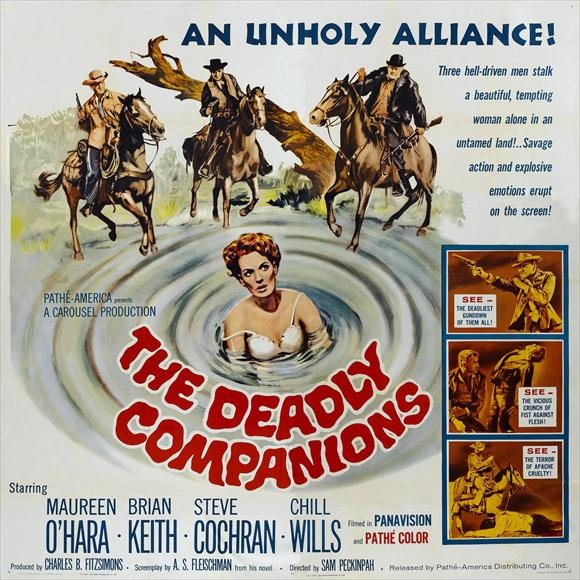
Maverick filmmaker Sam Peckinpah got his start in television, writing and directing for Westerns such as GUNSMOKE, THE RIFLEMAN, and HAVE GUN- WILL TRAVEL. In 1959, he created the series THE WESTERNER, starring Brian Keith as a drifter named Dave Blassingame, noted for its extreme (for the time) violence. When Keith was cast as the lead in THE DEADLY COMPANIONS, he suggested his friend Peckinpah as director. This was Peckinpah’s first feature film, and the result is a flawed but interesting film which has brief flourishes of the style he later perfected in THE WILD BUNCH and PAT GARRETT AND BILLY THE KID.
Keith is again a drifter, this time an ex-Union soldier known only as Yellowleg. He hooks up with a pair of Southern outlaws and they ride to Hila City to rob the bank. They get sidetracked at the saloon when it converts into a church service. Next thing you know…
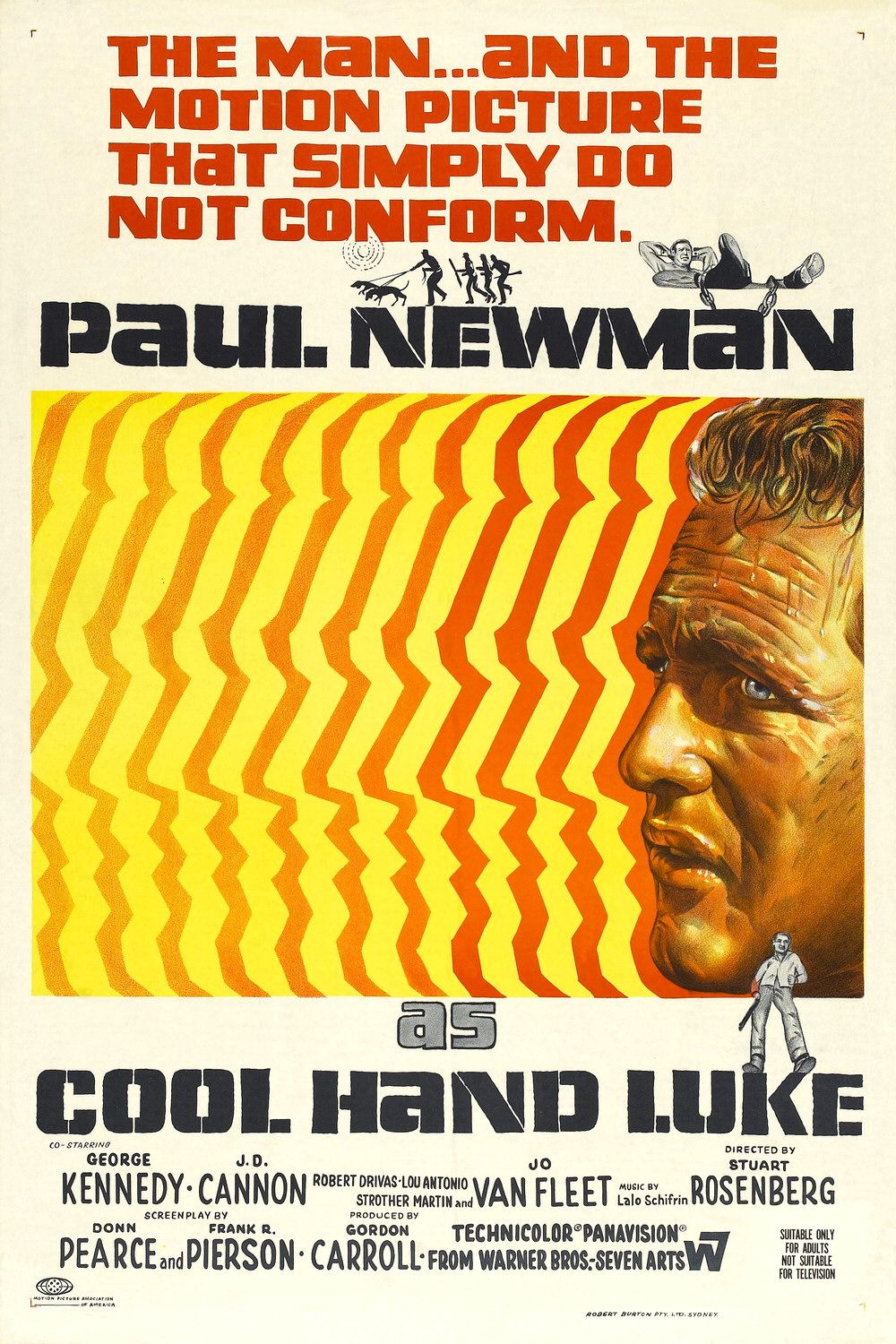
The Sixties was the decade of the rebellious anti-hero. The times they were a-changin’ and movies reflected the anti-establishment mood with BONNIE & CLYDE, EASY RIDER, and COOL HAND LUKE. Paul Newman starred as white-trash outsider Luke Jackson, but it was his co-star George Kennedy who took home the Oscar for his role as Dragline, the king of the cons who first despises then idolizes Luke.
War vet Luke gets busted for “malicious destruction of municipal property while drunk”, and sent to a prison farm in Florida. The non-conformist Luke butts heads with both the “bosses” (prison guards aka authority) and Dragline, a near illiterate convict who runs the yard. Dragline and Luke decide to settle their differences in a Saturday boxing match. The hulking Dragline beats the shit out of Luke, but the smaller man keeps getting up for more. Dragline finally walks away, and Luke earns both his and…
A century before Beatrix Kiddo killed Bill and The Deadly Viper Assassination Squad, there was Hannie Caulder.
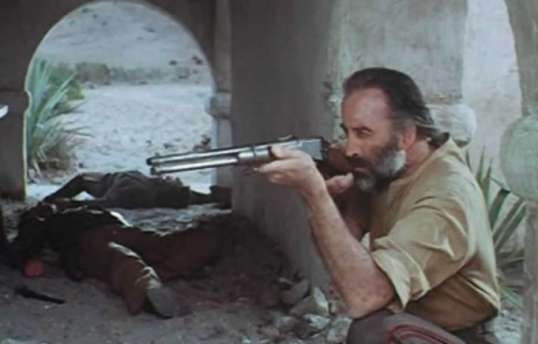
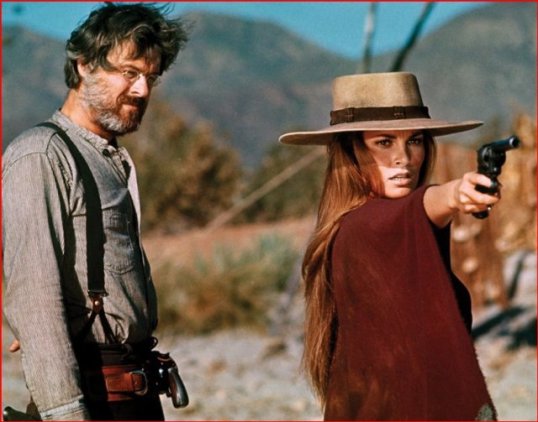
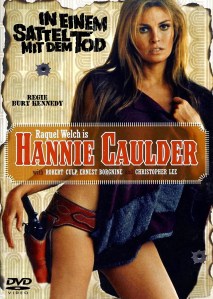
Hannie Caulder (played by Raquel Welch) lives at a horse station on the Texas/Mexico border. When the outlaw Clemmons brothers — Emmett (Ernest Borgnine), Frank (Jack Elam), and Rufus (Strother Martin) — arrive at the station following a disastrous bank robbery, they brutally murder her husband and take turns raping her. After setting the station on fire, the Clemmons Brothers leave Hannie for dead.
What they do not realize is that Hannie has managed to crawl out of the burning building. The next day, when a bounty hunter named Thomas Luther Price (Robert Culp) approached the burned out remains of the station, Hannie begs him to teach her how to shoot a gun.
“If I taught you the gun,” Tom says, “you’d go out and get your ass shot off!”
“It’s my ass!” Hannie replies.
“It’s a shame to get it shot full of holes,” Tom says, “It’s as pretty a one as I’ve ever seen.”
Tom refuses to teacher her how to handle a gun but he does allow her to ride with him. Before she mounts Tom’s second horse, Hannie sees that there is a body lying across the saddle. “I hope you don’t mind riding with a dead man,” Tom says.
After Tom realizes that she was raped, he agrees to her how to shoot. But first, he takes her into Mexico to meet a former Confederate gunsmith named Bailey so that Bailey can make her a gun. Bailey is played by Christopher Lee. In a career that spanned 70 years, Hannie Caulder was the only Western that Christopher Lee ever appeared in. At first, it’s strange to see Christopher Lee in a Western, using his Winchester rifle to gun down a group of bandits who threaten his family. But Lee is a natural and eventually, you stop seeing him as Dracula in a western and you just see him as Bailey.
As Bailey and Tom watch Hannie practice her shooting, Bailey says, “Fine-looking woman.”
“She wants to be a man,” Tom responds.
Bailey nods. “She’ll never make it.”
As an actress, Raquel Welch was often miscast in roles that were only meant to highlight her looks. She was always at her best when she played tough characters who were not afraid to fight and Hannie is one of her toughest. While the film certainly takes advantage of her appearance (she spends a good deal of it wearing nothing but a poncho), Welch also gives one of her best performances. Even with Culp, Borgnine, Elam, and Martin acting up a storm, she more than holds her own. She not only looks good with a gun but she knows how to use it too.
Though the film was obviously influenced by the violent Spaghetti westerns that were coming out of Italy at the time, Hannie Caulder was directed by Hollywood veteran Burt Kennedy. Kennedy was best known for comedic westerns like Support Your Local Sheriff and Hannie Caulder awkwardly mixes drama with comedy. Scenes of the Clemmons Brothers bickering and grizzled old west types doing a double take whenever Hannie walks by are mixed with Peckinpah-style violence and flashbacks of Hannie being raped. If the film had a director more suited to the material, it could have been a classic but under Kennedy’s direction, the end result is uneven but always watchable.
Should I start this post by ticking everyone off or should I start out by reviewing the 1969 best picture nominee Butch Cassidy and The Sundance Kid?
Let’s do the review first. I recently watched Butch Cassidy and the Sundance Kid when it aired as a part of TCM’s 31 Days of Oscar. This was actually my third time to see the film on TCM. And, as I watched Butch Cassidy and the Sundance Kid for the third time, I was shocked to discover how much I had forgotten about the film.
Don’t get me wrong. I remembered that it was a western and that it starred Paul Newman and Robert Redford as real-life outlaws Butch Cassidy and the Sundance Kid. I remembered that it opened and ended with sepia-toned sequences that suggested that Butch and Sundance represented the last gasp of the old west. I remembered that Butch won a fight by kicking a man in the balls. I also remembered that they robbed the same train twice and, the second time, they accidentally used too much dynamite. I remembered that, for some reason, Butch spent a lot of time riding around on a bicycle. I remembered that Butch and Sundance ended up getting chased by a mysterious posse. I remembered that Sundance could not swim. And I remembered that the film eventually ended on a tragic note in South America…
And I know what you’re saying. You’re saying, “It sounds like you remembered the whole movie, Lisa!”
No, actually I did not. The thing with Butch Cassidy and the Sundance Kid is that the scenes that work are so memorable that it’s easy to forget that there’s also a lot of scenes that aren’t as memorable. These are the scenes where the film drags and you’re thankful that Paul Newman and Robert Redford were cast as Butch and Sundance, because their charisma helps you overlook a lot of scenes that are either too heavy-handed or which drag on for too long. You’re especially thankful for Newman, who plays every scene with a twinkle in his wonderful blue eyes and who is such a lively presence that it makes up for the fact that Redford’s performance occasionally crosses over from being stoic to wooden. It can be argued that there’s no logical reason for a western to feature an outlaw riding around on a bicycle while Raindrops Keep Fallin’ On My Head plays on the soundtrack but Paul Newman’s so much fun to watch that you can forgive the film.
Newman and Redford both have so much chemistry that they’re always a joy to watch. And really, that’s the whole appeal of Butch Cassidy and the Sundance Kid, the chance to watch two iconic actors have fun playing opposite each other. Even though Katharine Ross appears as their shared romantic interest, the film’s love story is ultimately between Butch and Sundance (and, by extension, Newman and Redford). You can find countless reviews that will give all the credit for the film’s appeal to William Goldman’s screenplay. (You can also find countless self-satisfied essays by William Goldman where he does the exact same thing.) But, honestly, the film’s screenplay is nothing special. This film works because of good, old-fashioned star power.
Now, for the part that’ll probably tick everyone off (heh heh), I think that Butch Cassidy and the Sundance Kid is actually a pretty good pick for a future remake. All you have to do is pick the right actors for Butch and Sundance. I’m thinking Chris Pratt as Butch and Chris Evans as Sundance…
“When the legend become fact, print the legend.” — Maxwell Scott (Carleton Young) in The Man Who Shot Liberty Valance (1962)
Though I understand and respect their importance in the history of both American and Italian cinema, I have never really been a huge fan of westerns. Maybe its all the testosterone (“A man’s got to do what a man’s got to do…”) or maybe it’s all the dust but westerns have just never really been my thing.
However, I will always make an exception for The Man Who Shot Liberty Valance, which is not just a great western but a great film period.
But you already knew that. It’s a little bit intimidating to review a film that everyone already knows is great. I even opened this review with the exact same quote that everyone uses to open their reviews of The Man Who Shot Liberty Valance. To a certain extent, I feel like I should have found a quote that everyone hasn’t already heard a thousand times but then again, it’s a great quote from a great film and sometimes, there’s nothing wrong with agreeing with the critical consensus.
The Man Who Shot Liberty Valance opens with a train stopping in the small western town of Shinbone. The residents of the town — including newspaper editor Maxwell Scott (Carleton Young) — are shocked when Sen. Rance Stoddard (James Stewart) and his wife Hallie (Vera Miles) get off the train. Sen. Stoddard is considered to be a front-runner to become the next Vice President of the United States. Scott is even more shocked to discover why the Stoddards are in town. They’ve come to Shinbone to attend the funeral of an obscure rancher named Tom Doniphon (played, in flashback, by John Wayne).
Sitting in the funeral home with Doniphon’s coffin (and having reprimanded the local mortician for attempting to steal Tom’s boots), Rance tells Scott why he’s come to pay respect to Tom Doniphon. We see, in flashback, how Rance first came to Shinbone 25 years ago, an idealistic lawyer who — unlike most of the men in the west — refused to carry a gun. We see how Rance was robbed and assaulted by local outlaw Liberty Valance (a wonderfully intimidating and bullying Lee Marvin), we discover how Rance first met Hallie while working as a dishwasher and how he eventually taught her how to read, and we also see how he first met Tom Doniphon, the only man in town strong enough to intimidate Liberty Valance.
At first, Rance and Doniphon had an uneasy friendship, epitomized by the condescending way Doniphon would call Rance “pilgrim.” Doniphon was in love with Hallie and, when he attempted to teach Rance how to defend himself, he was largely did so for Hallie. Rance, meanwhile, was determined to bring law and society to the west.
And, eventually, Rance did just that. When Shinbone elected two delegates to the statehood convention in the territory’s capitol, Rance attempted to nominate Doniphon for the position but Doniphon refused it and nominated Rance instead, explaining that Rance understood “the law.” When Liberty Valance attempted to claim the other delegate spot, Rance and Doniphon worked together to make sure that it instead went to newspaper editor Dutton Peabody (Edmond O’Brien). And when Liberty Valance attempted to gun Rance down in the street, Rance shot him.
Or did he?
That’s the question that’s at the heart of The Man Who Shot Liberty Valance. However, as a film, The Man Who Shot Liberty Valance is far less interested in gunfights than it is in politics. Perhaps the most important scene in the film is not when Rance and Liberty meet out on that dark street. Instead, it’s the scene at the statehood convention where the reformers (represented by Rance) and the cattlemen (represented by John Carradine) battle over who will be the territory’s delegate to Washington. Between John Carradine orating, the horses riding in and out of the hall, Edmond O’Brien drinking, James Stewart looking humble, and John Wayne glowering in the background, this is one of the best political scenes ever put on film.
When Rance first arrives in the west, there is no political system in place. With the exception of the ineffectual town marshal (Andy Devine), there is no law. The peace is kept by men like Tom Doniphon and, oddly enough, by Liberty Valance as well. (Whether he realizes it or not, Shinbone’s fear of Liberty has caused the town to form into a community.) What little official law there is doesn’t matter because the majority of the Shinbone’s citizens can’t read.
When Rance arrives, he brings both education and the law. He makes Shinbone into a town that no longer needs Liberty Valance but, at the same time, it no longer need Tom Doniphon either. Hence, it’s Rance Stoddard who goes from dishwasher to U.S. Senator while Tom Doniphon dies forgotten. Rance represents progress and unfortunately, progress often means losing the good along with the bad things of the past.
(It’s no coincidence that when Rance and Hallie return to Shinbone, the first person that they see is the former town marshal, who no longer wears a star and who, we’re told, hasn’t for years. Time has passed by.)
It’s a bittersweet and beautiful film, one that features four great performances from Stewart, Wayne, Marvin, and Vera Miles. Personally, I like to think that maybe Sen. Stoddard had a daughter who married a man named Smith and maybe they had a son named Jefferson who later made his way to the Senate as well.