Welcome to Retro Television Reviews, a feature where we review some of our favorite and least favorite shows of the past! On Mondays, I will be reviewing Miami Vice, which ran on NBC from 1984 to 1989. The entire show can be purchased on Prime!
This week, Crockett goes undercover as a Neo-Nazi.
Episode 5.16 “Victim of Circumstances”
(Dir by Colin Bucksey, originally aired on May 5th, 1989)
When a Miami coffeeshop is the scene of a violent shooting that leaves several dealers and the coffeeshop’s owner dead, Crockett and Tubbs assume that it’s just another part of an ongoing drug war. However, when it’s discovered that the owner of the coffeeshop was a Holocaust survivor who was scheduled to testify against a former guard named Hans Kozak (William Hickey), Crockett comes to suspect that the hit was ordered by a Neo-Nazi group. Crockett and Switek go undercover to infiltrate the group but it turns out that the killer was actually Helen Jackson (Karen Black), a reporter who is the daughter of Hans Kozak and who is trying to kill everyone who can testify against her father. Crockett and Tubbs manage to capture Helen but Helen is subsequently gunned down by Angelo Alvarez (John Leguizamo), the brother of one the dealers who was killed at the coffeeshop.
This was an interesting episode. On the one hand, it was based in reality. In the days following World War II, several concentration camp commandants were put on trial and executed for war crimes but the Allies were so busy going after the people in charge that there were several guards, doctors, and other personnel who were able to escape justice and who immigrated elsewhere. Quite a few went to South America. Several turned up in the Middle East. And there were many who ended up in America. It wasn’t until decades after the war that people started to get serious about tracking down and putting on trial the camp personnel who were often as brutal as the people giving the orders. By the time many of them started going on trial, they were elderly and often frail, like Hans Kozak. And, just as in this episode, there were many Neo-Nazi groups who protested the trials and sometimes tried to help the accused escape justice.
On the other hand, this episode played out in such a surreal manner that it often felt rather dream-like, with Hans Kozak being haunted by nightmares and the Neo-Nazis themselves meeting in ceremonies that felt as if they could have been lifted from one of Fritz Lang’s Dr. Mabuse films. Karen Black plays her role with such wild-eyed intensity that the revelation that she was the killer isn’t really that much of a surprise. As for William Hickey, he doesn’t so much chew the scenery as he treats it like a buffet. This was one of those episodes that felt like it could spin off into space at any given moment. If James Brown had returned as the alien who abducted Trudy, I would not have been surprised.
This episode was definitely watchable and Stefan Gierasch gave a strong performance as the Nazi hunter who was determined to track down Hans Kozak. There was nothing subtle about it but it’s still one of the more memorable episodes of the show’s final season.
Speaking of final season, next week will feature Crockett and Tubbs in their final adventure. And then, we’ll look at the four “lost” episodes, which aired in syndication after the show’s network run ended. And then, we’ll done with Miami …. for now.
“Don’t count on me to make you feel safe.” — The Stranger
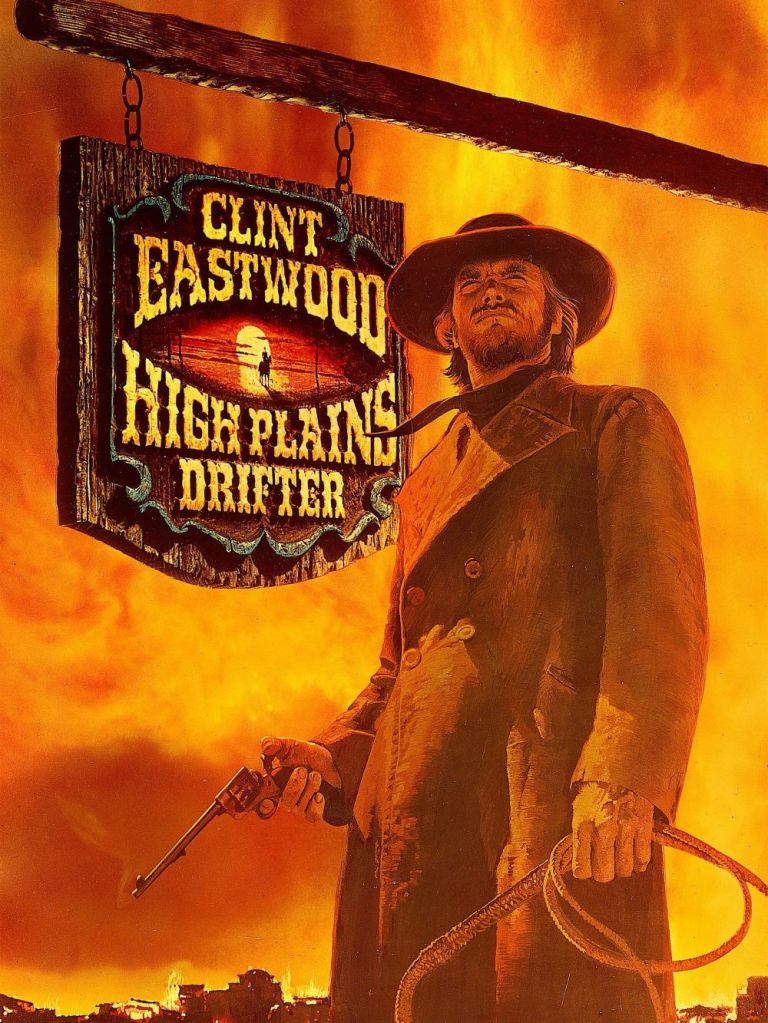
High Plains Drifter stands as one of the bleakest, most enigmatic entries in Clint Eastwood’s filmography—a Western that bleeds unmistakably into the realms of psychological and supernatural horror. This 1973 film is not just another dusty tale of lone gunfighters and frontier justice. It’s a nightmare set in broad daylight, a morality play whose hero is more monster than man.
Eastwood’s Stranger comes riding into the town of Lago from the shimmering desert, a silhouette both akin to and apart from his famed Man With No Name persona. The townsfolk are desperate, haunted by fear—less afraid of imminent violence, more of the sins they’ve half-buried. This is a place where a lawman was brutally murdered by outlaws while the townspeople looked away, their silence paid for with cowardice and greed. When the Stranger assumes command, he does so with often-gleeful sadism—kicking people out of their hotel rooms, replacing the mayor and sheriff with the dwarf Mordecai, and ordering that the entire town be painted red before putting “Hell” on its welcome sign.
There’s a surface plot: the Stranger is hired to protect Lago from the same three outlaws who once butchered its marshal. But he’s there for far more than that. The story unspools through dreamlike sequences, flashbacks that suggest the Stranger may well be an avenging spirit or a revenant—the dead lawman, spectral and merciless, returned to claim what the townsfolk owe to Hell itself.
The horror here isn’t about jump scares or gothic haunted houses. The supernatural lurks everywhere and yet nowhere. The Stranger moves with the implacable calm—and violence—of a slasher villain, transforming Lago into his personal stage for retribution. His nightmares, full of images of past atrocities, are painted with the same vivid brutality as the daytime violence. Eastwood’s use of silence, the squint of a face, the twitch of a pistol replaces musical cues in amplifying dread. The sound design evokes otherness—a howling wind, footsteps echoing across empty streets—that builds a shadow of terror around the Stranger’s presence.
This violence is hurried and brutal; its sexual politics unflinching. When the Stranger enacts revenge, he punishes not just the outlaws, but the townsfolk complicit in their crimes. There is little comfort in his sense of justice—the pleasures he takes border on sadistic. The film’s moral ambiguity cuts deeper than most Westerns or horrors: this is not a clear-cut tale of good versus evil, but a brutal reckoning of collective guilt, cowardice, and corruption.
Lago itself acts almost like a town stuck in purgatory—a holding pen between redemption and eternal damnation. The infamous “Welcome to Hell” sign the Stranger paints at the town’s entrance serves as a grim message. It’s no welcome to law and order, but a symbolic beacon to the very outlaws the Stranger is hired to confront, suggesting that Lago is a place where sin festers and punishes itself. The town’s dance with Hell is both literal and metaphorical. The inhabitants aren’t just awaiting judgment; they have invited it in their desperate attempts to hide their cowardice and greed under the guise of civilization.
This notion of Lago as purgatory stands in sharp contrast to other recent horror Westerns, which serve as prime examples of the genre’s thematic spectrum. These films tend to focus on the primal terror of nature barely held at bay by the fragile veneer of civilization the settlers claim. They pit human beings against the ancient, untamed forces of the wilderness—whether monstrous creatures or surreal phenomena—emphasizing that the supposed order and progress of the West remain fragile and constantly threatened. This dynamic symbolizes the uneasy balance between civilization’s reach and nature’s primal power, often revealing how thin and tenuous that barrier truly is.
Among these, Bone Tomahawk and Ravenous stand out as vivid examples. Bone Tomahawk confronts menacing cannibals lurking in the wild, reminding viewers that the West’s order is fragile and under perpetual threat from untamed wilderness. Ravenous uses cannibalism and survival horror as metaphors for nature’s savage predation hidden beneath the polite façade of civilization—nature’s horrors masked but not erased.
By contrast, High Plains Drifter directs its horror inward, exposing the corruption that manifest destiny imposed on settlers themselves. Instead of fearing nature as an external force, the film presents settlers as haunted by their own moral failures and complicity in violence and betrayal. The Stranger’s vengeance is a reckoning with the darkness festering inside the community, a brutal meditation on guilt, collective cowardice, and the price of greed disguised as progress.
Eastwood’s film strips away the mythic promises of the American West as a land of freedom and opportunity, revealing instead the brutal reality of communities locked in complicity, violence masquerading as justice, and the moral rot at the heart of manifest destiny. This moral ambiguity and psychological depth give High Plains Drifter a unique position in the horror Western subgenre, elevating it beyond simple scares to a profound exploration of American cultural myths.
The Stranger is not a traditional hero but a spectral judge, embodying divine or supernatural retribution. His calm yet ruthless punishment exposes the cruelty, cowardice, and malevolence within Lago’s population, meting out a justice that is neither neat nor forgiving. His supernatural aura and sadistic tendencies make him an unforgettable figure of terror and fate.
Visually, the film’s harsh daylight contrasts with the romanticized Western landscapes of earlier films. Instead of shadows hiding evil, blinding light exposes the town’s moral decay. Characters are reduced to symbols of greed, fear, and cruelty, highlighting that the true horror lies within human nature and the failure to uphold justice.
High Plains Drifter operates on multiple levels—a Western, a ghost story, a horror film, and a dark morality play. It is a relentless meditation on justice and punishment and a dismantling of the traditional Western hero myth. Through layered narrative, stark visuals, and Eastwood’s chilling performance, it remains an essential entry in the horror Western canon.
For those seeking a Western that doesn’t just entertain but unsettles and challenges, High Plains Drifter offers an unforgiving descent into darkness. It strips away the comforting myths of the frontier and exposes the raw, rotting core beneath. Unlike other modern horror Westerns such as Bone Tomahawk and Ravenous, which confront external terrors lurking in the wilderness, this film turns its gaze inward—on the moral decay, guilt, and violence festering within the settlers themselves. It’s a brutal, haunting reckoning, and Eastwood’s Stranger is the cold, relentless agent of that reckoning. This is a journey into a hell both literal and psychological, where justice is merciless and safety is a long-forgotten promise.
In 1973’s High Plans Drifter, Clint Eastwood plays …. The Stranger.
No, not the Man With No Name. The Stranger has a name but he chooses not to share it. That said, when one person says that he doesn’t even know the Stranger’s real name, the Stranger replies, “Yes, you do.” The Stranger appears to emerge from the heat of the desert, riding into the small mining town of Lago and gunning down the three bullies that the townspeople hired to protect them after the murder of their town marshal. With no other option, the townspeople accept the Stranger as the town’s new protector.
The Stranger is drawn to the town and the townspeople but he doesn’t seem to particularly like any of them, with the exception of Mordecai (Billy Curtis), the dwarf that the Stranger appoints as the town’s new sheriff. The townspeople, the majority of whom are cowardly and motivated by greed, aren’t particularly likable themselves. The Stranger rules the town like a dictator, kicking everyone out of the hotel so that he can have it for himself and ordering that every building in the town be painted red. Over the town’s welcome sign, he paints one word: “Hell.” When the townspeople see how well the Stranger can shoot, they celebrate in the belief that they’ll always be safe. The Stranger responds by leaving town just as three sadistic outlaws, led by Stacey Bridges (Geoffrey Lewis), approach. The Stranger may be looking for revenge on Bridges but he also seems as if he wants to make the town suffer for its sins as well.
Much as with the case of The Man With No Name, the Stranger is not motivated by kindness or any sort of concern for the safety of the townspeople. He often shows a cruel-streak when it comes to dealing with the cowardly townspeople. He doesn’t attack unless he’s attacked first but once you’re on his bad side, he’ll gun you down without a hint of emotion. When the Stranger sleeps, he is haunted by nightmares of the previous marshal (played by Buddy Van Horn, Clint Eastwood’s stunt double) being murdered by Bridges and his men while the townspeople stood by and did nothing. We learn that the townspeople, worried that it might be bad for their business interests, didn’t even give the late marshal a decent headstone after his death. One woman mentions that spirits can’t rest unless they have a proper marker….
Getting the idea?
High Plains Drifter is probably the closest that Eastwood has ever come to making a supernatural horror film. The Stranger may or may not be a vengeful ghost (the movie leaves that for you to decide) but he turns the small town of Lago into his own personal version of Hell and, when he attacks the men who killed the marshal, he moves with the ruthless determination of a slasher villain. The scene where Bridges and his men ride into the town is like a filmed nightmare. This is a dark film, one in which Eastwood’s Stranger is not the hero because he’s particular heroic but just because everyone else in the film is so bad.
This was also Eastwood’s second film as a director (following Play Misty For Me) and also the first of many westerns that Eastwood would direct. The imagery is often haunting, all the more so because some of the most violent scenes take place in broad daylight. The scenes where the Stranger seems to materialize out of the desert’s heatwaves perfectly capture the mythology of the old west and its “heroes.” Eastwood gets good performances out of his ensemble cast and, even more importantly, he shows that Eastwood the director had a perfect understanding of Eastwood the actor. As the Stranger, Eastwood says more with a snarl or a half-smile than most actors could say with a multi-page monologue.
High Plains Drifter is violent, often disturbing, and ultimately unforgettable.
Welcome to Retro Television Reviews, a feature where we review some of our favorite and least favorite shows of the past! On Tuesdays, I will be reviewing the original Fantasy Island, which ran on ABC from 1977 to 1986. Almost entire show is currently streaming is on Youtube!
This week’s trip to Fantasy Island is sadly forgettable. Let’s find out why.
Episode 3.13 “The Inventor/On The Other Side”
(Dir by Earl Bellamy, originally aired on December 15th, 1979)
This week, there is no banter between Tattoo and Mr. Roarke before they head off to meet their guests. In fact, Ricardo Montalban and Herve Villechaize barely look at each other. It’s a shame because this is actually a pretty dire episode. It could have used some passive-aggressive Tattoo/Roarke interaction.
The first fantasy features Arte Johnson as Professor Dwayne Clebe and Marcia Wallace as his assistant, Martha Meeks. Professor Clebe is tying to develop a solution that, when sprayed on metal, will make it impervious to damage. When he first arrives at Fantasy Island, the solution is called 2X76409, with the 9 signifying the 9 labs that have been blow up by Clebe’s experiments. By the time he and Martha perfect the solution, it has become the 2X76411. Fear not, no one is injured when the labs blow up. Even though Clebe and Martha are both standing in the middle of these explosions, they always just end up with soot on their face.
Anyway, once the formula is perfected, leaders of both industry and the world’s trade unions travel to Fantasy Island to try to destroy it. The industrialists think that it will drive down prices. The unionists think that it will put people out of work. Eventually, the Russians show up because they want the formula for themselves. It all leads to a big chase and Prof. Clebe realizing that he loves Martha.
The whole fantasy was way too cartoonish and overwritten for its own good and it featured some of the worst acting that I’ve ever seen on Fantasy Island. Let’s move on!
Unfortunately, the other fantasy really isn’t that great either. Irma Gideon (Jeanette Nolan) was the wife of a medium. When he died, he promised that he would contact her from the other side. He hasn’t done so and Irma’s fantasy is to go to the other side, see her husband, and then return. Mr. Roarke arranges for a séance but, when he suspects that Irma is planning on just going to the other side and staying there, he cancels the fantasy. After Irma swears that she won’t stay in “the other side,” Mr. Roarke allows her to enter a death-like trance in a Fantasy Island laboratory. When Irma goes to the Other Side and is tempted to cross a bridge and stay permanently, her grandson (Keith Gordon) enters into a trance of his own so that he can beg her to come back.
It all sounds like it should be interesting but the execution is lacking, with one scene featuring a painting of Irma’s husband speaking to her being so badly done that it makes it impossible to take the rest of the fantasy seriously. Jeanette Nolan and Keith Gordon both give marginally better performances that Arte Johnson and Marcia Wallace did in the other fantasy but, in the end, the whole thing just falls flat.
Well, not every trip to Fantasy Island can be a winner.
“Nom nom nom nom,” says that monster under the sand.
“Agck! Agck! Agck! Agck!” says the people above the sand.
And that’s all you really need to know about the 1981 film, Blood Beach.
Blood Beach takes place on a beach that also happens to be a hunting ground for this mutated worm thing that lives underground. Basically, whenever anyone takes a stroll on the beach, they get sucked down into the sand and, for the most part, they’re never seen again. Sometimes that’s not a bad thing, as in the case of a wannabe rapist who ends up getting castrated while being pulled down into the sand. But, far too often, the victims are innocent people who were just walking their dog, chasing after their hat, or searching for buried treasure.
The beach becomes so well-known for being a death trap that the locals start to call it Blood Beach but, for some reason, that doesn’t seem to stop people from wandering out on the sand at inopportune times. I mean, it would just seem logical to me that if there’s a monster killing people on the beach then maybe it would be a good idea to avoid the beach for a while. I mean, you could go see a movie or you could lay out and work on your tan in your back yard. Believe it or not, you do have the option of not going to a monster-infested location.
Strangely, there’s one person who is always on the beach but never gets killed. That’s Mrs. Selden (Eleanor Zee), a somewhat odd woman who always seems to be nearby whenever someone is getting dragged into the sand but who never gets attacked herself. Interestingly, Mrs. Selden never seems to be particularly concerned by all the carnage around her. (One victim is even killed while specifically checking to make sure Mrs. Selden is okay.) I kept expecting some sort of major twist where it was revealed that Mrs. Selden was a witch or something but it never happened.
Now, you would think that the presence of an underground monster would be the perfect excuse to call in the national guard but instead, the local police (led by John Saxon’s Captain Pearson) handle it. Sgt. Royko (Burt Young) heads up the monster investigation, which in this film means that he kinda of stumbles from scene-to-scene, never looking particularly impressed by or interesting in anything that’s happening around him. If anything, Royko seems to be annoyed that he’s having to give up time that he could be using to drink beer and watch TV and that attitude makes Royke the hero of this film. Forget the scientist who wants to understand where the monster came from. Forget the habor cop who wants to rekindle things with an old flame. Royko doesn’t care about science or love. He just wants to blow stuff up, which makes him the perfect audience surrogate
Anyway, Blood Beach sounds like it should be a fun movie but it’s not. The movie delivers a lot of beach but very little blood. There’s a lot of “nom nom” but very little “agck!” Blood Beach is almost as much of a misfire as spending spring break in West Texas.
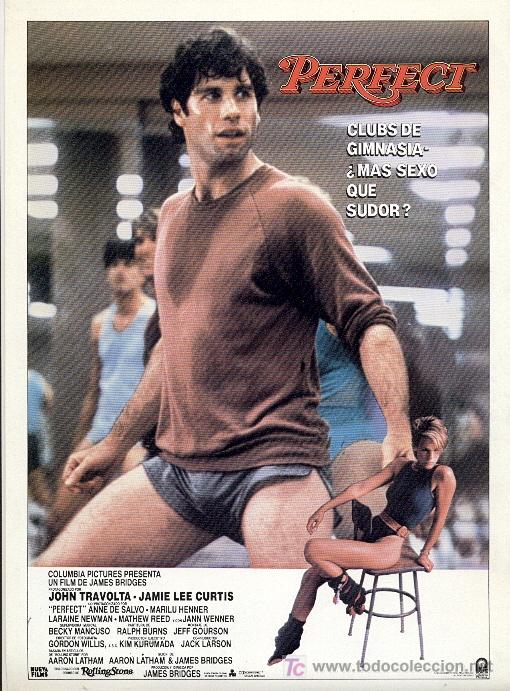
Okay,before reviewing the 1985 film Perfect, I have three things to say.
Number one, I nearly captioned the picture above “John Travolta, Jamie Lee Curtis, and Little Xenu.” And then I laughed and laughed. But, in the end, I resisted temptation because I’m an adult now.
Number two, Perfect came out in June in 1985, a few months before I was born. As a result, I have no idea what the 1985 reviews looked like. However, it still seems to me that you’re taking a big risk when you give a movie a title like Perfect, especially when the movie itself is far from perfect. How many reviews opened with, “Perfect fails to live up to its name…”
And finally, as a result of seeing both this film and Staying Alive, I have to say, “What the Hell, John Travolta?” Seriously, what the Hell was going on? John Travolta gave a great performance in the 1970s, with Saturday Night Fever. And then in the 1990s, he was good in Pulp Fiction, Get Shorty, Face/Off, Primary Colors, and a few others. (For our purposes here, we shall pretend that Battlefield Earth never happened.) Even though most of Travolta’s recent films have been forgettable, his performances have generally been adequate.
So, seriously, John — what was going on in the 80s? Because judging from both Perfect and Staying Alive, John Travolta apparently totally forgot how to act during that decade. When I reviewed Staying Alive, I said that Travolta’s performance managed to create a whole new definition of bad. But he’s actually even worse in Perfect. It helped, of course, that in Staying Alive, Travolta’s character was supposed to be stupid. In Perfect, on the other hand, he’s actually supposed to be a brilliant reporter.
Or, at the very least, he’s supposed to be brilliant by the standards of Rolling Stone. Travolta plays Adam Lawrence, an award-winning reporter for Rolling Stone. The magazine, by the way, plays itself and so does its publisher, Jann Wenner (though his character is technically named Mark Roth). What’s interesting is that the film itself doesn’t necessarily paint a flattering picture of Rolling Stone or Jann Wenner, though admittedly a lot of that is due to the fact that Wenner himself gives a performance that is even worse than Travolta’s. It’s impossible to watch Perfect without thinking about the fact that Adam is writing for the same magazine that would eventually put Dzokhar Tsarnaev on the cover and publish the UVA rape story.
Anyway, if I seem to avoiding talking about the exact plot of Perfect, that’s because there’s not really much of a plot to describe. Adam, a hard-hitting investigative journalist, is doing research on a story about how people are hooking up at gyms. Wenner agrees. “We haven’t done L.A. in a while!” he says. Adams joins the a gym called the Sports Connection, which he is soon calling “The Sports Erection” because he’s a super clever reporter. He falls in love with an aerobics instructor, who is played by Jamie Lee Curtis. She doesn’t trust reporters but is eventually won over by Travolta’s … well, who knows? Mostly she’s won over because the plot needs some conflict. She gets on Adam’s computer and she types, “Want to fuck?” Adam says sure but then tries too hard to dig into the dark secret from her past. “You’re a sphincter muscle!” she shouts as him. Adam writes a compassionate and balanced article about the Sports Connection. Wenner edits the article and turn it into a sordid hit piece. (And again, you wonder why Wenner agreed to play himself.) Feelings are hurt, issues are resolved, and eventually everyone takes an aerobics class.
Honestly, the entire movie is mostly just a collection of scenes of Jamie Lee Curtis and John Travolta working out. And, in all fairness, Curtis does about as well as anyone could in this terrible film. Travolta, on the other had … well, just check out the scene below and maybe you’ll understand why I had a hard time concentrating on Travolta’s acting.



 Through the Shattered Lens