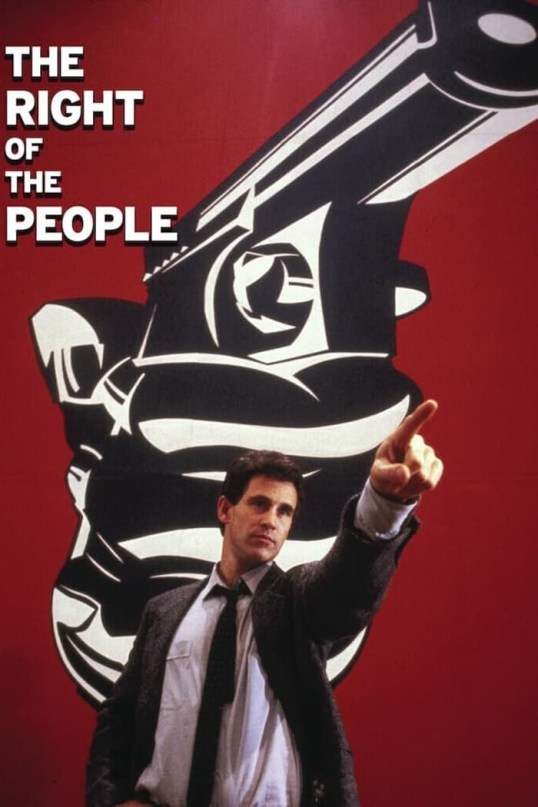
1986’s The Right of the People takes place in the small town of St. Lawrence, Kansas. It seems like a nice enough town, perhaps the ideal place to start a family. The people are friendly. The streets appear to be safe. It’s about as mid as Middle America can get.
Or, at least, that’s the case until a group of armed gunmen attempt to hold up a restaurant. They enter with their guns drawn and their masks pulled over their faces and they demand that everyone give them their money. When one person in the restaurant makes a sudden move, one of the thieves open fire. Soon, all of the thieves are firing and everyone in the restaurant is dead. Among the victims is the family of District Attorney Christopher Wells (Michael Ontkean).
Wells was a liberal on most law-and-order issues until it was his family that was victimized. He leads an effort to legalize open carry in the small town of St. Lawrence. At first, the mayor (M. Emmett Walsh) opposes the effort but, when it becomes apparent that Proposition G (G for Guns!) is going to pass, the mayor switches over and becomes an advocate for the Second Amendment.
The majority of the citizens are happy that they can now carry guns pretty much anywhere. Less enthused are a handful of cranky liberals who insist that everyone carrying a gun will make the streets less safe. When a man uses his gun to thwart a robbery at a grocery store, he is hailed as a hero. However, nobody talks about the poor cashier who was shot when he tried to use his own gun or any of the innocent people caught in the crossfire.
The Right of the People is an interesting artifact. On the one hand, it doesn’t hide its own position when it comes to gun control. The pro-gun rallies and the posters that decorate them are meant to be ominous and reminiscent of various fascist moments throughout history. At the same time, Christopher Wells is a sympathetic character. He’s someone who lost his entire family because no one was able to stop the criminals who randomly selected a restaurant to rob. One would have to have a heart made of stone to not understand how Wells would go from being a bleeding heart liberal to someone who isn’t exactly concerned about the rights of criminals. (At the same time, Wells is a bit like the fundamentalist who has no problem believing in God when bad things happen to other people but who turns into a rabid atheist as soon as something bad happens to him.) Michael Ontkean gives a strong performance and he gets good support from M. Emmet Walsh and Billy Dee Williams. The film starts out strong but, unfortunately, it falters a bit once everyone in town turns into a caricature of a gun nut. The even hand is tossed out for a heavy hand and the entire film suddenly starts to condescend to the character that it previously treated with such fairness.
What makes this film interesting to me is that I live in an open carry state. The film’s argument that open carry would lead to people eagerly looking for any excuse to start shooting feels rather false after you’ve spent a lifetime surrounded by responsible gun owners. The film was obviously made at a time when open carry wasn’t as common as it is today and it’s vision of a trigger-happy town ultimately becomes so over-the-top that it stops being effective. Fortunately, the film’s vision of the future did not come true.


