For tonight’s horror on television, we have 1973’s The Night Strangler.
This is the sequel to The Night Stalker and it features journalist Carl Kolchak (Darren McGavin) in Seattle. (After all the stuff that happened during the previous movie, Kolchak was kicked out of Las Vegas.) When Kolchak investigates yet another series of murders, he discovers that paranormal murders don’t just occur in Las Vegas and aren’t just committed by vampires.
I actually prefer this movie to The Night Stalker. The Night Strangler features a truly creepy villain, as well as a trip down to an “underground city.” It’s full of ominous atmosphere and, as always, Darren McGavin is a lot of fun to watch in the role in Kolchak.
Long before he achieved holiday immortality by playing the father in A Christmas Story, Darren McGavin played journalist Carl Kolchak in the 1972 made-for-TV movie, The Night Stalker. Kolchak is investigating a series of murders in Las Vegas, all of which involve victims being drained of their blood. Kolchak thinks that the murderer might be a vampire. Everyone else thinks that he’s crazy.
When this movie first aired, it was the highest rated made-for-TV movie of all time. Eventually, it led to a weekly TV series in which Kolchak investigated various paranormal happenings. Though the TV series did not last long, it’s still regularly cited as one of the most influential shows ever made.
The Night Stalker is an effective little vampire movie and Darren McGavin gives an entertaining performance as the rather nervous Carl Kolchak.
Welcome to Retro Television Reviews, a feature where we review some of our favorite and least favorite shows of the past! On Thursdays, I will be reviewing Decoy, which aired in Syndication in 1957 and 1958. The show can be viewed on Tubi!
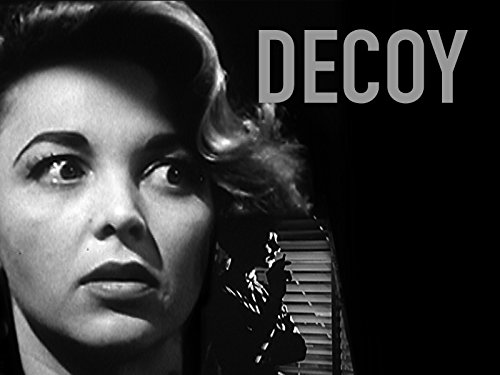
This week, Casey goes after a drug dealer.
Episode 1.5 “Dream Fix”
(Dir by Teddy Sills, originally aired on November 11th, 1957)
This week’s episode opens with Casey walking down a city street. She tells us that she’s working Juvenile undercover, which apparently means that she just walks around the city and waits for a teenager to do something strange. When she sees a teenage girl collapse on the sidewalk, Casey runs over to her and looks at the powder in her hand. Casey tastes it.
“Heroin!” Casey snaps.
(How are cops always able to dip their fingers in random powers and then taste it without anything bad happening? What if the cocaine turned out to be strychnine? It just seems like a poor training and an unnecessary risk.)
Joanne Kittridge (Phyllis Newman) is indeed hooked on cocaine and heroin. However, neither her rich father (Les Damon) or her attorney (Frank Bandimer) want her to work with the police to track down her dealer. Her attorney arranges for Joanne to be sent to a rehab. Casey’s lieutenant (played, in this episode, by Simon Oakland) assigns Casey to undercover as a nurse.
In the end, Joanne not only gets straight but she reveals that her drug dealer is her lawyer! When the attorney pulls a gun on Joanne, Casey pulls her gun and shouts, “Freeze, police!”
This was a good episode, one that was well-acted by the entire cast and which featured Beverly Garland at her best. (Garland even gets to show off some karate moves when she disarms the attorney.) That said, it’s starting to bother me how almost all of Casey’s assignments seem to involve her pretending to be someone’s friend. I get that she’s working undercover but it’s sometimes hard not to wonder what’s going to happen to people like Joanne after they realize that the only reason Casey talked to her in the first place was because someone ordered her to.
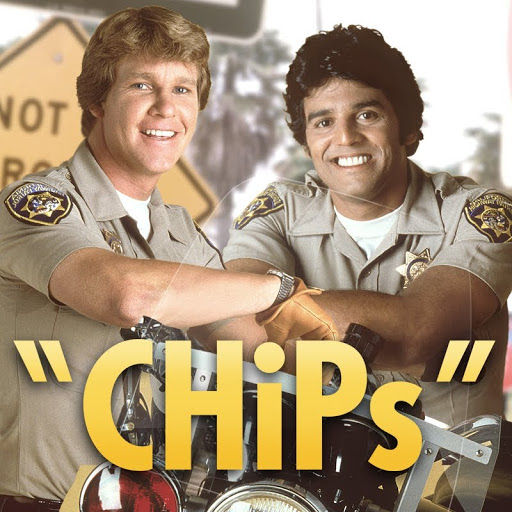
Welcome to Late Night Retro Television Reviews, a feature where we review some of our favorite and least favorite shows of the past! On Mondays, I will be reviewing CHiPs, which ran on NBC from 1977 to 1983. The entire show is currently streaming on Prime!
This week, it’s a special two-hour episode of CHiPs!
Episodes 3.9 and 3.10 “Drive, Lady, Drive”
(Dir by Don Weis, originally aired on November 10, 1979)
The police at nearby Palma Vista are on strike and the state of California has agreed to allow some members of the Highway Patrol to patrol the town until the strike is over. Getraer assigns Baker, Ponch, Bear, and some new guy named Lenny (Leon Isaac Kennedy) to head over to the town, Baker is named the OIC, which I eventually figured out stood for “Officer in Charge.” Getraer knows better than to give the job to Ponch.
Ponch, by the way, is back! After being absent for two episodes due to Erik Estrada actually injuring himself in a motorcycle crash, Ponch returns in this episode and he goes through the entire episode with this huge grin on his face as if he’s saying, “You know you missed me.” Ponch’s return means that Baker is once again relegated to being the strong, silent partner who doesn’t really get to do anything. In fact, Baker crashes his motorcycle early on in this episode, as if the show was trying to tell us, “See? It could happen to anyone!”
The striking cops accuse Baker, Ponch, Bear, and Lenny of being scabs and strike breakers. I’m not really a fan of public sector unions. (When it comes to the police striking, my hero is Calvin Coolidge, who came to fame when he broke up a policeman’s strike in Massachusetts.) Still, it felt strange to watch the show’s heroes cross that picket line. That would definitely not happen on television today.
There’s a lot going on in Palma Vista. There’s some rich kids who keep joyriding in a dune buggy and who think they can escape prosecution by crossing the city limits. (Joke’s on them! The Highway Patrol has jurisdiction everywhere!) There’s some truck hijackers who are setting up a headquarters in town. There’s an angry city councilman (Michael Conrad) who doesn’t feel his children should be held accountable for their actions.
That said, the majority of this two-hour episode centered on a stock car race and one of the racers, Candi Wright (Kelly Harmon). Will Candi win the big race or will she lose to her friendly rival (and possible future romantic partner) Don Croyden (Jordan Clarke)? Will Ponch be able to both date her and do his job? And most importantly, will she be able to adopt a traumatized little girl (played by Tracey Gold) who Candi discovered outside of a burning house? That’s a lot of storylines for someone who wasn’t even a regular cast member and a part of me wonders if maybe this episode was meant to be a secret pilot for a Candi Wright television series. It would explain a lot.
This really was a basic episode of CHiPs, with the only real difference being that it was two-hours long for some reason. A lot of what happened in the episode, especially the racing footage, felt like filler. There was really no need for this to be a double-sized episode. It also doesn’t help that, as opposed to the lovely Los Angeles scenery that we usually see, this episode took place in a rather ugly town. There was some appropriately spectacular crashes but, in the end, this episode ran too long and felt a bit pointless. Get the Highway Patrol back on the highways!
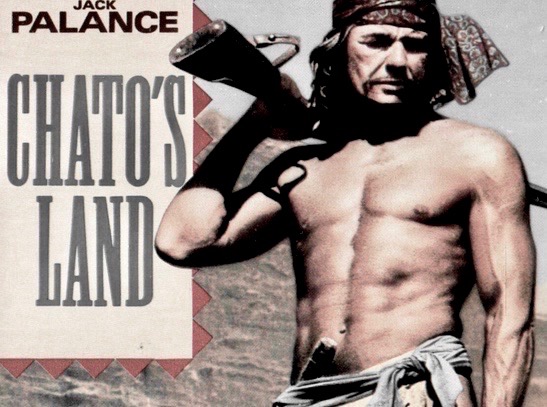
One of the most enjoyable things about being a dad is introducing your favorite things to your kids. I taught my son Hank the sports of basketball, baseball, and golf, and even now there’s nothing we enjoy doing more together than playing a round of golf. Of course, as one of the world’s biggest Charles Bronson fans, I’ve introduced him to many films starring my cinematic hero. It seems that two movies have stood the test of time and have gone on to become two of his favorite movies. The fact that THE DIRTY DOZEN (1967) is one of his favorites isn’t a big surprise as he’s always enjoyed playing video games set during World War II. The other, CHATO’S LAND (1972), was more of a surprise. A few years ago, when Hank was home from college, I asked him if there was a movie he wanted to watch. It could have been any movie in the world, and I was honestly a little surprised when he said he’d been wanting to watch CHATO’S LAND again. Needless to say, this dad was very proud.
Charles Bronson is Pardon Chato, a half breed Apache who’s minding his own business and having a drink in the saloon, when a small-town sheriff decides to give him hell just for being a “breed.” Forced to kill the racist POS in self-defense, Chato heads out of town a day ahead of the posse led by the former confederate Captain Quincey Whitmore (Jack Palance). Whitmore may be leading the posse, but the Hooker Brothers (played by Simon Oakland, Ralph Waite, and Richard Jordan) are just as bigoted as the sheriff who was killed, and they set about bullying their neighbors into joining their hunt for Chato. A couple of the guys who go along because it’s “expected of them” are Joshua Everette (James Whitmore) and Gavin Malechie (Roddy McMillan). When the posse comes across Chato’s home and woman, some of the members decide the wise thing to do is rape her and tie her up as bait. This is clearly not going to work out well for the posse, even those who tried to stop the rape. Using his sneaky Indian skills and the help of a fellow Indian, Chato is able to create a diversion and rescue his woman, but his friend is killed in the process. With his friend murdered and his woman brutalized and raped, Chato is no longer willing to just run away. From this point forward, the hunters will become the hunted as he leads them all further into CHATO’S LAND.
There are several things that I find interesting about CHATO’S LAND. This is the first of six films that director Michael Winner and Charles Bronson would make together. They would all be financially successful films with THE MECHANIC (1972) and the original DEATH WISH (1974) standing out as true 70’s classics. Charles Bronson’s last number one box office hit would be DEATH WISH 3 (1985), which would also be his final film with Winner. It should also be noted that the character of Chato would be an early precursor of the kind of character Bronson would go on to embody almost exclusively throughout the rest of his career, that of the quiet but deadly man of action. Chato only says 13 lines in the entire movie and most of those are in a Native American dialect. Chato doesn’t have that much actual screen time either, but his presence dominates every scene. He’s like the angel of death hanging over the entire proceedings waiting to strike, and Winner continues to build on this tension as the film moves towards its inevitable conclusion. It’s an incredible, physical performance that can only be delivered by an actor like Bronson. Finally, the film has an outstanding cast, a cast that Winner himself would call “as good a cast as I ever assembled.” In addition to Bronson, Jack Palance is excellent as the confederate captain who’s never gotten over losing the war, and who now finds himself losing the battle to control the men in the posse. James Whitmore and Roddy McMillan are solid as a couple of decent men who went along because they felt it was their duty to their neighbors, who now find themselves caught up in a bad situation with even worse men. And finally, Simon Oakland, Ralph Waite & Richard Jordan are the kind of men you love to hate as the ignorant and bigoted Hooker brothers. It doesn’t hurt your feelings at all to see those guys get what’s coming to them.
Overall, CHATO’S LAND is a very good western, dominated by Bronson’s presence in the same way that JAWS (1975) is dominated by a giant killer shark. It was also a hugely profitable film upon its initial release, guaranteeing that Bronson would continue to get starring roles in films backed by American studios. Bronson liked to work with the same directors once he felt comfortable with them, and his collaboration with Winner would prove to be extremely fruitful and help turn him into one of the biggest box office stars in America. Thanks, Michael!
For today’s horror on the lens, we have 1973’s The Night Strangler.
This is the sequel to The Night Stalker and it features journalist Carl Kolchak (Darren McGavin) in Seattle. (After all the stuff that happened during the previous movie, Kolchak was kicked out of Las Vegas.) When Kolchak investigates yet another series of murders, he discovers that paranormal murders don’t just occur in Las Vegas and aren’t just committed by vampires.
I actually prefer this movie to The Night Stalker. The Night Strangler features a truly creepy villain, as well as a trip down to an “underground city.” It’s full of ominous atmosphere and, as always, Darren McGavin is a lot of fun to watch in the role in Kolchak.
For today’s horror on the lens, we have a real treat! (We’ll get to the tricks later…)
Long before he achieved holiday immortality by playing the father in A Christmas Story, Darren McGavin played journalist Carl Kolchak in the 1972 made-for-TV movie, The Night Stalker. Kolchak is investigating a series of murders in Las Vegas, all of which involve victims being drained of their blood. Kolchak thinks that the murderer might be a vampire. Everyone else thinks that he’s crazy.
When this movie first aired, it was the highest rated made-for-TV movie of all time. Eventually, it led to a weekly TV series in which Kolchak investigated various paranormal happenings. Though the TV series did not last long, it’s still regularly cited as one of the most influential shows ever made.
The Night Stalker is an effective little vampire movie and Darren McGavin gives a great performance as Carl Kolchak.
For today’s horror on the lens, we have 1973’s The Night Strangler.
This is the sequel to The Night Stalker and it features journalist Carl Kolchak (Darren McGavin) in Seattle. (After all the stuff that happened during the previous movie, Kolchak was kicked out of Las Vegas.) When Kolchak investigates yet another series of murders, he discovers that paranormal murders don’t just occur in Las Vegas and aren’t just committed by vampires.
I actually prefer this movie to The Night Stalker. The Night Strangler features a truly creepy villain, as well as a trip down to an “underground city.” It’s full of ominous atmosphere and, as always, Darren McGavin is a lot of fun to watch in the role in Kolchak.
For today’s horror on the lens, we have a real treat! (We’ll get to the tricks later…)
Long before he achieved holiday immortality by playing the father in A Christmas Story, Darren McGavin played journalist Carl Kolchak in the 1972 made-for-TV movie, The Night Stalker. Kolchak is investigating a series of murders in Las Vegas, all of which involve victims being drained of their blood. Kolchak thinks that the murderer might be a vampire. Everyone else thinks that he’s crazy.
When this movie first aired, it was the highest rated made-for-TV movie of all time. Eventually, it led to a weekly TV series in which Kolchak investigated various paranormal happenings. Though the TV series did not last long, it’s still regularly cited as one of the most influential shows ever made.
Anyway, The Night Stalker is an effective little vampire movie and Darren McGavin gives a great performance as Carl Kolchak.
The 1967 film, Tony Rome, is about a detective named …. can you guess it?
That’s right! Tony Rome!
Tony works out of Miami and, because he’s played by Frank Sinatra, you can be sure that he’s a tough guy who knows how to throw a punch but who, at the same time, also knows how to have a good time. He’s got a bottle of liquor in the glove compartment. He’s got his own boat. He’s got a snappy quip for every occasion and a properly cynical sense of humor but at the same time, he also cares about doing the right thing. He says what’s on his mind and if that hurts your feelings, tough. Again, none of this should be a surprise, considering that he’s played by Frank Sinatra and Sinatra could play these type of sentimental tough guys in his sleep.
That’s not to say that Sinatra sleepwalks through the role, of course. Far from it. As played by Sinatra, Tony comes across as an authentic tough guy, as someone who has seen it all and who, as a result, understands that importance of stopping to have a drink and appreciate the world around him. Tony Rome might be a Rat Pack-style private investigator but that doesn’t mean he can’t solve the case and, even while Tony’s having a good time, Sinatra never lets you forget that he takes his job very seriously.
As for the film, it’s a story that beings when Tony is hired to drive a passed out rich girl back to her home. This leads to him investigating a jewelry theft and eventually discovering an extortion plot. Sue Lyon plays the rich girl. Gena Rowlands plays her stepmother while Simon Oakland (the psychologist at the end of Psycho) plays her father. Richard Conte, who played bad gangster Barzini in The Godfather, plays Tony Rome’s best friend on the police force. (Every good private eye has a best friend on the police force.) Jill St. John plays Ann Archer, who helps Tony out with his investigation. Ann is recently divorced. Will Tony claim her heart or will she go back to her husband? It wouldn’t be a Sinatra film without a little heartbreak. (To a large extent, St. John’s performance here feels like a slightly more serious version of the performance she would later give as Tiffany Case in Diamonds are Forever, which is perhaps as close as we’ll ever get to a Rat Pack-style James Bond film.)
The story itself is surprisingly easy to follow. This is not one of those detective stories that will leave you shocked over who turns out to be the bad guy. For a film that often takes something of a light-hearted approach to Tony’s efforts to solve the mystery, it’s also a rather violent film. More than a few people get killed. Tony gets kicked in the ribs at one point and the sound of the 50-something Sinatra groaning in pain is disconcerting. Of course, Tony recovers quickly and immediately gets his revenge. When you watch the scene, you think to yourself that anyone who would try to beat up Frank Sinatra has to be a fool. That’s largely because Tony is Sinatra and Sinatra is Tony.
It’s an entertaining film, one that works well as a time capsule of what it was like to cool and swinging and middle-aged in 1967. Tony Rome is smart enough to focus more on Sinatra’s charisma than on trying to impress the viewers with its own cleverness. If I ever have to hire a private detective, I hope he’s like Tony Rome. I hope he gets the job done. I hope he has a good time while doing it. And I hope he comes with his own Nancy Sinatra-sung theme song. That’s not too much to ask, is it?