Jim Jarmusch’s The Dead Don’t Die is a film that has definitely grown on me. When I first watched it, I thought it was intriguing but perhaps a bit too cutesy and enamored with itself. However, I’ve subsequently come to realize that, actually, Jarmusch finds just the perfect tone for his look at our zombie-saturated culture.
In the scenes below, Bill Murray, Chloe Sevigny, and the wonderful Adam Driver all deal with the inevitability of doom that comes with being a character in a zombie film.
Today’s horror scene that I love comes from the 1911 film, L’Inferno. This silent film is not only considered to be the first Italian feature film but it was also the first Italian horror film. Based on Dante’s Divine Comedy, the film took three years to make and was a hit with audiences. It made two million at the box office, an unheard of amount of money in 1911.
In this scene, Dante and Virgil observe the devil eating a sinner’s soul.
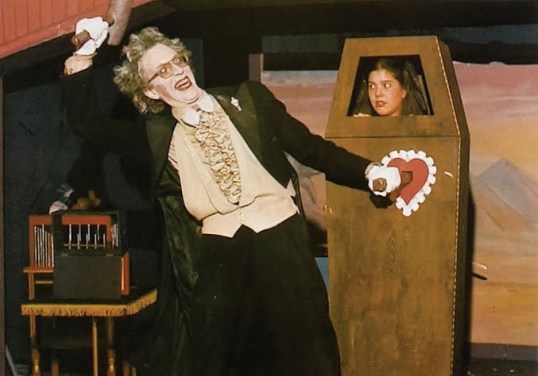
Now that it’s time to share a scene that I love, I figure why not continue to pay tribute to Tobe Hooper? The scene below is from Hooper’s unjustly neglected 1981 film, The Funhouse. It doesn’t really advance the plot in any way but it’s still a scene that I really enjoy. It shows Hooper being a bit more playful than usual and it does introduce one the film’s key themes: not everything at the carnival is what it seems. Later on in the film, the same people who made fun of this magician will discover that the magician is not the only person at the carnival who is more clever than they thought.
102 years ago today, the great actor Donald Pleasence was born.
Pleasence is, of course, best-known for playing Dr. Loomis in Halloween. He’s so identified with that franchise that it’s always seemed appropriate that he celebrated his birthday in October. And usually, to celebrate his birthday, we would share a scene of Dr. Loomis yelling at or shooting Michael Myers.
This year, though, I’m going to do something a little different and share a scene from a different type of horror movie, 1971’s Wake in Fright. In this Australian film, Donald Pleasence plays Doc Tydon, an alcoholic doctor who lives in the Australian outback and who befriends John Grant (Gary Bond), a naïve school teacher who has become stranded in a town full of people who don’t have much respect for Grant’s intellectual pursuits. Actually, befriends is perhaps the wrong word. Tydon allows Grant to stay with him but it soon become apparent that Tydon, like almost everyone else in this movie, might have a less-than-friendly agenda of his own.
Wake In Fright features what may be Pleasence’s best performance. In the scene below, Tydon and Grant meet for the first time and Pleasence shows that he was capable of far more than just playing Blofeld and Dr. Loomis.
In this scene from the 1970 film House of Dark Shadows, young David Collins explores around the old pool on the Collins estate and runs into his cousin, Carolyn. The only problem, of course, is that Carolyn died a few days ago so why is she now wandering around the estate? Could she be a …. VAMPIRE!?
There’s a lot of atmosphere in this scene. That dilapidated pool is frightening on its own. Add a vampire and …. AGCK! In the role of Carolyn, Nancy Barrett does a great job of portraying her new vampiric nature. Run, David, run!
Of course, back in the dining hall, no one believes him. A refusal to believe is a vampire’s best friend. (Personally, I don’t believe in vampires so I’ll probably be in trouble if I ever meet one.)
Every film about the Son of Sam and his reign of terror in New York City inevitably faces one huge question.
What to do about the dog?
Before he started blaming Satanists, David Berkowitz claimed that a dog told him to kill. Most people who have made films about the Son of Sam have been content to just have a dog barking in the distance. Spike Lee, however, had the guts to actually have a dog trot into Berkowtiz’s apartment and start yelling at him.
From 1999’s Summer of Sam:
The dog is voiced by John Turturro. I have to say that, for such an evil creature, it really is a cute dog.
Since today is Claudio Fragasso’s birthday, my first instinct was to select the famous “OH MY GAAAAAAAWWWD!” scene from Troll 2 as today’s horror scene that I love. However, I then remembered that I’ve already shared that scene a few times on this site.
So, instead, here’s a different scene from Troll 2. In this scene, Drew visits the town of Niblog and stops by the general store, where he’s pressured into drinking the poisonous Niblog milk. The milk will eventually turn Drew into a plant so that he can then be eaten by the town’s goblins. The goblins are all vegetarians but apparently, it’s okay to eat meat that’s been transformed by evil magic. It’s kind of weird. Personally, I think the Goblins are kind of hypocritical. They remind me of this girl I went college with who we’ll call Bree. Bree was vegan and would never hesitate to tell you that she was better than you. And yet, she still wore leather shoes. So, screw her, screw her pathetic attempts to steal everyone’s boyfriend, and screw the goblins.
Anyway, there’s two ways of looking at this scene. On the one hand, it’s an oddly acted and oddly paced scene in a film that was full of odd performances and odd directorial choices. On the other hand, it’s so strange and off-center that it contributes to the film’s dream-like atmosphere. Since today is Fragasso’s birthday and I tend to always assume the most positive explanation to be the correct one, I’m going to go with the second possibility.
Today’s horror scene that I love (and the inaugural entry in this year’s collection of Horrothon scenes) comes from the 2010 film, Sharktopus! And here it is:
A lot of people have made fun of this scene over the years but put yourself in the shoes of this unfortunate painter. Here you are. You’re just doing your job. You’re painting the side of a boat. It’s not glamorous work. It probably doesn’t pay very well. But you’re doing your best and you’re collecting a paycheck and you’re taking care of your family. It hasn’t always been easy. When you first got out of prison, you never thought you’d be able to find a job. Everyone wanted to do a background check. Your parole officer kept busting your ass. You were tempted to go back into a life of crime. You kept thinking about the old crew and wondering if they were still hanging out on the street corners, murking and doing time. But then the boat painting people said, “We know you’ve had some problems. But you’re damn good with a paint brush.”
And then suddenly, this happens. You wanted to die surrounded by your family. You want your last words to be, “I did okay, didn’t I?” Instead, you’re getting grabbed by an shark/octopus hybrid. Who wants to die that way? “Oh no! Not like this!” is one of the most honest lines in the history of horror cinema. It perfectly captures the existential dread that one undoubtedly feels while being pulled into the ocean by a sharktopus.
Since this weekend is going to see both the release of The Many Saints of Newark and the start of our annual October Horrorthon, I thought that this would be an appropriate time to share a creepy scene that I love from The Sopranos.
The Sopranos was well-known for its dream sequences. For me, this dream from the season 4’s Calling All Cars is one of the best of the series. It’s full of menace and ominous atmosphere, from the minute we see Tony being led to the house by the deceased Ralphie. And then, when that mysterious shadow appears on the staircase — AGCK!
I’ve read online speculation that the woman in the shadows was meant to represent Tony’s mother, who will be played by Vera Farmiga in The Many Saints of Newark. Young Tony Soprano, meanwhile, will be played by Michael Gandolfini, the son of the late (and missed) James Gandolfini.
I look forward to watching (and, hopefully, reviewing) The Many Saints of Newark on October 1st!
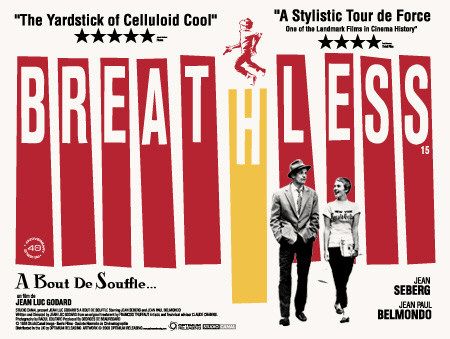
I was saddened to learn of the death of French actor Jean-Paul Belmondo earlier today. He was 88 years old and still an international icon of movie star charisma at the time of his death.
Belmondo spent the majority of his career in France, where he was one of the early faces of the New Wave and also a prominent action star, famed for doing his own very dangerous stunts. In America, he was best-known for his starring turn in Jean-Luc Godard’s Breathless. In Breathless, Belmondo was the perfect existential outlaw, living life day-by-day and obviously doomed but still so incredibly magnetic and stylish.
In tribute to Belmondo, here is a scene that I love, the final moments of Breathless.

 Through the Shattered Lens