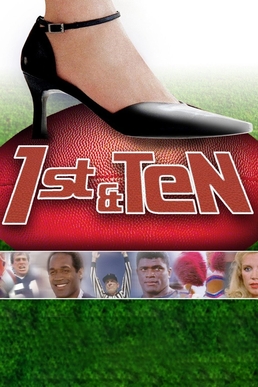
Late Night Retro Television Review: 1st & Ten 1.3 “All Roads Lead To Dayton”


Welcome to Late Night Retro Television Reviews, a feature where we review some of our favorite and least favorite shows of the past! On Wednesdays, I will be reviewing 1st and Ten, which aired in syndication from 1984 to 1991. The entire series is streaming on Tubi.

This week, the Bulls are on the road!

Episode 1.3 “All Roads Lead to Dayton”

(Dir by Bruce Seth Green, originally aired on December 9th, 1984)

The Bulls are playing their second game in Dayton!  It’s a road game and Coach Denardo tells all of the players that they are expected to conduct themselves like gentlemen on the road.

“Booooo!” the team replies.

Denardo replies, “I know but the owner’s a broad now….”

Speaking of Dana Barrow, she has a lot to deal with.  The Arcola Brothers are still trying to muscle their way into the team’s business.  Meanwhile, her ex-husband, Paul (now played by Ben Cooper), is determined to get his team back.  At the hotel in Dayton, he and his sleazy lawyer arrange for Dana’s drink to be drugged so that the hotel’s assistant manager can rape Dana while being filmed by a camera hidden behind a two-way mirror.  They plan to leak the tape to the press and claim that Dana is a nymphomaniac who shouldn’t be allowed to own an NFL team.  Fortunately, quarterback Bob Dorsey stops by Dana’s hotel room to discuss an offer he’s gotten to become a sports commentator and he proceeds to beat the hell out of the assistant manager, shatter the mirror, and give the camera the finger.  And he wins the game!

Take that, Dayton!

He even scores an extra touchdown, just so the Mafia won’t make any money on their bets.

Take that, Arcola Brothers!

The episodes of 1st & Ten that are on Tubi are apparently a combination of episodes that were edited for syndication and the original HBO episodes.  The version that I saw of All Roads to Dayton was clearly the HBO original, as there was significant amount of cursing and quite a bit of nudity.  I get the feeling that those were the two main reasons that 1st and Ten found success when it first aired.  It certainly wasn’t for the acting or the storylines, neither of which were especially noteworthy.  That said, I’m from Dallas and I’ve heard all the stories about the Cowboys and Jerry Jones so I imagine that this episode’s depiction of a football team on a road trip was probably fairly tame when compared to the real thing.

As for this episode, Dana was a bit too naive to be believed.  Delta Burke actually gives a good performance as Dana but the scripts continually let her down.  We’re only three episodes in and Roger, the team’s general manager, has planted drugs in her house, caused Bob to get seriously injured during practice, and drugged her so that she could be raped in her hotel room.  I would seriously be looking for a new general manager at this point.  On the plus side, I do like Geoffrey Scott’s performance as Bob Dorsey.  He’s charming without being smarmy about it.

Next week …. more football stuff, I guess.

Late Night Retro Television Review: 1st & 10 1.2 “The Opener”


Welcome to Late Night Retro Television Reviews, a feature where we review some of our favorite and least favorite shows of the past! On Wednesdays, I will be reviewing 1st and Ten, which aired in syndication from 1984 to 1991. The entire series is streaming on Tubi.

This week, the football season begins!

Episode 1.2 “The Opener”

(Dir by Bruce Seth Green, originally aired on December 2nd, 1984)

The opening game of the season is approaching.  The Bulls have trader their former quarterback (who was played, briefly, by Robert Logan in the pilot) for a new quarterback, Bob D0rsey (Geoffrey Scott).  Bob Dorsey is a notorious womanizer and a veteran player with a strong arm and a bad knee.  So, basically, he’s just like their former quarterback except he’s played by Geoffrey Scott instead of Robert Logan.

Dana has decided that Bob will start on opening day, instead of the quarterback that they drafted out of BYU, the ultra-religious Bryce Smith (Jeff East).  (Opening Day, quarterback, drafted — look at me using all the football terminology!)  Bryce is fine with not starting because he feels that it is God’s will for Bob to start.

However, the Mafia (represented by Michael V. Gazzo and Robert Miranda) is not happy!  It turns out that general manager Roger Barrow has been doing business with the Arcola Brothers.  He’s been giving them tickets and allowing the Arcolas to scalp them in return for a 20% commission.  Dana puts an end to that, saying that all the tickets will now be sold through the box office as opposed to being held for VIPs.  The Mafia wants Roger to make sure that Bob does not start.  Roger convinces one of the other players to injure Bob during practice so that Bryce will be the starter.

Uh-oh!  Bob injures his knee.  Bryce is going to have to play …. except, right before the team hits the field, the team doctor suddenly says that Bob’s knee is at 80% and he can play if he wants to.  Of course, Bob wants to!  Bob takes the field and, after several minutes of stock footage, we’re told that the Bulls have won the game.

This show feels so strange.  On the one hand, I get the feeling that this episode probably was realistic about the physical toll that playing football takes on a player.  Bob is 35 and can barely walk.  I imagine that the episode’s portrayal of the locker room being a mx of stupidity and testosterone was probably accurate as well.  I’ll even give the episode credit for showing that all of the players resent the team’s owner and that Coach Denardo uses that to his advantage when it comes to motivating them.  Everyone — well, almost everyone — resents their boss.  (Not me!  I love everyone I’ve ever worked with!)

On the other hand, the first two episodes have been so low-budget that it appears there’s only five or six players on the team and the mix of comedy and drama feels rather awkward.  Dana’s friend Mona (Ruta Lee) starts drinking in the morning and tossing out pithy one liners.  Meanwhile, the Mafia is threatening to kill Roger.  It really doesn’t fit together.  The whole thing just looks and feels cheap.

But, hey, the Bulls won!  Good for them!

Late Night Retro Television Review: 1st & Ten 1.1 “By The Bulls”


Welcome to Late Night Retro Television Reviews, a feature where we review some of our favorite and least favorite shows of the past! On Wednesdays, I will be reviewing 1st and Ten, which aired in syndication from 1984 to 1991. The entire series is streaming on Tubi.
For a few years now, first Prime and now Tubi have been recommending that I watch a sitcom called 1st & Ten.

My initial reaction, upon looking the show up online and discovering that it was about a football team that was owned by a woman and coached (from the second season on) by OJ Simpson, was to say, “Why would I want to watch this?”  And, to be honest, that’s still kind of my reaction.  Football is not my thing.  The only thing that is less my thing than football is soccer.

(“But in the rest of the world, soccer is called….”  Yeah, yeah, I know.  I don’t care.)

But then I read on and discovered that this is actually a historically significant show in that it was HBO’s first attempt to produce an original sitcom.  It was later sold into syndication, with all of the cursing and nudity edited out.  (Apparently, most of the episodes that are currently on Tubi are the edited syndication versions.)  That piqued my interest.  I may not care about football but I love historical footnotes.

So, without further ado, let’s get things started.

Episode 1.1 “By The Bulls”

(Dir by Rod Daniel, originally aired on December 2nd, 1984)

The show begins as wealthy Diane Barrow (Delta Burke) comes home to her mansion and discovers her husband, naked in their bedroom with another man.  “This is Ty Tylor,” her husband says, “he’s a tight end.”

“I bet he is!” Diane replies.

Later, while talking to her divorce lawyer (Earl Boen), Diane announces, “I want his Bulls!”

“You want his….?” the lawyer replies, glancing down at his crotch.

No, Diane doesn’t want his balls  She wants the Los Angeles Bulls, the football team that he owns.  When the lawyer replies that Diane’s husband loves the Bulls, Diane announces that if she doesn’t get the football team, she’ll let the world know that her husband’s gay.

(It’s the 1980s, folks.)

Diane gets the Bulls and she also gets a lot of attention due to being apparently the only woman to ever own a football team.  Everyone doubts her but Diane is determined to prove herself.  However, her sniveling general manager (and her husband’s nephew), Roger Barrow (Clayton Landey), tries to end her ownership before the season even begins by planting cocaine in her mansion,  His plan is that, during the pre-season party, one of the players will snort the cocaine and …. I don’t know.  I guess he’s hoping some will call the police or something.  It doesn’t seem like much of a plan, to be honest.

Fortunately, veteran Coach Ernie Denardo (Reid Scott) hears about the plan from a friend of his so he rushes over to the party and gets rid of the cocaine, though not before letting Diane know that she has powerful enemies.  That was nice of him since Diane previously fired him for being incompetent.  Needless to say, Denardo gets his job back.

And that’s it!  We did get to see a few snippets of the players, who all seem to be wild and wacky.  Carl Witherspoon (Sam Scarber) shows up at the party with his lawyer and demands a lot of money.  Another player, Kyle Brody (Robert Logan), tries to hit on Diane.  I checked with the imdb and this is Logan’s only appearance on the show so I’m not really sure what the point of him being at the party was.  It’s a pilot so I imagine that a lot of the background people in this episode will never be seen again.

Overall, my feeling about the pilot was that it …. well, it sucked.  The humor fell flat.  The acting was terrible.  Delta Burke showed some potential as Diane but I didn’t like how, after demanding, “I want his Bulls!,” Diane suddenly became this passive character who needed Denardo to tell her about the cocaine in her mansion.  But you know what?  It’s always unfair to judge a show by it’s pilot.  The Office, for instance, had a terrible pilot.  In the end, this particular pilot did what it was supposed to do — it introduced us to the main character and it set up the premise of the show.

We’ll see if things get better in the weeks to come.

MAN WITH A CAMERA (TV Series) – Starring Charles Bronson – S1,E1: Second Avenue Assassin


Charles Bronson began acting in movies and on TV shows in 1951. Through the mid-fifties, he established himself as a solid character actor with a strong physical screen presence. Beginning in October of 1958, he was given the opportunity to headline his own TV show, MAN WITH A CAMERA. The show, which ran for 29 episodes, features Bronson as a freelance photographer from New York named Mike Kovac, a guy who specializes in the difficult and dangerous assignments that his peers stay away from. Always on the side of truth and justice, Kovak will do anything to get the picture. 

In the first episode of the series, Mike Kovac (Charles Bronson) wants to get a picture of his old neighborhood pal, Joey Savoyan (Tom Laughlin). Joey has risen in the boxing ranks, and is getting a title shot at the champ, Sal Benning (Don Kennedy). But it seems that success has changed Joey from the guy Mike knew, and there have been many reports that he’s turned into a jerk who’d rather punch a reporter or photographer than look at them. When Mike goes to Joey’s training camp, and proceeds to tell him that his attitude is an embarrassment to the people pulling for him back home, Joey gets pissed and the two men end up in the ring. Apparently Mike could whip him back in the day, but times have changed and after absorbing a few of Mike’s jabs, Joey lays his ass out cold with one punch. The photograph that makes the papers that night is Mike laying flat on his back with the headline “Joey Savoyan puts ace photographer in darkroom!” Licking his wounds with spare ribs at a local restaurant that night, another pal from the old neighborhood shows up to see him. This time it’s Dolly (Ruta Lee), Joey’s main squeeze, who’s there on his behalf. Joey’s in trouble and needs Mike’s help. Mike goes out to Joey’s cabin where he’s filled in on the truth. The reports of his punching photographers and reporters were all made up to create his “killer” image. What’s even worse is the fact that Joey had found out the day before that the fights he had won to get the title shot were all fixed. Now, gangster Willie Fletcher (Theodore Marcuse) is putting the pressure on him to take a dive. Joey doesn’t want to do it, so he asks Mike to get a picture of him, Willie, and the champ planning the fix that night. He believes he can use this picture as leverage to turn the dangerous mobster down. It wouldn’t be much of a show if things went exactly as planned, and the fun is seeing how it all plays out! 

The series MAN WITH A CAMERA stretches our ability to suspend our disbelief right off the bat, when it asks us to accept that anyone, including Billy Jack himself, could lay out Charles Bronson with one punch. The fact that Bronson is shirtless, revealing muscle on top of muscle, makes it that much harder to believe. That lack of realism aside, I really did enjoy this first episode. Bronson plays Mike Kovac with a determination and uncompromising integrity that lets us know right off the bat that he will do whatever it takes to get to the truth, and that he doesn’t care who he has to piss off to accomplish that goal. He seems fearless and very tough. When the gangster Willie Fletcher, who’s known for using his gun, threatens Mike, he responds with “Boy, you talk tough… you scare me, Willie” in a way that would indicate it’s impossible to scare him and you get the feeling he can back it up. As a lifelong fan of Bronson, it’s nice seeing his powerful screen charisma and toughness come across so easily at this early point in his career. It’s also fun seeing Bronson and Tom Laughlin on screen together, even if the writers came up with the unrealistic scenario that I discussed earlier. I have to admit I would love to see Billy Jack take on Chaney from HARD TIMES. I think that would be one hell of a show!

This is a solid first episode, and I’m looking to see where the show heads from here. I’ve watched various episodes of MAN WITH A CAMERA over the years, but this will be first time I’ve ever started from the beginning and watched and reviewed each episode. Although he’s only talked about in episode 1, I remember Mike’s dad being a fairly big part of the series. Father/son relationships on TV and in movies are my favorites, so I’m looking forward to seeing that play out. If Tom Laughlin is any example, I’m also looking forward to the quality of guest stars we’ll be seeing. A quick look on IMDB reveals actors like Don Gordon, Angie Dickinson, Gavin McLeod, and Lawrence Tierney will be showing up throughout the series. This should be a lot of fun!

Retro Television Review: Fantasy Island 6.6 “The Beautiful Skeptic/The Last Platoon”


Welcome to Retro Television Reviews, a feature where we review some of our favorite and least favorite shows of the past!  On Tuesdays, I will be reviewing the original Fantasy Island, which ran on ABC from 1977 to 1984.  Unfortunately, the show has been removed from most streaming sites.  Fortunately, I’ve got nearly every episode on my DVR.

This week, someone tries to expose Fantasy Island!

Episode 6.6 “The Beautiful Skeptic/The Last Platoon”

(Dir by Ricard Montalban, originally aired on November 27th, 1982)

Your eyes do not deceive you.  This episode was directed by Mr. Roarke himself, Ricardo Montalban!

The main fantasy deals with Jack Oberstar (Gary Frank), who wants to go back to World War II so that he can find proof that his brother, Ken (Steve Kanaly), was killed in action and did not, as the army claims, desert and become a black market smuggler.  After the customary warnings from Mr. Roarke, Jack finds himself serving alongside his brother in France.  Jack not only gets to bond with his brother but he also discovers that it was the evil Galloway (Don Stroud) who stole his brother’s identity and went on to become a criminal.  Ken did die heroically but, without his dog tags, he was misidentified.  No sooner does Jack learn all this then he finds himself back in the present.  Jack is happy to know the truth but he regrets not having returned with proof.

However, Mr. Roarke reveals that, while Jack was having his fantasy, a career criminal died while serving a life sentence in France.   By checking his fingerprints, the authorities discovered that the criminal was Galloway, who was long believed to have died in World War II.  Jack realizes that he can now argue that Galloway stole Ken’s identity!  He’s happy, even if he doesn’t have his definite proof.  Myself, I started thinking about how different the world must have been in the days before DNA testing.  Today, Jack presumably wouldn’t even have to go Fantasy Island to prove that the body buried in “Galloway’s” grave was actually his brother.

As for the other storyline, it features Connie Stevens as journalist Christine Connelly, who is determined to prove that Mr. Roarke is a fake.  She tells Roarke that she interviewed eleven former guests and all of them were happy with how their fantasies went.  Christine argues that there’s no such thing as “eleven satisfied customers,” which is a weird way to put it.

Christine brings along two people who have fantasies.  Jay (Jimmie “JJ” Walker) wants to win a weight-lifting competition, despite being Jimmie “JJ” Walker.  Luckily, Roarke has some magic chalk dust that allows Jay to do just that.  (You have to feel bad for everyone who actually wasted their time training for the competition.)  Frank (Herb Edelman ) wants to be reunited with his estranged wife, Connie (Ruta Lee).  This actually proves somewhat difficult, as Connie really doesn’t want to see Frank.  But it turns out that this is because Connie thinks that Frank is having an affair with Christine.  I’m not sure that Roarke reunited Connie and Frank is really greater proof than Jimmie Walker winning a strongman competition but the important thing is that Christine learns to be less of a cynic and to open her mind to the magic of Fantasy Island.

This was not a bad trip to the Island.  Much as Mr. Roarke did with the Island, Ricardo Montalban kept the episode moving quickly and efficiently.  It’s interesting that Fantasy Island started out as this place that was shrouded in mystery but, by the sixth season, it was apparently well-known enough to attract the attention of tabloid television.  In the end, Mr. Roarke proved his good intentions and protected the Island.  Good for him!


Retro Television Review: Indict & Convict (dir by Boris Sagal)


Welcome to Retro Television Reviews, a feature where we review some of our favorite and least favorite shows of the past!  On Sundays, I will be reviewing the made-for-television movies that used to be a primetime mainstay.  Today’s film is 1974’s Indict & Convict!  It  can be viewed on YouTube.

There’s been a murder!

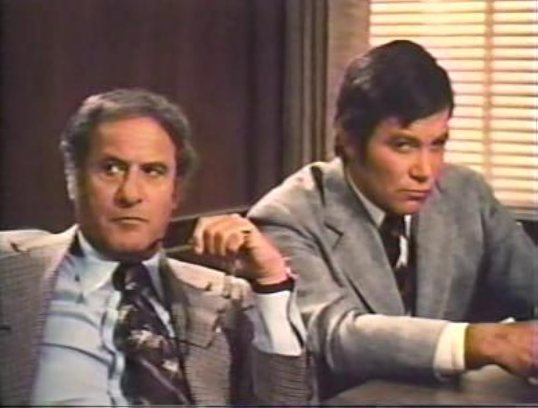
The wife of Assistant District Attorney Sam Belden (William Shatner) has been found, shot to death.  Making things especially awkward is that the body of her lover is found next to her.  Though Belden is the obvious suspect, he has an alibi for the time of the murders.  He claims that he was in Las Vegas, attending a convention.  Two gas station attendants remember seeing him filling up his car with gas at around the same time that his wife and her lover was being shot.

Attorney General Timothy Fitzgerald (Ed Flanders) is not so sure that Belden is innocent.  He instructs two of his top prosecutors to check out Belden’s story and to see if there’s enough evidence to not only indict but also to convict.  Bob Matthews (George Grizzard) is a veteran prosecutor and he’s the one who narrates the story for us.  Assisting him is Mike Belano, who is played by the always likable Reni Santoni.  Just three years before this movie aired, Santoni played Harry Callahan’s partner in Dirty Harry.  There was just something about Santoni’s friendly but determined demeanor that made him perfect the role of the supportive partner or assistant.

The film is very much a legal procedural, with the emphasis on not only the investigation but also on the strategies and the techniques that are used in the courtroom by Matthews and defense attorney DeWitt Foster (Eli Wallach).  In many ways, it feels like a forerunner to Law & Order.  Usually, I love court procedurals but Indict & Convict was a bit too slow and high-minded for its own good.  Maybe it’s because I’ve been spoiled by all of the legal shows that I’ve seen but I have to admit that I spent a good deal of Indict & Convict wanting the prosecutors to get on with it.  Flanders, Grizzard, Santoni, and Wallach were all ideally cast but the film itself sometimes got bogged down with all the debate about the best way to win a conviction.  It’s a shame because the story itself is an intriguing one and I actually enjoyed the movie’s use of spinning newspaper headlines to let us know what had happened in between scenes.  Also, as a classic film fan, I enjoyed seeing Myrna Loy as the judge.  She didn’t get to do much other than say, “Sustained” and “Overruled,” but still …. Myrna Loy!

Most people who watch this film will probably do so out of the hope of seeing some trademark Shatner overacting.  William Shatner doesn’t actually get to say much in this film.  He spends most of the running time sitting silently at the defense table.  Towards the end, he does finally get a chance to deliver a brief speech and it’s everything you could hope for.  Shatner takes dramatic pauses.  Shatner emphasizes random words.  Every line is delivered with the subtext of, “Pay attention, Emmy voters!”  Eventually, Shatner would learn the value of laughing at oneself but apparently, that lesson had not yet been learned when he did Indict & Convict.

Retro Television Reviews: Fantasy Island 4.5 “The Love Doctor/The Pleasure Palace”


Welcome to Retro Television Reviews, a feature where we review some of our favorite and least favorite shows of the past!  On Tuesdays, I will be reviewing the original Fantasy Island, which ran on ABC from 1977 to 1986.  Almost the entire show is currently streaming is on Youtube, Daily Motion, and a few other sites.

This week, Roarke and Tattoo are still ignoring each other.

Episode 4.5 “The Love Doctor/The Pleasure Palace”

(Dir by Earl Bellamy and Cliff Bole, originally aired on November 22nd, 1980)

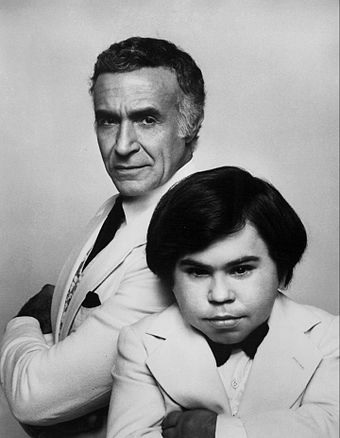
The plane has arrived and, once again, Mr. Roarke and Tattoo head down to the docks to meet their guests.  And, as with the previous season four episodes, it’s hard not to notice that neither Ricardo Montalban nor Herve Villechaize are willing to look at each other while delivering their lines.  I feel a little bit bad about having started almost every recent review by mentioning the obvious hostility between the two of them but it’s impossible not to notice.  Previously, one of the show’s greatest strengths was the playful banter between Roarke and Tattoo and, when it’s gone, it’s impossible not to notice the absence.

Speaking of hostility, Gordon Hughes (Gary Burghoff) seem to have a lot resentment against the world.  Thanks to the inheritance that he received from his grandmother, Gordon has graduated from law school and he is on the verge of joining a top law firm.  But, before he does so, he wants to go back in the past and discover how his grandmother made all of her money.  Mr. Roarke takes Gordon to a recreation of the saloon that his grandmother owned in turn-of-the-century San Francisco.  Gordon takes a sip of brandy and is transported into the past.  He quickly discovers that …. HIS GRANDMOTHER OWNED A BROTHEL!

At first, Gordon is upset about this discovery.  But then he falls in love with one of his grandmother’s employees, a waitress named Molly (Barbie Benton).  And then he stands up to a crooked cop (Dane Clark).  And then he meets his grandmother (Ruta Lee) and discovers that she was tough and refused to let anyone push her around.  Gordon realizes that he should be proud of his grandmother and his heritage and that he wants to be with Molly.  But then the San Francisco earthquake hits and Gordon is abruptly transported to the present.  Not to worry, though!  It turns out Molly was also a guest having a fantasy and she and Gordon board the airplane home together.

This fantasy — which featured a lot of nice clothes and period detail — would have been effective if not for Gary Burghoff’s rather off-putting performance as Gordon.  Seriously, Gordon came across as being such an uptight and self-righteous prig that it was difficult to have much sympathy for him.  Of course, that was kind of the point.  Gordon was supposed to be a snob but Burghoff made him such a convincing and such a committed snob that it was hard to believe that he could have changed his ways just over the course of a few days.

The second guest is actress Kim Holland (Loni Anderson), who is the biggest star in the world after appearing in only three movies.  She wants a break from being a star so Mr. Roarke arranges for her to serve as a nurse in a remote clinic that is run by the gruff Dr. Greg Miller (Christopher George).  Kim finds a purpose in life helping Dr. Miller but, when they’re kidnapped by a native tribe, Dr. Miller reveals that he has always known who Kim is.  Dr. Miller plays one of her movies for the tribe, convincing them that Kim is a goddess.  Miller goes on to explain that he’s been in love with Kim ever since he first saw her on screen.  Seeing as Kim’s fantasy was to not be recognized for a few days, it would seem that Roarke failed to keep up his end of the bargain.  But it doesn’t matter because Kim and Greg are in love.  This fantasy could have worked with perhaps a different actress in the role of Kim.  Loni Anderson gave such a blank performance as Kim that it was hard to really believe her either as a movie star or a nurse.

(Interestingly enough, the character of Kim Holland also appeared on the episode of The Love Boat that aired right before this episode.  So, if nothing else, this is the first Love Boat/Fantasy Island cross-over.  Incidentally, I’ll be reviewing that episode of The Love Boat in a few more months.)

This was a fairly forgettable episode.  The island was lovely to look at and I’m glad that everyone found love but I just wish Mr. Roarke and Tattoo could be friends again.

Retro Television Review: Roll, Freddy, Roll (Dir by Bill Persky)


Welcome to Retro Television Reviews, a feature where we review some of our favorite and least favorite shows of the past!  On Sundays, I will be reviewing the made-for-television movies that used to be a primetime mainstay.  Today’s film is 1974’s Roll, Freddy, Roll!  It  can be viewed on YouTube!

Poor Freddy Menlo!

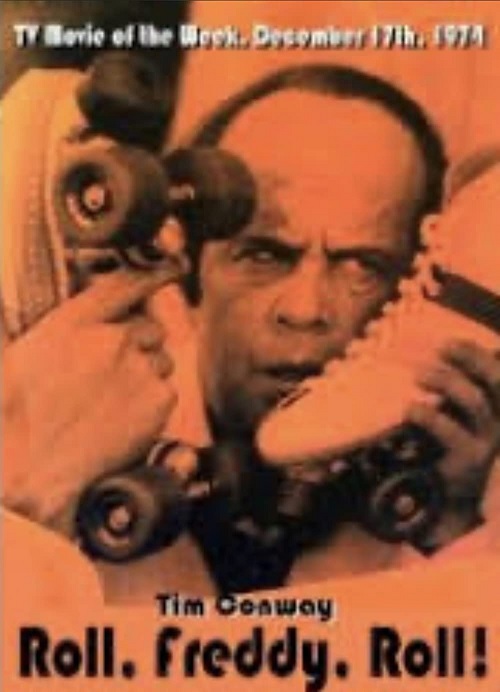
Played by Tim Conway, Freddy is a well-meaning guy who gets absolutely zero respect from the rest of the world.  He works as a computer programmer but his boss (Henry Jones) doesn’t think much of him and an attempt to score a contract with the U.S. Navy falls through when Admiral Norton (Scott Brady) announces that he doesn’t think much of computers.  Meanwhile, his ex-wife (Ruta Lee) has fallen in love with and married “Big Sid” Kane (Jan Murray).  Big Sid is a millionaire who made his fortune selling used cars.  Big Sid is seen every day on television.  And, due to catching the biggest bluefish tuna on record while on his honeymoon, Big Sid Kane is now in the Guinness Book of the World Records.

A lesser engineer would crack under the pressure and go on a rampage through Los Angeles, Falling Down-style.  But Freddy just wants to be a good father.  He just wants his son, Tommy (Moosie Drier), to look up to him the way that he now looks up to Big Sid.  Freddy takes Tommy to a roller skating rink and awkwardly skates around while Tommy talks about how much he enjoys going to Big Sid’s car lot.  When it’s time to leave the rink, Freddy is informed that his shoes have been lost.  An angry Freddy refuses to return the rink’s skates until he gets back his shoes.  Freddy then takes Tommy down to Big Sid’s used car lot, where Big Sid has invited other people to come and try to set world records of their own.  A local news reporter sees that Freddy is on roller skates and announces that Freddy is seeking to set the world record for the most time spent rolling around!  Finally, Freddy has found a way to impress his son!

Excuse me while I catch my breath.  That was a lot of plot to cram into just two paragraphs.

Roll, Freddy, Roll is not a particularly complicated movie.  For the most part, it exists solely so that Tim Conway can do some mild physical comedy while trying to balance himself on roller skates.  It only has a 73-minute run time and it basically feels like an extended episode of an old sitcom.  With all that in mind, it still seems like it takes forever to actually get Freddy into those roller skates and once he does put them on, the movie keeps up coming with implausible excuses to keep him from taking them off until he finally decides to go for the world record.  The story would have been stronger if Freddy has been the one to look at his feet and say, “I’m going to set a world record,” as opposed to him just being bullied into it by a news reporter.  Tim Conway’s likable but there’s only so many times you can watch someone fall on roller skates before the joke starts to wear thin.

It would not surprise me if Roll, Freddy, Roll was meant to be a pilot for a sitcom.  It’s easy to imagine Tim Conway trying to impress his son and win back his wife by doing something stupid on a weekly basis.  As far as I know, Roll, Freddy, Roll did not lead to a television series and that’s probably a good thing.  Freddy had a hard enough time just rolling around Los Angeles for two days!  Who knows what would have happened if he had tried to do it on a weekly basis!?

Lisa Watches an Oscar Nominee: Witness for the Prosecution (dir by Billy Wilder)


Movie_poster_for_-Witness_for_the_Prosecution-

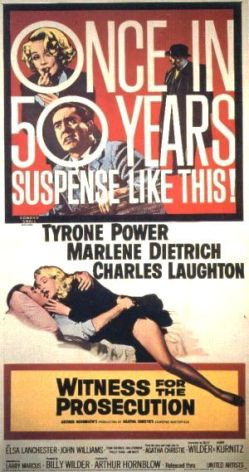
Earlier today, I DVRed the 1957 best picture nominee, Witness for the Prosecution, off of TCM.  I watched the film as soon as I finished dinner and, having now seen Witness for the Prosecution, I am prepared to give you my professional and erudite review.

Okay, are you ready for it?  Here we go:

🙂 Oh my God, I freaking love this movie!!!!!!!!! 🙂

Witness for the Prosecution is many things.  It’s a courtroom drama.  It’s a domestic comedy.  It’s a twisty murder mystery.  It’s a showcase for three great performers.  It’s crowd pleaser that will make you think and, even if it does involve people killing each other, it will probably make you smile as well.  Don’t let that 1957 date fool you.  Witness For the Prosecution is a lot of fun.

Leonard Vole (Tyrone Power) is a somewhat sleazy man who has two claims to fame.  One is that he claims to be responsible for inventing the egg beater.  The other is that he’s been accused of murdering Mrs. French (Norma Varden), a wealthy widow who had recently named Leonard as the beneficiary of her will.  Everyone assumes that Leonard must have been having an affair with Mrs. French but Leonard claims that he’s innocent.

Suspecting that he is soon going to be arrested, Leonard hires Sir Wilfred Robarts (Charles Laughton) to serve as his attorney.  Though Sir Wilfred is recovering from a heart attack and has been ordered to not take on any more stressful criminal cases, he agrees to defend Leonard.  He proceeds to do just that, under the watchful eye of his nurse, the protective Mrs. Plimsoll (Elsa Lanchester).

(The testy relationship between Sir Wilfred and Mrs. Plimsoll provides the film with its comedic relief.  Laughton and Lanchester were married in real life and, watching the film, you can tell that they had a lot of fun acting opposite each other.)

Sir Wilfred is convinced that he can win acquittal for Leonard, especially since Leonard’s German wife, Christine (Marlene Dietrich), is willing to provide an alibi for him.  (In one of the film’s best moments, Sir Wilfred talks about how distraught Christine will be to discover that Leonard has been arrested just to then have the very calm and self-possessed Christine step into the room.)  However, to everyone’s shock, Christine is called as a witness for the prosecution.  She testifies that Leonard confessed the murder to her and that she only provided an alibi out of fear and love.

Things aren’t looking good for Leonard but then, a mysterious woman with a cockney accent contacts Sir Wilfred and reveals that Christine may have had reasons of her own for not giving Leonard an alibi…

Witness For The Prosecution ends with a voice over that says, “The management of this theater suggests that for the greater entertainment of your friends who have not yet seen the picture, you will not divulge, to anyone, the secret of the ending of Witness for the Prosecution.”  And I have to say that, when I heard that, it just made me love the film even more.  I had enjoyed the film so much and had so much fun following all the twists and the turns of the mystery that I found myself nodding in agreement.

“Sure, 58 year-old voice over,” I said, “I will not divulge the secret ending of Witness For The Prosecution.”

And I’m not going to!  Though, to be honest, you’ll probably guess the secret before it’s revealed.  It’s a plot twist that has been imitated by so many other courtroom dramas that it’s probably not as much of a mind-blower today as it may have been back in 1957.

But no matter!  Witness For The Prosecution is still a lot of fun.  Even if you figure out the mystery early, you can still watch the film and enjoy Laughton’s wonderfully theatrical performance.

Witness for the Prosecution was nominated for best picture and, interestingly enough, another theatrical courtroom drama — 12 Angry Men — was also nominated that year.  It’s interesting to compare the low-key drama of 12 Angry Men to the cheerful flamboyance of Witness For The Prosecution.  They are both great films about the law but each is told from a very different perspective.

Of course, in the end, both of these great films ended up losing to The Bridge On The River Kwai.