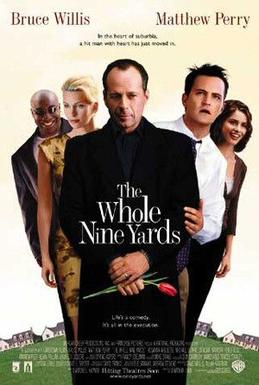
Oz (Matthew Perry) is an unhappily married dentist who discovers that his new neighbor, Jimmy (Bruce Willis), is a notorious contract killer who has a bounty on his head. Oz’s wife, Sophie (Rosanna Arquette), wants Oz to rat Jimmy out to the local mob boss (Kevin Pollack) and collect the bounty. Oz is deeply in debt and has a hard time saying no to his wife but he and Jimmy have actually become friends. Also, Oz is falling in love with his dental assistant, Jill (Amanda Peet) despite the fact that Jill is also a contract killer, though she’s still a “virgin” because she’s falling in love with the man that she was hired to kill.
The Whole Nine Yards is an amusing comedy that works because of the chemistry between Matthew Perry and Bruce Willis. When it came to his movie career, Perry was always Chandler Bing no matter who he was playing but that didn’t matter because everyone loved Chandler. I know I loved Chandler, even if Joey would have been the Friend that I probably would have ended up flirting with. Perry was a naturally funny actor and he and Willis made for a good team in The Whole Nine Yards. I also really liked Amanda Peet’s energetic performance as Jill and Kevin Pollack as the crime boss. The Whole Nine Yards is basically a violent sitcom. It may not be a great movie but Perry and Willis will make you laugh.
It’s a little hard to rewatch now. Matthew Perry is gone. Bruce Willis is retired for health reasons. They’re both having so much fun in this movie and are so entertaining to watch that it’s impossible not feel a little sad watching them. But the movie also shows what Perry and Willis could do, even with so-so material. Watching the movie made me laugh and it made me sad but mostly it just made me appreciate their talent. We can mourn what we’ve lost while still appreciating what we had.
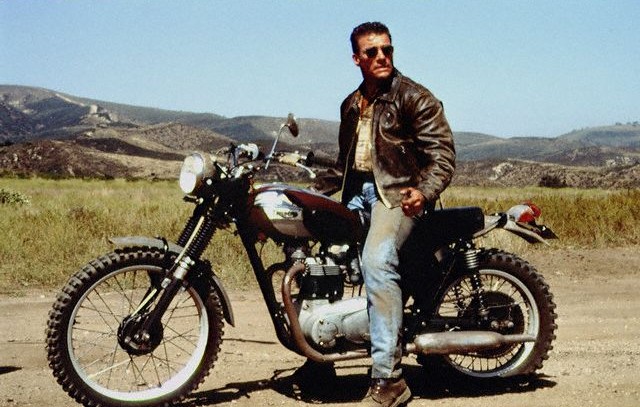
In NOWHERE TO RUN, Jean-Claude Van Damme plays Sam Gillen, a recently escaped convict who finds himself hiding on the outer edges of a rural farm owned by widowed mother Clydie Anderson (Rosanna Arquette) and her two children, Mookie and Bree (Kieran Culkin and Tiffany Taubman). Through a variety of circumstances, Sam learns that a ruthless developer, Franklin Hale (Joss Ackland), and his enforcer Mr. Dunston (Ted Levine), are trying to force all of the farmers to sell their land, using violence if necessary. When bad guys show up one night and threaten Clydie and her kids, Sam emerges from the woods and kicks their asses. Soon Sam finds himself fighting off more of Hale’s goons, romancing the beautiful widow and becoming more emotionally connected to the kids. With his past closing in, Sam decides to do whatever it takes to protect Clydie and her kids, even if that costs him his freedom.
The late 80’s and early 90’s saw the emergence of two new action stars… Steven Seagal and Jean-Claude Van Damme. As a constant patron of our local video stores, I was there at the beginning of their careers and rented each of their new movies as they became available. Van Damme would establish himself in hit films like BLOODSPORT (1988), KICKBOXER (1989), DEATH WARRANT (1990) and UNIVERSAL SOLDIER (1992). As a big fan, I found myself in a movie theater in January of 1993 to watch his latest film, NOWHERE TO RUN.
With a plot that resembles an old western… a man corrupted by wealth tries to force a widow off her land until a kind-hearted drifter steps in… NOWHERE TO RUN isn’t trying to reinvent the action genre, but it does give Van Damme a different kind of role. His Sam Gillen isn’t a wisecracking action hero or an unstoppable martial artist. Rather, he’s a flawed man with a particular set of skills who’s looking for redemption. I think Van Damme plays that soulful weariness better than most would give him credit for. Rosanna Arquette brings a credible presence to this genre film that helps sell the relationship between her and Van Damme, and the presence of her kids, also amps up the stakes and gives the story a genuine sense of vulnerability. When Sam decides to fight back, it’s not to protect himself, but to protect people worth standing up for. That motivation helps make the film more engaging than you might normally expect from an early 90’s action film.
Speaking of action, NOWHERE TO RUN doesn’t feature a ton of action, but what it does have is effective. The early sequence where Van Damme’s character initially steps in to help the terrorized family is especially strong. There are several additional fight sequences and a prolonged motorcycle chase to provide some entertainment, but don’t expect wall-to-wall action or you could be disappointed. Joss Ackland (LETHAL WEAPON 2) and Ted Levine (THE SILENCE OF THE LAMBS) are suitably nasty villains so we definitely want to see them get their comeuppances, and the film effectively obliges. I also like the fact that NOWHERE TO RUN is set out on a rural farm. This setting enhances its “western” feel, and I certainly appreciate that unique element for an action film of this era.
At the end of the day, I enjoyed NOWHERE TO RUN when I watched it in the movie theater back in 1993, and I enjoyed it again today. It’s certainly not flashy and action packed like HARD TARGET or TIMECOP, but it is a solid, and surprisingly emotional Van Damme film. I recommend it.
“Pulp Fiction” was as peak 1990s as much as these two:
Or this Archie’s Comic live action show
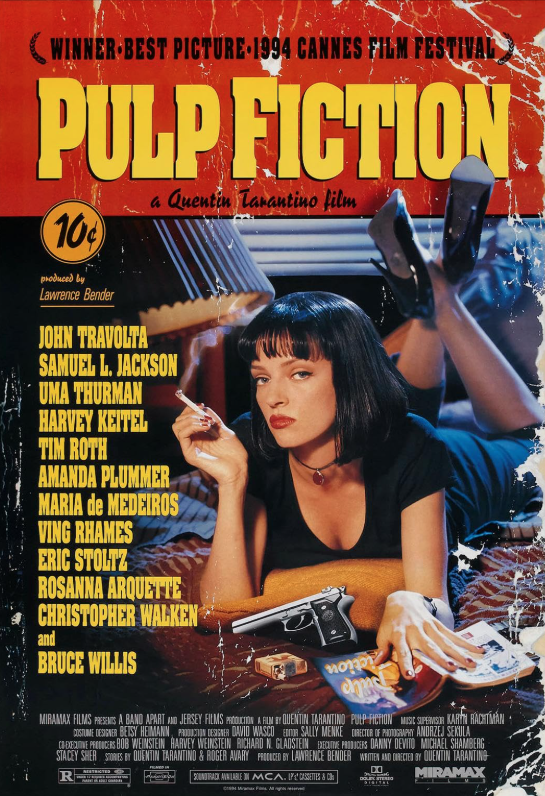
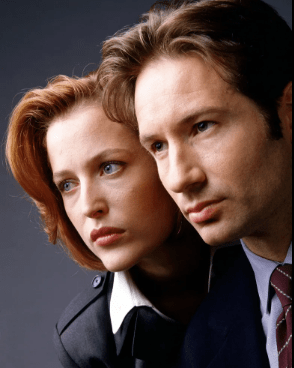
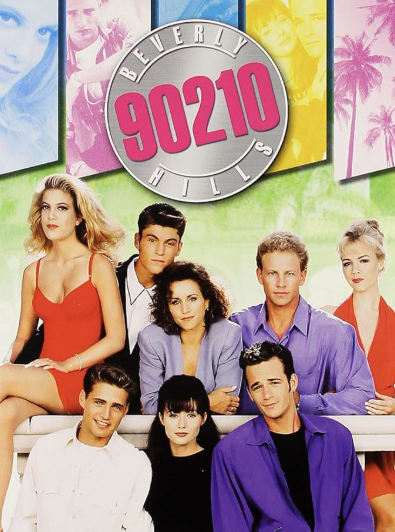
While “X-Files” attracted big audiences 60-40% male and the reverse for “90210”, “Pulp Fiction” captured 1994: Jocks, Nerds, Guys, Women, Girls, Boys, Boomers, X-ers, Older Millennials, you name it – Everyone was into Pulp Fiction. Tarantino described this art as a number of cliches: the mobster attracted to the mob wife, the boxer who tricks the mobsters into giving him money and NOT throwing the fight, and the killer who finds God. The cliches dig into DNA. WHY? Because they have the same motivations as our caveman ancestors: the unobtainable mate, a sense of honor, and redemption. These themes are the basic building blocks of what make us human beings and why these stories echo through the millennia – our ancestors fears are the same as ours today. Some might claim that “Reservoir Dogs’ was better- they are incorrect– Pulp Fiction was WAY more entertaining.
Even though this was released and written in the 1990s, it had an older feel to it. First, everyone smoked indoors. I remember the 1990s, smoking was on the OUTS big time! Second, man did he like to use a certain racial slur. OOF. But then again, I’m not from Los Angeles. Maybe, it’s like Alabama there? I have no idea! I can say that the film did hold up as re-watched it today. It was still relevant and maybe that’s because it was difficult to pin down the time period; in fact, the music was mostly from the 1970s and the story time jumped- A LOT! The Miramax producer who worked on the show also jumps a lot, but mostly in the shower.
The story begins with two mobsters Vincent Vega and Jules Winnfield murdering two guys to get a magical briefcase back to their boss Marsellus Wallace, which feeds into the next storyline of Butch an aging fighter who’s about to rip off the mob, which feeds into Mia Wallace – Marsellus Wallace’s wife overdosing on heroin, which feeds into Butch on a quest to retrieve his great-grandfather’s watch, which feeds into a pretty graphic man on man scene of sexual violence and revenge, which feeds into Jules finding God, which feeds into cleaning brains out of a car, and finally ending in a diner being robbed by Tim Roth. Yes, the film requires attention. It’s not “Dazed and Confused”. You gotta pay attention.
I recently watched a show with Lisa Marie that time jumped – oh no, were their Germans around who got too close at a family reunion off camera?!
I still believe this is Quentin’s Opus and you cannot convince me otherwise because it connected to everyone and launched and re-launched A LOT of careers. Pulp Fiction’s legacy was that it empowered a 1990s writers to work in humor with their grittiness like in Halloween H20, which I reviewed here
In the old west, a cowboy named Emmet (Scott Glenn) teams up with a reformed outlaw named Paden (Kevin Kline) and they bust Emmet’s wild younger brother, Jake (Kevin Costner), out of jail. After Mal (Danny Glover) helps the three of them escape from a posse, they all end up going to the town of Silverado, where all four of them have business. Emmett and Jake want to protect their sister from the corrupt son (Ray Baker) of a cattle baron who was previously killed by Emmett. Mal wants to save his sister Rae (Lynn Whitfield) from an evil gambler (Jeff Goldblum). Paden discovers that Cobb (Brian Dennehy), his former partner-in-crime, is now the sheriff of Silverado and working for the cattle barons. When Paden tries to protect the new settlers (including Rosanne Arquette), it leads to a confrontation with his former partner.
In the 80s, when he wasn’t directing films like The Big Chill and The Accidental Tourist, Lawrence Kasdan specialized in paying homage to the films of Hollywood’s golden age. He started his directorial career with Body Heat, a modern film noir. He worked on the screenplays of both Empire Strikes Back and Raiders of the Lost Ark. With Silverado, Kasdan tried to resurrect the western.
Silverado is a traditional western with a few modern touches, like casting Jeff Goldblum as a gambler and John Cleese as the sheriff who wants to execute Kevin Costner. Silverado also has more humor than a typical western, largely thanks to Kevin Kline. Silverado starts out as a comedy before turning serious and grim once the four heroes finally reach Silverado.
Kasdan’s love of the genre is obvious in every frame of Silverado but, in trying to tell multiple stories at once, the movie spreads itself too thin. I like that Kasdan tried to shake things up by casting actors who most people wouldn’t expect to see in a western but both Kevin Kline and Brian Dennehy seem miscast in their roles and their final confrontation never becomes the epic moment that it needs to be. Scott Glenn and Kevin Costner are far more believable in their roles. Danny Glover is also believable but his character is underused.
Silverado was obviously a labor of love for Kasdan and it shows that, if nothing else, Kasdan understood the appeal of the genre and the beauty of the wide open frontier. The movie has its flaws but fans of westerns will appreciate his effort.
Directed by Martin Scorsese, 1985’s After Hours opens in an office. This isn’t the type of office that one might expect a Scorsese movie to open with. It’s not a wild, hedonistic playground like the office in The Wolf of Wall Street. Nor is it a place where an aging man with connections keeps his eye on the business for his friends back home, like Ace Rothstein’s office in Casino. Instead, it’s a boring and anonymous office, one that is full of boring and anonymous people. Scorsese’s camera moves around the office almost frantically, as if it’s as trapped as the people who work there.
Paul Hackett (Griffin Dunne) works in the office, at a job that bores him but presumably pays him enough to live in New York. Paul is not a typical Scorsese protagonist. He’s not a fast-talker or a fearsome fighter. He’s not an artist consumed by his own passion or an amoral figure eager to tell his own story. Instead, he’s just a guy who wears a tie to work and who spends his day doing data entry. He’s a New Yorker but he doesn’t seem to really know the city. (He certainly doesn’t know how much it costs to ride the subway.) He stays in his protected world, even though it doesn’t seem satisfy him. Paul Hackett is not Travis Bickle. Instead, Paul is one of the guys who would get into Travis’s cab and, after spending the drive listening to Travis talk about how a storm needs to wash away all of New York’s sin, swear that he will never again take another taxi in New York.
One day, after work, Paul has a chance meeting with a seemingly shy woman named Marcy (Rosanna Arquette). Marcy lives in SoHo, with an artist named Kiki (Linda Fiorentino) who sells plaster-of-Paris paperweights that are made to look like bagels. Marcy gives Paul her number and eventually, Paul ends up traveling to SoHo. He takes a taxi and, while the driver is not Travis Bickle, he’s still not amused when Paul’s last twenty dollar bill blows out the window of the cab.
Paul’s trip to SoHo doesn’t goes as he planned. Kiki is not impressed with him. Marcy tells him disturbing stories that may or may not be true while a search through the apartment (not cool, Paul!) leads Paul to suspect that Marcy might have disfiguring burn scars. Paul decides to end the date but he then discovers that he doesn’t have enough change on him to take the subway home. As Paul attempts to escape SoHo, he meets a collection of strange people and finds himself being hunted by a mob that is convinced that he’s a burglar. Teri Garr plays a sinister waitress with a beehive hairdo and an apartment that is full of mousetraps. Catherine O’Hara chases Paul in an ice cream truck. Cheech and Chong play two burglars who randomly show up through the film. John Heard plays a bartender who appears to be helpful but who also has his own connection to Marcy. Even Martin Scorsese appears, holding a spotlight while a bunch of punks attempt to forcibly give Paul a mohawk. The more that Paul attempts to escape SoHo, the more trapped he becomes.
Martin Scorsese directed After Hours at a time when he was still struggling to get his adaptation of The Last Temptation of Christ into production. If Paul feels trapped by SoHo, Scorsese felt trapped by Hollywood. After Hours is one of the most nightmarish comedies ever made. It’s easy to laugh at Paul desperately hiding in the shadows from Catherine O’Hara driving an ice cream truck but, at the same time, it’s impossible not to relate to Paul’s horror as he continually finds himself returning again and again to the same ominous locations. In many scenes, he resembles a man being hunted by torch-wielding villagers in an old Universal horror film, running through the shadows while villager after villager takes to the streets. Paul’s a stranger in a strange part of the city and he has absolutely no way to get home. I think everyone’s had that dream at least once.
Paul is not written to be a particularly deep character. He’s just a somewhat shallow office drone who wanted to get laid and now just wants to go home. Fortunately, he’s played by Griffin Dunne, who is likable enough that the viewer is willing to stick with Paul even after Paul makes some very questionable decisions and does a few things that make him a bit less than sympathetic. Dunne and John Heard keep the film grounded in reality, which allows Rosanne Arquette, Linda Fiorentino, Catherine O’Hara, and especially Teri Garr to totally play up the bizarre quirks of their character. Teri Garr especially does a good job in this film, revealing a rather frightening side of the type of quirky eccentric that she usually played.
Scorsese’s sense of humor has been evident in almost all of his films but he still doesn’t get enough credit for his ability to direct comedy. (One need only compare After Hours to one of Brian De Palma’s “comedies” to see just how adroitly Scorsese mixes laughs and horror.) After Hours is one of Scorsese’s more underrated films and it’s one that everyone should see. After Hours is a comedy of anxiety. I laughed while I watched it, even while my heart was racing.
Welcome to Late Night Retro Television Reviews, a feature where we review some of our favorite and least favorite shows of the past! On Tuesdays, I will be reviewing Gun, an anthology series that ran on ABC for six week in 1997. The entire show is currently streaming on Tubi!
This week, Gun welcomes …. JAMES GANDOLFINI!
Episode 1.3 “Columbus Day”
(Dir by James Steven Sadwith, originally aired on May 3rd, 1997)
The third episode of Gun does indeed features James Gandolfini. Gandolfini play Walter Difideli, who seems to have quite a bit in common with Gandolfini’s best-known character. Like Tony Soprano, Walter is proud of his Italian heritage, loudly discussing the superiority of men like Amerigo Vespucci and Christopher Columbus. Walter makes it a point to stay home on Columbus Day so that he can properly celebrate. Like Tony, Walter boasts about how he will always take care of his family and he also has something of a quick temper. And, like Tony, Walter keeps a gun around the house.
However, there are a few differences as well. For one thing, Walter is firmly on the side of law and order. Unlike Tony, who lived in a mansion and never worried about the legality of his activities. Walter is very honest and, as a result, he and his family live in a crappy apartment. Another big difference between Walter and Tony is that, while Tony always had a mistress, Walter is loyal to his wife, Lilly (Rosanna Arquette). Walter is not one to cheat. The only cheating in the marriage is done by his wife.
Walter works for TSA at an airport. One day, he helps to chase down a terrorist. Before the terrorist is captured, he tosses his gun — the Gun of the show’s title — into a janitor’s cart. When the janitor later comes across the gun, he sells it to Walter for $50.
Walter wants Lilly to have a gun because he’s taking an extra job at night so that he can raise enough money to afford ballet lessons for their daughter and an engagement ring for his wife. (When they were engaged, he could never afford to get her a ring.) Lilly is unhappy about Walter refusing to let her work and instead expecting her to spend all of her time around the apartment. But then Lilly meets one of her neighbors, a writer named Jack Keyes (Peter Horton). Soon, she and Jack are having a passionate affair, one that inspires Jack to write a less-than-flattering shorty story called The Tryst.
Meanwhile, the terrorist’s collaborator wants to get the gun back and, after he finds out that Walter has it, he starts harassing Walter at work and later at his apartment. The nervous Walter starts to carry around the gun with him. When Lilly, upset over Jack’s short story, deletes all of his files from his laptop, the angry Jack goes down to Lilly’s apartment and kicks open the door. What he doesn’t know is that Walter is waiting on the other side of the door, with his gun. Jack ends up dead. Walter is declared a hero for protecting his home. Lilly submits Jack’s short story under her name and it gets published. And the terrorist …. well, he’s just kind of forgotten about.
This was an unsatisfying episode, one that ended with a few too many loose ends still dangling. (At one point, it’s revealed that Jack secretly films his encounters with Lilly but it’s one of those plot points that goes nowhere.) An even bigger problem was that there really wasn’t anyone in this episode who seemed worthy of being the center of a story. Walter was a hopelessly naïve blowhard. Lilly cheated on her devoted husband and never appeared to feel the least bit of guilt about it, even after Walter gunned down her lover. Jack was a jerk but it’s hard not to feel that he deserved better than to have his life’s work deleted by the whiny Lilly. The performances were all good but none of the characters seemed to be worth the effort.
Still, for James Ganolfini fans, this episode does provide a bit of a dry run for Gandolfini’s legendary performance as Tony Soprano. Imagine a world where Tony is a complete dunce and you’ll probably come up with this episode of Gun.
It seems like whenever there’s any sort of disaster, people are advised to seek shelter. Often, if the disaster is national news, people are told to take shelter in their basement, as if everyone in the world has a basement. This is a bit of a pet peeve of mine because I live in North Texas, where the land is completely flat and no one has a basement, a cellar, or any other sort of underground shelter. (We also don’t have mud rooms and, in fact, I’m not even sure what a mud room is.)
That said, there’s a part of me that’s glad that it would be impossible for me to take shelter because, from what I’ve seen in the movies, it appears that spending months in a shelter can actually be worse than dying in a disaster.
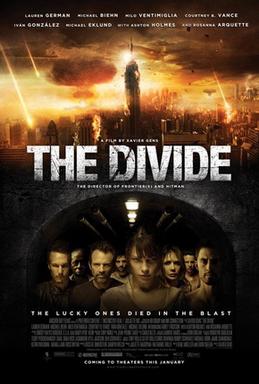
Take the 2011 film, The Divide, for instance.
The Divide opens with several people watching while a mushroom cloud blooms over New York City. Eight of those people all end up taking shelter in the same basement. While that means that they don’t get incinerated by the nuclear blast, it also means that they now have to figure out how to live together. That’s not going to be easy because it doesn’t take long to realize that none of these people should be anywhere near each other.
For instance, there’s Mickey (Michael Biehn). Mickey’s the one who built the shelter. He says that he specifically built it so that, in case of a nuclear war or a terrorist attack, he could safely sit underground and laugh at everyone dying above him. That’s not a nice sentiment but Mickey is played by Michael Biehn so he’s still one of the more likable characters in the film.
There’s Josh (Milo Ventimiglia) and his brother Adrien (Ashton Holmes) and their friend Bobby (Michael Eklund), three idiots who are clearly destined to end up going crazy before the ordeal is over.
There’s Eva (Lauren German) and her boyfriend, Sam (Ivan Gonzalez), who are both obviously destined to be the voices of reason to which no one is going to listen.
And then there’s Marilyn (Rosanna Arquette) and her daughter (Abby Thickson), who are there because it’s not a shelter-movie without a child being put in jeopardy.
Lastly, there’s Devlin (Courtney B. Vance), who is there to be the older authority figure who ultimately fails to exercise much authority.
After an effectively chilling scene where the basement is briefly invaded by some mysterious men in Hazmat suits, The Divide settles down to be a fairly predictable and, to be honest, rather unpleasant examination of a group people going crazy from the stress of being trapped together. It may seem odd to complain that a film about the aftermath of a nuclear apocalypse was unpleasant and I guess it is. But The Divide runs a little over two hours and it’s so relentlessly bleak and everyone is ultimately so nasty that it becomes a bit of a chore to sit through. By the time the torture scenes begin, The Divide has slipped into Hostel territory and it’s hard not to feel that the film is being grotesque simply for the sake of being grotesque.
That said, the film does have its strength. The shelter is an effectively claustrophobic location and Michael Biehn does what he can with the role of Mickey. When some of the characters end up getting radiation sickness, it creates some effectively scary visuals. I mean, if you ever thought it would be cool to poison yourself with radiation, this film will change your mind. That’s a good thing, I suppose.
The Divide is a very long movie about some very unpleasant people in an even more unpleasant situation. It’s well-made but not particularly entertaining to watch. In the end, it’s easy to feel that everyone would have been better off just staying above ground and getting it over with.
Billionaire Boys Club, a fact-based film about two murders that occurred back in the greed and cocaine-filled 80s, was first announced in 2010. After five years of pre-production, the film started shooting in 2015. It featured up-and-coming stars Ansel Elgort and Taron Egerton in the lead roles and Emma Roberts in a key supporting role. It also featured a certain two-time Oscar-winning actor, who we will talk about shortly. There was speculation that Billionaire Boys Club could be an Oscar contender. At the very least, that two-time Oscar-winning actor might pick up another supporting nomination. Shooting started in December of 2015 and wrapped in January of 2016.
And then …. nothing.
What happened?
Kevin Spacey happened. On October 29th, 2017, Anthony Rapp told how, when he was 14, an intoxicated Kevin Spacey made a sexual advance towards him. Subsequently, 15 other people came forward with stories about Spacey making similar advances towards them. At the time, the Oscar-wining actor had key supporting roles in two upcoming films: All The Money In The World and Billionaire Boys Club. The producers of All The Money In The World replaced Spacey with Christopher Plummer and hastily refilmed all of his scenes.
Unfortunately, that really wasn’t an option for the producers of Billionaire Boys Club. Whereas Spacey’s role in All The Money In The World was basically an extended cameo, he was a key part of Billionare Boys Club. Spacey had been cast as Ron Levin, a flamboyant con man whose murder led to the collapse of an 80s investment firm. There was really no feasible way to replace Spacey without reshooting the majority of the film. As a result, Billionaire Boys Club sat a while in limbo before finally getting an extremely limited release back in July. On opening day, the film made a total of $126. (The final weekend gross was $618.)
As for the film itself, the behind the scenes drama is far more interesting than anything that actually happens on screen. Elgort and Egerton play Joe Hunt and Dean Karny, two middle-class guys who want to be rich in the 80s. They do this by starting an investment firm called Billionaire Boys Club and, for a few months, everything seems to be perfect. They appear to be making money. They drive nice cars and live in big mansions and throw big parties. There’s all the usual stuff that you expect to see in films about rich twentysomethings: cocaine, swimming pools, black lingerie, and fast cars. In fact, that’s kind of the problem with the film. There’s nothing surprising about what happens to Joe and Dean. If you’ve seen Wolf of Wall Street, you’ve seen it all before. In fact, if anything, the film’s recreation of greed-fueled decadence is almost too tame. I mean, sure — we get the shot of the lines of cocaine getting snorted off a counter top but it’s hardly the mountain of coke that usually shows up in a movie like this. If anything, this movie needed more cocaine.
Of course, everything eventually falls apart. It turns out that Ron Levin, their main financial backer, was actually a con man who had managed to trick everyone into thinking that he was a millionaire. In the end, it all leads to two murders, one prison sentence, and one new life in the witness protection program.
The film tries to critique the culture of greed but it fails because it never seems to understand why that culture would be so attractive to two guys like Joe and Dean in the first place. Despite the efforts of Elgort and Egerton, Joe and Dean just come across as being two ciphers who maybe watched Wall Street one too many times. It’s never clear what made these two click or why they were able to trick so many people into believing in them. Unlike something like The Wolf of Wall Street, Billionaire Boys Club is so busy scolding everyone for being greedy that it never acknowledges that being rich can also be a lot of fun. (It doesn’t help that Billionaire Boys Club features first person narration, which often leads to the film telling us what it should be showing us.)
As for Kevin Spacey, he gave the same performance that he gave in any number of similar films. He’s arch and sarcastic and sometimes ambiguously flamboyant. He gets upset whenever anyone says anything against his dog. When he announces that he’s a “hustler” and brags about how he can get away with anything because he’s convinced people that he’s something that he’s not, it’s hard not to cringe. It’s not really a bad performance, as much as it just kind of a predictable one. It feels destined to be remembered only for being Spacey’s final appearance in a feature film.
Billionaire Boys Club will be making its Showtime premiere later tonight. It’s not a terrible film but it’s not a particularly memorable one either.
I have long contended that the most annoying serial killer of all time was Paul Michael Stephani, a resident of Minneapolis who killed three women in 1980.
Stephani was known as The Weepy-Voiced Killer. (Even his nickname was annoying.) Whenever Stephani committed a murder, he would promptly call 911 and confess while sobbing. As you might expect would happen to someone who was enough of a dumbass to call the police right after murdering someone, Stephani was eventually captured and convicted. Sentenced to 40 years, Stephani died of cancer while in prison and nobody misses him.
Unfortunately, because all of Stephani’s 911 calls were recorded, he’s recently become a very popular subject for true crime shows. It’s not there’s anything particularly interesting about Stephani’s crimes. It’s just that it’s easy (and cheap) to build a show around the sound of him whining on the phone. As someone who probably spends too much time watching true crime realty television, I’ve had to listen to Stephani’s voice more than anyone should ever have to. Making it even worse, there’s currently a show called Evil Calls, which uses a recording of Stephani in its commercials. I’ve actually stopped watching Investigation Discovery just because I’ve gotten so sick of hearing that loser whining, “Please don’t talk, just listen… I’m sorry I killed that girl. I stabbed her 40 times…”
However, the Stephani tapes do provide one valuable service. The sound of Stephani’s pathetic voice reminds us that most serial killers are not the urbanely witty and intelligent figures that we’ve gotten used to seeing in the movies. Most real-life killers are whiny losers who kill for very basic reasons and who are stupid enough to call 911 and confess. Movie killers are a different breed all together.
Take the 1997 mystery Deceiver, for instance.
In Deceiver, Renee Zellweger plays a world weary prostitute. We only see her in flashbacks, largely because she was murdered before the film’s opening scene. Her name was Elizabeth, which brings to mind Elizabeth Short, the legendary Los Angeles murder victim who is better known as the Black Dahlia. Much like the real-life Black Dahlia, Elizabeth’s body was cut into two pieces and left in a park. (According to the film’s imdb trivia section, Elizabeth was also named after Elizabeth Loftus, a psychologist who pioneered the study of false memories.)
Suspicion immediately falls on James Walter Wayland (Tim Roth). The youngest son of a wealthy and powerful South Carolina family, Wayland is an infamous alcoholic. Wayland admits that he knew Elizabeth. He even took Elizabeth with him to a fancy party, all the better to offend his parents. Wayland may be a black-out drunk with a history of erratic behavior but he also swears that he didn’t kill Elizabeth.
Two detectives are determined to trick Wayland into confessing. Detective Edward Kennesaw (Michael Rooker) is a respected veteran, the type of detective who can get a confession out of almost anyone. His partner is Detective Philip Braxton (Chris Penn), who is a bit less impressive. As we’re informed early in the film, Braxton graduated at the bottom of his high school class and has been waiting for a promotion for quite some time.
From the minute that Kennesaw and Braxton start to interrogate Wayland, it becomes obvious that Wayland is hardly your typical murder suspect. He’s certainly more impressive than the Weepy-Voiced Killer. He’s witty. He’s smart. He’s cocky. He admits to being an alcoholic and to suffering from black outs and seizures but he also claims that, unlike every other man who Elizabeth dealt with, he actually cared about her. Wayland also reveals that he knows some details about Kennesaw and Braxton. He knows about Kennesaw’s troubled marriage to a woman (Rosanna Arquette) who has a history of cheating on him. He knows that Braxton is in debt to a local bookie (Ellen Burstyn). And, as the interrogation continues, Wayland starts to suggest that one of the interrogators is hiding an even darker secret.
Deceiver‘s a frequently fascinating film to watch, even if it’s not always easy to follow. If there’s any film that would seem to demand multiple viewings, it’s this one. The majority of the movie takes place in one darkened room and directors Joan and Josh Pate do a wonderful job capturing the claustrophobia of that setting. (Fortunately, there’s enough flashbacks to keep the film from getting too stagey.) Roth, Rooker, and Penn all give intensely stylized performances. They may not feel realistic but they fit in perfectly with the fever dream atmosphere of the film. Roth, in particular, gives a performance that is both mannered and intriguing. It even feel appropriate that his Southern accent is in no way convincing. It just makes sense that Wayland wouldn’t sound like anyone else in the world.
It’s a heavily stylized film, full of odd dialogue and skewed camera angles. It’s a film that often feels like a journey right to the center of an extremely twisted mind. (Of course, the movie is designed so that you’re never quite sure whose mind you’ve entered.) There’s nothing realistic about it but that’s okay. It’s certainly preferable to watching a movie about The Weepy-Voiced Killer.
Rosanna Arquette turns 57 today! The beautiful granddaughter of comedian Cliff Arquette (aka Charlie Weaver of HOLLYWOOD SQUARES fame) began her career in the 70’s with TV mini-series like THE DARK SECRET OF HARVEST HOME and THE EXECUTIONER’S SONG, which brought her acclaim playing Nicole Baker in the adaptation of Norman Mailer’s Pulitzer Prize winning novel based on the Gary Gilmore case.
Soon Rosanna hit the big screen, costarring in John Sayles’ BABY IT’S YOU, then her signature role as the bored housewife who takes a walk on the wild side in DESPERATELY SEEKING SUSAN, the first major film for pop princess Madonna. Rosanna did some good movies (SILVERADO, 8 MILLION WAYS TO DIE), then her career took somewhat of a nose dive, and she wound up in Europe a few years. Quentin Tarantino cast her as the dope dealer’s wife in the seminal PULP FICTION, and since then Rosanna has continued…





 Through the Shattered Lens