Born in what is now Slovakia, Peter Lorre began his acting career in Europe, appearing on the stage and making quite an impression when he starred in Fritz Lang’s M. When the Nazis came to power, Lorre was one of the many film artists who left Germany. At first, he moved to France but, in 1934, he set sail for the United States and continued his career in Hollywood. A popular character actor, Lorre appeared in such classic films as The Man Who Knew Too Much,The Maltese Falcon, Mad Love, Arsenic and Old Lace and Casablanca. Though his role in Casablanca was small, he still played a key role when he gave Rick the letters of transit.
He also appeared in several horror films, often opposite his good friend Vincent Price and Boris Karloff. In this scene from 1962’s Tales of Terror, Lorre and Price challenge each other to a wine-drinking contest.
(It’s tradition here at the Lens that, every October, we watch the original Little Shop of Horrors. And always, I start things off by telling this story…)
Enter singing.
Little Shop…Little Shop of Horrors…Little Shop…Little Shop of Terrors…
Hi! Good morning and Happy October 24th! For today’s plunge into the world of public domain horror films, I’d like to present you with a true classic. From 1960, it’s the original Little Shop of Horrors!
When I was 19 years old, I was in a community theater production of the musical Little Shop of Horrors. Though I think I would have made the perfect Audrey, everybody always snickered whenever I sang so I ended up as a part of “the ensemble.” Being in the ensemble basically meant that I spent a lot of time dancing and showing off lots of cleavage. And you know what? The girl who did play Audrey was screechy, off-key, and annoying and after every show, all the old people in the audience always came back stage and ignored her and went straight over to me. So there.
Anyway, during rehearsals, our director thought it would be so funny if we all watched the original film. Now, I’m sorry to say, much like just about everyone else in the cast, this was my first exposure to the original and I even had to be told that the masochistic dentist patient was being played by Jack Nicholson. However, I’m also very proud to say that — out of that entire cast — I’m the only one who understood that the zero-budget film I was watching was actually better than the big spectacle we were attempting to perform on stage. Certainly, I understood the film better than that screechy little thing that was playing Audrey.
The first Little Shop of Horrors certainly isn’t scary and there’s nobody singing about somewhere that’s green (I always tear up when I hear that song, by the way). However, it is a very, very funny film with the just the right amount of a dark streak to make it perfect Halloween viewing.
So, if you have 72 minutes to kill, check out the original and the best Little Shop of Horrors…
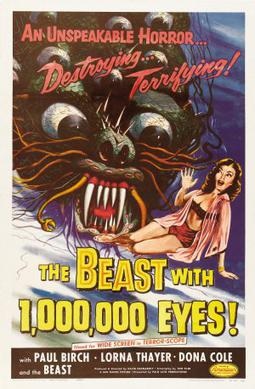
The 1955 film, The Beast With A Million Eyes, has three credited directors and reportedly, Roger Corman also stepped in and took over the direction as well, even though he received no screen credit. That’s a lot of directors for a relatively simple sci-fi/horror film. Reportedly, the problem with the directors came from the fact that The Beast With A Million Eyes was a non-union production and, after one day of production, the unions threatened to picket the set and basically shut down production unless the entire cast and crew signed up for the guilds. The unions eventually got their members and their money but all of the drama set production so far behind that Roger Corman stepped in, fired award-winning cinematographer Floyd Crosby, and proceeded to finish up the film himself.
As for the film itself, it takes place in the California countryside. Allan Kelly (Paul Birch, who was one of the first guys to get killed in The War of the Worlds and later played the dying alien in Corman’s Not Of This Earth) has no use for modern society and he has moved his family to a ranch in the California desert. His family is not particularly happy about this. His wife, Carol (Lorna Thayer), hates being isolated from the world. Their teenage daughter, Sandy (Dana Cole), is lonely and has a strained relationship with her mother. The only thing that makes Sandy happy is her boyfriend (played by Dick Sargent, who would later take over the role of Darin on Bewitched) and her dog. Perhaps the worst part of living out in the desert is that their handyman is a weirdo known as Him (Leonard Tarver).
Now, I should mention that, when I was growing up, my family moved around a lot. I spent a while living on a few farms that were owned by my aunts, uncles, and grandparents. Even after we finally settled down in Texas, I would still frequently visit their farms. I enjoyed visiting the farms, even though I’m pretty much a city girl at heart. I can say that The Beast With A Million Eyes definitely captured the isolated feel of country life. Watching the film, I could feel the heart of the unforgiving sun. I could feel the feeling of tall grass against my bare legs. And, at times, I could even remember the sound of roosters in the distance and crickets and grasshoppers chanting in the night.
Fortunately, my family was never bothered by aliens while we were on the farm. Unfortunately, the same cannot be said for the family at the center of The Beast With A Million Eyes. An alien decides to test its invasion plan on the family. First, the animals turn against the family, including the poor family dog. (This is probably not a film to watch if you feel about dogs the way that I feel about cats.) Then, the handyman suddenly turns against the family as well. The alien is taking over the minds of the living beings around, starting with animals and then moving on to humans. Can the family defeat the aliens? And will nature ever be the same?
Hey, I liked The Beast With A Million Eyes! Usually, when the film has a lot of directors, it results in a disjointed mess but The Beast With A Million Eyes actually had an interesting story and a lot of country atmosphere. As opposed to the stereotypically perfect 50s family, the family at the center of The Beast With A Million Eyes is believably dysfunctional but, in the end, they have to come together to save the humanity. I just hope the rest of the world would be willing to do the same.
4 Shots From 4 Films is just what it says it is, 4 shots from 4 of our favorite films. As opposed to the reviews and recaps that we usually post, 4 Shots From 4 Films is all about letting the visuals do the talking.
This October, I am going to be using our 4 Shots From 4 Films feature to pay tribute to some of my favorite horror directors, in alphabetical order! That’s right, we’re going from Argento to Zombie in one month!
Today’s director is one of the most influential figures in American film history, the one and only Roger Corman!
4 Shots From 4 Roger Corman Films
Not of this Earth (1957, dir by Roger Corman, DP: John Mescall)
The Little Shop of Horrors (1960, dir by Roger Corman, DP: Archie R. Dalzell)
X: The Man With The X-Ray Eyes (1963, dir by Roger Corman, DP: Floyd Crosby)
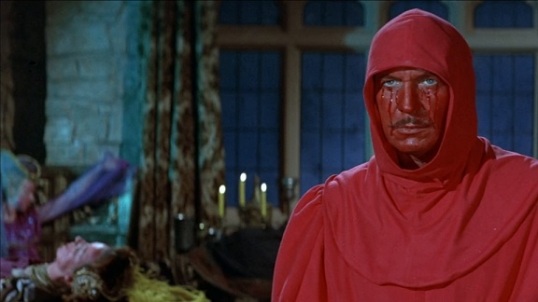
The Masque of Red Death (1964, dir by Roger Corman, DP: Nicolas Roeg)
As the saying goes, everyone has to start somewhere and, for Curtis Hanson, that somewhere was with 1973’s Sweet Kill.
Curtis Hanson, of course, would go on to become one of Hollywood’s top genre directors, directing films like The River Wild, Bad Influence, Wonder Boys, The Hand That Rocks The Cradle, 8 Mile, and the Oscar-nominated L.A. Confidential. But, in the early 70s, he was just one of the many recent film school grads who approached Roger Corman for a job.
Having previously worked on the script for the Corman-produced Dunwich Horror, Hanson approached Roger and told him that he had an idea for a Psycho-inspired movie about a female serial killer. Corman replied that he would help finance the film if Hanson made the killer into a man. Hanson did so but Corman still ended up only putting up a third of the film’s budget as opposed to the two/thirds that he had originally offered. Hanson ended up convincing his parents to take out a mortgage on their home to help finance the movie.
Hanson shot the film in 1971. Corman said that the film showed promise but that it needed more nudity and a better title if it was going to be successful. Corman re-edited the film and additional nude scenes were shot and inserted into the film. Despite this, Sweet Kill was a box office disappointment when it was originally released. Corman re-titled the film Kisses For Eddie but it didn’t help at the box office. Finally, the film was released under a third title, The Arousers. Despite a lurid ad campaign built around “the arousers,” the film once again failed at the box office. It wouldn’t be until years later, when Hanson started to achieve some mainstream success, that Sweet Kill would be rediscovered.
After all of the drama that went into post-production, it would be nice to be able to report that Sweet Kill was some sort of overlooked masterpiece but, to be honest, it’s pretty bad. The film stars Tab Hunter as Eddie Collins. When Eddie was a kid, he used to hide in the closet and watch as his mother lounged around her bedroom in lingerie. Now that Eddie is a grown-up and working as a high school gym coach, he is still so haunted by his mother that he’s impotent. As a result, Eddie spends his time breaking into apartments, stealing underwear, and having a prostitute dress up like his mother so that he can undress her while sobbing. After a chance meeting with a hippie girl leads to Eddie once again failing to get it up, he shoves the girl hard enough to kill her. The film implies that this act of violence leads to Eddie getting aroused for the first time and soon, Eddie is killing people and …. well, that’s pretty much the whole movie. There’s not really a plot, beyond Eddie looking confused and trying to keep his sympathetic neighbor from finding out that he’s a serial killer.
Sweet Kill has gotten some attention because of the casting of former teen idol Tab Hunter in the role of psycho Eddie. Tab Hunter has the right blonde look for Eddie, who is basically a homicidal beach bum, but otherwise, Hunter’s performance is fairly dull. Watching the film, it’s obvious that he wasn’t particularly comfortable with the role of Eddie and, as such, he sleepwalks through the performance. (Ironically, Eddie was based on Norman Bates, who was played by Hunter’s former partner, Anthony Perkins.) There are a few creepy moments where Hunter stares off into the distance with a blank look on his face but otherwise, this isn’t a particularly memorable performance nor is Sweet Kill a particularly interesting film.
That said, Curtis Hanson went on to have quite a career so, on that level, Sweet Kill‘s bland badness is inspiring. If the director of Sweet Kill could still go on to direct and produce some of the best films of the past 50 years, there’s hope for everyone looking to achieve their dreams. Don’t let one failure get you down.
The 1986 film, Sorority House Massacre, tells the story of two people who share a psychic bond.
Beth (Angela O’Neill) is a college student who can’t remember anything about her childhood and who was raised by her aunt. After her aunt dies, Beth joins a sorority and moves into their house. Almost from the minute that she arrives, Beth starts to have disturbing visions and dreams of a man with a knife and blood dripping from the ceiling. With most of the members of the sorority leaving for the Memorial Day weekend, Beth ends up staying with Linda (Wendy Martel), Sara (Pamela Ross), and Tracy (Nicole Rio). The other girls want to have a fun weekend but instead, they find themselves dealing with Beth and her glum attitude. Linda and Sara sincerely want to help. Tracy is a bit annoyed with the whole thing and I don’t blame her.
Meanwhile, a man named Bobby (John C. Russell) is a patient at a mental asylum. He’s been a patient ever since he was arrested for murdering almost his entire family. Bobby has been in a rage for the past few days, beating his head on the walls and attacking anyone who enters the room. Just as Beth finds herself having visions of Bobby, Bobby has visions of Beth. When Bobby does finally manage to escape from the hospital, the first thing he does is break into a hardware store and steal a hunting knife. (He uses the knife to take care of the owner of the store.) Then he steals a car and promptly drives off towards Los Angeles and the sorority house.
Sorority House Massacre was produced by Roger Corman and, just as he did with Slumber Party Massacre, he hired a woman to both direct and write the film. As such, while Sorority House Massacre has all of the usual scenes of sorority girls taking showers, trying on clothes, and running around in states of undress, it’s still never as misogynistic as some other slasher films. Beth, Sara, Linda, and Tracy all come across as being fully-rounded characters and the viewer doesn’t want anything bad to happen to any of them. If anything, in this film, it’s the various boyfriends who are portrayed as being somewhat disposable and easily victimized. Certainly, not a single one of the guys proves to be particularly useful once Bobby shows up at the sorority house and starts his massacre.
Why is Bobby fixated on the sorority house and Beth in particular? Director Carol Frank does a good job of portraying the killer’s mental state, with a good deal of the film’s scenes being shot from his own point of view. (Perhaps the scariest moments are not the ones featuring blood and knives but the ones in which the killer moves from location to location and we see, through his point of view, just how relentless he is.) Frank also takes us straight into Beth’s mind, showing us her vivid hallucinations as they happen and the end result is that Sorority House Massacre often has an unexpectedly surreal feel to it. It’s a low-budget slasher film that plays out like a filmed nightmare and it sticks with you, even after the end credits.
4 (or more) Shots From 4 (or more) Films is just what it says it is, 4 (or more) shots from 4 (or more) of our favorite films. As opposed to the reviews and recaps that we usually post, 4 (or more) Shots From 4 (or more) Films lets the visuals do the talking.
Today, we wish a happy 97th birthday to the legendary filmmaker, Roger Corman! And that means that it’s time for….
4 Shots From 4 Roger Corman Films
It Conquered The World (1956, dir by Roger Corman, DP: Fred E. West)
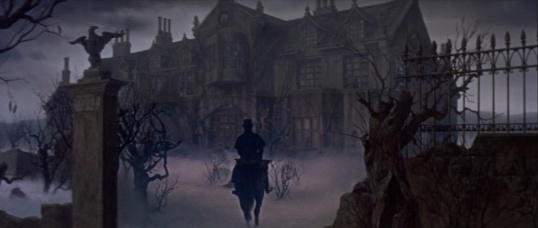
House of Usher (1960, dir by Roger Corman, DP: Floyd Crosby)
The Masque of the Red Death (1964, dir by Roger Corman, DP: Nicolas Roeg)
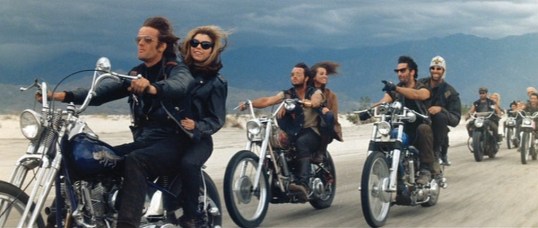
The Wild Angels (1966, dir by Roger Corman, DP: Richard Moore)
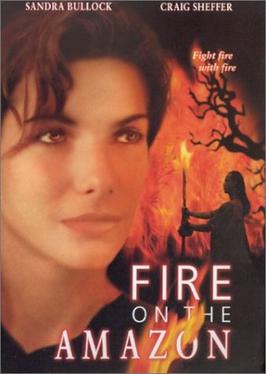
Released in 1993 and produced by none other than Roger Corman, Fire on the Amazon takes place in Bolivia. Despite the protests of the indigenous population and the environmental activists who have flown down to support them, the Rain Forest is being destroyed by corporations, cattle ranchers, and military units. After an activist named Rafael Santos (Eduardo Cesti) is assassinated, photojournalist R.J. O’Brien (Craig Sheffer) comes down to document the accused assassin’s trial.
R.J. tries to remain detached from the injustices that he sees around him. Much like Robert Forster in Medium Cool, R.J. claims to be an observer and not a participant. But then he meets an environmentalist named Alyssa Rothman (a pre-stardom Sandra Bullock) and he comes to realize that the Bolivian government is covering up the details of Santos’s death. R.J. and Alyssa go deep into the Rain Forest, searching for evidence that can prove that the military was behind the assassination. The military, of course, is determined to keep them from doing that.
Fire on the Amazon is a Roger Corman films with a social conscience. It features several speeches about the importance of the Rain Forest and it ends with a title card informing viewers of how much of the Rain Forest was destroyed on a daily basis in 1993. Whatever else one might have to say about the films that Corman has either produced or directed, he has always seemed very sincere when it comes to his messages. That said, Corman has also always been very sincere in his belief that movies should make money and Fire on the Amazon doesn’t allow its environmental message to get in the way of the sex and violence that most of the film’s viewers were probably looking for. The film actually feels a bit like a companion piece to The Forbidden Dance. Yes, saving the Rain Forest is importance but so is doing the Lambada.
Today, if Fire on the Amazon is known for anything, it’s probably for the rather random sex scene featuring Sandra Bullock and Craig Sheffer. To be honest, while the scene is graphic and lengthy, the only thing that sets it apart from other low-budget sex scenes is the fact that it features a future Oscar winner. A huge problem with the scene is that there are next to no romantic sparks between Bullock and Craig Sheffer. Indeed, Sheffer gives such a lifeless performance that, at one point, it appears that he’s actually fallen asleep during the big sex scene. Fortunately, Sheffer sticks out his tongue long enough to let us know that he’s still alive.
Make no mistake about it, while Sandra Bullock may be the name that’s highlighted whenever this film shows up on a streaming site, Craig Sheffer is the star of the film. The majority of the film focuses on him as he wanders around Bolivia and whines about having to do his job. Though he’s certainly not helped by the film’s script, Sheffer gives a performance that alternates between sleep-walking and histrionic shouting. The problem is that the only time Sheffer shows any emotion is when his character has been inconvenienced. He can watch the police beat up a man without barely lifting an eyebrow but, as soon as he’s arrested and put in a cell, the audience is subjected to over a minute of Sheffer shrilly screaming, “Call the embassy!”
It would be nice to say that Sandra Bullock gives a performance that transcends the material but, unfortunately, she’s miscast as a somber activist and, worst of all, she gets stuck with the film’s worst line when she tells Sheffer to write about what “you feel and not what you see.” It seems like better advice would be to do both but what do I know? I mean, as of right now, it seems like people focusing on what they feel as opposed to what they see has led to a lot of problems but maybe the 90s were a simpler time.
Just a year after this film was released, Sandra Bullock would star in Speedand become a star. This meant that Bullock would no longer be filming sex scenes in Roger Corman-produced eco-thrillers. It also meant that Fire on the Amazon would forever be promoted on DVD and Blu-ray as being a “Sandra Bullock film” while Craig Sheffer would often go unmentioned. (In Sheffer’s defense, he’s still acting and has given many performances that are a hundred times better than his work in Fire on the Amazon.) If you want to see a good film about Sandra Bullock in the jungle, check out The Lost City. If you want to see an entertaining environmentally-themed thriller from director Luis Llosa, check out Anaconda. Worthy intentions aside, Fire on the Amazon is best avoided.
Believe it or not, he’s Robert Vaughn. Vaughn, who would later go on to appear in The Magnificent Seven, The Man From UNCLE, Bullitt,The Towering Inferno, and Hustle, was 26 years old when he played a nameless caveman in Roger Corman’s 1958 film, Teenage Caveman. At the age of 26, Vaughn looked like he was closer to 35 and he certainly didn’t resemble a teenager. Despite wearing a loin cloth, he also didn’t appear to be a caveman. If he was a caveman than he was certainly a well-groomed caveman and perhaps the only caveman to understand how to use hairspray. Seriously, his hair is perfect in this film.
As for the film itself, it’s about a primitive tribe of people who live in a rocky wasteland. However, just across the river, there’s a land that’s full of plants and animals. It would obviously be a much better place to live and Vaughn’s teenage caveman is totally annoyed that the older folks on the tribe refuse to cross the river. They claim that a monster lives in the river and that it will kill anyone who tries to cross. Being a rebellious teenager, Vaughn decides to cross the river anyway. He convinces a group of friends to go with him. When they reach the river, they meet and fight the monster and they also discover that the monster was doing more than just guarding the river. It all leads to a plot twist that feels as if it was added at the last possible second.
In a later interview, Robert Vaughn referred to Teenage Caveman as being the worst film in which he ever appeared. He went on to suggest that it was the worst film ever made. Those are bold words coming from someone who appeared in as many bad films as Robert Vaughn did. That said, I do think that Vaughn was being a bit too hard on Teenage Caveman. For what it is — an extremely low-budget film that barely runs over an hour — Teenage Caveman is entertaining if you’re in the right mood for it. It’s hard not to smile at the cavepeople, with their modern haircuts and their very American accents. As well, the film features the same stock footage of dinosaurs fighting that appeared in countless other B-movies of the time and, again, it’s hard not to smile at the actors valiantly trying to pretend that there are dinosaurs fighting just a few feet away from them. And while that final plot twist may come out of nowhere, it’s just random enough to be interesting. Worst film of all time? With all respect to the teenage caveman, I have to disagree. It’s a B-movie and, if you enjoy B-movies, you’ll enjoy this one. And let’s give some credit to Robert Vaughn. He gives an earnest performance, even though he later said that he felt foolish every time he stepped out on the set. Add to that, his hair is perfect.
(I originally shared this film back in 2011 and 2019 — can you believe we’ve been doing this for that long? — but the YouTube vid was taken down both times! So, I’m resharing it today!)
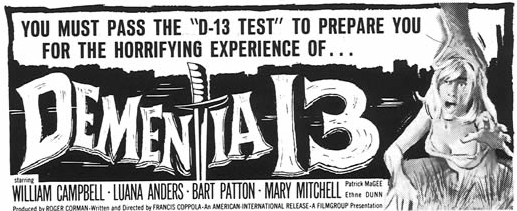
For today’s excursion into the world of public domain horror, I offer up the film debut of Francis Ford Coppola. Before Coppola directed the Godfather and Apocalypse Now, he directed a low-budget, black-and-white thriller that was called Dementia 13. (Though, in a sign of things to come, producer Roger Corman and Coppola ended up disagreeing on the film’s final cut and Corman reportedly brought in director Jack Hill to film and, in some cases, re-film additional scenes.)
Regardless of whether the credit should go to Coppola, Corman, or Hill, Dementia 13 is a brutally effective little film that is full of moody photography and which clearly served as an influence on the slasher films that would follow it in the future. Speaking of influence,Dementia 13 itself is obviously influenced by the Italian giallo films that, in 1963, were just now starting to make their way into the drive-ins and grindhouses of America.
In the cast, keep an eye out for Patrick Magee, who later appeared as Mr. Alexander in A Clockwork Orange as well as giving a memorable performance in Lucio Fulci’s The Black Cat. Luana Anders, who plays the duplicitous wife in this film, showed up in just about every other exploitation film made in the 60s and yes, the scene where she’s swimming freaks me out to no end.






 Through the Shattered Lens