Smokey Bites The Dust (1981, directed by Charles B. Griffith)


Sheriff Hugh “Smokey” Turner (Walter Barnes) of Cyco County, Arkansas is determined to capture teenage car thief and prankster, Roscoe Wilton (Jimmy McNichol).  Roscoe is determined to disrupt the high school homecoming dance by abducting the homecoming queen, Peggy Sue (Janet Julian).  Peggy Sue is, at first, determined to escape from Roscoe but changes her mind as they flee from her father, who just happens to be Sheriff Turner.

From producer Roger Corman, Smokey Bites The Dust is an 88-minute car chase film where the most spectacular getaways and crashes are lifted from other Roger Corman productions.  Eagle-eyed viewers will spot footage from Eat My Dust, Grand Theft Auto, and Moving Violations.  In order to explain why the cars keep changing from scene to scene, the chase moves from county-to-county where both Roscoe and Sherriff Turner inevitably end up ditching (or crashing) their old car and then stealing a new vehicle to continue the pursuit.

That’s not much of a plot so the run time is padded out with several subplots.  A local moonshiner tries to sell his special brew to a group of Arabs.  Peggy Sue’s boyfriend, Kenny (William Forsyth, in one of his first films), joins in the chase.  Dick Miller flies around in a helicopter and also gets involved in the chase.  None of it makes any sense and none of it is particularly amusing but Roger Corman undoubtedly made a lot of money pushing this thing into Southern drive-ins and letting people assume it was some sort of a sequel to Smokey and the Bandit.

Most of the acting is pretty bad.  When it comes to being an incompetent sheriff, Walter Barnes is no Jackie Gleason.  Jimmy McNichol comes across as being seriously disturbed.  Of the main cast, Janet Julian is alone in giving an appealing and naturalistic performance as Peggy Sue.  While Julian (who has since retired from acting) never became the star she deserved to be, she is remembered for her later turn as Christopher Walken’s lawyer and girlfriend in 1990’s King of New York.

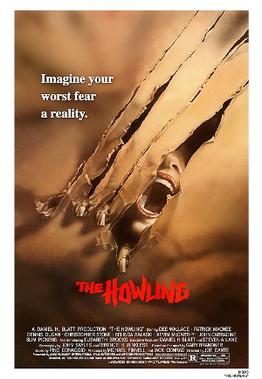
Horror Film Review: The Howling (dir by Joe Dante)


The 1981 film, The Howling, takes place at The Colony.

The Colony is a lovely place, a nice resort out in the middle of the countryside.  It’s a place that celebrity therapist George Waggener (Patrick Macnee) sends his clients so that they can recover from trauma.  It’s a bit of a grown-up version of the ranch to which Dr. Phil used to send juvenile delinquents.  Of course, the Colony is full of adults and they’re an eccentric bunch.  I mean, one of them — named Erle Kenton — is actually played by John Carradine!  That’s just how eccentric the place is.  Sheriff Sam Newfield (Slim Pickens) keeps an eye on the place but everyone knows that there’s nothing to worry about when it comes to The Colony.  Dr. Waggner does good work.

Karen White (Dee Wallace) is a Los Angeles news anchor who was held hostage by a serial killer named Eddie Quist (Robert Picardo).  While she was with Eddie, she was forced to not only watch videos of Eddie’s crimes but she also saw something happen with Eddie that terrified her to such an extent that she has blocked it from her mind.  Karen was rescued by the police but she is haunted by nightmares.  Dr. Waggner arranges for Karen and her husband, Bill Neill (Christopher Stone, who was married to Dee Wallace when they co-starred in this film), to spend some time at the Colony.

Bill loves the Colony, especially after he attracts the eye of Marsha (Elisabeth Brooks), the resort’s resident seductress.  Karen, however, is less enamored of the place.  The Colony feels off to her and she’s not happy about the howling in the distance or the fact that Bill has suddenly started to grow distant from her.  Could it be that The Colony is actually crawling with werewolves and that Bill has become one of them?  (It’s totally possible and, to The Howling‘s credit, it doesn’t waste any time letting us know that.)  Karen’s friend, Terry Fisher (Belinda Balanski), and her boyfriend, Chris Halloran (Dennis Dugan), do some research of their own into Eddie Quist, The Colony, and whether or not werewolves exists and they meet a helpful bookstore owner named Walter Paisley (Dick Miller).

To understand the approach that director Joe Dante and screenwriter John Sayles take to The Howling, one needs to only consider the names of some of the characters.  George Waggner.  Bill Neill. Terry (which can be short for Terence) Fisher.  Fred (or is that Freddie) Francis.  Erle Kenton.  Sam Newfield.  Jerry Warren.  All of these characters are named after horror film directors.  This is the type of werewolf film where Chris Halloran has a copy of The Three Little Pigs sitting on his desk.  Veteran actors like Kevin McCarthy, John Carradine, Slim Pickens, and Kenneth Tobey show up in small roles.  Roger Corman mainstay Dick Miller plays yet another character named Walter Paisley and he kicks Forrest J. Ackerman out of his bookstore.  Roger Corman himself plays a man making a phone call.  After a werewolf is shot on live TV, the program immediately cuts to a dog food commercial and we see a blank-faced child telling his unconcerned parents that someone just turned into a wolf.  The Howling was made by people who obviously love B-horror and that love is present in every frame of the film.

Like Dante’s Piranha, The Howling is a film with a sense of humor but it’s not a comedy.  The werewolves are still impressive, even forty-two years after the film was first released.  The character of Eddie Quist (“I’m going to give you a piece of my mind”) is a terrifying monster and the sight of his signature smiley face will fill you with dread, especially when it shows up in a place where it really shouldn’t be.  The film cynically ends on a note of noble sacrifice that will apparently not make much difference, with the suggestion being that human beings are either too distracted or too jaded to realize that there are monsters among them.  The Howling is a fast-paced and well-directed homage to B-horror and it’s still terrifically entertaining.

Horror Film Review: The Raven (dir by Roger Corman)


“Shall I ever see the rare and radiant Lenore again?” — Dr. Erasmus Craven (Vincent Prince)

“How they Hell should I know?” — Dr. Adolphus Bedlo (Peter Lorre)

This exchange comes from Roger Corman’s 1963 film, The Raven, and it pretty much epitomizes the film.  Very loosely based on the poem by Edgar Allan Poe, The Raven was one of the many Poe adaptations that Corman did with Vincent Price.  As opposed to the other films in Corman’s Poe cycle, The Raven was a flat-out comedy, one that parodied the other films in the cycle.  Reportedly, Peter Lorre improvised his response to Vincent Price’s question about Lenore.  In fact, Lorre improvised a good deal of his performance and his jokes sometimes even took Corman by surprise.  As a result and despite the fact that Richard Matheson did write a script for the film, The Raven is one of those films that feels like it was made up while the camera was rolling.

The Raven is a film about three sorcerers who are always fighting and arguing with each other.  Dr. Erasmus Craven (Vincent Price) spends his time mourning the late Lenore.  The evil Dr. Scarabus (a frail-looking Boris Karloff) has his own castle where he lives with the ghost of the late Lenore (Hazel Court).  Dr. Adolphus Bedlo (Peter Lorre) is a sarcastic ne’er-do-well who saw Lenore in Scarabus’s castle and was transformed into a talking raven as a result.

In raven form, Dr. Bedlo flies over to Craven’s castle and convinces Craven to transform him back into human form.  After informing Craven that Scarabus has Lenore’s ghost in his castle, the heart-broken Craven decides to head over to Scarabus’s castle and get some answers.  Accompanying the group is Craven’s daughter, Estelle (Olive Sturgess) and Bedlo’s son, Rexford (Jack Nicholson, looking somewhat lost in the role of a boring young man).

At the castle, Scarabus puts on an act of being a friendly and gracious host but the opposite soon turns out to be true.  In fact, the entire castle is full of secrets and it quickly turns out that hardly anyone — with the exception of Estelle and Rexford — are who they actually claim to be.  It leads to a battle in magic between Craven and Scarabus.  I nearly described their battle as being “epic” but that’s probably not the right world.  It’s epic by the standards of Roger Corman but actually, the big battle is just as jokey as the rest of the film.

The Raven is definitely not a film that’s meant to be taken seriously.  One gets the feeling that Corman knew that the presence of Price, Karloff, and Lorre would make the film a success no matter what the film was like so he decided to have some fun with it.  (Price and definitely Lorre appear to have been in on the joke while Karloff was perhaps a bit less so.)  To be honest, the film’s only earnest moments come courtesy of Oliva Sturgess and Jack Nicholson but, because Nicholson is Nicholson, you watch those earnest moments waiting for Rexford to arch an eyebrow or flash that devilish grin.  Unfortunately, he doesn’t.  Jack is pretty boring here.

The Raven, if we’re going to be honest, is probably too jokey for its own good but it’s still hard to resist the charm of Price, Lorre, and Karloff.  The film is a chance to see three horror icons acting opposite each other and, as a result, it’s a fun film for horror fans.  Vincent Price breaks the fourth wall at the end of the film and it’s hard not to love it.

Horror Scenes That I Love: Vincent Price in Masque of the Red Death


Today’s horror star is the great Vincent Price.

Born in Missouri and blessed with both an aristocratic profile and a resonant voice, Vincent Price started his career as a romantic leading man before eventually before finding more success a character actor.  Starting in the late 40s and continuing until his death in 1993, Price was a beloved horror icon, bringing his witty presence to several different horror films.

Price always cites Roger Corman’s Edgar Allan Poe adaptations as being amongst his favorite of the horror films in which he appeared.  In this scene from 1964’s The Masque of the Red Death, Vincent Price delivers a monologue on the meaning of terror as only he could.

Horror Scenes That I Love: Dick Miller In The Howling


A true scene stealer, the character actor Dick Miller was a Navy veteran who went to City College of New York, Columbia University, and New York University and eventually earned a Phd in psychology.  Even as Miller was earning his degree, he was already appearing on stage.  In 1952, he moved to California to pursue a career as a writer and ended up becoming one of the most beloved members of Roger Corman’s stock company.  Famously, in 1952’s Apache Woman, he played both a Native American and the townsperson who shot him.

The many directors who started their careers under Roger Corman continued to cast Dick Miller in their own films, keeping Miller busy as a character actor.  Miller worked with everyone from Martin Scorsese to Joe Dante to James Cameron to Steven Spielberg to Jim Wynorski.  Miller often played characters named Walter Paisley, a reference to his first starring role in Corman’s A Bucket of Blood.

In this scene from 1981’s The Howling, Dick Miller lets us know what’s truly going on with the werewolves.

Horror Film Review: Monster From The Ocean Floor (dir by Wyott Ordung)


Are you ready to go in the water?

That’s the question asked by the 1954 film, Monster From The Ocean Floor.  Taking place in a Mexican fishing village and artist’s colony, Monster From The Ocean Floor features a lot of underwater action.  It also features a monster who lives on the ocean floor and who has been terrorizing fisherman, swimmers, and divers.  Unfortunately, despite being featured in the title, there’s not really much of the Monster in this film.  It takes a while for the Monster to even be acknowledged and, when the Monster finally does show up, it’s over all too quickly.  I guess we shouldn’t be too surprised by any of that, seeing as how this is a 1950s Roger Corman production that was apparently made on a budget of $20,000.  Producer Corman and director Wyott Ordung had to choose between devoting screen time to a potentially expensive monster or to a one-man submarine that they could use for free as long as they listed the submarine’s manufacturer in the opening and end credits.  They went with the submarine.

In fact, the submarine was apparently the main reason that Corman decided to make this film, his first as a producer.  He read an article about it in the Los Angeles Times and decided that it sounded like the perfect thing to feature in a movie.  In what would become typical Corman fashion, Corman got the submarine first and then built a movie around it.

As for the movie, it features Stuart Wade as Steve Dunning, the hunky Marine biologist who loves the ocean and frequently pilots the submarine.  When Steve and his submarine first emerge from the ocean, they briefly frighten Julie Blair (Anne Kimbell), an artist who is at the village in search for inspiration.  Later, when Julie actually does briefly see the monster rising from the ocean, Steve and Dr. Baldwin (Dick Pinner) theorize that the Monster From The Ocean Floor is actually a prehistoric creature that was in a Cthulhu-like slumber until it was reawakened by atomic bomb testing on the nearby Bikini Islands.

The people at the village don’t really care where the Monster came from or what the Monster might mean for the cause of science.  They just want the Monster go away so that they continue their lives in peace.  Pablo (played by the film’s director, Wyott Ordung) and Tula (Inez Palange) think that the solution might be a human sacrifice and they make plans to summon a shark to eat the diving Julie.  Agck!

As I mentioned earlier, this film was Roger Corman’s debut as a producer.  Corman was only 25 at the time and he didn’t direct the film but still, everything about Monster From The Ocean Floor — from the low budget to the casting of Jonathan Haze (and Corman himself!) in a small role — easily identifies this as being a Corman film.  It has its fun moments and, for a 1954 film, Anne Kimbell’s Julie Blair is a refreshingly independent and liberated character.  Unfortunately, the overall film is a bit slow and it does seem to take forever for the monster to actually show up.

Ultimately, Monster From The Ocean Floor‘s main importance is as a piece of B-movie history.  With this movie, the glorious filmmaking career of Roger Corman began.

Horror on the Lens: The Terror (dir by Roger Corman, Francis Ford Coppola, Jack Hill, Monte Hellman, Dennis Jakob, and Jack Nicholson)


Have you ever woken up and thought to yourself, “I’d love to see a movie where a youngish Jack Nicholson played a French soldier who, while searching for a mysterious woman, comes across a castle that’s inhabited by both Dick Miller and Boris Karloff?”

Of course you have!  Who hasn’t?

Well, fortunately, it’s YouTube to the rescue.  In Roger Corman’s 1963 film The Terror, Jack Nicholson is the least believable 19th century French soldier ever.  However, it’s still interesting to watch him before he became a cinematic icon.  (Judging from his performance here and in Cry Baby Killer, Jack was not a natural-born actor.)  Boris Karloff is, as usual, great and familiar Corman actor Dick Miller gets a much larger role than usual.  Pay attention to the actress playing the mysterious woman.  That’s Sandra Knight who, at the time of filming, was married to Jack Nicholson.

Reportedly, The Terror was one of those films that Corman made because he still had the sets from his much more acclaimed film version of The Raven.  The script was never finished, the story was made up as filming moved alone, and no less than five directors shot different parts of this 81 minute movie.  Among the directors: Roger Corman, Jack Hill, Monte Hellman, Francis Ford Coppola, and even Jack Nicholson himself!  Perhaps not surprisingly, the final film is a total mess but it does have some historical value.

(In typical Corman fashion, scenes from The Terror were later used in the 1968 film, Targets.)

Check out The Terror below!

Horror on the Lens: Dementia 13 (dir by Francis Ford Coppola)


(I originally shared this film back in 2011, 2019, and 2022 — can you believe we’ve been doing this for that long? — but the YouTube upload keeps getting taken down!  So, I’m resharing it today!)

For today’s excursion into the world of public domain horror, I offer up the film debut of Francis Ford Coppola.  Before Coppola directed the Godfather and Apocalypse Now, he directed a low-budget, black-and-white thriller that was called Dementia 13.  In a possible sign of things to come, producer Roger Corman and Coppola ended up disagreeing on the film’s final cut and Corman reportedly brought in director Jack Hill to film and, in some cases, re-film additional scenes.

Regardless of whether the credit should go to Coppola, Corman, or Hill, Dementia 13 is a brutally effective little film that is full of moody photography and which clearly served as an influence on the slasher films that would follow it in the future.  Speaking of influence, Dementia 13 itself is obviously influenced by the Italian giallo films that, in 1963, were just now starting to make their way into the drive-ins and grindhouses of America.

Speaking of giallo films, keep an eye out for Patrick Magee, who gave a memorable performance in Lucio Fulci’s The Black Cat.  Luana Anders, who plays the duplicitous wife in this film, showed up in just about every other exploitation film made in the 60s and yes, the scene where she’s swimming freaks me out to no end.  Other films featuring Luana Anders include Night Tide and Easy Rider, in which she played one of the hippies who unsuccessfully enticed Peter Fonda and Dennis Hopper to stay at the commune.

As for Francis Ford Coppola, his career has had its up and downs but he’s a beloved figured on the pop cultural landscape and a director whose best films continue to inspire and influence.  He is currently filming Megalopolis.

Horror Scenes I Love: Peter Lorre in Tales of Terror


Born in what is now Slovakia, Peter Lorre began his acting career in Europe, appearing on the stage and making quite an impression when he starred in Fritz Lang’s M.  When the Nazis came to power, Lorre was one of the many film artists who left Germany.  At first, he moved to France but, in 1934, he set sail for the United States and continued his career in Hollywood.  A popular character actor, Lorre appeared in such classic films as The Man Who Knew Too Much, The Maltese Falcon, Mad Love, Arsenic and Old Lace and Casablanca.  Though his role in Casablanca was small, he still played a key role when he gave Rick the letters of transit.

He also appeared in several horror films, often opposite his good friend Vincent Price and Boris Karloff.  In this scene from 1962’s Tales of Terror, Lorre and Price challenge each other to a wine-drinking contest.


Horror on the Lens: The Little Shop of Horrors (dir by Roger Corman)


(It’s tradition here at the Lens that, every October, we watch the original Little Shop of Horrors.  And always, I start things off by telling this story…)

Enter singing.

Little Shop…Little Shop of Horrors…Little Shop…Little Shop of Terrors…

Hi!  Good morning and Happy October 24th!  For today’s plunge into the world of public domain horror films, I’d like to present you with a true classic.  From 1960, it’s the original Little Shop of Horrors!

When I was 19 years old, I was in a community theater production of the musical Little Shop of Horrors.  Though I think I would have made the perfect Audrey, everybody always snickered whenever I sang so I ended up as a part of “the ensemble.”  Being in the ensemble basically meant that I spent a lot of time dancing and showing off lots of cleavage.  And you know what?  The girl who did play Audrey was screechy, off-key, and annoying and after every show, all the old people in the audience always came back stage and ignored her and went straight over to me.  So there.

Anyway, during rehearsals, our director thought it would be so funny if we all watched the original film.  Now, I’m sorry to say, much like just about everyone else in the cast, this was my first exposure to the original and I even had to be told that the masochistic dentist patient was being played by Jack Nicholson.  However, I’m also very proud to say that — out of that entire cast — I’m the only one who understood that the zero-budget film I was watching was actually better than the big spectacle we were attempting to perform on stage.  Certainly, I understood the film better than that screechy little thing that was playing Audrey.

The first Little Shop of Horrors certainly isn’t scary and there’s nobody singing about somewhere that’s green (I always tear up when I hear that song, by the way).  However, it is a very, very funny film with the just the right amount of a dark streak to make it perfect Halloween viewing.

So, if you have 72 minutes to kill, check out the original and the best Little Shop of Horrors