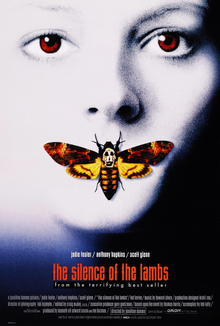
Lisa Reviews An Oscar Winner: The Silence of the Lambs (dir by Jonathan Demme)


Oh, The Silence of the Lambs, I have such mixed feelings about you.

On the one hand, I’m a horror fan and Silence of the Lambs is a very important film in the history of horror.  Back in 1992, it was the first horror film to win the Academy Award for Best Picture!  It even made history by winning all of the big “five” awards — Picture, Director, Actor, Actress, and Adapted Screenplay!  It was the first film since One Flew Over The Cuckoo’s Nest and It Happened One Night to pull that off!

Beyond that, it’s one of the most influential films ever made.  Every erudite serial killer owes a debt to Anthony Hopkins’s performance as Hannibal Lecter.  Every competent but untested and unappreciated female FBI agent owes a debt to Jodie Foster’s performance as Clarice Starling.  Even though the whole criminal profiler craze probably owes more to Manhunter (a film to which Silence of the Lambs is a sequel, though that often seems to go unacknowledged) than to anything else, this Oscar winner still definitely played a part.  I mean, how many people watched Manhunter for the first time, specifically because Lecter mentioned the events in that earlier film in Silence of the Lambs?

Plus, this won an Oscar for Jonathan Demme, one of my favorite directors!  And while I’m sure Jodie Foster would have gone on to have a strong career regardless of whether she had played Clarice Starling or not, it’s generally acknowledged that Silence of the Lambs revitalized the career of Anthony Hopkins.  So for that, we should all be thankful.

And yet, it can be strange to watch Silence of the Lambs today.  All of the imitations (not to mention some ill-thought sequels and prequels) have lessened its bite.  I can only imagine how it must have freaked out audiences when it was first released but I have to admit that I was slightly disappointed the first time that I watched the film.  Looking back, I can see that disappointment was due to having been told that it were one of the scariest movies of all time but, because, I had seen a countless number of imitations, parodies, and homages, I felt as if I had already watched the film.  So, I wasn’t shocked when Lecter turned out to be ruthlessly manipulative and dangerously charismatic.  Nor was I shocked when he managed to escape and poor Charles Napier ended up strung up in that cage.  I’m sure that audiences in 1991 were freaked out, though.

Actually, as good as Foster and Hopkins and Scott Glenn are, I think the best performance in the film comes from Ted Levine, playing Buffalo Bill.  Seriously, Levine’s performance still freaks me out.  It’s the voice and the way he says, “Precious.”  Levine’s performance, I found to be a hundred times more frightening than Anthony Hopkins’s and I think it’s due to the fact that Hannibal Lecter was clearly an author’s invention while Levin’s Buffalo Bill came across like he might very will be hiding in an alley somewhere, waiting for one of your friends to walk by. (Interestingly enough, I had the same reaction when I first saw Manhunter.  Brian Cox did a good job as Lecter but he still came across as a bit cartoonish.  Meanwhile, Tom Noonan was absolutely terrifying.)  Levine has subsequently gone on to play a lot of nice guy roles.  He was a detective on Monk, for instance.  Good for him.  I’m glad to see he was able to escape being typecast.  Admittedly, I do kinda wonder how many serial killer roles he had to turn down immediately after the release of The Silence Of The Lambs.

Still, it’s a good film.  Time may have lessened it’s power but The Silence of the Lambs is still an effective and well-directed thriller.  It’s impossible not to cheer for Clarice.  It’s impossible not to smile at the fun that Anthony Hopkins seems to be having in the role of Lecter.  Jonathan Demme creates a world of shadows and darkness and still adds enough little quirks to keep things interesting.  (I especially liked Lecter watching a stand-up special in his cell.)  It’s the little details that makes the world of The Silence of the Lambs feel lived in, like Clarice’s nervous laugh as she gives a civilian instructions on what to do in case she accidentally gets trapped in a storage locker.  Even the film’s final one liner will make you smile, even though it’s the type of thing that every film seemed to feel the need to do nowadays.  It’s still a good movie, even if it no longer feels as fresh as it once may have.

Horror on the Lens: Not of this Earth (dir by Roger Corman)


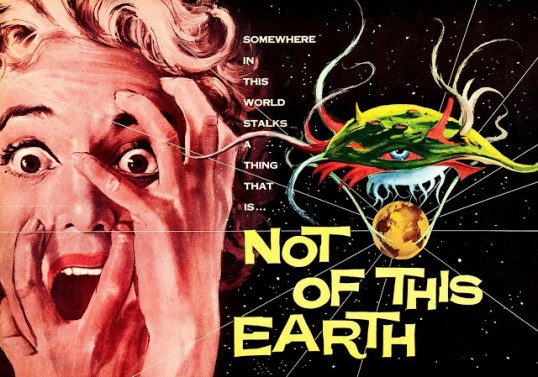
Today’s horror on the lens is the 1957 Roger Corman-directed, sci-fi “epic,” Not of this Earth.

Paul Johnson (Paul Birch) may seems like a strange character, with his stilted way of speaking and his sunglasses and his overdramatic reaction to any and all loud noises.  Paul could us be an eccentric.  Or, he could be …. NOT OF THIS EARTH!  Actually, his habit of draining people of their blood and sending weird, umbrella-like creatures out to attack his enemies would seem to suggest that the latter is probably true.

Listen, it’s not easy being a blood-sucking alien.  I mean, sure, there’s always seems to be people stupid enough to show up at your mansion so that you can drain their bodies.  Paul is lucky that he doesn’t exactly seem to be surrounded by brain surgeons.  But sometimes, things happen.  For instance, someone might show up from your home planet and demand an immediate transfusion!  What is an alien to do?

Watch this low-budget but undeniably entertaining film to find out!  And be sure to especially keep an eye out for the great Dick Miller, who reportedly improvised his role as a vacuum cleaner salesman.  (Before going into acting, Miller actually did sell vacuum cleaners door-to-door.)

Enjoy!

Horror on the Lens: The Terror (dir by Roger Corman)


Have you ever woken up and thought to yourself, “I’d love to see a movie where a youngish Jack Nicholson played a French soldier who, while searching for a mysterious woman, comes across a castle that’s inhabited by both Dick Miller and Boris Karloff?”

Of course you have!  Who hasn’t?

Well, fortunately, it’s YouTube to the rescue.  In Roger Corman’s 1963 film The Terror, Jack Nicholson is the least believable 19th century French soldier ever.  However, it’s still interesting to watch him before he became a cinematic icon.  (Judging from his performance here and in Cry Baby Killer, Jack was not a natural-born actor.)  Boris Karloff is, as usual, great and familiar Corman actor Dick Miller gets a much larger role than usual.  Pay attention to the actress playing the mysterious woman.  That’s Sandra Knight who, at the time of filming, was married to Jack Nicholson.

Reportedly, The Terror was one of those films that Corman made because he still had the sets from his much more acclaimed film version of The Raven.  The script was never finished, the story was made up as filming moved alone, and no less than five directors shot different parts of this 81 minute movie.  Among the directors: Roger Corman, Jack Hill, Monte Hellman, Francis Ford Coppola, and even Jack Nicholson himself!  Perhaps not surprisingly, the final film is a total mess but it does have some historical value.

(In typical Corman fashion, scenes from The Terror were later used in the 1968 film, Targets.)

Check out The Terror below!

Horror on the Lens: Dementia 13 (dir by Francis Ford Coppola)


(I originally shared this film back in 2011 — can you believe we’ve been doing this for that long? — but the YouTube vid was taken down.  So, I’m resharing it today!)

For today’s excursion into the world of public domain horror, I offer up the film debut of Francis Ford Coppola.  Before Coppola directed the Godfathers and Apocalypse Now, he directed a low-budget, black-and-white thriller that was called Dementia 13.  (Though, in a sign of things to come, producer Roger Corman and Coppola ended up disagreeing on the film’s final cut and Corman reportedly brought in director Jack Hill to film and, in some cases, re-film additional scenes.)

Regardless of whether the credit should go to Coppola, Corman, or Hill, Dementia 13 is a brutally effective little film that is full of moody photography and which clearly served as an influence on the slasher films that would follow it in the future.  Speaking of influence,Dementia 13 itself is obviously influenced by the Italian giallo films that, in 1963, were just now starting to make their way into the drive-ins and grindhouses of America.

In the cast, keep an eye out for Patrick Magee, who later appeared as Mr. Alexander in A Clockwork Orange as well as giving a memorable performance in Lucio Fulci’s The Black Cat.  Luana Anders, who plays the duplicitous wife in this film, showed up in just about every other exploitation film made in the 60s and yes, the scene where she’s swimming freaks me out to no end.

(One final note: I just love the title Dementia 13.  Seriously, is that a great one or what?)

Horror on the Lens: The Little Shop of Horrors (dir by Roger Corman)


(It’s tradition here at the Lens that, every October, we watch the original Little Shop of Horrors.  And always, I start things off by telling this story…)

Enter singing.

Little Shop…Little Shop of Horrors…Little Shop…Little Shop of Terrors…

Hi!  Good morning and Happy October the 2nd!  For today’s plunge into the world of public domain horror films, I’d like to present you with a true classic.  From 1960, it’s the original Little Shop of Horrors!

When I was 19 years old, I was in a community theater production of the musical Little Shop of Horrors.  Though I think I would have made the perfect Audrey, everybody always snickered whenever I sang so I ended up as a part of “the ensemble.”  Being in the ensemble basically meant that I spent a lot of time dancing and showing off lots of cleavage.  And you know what?  The girl who did play Audrey was screechy, off-key, and annoying and after every show, all the old people in the audience always came back stage and ignored her and went straight over to me.  So there.

Anyway, during rehearsals, our director thought it would be so funny if we all watched the original film.  Now, I’m sorry to say, much like just about everyone else in the cast, this was my first exposure to the original and I even had to be told that the masochistic dentist patient was being played by Jack Nicholson.  However, I’m also very proud to say that — out of that entire cast — I’m the only one who understood that the zero-budget film I was watching was actually better than the big spectacle we were attempting to perform on stage.  Certainly, I understood the film better than that screechy little thing that was playing Audrey.

The first Little Shop of Horrors certainly isn’t scary and there’s nobody singing about somewhere that’s green (I always tear up when I hear that song, by the way).  However, it is a very, very funny film with the just the right amount of a dark streak to make it perfect Halloween viewing.

So, if you have 72 minutes to kill, check out the original and the best Little Shop of Horrors

Film Review: Last Woman On Earth (dir by Roger Corman)


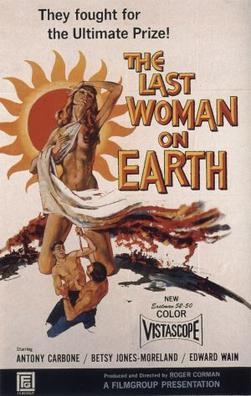
The title character of the 1960 Roger Corman film, Last Woman On Earth, is Evelyn Gern (Besty Jones-Moreland).  When a vaguely defined apocalypse occurred and apparently wiped out almost every living person on the planet, Evelyn was on vacation in Puerto Rico and scuba diving.  Because she had her own oxygen tank, she was able to survive while everyone on the surface was asphyxiated by a sudden change in the atmosphere.  (Or something like that.  To be honest, I never quite understood what the apocalypse was about or if it had occurred worldwide or just in Puerto Rico.)

Evelyn may potentially be the last woman on Earth but, unfortunately for her, there’s at least two men left.  There’s her husband, Harold (Antony Carbone).  Harold is a brutish businessman who, before the world ended, was constantly under the threat of indictment.  And then there’s Martin (Robert Towne, who also wrote the script), who is Harold’s attorney.  With the world apparently ending, Harold decides that he’s in charge while Martin decides that he’s in love with Evelyn.  Evelyn, for her part, ends up spending a lot of time praying in the local church.  At the end of 71 minutes, someone is dead and the survivors are left to consider an uncertain future.  It’s not a particularly happy film, though, at the same time, it’s not really well-made enough to be that depressing.

It’s perhaps not a coincidence that this film opens with everyone watching a cock fight because, despite its title, Last Woman On Earth is all about the extremes to which men will go to assert their authority.  There’s absolutely no reason for Harold and Martin to end up trying to kill each other, beyond the fact that they both want to be in charge and they both want the same woman.  Honestly, though, if you’re one of the last three people on Earth, I would think that you might be inspired to rethink certain traditional and patriarchal concepts.  That, of course, doesn’t happen in Last Woman On Earth.  It’s hard not to be disappointed with the fact that, even with society no longer existing, Evelyn’s reaction to most conflict is to retreat to the background and let the man fight it out among themselves.  I mean, we expect no better from Harold and Martin but Evelyn’s passivity in the face of everything gets rather frustrating very quickly.

Of course, it could be argued that I may be expecting too much from a film that was shot over a week and only made because Corman happened to be shooting another movie in Puerto Rico at the time.  Corman rarely went on location so, when he went down to Puerto Rico to do Creature of the Haunted Sea, he decided to get the most out of the location as he could by shooting a second film.  Screenwriter Robert Towne was cast as Martin because he was already getting paid to write the script while the film was being shot.  By casting Towne, Corman saved money that would have otherwise been spent on a professional actor.  Towne, who is credited as Edward Wain, ends up giving a rather bizarre performance, alternating between stiff underacting and eye-bulging overacting.  You kind of find yourself regretting that apparently it was decided that it would have been too expensive to fly Dick Miller or Peter Graves down to Puerto Rico.

The film doesn’t add up too much, beyond serving as a document of an era’s paranoia about the impending end of the world.  (Two years after the release of this film, the Cuban Missile Crisis would bring the world to the brink of a real-life apocalypse.)  Corman does manage to get a few haunting shots of the deserted streets of San Juan, though one gets the feeling that this would more due to luck than any specific intention on his part.  Last Woman On Earth was released on a double bill with Little Shop of Horrors and, when seen today, it really can’t start to compete with Seymour and his talking plant.

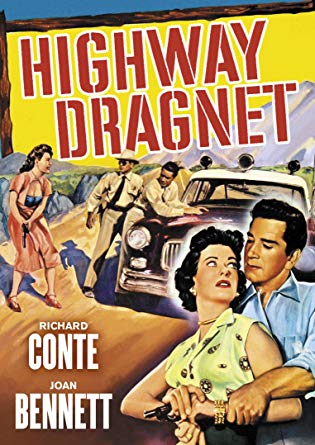
Film Noir Review: Highway Dragnet (dir by Nathan Juran)


Nifty is not really a word that I ever use, mostly because I’m not 80 years old and I’m not totally sure what the word means.  I’ve always assumed that nifty is way of saying that something is good without being too good and, if that’s true, then I have to say that the low-budget 1954 film noir, Highway Dragnet, certainly is a nifty film.

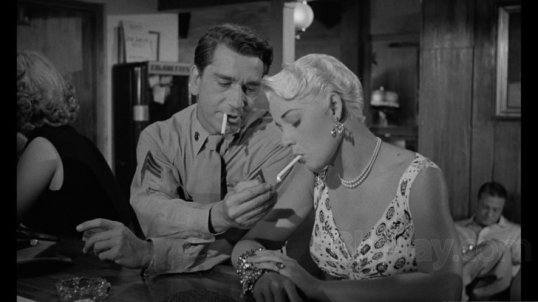
Highway Dragnet opens with Jim Henry (Richard Conte, who decades later would play the evil Barzini in The Godfather) in Las Vegas.  Jim’s just gotten out of the army and he’s visiting his friend, Paul (Frank Jenks).  Paul is a secret agent who is often unexpectedly called away.  Unfortunately, this means that Paul is not around when Jim is accused of murdering another man.  Since Jim was previously seen hitting on the dead man’s girlfriend, the police naturally assume that Jim’s the murderer.  When Jim says that Paul can provide an alibi whenever he gets back from doing his super secret spy stuff, the cops assume that Paul doesn’t actually exist.

Under the direction of the stern Lt. White Eagle (Reed Hadley), the cops are doing a lot of assuming!  Now, if Jim was smart, he would say, “Hey, White Eagle, you know what?  When you assume, you make an ass out of u and me!”  But Jim’s not smart so he decides to fire a gun at the cops and then go on the run!

Hey, Jim …. none of that makes you look innocent!

Anyway, while making his way across the desert, Jim comes across two women who are having car trouble.  Mrs. Cummings (Joan Bennett, who went from nearly getting cast as Scarlett O’Hara in Gone With The Wind to becoming a low-budget noir mainstay) is a fashion photographer and Susan Willis (Wanda Hendrix) is her model.  Jim fixes their car and then asks them for a ride.  They agree, little knowing that they’re heading straight into a …. HIGHWAY DRAGNET!

Of course, it turns out that Jim’s new friends have a connection to the crime of which he’s been accused.  The plot of Highway Dragnet hinges on a totally implausible coincidence.  This is perhaps not surprising when you consider that the script for Highway Dragnet was written by the legendary Roger Corman.  In fact, it was the first script that he ever sold and, though the film was directed by Nathan Juran, Highway Dragnet feels very much like a Corman quickie.  The plot is whatever it needs to be to get the story from the beginning to the end in 71 minutes.  Whether it all makes sense or not doesn’t appear to be all that much of a concern.

So, here’s what does work about Highway Dragnet.  First off, director Nathan Juran (who was also an award-winning art designer) manages to capture some memorable images of the Nevada desert and the film ends with a wonderfully over-the-top and atmospheric confrontation in a flooded house.  Secondly, Joan Bennett is as passive-aggressively menacing in Highway Dragnet as she would later be in Dario Argento’s Suspiria.  I also liked the performance of Reed Hadley, playing the unstoppable and incorruptible Lt. White Eagle.

Last Saturday, I watched Highway Dragnet with my friends in the Late Night Movie Gang and we enjoyed it.  It’s undoubtedly a minor film noir but it’s still entertaining when taken on its own terms.  If nothing else, the box office success of this low-budget production (which was shot over ten days) reportedly inspired Roger Corman to get serious about pursuing his own career in the film industry and, for that, movie lovers will always be thankful.

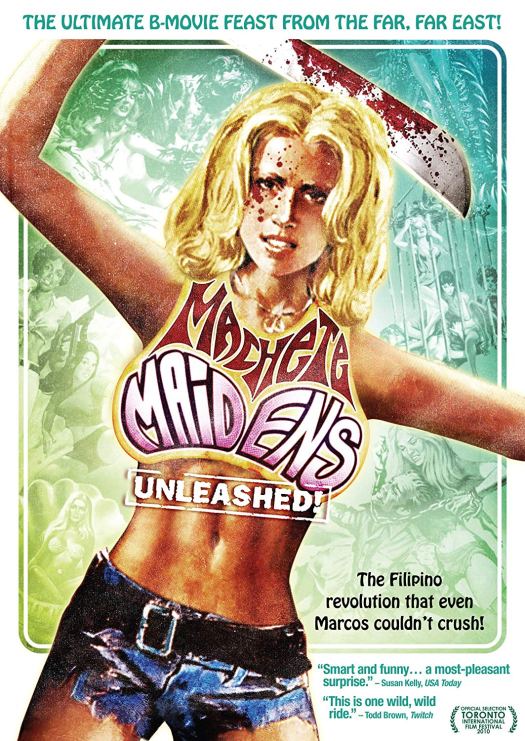
All Star Exploitation: MACHETE MAIDENS UNLEASHED (Australian 2010)


gary loggins's avatarcracked rear viewer

Tonight we celebrate baseball with MLB’s 90th annual All-Star Game, and… what’s that you say, Dear Readers? You don’t LIKE baseball?!? (*sighs, shakes head, mutters “must be some kinda Commies”*) Luckily for you, I’ve got an alternative for your viewing pleasure this evening. It’s an All-Star salute to the halcyon days of low-budget Exploitation filmmaking in the Philippines that lasted roughly from 1959 (Gerry DeLeon’s TERROR IS A MAN, with Francis Lederer and Greta Thyssen) to the early 80’s and the advent both of VHS, which effectively ended the Drive-In/Grindhouse Era, and political upheaval caused in part by Fernando Marcos’s imposition of martial law on the island nation.

1971’s “Beast of the Yellow Night”

This Australian-made documentary by writer/director Mark Hartley covers the wild, wild world of making Exploitation movies in the jungle on a shoestring budget through judicious use of clips, trailers, and interviews with the people who made…

View original post 433 more words

From the Direct-To-Video Film Vault: Naked Obsession (1990, directed by Dan Golden)


Franklyn Carlysle (William Katt) is a fine, upstanding city councilman, with a rich wife (Wendy MacDonald) and a bright future.  Carlysle wants to be mayor and he’s come up with the perfect scheme.  He’s going to work with a developer to renovate Dante’s Square, the city’s notorious red light district.
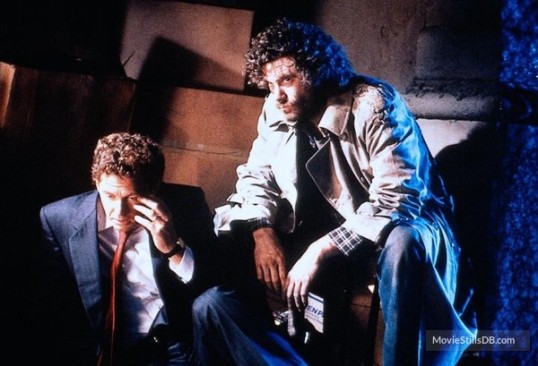
One night, while Franklyn is driving through Dante’s Square, he’s carjacked.  Someone knocks him out before stealing both his car and his wallet.  When Franklyn comes to, he discovers that he’s being watched over by Sam Silver (played by Rick Dean).  Sam is apparently a homeless philosopher, who tells Franklyn that he’s been taking life too seriously and that sometimes, you just have to yell, “Fuck this shit!” at the top of your lungs.  When Franklyn asks where he can find a phone so he can call the cops, Sam leads Franklyn to the Yin Yang Club.  It’s there that Franklyn sees Lynne (Maria Ford), a dancer to whom he is immediately attracted.  Suddenly, his missing car and his stolen wallet no longer seem that important.  With his marriage already in trouble, Franklyn returns to the club the next night.

Franklyn soon discovers that Lynne has a thing for being choked during sex.  Even though Sam keeps telling him things like, “Nothing wrong with the dark – you spend half your life in it – trouble is, most people keep their eyes closed,” Franklyn is worried that his affair with Lynne will derail his mayoral ambitions.  However, when Lynne shows up dead, Franklyn finds himself dealing with a much bigger problem.  He’s now the number one suspect in her murder.  Things just get stranger as Franklyn discovers that he wasn’t the only one cheating, meets a masked, gun-wielding stripper, and discovers that Sam might not even be of this world.

William Katt and Rick Dean in Naked Obsession

It can be said, without fear of hyperbole, that Naked Obsession in the Citizen Kane of Roger Corman-Produced Straight-To-Video Maria Ford-Stripper movies.  This is largely due to the performance of the late, great Rick Dean in the role of Sam.  Sam’s not just just a homeless drunk with a motormouth.  As played by Dean, he’s a philosopher king and, the film hints, much more.  He comes across like an angel of the devil and he’s exactly what Franklyn Carlysle needs to liven up his too safe life.  Maria Ford, who specialized in playing troubled strippers in Roger Corman films, gives one of her best performances and, in the role of Franklyn’s secretary, Elena Sahagun, has some great scenes too.  Finally, William Katt classes up the joint, giving a real performance as Franklyn instead of just sleepwalking through the film.  Dan Golden’s direction emphasizes the surreal and, by the time the end credits roll, Naked Obsession will leave you wanting to spend a night or two at Dante’s Square.

Like so many classic films from the golden age of late night Cinemax. Naked Obsession has never been released on DVD or Blu-ray but it can be found on YouTube.

4 Shots From 4 Roger Corman Films: X: The Man With X-Ray Eyes, The Masque of the Red Death, St. Valentine’s Day Massacre, The Trip


4 Shots From 4 Films is just what it says it is, 4 shots from 4 of our favorite films. As opposed to the reviews and recaps that we usually post, 4 Shots From 4 Films lets the visuals do the talking.

Let us all wish a happy 93rd birthday to the one and only Roger Corman!

As a director and a producer, Roger Corman is one of the towering figures in the history of American cinema.  At a time when the major studios dominated the industry, Roger Corman set off on his own fiercely independent path.  At a time when most filmmakers were either apolitical or predictably middle-of-the-road in their liberalism, Corman was an outspoken progressive.  At a time when mainstream Hollywood refused to give opportunities to new talent, Corman was giving work to people like Francis Ford Coppola, Martin Scorsese, Jonathan Demme, and Jack Nicholson.

Here are….

4 Shots From 4 Roger Corman Films

X: The Man With X-Ray Eyes (1963, dir by Roger Corman)

The Masque of the Red Death (1964, dir by Roger Corman)

St. Valentine’s Day Massacre (1967, dir by Roger Corman)

The Trip (1967, dir by Roger Corman)