Seven strangers are invited to a remote island by a mysterious billionaire named Osiris. There is a doctor, a dancer, an auto mechanic, a mercenary, a football player and his agent, and a member of the Yakuza. The auto mechanic points out that, in Egyptian mythology, Osiris judged mankind’s sins. For some reason, none of the seven think twice about going to the island but, once they arrive, they soon discover that they should have. Osiris is willing to give them seven million dollars but to get it, they have to reach the other end of the island without being killed by Osiris or his men.
Of the many movie adaptations of The Most Dangerous Game, this is probably the worst. The cast, which includes Michael Beck, Marc Singer, Jenny Seagrove, Mitch Ryan, John Pleshette, Soon-Tek Oh, and Roddy McDowall, isn’t bad but the script is terrible, full of overwrought dialogue and plot holes. Across the island, Osiris has left clues that are designed to trigger flashbacks and lead to each member of the seven explaining what it is that they did in the past. But for that to work, Osiris would have to know exactly what route the seven of them were going to use to cross the island and he would also have to know who would still be alive by the time that they came across each clue. Also, whenever they come across the clue, everyone stands around and wastes valuable time arguing about it. Considering that there are armed men trying to kill them, no one seems to be in that much of a hurry to make it to the other side of the island. The flashbacks themselves are interesting in how clumsily they are put together. 40ish Marc Singer plays himself as a senior in high school.
Like Hitler’s Daughter, Deadly Game was originally made for the USA network. The first time I saw it was in the UK where, for some reason, it seemed to air frequently during the mid-1990s. (Possibly this was because it starred quintessential Hollywood Brit Roddy McDowall. That’s the only reason I can think of.) It’s now on YouTube, for anyone who wants to sit through it.
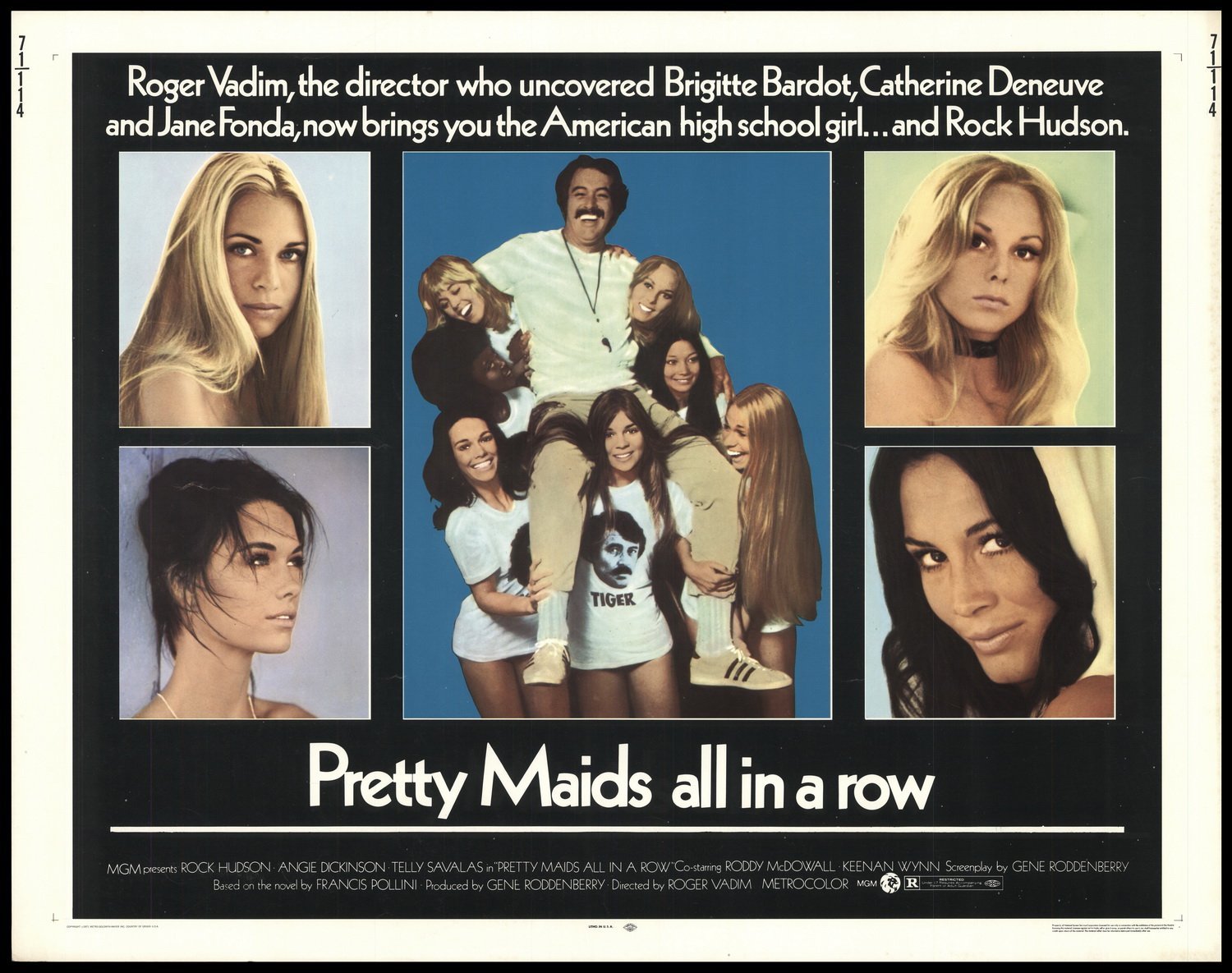
Gene Roddenberry’s post-STAR TREK career had pretty much gone down the tubes. The sci-fi series had been a money loser, and Roddenberry wasn’t getting many offers. Not wanting to be pigeonholed in the science fiction ghetto, he produced and wrote the screenplay for PRETTY MAIDS ALL IN A ROW, a black comedy skewering the sexual revolution, with French New Wave director Roger Vadim making his first American movie. The result was an uneven yet entertaining film that would never get the green light today with its theme of horny teachers having sex with horny high school students!
All-American hunk Rock Hudson was in the middle of a career crisis himself. After spending years as Doris Day’s paramour in a series of fluffy comedies, his box office clout was at an all-time low. Taking the role of Tiger McGrew, the guidance counselor/football coach whose dalliances with the cheerleading squad leads to murder…
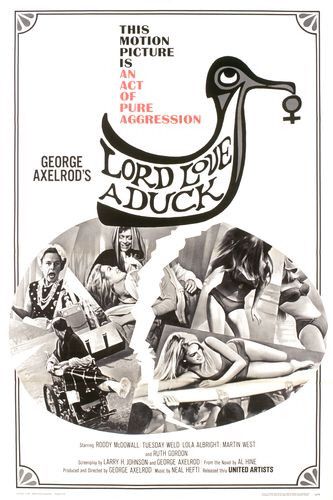
For my third Back to School review, I watched the 1966 satire, Lord Love A Duck!
Hey hey hey!
I have to admit that, because I’m writing this review in a hurry and because the D and the F key are located right next to each other, I keep accidentally calling this film Lord Love A Fuck. Somehow, that seems appropriate because Lord Love A Duck is a very odd and subversive little movie that deals with people who are largely motivated by lust and I’m pretty sure that, at one point, Roddy McDowall is seen saying, “Fuck off!” but, of course, we don’t actually hear him say it. But seriously, Lord Love A Duck is a weird movie.
Hey hey hey!
Roddy McDowall plays Alan Musgrave, a student at a “progressive” high school in California. Roddy was about 37 years old when he played a high school senior and he doesn’t look like a teenager at all but somehow, it’s appropriate. After all, Alan is no ordinary teenager! He’s smarter than everyone else. He’s wittier than everyone else. He’s more clever than everyone else. He’s also totally obsessive and willing to do just about anything to get what he wants. And you can be sure of one thing: whenever Alan does something borderline insane, you’ll hear a group of singers harmonizing, “Hey hey hey!” in the background.
Hey hey hey!
See, it’s happening already. It doesn’t matter what Alan’s doing. He could be kicking a skateboard in the way of a romantic rival. He could be interrupting the graduation ceremony with a tractor. He could be going to prison for life. No matter what it is, it will always be accompanied by:
Hey hey hey!
Anyway, Alan is in love with the innocent, sweet, and constantly flirtatious Barbara Anne Greene (Tuesday Weld). In fact, almost everyone in the film is in love with (or, at the very least, turned on by) Barbara. The only person who doesn’t seem to be in love with Barbara is her mother (Lola Albright), a former-beauty-turned-cocktail-waitress whose world-weary cynicism seems to offer a depressing hint of what’s in store for Barbara once she gets older.
Hey hey hey!
But everyone else loves Barbara. Especially Alan! In fact, Alan is so in love with her that he swears that he’s going to make sure that she gets everything that she wants. When she needs 12 cashmere sweaters so that she can join an exclusive girl’s club, Alan helps her to convince her father (Max Showalter) to pay for them. When Barbara needs a job after dropping out of school, Alan helps her get one as a secretary for the high school’s progressive principal (Harvey Korman). When Barbara decides she wants to marry the boring but respectable Christian youth leader, Bob (Martin West), Alan keeps Bob’s mother (Ruth Gordon) so drunk that she doesn’t get a chance to reprimand her son for falling in love with a girl from a divorced family. (As Bob’s mother explains it, she doesn’t believe in divorce. “We don’t leave our husbands. We bury them.”) Eventually, a movie producer decides that he wants Barbara to star in his beach films but Bob says no. No wife of his is going to be a movie star! So, of course, Alan decides to murder Bob so that Barbara can again have what she wants…
Hey hey hey!
Lord Love A Duck is a manic comedy that satirizes everything that mainstream audiences in 1966 would have held sacred. Teenagers, conservatives, liberals, love, hate, murder, justice, marriage, divorce, morality, sex, religion, television, movies — it’s all thoroughly ridiculed in this film. (It’s not surprising that the film’s director also wrote the script for The Manchurian Candidate, a satire disguised as a thriller.) To be honest, it’s probably a little bit too manic for its own good. At times, the film run the risk of becoming exhausting. But then there’s even more times when the film is absolutely brilliant.
Hey hey hey!
Speaking of absolutely brilliant, Lord Love A Duck makes brilliant use of Roddy McDowall’s eccentric screen presence but, even better, it features one of Tuesday Weld’s best performances. Weld was a talented actress whose performances often revealed that a fragile soul is often the price that is payed for great beauty. (There’s no greater insecurity than wondering whether people are responding to who you are or to how you look. Would you still care if I was ugly is not a question we’re supposed to ask but it’s one that we’ve all wondered.) It would have been far too easy to make Barbara either totally innocent or totally manipulative. Wisely, the film does neither. Barbara may occasionally be manipulative but she always means well. It’s not her fault that everyone around her is either idiotic or insane.
Hey hey hey!
Though Lord Love A Duck is obviously a time capsule of the culture of mid-60s, it’s also a film that remains relevant even today. Culturally, we’re still obsessed with fame, youth, and beauty. In many ways, the satire of Lord Love A Duck still feels more extreme that anything that any contemporary filmmaker would dare to attempt. I can only imagine what audiences in 1966 thought as they watched this subversive teen film.
(For those following at home, Lisa is attempting to clean out her DVR by watching and reviewing 38 films by this Friday. Will she make it? Keep following the site to find out!)
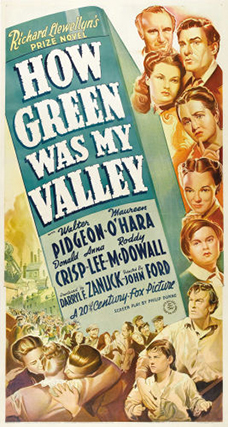
Before I really get into this review, I should admit that I watched How Green Was My Valley with a bias.
Before the movie started, I was expecting to be disappointed with it. I think that a lot of film lovers would have felt the same way. How Green Was My Valley won the 1941 Oscar for best picture. In doing so, it defeated three beloved films that have only grown in popularity and renown since they were first released: Citizen Kane, The Maltese Falcon, and The Little Foxes. (As well, just consider some of the 1941 films that weren’t even nominated for best picture: Ball of Fire, The Devil and Daniel Webster, Dr. Jekyll and Mr. Hyde, High Sierra, The Lady Eve, Never Give A Sucker An Even Break, The Sea Wolf, The Wolf Man, and Sullivan’s Travels.) Because it defeated so many great films and since we’re all used to the narrative that the Academy always screws up, there’s a tendency to assume How Green Was My Valley was really bad.
Well, after years of assumptions, I finally actually watched How Green Was My Valley? Was it bad? No, not really. Was it great? No, not all. If anything, it felt rather typical of the type of films that often win best picture. It was well-made, it was manipulative enough to be a crowd-pleaser while serious enough to appeal to highbrow critics, and, perhaps most importantly, it never really challenged the viewer. Unlike Citizen Kane and The Maltese Falcon, How Green Was My Valley is a film that doesn’t require that you give it too much thought and, as such, it really shouldn’t be surprising that it was named the best picture of the year.
How Green Was My Valley was directed by John Ford and, as you might expect from Ford, it deals with a changing way of life and features good performances and a few impressive shots of the countryside. Taking place in the late 1800s, How Green Was My Valley tells the episodic story of the Morgans, a large family of Welsh miners. The film is narrated by Huw (Roddy McDowall), a youngest member of the family. Though Huw’s eyes, we watch as his once idyllic and green village is transformed by the growing mining industry and blackened with soot, poverty, and death.
The film starts out as a fairly even mix of sentiment and drama. Huw has a crush on his brother’s fiancee. His sister, Angharad (Maureen O’Hara), has a flirtation with the new preacher, Mr. Gruffydd (Walter Pidgeon). Much emphasis is put on communal gatherings. There is a wildly joyful wedding celebration. We often see the villagers in church and hear them singing both hymns and folk songs. In their isolate village, they are are united against a changing world.
Or, at least, they think they are. As the mining industry grows, that united front and sense of community starts to vanish. A strike sets family members against each other, as each miner is forced to decide whether to side with management or with his fellow workers. Each year, the wages become lower. When management realizes that its cheaper to just continually hire new miners, several of the veteran workers are fired and end up leaving the village to seek a living elsewhere. As new people come to the village, even Mr. Gruffydd finds himself the subject of gossip.
As for Huw, he grows up. He goes to school, deals with a sadistic teacher, and learns how to defend himself against bullies. And eventually, like everyone in his family, he is sent down into the mines and soon, his once innocent face is covered in soot.
And, of course, there’s a big tragedy but you probably already guessed that. How Green Was My Valley is not a film that takes the viewer by surprise.
For the most part, it’s all pretty well done. The big cast all inhabit their roles perfectly and Roddy McDowall is extremely likable as Huw. Maureen O’Hara shows why she eventually became a star and even Walter Pidgeon gives a surprisingly fiery performance. How Green Way My Valley is a good film but it’s too conventional and predictable to be a great film, which is why its victory over Citizen Kane and The Maltese Falcon will always be remembered as a huge Oscar injustice.
But, taken on its own terms and divorced from the Oscar controversy, How Green Was My Valley may be a conventional but it’s not a bad film. It’s just no Citizen Kane.
For today’s Horror on the Lens, we are happy to present It!, a Hammer-style British horror film from 1966.
In It!, Roddy McDowall plays Arthur Pimm. Arthur works as an assistant at a museum and, needless to say, he’s eager to move up in his profession. There’s nothing unusual about that. And I guess you could argue that, while it’s certainly not ideal, it’s not necessarily unusual that Arthur still lives with his mother. What is unusual is that Arthur’s mother happens to be dead.
That right — Arthur is totally and completely insane.
As you can probably guess, Arthur is probably the last person who should have control of the immortal and indestructible Golem. But that’s exactly what happens! Soon, Arthur is using the Golem to kill his enemies and kidnap the woman that he loves.
Needless to say, things end with a bang.
Along with being a time capsule of 1966, It! is worth watching for Roddy McDowall’s memorably unhinged lead performance.
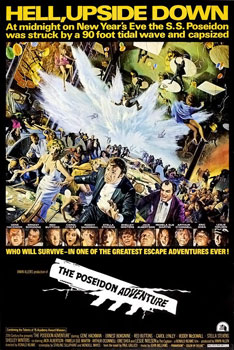
A few years ago, when I first told Arleigh that I had recently watched the 1972 film The Poseidon Adventure, I remember him as being a bit shocked and amazed that I had made it through the entire film. This was because Arleigh knows that I have a morbid obsession with drowning and that the mere sight of someone struggling underwater is enough to send me into a panic attack.
And The Poseidon Adventure is a film that is totally about drowning. The majority of the cast drowns over the course of the film. The few who survive spend all of their time trying not to drown. The main villain in The Poseidon Adventure is the ocean. The Poseidon Adventure is a film specifically designed to terrify aquaphobes like me.
And there are certain parts of The Poseidon Adventure that freaked me out when I first watched it and which continue to freak me out whenever I rewatch it.
For instance, just the film’s plot freaks me out. On New Year’s Day, an ocean liner is capsized by a huge tidal wave. With the boat upside down, a small group of survivors struggle to make their way up to the hull where, hopefully, they might be rescued. That involves a lot of fighting, arguing, climbing, and drowning.
It freaks me out whenever I see the huge tidal wave crash into the bridge and drown Captain Leslie Nielsen. That’s largely because it’s impossible for me to look at Leslie Nielsen without smiling. (I’ve already written about my reaction to seeing him in the original Prom Night.) When he suddenly drowns, it’s not funny at all.
It freaks me out when the boat turns over and hundred of extras are tossed around the ballroom. I always feel especially bad for the people who vainly try to hold onto the upside down tables before eventually plunging to their deaths. (Did I mention that I’m scared of heights as well?)
It freaks me out when Roddy McDowall plunges to his death because who wants to see Roddy McDowall die? Whenever I see him in an old movie, he always come across as being such a super nice guy. (Except in Cleopatra, of course…) Plus, Roddy had an absolutely chilling death scream. They need to replace the Wilhelm Scream with the Roddy Scream.
It freaks me out when survivor Shelley Winters has a heart attack right after swimming from one part of the ship to another. Because seriously, Shelley totally deserved the Oscar nomination that she got for this film.
And it really freaks me out when Stella Stevens plunges to her death because I related to Stella’s character. Stella was tough, she didn’t take any crap from anyone, and she still didn’t make it. If Stella Stevens can’t make it, what hope would there be for me?
And yet, at the same time, The Poseidon Adventure is such an entertaining film that I’m willing to be freaked out. The Poseidon Adventure was one of the first of the classic disaster films and it’s so well done that even the parts of the film that don’t work somehow do work.
For instance, Gene Hackman plays the Rev. Frank Scott, the leader of the group of survivors. And Hackman, who can legitimately be called one of the best actors ever, gives an absolutely terrible performance. His performance is amazingly shrill and totally lacking in nuance. When, toward the end of the film, he starts to angrily yell at God, you actually feel sorry for God. And yet, Hackman’s terrible performance somehow works perfectly for the film. It’s such an over-the-top performance that it sets the tone for the whole film. The Poseidon Adventure is an over-the-top film and, if Hackman had invested his character with any sort of nuance, the film would not have worked as well as it did.
And then there’s Ernest Borgnine, who plays Stella Stevens’s husband. Borgnine spends the entire film arguing with Gene Hackman. Whenever something bad happens, Borgnine starts acting like Edward G. Robinson in The Ten Commandments. He never actually says, “Where is your God now!?” but it wouldn’t have been inappropriate if he had. And yet, again, it’s exactly the type of performance that a film like this needs.
And finally, there’s that theme song. “There has to be a morning after…” It won an Oscar, defeating Strange Are The Ways Of Love from The Stepmother. And is it a good song? No, not really. It’s incredibly vapid and, while it does get stuck in your head, you don’t necessarily want it there. But you know what? It’s the perfect song for this film.
The Poseidon Adventure is not a deep film, regardless of how many times Hackman and Borgnine argue about the role of God in the disaster. It’s an amazingly shallow film about people drowning. But it’s so well-made and so perfectly manipulative that you can’t help but be entertained.
The Poseidon Adventure totally freaks me out. But I will probably always be willing to find time to watch it.
While watching the 1963 best picture nominee, Cleopatra, I had many thoughts. The film lasts over 4 hours so I had a lot of time to think.
For instance, I often found myself impressed by the sheer size of the production. I marveled at the recreation of ancient Greece and Rome. I loved looking at the ornate costumes. I loved feeling as if I was taking a look back at what Rome may have actually looked like at the height of the Roman Empire. Making it all the more impressive was that this film was made in the days before CGI. When the film’s Romans walked through the streets of Rome, they weren’t just actors standing in front of a green screen. They were walking down real streets and surrounded by real buildings. It reminded me of the awe and wonder that I felt when I was in Italy and I was visiting the ruins of ancient Rome.
(I don’t know if any of the cast accidentally flashed everyone like I did when I visited during Pompeii on a windy day but considering how short some of the skirts on the men were, it wouldn’t surprise me if they did!)
And, as I marveled at the recreation of Rome, I also thought to myself, “How long is this freaking movie?” Because, seriously, Cleopatra is an amazingly long movie. It’s not just the film is over four hours long. It’s that the film feels even longer. Gone With The Wind, The Godfathers Part One and Part Two, Once Upon A Time In America; these are all long films but, because they’re so great, you never find yourself checking the time while watching. Cleopatra is the opposite of that. Cleopatra is a film that, at its slowest, will make you very much aware of how many seconds are in a minute.
I found myself marveling at the lack of chemistry between Elizabeth Taylor and Richard Burton. If anything, this is the most shocking thing about Cleopatra. If Cleopatra is famous for anything, it’s famous for being the film where Elizabeth Taylor (cast in the role of Cleopatra) first met Richard Burton (who was playing Mark Antony). Their affair dominated the gossip headlines. (If TMZ and YouTube had been around back then, there would be daily videos of Richard Burton punching out paparazzi.) Cleopatra was the first of many big-budgeted, overproduced films that Taylor and Burton co-starred in.
(Then again, they also starred in Who’s Afraid of Virginia Woolf, a film that is almost the exact opposite of Cleopatra.)
In the role of Mark Antony, Burton spends most of the film looking absolutely miserable. Elizabeth Taylor, meanwhile, seems to be having a lot more fun. It’s almost as if she understood what Cleopatra was going to become so she went out of her way to give the type of over-the-top performance that the film deserved. The same can also be said about Rex Harrison, who plays Julius Caesar and who, perhaps because he appears to have shared her attitude, actually does have some chemistry with Taylor.
Actually, if anyone gives a truly great performance in Cleopatra, it’s Roddy McDowall. McDowall plays the future Emperor Augustus with a mesmerizing intensity. Again, McDowall’s performance is not exactly subtle but Cleopatra is not a film that demands subtlety.
As the film finally neared its end, I found myself wondering how Joseph L. Mankiewicz went from directing two close to perfect films, A Letter To Three Wives and All About Eve, to directing this. Even more amazing, Mankiewicz had previously directed one of the best Roman Empire films ever, 1953’s Julius Caesar. (When compared to Cleopatra, the low-key and thoughtful Julius Caesar appears to have been filmed on an entirely different planet.) Well, in Mankiewicz’s defense, he was not the original director. He was brought in to replace Rouben Mamoulian, who had previously attempted to make the film with Joan Collins, Ben-Hur‘s Stephen Boyd, and Peter Finch. When Mankiewicz was brought in, the cast was replaced with Taylor, Burton, and Harrison. Between the expensive stars, the troubled production, and all of the offscreen romantic melodrama, Mankiewicz probably did the best that he could.
Today, Cleopatra is mostly interesting as an example of a film from the “Only Gigantic Productions Will Save Us From Television!” era of Hollywood filmmaking. Cleopatra started out as a $2,000,000 production and ended up costing $31,000,000. It was the number one film at the 1963 box office and it still nearly bankrupted 20th Century Fox. While the film does have some kitsch appeal, the critics hated it and it’s easy to see why.
And yes, it was nominated for best picture of the year, a tribute to the size of the production and the determination of 20th Century Fox to get something — anything — in return for their money.
Cleopatra is a bit of a chore to sit through but it can be fun if you’re in a snarky mood. It’ll do until the inevitable Angelina Jolie remake comes along.
“I am the future!” — Peter Stegman (Timothy Van Patten) in Class of 1984 (1982)
In many ways, the classic exploitation film Class of 1984 feels like an update of Blackboard Jungle. An idealistic teacher Andrew Norris (Perry King) takes a job teaching at a crime-ridden inner city school. There are a few differences. For one thing, the teacher in Class of 1984 teaches music. The graffiti-covered school in Class of 1984 looks a hundreds times worse thanthe one in Blackboard Jungle. Sidney Poitier is nowhere to be seen in Class of 1984 though Michael J. Fox does show up as one of the good students. Bad student Peter Stegman (Timothy Van Patten) and his gang are a lot more colorful and flamboyant than Vic Morrow ever was in Blackboard Jungle.
And, of course, the main difference between Blackboard Jungle and Class of 1984 is that, in the former film, teacher Glenn Ford’s liberal idealism ultimately defeated the forces of juvenile delinquency. Ford may have been tempted to turn violent but, ultimately, he appealed to the better instincts of his other students and the world was better for it.
In Class of 1984, Andy Norris may start off as a liberal idealist but, ultimately, he reveals himself to be just as violent as his students. And again, the world appears to be better for it.
(I imagine that, when this film was originally released, a lot of teachers probably watched it as a form of wish-fulfillment.)
Now, Andy’s actions may be extreme but he has his reasons. Just consider everything that happened to him after he started teaching.
First off, his best friend and fellow teacher Terry Corrigan (Roddy McDowall) was driven insane by the school’s students. Terry eventually ended up teaching while pointing a gun at his entire class. (The scene where McDowall finally gets his class to pay attention is one of the best in the film, largely due to McDowall’s excellent performance. The look of happiness that crosses his face when a student finally gives him the correct answer is both disturbing and funny at the same time.)
Secondly, his best student (that would be Michael J. Fox) ended up getting stabbed in the cafeteria by one of Stegman’s goons.
And finally, Stegman and his gang assaulted Andy’s wife.
Can you blame Andy Norris for taking the law into his own hands?
Now, me, I have a tendency towards being a bleeding heart when it comes to those living on the fringes of society. I’m against the death penalty. I’m against the war on drugs. I’m against violence. I believe in compassion. I believe in understanding. I believe in love. But even with all that in mind, I couldn’t help but enjoy Class of 1984. Some of that is because the film is surprisingly well-acted. You find yourself really caring about the characters played Perry King and Roddy McDowall and you also find yourself really hating Peter Stegman and his goons. I don’t care how compassionate you are, there’s something very cathartic about watching Andy finally get back at his tormentors. And then there’s the fact that, of all the directors to work in what has been termed the “exploitation” field, Mark Lester is one of the best. He’s one of those directors who knows exactly how to tell a story and what buttons to push to get the proper emotional respect.
But mostly, the film works because of Timothy Van Patten’s performance as Peter Stegman. Van Patten makes Stegman into one of the definitive teenage psychos. As intimidating as Van Patten is, his best moments come when the film reveals the type of person that Stegman could have been if not for the fact that he’s a total sociopath. At one point, when Andy tries to kick him out of music class, Stegman responds by sitting down at a piano and playing a beautiful piece of music. Perhaps my favorite Stegman moments comes late in the film, when he’s seen sweetly talking to his devoted (and clueless) mother.
Not surprisingly for a film that was released over 30 years ago, Class of 1984 is undeniably dated. But it doesn’t matter because Class of 1984 captures a universal and timeless truth. There are always going to be frustrated teachers and dangerous students. The only thing that changes is how society deals with the frustration and the danger.
Pretty Maids All In A Row, which — as should be pretty obvious from the trailer above — was originally released in 1971, is a bit of a historic film for me. You see, I love movies. And, as a part of that love, I usually don’t give up. Regardless of how bad a movie may turn out to be, once I start watching, I stick with it. I do not give up. I keep watching because you never know. The film could suddenly get better. It could turn out that what originally seemed like a misfire was actually brilliant satire. If you’re going to talk or write about movies, you have an obligation to watch the entire movie. That was a rule that I had always lived by.
And then, one night, Pretty Maids All In A Row popped up on TCM.
Now, I have to admit that I already knew that Pretty Maids was going to be an extremely 70s film. I knew that it was probably going to be more than a little sexist. I knew all of this because the above trailer was included on one of my 42nd Street Forever DVDs. But I still wanted to see Pretty Maids because the trailer hinted that there might be an interesting hiding underneath all of the cultural baggage. If nothing else, it appeared that it would have some sort of worth as an artifact of its time.
(If you’re a regular reader of this site, you know how much I love my cinematic time capsules.)
So, the film started. I logged onto twitter so that I could live tweet the film, using the hashtag #TCMParty. And from the moment the film started, I knew it wasn’t very good. It wasn’t just that the film’s camerawork and music were all extremely 70s. After all, I like 70s music. I don’t mind the occasional zoom lens. And random psychedelic sequences? WHO DOESN’T LOVE THOSE!? No, my dislike of the film had nothing to do with the film’s style. Instead, it had to do with the fact that there was absolutely nothing going on behind all of that style. It wasn’t even style for the sake of style (which is something that I usually love). Instead, it was style for the sake of being like every other “youth film” that came out in the 70s.
And then there was the film’s plot, which should have been interesting but wasn’t because director Roger Vadim (who specialized in stylish decadence) had no interest in it. The film takes place at Oceanfront High School, where the only rule is that apparently nobody is allowed to wear a bra. We meet one student, Ponce De Leon Harper (played by an amazingly unappealing actor named John David Carson), who is apparently on the verge of having a nervous breakdown because, at the height of the sexual revolution, he’s still a virgin.
(Because, of course, the whole point of the sexual revolution was for losers like Ponce to finally be able to get laid…)
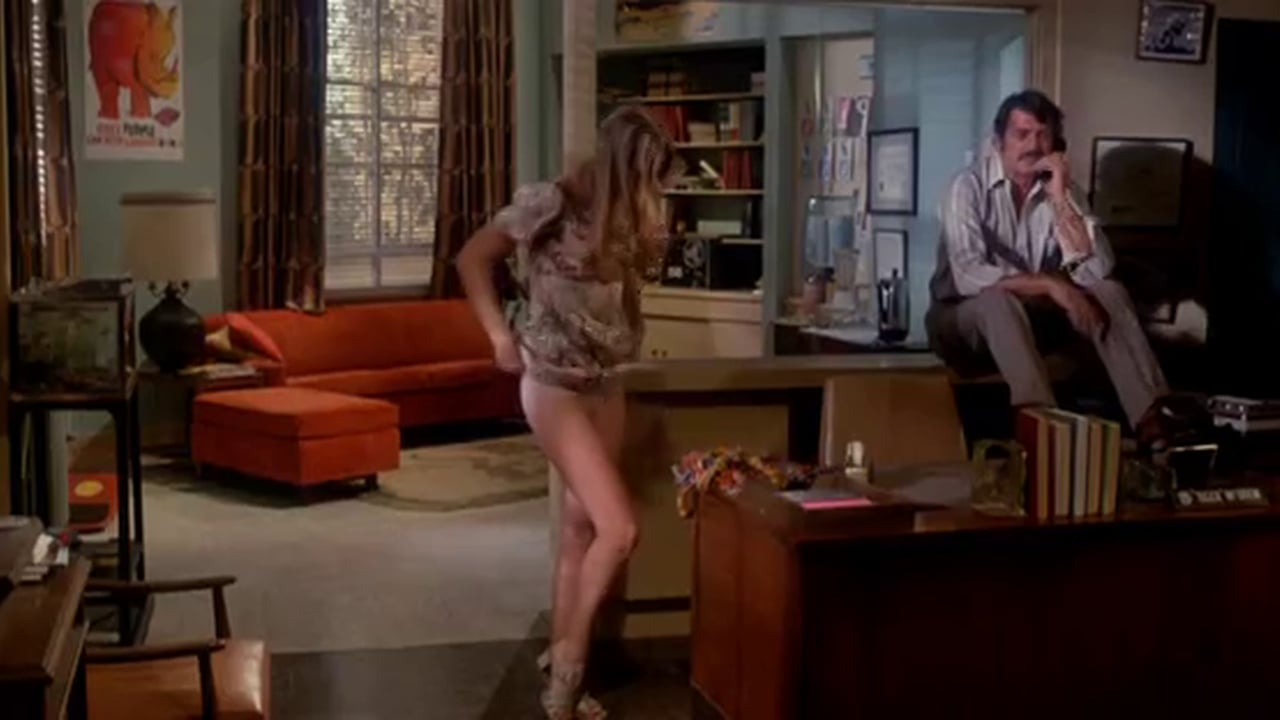
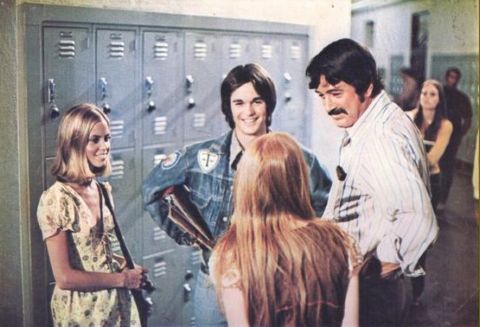
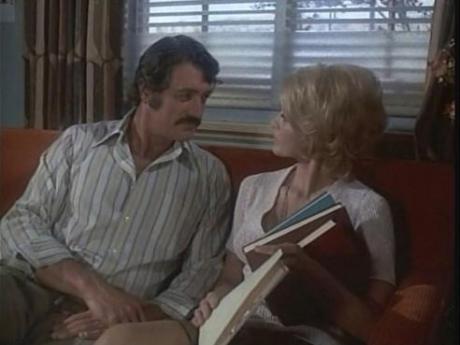
Ponce is taken under the wing of high school guidance counselor Tiger McDrew (Rock Hudson, complete with porn star mustache). Quickly figuring out exactly what Ponce needs, Tiger sets him up with a teacher played by Angie Dickinson. However, Tiger has other concerns than just Ponce. Tiger, it turns out, is a sex addict who is sleeping with nearly every female student at the school. But, American society is so oppressive and puts so much pressure on the American male that Tiger has no choice but to kill every girl that he sleeps with…
This is one of the only film I can think of that not only makes excuses for a serial killer but also presents him as being a heroic character. And, while it’s tempting to think that the film is being satirical in its portrayal of Tiger and his murders, it’s actually not. Don’t get me wrong. The film is a very broad comedy. The high school’s principal (Roddy McDowall) is more concerned with the football team than with all of the girls turning up dead at the school. The local sheriff (Keenan Wynn) is a buffoon. The tough detective (Telly Savalas) who investigates the murders gets a few one liners.
But Tiger, most assuredly, is the film’s hero. He’s the only character that the audience is expected to laugh with, as opposed to at. He is the character who is meant to serve as a mouthpiece for screenwriter Gene Roddenberry’s view on America’s puritanical culture. If only society was less hung up on sex, Tiger wouldn’t have to kill. Of course, the film’s celebration of Tiger’s attitude towards sex is not extended towards the girls who sleep with him. Without an exception, they are all presented as being empty-headed, demanding, shallow, and annoying, worthy only of being leered at by Vadim’s camera until Tiger finally has to do away with them.
(The film’s attitude towards women makes Getting Straight look positively enlightened.)
Rock and Angie
ANYWAY! I spent about 40 minutes watching this movie before I gave up on it. Actually, if you want to be technical about it, I gave up after 5 minutes. But I stuck with it for another 35 minutes, waiting to see if the film was going to get any better. It didn’t and finally, I had to ask myself, “Why am I actually sitting here and wasting my time with this misogynistic bullshit?” So, I stopped watching and I did so with no regrets.
What I had forgotten is that I had set the DVR to record the film while I was watching it, just in case I later decided to review it. So, last week, as I was preparing for this series of Back to School posts, I saw Pretty Maids All In A Row on my DVR. I watched the final 51 minutes of the film, just to see if it ever got better. It didn’t.
However, on the plus side, Rock Hudson does give a good performance in the role of Tiger, bringing a certain seedy desperation to the character. (I’m guessing that this desperation was Hudson’s own contribution and not an element of Roddenberry’s screenplay, which more or less presents Tiger as being a Nietzschean superman.). And beyond that, Pretty Maids serves as evidence as to just how desperate the Hollywood studios were to makes movies that would be weird enough to appeal to young people in the early 70s.
Watching the film, you can practically hear the voices of middle-aged studio executives.
“What the Hell are we trying to do with this movie!?” one of the voices says.
“Who cares!?” the other voice replies, “the kids will love it!”
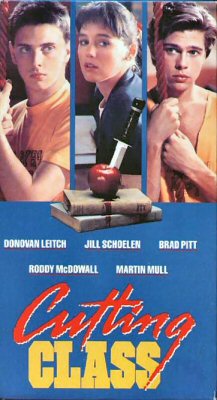
it’s been said that, early in the career of every Oscar nominee, there’s a film or two that he probably wishes would be forgotten. Today’s movie is one of those films, 1989’s Cutting Class.
Cutting Class is, in many ways, a fairly standard 1980s slasher comedy hybrid. It features a stronger heroine than most and it does a bit of a better job than expected at making you guess who the killer is but, for the most part, Cutting Class is mostly memorable for being one of Brad Pitt’s first major roles.
The bad news is that the character he’s playing here is kind of an asshole and not even the fact that he looks like Brad Pitt can make him likable.
The good news is that Brad Pitt has always been hot.
 Seven strangers are invited to a remote island by a mysterious billionaire named Osiris. There is a doctor, a dancer, an auto mechanic, a mercenary, a football player and his agent, and a member of the Yakuza. The auto mechanic points out that, in Egyptian mythology, Osiris judged mankind’s sins. For some reason, none of the seven think twice about going to the island but, once they arrive, they soon discover that they should have. Osiris is willing to give them seven million dollars but to get it, they have to reach the other end of the island without being killed by Osiris or his men.




 Through the Shattered Lens