THE TWILIGHT ZONE (TV Series) – S3, E1: “Two,” starring Charles Bronson and Elizabeth Montgomery!


You know producer Buck Houghton had high hopes for the opening episode of Season 3 of THE TWILIGHT ZONE when it aired on September 15, 1961. It stars up and coming actors of the time, Charles Bronson and Elizabeth Montgomery, who were all over TV screens in the 50’s and early 60’s, with Bronson emerging as a strong character actor in movies as well. The two would be major stars within a few years, but they weren’t quite there yet. 

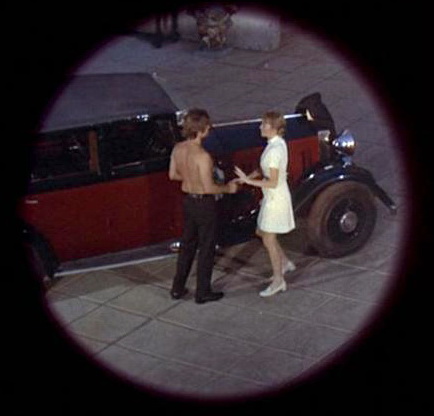
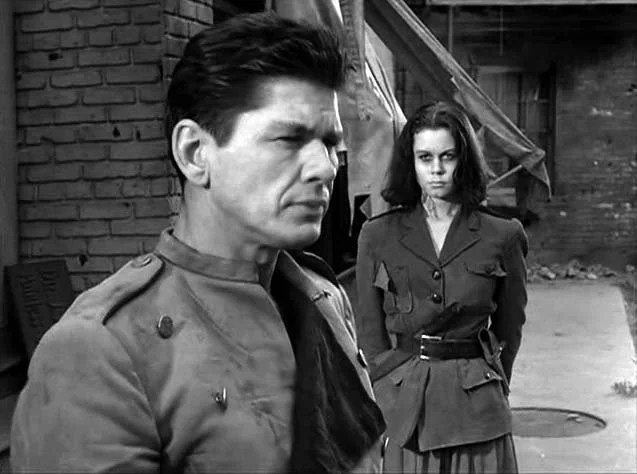
This episode, titled “Two,” opens with “The Woman” (Elizabeth Montgomery), who is wearing a tattered dark military uniform, wandering into a bombed out, deserted city, and spotting the remains of a restaurant. Tired and hungry, she goes in and digs around until she finds an old can of chicken. As she’s opening the can, “The Man” (Charles Bronson), who’s wearing a tattered, light-colored uniform, walks in on her. Immediately attacking him with a combination of meat cleavers, bottles, pots and pans, The Man tries to hold her off until if becomes clear that he’s going to have to subdue her, which he does with one vicious punch that knocks her out cold. At this point it’s clear that these are the last two remaining survivors of a devastating war, on opposing sides no less, that completely destroyed the world. When The Man wakes The Woman up by dumping a pot of cold water on her face, he gives her back her chicken and tells her that there is no reason to fight anymore, as everyone else is dead. She doesn’t understand what he is saying so he walks off in frustration. The Woman doesn’t trust The Man, but she begrudgingly starts to follow him around to keep an eye on him. Will they kill each other? Will they join forces to survive? Could they even fall in love? Writer-Director Montgomery Pittman answers all of these questions over the course of the episode’s brisk 25 minutes. 

The allegorical “Two” was a bold choice to open the popular TV show’s third season with its minimalist production set in a few sections of a single bombed-out town and featuring only two characters who barely even speak, especially Montgomery, who says two words throughout the entire episode. Not that much really happens either, so it’s the type of episode that lives or dies based on the performances of the lead actors, and Bronson and Montgomery both deliver outstanding work. Bronson, a dependable character actor at this point in his career, is especially good as The Man. His square-jawed stoicism unravels enough to reveal a weary vulnerability and desire for a connection with another person, even when they’re supposed to be mortal enemies. It’s ultimately a romantic part and Bronson kills it. For those who mostly know Bronson from his post DEATH WISH action star roles, parts like this are a revelation. Montgomery, still a few years away from beginning her iconic portrayal of Samantha in BEWITCHED, is quite beautiful even when she’s this grimy. Her performance as The Woman is even more challenging as it’s almost completely a physical performance, and she shines as her character transforms over the course of the episode.

Ultimately, “Two” may resolve its setup a little too quickly to be realistic, but I still enjoyed it immensely. The performances are outstanding and its hopeful denouement left me with a smile on my face. 
Great Moments In Television History #38: The Twilight Zone Premiers On CBS


“There is a sixth dimension, beyond that which is known to man. It is a dimension as vast as space and as timeless as infinity. It is the middle ground between light and shadow, between science and superstition, and it lies between the pit of man’s fears and the summit of his knowledge. This is the dimension of imagination. It is an area which we call The Twilight Zone.”

66 years ago today, viewers heard those words for the first time when The Twilight Zone premiered on CBS.  Those words were delivered by the show’s creator and the writer of its first episode, Rod Serling.  (In future episodes, “the sixth dimension” would be relabeled “the fifth dimension.”)

The first episode of The Twilight Zone starred Earl Holliman as a man who finds himself walking down a dirt road with no memory of how he got there.  He sees signs of civilization — a police station, a diner, and a movie theater — but no people.  The isolation and the loneliness threaten to drive him mad but, at the end of the episode, it’s revealed to have all been a simulation performed by the military to test whether the man, as astronaut, will be able to mentally handle being alone in space.

The barrier of loneliness: The palpable, desperate need of the human animal to be with his fellow man. Up there, up there in the vastness of space, in the void that is sky, up there is an enemy known as isolation. It sits there in the stars waiting, waiting with the patience of eons, forever waiting… in The Twilight Zone.

With no supernatural or extraterrestrial elements, this episode was not typical of what The Twilight Zone would eventually become.  But, on October 2nd, 1959, it was enough to launch the show and make television history.  It was truly a great moment in television history.

Previous Moments In Television History:

  1. Planet of the Apes The TV Series
  2. Lonely Water
  3. Ghostwatch Traumatizes The UK
  4. Frasier Meets The Candidate
  5. The Autons Terrify The UK
  6. Freedom’s Last Stand
  7. Bing Crosby and David Bowie Share A Duet
  8. Apaches Traumatizes the UK
  9. Doctor Who Begins Its 100th Serial
  10. First Night 2013 With Jamie Kennedy
  11. Elvis Sings With Sinatra
  12. NBC Airs Their First Football Game
  13. The A-Team Premieres
  14. The Birth of Dr. Johnny Fever
  15. The Second NFL Pro Bowl Is Broadcast
  16. Maude Flanders Gets Hit By A T-Shirt Cannon
  17. Charles Rocket Nearly Ends SNL
  18. Frank Sinatra Wins An Oscar
  19. CHiPs Skates With The Stars
  20. Eisenhower In Color
  21. The Origin of Spider-Man
  22. Steve Martin’s Saturday Night Live Holiday Wish List
  23. Barnabas Collins Is Freed From His Coffin
  24. Siskel and Ebert Recommend Horror Films
  25. Vincent Price Meets The Muppets
  26. Siskel and Ebert Discuss Horror
  27. The Final Scene of Dark Shadows
  28. The WKRP Turkey Drop
  29. Barney Pops On National TV
  30. The Greatest American Hero Premieres
  31. Rodney Dangerfield On The Tonight Show
  32. The Doors Are Open
  33. The Thighmaster Commercial Premieres
  34. The Hosts of Real People Say “Get High On Yourself”
  35. The 33rd NFL Championship Game Is Broadcast In Color
  36. The Sopranos Premieres on HBO
  37. Eisenhower Hosts The First Televised Press Conference

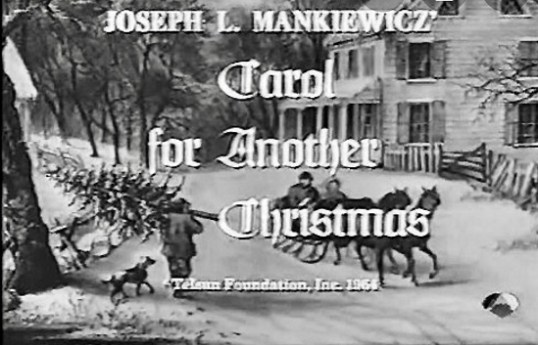
Holiday Film Review: Carol For Another Christmas (dir by Joseph L. Mankiewicz)


Daniel Grudge (Sterling Hayden) is a wealthy American industrialist who served in World War II and who, despite seeing first hand the horrors of Hiroshima, still believes that war is sometimes the only answer.  He spends his Christmas Eve sitting in darkened study, thinking about his dead son (who was killed in combat) and listening to an old record.  When his nephew, Fred (Ben Gazzara), stops by, it leads to an argument about American foreign policy.  (Who stops by their uncle’s house on Christmas Eve to argue politics?)  Fred is do-gooder.  Daniel Grudge hates do-gooders.

So, naturally, it’s time for Daniel Grudge to be visited by three ghosts!  The Ghost of Christmas Past (Steve Lawrence) takes Grudge first to a troop ship that is full of coffins, representing the dead of World War I.  Then he forces Grudge to relive his own callous reaction to Hiroshima.  Grudge sees how his actions upset the nurse (Eva Marie Saint) who was traveling with him.  The Ghost of Christmas Present (Pat Hingle) invites Grudge to eat a feast in front of a camp full of refugees.  The Ghost of Christmas Future (Robert Shaw) takes Grudge to the future where, after a devastating nuclear war, a buffoonish leader (Peter Sellers) encourages his followers to continue to make war and to live only for themselves.  Grudge watches as his former butler (Percy Rodriguez) is murdered for advocating for peace.  Back at his mansion, Fred shows up again and Grudge must now decide …. will he support the work of the United Nations?

YEEEEESH!  What a heavy-handed movie!  Really, I guess I shouldn’t be surprised at how unsubtle the film’s message was.  Originally made for television, A Carol For Another Christmas was actually co-produced by the United Nations.  It was the first of four UN-produced films that aired on ABC between 1964 and 1966.  Seen today, with all that we know about the UN’s signature mix of corruption and incompetence, the film’s message seems almost laughably naïve.   “Only the UN can bring peace,” the film says.  Tell that to Israel, the next time that the UN passes a resolution condemning it for existing and defending itself.  Say that only the UN can make the world a better place when some of the worst dictatorships on the planet are sitting on the Human Rights council.

The heavy-handed message aside, A Carol For Another Christmas was full of talent both behind and in front of the camera.  This was the only TV movie to be directed by Joseph L. Mankiewicz and, whatever else one might say about the film, he was responsible for some intriguingly moody shots.  The script was written by Rod Serling who, unfortunately, allowed his didactic tendencies to get the better of him and wrote a film where characters didn’t have conversations as much as they just gave speeches.  The cast, however, is uniformly strong.  Sterling Hayden, Robert Shaw, and Steve Lawrence are obvious stand-outs.  Pat Hingle does fine until his role is diminished to one long harangue.  Playing the so-called “Imperial Me,” Peter Sellers brings so much needed unpredictability to the film, even if his character is saddled with the film’s most heavy-handed moment.  The Imperial Me teaches his followers that the individual is more important than the state and that everyone should focus on “me” instead of “we.”  Cutting-edge satire this is not and again, there’s something rather offensive about the UN being held up as humanity’s last hope against rampant individualism. 

This is very much a film of its time.  The fear of nuclear war runs through every frame.  The disillusionment that came with the assassination of John F. Kennedy is present in the film’s open-ended conclusion.  What good is convincing one man when the rest of the world continues to think for itself? the film seems to be asking.  Dickens, I think, would probably say that Serling missed the point of A Christmas Carol and it’s hard not to feel that Dickens would be correct.

Horror Scenes That I Love: Anthony Sends Dan To The Cornfield in The Twilight Zone


“You’re a very bad man!”

Today’s horror scene that I love comes not from film but from television.  In this episode of The Twilight Zone (entitled “It’s A Good Life”), the citizens of a rural community have to go out of their not to upset a rather unpredictable six year-old.

What happens when you upset little Anthony Fremont?

Take a look:

Written by Rod Serling and directed by James Sheldon, this episode originally aired on November 3, 1961.

TV Review: Night Gallery 2.1 “The Boy Who Predicted Earthquakes/Miss Lovecraft Sent Me/The Hand of Borgus Weems/Phantom of What Opera?”


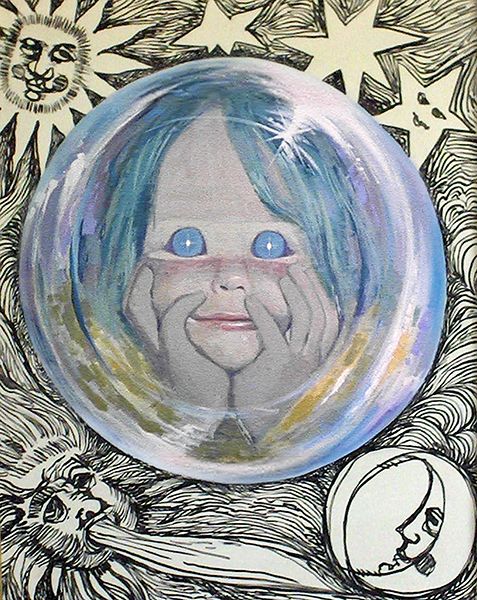
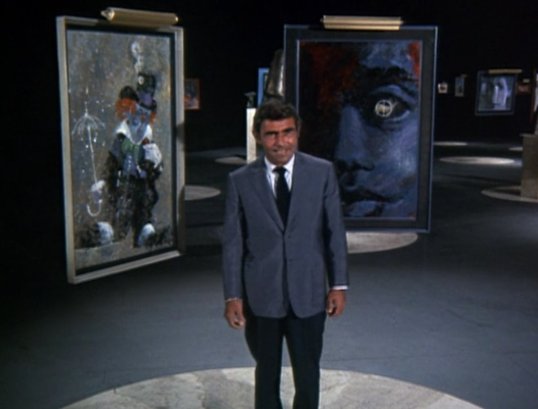
The second season of Night Gallery premiered on September 15th, 1971.  Once again, Rod Serling led viewers through a darkened museum, inviting them to look upon macabre paintings and imagine the story behind image.

The first episode had four — that’s right, four! — different stories!  Apparently, the show’s producers demanded that, for the 2nd season, each episode feature shorter stories along with some light-heated segments.  From what I’ve read, Rod Serling was not particularly happy with the directive and it’s perhaps significant that, after writing every story featured in Night Gallery‘s first season, he only wrote one of the stories featured in the second season premiere.

The Boy Who Predicted Earthquakes (dir by John Badham, written by Rod Serling)

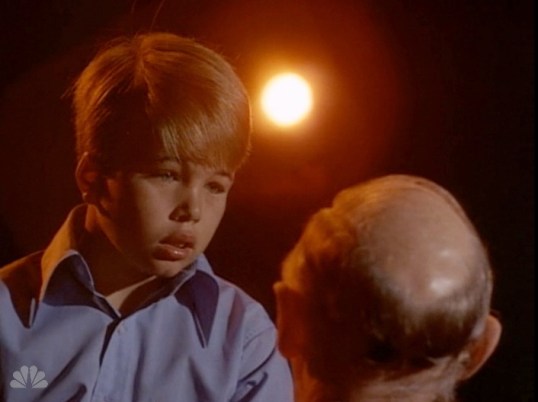
Herbie (played by 12 year-old Clint Howard, younger brother of Ron) is a little boy with a very special gift.  He can see the future.  He seems like a normal child, the type who rambles about random subjects except that, at random, he’ll suddenly stop and ominously predict the future.  After Herbie correctly predicts both the rescue of a missing girl and an earthquake, Herbie is given his own TV show.  For a year, Herbie makes predictions, all of which come true.  Then, suddenly, Herbie refuses to shares his latest prediction and says that he doesn’t want to do the show anymore.  What has Herbie seen and is it a good thing or a bad thing?

The Boy Who Predicted Earthquakes gets the second season of Night Gallery off to a good start.  Centered by a natural performance from Clint Howard, The Boy Who Predicted Earthquakes is an intelligently written and thought-provoking story.  Not only does it examine the burden of being able to see the future but it’s also a provocative look at how society exploits the gifted.  With the exception of Herbie’s grandfather (William Hansen), the people around Herbie are less concerned with what he predicts than that people keep watching.  The segment ends on an appropriately dark note, one that will keep the viewer thinking.

Miss Lovecraft Sent Me (dir by Gene Kearney, written by Jack Laird)

A gum-chewing babysitter (Sue Lyon) show up for her latest job.  It’s at a castle!  And the owner of the castle (played by Joseph Campanella) has gray skin, is wearing a cape, and has a Transylvanian accent!  What could it all mean?

This is a short comedic segment.  Apparently, the producer of Night Gallery, Jack Laird, had the idea to liven things up with sketches like this one.  Serling was apparently not a fan of the idea but Miss Lovecraft Sent Me isn’t that bad.  It’s silly and insubstantial because Joseph Campanella and Sue Lyon handled their roles well.  It’s impossible not to laugh when the babysitter reads aloud the names of the books that Campanella has sitting on his bookshelf.

The Hand of Borgus Weems (dir by John M. Lucas, written by Alvin Sapinsley)

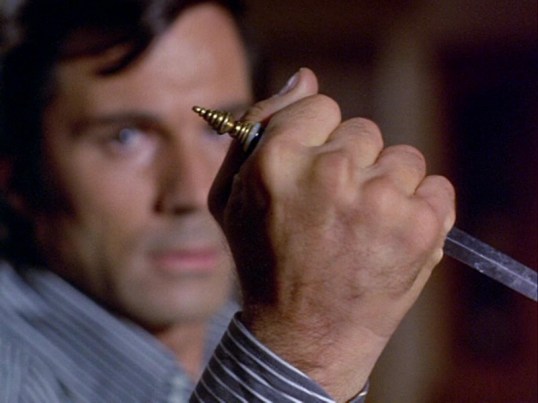
Peter Lacland (George Maharis) sits in a doctor’s office and asks Dr. Ravadon (Ray Milland) to remoe his right hand.  Peter explains that his right hand has a mind of its own and that it keeps trying to kill everyone who Peter comes into contact with.  Peter explains that his hand has been possessed!

There’s a surprisingly large number of stories out there about possessed hands.  The Hand of Borgus Weems doesn’t necessarily bring anything new to the genre and it gets a bit bogged down with its flashback structure but it’s still an enjoyably creepy little segment, featuring good performances from George Maharis and Ray Milland.  Possessed hands are also creepy, no matter what.  Like The Boy Who Predicted Earthquakes, it also has an effective ending, which is quite a contrast to the often insubstantial conclusions of Night Gallery’s first season.

Phantom Of What Opera?  (written and dir by Gene Kearney)

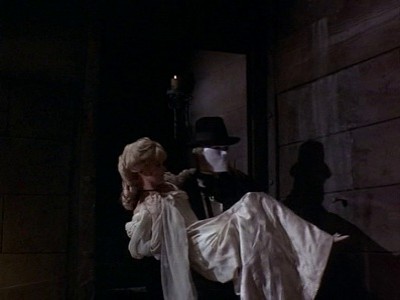
This is a short, 4-minute comedic story — a skit really — featuring Leslie Nielsen as the Phantom of the Opera and Mary Ann Beck as Christine. This version starts out like a typical Phantom segment, with the Phantom kidnapping Christine, taking her down to the dungeon, and telling her never to remove his mask.  Christine, of course, removes his mask while he’s playing the organ just for him to then discover that she’s also wearing a mask.  It all leads to love and a happy ending!  It’s kind of a sweet segment, actually.

So the 2nd season of Night Gallery got off to a pretty good start!  Would future episodes continue the trend?  We’ll find out soon as I continue to watch Night Gallery.

Previous Night Gallery Reviews:

  1. The Pilot
  2. The Dead Man/The Housekeeper
  3. Room With A View/The Little Black Bag/The Nature of the Enemy
  4. The House/Certain Shadows on the Wall
  5. Make Me Laugh/Clean Kills And Other Trophies
  6. Pamela’s Voice/Lone Survivor/The Doll
  7. They’re Tearing Down Tim Riley’s Bar/The Last Laurel

TV Review: Night Gallery 1.6 “They’re Tearing Down Tim Riley’s Bar/The Last Laurel)


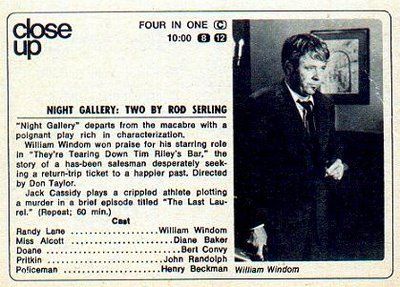
The first season of Night Gallery came to a conclusion on January 20th, 1971.  Though the first season was undoubtedly uneven, it did end on a high point.  The first segment in the 6th episode, They’re Tearing Down Tim Riley’s Bar, is widely considered to be the best episode of Night Gallery and one of Rod Serling’s best teleplays.  It also brought Night Gallery one of it’s few Emmy nominations when it was nominated for Outstanding Single Program of the year.  (It lost to The Andersonville Trial, a theatrical adaptation that was produced for PBS.)

They’re Tearing Down Tim Riley’s Bar (dir by Don Taylor, written by Rod Serling)

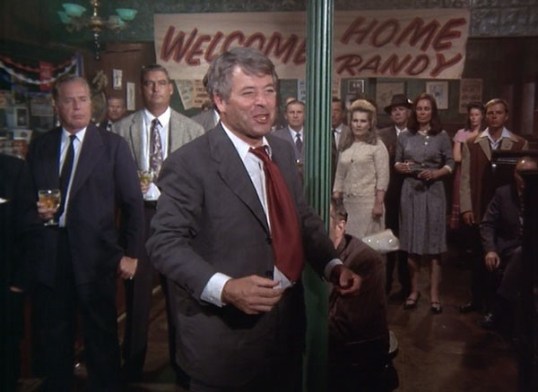
They’re Tearing Down Tim Riley’s Bar tells the story of Randy Lane (William Windom).  In 1945, Sgt. Randy Lane returned home from serving in World War II, a war hero who had a wonderful future ahead of him.  He had just gotten married.  He had just gotten a good job at an up-and-coming company called Pritzker Plastics.  When he came home, the first place he went was Tim Riley’s Bar, where his father and the other bar patrons toasted him and told him to look forward to the future.

Twenty-five years later, the middle-aged Randy Lane is looking at his life and asking, “Is this as good as it gets?”  He’s now a sales director at Pritzker Plastics but his boss (John Randolph) doesn’t appreciate him, his assistant (Bert Convy) is plotting to steal his job, and the only person who seems to care about him is his sympathetic secretary (Diane Baker).  Randy’s wife died in 1952, while Randy was out of a sales call.  Randy now lives alone.  Even his neighborhood bar — Tim Riley’s Bar — has closed and been abandoned.  With the bar schedule to be torn down, Randy wonder what happened to all of the promise and happiness of the past.

When Randy goes by the deserted bar and looks through the front window, he’s shocked to see all of his old friends and his father waving at him.  But when Randy rushes into the bar to join them, he discovers the bar is deserted.  Later, Randy is at work when suddenly, he sees Pritzker Plastics the way it was back in 1948.  Even later, when he enters his house, he finds himself standing in a hospital hallway in 1952, once again getting the news that his wife has died.

In many ways, They’re Tearing Down Tim Riley’s Bar is an atypical Night Gallery segment.  Though there are hints of the supernatural throughout the story, it’s hardly a work of horror.  Instead, it’s a rather melancholy meditation on aging, disappointment, and regret.  Is the past forever lost?  Can things ever be as good as they once were?  These are the questions that are raised in this well-directed and well-acted segment.

The Last Laurel (dir by Daryl Duke, written by Rod Serling)

Clocking in at 8 minutes, The Last Laurel is yet another segment about a bitter man (in this case, Jack Cassidy) who suspects that his wife (in the case, Martine Beswick) is cheating on him with his doctor (in this case, Martin E. Brooks) so he teaches himself a supernatural skill in order to get revenge.  In this case, it involves astral projection.  Not surprisingly, it ends with a twist that’s pretty much dependent on one of the characters doing something extremely stupid.

The Last Laurel is well-acted but predictable.  It’s not bad but, especially when compared to something like They’re Tearing Down Tim Riley’s Bar, it feels rather insubstantial.  It feels like filler.

The first season of Night Gallery came to an end with an excellent episode.  Starting tomorrow — season 2!

Previous Night Gallery Reviews:

  1. The Pilot
  2. The Dead Man/The Housekeeper
  3. Room With A View/The Little Black Bag/The Nature of the Enemy
  4. The House/Certain Shadows on the Wall
  5. Make Me Laugh/Clean Kills And Other Trophies
  6. Pamela’s Voice/Lone Survivor/The Doll

TV Review: Night Gallery 1.5 “Pamela’s Voice/Lone Survivor/The Doll”


The fifth episode of Night Gallery originally aired on January 13th, 1971.  It featured three stories, each one of which was introduced by Rod Serling walking through a darkened museum.

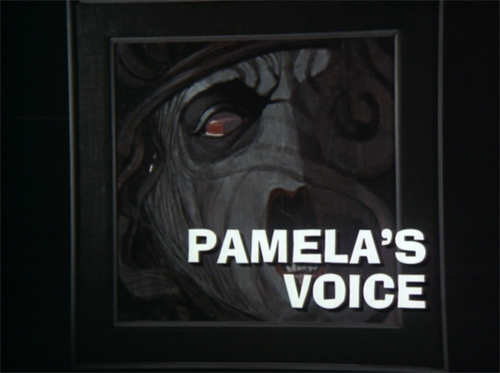
Pamela’s Voice (dir by Richard Benedict, written by Rod Serling)

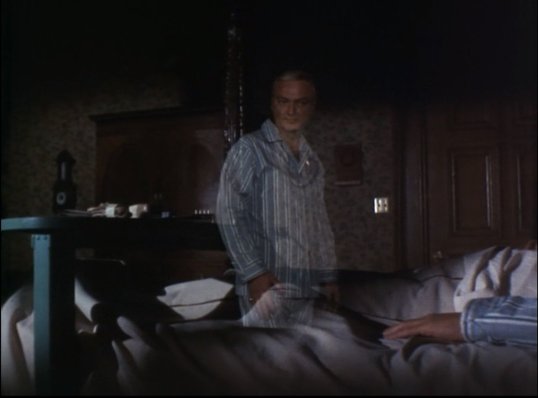
Jonathan (John Astin) kills his wife, Pamela (Phyllis Diller), because he’s sick of listening to her shrill voice.  However, it turns out that not even death can stop Pamela.  While Jonathan is staring at a coffin, he starts to hear Pamela’s voice.

At first, you might think that this is going to be one of those stories where it’s going to turn out that the murderer has been driven made by his crimes and he’s imagining being taunted by his victim.  But then Pamela makes an post-death appearance herself and the story reveals it’s final twist.

For the most part, Pamela’s Voice is entertaining.  Both John Astin and Phyllis Diller give such eccentric performances that their fun to watch even if the majority of the audience will be able to guess this segment’s big twist.

Lone Survivor (dir by Gene Levitt, written by Rod Serling)

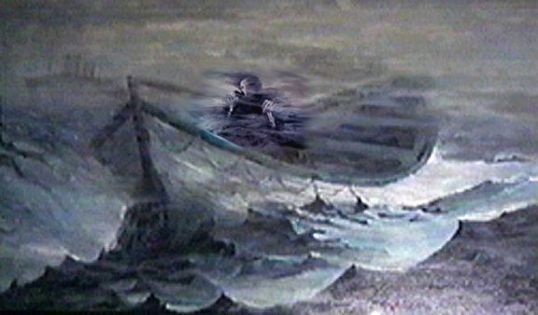
This wonderfully atmospheric story opens in 1915, with the crew of the Lusitania discovering a man (John Colicos) floating in a lifeboat.  The lifeboat is from the Titanic and the man, who claims to be a crewmember of that doomed ship, is wearing a dress, leading the ship’s doctor to assume that the man survived the sinking of the Titanic by pretending to be a woman and stealing someone else’s rightful spot in the lifeboat.

At first, his rescuers are skeptical.  If the man was indeed a survivor of the Titanic, that would mean that he had spent the past three years floating in that lifeboat?  How could the man have survived?  And, assuming that he is telling the truth about the ship that he came from, what has now brought him to the Lusitania?  Could the man possibly be a German spy?  After all, World War I has just broken out and the sea is no longer as safe as it once was….

Lone Survivor is an example of this often uneven show at its best.  It’s a genuinely creepy short film, one that ends on a frightening and rather sad note.  Lone Survivor is the tale of man trying to escape both his own guilt and the whims of fate and discovering that neither can be easily conquered.  In the main role, John Colicos gives a wonderfully intense and haunted performance.

The Doll (dir by Rudi Dorn, written by Rod Serling)

“Our painting is called The Doll,” Rod Serling says as he introduces this one, “and it’s one that you better not play with.”  Truer words were never spoken!

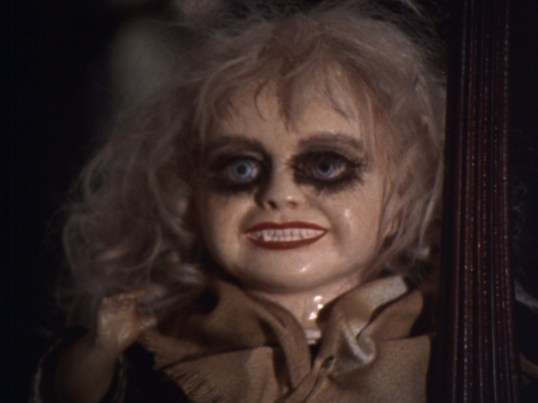
In this one, British Col. Hymber Masters (John Williams) returns home from India and discovers that his niece (Jewel Branch) has a new doll.  Someone mailed the doll to her.  Everyone assumed that Col. Masters sent the doll but he actually had nothing to do with it.  Masters is not happy to see his niece carrying around that doll and it makes sense when you consider just how ugly the doll is.  I mean, this is one creepy doll!

It turns out that the Masters was correct to be concerned because the doll was sent by Pandit Chola (Henry Silva), who holds Masters responsible for the death of his brother.  The doll has been sent to take revenge….

The Doll is another triumph, largely because the doll itself is so creepy that it looks like something that sprung straight out of a nightmare.  John Williams does a good job playing the well-meaning if somewhat stuffy colonel and Henry Silva is well-cast as the villain of the piece.  This segment deserves a lot of credit for taking a fanciful story and playing it totally straight.

The fifth episode of Night Gallery is a triumph.  After a run of uneven episodes, this episode is consistently creepy and entertaining.  For this episode, at least, Night Gallery lived up to its potential.

Previous Night Gallery Reviews:

  1. The Pilot
  2. The Dead Man/The Housekeeper
  3. Room With A View/The Little Black Bag/The Nature of the Enemy
  4. The House/Certain Shadows on the Wall
  5. Make Me Laugh/Clean Kills And Other Trophies

Night Gallery 1.4 “Make Me Laugh/Clean Kills And Other Trophies”


The fourth episode of Night Gallery originally aired on January 6th, 1971.  It was the first episode of the new year and it continued to open with Rod Serling walking through a most curious museum, inviting us to take a look at the macabre paintings on display and consider the stories behind them.

This episode featured two stories.

Make Me Laugh (dir. by Steven Spielberg, written by Rod Serling)

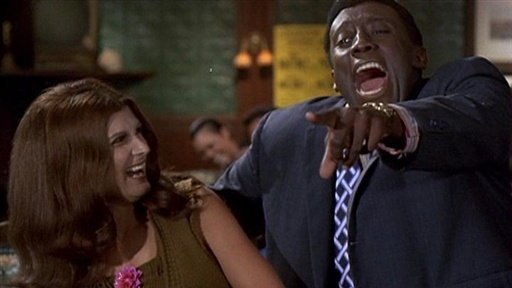
Jackie Slater (Godfrey Cambridge) is a comedian who can’t make anyone laugh.  He’s just been fired from his latest job and even his loyal agent (Tom Bosley) is suggesting that it might be time to throw in the proverbial towel.  While Jackie drowns his sorrows at a bar, he’s approached by a man named Catterje (Jackie Vernon).  Chatterje explains that he can cast miracles but, because he’s not very good at his job, the miracles often have unintended consequences.  “I don’t care!”  Jackie says, “I’ll take the risk!”  Jackie wants people to laugh at him.  Jackie gets his wish but it turns out that he should have listened to Chatterje’s warning.

This segment was directed by Steven Spielberg, back when he was just starting his career and he was largely working in television.  Spielberg also directed Eyes, which was a highlight of the Night Gallery pilot.  Unfortunately, his direction of Make Me Laugh is a bit less successful than his work on Eyes.  Spielberg’s direction features none of the inspired touches that made Eyes so successful.  Part of the problem may be that this story takes place in the word of comedy and comedy has never been a topic for which Spielberg has shown much affinity.

Make Me Laugh does feature a good lead performance from Godfrey Cambridge.  Otherwise, this segment is largely forgettable.

Cleans Kills And Other Trophies (dir by Walter Doniger, written by Rod Serling)

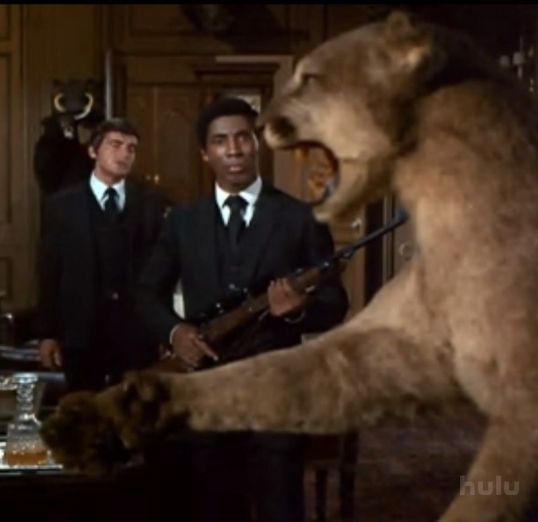
Raymond Massey plays Col. Archie Dittman, a wealthy racist who is obsessed with hunting and killing.  He even has a study full of the mounted heads of all of the animals that he’s killed.  Archie’s son, Archie, Jr. (Barry Brown), has just graduated from college and has no interest in hunting.  Col. Dittman demands that his son go on a hunt or risk being disinherited.  What the colonel fails to take into consideration is that both his bloodlust and his racism has offended his butler (Herbert Jefferson, Jr.) and that his butler has a magic-related revenge in mind.

Clean Kills and Other Trophies is hardly subtle but it does create and maintain a properly ominous atmopshere.  Raymond Massey gives a wonderfully villainous performance and it’s hard not to be amused by the fact that his son is wearing a peace signal prominently on his lapel, as if the segment’s director took one look at it and said, “What’s one thing that we can do to make the themes of this segment even more heavy-handed?”  The segment ends on a note that is so entertainingly over-the-top that it’s hard not to love it.

This episode was uneven.  Make Me Laugh does’t quite work but Cleans Kills and other Trophies is good enough to make up for the disappointing segment that precedes it.

Previous Night Gallery Reviews:

  1. The Pilot
  2. The Dead Man/The Housekeeper
  3. Room With A View/The Little Black Bag/The Nature of the Enemy
  4. The House/Certain Shadows on the Wall

TV Review: Night Gallery 1.3 “The House/Certain Shadows on the Wall”


The third episode of Night Gallery aired on December 30th, 1970.  While Americans were undoubtedly finalizing their plans for a wild New Year’s Eve (because, after all, Nixon was president and every day was a party), NBC and Rod Serling invited viewers to take a tour through a darkened museum, one where every painting told a story.

This episode of Night Gallery featured two stories:

The House (dir by John Astin, written by Rod Serling)

The House opens with Elaine Latimer (Joanna Pettet) talking about a recurring dream.  She’s driving her car through the countryside when she comes across a large house.  Though she’s never seen the house, she finds herself drawn to it, as if she somehow belongs in the house.  As Elaine describes her dream, we come to realize that she’s talking to a psychiatrist (Steve Franken) and that Elaine is recovering from mental breakdown.  Her doctor tells Elaine that the dream is nothing to worry about.

However, when Elaine is driving home, she realizes that the countryside looks familiar.  Soon, she’s pulling up in front of the house from her dreams!  When Elaine gets out of the car, she’s greeted by a real estate named Peugeot (Paul Richards) who asks her if she’s interested in buying the house.  As Peugeot gives her a tour of the estate, he mentions that the house is thought to be haunted….

I liked The House.  It was an atmospheric little tale and, from the minute that Elaine started talking about her dream, the story captured my attention.  (I should admit that I also have recurring dreams about a house that I’ve never actually seen before.)  Admittedly, the story does play out at a very deliberate pace and requires a bit of patience but the dream sequences are effectively surreal and Joanna Pettet gives an empathetic performance in the lead role.

Certain Shadows On The Wall (dir by Corey Allen, written by Rod Serling)

This segment features Agnes Moorehead as the sickly Emma, who is poisoned by her own brother, the despicable Stephen (Louis Hayward).  After Emma’s death, Stephen is shocked to discover that, even though Emma is gone, her shadow remains on the wall.  While Stephen is trying to make sense of that, his other two sisters (played by Grayson Hall and Rachel Roberts) have plans of their own for how to deal with their duplicitous brother.

Like The House, Certain Shadows On The Wall is appropriately atmospheric.  The ending is a bit weak as Stephen gets what he deserves but the shadow itself doesn’t have much to do with his actual fate.  Just when you’re waiting for Agnes Moorehead to make a sudden, ghostly appearance, the story comes to an end.  Still, this is an effective segment and it features excellent work from its ensemble.  I especially liked the performance of Grayson Hall, which features one of the most frightening glares that I’ve ever seen.

The third episode of Night Gallery was a definite improvement over the two that came before it.  Both segments tell intriguing stories, though it’s obvious that the show was still better at coming up with good premises than effective endings.

Previous Night Gallery Reviews:

  1. The Pilot
  2. The Dead Man/The Housekeeper
  3. Room With A View/The Little Black Bag/The Nature of the Enemy

TV Review: Night Gallery 1.2 “Room With A View/The Little Black Bag/The Nature of the Enemy”


The second episode of Night Gallery originally aired on December 23rd, 1970 and it featured three stories, two of which were written by Rod Serling.  Serling, himself, introduced all three of the stories by inviting us to look at the paintings that may or may not have been inspired from them.

Room With A View (dir by Jerrold Freedman, written by Hal Dresner)

When a cranky, bed-bound man (Joseph Wiseman) discovers this his wife (Angel Tompkins) is cheating on him, he comes up with an elaborate scheme to get revenge.  It all hinges on his somewhat nervous nurse (Diane Keaton), who has no idea that she’s being manipulated.

This short segment is well-done but it doesn’t really feel like it belongs on an episode of Night Gallery.  There’s no elements of horror or science fiction to be found in this story.  Instead, it’s just about a manipulative man seeking revenge on his wife.  It’s actually easy to imagine this segment as being a flashback on a Monk-style detective show.  You just need a detective saying, “I finally figured out how you did it!”

For most viewers, probably the most interesting thing about this segment will be the presence of a young Diane Keaton, playing the nurse and laughing nervously at her patient’s rather intrusive questions.

The Little Black Bag (dir by Jeannot Szwarc, written by Rod Serling)

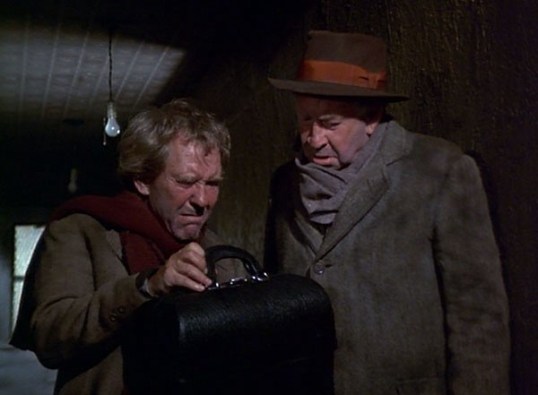
In the 30th Century, a careless accident at a time travel station sends a black medical bag into the past.  It arrives in 1971, where it’s discovered by two homeless gentlemen.  One of the men is a disgraced former doctor named William Fall (Burgess Meredith).  The other, Hepplewhite (Chill Wills), has no medical experience but he does have a greedy spirit.  Fall wants to use the bag to do good,  Hepplewhite wants to use the bag to make money.  Meanwhile, in the future, poor put-upon Gillings (George Furth) is just trying to figure out what to do about the missing bag.

The Little Black Bag is this episode’s high point, featuring good performances from Meredith, Wills, and Furth and also ending with properly macabre twist.  This is another Rod Serling story about how terrible, at heart, most people are but Jeannot Szwarc’s direction is fast-paced and he never allows things to get too heavy-handed.

The Nature of the Enemy (dir by Allen Reisner, written by Rod Serling)

NASA’s latest expedition to the Moon has run into trouble.  The astronauts have discovered that there is something living on the lunar surface.  On Earth, the director of NASA (Joseph Campanella) tries to keep everyone calm while also figuring out the nature of the enemy.

This segment has an intriguing premise but it’s let down by a so-so execution.  Like a lot of less-than-effective Night Gallery segments, this one features a story that doesn’t so much conclude as it just stops after a somewhat weak punchline.

So, the second episode of Night Gallery was not an improvement on the first and it was nowhere close to matching the pilot.  Watching this episode, it was hard not to feel that the show had a few growing pains.  Did it want to be a horror anthology or a collection of short skits?  The 2nd episode reveals a show that was still trying to find it’s voice.

Previous Night Gallery Reviews:

  1. The Pilot
  2. The Dead Man/The Housekeeper