Retro Television Review: The American Short Story Episode 7: The Displaced Person


Welcome to Retro Television Reviews, a feature where we review some of our favorite and least favorite shows of the past!  On Saturdays, I will be reviewing The American Short Story, which ran semi-regularly on PBS in 1974 to 1981.  The entire show can be purchased on Prime and found on YouTube and Tubi.
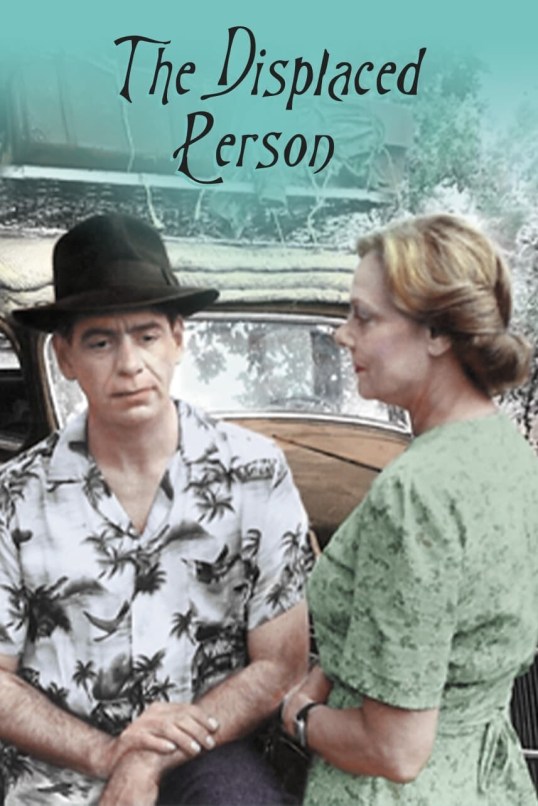
This week, we have an adaptation of Flannery O’Connor’s longest short story.

Episode #7: “The Displaced Person”

(Dir by Glenn Jordan, originally aired in 1977)

Life at a Georgia farm is thrown into turmoil when the farm’s owner, widow Mrs. McIntyre (Irene Worth), agrees to give a job to a Polish refugee named Mr. Guizac (Noam Yerushalmi).  As World War II has just ended and Father Flynn (John Houseman) has assured Mrs. McIntyre that Guizac can drive a tractor, Mrs. McIntyre is happy to give Guizac a home in America.  Less happy are the people who already work at the farm, most of whom see the hard-working Guizac as being a threat.  Mrs. Shortley (Shirley Stoler) worries that her husband (Lane Smith) is going to lose his job to Guizac.  Meanwhile, a young farmhand named Sulk (Samuel L. Jackson) enters into a business arrangement with Guizac, one that causes Mrs. McIntyre to change her opinion of Guizac.  Needless to say, it all ends in tragedy.

This adaptation is based on a short story that Flannery O’Connor wrote after her own mother hired a family of Polish refugees to work at their family farm, Andalusia.  This adaptation was actually filmed at Andalusia, only a few months after Flannery O’Connor’s death.  The furniture seen in the house was O’Connor’s own furniture.  The peacocks the drive Mrs. McIntyre crazy and which cause Father Flynn to have a religious epiphany are the same peacocks that roamed the farm when Flanney O’Connor lived there.  The cemetery that Mrs. McIntyre visits is the O’Connor family cemetery.  It brings a sense of authenticity to the film, one that is often missing from films made about the South.

The adaptation moves at a deliberate pace but it’s well-acted and it stays true to O’Connor’s aesthetic.  Those who might complain that there are only two likable characters in the film — Mr. Guizac and Father Flynn — are missing the point of O’Connor’s story.  Even Mrs. McIntyre, who initially seems to be trying to do the right thing, is blinded by the prejudices of race and class.  Father Flynn never gives up on trying to redeem both Mrs. McIntyre and the rest of the world but one gets the feeling that he might be too late.

The cast is what truly makes this adaptation stand-out.  Irene Worth, John Houseman, Lane Smith, Robert Earl Jones, they all give excellent performances.  Samuel L. Jackson was very young when he appeared in The Displaced Person but he already had the screen presence that has since made him famous.  The best performance comes from Shirley Stoler, who plays Mrs. Shortley as being a master manipulator who, unfortunately, happens to be married to a worthless man.  Mrs. Shortley does what she does to protect her husband.  Mr. Shortley does what he does because he’s a loud mouth bigot.  Everyone has their own reasons, to paraphrase Jean Renoir’s The Rules of the Game.  In this story, those reasons lead to tragedy.
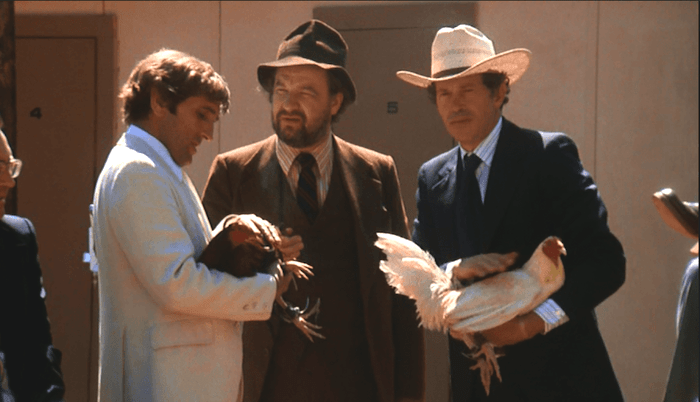
Brad reviews COCKFIGHTER (1974), starring Warren Oates!


I read about the movie COCKFIGHTER many years ago, and I remember the review being very positive. I had never watched the film before, but with today being Warren Oates’ birthday and it being available on Amazon Prime, I decided I’d finally watch it. 

Directed by Monte Hellman and based on Charles Willeford’s 1962 novel, COCKFIGHTER introduces us to Frank Mansfield (Warren Oates), a man completely obsessed with the southern “sport” of cockfighting. As we meet him, he’s in the process of losing a bet and a cockfight with Jack Burke (Harry Dean Stanton). The loss isn’t just a setback, it costs him all of his cash, his truck, his trailer, and his current girlfriend Dody White (Laurie Bird). We also notice in these early scenes that Frank only communicates through sign language and writing notes. It seems that he’s been living under a self-imposed vow of silence. Two years earlier, on the eve of the big, season-ending cockfighting grand finale, Frank’s big-mouthed braggadocio caused him to lose his prized cock, and the prestigious “Cockfighter of the Year” medal in a meaningless hotel bet, also against Jack Burke. Frank vows not to speak again until he wins that medal. Coming up with cash in the only way he can by selling his family’s home, Frank buys a new cock named White Lightning from Ed Middleton, played here by the film’s writer Charles Willeford. Armed with new fowl and a new, capital rich partner named Omar Baradansky (Richard B. Shull), Frank will not let anything stop him, including the love of his life Mary Elizabeth (Patricia Pearcy) or an axe wielding competitor (Ed Begley, Jr.), from being named “Cockfighter of the Year” and finally regaining his voice and the respect he desires!

COCKFIGHTER definitely has some things going for it. First and foremost, Warren Oates is so good in the lead role as the obsessed man who puts success in cockfighting above anything else in his life, including every other person. He literally sells the family home out from under his alcoholic brother Randall (Troy Donahue) in order to fund his next cock purchase after he’s gone bust. This sets up quite the sight gag for such a gritty and realistic film as a large truck and trailer drives away the family home taking up the entire state highway. When his long time fiancé asks him to give up cockfighting, he just gets up, leaves her shirtless and heads back out on the circuit. He writes her a letter from the road and tells her he loves her, but he also makes it clear that life without cockfighting is a life that he’s unwilling to live. Oates’ Frank Mansfield is not the kind of person you’d ever want to depend on in life, but he’s also an uncompromising individual who is determined to live life wholly on his own terms, accepting of the successes and failures that come with it. I watched the film because it features Warren Oates, and after having done so, I can say that his performance is truly special. 

COCKFIGHTER is one of those movies that makes us feel like we’re watching real people, and that’s kind of fascinating even if they reside in a world that we don’t really want to live in. The primary credit for that has to go to director Monte Hellman and Oscar winning cinematographer Nestor Almendros (DAYS OF HEAVEN). The restraint that is shown in the storytelling, as well as the sweaty, ramshackle authenticity of the Georgia locations, brings the story to life. The supporting cast also does its part to create the world of COCKFIGHTER. Harry Dean Stanton as Jack Burke, Frank’s primary rival in the cockfighting game, is excellent as you might expect, and he seems a lot like a regular guy. I really like Richard B. Schull, who plays Frank’s outgoing and talkative partner Omar. His friendly and gregarious personality seems a little untrustworthy at first, but he turns out to be the most likable person in the film. And finally, I want to shoutout Charles Willeford. Not only did he write the source novel and screenplay for COCKFIGHTER, he also gives a solid performance as Ed Middleton, an old-timer in the game who treats Frank with honesty and decency when he’s hit rock bottom. 

With all the positive things I’ve said above, I have to address the graphic depiction of cockfighting in COCKFIGHTER. This was the 70’s, and the scenes shown here are real and were very difficult for me to watch. It’s not fun to see animals fight and kill each other, and this is coming from a person who loves fried chicken and is not particularly an animal lover. The scenes are presented as matter of fact and in service of the story, but that still doesn’t make them easy to watch. Director Monte Hellman has gone on record to express his personal disgust at even filming these scenes. While a movie made in the 1970’s probably couldn’t have been made without these sequences, I just wanted to make it clear that this film is probably unwatchable for a lot of people.

Overall, COCKFIGHTER is a relic of the 1970’s. It’s a gritty and realistic film, featuring a great central performance from Warren Oates. It’s also an ethically troubling film that features real animal on animal violence. Based on that I don’t necessarily recommend the film. Rather, I just want to share my own thoughts, and you can determine if you want to watch it or not. That’s what I’ve tried to do above. 

Maniac Cop 2 (1990, directed by William Lustig)


Maniac Cop 2 picks up where the first Maniac Cop ended.

The NYPD thinks that the undead maniac cop Matt Cordell (Robert Z’Dar) has been destroyed but he is actually still alive and killing civilians and cops in New York.  He has even teamed up with a serial killer named Steven Turkell (Leo Rossi, ranting and raving like a pro).  Jack Forrest (Bruce Campbell) and Theresa Malloy (Laurene Landon) both return from the first film but both of them are killed by Cordell before the movie is even halfway over.  Maniac Cop 2 is not playing around.

With Jack and Theresa gone, it falls to Detective Sean McKinney (Robert  Davi) and Officer Susan Riley (Claudia Christian) to discover what the rest of the audience already knows, that Cordell is seeking revenge against the system that abandoned him in prison.  The new police commissioner, Ed Doyle (Michael Lerner), is determined to cover up what happened but Cordell is even more determined to have his vengeance.  Working with Turkell, Cordell heads to the prison where he was unjustly incarcerated and murdered.

Maniac Cop 2 is a marked improvement on the first film.  Cordell is no longer a lumbering and slow monster.  He is now a ruthless, Terminator-style executioner who, in the film’s best-known scene, wipes out an entire police precinct in a matter of minutes.  Cordell is so ruthless that he won’t even stop when he’s on fire.  His partnership with Turkell adds a new twist to the Maniac Cop saga.  Turkell views Cordell as his partner-in-crime but Cordell is only interested in getting his revenge.  (Turkell was originally meant to be Frank Zito, the main character from Lustig’s Maniac.  When Maniac star Joe Spinell died before shooting began, the role was changed to Leo Rossi’s Steven Turkell.)

Stepping into the shoes of the main investigation, Robert Davi gives one of his best performances.  As opposed to the boring heroes of the first film (sorry, Bruce!), Davi’s Sean McKinney is just as obsessive and ruthless as Cordell.  Cordell sets fire and McKinney uses those fires to light his cigarettes.

William Lustig has described Maniac Cop 2 as being his best film and he’s probably right.  It is definitely the best of the Maniac Cop films and the only one to fully take advantage of its premise.

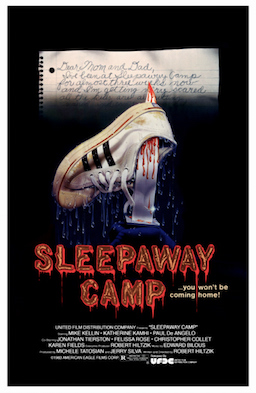
October Hacks: Sleepaway Camp (dir by Robert Hiltzik)


So much attention has been devoted to dissecting and discussing the ending of 1983’s Sleepaway Camp, that I think people tend to overlook the bigger issue.  This film is the biggest argument against summer camp over filmed.

Seriously, don’t send your kids to camp!  Don’t get a job working at a camp!  Don’t live anywhere near a camp!  If someone tries to open a camp near your home, gather together a posse and run them out of town!  If you discover an abandoned camp within one hundred miles of your home, set the place on fire!  Camps are bad news.  They attract bullies and tragedy and murder.  If there’s anything that I’ve learned from watching the horror movies of the early 80s, it’s that summer camps mean trouble.

Consider the camp in Sleepaway Camp.  Even before the murders start, the place comes across as being a prison camp.  Seriously, I’ve seen a lot of summer camps in a lot of slasher films and it’s hard to think of any of them that look as shabby and dirty as the camp in Sleepaway Camp.  None of the campers appear to be happy to be there.  No one is allowed to leave.  The campers are divided into two groups, the bullies who rule the place like mini-tyrants and the poor kids who spend the entire summer being beaten up and taunted.  Not even the counselors are worth much.  Counselor Meg (Katherine Kamhi) is best friends with the camp’s main mean girl, Judy (Karen Fields).  Meg is the type who tosses a camper in the lake, just because Judy tells her to.  Meanwhile, the owner of the camp is named Mel (Mike Kellin) and he’s just an old perv who doesn’t want to bothered with anyone’s problems.  What type of horrific world is this?

And then, let’s consider some of the murders at the camp.  The skeevy camp cook get scalded with boiling water.  (It’s debatable whether the cook actually dies or not.)  Kenny, one of the camp’s bullies, get drowned while playing a canoe-related prank.  Another bully is stung to death by bees.  That’s just three of the many deaths here and yet, the camp never closes.  It never occurs to the camp’s owner to send anyone home.  It never occurs to anyone that maybe they should send the campers to another camp.  None of the deaths lead to an increased police presence nor does it lead to any changes with the camp’s schedule.  None of the campers appear to be particularly upset by all the deaths.  It’s a disturbing world.

Everyone who dies at the camp earlier picked on Angela (Felissa Rose), an introvert who ends up getting targeted by Judy.  Angela’s cousin, Ricky (Jonathan Tiersten), is very protective of Angela and, as a result, he becomes the number one suspect.  As the film’s ending reveals, the truth is something much different.  The film ends with a justifiably famous shot and it does stick with you as the end credits role.  It’s tempting to read a lot of meaning into the film’s ending but I imagine that’s giving the filmmakers a bit too much credit.  The film was made for 1983 audiences who were looking for a shock, not 2023 cultural critics.

Even before that ending, though, Sleepaway Camp is a bit more creepy than the average 80s slasher film.  The killer is relentless and ruthless and it’s disturbing that the victimized campers are played by performers who are close to the age of their victims as opposed to the usual 30 year-old who played teenagers in these type of films.  The scene with the curling iron is something that I can only watching through the fingers that I’m holding in front of my eyes.  It’s not a great film by any stretch of the imagination but it does definitely capture the feel of being at the worst summer camp imaginable (seriously, one can hear the flies buzzing and even smell the stale order of stopped-up plumbing) and it does stick with you after you watch it.  It’s nothing to lose your head over, it’s just too bad no one told that to the campers.

Film Review: One Potato, Two Potato (dir by Larry Peerce)


The 1964 film, One Potato, Two Potato, is the story of two people who fall in love.

Julie Cullen (Barbara Barrie) was previously married to Joe (Richard Mulligan).  She’s divorced now and raising her daughter, Ellen (Marti Mericka), on her own.  Ellen was barely a year old when Joe abandoned his family and she’s never known her father.  Perhaps that’s for the best because, as we later see firsthand, Joe was an immature and abusive man.

Frank Hamilton (Bernie Hamilton) is quiet, responsible, and mild-mannered.  For the majority of the movie, the only time that we see Frank show any emotion is when he’s playing football with coworkers.  However, he’s obviously a sensitive and intelligent man.  He and Julie begin a relationship, tentatively at first.  But soon, they’re very much in love and planning to get married.

And really, there’s nothing unusual about either one of them.  They’re two genuinely nice people who met and fell in love.  The only thing that sets their romance apart from so many other romances is that Julie’s white and Frank’s black.  For that reason, Frank and Julie get harassed by the police when they try to enjoy a romantic stroll at night.  For that reason, Frank’s parents (played by Robert Earl Jones and Vinette Carroll) object to their relationship, saying that all the love in the world can’t overcome prejudice.  For that reason, when Frank and Julie do get married, hardly anyone comes to the wedding and the one bridesmaid glares at them throughout the ceremony.  Frank and Julie end up living on a farm with Frank’s parents, in love but practically isolated from the world.  (Tellingly, the “friend” who first introduced them doesn’t want to visit them after they marry.)  When Joe suddenly shows up and discovers that Julie has not only remarried but that her new husband is black, he goes to court and demands custody of his daughter.

It’s interesting think that, in 2019, it’s very easy to take interracial relationships (not to mention interracial marriages) for granted.  And yet, it wasn’t until 1967 (three years after the release of One Potato, Two Potato), that the U.S. Supreme Court officially ruled that laws against interracial marriage were unconstitutional.  One Potato, Two Potato was an early independent film, precisely because none of the major studios were willing to deal with an issue as controversial as interracial marriage.  (When the studios finally did deal with it, the end result was Guess Who’s Coming To Dinner, a film that was as safe and mild as One Potato, Two Potato was brave and angry.)  Barbara Barrie did win the best actress award at Cannes and the film itself received an Oscar nomination for Best Original Screenplay but otherwise, it’s a sadly neglected piece of film history.  If I hadn’t recorded it off of TCM, I probably never would have seen or even heard of this film.

And that would have been a shame because, along with being a valuable historical document, One Potato, Two Potato is a compelling and heartbreaking drama.  The film approaches its subject matter with a maturity and an honesty that probably stunned audiences back in 1964.  This film refuses to give into any of the well-intentioned clichés that often dominated films about racism in the 60s and 70s.  There are no sympathetic whites (à la Gregory Peck in To Kill A Mockingbird) willing to argue for Frank and Julie’s right to raise Ellen.  (In fact, the lawyer that they hire gets angry when Frank first approaches him and advises them to leave the state.)  It does Frank no good to be dignified and patient.  The racism in One Potato, Two Potato does not come from a handful of ignorant souls.  Instead, it’s built into the very system to which Frank and Julie are now having to appeal.

One Potato, Two Potato is also a rarity in that it’s a film that allows a black man to get angry about the way he’s being treated, even if it means making whites in the audience uncomfortable.  One need only compare the hopeful ending of Guess Who’s Coming To Dinner with the heart-breaking conclusion of One Potato, Two Potato.  Whereas Guess Who’s Coming To Dinner highlighted Sidney Poitier saying, in his dignified manner, that he has no interest in fighting the battles of the past, One Potato, Two Potato finds a distraught Bernie Hamilton watching a western and finally breaking down as he yells, “Kill that white bastard!”

One Potato, Two Potato ends with a title card that informs us that the story that we’ve seen is fictional but that the laws and the issues discussed in the film are real.  55 years after it was released, One Potato, Two Potato remains a compelling drama and an important historical document.


Lisa Reviews an Oscar Winner: The Sting (dir by George Roy Hill)


Earlier tonight, as a part of their 31 Days of Oscar, TCM aired The Sting, the film that the Academy selected as being the best of 1973.  I just finished watching it and what can I say?  Based on what I’ve seen of the competition (and there were a lot of great films released in 1973), I would not necessarily have picked The Sting for best picture.  However, the movie is still fantastic fun.

The Sting reunited the director (George Roy Hill) and the stars (Robert Redford and Paul Newman) of Butch Cassidy and the Sundance Kid and told yet another story of likable criminals living in the past.  However, whereas Butch Cassidy largely satirized the conventions of the traditional Hollywood western, The Sting is feels like a loving homage to the films of 1930s, a combination of a gritty, low-budget gangster film and a big budget musical extravaganza.  The musical comparison may sound strange at first, especially considering that nobody in The Sting randomly breaks out into song.  However, the musical score (which is famously dominated by Scott Joplin’s The Entertainer) is ultimately as much of a character as the roles played by Redford, Newman, and Robert Shaw.  And, for that matter, the film’s “let-pull-off-a-con” plot feels like an illegal version of “let’s-put-on-a-show.”

The film takes place in the 1936 of the cultural imagination, a world dominated by flashy criminals and snappy dialogue.  When con artists Johnny Hooker (Robert Redford) and Luther Coleman (Robert Earl Jones) inadvertently steal money from a gangster named Lonnegan (Robert Shaw), Lonnegan has Luther murdered.  Fleeing for his life, Hooker goes to Chicago where he teams up with Luther’s former partner, veteran con man Henry Gondorff (Paul Newman).  Gondorff used to be one of the great con artists but he is now living in self-imposed obscurity, spending most of his time drinking and trying to avoid the FBI.  Hooker wants to get revenge on Lonnegan by pulling an elaborate con on him.  When Gondorff asks Hooker why, Hooker explains that he can either con Lonnegan or he can kill him and he doesn’t know enough about killing.

The rest of the film deals with Hooker and Gondorff’s plan to con Lonnegan out of a half million dollars.  It’s all very elaborate and complicated and a bit confusing if you don’t pay close enough attention and if you’re ADHD like me.  But it’s also a lot of fun and terrifically entertaining and that’s the important thing.  The Sting is one of those films that shows just how much you can accomplish through the smart use of movie star charisma.  Redford and Newman have such great chemistry and are so much fun to watch that it really doesn’t matter whether or not you always understand what they’re actually doing.

It also helps that, in the great 70s tradition, they’re taking down stuffy establishment types.  Lonnegan may be a gangster but he’s also a highly respected and very wealthy gangster.  When Newman interrupts a poker game, Lonnegan glares at him and tells him that he’ll have to put on a tie before he’s allowed to play.  Lonnegan may operate outside the law but, in many ways, he is the establishment and who doesn’t enjoy seeing the establishment taken down a notch?

As entertaining as The Sting may be and as influential as it undoubtedly is (Steven Soderbergh’s Ocean films may be a lot more pretentious — which makes sense considering that Soderbergh is one of the most pretentious directors in film history — but they all owe a clear debt to The Sting), it still feels like an unlikely best picture winner.  Consider, for instance, that The Sting not only defeated American Graffiti and The Exorcist but Ingmar Bergman’s Cries and Whispers as well.  On top of that, when you consider some of the films that were released in 1973 and not nominated — Mean Streets, Badlands, The Candy Snatchers, Day of the Jackal, Don’t Look Now, Jesus Christ Superstar, and The Long Goodbye — it’s debatable whether The Sting should have been nominated at all.  That’s not a criticism of The Sting as much as it’s an acknowledgement that 1973 was a very good year in film.

So, maybe The Sting didn’t deserve its Oscar.  But it’s still a wonderfully entertaining film.  And just try to get that music out of your head!