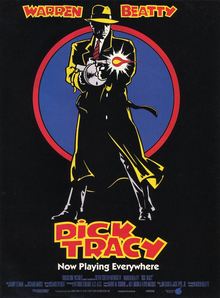
Dick Tracy (1990, directed by Warren Beatty)


The year is 1937 and “Big Boy” Caprice (Al Pacino) and his gang of flamboyant and often disfigured criminals are trying to take over the rackets.  Standing in their way is ace detective Dick Tracy (Warren Beatty), the yellow trench-wearing defender of the law.  Tracy is not only looking to take down Caprice but he and Tess Trueheart (Glenne Headly) are currently the guardians of The Kid (Charlie Korsmo), a young street kid who witnessed one of Caprice’s worst crimes.  Tracy’s investigation leads him through a rogue’s gallery of criminals and also involves Breathless Mahoney (Madonna), who has witnessed many of Caprice’s crimes but who also wants to steal Tracy’s heart from Tess.

Based on the long-running comic strip, Dick Tracy was a labor of love on the part of Warren Beatty.  Not only starring but also directing, Tracy made a film that stayed true to the look and the feel of the original comic strip (the film’s visual palette was limited to just seven colors) while also including an all-star cast the featured Madonna is an attempt to appeal to a younger audience who had probably never even heard of Dick Tracy.  When Dick Tracy was released, the majority of the publicity centered around Madonna’s participation in the film and the fact that she was dating Beatty at the time.  Madonna is actually probably the weakest element of the film.  More of a personality than an actress, Madonna is always Madonna no matter who she is playing and, in a film full of famous actors managing to be convincing as the members of Dick Tracy’s rogue gallery, Madonna feels out of place.  Michelle Pfeiffer would have been the ideal Breathless Mahoney.

It doesn’t matter, though, because the rest of the film is great.  It’s one of the few comic book films of the 90s to really hold up, mostly due to Beatty’s obvious enthusiasm for the material and the performances of everyone in the supporting cast who was not named Madonna.  Al Pacino received an Oscar nomination for playing Big Boy Caprice but equally good are Dustin Hoffman as Mumbles, William Forsythe as Flaptop, R.G. Armstong as Pruneface, and Henry Silva as Influence.  These actors all create memorable characters, even while acting under a ton of very convincing makeup.  I also liked Dick Van Dyke as the corrupt District Attorney.  Beatty knew audience would be shocked to see Van Dyke not playing a hero and both he and Van Dyke play it up for all its worth.  Beatty embraces the comic strip’s campiness while still remaining respectful to its style and the combination of Danny Elfman’s music and Stephen Sondheim’s songs provide just the right score for Dick Tracy’s adventures.  The film can be surprisingly violent at times but the same was often said about the Dick Tracy comic strip.  It wasn’t two-way wrist radios and trips to the Moon.  Dick Tracy also dealt with the most ruthless and bloodthirsty gangsters his city had to offer.

Dick Tracy was considered to be a box office disappointment when it was originally released.  (Again, you have to wonder if Beatty overestimated how many fans Dick Tracy had in 1990.)  But it holds up well and is still more entertaining than several of the more recent comic book movies that have been released.
Retro Television Review: St. Elsewhere 1.14 “Remission”


Welcome to Retro Television Reviews, a feature where we review some of our favorite and least favorite shows of the past! On Fridays, I will be reviewing St. Elsewhere, a medical show which ran on NBC from 1982 to 1988.  The show can be found on Hulu and, for purchase, on Prime!

It’s another day at the hospital.

Episode 1.14 “Remission”

(Dir by Mark Tinker, originally aired on February 22nd, 1983)

A young Michael Madsen pops up in this episode, playing a hoodlum named Mike O’Connor who brings his severely beaten friend to the hospital.  This was Madsen’s first role on television and, in his very first scene and while delivering his very first televised monologue, he drops the N-word as he accuses a group of black men of beating up his friend.  Dr. Morrison is worried about whether or not Madsen’s friend is going to lose a kidney.  Meanwhile, race relations in Boston are not doing well.  What else is new?

(I remember, after the shooting of Michael Brown in Ferguson, there was a commentator who thought he was being clever when he said, “I don’t understand why blacks stay in the South when they could just move to Boston.”  The response to his comments served as a reminder that Boston’s history of racism makes some Southern cities seem almost progressive by comparison.)

It’s interesting that Michael Madsen is the second well-known actor to appear on St. Elsewhere as a gang member.  Just a few episodes ago, Howie Mandel was chasing Ray Liotta out of the hospital.  This particular episode ended with a fight breaking out in the ER between a white gang and a black gang.  I assume this will be continued next week so I guess we still have time to see Howie Mandel pull a gun on Michael Madsen.  Seriously, it better happen.  I’m plotting the upcoming week around it.

Speaking of Dr. Fiscus, he got evicted from his apartment.  He was shocked, even though he hadn’t paid his rent in forever.  No one wants Fiscus to stay with them but, after Fiscus saved Dr. Ehrlich from getting beaten up in the ER (and no, this was not a part of the gang fight, instead it was a different fight — goldang, Boston’s dangerous!  And yes, I gave up cursing for Lent), Ehrlich agrees to let Fiscus stay with him until he gets a new place.  I imagine Ehrlich will come to regret that, especially after Fiscus showed up with Dr. Kochar and a homeless guy who had earlier helped them steer a truck out of a traffic jam.  What?  Don’t ask, it didn’t make much sense on the show either.

Dr. Cavenero has been nominated for a prestigious fellowship by Dr. Auschlander but she’s not sure if she should accept it because the fellowship would be for research and she’s not sure that’s what she wants to focus on.  Auschlander has bigger issues to deal with, as he ends up collapsing in the hospital hallway, a result of his liver cancer.  The irony that Auschlander, a liver specialist, is dying of liver cancer is not lost on Auschlander and Norman Lloyd did a wonderful job in this episode, portraying not only Auschlander’s frustration but also his gentle humor.

Also, a woman was walking around the hospital and flashing people.  She said it was because she wanted to show off that, even in middle age, she still had a good body.  That makes sense to me.  Played by Janis Page, she was somehow who was fine for a one episode storyline but I’m going to scream if this becomes a multi-episode thing, like it did with Ralph the Birdman.

This was a good episode, even if I get the feeling the whole gang thing is going to be cringey in the way that most 80s television shows tended to be whenever they tried to take on race relations.  Norman Lloyd’s heartfelt performance carried the hour.  I’m hoping the best for Dr. Auschlander.  He’s a character that I would hate to lose.

Retro Television Review: St. Elsewhere 1.9 “Hearts”


Welcome to Retro Television Reviews, a feature where we review some of our favorite and least favorite shows of the past! On Fridays, I will be reviewing St. Elsewhere, a medical show which ran on NBC from 1982 to 1988.  The show can be found on Hulu and, for purchase, on Prime!

This week, Dr. Ehrlich faints!

Episode 1.9 “Hearts”

(Dir by Mark Tinker, originally aired on January 11th, 1983)

Ralph, the guy who thinks that he’s a bird, is now running around the hospital and checking in on patients and signing his name as “Dr. Bullfinch.”  I guess it says something about how big St. Elgius is that Dr. Chandler spends most of this episode asking people if they’ve ever heard of or met Dr. Bullfinch.  The show plays this for humor.  There’s only two problems.

First off, we’ve already done the fake doctor thing.  Dr. Craig spent three episodes searching for Dr. Barnum, the fictional doctor who Mark thought was interested in buying his car.  Since Chandler was a part of that whole practical joke, it surprised me that it didn’t occur to him that maybe Dr. Bullfinch also didn’t exist.

Secondly, Ralph is one of those character who was amusing at first but, after episode-after-episode of him disrupting the hospital and making the patients uncomfortable, I can’t help but feel that it’s time for Ralph to at least try to fly off into the sunset, even if it leads to him crashing to the pavement below.  Dr. Westphall tells Dr. Beale to keep Ralph locked up in the psych ward or else Westphall will send Ralph to a mental hospital.  I think Westphall should have just gone for it.  I mean, does Westphall not realize the legal jeopardy that the hospital is now in because of Ralph’s continued presence?

While that was going on, an overweight woman (Conchata Ferrell) checked into the hospital with stomach pains and was shocked to discover that she was pregnant and going into labor.  This was a heartbreaking story, largely due to the wonderful performance of Conchata Ferrell.  No one — from her father to the nurses at the hospital — has ever treated her with any sort of compassion.  In the end, she checks out of the hospital and abandons her baby in the maternity ward.

A new doctor (Dorothy Fielding) came to work at St. Eligius and — hey! — she has a romantic history with Dr. Samuels.  *Yawn*  Samuels is the most boring character on the show and I tuned out this storyline as soon as I realized he was going to be at the center of it.

Newly separated from his wife, Dr. White is having a nervous breakdown and has to abandon a patient so that he can cry in the stairwell.  Dr. Westphall offers him some heartfelt advice but you can tell that Westphall thinks that White doesn’t have what it takes to be a doctor.  I think Westphall is right.

Finally, an ill Dr. Erhlich tries to get out of assisting Dr. Craig with an operation.  Craig tells Erhlich to man up.  Erhlich faints during the operation.  Surprisingly, Dr. Craig is not angry with Ehrlich because, as he explains it, the important thing is that the operation was a success.  Seeing how sick Ehrlich has become, Craig tells Ehrlich to go home and get some rest.

“Do you have a car?” Dr. Craig asks.

“No, I usually ride the bus,” Ehrlich replies.

“Good,” Craig says, “you shouldn’t be driving in your condition.”

And I have to admit that exchange made me laugh.  William Daniels gives such a good performance as the arrogant yet talented Dr. Craig that you can’t help but love the guy, no matter how much of a jerk he is.  After knowing him best as the always compassionate Mr. Feeney on Boy Meets World, it’s been interesting to watch William Daniels play a character as thoroughly self-centered and vain as Dr. Craig.  On the drama St. Elsewhere, William Daniels often provides some much-needed comedic relief.  On the (very silly) sitcom Boy Meets World, Daniels was the dramatic relief.  It’s a strange world.

This episode had a few too many plotlines that I either didn’t care about or which felt a bit played out (like Ralph the Birdman).  It wasn’t St. Elsewhere at its best but William Daniels and Conchata Ferrell still saved the episode.

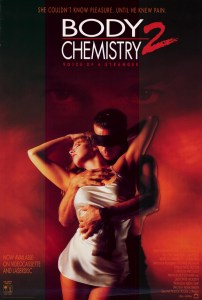
A Movie A Day #47: Body Chemistry II: Voice of a Stranger (1992, directed by Adam Simon)


body-chemistry-ii-the-voice-of-a-stranger-movie-poster-1992-1020211070Dr. Claire Archer is back!

Having gotten away with murder at the end of the first Body Chemistry, Claire (played again by Lisa Pescia) is now working as a radio psychologist, taking the 9 pm to 1 am slot at a station managed by a sleazy chain smoker named Big Chuck (played by real-life sleazy chain smoker Morton Downey, Jr.).  Claire invites her listeners to call with their deepest desires.  “Without pain, you’re not truly alive.”

One night, “John” calls.  When Claire looks at the list of callers and sees, “John likes rough sex,” she immediately put him on the air.  John is actually Dan (Gregory Harrison).  Dan is dating Claire’s call screener, Brenda (Robin Riker), who cannot recognize her own boyfriend’s voice over the telephone.  Dan is a former high school football star who left town and became a cop in Los Angeles.  When his violent impulses became impossible to control, Dan was kicked off the force and he returned home.  Dan wants to suppress his dark side but Claire has other ideas.

Body Chemistry II is a marginal improvement over the first Body Chemistry, because Dan is a more sympathetic victim character than Marc Singer was in the first film and Body Chemistry II puts Lisa Pescia’s vampy performance front and center.  Though both films tell the same basic story, Body Chemistry II is stylistically a very different film.  Body Chemistry II takes it cue from film noir, which means a lot of dark rooms with Venetian blinds.  Dan’s flashbacks and nightmares also add some surreal moments to Body Chemistry II, distinguishing it from the more straight forward first film.

Though there would be two more Body Chemistry sequels, this would be the last time that Lisa Pescia would play Dr. Archer.  Keep an eye out for Clint Howard, Jeremy Piven, and director John Landis, all of whom show up in small roles.

For tomorrow’s movie a day, Shari Shattuck takes over the role of Claire Archer in Body Chemistry III: Point of Seduction.


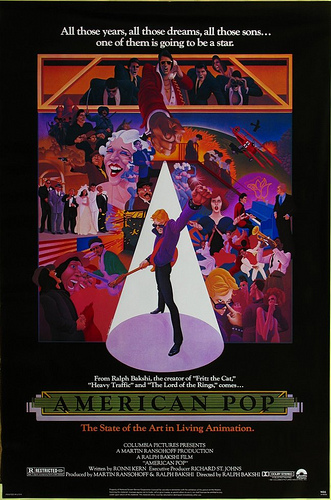
Film Review: American Pop (1981, directed by Ralph Bakshi)


American PopLong before South Park, The Simpsons, and Pixar, there was Ralph Bakshi.  At a time when animation was considered to only be good for children, Bakshi shocked audiences and critics with animated films that dealt with mature themes and were definitely meant for adults.  His first two films, Fritz the Cat (1972) and Heavy Traffic (1973), was the also the first two animated films to receive an X-rating.  Bakshi satirized racism in the controversial Coonskin (1975) and Bakshi’s adaptation of The Lord Of Rings (1978) beat Peter Jackson’s by 23 years.  It was after the critical and commercial disappointment of the heavily flawed but interesting Lord of the Rings that Bakshi decided it was time to make a film that would be more personal to him.  The end result was American Pop.

American Pop tells the story of four generations of a family of Jewish immigrants and how music affects their lives.  In typical Bakshi fasion, this animated film deals with issues of violence, sexuality, drug abuse, and poverty.  American Pop may be animated but it is definitely a film meant for adults.

In the 1890s, Zalmie (Jeffrey Lippa) and his mother escape from Russia after Zalmie’s father, a rabbi, is killed by the Cossacks.  Zalmie grows up in New York and after his mother is killed in the Triangle Shirtwaist Factory fire, he is raised by a vaudeville comedian named Louie (Jerry Holland).  Zalmie wants to be a singer but is shot in the throat during World War I.  His voice ruined, Zalmie marries a stripper named Bella (Lisa Jane Persky) and manages her career.  His partnership with the mobster Nicky Palumbo (Ben Frommer) leads to Bella dying and Zalmie going to prison.

Zalmie’s son, Benny (Richard Singer), is a jazz pianist who, as a favor to his father, marries Nicky’s daughter.  Benny has a son named Tony and tries to pursue his career without using his father’s influence.  Then World War II breaks out.

Benny enlists in the army, seeking redemption from the crimes of his father and father-in-law.  Serving in Europe, he misses his piano and, when he finds one in a bombed-out house in Nazi Germany, he plays a few bars of As Time Goes By.  When a Nazi walks in on Benny, Benny plays Lili Marleen.  For a few seconds, Benny and the Nazi share the common bond of music.  “Danke,” the Nazi says before shooting Benny dead.

Growing up without his father, Tony (Ron Thompson) becomes a beatnik and eventually runs away from home.  He ends up in Kansas, where he has a one-night stand with a waitress and becomes a songwriter for Frankie Hart (Marya Small), a stand in for Janis Joplin.  Both Tony and Frankie start using heroin and Frankie dies of an overdose right before she is supposed to open for Jimi Hendrix.  Abandoned by Frankie’s band, Tony ends up as an addict and dealer in New York.  Accompanying him is his son, Pete, the result of his hookup with the waitress.

After being abandoned by his father, Pete (also played by Ron Thompson), follows in his footsteps and becomes a successful drug dealer.  He is dealing cocaine to all of the big rock bands but, after discovering punk rock, he realizes that he wants something more out of his life.

After announcing that he will no longer sell anyone cocaine unless he is given a chance to record a demo, Pete is given a band and a recording studio.  With the drug-craving record company execs watching, this tough and cocky punk grabs the microphone and sings…

…BOB SEGER’S NIGHT MOVES!?

The use of Night Moves, which is one of the least punk songs ever written, is one of the few false notes in American Pop.  Otherwise, this is one of Ralph Bakshi’s best films.  The majority of the film’s animation was done through rotoscoping, a technique in which animation is traced over live action footage.  (For the gang war scenes, scenes from The Public Enemy were rotoscoped, as was footage of the Nicholas Brothers used in the Sing Sing Sing With A Swing montage.)  Seen today, the technique is crude but effective at showing the contrast between the fantasy of music and the grim reality of life.  Though it has its flaws (*cough* Night Moves *cough*), American Pop is an engaging look at the history and development of American music.

American_Pop