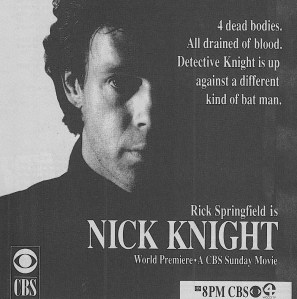
Nick Knight (dir. by Farhad Mann)


Directed in 1989 by Farhad Mann, Nick Knight (a.k.a. Midnight Cop) was a made for tv movie meant as a pilot for a series filmed in Los Angeles. It would take another 3 years to for the show to be picked up as Forever Knight, and even then, it was difficult show to catch given you could really find it sometime after Midnight on Saturdays and/or Sundays. As Vampires in media go, Nick Knight is tucked away in a very small place between the success of Kathryn Bigelow’s Near Dark in 1987 and Francis Ford Coppola’s Bram Stoker’s Dracula in 1992. It’s nowhere near as good as either of those films, but plays on most of the vampire tropes. Allergic to Garlic? Check. Aversion to sunlight? Sure. As I’m writing this the way I would cover a TV episode, this review will have spoilers and will be a bit long in the tooth. My apologies in advance. For the TSL Horrorthon this year, I’m hoping my contribution will be (at least) the first season of Forever Knight. For the film, If you search for it, you can find on YouTube.

Detective Nick Knight (Rick Springfield, Hard to Hold) loves to work the night shift, but not before getting in a quick visit at a local suntan spa. It’s a bit uncomfortable, enough for him to hit the panic button and bring in a few staff to check in on him. He blames it on claustrophobia, “It’s like a coffin in there.”, he says and moves on. When an ancient jade goblet is stolen from a museum, leaving a guard murdered, Knight is brought on to the scene where Don Schanke (John Kapelos, The Shadow, The Breakfast Club) is already helping the cops take photos of the crime scene, and putting himself in the way of things. Nick interviews Dr. Alyce Hunter (Laura Johnson, TV’s Falcon Crest) about the homicide. Alyce reports the goblet was used in ritual blood drinking sacrifices (something that Knight sounds like he’s aware of since he can understand some of the ancient writing in the museum).

Cleaning up the scene, the media approaches Knight and asks if it’s “another Vampire murder”. Word has gotten out that there’s no blood in the course. Knight’s rescued by Captain Brunetti (Richard Fancy, The Girl Next Door) who asks to have him stop by his office after he gets the autopsy work. At the morgue, Nick is given a mug of tea that he just can’t stomach. Thankfully, Dr. Jack (Robert Harper, Twins)knows about Nick’s true nature, and is working helping him find a cure (which includes the tea). “How is your tanning coming along?”, Jack asks. “I’m up to ten minutes.” is Nick’s response, with a smile. When Nick returns to the Precinct, the Captain assigns Knight a new partner to help him with the vampire crimes. Nick’s been able to work alone for the most part, but now he finds himself paired with Schanke. This poses a few problems with hiding his nature.

Schanke and Knight get to know each other on their first night shift, with some talk about Schanke’s married life vs. Nick being forever single. The conversation is interrupted by a dispatch call about an Uzi toting gunman terrorising a local gym. They arrive on the scene, and much like Riggs & Murtaugh, Nick is gung ho about the situation, which causes a third cop on the scene to get killed. With a hostage in stow, the gunman threatens Nick. The girl gets herself out of trouble with a swift knee to the gunman’s gut, causing him to unload a full magazine into Knight. This brings out the vampire in Nick, who throws the gunman into an electrical fence, killing him.

With the case wrapped up, Nick visits Alyce, who spent her evening going through a book on the dig that discovered the cup. Before his arrival, she found a picture of the archeological team that includes someone who looks just like Nick. She makes a copy of the picture, but never mentions it to Nick during his visit. They have a moment, leading to a kiss. Of course, this also causes Nick’s fangs to sprout. He makes a hasty exit.

Having not seen Nick during the evening, Dr. Jack visit’s Nick’s haven, a closed down movie theatre with It’s a Wonderful Life still on the marquee. He finds Nick chugging on a wine bottle full of blood. They have a small argument over Nick’s humanity, leading Nick to admit his desire for love and companionship despite the vampiric side effect of watching people die around them. They make up and move on, there’s crime on the streets and the city needs it’s Midnight Cop. Nick explains that the stolen goblet is part of a pair (one of which he owns) that may be able to cure one of vampirism. The other goblet was coveted by Nick’s maker, LaCroix (Michael Nader, TV’s All My Children), who wants Nick to embrace his vampirism instead of trying to fix it. Could he be the thief?

When a homeless couple goes missing, Nick visits a local vampire nightclub. There he finds Janette (Cec Verrell (Silk). She informs him that while, yes, LaCroix is in town and yes, he may have something to do with the goblet, the missing couple has nothing to do with him. On his way out of the nightclub, Nick bumps into Alyce, who followed him. When some other vampire locals approach the couple, she notices a scar on Nick’s chest (matching one in the photo she had), and confronts him. He doesn’t outright admit to being a vampire, but she gets the feeling she’s on the right track. She even dares him a little, baring her neck. Nick doesn’t take the bait.

On the radio, we hear “The Nightcrawler” who is really LaCroix. The Nightcrawler hosts “Metal for the Ages”, lamenting that he hasn’t seen his old friend Jean Pierre (Nick) in some time. LaCroix dedicates his next song to him, which just happens to be Bobby Brown’s “My Prerogative”. I don’t remember Bobby Brown’s music ever being Metal, but we’ll roll with it.

Eventually, Nick has to deal with both LaCroix and the real villain in this tale. The story ends on a bit of a dark note, resolving the whole mystery, but still leaves open the promise of Nick’s search for Mortality. The city is safe for now, and that’s what counts.

Though the film isn’t terribly strong on the plot, it does shine with the music choices. With classic 80s hits like Steve Winwood’s “Don’t You Know What the Night Can Do” and “Human” by The Human League, Nick Knight definitely has a bit of style, though it’s a bit over the top and campy on the action sequences. It was one of those films that I had a better memory of than what it truly was.
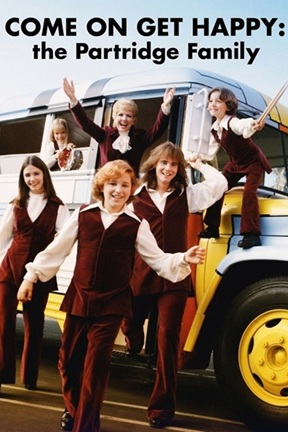
Come On Get Happy: The Partridge Family Story (1999, directed by David Burton Morris)


In 1969, a group of television network executives get together and decide the world needs a sitcom that will mix music with family comedy.  The result is The Partridge Family.  While Shirley Jones (Eve Gordon) tries to keep her television family safe from the networks and, in some cases, their own dysfunctional families, David Cassidy (Rodney Scott) struggles with being a teen idol and Danny Bonaduce (Shawn Pyfrom) deals with living with an abusive father (William Russ).  Danny finds a new father figure in the form of co-star Dave Madden (Michael Cheiffo) while Danny dates his tv sister, Susan Dey (Kathy Wagner).

This was one of the many made-for-TV movies that took advantage of boomer nostalgia at the turn of the 20th Century.  Like most of those movies, Come On Get Happy is on the shallow side, providing the details that everyone had already heard without digging too far underneath the surface.  The main thing that sets this film apart from so many other behind-the-scenes movies is that the cast, for the most part, actually resemble the real-life people that they’re playing.  That’s especially true in the case of Shawn Pyfrom.  If you’re a fan of the show or Cassidy’s music, this movie might appeal to you.  I Think I Love You is still a banger.

It’s well-made but it’s still hard not to feel that it would have been more entertaining just to watch a 2-hour interview with the real-life Danny Bonaduce.

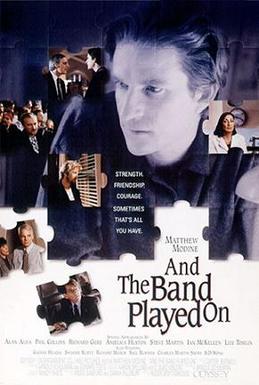
Film Review: And The Band Played On (dir by Roger Spottiswoode)


I live in a very cynical time.

That was one of my main thoughts as I watched 1993’s And The Band Played On.

Directed by Roger Spottiswoode and featuring an all-star cast, And The Band Played On deals with the early days of the AIDS epidemic.  It’s a film that features many different characters and storylines but holding it all together is the character of Dr. Don Francis (Matthew Modine), an epidemiologist who is haunted by what he witnessed during the Ebola epidemic in Africa and who fears that the same thing is going to happen in America unless the government gets serious about the mysterious ailment that is initially called “gay cancer” before then being known as “GRID” before finally being named AIDS.  Dr. Francis is outspoken and passionate about fighting disease.  He’s the type who has no fear of yelling if he feels that people aren’t taking his words seriously enough.  In his office, he keeps a track of the number of HIV infections on a whiteboard.  “Butchers’ Bill” is written across the top of the board.

Throughout the film, quite a few people are dismissive of Dr. Francis and his warnings.  But we, the audience, know that he’s right.  We know this because we know about AIDS and but the film also expects us to trust Dr. Francis because it’s specifically stated that he worked for the World Health Organization before joining the Center For Disease Control in Atlanta, Georgia.  As far as the film is concerned, that’s enough to establish his credentials.  Of course, today, after living through the excesses of the COVID pandemic and the attempts to censor anyone who suggested that it may have begun due to a lab leak as opposed to some random guy eating a bat, many people tend to view both the WHO and the CDC with a lot more distrust than they did when this film was made.  As I said, we live in a cynical time and people are now a lot less inclined to “trust” the experts.  To a large extent, the experts have only themselves to blame for that.  I consider myself to be a fairly pragmatic person but even I now find myself rolling my eyes whenever a new health advisory is issued.

This new sense of automatic distrust is, in many ways, unfortunate.  Because, as And The Band Played On demonstrates, the experts occasionally know what they’re talking about.  Throughout the film, people refuse to listen to the warnings coming from the experts and, as a result, many lives are lost.  The government refuses to take action while the search for a possible cure is hindered by a rivalry between international researchers.  Alan Alda gives one of the best performances in the film, playing a biomedical researcher who throws a fit when he discovers that Dr. Francis has been sharing information with French scientists.

It’s a big, sprawling film.  While Dr. Francis and his fellow researchers (played by Saul Rubinek, Glenne Headly, Richard Masur, Charles Martin Smith, Lily Tomlin, and Christian Clemenson) try to determine how exactly the disease is spread, gay activists like Bobbi Campbell (Donal Logue) and Bill Kraus (Ian McKellen) struggle to get the government and the media to take AIDS seriously.  Famous faces pop up in small rolls, occasionally to the film’s detriment.  Richard Gere, Steve Martin, Anjelica Huston, and even Phil Collins all give good performances but their fame also distracts the viewer from the film’s story.  There’s a sense of noblesse oblige to the celebrity cameos that detracts from their effectiveness.  All of them are out-acted by actor Lawrence Monoson, who may not have been a huge star (his two best-known films are The Last American Virgin and Friday the 13 — The Final Chapter) but who is still heart-breakingly effective as a young man who is dying of AIDS.

Based on a 600-page, non-fiction book by Randy Shilts, And The Band Played On is a flawed film but still undeniably effective and a valuable piece of history.  Director Roger Spottiswoode does a good job of bringing and holding the many different elements of the narrative together and Carter Burwell’s haunting score is appropriately mournful.  The film ends on a somber but touching note.  At its best, it’s a moving portrait of the end of one era and the beginning of another.

44 Days of Paranoia #30: Nixon (dir by Oliver Stone)


For our latest entry in the 44 Days of Paranoia, we take a look at Oliver Stone’s 1995 presidential biopic, Nixon.

Nixon tells the life story of our 37th President, Richard Nixon.  The only President to ever resign in order to avoid being impeached, Nixon remains a controversial figure to this day.  As portrayed in this film, Nixon (played by Anthony Hopkins) was an insecure, friendless child who was dominated by his ultra religious mother (Mary Steenburgen) and who lived in the shadow of his charismatic older brother (Tony Goldwyn).  After he graduated college, Nixon married Pat (Joan Allen), entered politics, made a name for himself as an anti-communist, and eventually ended up winning the U.S. presidency.  The film tells us that, regardless of his success, Nixon remained a paranoid and desperately lonely man who eventually allowed the sycophants on his staff (including James Woods) to break the law in an attempt to destroy enemies both real and imagined.  Along the way, Nixon deals with a shady businessman (Larry Hagman), who expects to be rewarded for supporting Nixon’s political career, and has an odd confrontation with a young anti-war protester who has figured out that Nixon doesn’t have half the power that everyone assumes he does.

Considering that his last few films have been W., Wall Street: Money Never Sleeps, and SavagesI think it’s understandable that I’m often stunned to discover that, at one point in the distant past, Oliver Stone actually was a worthwhile director.  JFK, for instance, is effective propaganda.  Nixon, which feels a lot like an unofficial sequel to JFK, is a much messier film than JFK but — as opposed to something like Savages — it’s still watchable and occasionally even thought-provoking.  Thanks to Hopkins’ performance and, it must be admitted, Stone’s surprisingly even-handed approach to the character, Nixon challenges our assumptions about one of the most infamous and villified figures in American history.  It forces us to decide for ourselves whether Nixon was a monster or a victim of circumstances that spiraled out of his control.  If you need proof of the effectiveness of the film’s approach, just compare Stone’s work on Nixon with his work on his next Presidential biography, the far less effective W.

(I should admit, however, that I’m a political history nerd and therefore, this film was specifically designed to appeal to me.  For me, half the fun of Nixon was being able to go, “Oh, that’s supposed to be Nelson Rockefeller!”)

If I had to compare the experience of watching Nixon to anything, I would compare it to taking 10 capsules of Dexedrine and then staying up for five days straight without eating.  The film zooms from scene-to-scene, switching film stocks almost at random while jumping in and out of time, and not worrying too much about establishing any sort of narrative consistency.  Surprisingly nuanced domestic scenes between Anthony Hopkins and Joan Allen are followed by over-the-top scenes where Bob Hoskins lustily stares at a White House guard or Sam Waterston’s eyes briefly turn completely black as he discusses the existence of evil.  When Nixon gives his acceptance speech to the Republican Convention, the Republican delegates are briefly replaced by images of a world on fire.  Familiar actors wander through the film, most of them only popping up for a scene or two and then vanishing.  The end result is a film that both engages and exhausts the viewer, a hallucinatory journey through Stone’s version of American history.

Nixon is a mess but it’s a fascinating mess.

Other Entries In The 44 Days of Paranoia 

  1. Clonus
  2. Executive Action
  3. Winter Kills
  4. Interview With The Assassin
  5. The Trial of Lee Harvey Oswald
  6. JFK
  7. Beyond The Doors
  8. Three Days of the Condor
  9. They Saved Hitler’s Brain
  10. The Intruder
  11. Police, Adjective
  12. Burn After Reading
  13. Quiz Show
  14. Flying Blind
  15. God Told Me To
  16. Wag the Dog
  17. Cheaters
  18. Scream and Scream Again
  19. Capricorn One
  20. Seven Days In May
  21. Broken City
  22. Suddenly
  23. Pickup on South Street
  24. The Informer
  25. Chinatown
  26. Compliance
  27. The Lives of Others
  28. The Departed
  29. A Face In The Crowd