Retro Television Reviews: Fantasy Island 1.2 “Bet A Million/Mr. Irresistible”


Welcome to Retro Television Reviews, a feature where we review some of our favorite and least favorite shows of the past!  On Tuesdays, I will be reviewing the original Fantasy Island, which ran on ABC from 1977 to 1996.  The entire show is currently streaming on Tubi!

Welcome to Fantasy Island!  Who will have a fantasy this week and what will be left of them?

Episode 1.2 “Bet A Million/Mr. Irresistible”

(Directed by John Newland and Cliff Bole, originally aired on February 4th, 1978) 

In the second episode of Fantasy Island, a bit more was revealed about the resort.

First off, it only costs $6,000 to travel to Fantasy Island and have a fantasy.  (In the pilot, it cost $60,000.)  I assume that, with inflation, it would cost a bit more today but still, $6,000 seems like a pretty good deal for something that could potentially change your life.  However, we also learn that Mr. Roarke doesn’t always charge full price.  In fact, it appears that he often allows people to come to the island for free.  Tattoo thinks that is a little bit foolish and it is.  I mean, it’s a big resort.  I imagine it must not be cheap to run the place.

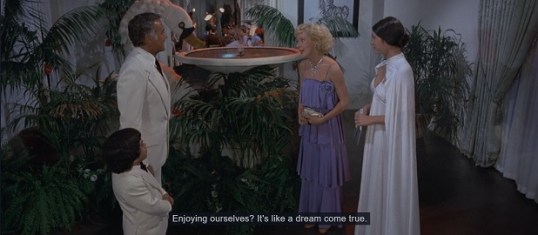
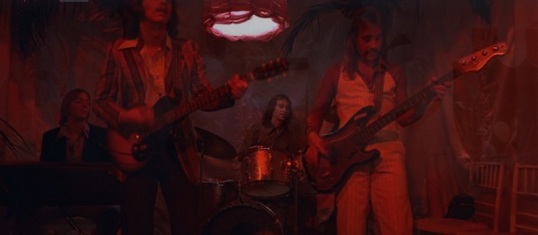
Secondly, in this episode, we discovered that Fantasy Island has a house band.  They play in the lounge and they are totally funky.  Check them out:
Finally, in this episode, we are introduced to the Fantasy Island casino.  Apparently, if a visitor “breaks the bank” at the casino, they can play for a chance to win the island itself!  However, Mr. Roarke insists on being at the table if anyone plays for the island and Mr. Roarke has magical powers so you can be sure that he’s never going to lose.

The casino plays a huge role in one of this episode’s two fantasies.  Fred Wade (Henry Gibson) sells hotel supplies for a living.  His friends call him “Mr. Hotel,” which he apparently considers to be a compliment.  Fred and his wife (Jane Powell) come to Fantasy Island.  Their fantasy?  A chance to talk to wealthy hotelier Otis Hayden about a resort that Fred wants to build and run.  (It seems like it would have been smarter to actually make running the hotel the fantasy but what do I know about the hotel business?)  Mr. Roarke informs Fred that, if he wants his fantasy to come true, he’s going to have to approach Hayden in the casino and play some card games.  Fred admits that he doesn’t have any money.  Mr. Roarke explains that Tattoo has totaled up all of Fred’s assets (including his house and his car) and, as such, Fred has $40,000 to play with.  Fred agrees to do so because this isn’t creepy at all.

Things don’t go so well.  Fred meets Hayden and makes his pitch.  But, in the process, he loses $30,000 and, the next morning, Hayden leaves the island without talking to Fred about his plans.  Fred nearly gives up on his dreams but then he decides to bet his remaining money at the casino.  With his wife at his side, Fred has an early run of luck.  He wins over a million dollars.  He gets to play for the ownership of Fantasy Island!  And …. he loses the final hand.
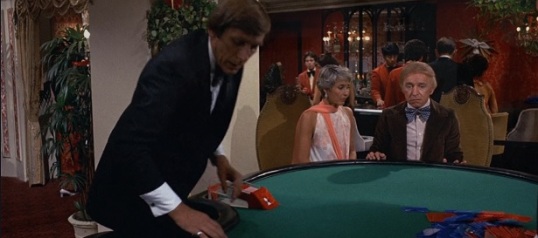
Not to worry though!  This is Fantasy Island!  Just as Fred and his wife are preparing to leave the island, words comes through that Hayden wants to build the resort.  And Hayden sends Fred a cashier’s check for $49,000!  Fred learns a valuable lesson about never giving up hope.

Meanwhile….
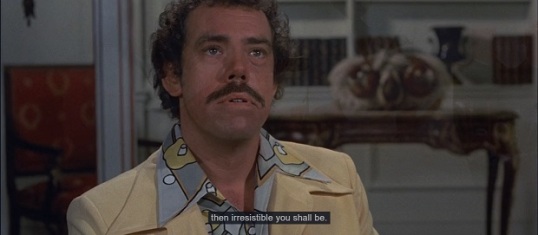
Gangly Chuck Sheffield (John Schuck) wins a free trip to Fantasy Island in a contest.  His fantasy?  He wants to know what it’s like to be irresistible to women.  It’s not that he doesn’t love his fiancée, Stephanie.  It’s just that Chuck doesn’t want to get married and then spend the rest of his life wondering.  To me, it sounds like he’s just looking for an excuse to cheat.  However, Tattoo sympathizes with Chuck.
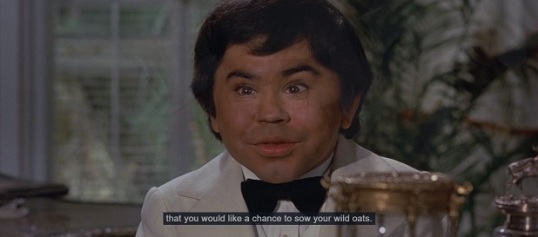
In fact, Tattoo looking for love was a major subplot during this episode.
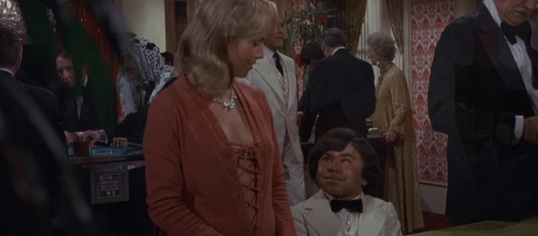
Mr. Roarke gives Chuck the “love root,” a cologne that makes Chuck irresistible to every woman that he meets.  Again, Tattoo thinks that it’s a wonderful idea.
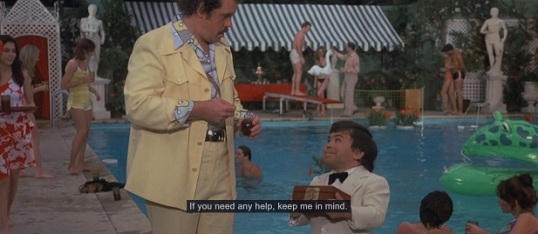
And, at first, Chuck thinks it’s a wonderful idea.
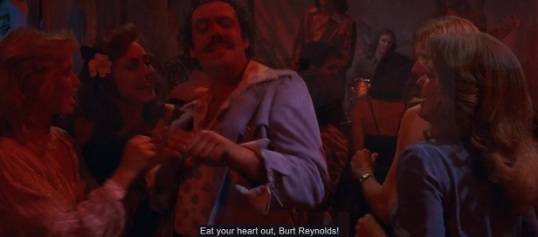
However, Chuck soon has every woman on the island fighting over him and all of their boyfriends want to beat up Chuck!  Chuck learns to appreciate the life he has, despite the power of the love root.
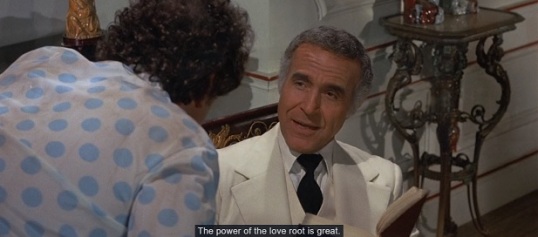
Surprise, surprise!  It turns out that the love root is just scented water and that the entire contest was fake.  Stephanie arranged for Chuck to go to Fantasy Island so that he wouldn’t have any lingering regrets once they got married.  I would not do that for my boyfriend.

Anyway, this episode of Fantasy Island was fairly silly but at least Mr. Roark and Tattoo got to do a bit more here than they did last week.  Henry Gibson and Jane Powell were sympathetic as the couple with a dream.  John Schuck was a good actor but not even he could redeem Chuck.  Seriously, Stephanie, you deserve better!  The important thing is that the resort looked lovely and, since it only costs $6,000, I know where we’re all going on our next vacation!

Retro Television Review: Fantasy Island 1.1 “Escape” / “Cinderella Girls”


Welcome to Retro Television Reviews, a feature where we review some of our favorite and least favorite shows of the past!  On Tuesdays, I will be reviewing the original Fantasy Island, which ran on ABC from 1977 to 1996.  The entire show is currently streaming on Tubi!

Smiles, smiles, everyone….

Episode 1.1 “Escape/Cinderalla Girls”

(Directed by Don Weis, originally aired on January 28th, 1978)

Last week, while reviewing the Fantasy Island pilot, I commented on the fact that Mr. Roarke seemed to be a bit sinister, almost as if he took delight in the idea of mortals discovering that their fantasies weren’t as wonderful as they were expecting.

In the first regular episode of Fantasy Island, it’s made clear that, while Mr. Roarke may occasionally act like he doesn’t care, it’s only to teach a lesson.

When internationally renowned stage musician Gregory Udall (Bert Convy) requests that he be allowed to perform the world’s greatest escape, Mr. Roarke doesn’t appear to be the least bit concerned when Udall is transported to Devil’s Island, the infamous French island prison.  Devil’s Island was known for being escape proof.  It was also known for being harsh even by the prison standards.  75% of the people sentenced to Devil’s Island died before their sentence ended.  When Udall reaches the island, he discovers that the Warden (Reggie Nadler, best-known for playing the vampire in Salem’s Lost) doesn’t care whether he lives or dies.  He’s also told, by another prisoner named Ipsy Dauphin (Robert Clary), that Mr. Roarke regularly abandons people at the prison!

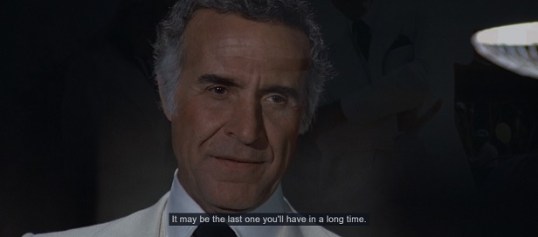
After Udall’s first escape fails, he is visited in the island’s infirmary by Mr. Roarke himself.  Udall says that he’s ready to give up and opt out of the fantasy.  Mr. Roarke informs him that failure is not an option.  He also suggests that Udall enjoy his cigarette because….

Agck!

Fear not, though, Mr. Roarke is not evil.  Instead, he’s just giving Udall the extra push that he needs to not only successfully escape from the prison but to take Ipsy with him as well.  Udall not only gets his confidence back but he also saves another human being.  Mr. Roarke may have seemed harsh but it was only to make sure that everyone got something out of the fantasy.  As well, it’s revealed that Ipsy was not actually prisoner but was instead Fantasy Island’s head chef.

Mr. Roarke is far more cheerful in the episode’s other fantasy.  Georgia Engel and Diana Canova want to know what it’s like to be wealthy so they not only get makeovers but they also get a lot of new clothes.  Of course, being wealthy also means that they’ll be expected to bid at a charity auction that is being held on Fantasy Island.  (Apparently, Fantasy Island also doubles as a resort for people who don’t have fantasies but just want to spend the weekend hanging out by the pool.)  Georgia Engel ends up running away with a prince.  Diana Canova falls in love with an idealistic doctor who is played by John Saxon.  Does the doctor care that she doesn’t actually have any money?  Fortunately, it turns out that the doctor is poor himself.  Yay!

As you may have guessed, the first episode was a strange mismash of tones.  On the one hand, you had a silly but sweet story about two friends who wanted to pretend to be rich.  On the other hand, you’ve got a harsh prison story featuring Reggie Nadler as a desiccated villain and uber-70s actor Bert Convy as a stage musician.  It really shouldn’t work but it does, largely because the idea of the island is so appealing and Ricardo Montalban seems to be having fun in the role of Mr. Roarke.  Plus, who can resist John Saxon pretending to be from Texas?

The premiere episode got Fantasy Island off to a good start!  Would that continue next week?

Retro Television Review: Fantasy Island (dir by Richard Lang)


Welcome to Retro Television Reviews, a feature where we review some of our favorite and least favorite shows of the past!  On Tuesdays, I will be reviewing the original Fantasy Island, which ran on ABC from 1977 to 1996.  The entire show is currently streaming on Tubi!

Ah, Fantasy Island!

There have been several versions of Fantasy Island.  In the late 90s, there was a version that featured Malcolm McDowell as the somewhat aloof owner of the island.  More recently, there was a movie that featured Michael Pena as the owner of the Island and which tried to turn the whole thing into a horror franchise.  It wasn’t very good.  And right now, there’s a show on Fox that features Roselyn Sanchez as the grand niece of the island’s original owner.  The Fox series is about to start its second season.  It’s a bit silly, which is why I kind of love it.

And then there’s the Fantasy Island that started it all, the Aaron Spelling-produced series that ran from 1977 to 1984 on ABC and which has lived on in reruns and on streaming platforms like Tubi.  Both the original series and all of its subsequent spin-offs took place on a mysterious tropical island where people would pay to live out their fantasies.  In the original series, the island was run by Mr. Roarke (Ricardo Montalban), who wore a white suit and encouraged everyone to smile whenever the guests arrived.  Serving as Mr. Roarke’s second-in-command was Tattoo (Herve Villechaize), who was 3’11, always wore a matching white suit, and announced the arrival of the plane by ringing a bell and shouting, “The plane, the plane!”  Of course, each week would bring in a different group of guest stars.  They would come to the island with a fantasy and, hopefully, they would learn that reality was the only fantasy that they needed.

All seven seasons of the original Fantasy Island are currently streaming on Tubi.  However, if you want to see the 1977 pilot film that started it all, you have to go to YouTube.

In many ways, the 90-minute pilot film feels like a typical episode of Fantasy Island.  It’s interesting to see that the show’s basic premise and format was already set in stone when the pilot was filmed.  (Pilots are notorious for often being dramatically different from the shows that they were created to sell.)  The pilot opens with the plane arriving (and yes, from the start, Tattoo rings the bell and shouts, “The plane!”) and three guests meeting Mr. Roarke.  Our three guest stars are Bill Bixby, Hugh O’Brian, and Eleanor Parker.  Bixby plays Arnold Greenwood, a former war correspondent who wants to be reunited with Francesca (Sandra Dee), the woman with whom he fell in love during World War II.  O’Brian is Paul, a famous big game hunter who wants to be hunted for once.  Eleanor Parker is Eunice Hollander Barnes, one of the world’s richest women.  She wants to fake her death so she can see who, from her life, would actually mourn her and who would just try to steal her fortune.

If the pilot’s format is the same as the series that followed, the general tone is somewhat different.  Mr. Roarke is an almost sinister figure, one who doesn’t really seem to think much of his guests and who is quick to point out that no one gets a fantasy until they’ve paid him the required $50,000.  (That’s $50,000 in 1970s money.  I have to admit that when Mr. Roarke first mentioned how much the fantasies cost, I was like, “Hey, I could afford this place!”)

Consider the story of the hunter.  Paul wants to be hunted because he’s suicidal.  His real fantasy is to die.  The night before Paul’s fantasy is to begin, Michelle (Victoria Principal) shows up at Paul’s room.  Michelle explains that Mr. Roarke has hired her to provide Paul with companionship during the night.  Unfortunately, Michelle ends up handcuffed to Paul and, as a result, she’s hunted along with him!  Now, you could argue that Mr. Roarke did this to teach Paul to think about someone other than himself.  But what if Paul hadn’t learned the lesson?  Then Michelle would be dead too!  What would Mr. Roarke do then?  Just have Tattoo dump the bodies in the lagoon?  “To hell with you, Roarke!” Paul yells and who can blame him?

And then there’s our war correspondent, Arnold.  Arnold’s fantasy seems simple enough but then it turns out that the reason he lost contact with Francesca is because he murdered her!  As a result of his fantasy, Arnold not only relives the first time he met Francesca but also how their relationship ended.  The entire experience leaves Arnold laughing like a madman as his sanity slips away.

As for Eunice’s story, it’s pretty stupid.  She dresses up like a maid so that she can listen to what people have to say about her once they think she’s dead.  It’s like an episode of Undercover Boss.  At least former Kennedy in-law Peter Lawford makes an appearance as Eunice’s husband.  Eunice ends up far less traumatized than either Paul or Arnold but she still had to fake her death to come to peace with her life.

The pilot is entertaining.  One can understand why it would lead to a series.  The island is lovely to look at.  Even with the somewhat sinister tone of two of the stories, it’s still impossible to watch the pilot without wondering what type of fantasy you would pursue if you went to the Island.  For me, that’s always been the main appeal of all of the various versions of Fantasy Island.  Still, it’s interesting that the fantasies themselves are less comforting than what I think many would expect on account of the show’s reputation.  For all the criticism that Blumhouse received for their reinterpretation of Fantasy Island, they were not the first to imagine Mr. Roarke as being somewhat less than benevolent.  Of course, when the actual series started, Mr. Roarke was a far friendlier host.

Next week, the series begins and hopefully, no further guests are traumatized to the point of catatonia.

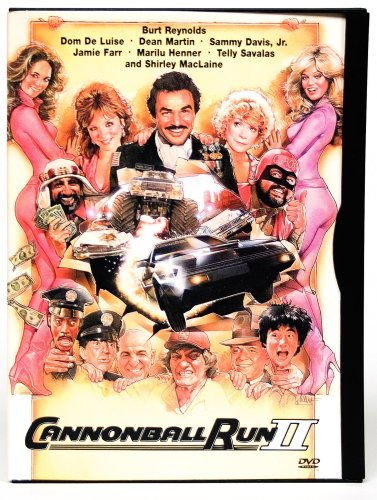
Cannonball Run II (1984, directed by Hal Needham)


In 1981, director Hal Needham and star Burt Reynolds had a surprise hit with The Cannonball Run.  Critics hated the film about a race from one end of America to the other but audiences flocked to watch Burt and a group of familiar faces ham it up while cars crashed all around them.  The original Cannonball Run is a goofy and gloriously stupid movie and it can still be fun to watch.  The sequel, on the other hand…

When the sequel begins, the Cannonball Run has been discontinued.  The film never explains why the race is no longer being run but then again, there’s a lot that the sequel doesn’t explain.  King Abdul ben Falafel (Ricardo Montalban, following up The Wrath of Khan with this) wants his son, The Sheik (Jamie Farr, returning from the first film) to win the Cannonball so he puts up a million dollars and announces that the race is back on.  Problem solved.

With the notable exceptions of Farrah Fawcett, Roger Moore, and Adrienne Barbeau, almost everyone from the first film returns to take another shot at the race.  Burt Reynolds and Dom DeLuise are back.  Jack Elam returns as the crazy doctor, though he’s riding with the Sheik this time.  Jackie Chan returns, riding with Richard “Jaws” Kiel.  Dean Martin and Sammy Davis, Jr. return, playing barely disguised versions of themselves.  They’re joined by the surviving members of the Rat Pack.  Yes, Frank Sinatra is in this thing.  He plays himself and, from the way his scenes are shot, it’s obvious they were all filmed in a day and all the shots of people reacting to his presence were shot on another day.  Shirley MacClaine also shows up, fresh from having won an Oscar.  She plays a fake nun who rides with Burt and Dom.  Burt, of course, had a previous chance to co-star with Shirley but he turned down Terms of Endearment so he could star in Stroker AceCannonball Run II finally gave the two a chance to act opposite each other, though no one would be winning any Oscars for appearing in this film.

Say what you will about Hal Needham as a director, he was obviously someone who cultivated a lot of friendships in Hollywood because this film is jam-packed with people who I guess didn’t have anything better to do that weekend.  Telly Savalas, Michael V. Gazzo, Henry Silva, Abe Vigoda, and Henry Silva all play gangsters.  Jim Nabors plays Homer Lyle, a country-fried soldier who is still only a private despite being in his 50s.  Catherine Bach and Susan Anton replace Adrienne Barbeau and Tara Buckman as the two racers who break traffic laws and hearts with impunity.  Tim Conway, Don Knotts, Foster Brooks, Sid Caesar, Arte Johnson, Mel Tillis, Doug McClure, George “Goober” Lindsey, and more; Needham found room for all of them in this movie.  He even found roles for Tony Danza and an orangutan.  (Marilu Henner is also in the movie so I guess Needham was watching both Taxi and Every Which Way But Loose while casting the film.)  Needham also came up with a role for Charles Nelson Reilly, who is cast as a mafia don in Cannonball Run II.  His name is also Don so everyone refers to him as being “Don Don.”  That’s just a typical example of the humor that runs throughout Cannonball Run II.  If you thought the humor of It’s A Mad, Mad, Mad, Mad World was too subtle and cerebral, Cannonball Run II might be right up your alley.

The main problem with Cannonball Run II is that there’s not much time spent on the race, which is strange because that’s the main reason why anyone would want to watch this movie.  The race itself doesn’t start until 45 minutes into this 108 minute film and all the racers are quickly distracted by a subplot about the Mafia trying to kidnap the Sheik.  Everyone stops racing so that Dean Martin and Sammy Davis, Jr. can disguise themselves as belly dancers to help rescue the Sheik.  By the time that’s all been taken care of, there’s only 10 minutes left for everyone to race across the country.  After a montage of driving scenes and a cartoon of an arrow stretching across the nation (the cartoon was animated by Ralph Bakshi!), we discover who won the Cannonball and then it’s time for a montage of Burt and Dom blowing their lines and giggling.  Needham always ended his films with a montage of everyone screwing up a take and it’s probably one of his most lasting cinematic contributions.  Every blooper reel that’s ever been included as a DVD or Blu-ray extra owes a debt of gratitude to Hal Needham.  Watching people blow their lines can be fun if you’ve just watched a fun movie but watching Burt and Dom amuse themselves after sitting through Cannonball Run II is just adding insult to injury.  It feels less like they’re laughing at themselves and more like they’re laughing at you for being stupid enough to sit through a movie featuring Tony Danza and an orangutan.

The dumb charm of the first Cannonball Run is nowhere to be found in this sequel and, though the film made a profit, the box office numbers were still considered to be a disappointment when compared to the other films that Reynolds and Needham collaborated on.  Along with Stroker Ace, this is considered to be one of the films that ended Reynolds’s reign as a top box office attraction.  Cannonball Run II was also the final feature film to feature Dean Martin and Frank Sinatra.  This could be considered the final Rat Pack film, though I wouldn’t say that too loudly.

Cannonball Run II is a disappointment on so many levels.  It’s hard to believe that the same director who did Smokey and the Bandit and Hooper could be responsible for the anemic stunts and chases found in this movie.  The cast may have had a good time but the audience is left bored.  Stick with the first Cannonball Run.


Lisa Cleans Out Her DVR: Hemingway’s Adventures Of A Young Man (dir by Martin Ritt)


(Lisa is currently in the process of cleaning out her DVR!  It’s going to take a while.  She recorded this 1962 literary adaptation off of FXM on January 30th!)

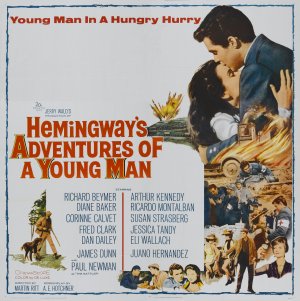
Hemingway’s Adventures Of A Young Man is one of those films that you just know was made specifically to win Oscars.  It’s a big prestige production, complete with a historical setting, an epic scope and big, all-star cast.  That most of those stars appear in relatively small roles was undoubtedly meant to evidence of the film’s importance.

“Look!” the film seems to shout at times, “This is such an important film that even Paul Newman was willing to stop by for a day’s work!”

The film is based on ten short stories by Ernest Hemingway and, loosely, A Farewell to Arms.  The stories all dealt with the early life of Nick Adams, who was a literary stand-in for Hemingway.  Since the Nick Adams stories were autobiographical (and, for that matter, so was A Farewell to Arms), the film can also be viewed as biopic.  Richard Beymer (who, a year earlier, had starred in West Side Story and who is currently playing Ben Horne on Twin Peaks) may be playing Nick Adams but the film leaves little doubt that he was actually meant to be playing Ernest Hemingway.

The film opens with Nick hunting with his father, Dr. Harold Adams (Arthur Kennedy).  He is present when his father travels to an Indian camp and helps to deliver a baby.  He respects his father but Nick wants to see the world and the film follows him as he explores America, working odd jobs and meeting colorful characters along the way.  Paul Newman shows up as a punch-drunk boxer and proceeds to overact to such an extent that he reminded me of Eric Roberts appearing in a Lifetime film.  Nick meets rich men, poor men, and everything in between.  He works as a journalist.  He works as a porter.  Eventually, when World War I breaks out, Nick enlists in the Italian army and the film turns into the 100th adaptation of A Farewell to Arms.

And really, I think it would have been an enjoyable film if it had been directed by someone like Otto Preminger, George Stevens, or maybe even Elia Kazan.  These are directors who would have embraced both the pulpy potential of the Nick Adams stories and the soapy melodrama of the war scenes.  A showman like Preminger would have had no fear of going totally and completely over the top and that’s the approach that this material needed.  Instead, Hemingway’s Adventures Of A Young Man was directed, in a painfully earnest style, by Martin Ritt.  Ritt tries to imitate Hemingway’s famously understated style with his understated direction but, cinematically, it’s just not very interesting.  Ritt portrays everything very seriously and very literally and, in the end, his direction is more than a little dull.

Sadly, the same can be said for Richard Beymer’s performance in the lead role.  Beymer comes across as being the nice guy who everyone says you should marry because he’ll be able to get a good and stable job and he’ll probably never go to jail.  Two months ago, when I watched and reviewed Twin Peaks, I really loved Beymer’s performance as Ben Horne.  He just seemed to be having so much fun being bad.  Unfortunately, in Hemingway’s Adventures Of A Young Man, he never seemed to be having any fun at all.  No wonder he temporarily put his film career on hold so that he could fully devote himself to working as a civil rights activist.

In the end, this is a movie that’s a lot more fun to look at than to actually watch.  Visually, the film is frequently quite pretty in an early 1960s prestige movie so sort of way.  And there are some good performances.  Eli Wallach, Ricardo Montalban, Susan Strasberg, Arthur Kennedy — there’s a whole host of performers doing memorable supporting work.  Unfortunately, even with all that in mind, this well-intentioned film largely falls flat.

Lisa Marie Reviews The Oscar Nominees: Battleground (dir by William Wellman)


I love February.

Why?  Well, first off, we all know that February is the most romantic month of the year.  February is Valentine’s Day, romantic movies, flowers, lingerie, and chocolate.  February is also the month when, in a lead up to the Oscars, TCM devotes a good deal of its programming to showing Oscar nominees of the past.

As I’ve mentioned in the past, one of my dreams is to watch and review every single film that has ever been nominated for best picture. Now, realistically, I’ll never be able to accomplish this goal because the 1929 Best Picture nominee The Patriot is currently a lost film.  But, even if it does mean that I’ll only be able to see 510 out of the 511 nominated films, it’s still a dream that I’m pursuing and, with the help of TCM and the month of February, it’s a dream that’ll come true.

Take, for instance, Battleground.  This 1949 Best Picture nominee (it lost All The King’s Men) recently aired on TCM.  I’m not exactly a fan of war films but, since it was a best picture nominee, I still made sure to DVR and watch it.

Set during the final days of World War II, Battleground follows one platoon of soldiers as they fight and attempt to survive the Battle of the Bulge.  The platoon is made up of the type of characters that we usually expect to find in a WWII film but, fortunately, they’re played by an ensemble of likable actors who all bring their familiar characters to life.  There’s Jim Layton (Marshall Thompson), the newest member of the platoon who nobody wants to run the risk of getting close to.  There’s Holley (Van Johnson), the cheerful soldier who is unexpectedly thrust into a position of leadership that he might not be right for.  Roderiques (Ricardo Montalban) is from Los Angeles and is amazed by the sight of snow.  “Pops” Stazak (George Murphy) is the type of older soldier who you would totally expect to be nicknamed “Pops.”  Bettis (Richard Jaeckel) is scared of combat.  Kippton (Douglas Fowley) spends nearly the entire film looking for his lost teeth.  And finally, of course, there’s the hard-boiled but warm-hearted Sgt. Kinnie (James Whitmore).

In some ways, Battleground is a very conventional film and it’s easy to wonder how it ended up getting nominated for best film of the year.  (Among the eligible films that were not nominated: The Bicycle Thief, Champion, The Fountainhead,  On The Town, Sands of Iwo Jima, She Wore A Yellow Ribbon, They Live By Night, and White Heat.)  However, the film’s nomination makes a bit more sense when you consider that it was released just four years after the end of World War II.  It was a film that appealed both to the veterans who were able to relate to the film’s story and to the patriotic spirit of a country that had just defeated the greatest evil of the 20th Century.

Battleground did not exactly make me a fan of war movies but it’s still a well-made and effective film. As opposed to a lot of other war films, Battleground never makes war look like fun.  For the most part, the emphasis is less on strategy and combat and more on the soldiers who are simply trying to survive from day-to-day.  The end result is a film that serves as a moving tribute to the soldiers who fought in World War II.

A Quickie With Lisa Marie: Conquest of the Planet of the Apes (dir. by J. Lee Thompson)


(WARNING: SPOILERS BELOW)

Released in 1972, Conquest of the Planet of the Apes was the fourth film in the original Planet of the Apes saga.  Taking place two decades after the end of Escape from the Planet of the Apes, Conquest details how Caesar, the son of Cornelius and Zira, eventually rallies his fellow apes to overthrow humanity.   Caesar, in this film, is played by Roddy McDowall and Conquest features what is probably his best performance of the series.

Conquest of the Planet of the Apes is definitely the most radical film of the series and it’s probably one of the most radical films of the 1970s.  Once you peel away the sci-fi/fantasy wrapping, you’re left with one of the few “mainstream” studio films to ever promote the idea of overthrowing society with a violent revolution.  Even when viewed today, it’s odd to consider that this violent and rather dark film was actually given the same G rating that was otherwise exclusively given to children’s films.  Obviously, the poor critical reputation of the Planet of the Apes series kept the Hollywood censors from really paying attention to what they were watching.

Director J. Lee Thompson goes for a far different direction from the previous more television-orientated directors involved with the series.  Thompson emphasizes that savage, totalitarian aspect of future human civilization.  This is a film in which the most sympathetic human character (the circus owner played by Ricardo Montalban) is graphically tortured and murdered within the first few minutes of the film.  This is followed by Caesar being given electro-shocked treatment by the cheerful torturer Kolp (Severn Darden, who is a chilling villain) and finally, Caesar and his fellow apes violently overthrowing society while the futuristic city burns in the background. 

Director Thompson reportedly based the ape uprising on contemporary news reports about the Black Panthers and it brings a real sense of urgency to the film.  What sets this film apart is that director Thompson is clearly on the side of the Apes and by the end of the film, so is the audience.  McDowall’s passionate performance is neatly contrasted with an equally impassioned performance from Don Murray (who plays Breck, the racist leader of the humans) and the audience is firmly on McDowall’s side by the end of the film, cheering as their own civilization is destroyed.

Originally, Thompson wanted to end the film with McDowall giving a fiery speech announcing that the time of man was finished.  However, this finally proved to be too much for the film’s producers and, at the last minute, the scene was clumsily redubbed to allow Caesar to suddenly — out of nowhere — have a change of heart and call for a peaceful co-existence.  This revised ending — though it did leave things open for yet another sequel — is an undeniable weakness.  It just doesn’t feel right.

With that in mind, here’s Thompson’s original, unseen ending, in which Caesar watches as his apes followers murder Don Murray.  It gives you a feeling of the type of film that Thompson was going for:

A Quickie With Lisa Marie: Escape From The Planet of the Apes (dir. by Don Taylor)


(Warning: Potential Spoilers, especially if you’re good at reading between the lines of my attempts to be all mysterious-like)

Continuing with our look at the original Planet of the Apes films, we come to 1971’s Escape from The Planet of the Apes.

Escape From The Planet of the Apes starts out with a huge problem — how do you make a sequel to a film that literally ended with the entire planet being destroyed?  Escape handles this problem by reversing the plotline of the original film.  Instead of a group of humans going into the future and landing on a planet dominated by apes, this film features three apes going into the past and landing on a planet dominated by the past.  It’s a premise that the film handles with a surprising amount of cleverness and the end result is probably the best of the various Planet of the Apes sequel.  Certainly, it is the only one that can stand alone as a film separate from the rest of the series.

Using Taylor’s old space capsule, Zira (Kim Hunter), Cornelius (Roddy McDowall), and Milo (Sal Mineo, who you know is doomed because he’s the only one of the three who hasn’t appeared in either of the two previous films) escape Earth shortly before Charlton Heston blows the planet up at the end of Beneath the Planet of the Apes.  Slipping through the same vortex as Heston did in the first film, they end up crash landing on Earth in the year 1974. 

At first, Cornelius and the outspoken Zira become media celebrities.  They do interviews with the press, appear on the covers of magazines, and are generally celebrated like simian Kardashians.  However, one scientist — played by a very handsome Eric Braeden (seriously, he has gorgeous hair in this film) — isn’t as charmed by Zira and Cornelius.  Instead, he views them as threats to the future of the human race, especially after he discovers that Zira is pregnant.

The character that Braeden plays, by the way, is named Dr. Otto Hasslien and attentive viewers will recognize the name from a throw-away reference made by Taylor (Charlton Heston) in the original Planet of the Apes.  One of the more interesting subtexts in this film is that, much as chimpanzees Zira and Cornelius are this film’s equivalent to the human Taylor, Braeden’s Hasslien is this film’s version of Dr. Zaius.  Much as Maurice Evans did for Dr. Zaius, Braeden brings a certain ambiguity to his villianous character.  Though Braeden’s actions are ultimately hateful, it’s also made clear that they’re more motivated by fear than by evil.  Indeed, when Braeden first appears in this film, he’s almost likable.  It’s only at the film’s conclusion that we become fully aware of the irony that the human, “civilized” Dr. Hasslien ultimately shows less mercy and empathy to Zira and Cornelius than the ape Dr. Zaius showed to Taylor.  The moral ambiguity of Braeden’s performance makes this a far more resonant film than most mainstream critics are willing to admit.

 As for, Zira and Cornelius, the once-fawing public eventually turns against them as it becomes apparent that for the two of them to exist, humanity has to be wiped out.  Zira and Cornelius find themselves hunted fugitives, fleeing for their lives while the whole planet — with the exception of a zoo keeper played by Ricardo Montalban and another scientist (played by Bradford Dillman — what a great name for an actor) — seems to be determined to destroy them.

Escape From The Planet of the Apes starts out as a likable, rather breezy social satire (much like Pierre Boulle’s Monkey Planet, the novel that Planet of the Apes was loosely adapted from) and that makes it even more surprising when, about halfway through, the movie shifts gears and becomes a rather dark and bleak action film.  It all ends, like many films from the early 70s, in a brutal act of violence that carries a surprising punch to it.  It’s after the end of the film that we truly become aware just how involved we had become with Zira and Cornelius.  A lot of that has to do with the strong performances of McDowall and Hunter who both created characters that came across as real and worthy, regardless of how many layers of makeup they were acting under.  Their chemistry as a couple makes this underrated film one of the surprising gems of the early 70s.

9 Favorite Revenge Films


Having recently seen Michael Caine’s revenge film Harry Brown I got to thinking about other revenge-themed films I’ve watched through the years and I realized that there were quite a bit of them. There’s something just primal and Old Testament about revenge flicks. It doesn’t matter whether they’re high-brow art-house films or the cheapest grindhouse flicks in the end it all boils down to one individual raining down their own version of Divine Wrath on those who wronged them.

Who hasn’t fantasized or thought about going all medieval on someone who just screwed them over. Maybe it was an infraction that was minor that one didn’t need to get overly upset over or something so heinous that only violence at its most basest was the only response. Going through with such thoughts usually stayed there: in one’s thoughts and imaginings. Revenge films seems to be quite popular because they allow even the meekest and most pacifist to secretly live vicariously through the revenge-minded leads in the film.

The list below is not the best revenge films out there but they definitely are my favorites…

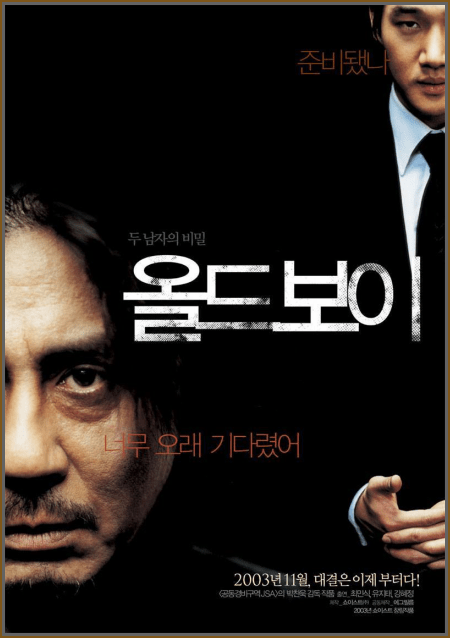
Oldboy – This revenge film by South Korean auteur Park Chan-wook wasn’t just a blast to watch but also happens to be one of the best films of the past decade. It takes a simple plot of a man imprisoned against his will for 15 years with no explanation whatsoever that he literally goes insane and back to sane during his captivity. Revenge being the one thing which keeps him going and revenge he gets to inflict on all those he discovers were responsible. The mind-twisting last act in the film takes the revenge-theme right on it’s head as we find out that the main lead wasn’t the only one on a revenge train of thought.

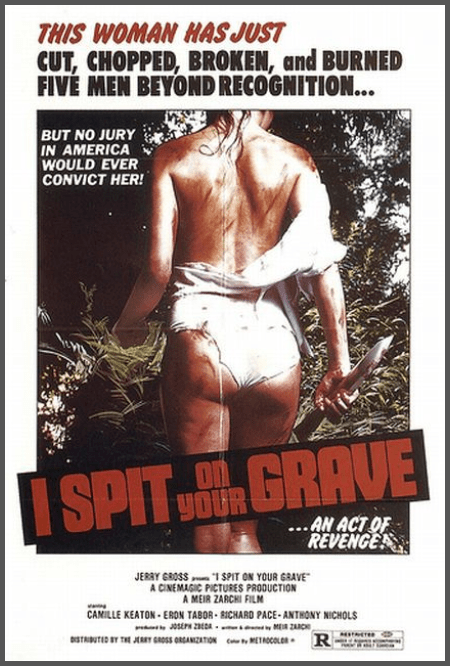
I Spit On Your Grave aka Day of the Woman – This grindhouse classic from Meir Zarchi is the epitome of the rape victim turned revenge valkyrie. The film is not very easy to sit through since there’s nothing subtle about how filmmaker Meir Zarchi filmed every exploitative scene. From the prolonged gang rape sequence to each subsequent revenge act by Camille Keaton’s Jennifer character. Some critics have blasted the film as pandering to the lowest common denominator while others have hailed it as a post-modern feminist film. I like to think that both sides are correct and that the film lies somewhere in the middle. It definitely will put a scare on any group of men who are having thoughts of shenanigans.

Death Wish – When people hear revenge flick they almost always say this iconic film by Charles Bronson from the 70’s. The film was adapted from Brian Garfield’s 1072 novel of the same name and directed by Michael Winner. While critics had mixed reactions to the film with some calling it irresponsible filmmaking, the nation as a whole embraced the film. Here was a film which screamed to the nation that the rising crime-rate in the U.S. during the 1970’s wasn’t going to go unanswered. While some people may have seen the film as a blank check to actually commit vigilantism in the end it just helped a country sick and tired of the crime they see day in and day out. Again here was art becoming a driving force in changing a nation’s collective malaise into something more positive. It didn’t hurt that Bronson was badass as Paul Kersey.

Kill Bill: Volume 1-2 – Who else but the video clerk made good would make what I would consider the greatest genre mash-up film ever made. Quentin Tarantino’s ode to kung fu, spaghetti westerns and revenge flicks became so massive that he had to split the film into two volumes. I am talking about Kill Bill. Not his greatest film ever but I definitely consider it his most geek-friendly and most entertaining. Uma Thurman as The Bride tearing a bloody and witty path of revenge on those who failed to kill her created some of the most iconic fight sequences of the generation this film came out in. Every scene almost seemed to be inspired by other films of a similar theme and genre that film geeks everywhere must’ve exploded in their pants from all the awesomeness they were witnessing. Each volume had two great action sequences that were both fantastical and brutal.

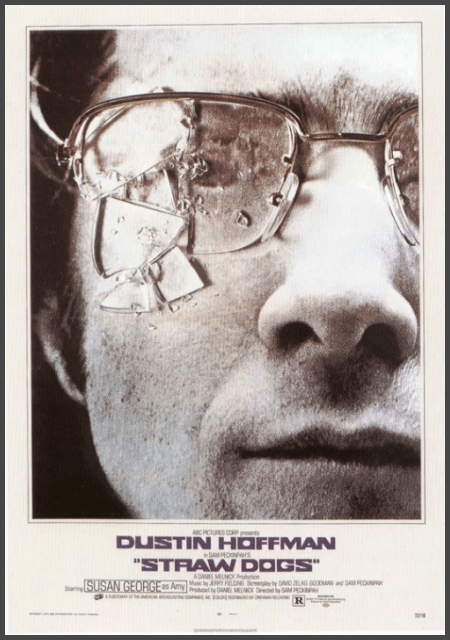
Straw Dogs – One of the most controversial films in Sam Peckinpah’s controversy-filled directing career. Released in 1971 it told the story of how even the meekest person could be pushed into dealing out extreme violent justice on those who have wrong them and those they love. Seen by critics as quite misogynistic due to the nature of the rape scene of Susan George’s Amy character the film was banned for two decades in the UK for it’s unflinching look at violence. Being a huge fan of Sam Peckinpah I had to see it and when I did it automatically became one of my favorite films ever and not just a favorite revenge film. If there was ever a modern retelling of a Biblical-level fable it is this classic from Sam Peckinpah. Every revenge-fueled act by Dustin Hoffman literally oozes Old Testament justice. Just the way I like my revenge. 🙂

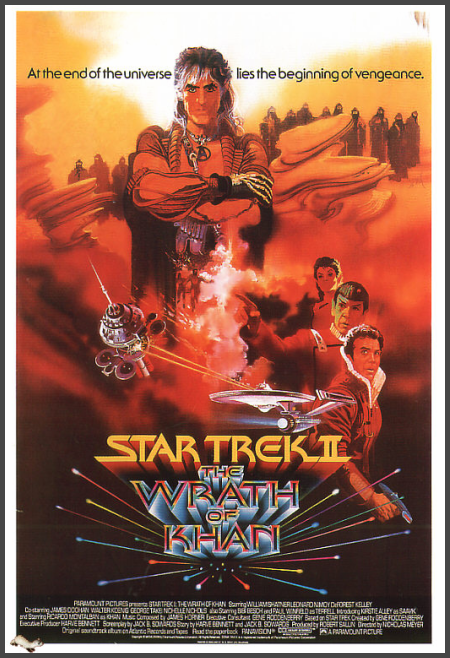
Star Trek II: The Wrath of Khan – Speaking of Biblical this first sequel in the Star Trek film franchise still considered by fans and non-fans alike as the best in the series. Hard to argue with them since it’s also an opinion I share. The sequel takes a popular episode from the original series and follows it up with all the cast of characters older and more seasoned. In the case of Ricardo Montalban’s Khan Noonian Singh quite seasoned and classy as smooth Corinthian leather. It’s a film with Shatner’s Kirk and Montalban’s Khan in an everending cycle of revenge which would culminate in what would be one of film’s most heartbreaking scenes. One could taste the revenge emanating from the two characters as age-won wisdom and genetically-engineered intellect fell by the wayside to feed the vengeance sought by Kirk and Khan. This revenge flick also has one of the most awesome death speeches by a character on film.

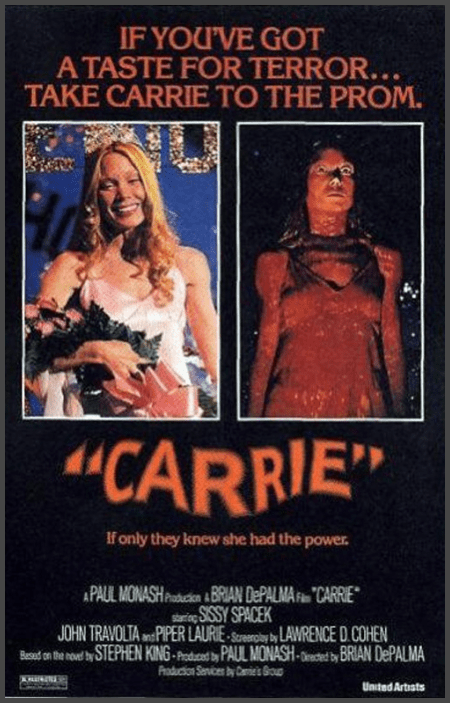
Carrie – Brian De Palma’s film adaptation of one of Stephen King’s better horror novels still seen by many as the best film adapt of a King novel. It combines the existential horror of being a girl and her body maturing in the dog-eat-dog world of high school and the horror said girl can inflict on those tormenting her. It’s high school bullying and revenge with a healthy dose of Stephen King shenanigans mixed in. Sissy Spacek was great as the titular character. One doesn’t have to be a high school girl to feel for Carrie and what she goes through. Her snapping in the last act and inflicting her psychokinetic-brand of revenge on her tormentors must’ve gotten more than a few “Hell yeah!” from some of the teens and adults who went through high school hell. It also has a classic line uttered by Carrie’s mother played by Piper Laurie: “I can see your dirty pillows. Everyone will.”

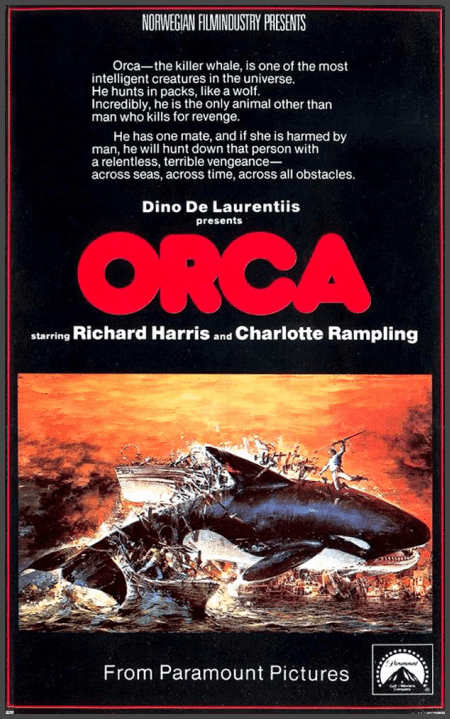
Orca – This film was to be producer Dino De Laurentiis’ attempt to capitalize on the success of Steven Spielberg’s classic man-versus-nature thriller, Jaws. Starring Richard Harris, Charlotte Rampling and Bo Derek the film wasn’t a success when it first came out. While Spielberg’s film was a modern retelling of Moby Dick this killer whale version by director Michael Anderson was Death Wish on water with Paul Kersey as the killer whale. This was one of the first films where I realized none of the people on the screen were worth rooting for to survive. I was all for the killer whale who was on a warpath to avenge his mate and unborn wee killer whale who were killed by Harris and his crew. Shamu this killer whale was not and it always brought a smile to my face whenever the killer whale outsmarted the humans and killed each and everyone in inventive ways. I’m wondering if all the killer whales in all the aquatic parks are just biding their time before they too go all Orca on their handlers and the audience. I’d pay to see that!

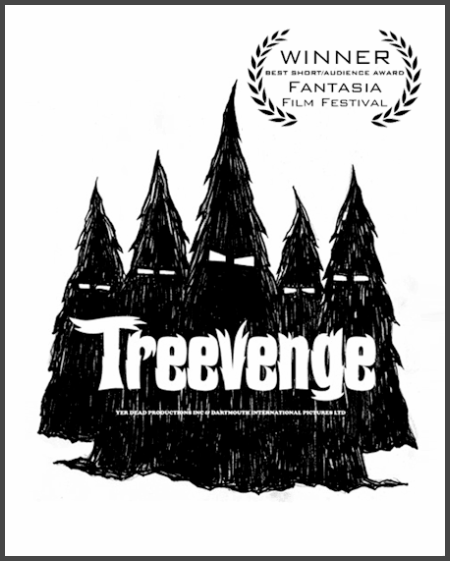
Treevenge – Last but not least the greatest film ever made!