Review: Dragon Age 2


Unfocused Ramblings

After a long wait, I hope to be back and better than ever. I was originally planning to go off the board with MLB 2K11… which is still getting a review I might add … but Dragon Age II consumed my life for a while, and I have to talk about it. BioWare and I have had a rocky relationship. The first game of theirs which I played was actually Neverwinter Nights… which I got about halfway through before my friend told me to stop playing it and go back and hit Baldur’s Gate II: Shadows of Amn instead. It was a formative experience for me. Up until that time, I would have described myself as an irredeemable JRPG fan. Since that fateful day, I’m not sure I’ve ever enjoyed a JRPG as much again. Naturally, this launched my love affair with BioWare. There have definitely been parts of that relationship that I’ve enjoyed more than others. For me, as much as I enjoyed Baldur’s Gate II, the current generation of these games is really the golden age of WRPGs in my eyes.

Is Dragon Age II the best WRPG that I’ve ever played? Ultimately, I would have to say no. Its release was too obviously rushed, which is evident in the plethora of bugs available for your gaming pleasure (some of them pretty damaging to your game experience, and all of those impossible to correct when playing the console versions). In years past, it was always true that the PC release was preferable because the developer could release patches that would solve a lot of the known bugs, and knowledgeable use of the game’s console could solve a lot of other problems. Obviously console games still don’t have the latter option, and only (relatively) recently gained the former. But as time has gone on and computers have easily outpaced what I need them for in terms of work, it became steadily less economically viable for me to upgrade my GPU three times a year… especially when I could own one XBox 360 for four years and counting.

The potential annoyance factor only comes out occasionally – when games are pushed through release with known bugs, and you have some agonizing wait for them to be fixed for the console version. Unfortunately, this was definitely the case with Dragon Age II and it sapped some of the luster off of what I otherwise felt to be an extremely fun offering from one of my favourite developers.

Oh, and a little disclaimer before I begin complaining in earnest. As I am wont to do, I’m going to table any discussions about DLC, micro-transactions, and EA’s 2010+ marketing strategy of bundling add-ons with pre-orders and adding content at regular intervals to bridge the gaps between releases. I think we can all agree that it is one of the more brilliant marketing ploys (not that we’re giving EA credit for coming up with it, but that doesn’t really detract from the idea itself) that we’ve seen… ever. I think we can also all agree that regardless of our personal feelings, on the whole, it works. This was the first game I’ve pre-ordered in years, and I did it entirely to gain access to the launch DLC that I’d otherwise have to pay for. It wasn’t particularly onerous, since I knew I was going to purchase the game anyway, and EA knew for a fact that they’d sold me a copy six months before launch. I’m sure some executives slept very soundly knowing that they’d suckered yet another fan into pre-ordering titles and sitting around in anticipation of Amazon’s launch day delivery time.

So how is Dragon Age II? As a sequel to the dark fantasy original, Dragon Age: Origins I would say that it both succeeds masterfully and disappoints completely. The feel of the two games is almost entirely different. In the original, we’re treated to a bleak literal-end-of-the-world scenario that is playing out before our eyes. Factions of whom we urgently require aid are fighting one another, the enemy is building in power, and in the grand tradition of Tolkien-esque fantasy, evil used to have a hell of a lot harder time of it. The sequel, rather, takes us through an eight-ish year period in the life of a single protagonist within the Dragon Age setting. It deals heavily with plot elements that were introduced in the original game and it has some obligatory cameos from characters we’ll recognize, but it otherwise is entirely stand alone. Gone is the overarching threat of a darkspawn-fueled apocalypse. Instead, the conflict centers around the city of Kirkwall, a deeply troubled metropolis that was formerly the center of a bustling slave trade in the ancient Tevinter Imperium.

We haven’t really gotten away from the slavery, however. Not only is Kirkwall infested with some of those very same modern-day Tevinter slavers, but the whole city lies under the pall of another form of slavery. As brutal as we may have found the treatment of mages in Ferelden – what with the vials of blood taken from every Apprentice that could allow them to be unerringly tracked down, or with the merciless hunting of unlicensed ‘Apostate’ mages – we only saw the tip of the iceberg in terms of both what mages have to suffer through, and what they’re capable of when they’re left unshackled. The picture painted by this conflict is an interesting one primarily for its gray morality. Very few issues in real life have the kind of clear-cut good and evil dynamics that we often see in video games. Real people are complex organisms with complex motivations. We are not a society of mustache-twirling villains tying maidens to railroad tracks only to be foiled by tights-wearing do-gooders from every angle. To an extent, we experienced this in Dragon Age: Origins as well. Both games mercifully liberate us from the point-based good-versus-evil system that characterized the Knights of the Old Republic games and others during that era.

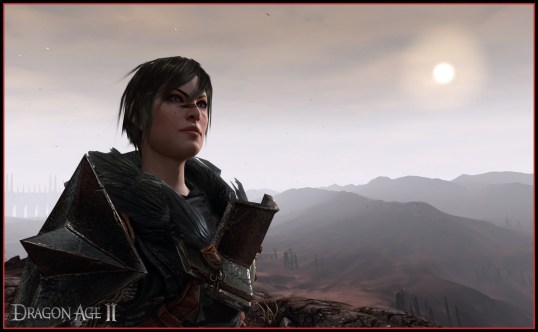
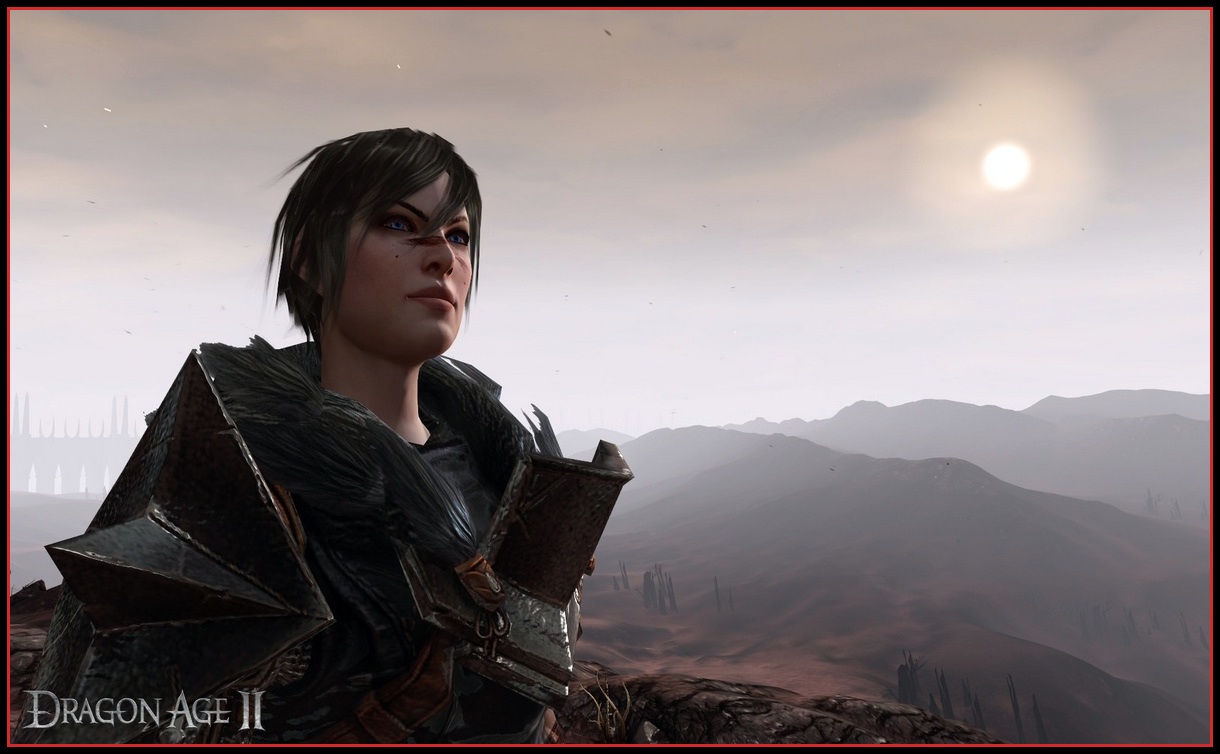
In Dragon Age II we’re treated to a whole new system which bears a little resemblance to the party-favour style system we saw in Origins, but with a new twist. Now, our party members (as expected) either approve or disapprove of our protagonist, Hawke, and the actions we take as Hawke. The relative level of either ‘Friendship’ or ‘Rivalry’ (I’m sure you can figure out which is which) then begins to colour all of Hawke’s interactions with the rest of the party. Many of the changes are subtle, but Dragon Age II is rife with subtle-but-appreciated touches that make it stand out as a game above many of the other offerings in this same genre. These little touches serve ultimately to give this title a more authentic feel than many games that I’ve played over the years, and I appreciated the attention to detail. It seems an odd contrast with the various bugs, which, I really can’t state enough, were plentiful and ranged from mildly irritating to infuriating.

Oh, and while we’re unfocused, and while we’re talking about subtle details? An odd thing occurs in this game. One which I might have appreciated more than almost anything else in the whole thing. Each conversation option is responded to with a variant of the Mass Effect style conversation wheel – responses to the right tend to lead toward the conclusion of the conversation and have a certain tone, while ones to the left tend to be follow-up questions. Unlike Mass Effect, we are treated to some symbols which help to identify the tone of the message before Hawke plants her foot in her mouth. For example, a sarcastic or whimsical reply will be accompanied by a comedy mask icon. A decisive, aggressive reply is accompanied by a closed fist. A bribe is accompanied by an image of falling coins. And so on. Anyway, this in and of itself is nice, but the truly outstanding dialog feature of the game? If you reply consistently in one vein (i.e., if you are consistently sarcastic) then the filler dialog or automatic replies from Hawke begin to mirror that type of response. Again, using the ‘sarcastic Hawke’ as an example… the dialog which is default, that is, not under the control of the player. Eventually, if enough sarcastic replies are given in order to establish a pattern, Hawke will begin to respond in a sarcastic manner on her own. It adds a lot of character to Hawke solely based on how you’re already playing the game. I hope that you can see why I think this is one of the best (albeit very subtle) features that BioWare thoughtfully included for me in this title.

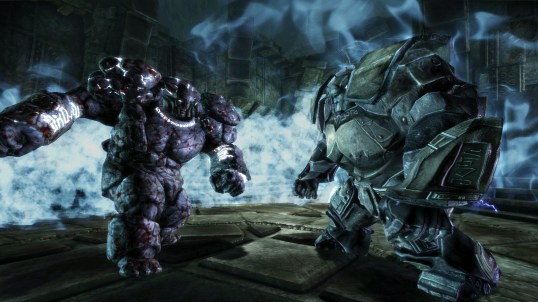
So, I suppose the real question is… what is Dragon Age II like? True to how it was promoted, it’s sort of a compromise between the FPS-action-with-RPG-elements style of Mass Effect 2 and the old-school WRPG tactical gameplay of Dragon Age: Origins. If what you loved most about Origins was how it harkened back to Baldur’s Gate II, you’ll probably find the combat system in Dragon Age II to be a bit on the shallow side. You’re still, of course, perfectly at liberty to pause the game, arrange your party, and launch a more tactical assault. On the harder difficulties, being discriminating and tactical pays off big dividends. However, the game clearly wants to draw in fans of the Mass Effect games with a pace that is overall faster, and a system that is much more streamlined. As a result of this intention, it’s pretty quick-paced… or, at least, it can be, with an optimized party on the lower difficulties. Don’t expect the same degree of difficulty that Origins could present, either, if you chose to visit Orzammar first and played on the higher difficulties. Although, again, on the higher difficulties Dragon Age II has its own challenges.

Let’s boil things down, shall we?

The Good

– It’s a beautiful, detailed, thoughtful world. We’re introduced to more of a setting we’ve been introduced to. In a lot of ways, Dragon Age II exceeds Mass Effect 2 in terms of expanding on an existing setting. If you were really drawn into the world of Dragon Age, you’ll find a lot to like in the sequel.

– The voice acting is exceptional. I can’t think of a single character whose voice acting was poor, whether you like the character or not (and – almost as a side note – I liked them all)

– The characters offer a lot to the narrative, and have some fantastic interactions. BioWare has done a stunning job letting the party members banter back and forth during quiet moments. Try different combinations. You won’t be disappointed!

– The slice-of-life style which follows a single character, Hawke, and her life is perhaps a bit less ‘epic’ on the overall than the Grey Warden’s quest, but it delves far deeper into the underlying themes of the setting.

– Combat system is streamlined and intuitive. You’ll recognize everything from Dragon Age: Origins and the menus are actually easier to navigate now.

– Party members have completely unique skills, maintain their own wardrobe, and maintain their personal opinions, which lets them keep a refreshing flavour each of their own.

– BioWare went out of their way to make crafting your own potions, Runes, poisons, grenades, and supplies more attractive. Given how frustrating it could be to locate certain components in Origins, it may almost seem like an overreaction for how simple things become in Dragon Age II – but it works well.

– Girthy. This game is pretty long. If you’re planning to do everything… settle in. You’re looking at forty hours of game-play or more.

– The DLC items (from every source!) are not the best items in the game. They’ll definitely serve you well in the early part of the game, but they’re outclassed by the mid-game, and they also don’t sell for a ton of money. Just having DLC gear won’t make this game a breeze for you, or render all other equipment useless. It’s a nice touch to actually be trying to upgrade my stuff, rather than just equipping Blood Dragon Plate and calling it a day.

The Bad

– Buggy. Buggy. Buggy. Buggy. I really can’t overstate this. Every game launches with bugs, but this one launches with an unacceptable amount, and an unacceptable severity. Patches have already cleared up a couple of them (even for the console versions) but I was still frustrated to see the sloppy polish on what is otherwise a very delicious fruit.

– Much of the tactical aspect of gameplay is gone. Baldur’s Gate II could be a serious pain in the ass sometimes, but it really rewarded good planning and a thorough knowledge of spells and mechanics. Dragon Age: Origins made a strong compromise between viable-console-game and hardcore-tactical-gameplay… this element isn’t nearly as strong in Dragon Age II.

– Did I mention the bugs? Seriously. Hopefully more of the issues in this game can be patched out.

– Overused sets. Although the set pieces are beautiful and I love the look of the game, it suffers from a bit of the Mass Effect syndrome, where there are a hundred caves which are all built using the same “cave” layout and look. Very disappointing to see a step backward here after what we saw from Origins, Awakening, and Mass Effect 2. I can only assume this is another aspect of rushed production.

– We revisit too many places. I understand the scope of the game, its focus on Kirkwall and the surrounding environs, and whatever else… but while I don’t mind re-treads within the city (especially in, as the game runs on, a number of years) it seems like there should be more unique locales around the city. It feels lazy for us to revisit the same places over and over again for quests in each Act of the game. I’ll mention it once more… it was probably intended to have a few more locales, and that was probably scrapped for time. I’m in no position to complain because I bought the game, and I loved it, but I would have loved it more if EA/BioWare had spent another month catering to my discerning tastes.

– The game seems to lack focus at times in terms of the narrative. I actually appreciated this characteristic as it seemed to mirror how a real person’s life would tend to pan out… but it does seem out of place in a video game. At times, it’s not clear where the game is headed.

– This may sound stupid, but I’m far from above personal pique, so… way too much energy spent on promoting the game prior to launch. Although their strategy of offering DLC items for interacting with people on the BioWare website or whatever else might have drawn in a couple of new fans, it almost assuredly annoyed a lot of fans who were planning to buy the game anyway.

The Bottom Line

BioWare has me, at least, hook line and sinker. In spite of my various whiny complaints. I can’t wait for their next release.
Lisa Marie Does A Line With The Cocaine Fiends (dir. by William A. O’Connor)


Back in the 1930s, the American film industry regulated itself with the Motion Picture Production Code.  The production code stated that, in films, crimes would always be punished, profanity would not be heard, bodies would remain clothed, and drug abuse would not be portrayed.  The only way to get around these rules was to make sure that the film was “educational” and that it pretended to condemn the behavior shown on-screen.  This was the birth of what would eventually become grindhouse cinema.

It’s always interesting to watch these early grindhouse films because, even with the inclusion of such forbidden elements as nudity, violence, and drugs, they all still seem oddly innocent.  Yes, there’s always a scene or two of the lead actress undressed but the camera rarely lingers as if it’s aware that it’s somehow breaking the rules.  Whenever one of these films dealt with drug addiction or white slavery, the depictions were often so heavy-handed and silly that it was obvious that nobody involved with the film had any first-hand knowledge of what they were showing.  The end results were often undeniably fun.

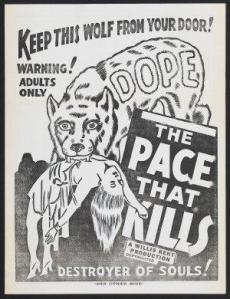
I watched one of these films last night, 1935’s The Cocaine Fiends (also known as The Pace that Kills, which is a much better title).  The Cocaine Fiends starts with a waitress named Jane (Lois January) who meets and falls in love with a mysterious fellow named Nick the Pusher (Noel Madison).  For most people, I would think that Nick the Pusher’s name would be a dead give away to what he does for a living but Jane is from the country and, by this film’s logic, this makes her an idiot.  Anyway, Jane goes to the city with Nick.  Whenever Jane starts to get a headache, Nick gives her some headache powder.  Jane snorts the powder and her headache goes away.  Soon, she’s calling herself Lil and sleeping with strangers to get money so that Nick will keep giving her headache powder.  Soon Jane/Lil discovers that she hasn’t been doing lines of headache powder at all!  Nope, that white powder is cocaine!

(Now, I know you’re probably laughing at Jane but I have to be honest and admit that last year, I was at work when I got a terrible migraine.  This woman who works in the same building as me took sympathy on me and gave me a little packet of white powder.  I quickly got out my credit card and a dollar bill and cut myself a line.  “Wait, what are you doing!?” she said as I held the tightly rolled dollar bill up to my nostril.  “I’m going to do a line,” I said.  “Oh no, honey,” she said, sweetly, “you don’t snort B.C. Headache Powder.”  True story.)

Anyway, Jane’s brother, Eddie (Dean Benton), comes to the city looking for his sister and gets a job working as a carhop.  At his job, he befriends Fanny (Sheila Bromley) who, seriously, is one of the greatest film characters ever.  Seriously, I had a huge girlcrush on Fanny by the end of this film.  Not only is she hot and independent but she also hides cocaine underneath her garter and says stuff like, “Tonight, I’m going to take you on a sleigh ride with some snowbirds.”  Eddie has a crush on Fanny too and they end up hanging out at sordid nightclubs together.  Unfortunately, Fanny also gets Eddie hooked on cocaine and soon, they both get fired.  Eddie forgets about finding his sister while Fanny turns to prostitution to support her habit.

Meanwhile, Fanny’s friend Dorothy (Lois Lindsay) doesn’t use cocaine but she still ends up getting kidnapped by Nick anyway.  Apparently, Dorothy’s father is rich.  While Eddie spends his time at an opium den (a surprisingly effective sequence), Dorothy’s boyfriend Dan (Charles Delaney) recruits Lil (remember her?) to help him rescue Dorothy and hopefully reveal the secret identity of the shadowy figure in charge of the city’s dope trade…

Did I mention all of this happens in 61 minutes?  Seriously, the Cocaine Fiends is one busy film.  Now, to be honest, all of this plot doesn’t leave much room for anything resembling introspection or nuance but perhaps that’s appropriate for a film about cocaine. I do have to admit that the Cocaine Fiends isn’t as much fun as some other exploitation films from the roadshow era.  Unlike a lot of those films, Cocaine Fiends actually does have at least a tenuous connection to reality in that, when abused, cocaine actually is a dangerous drug that can contribute to people doing some pretty dangerous things.  Still, for those searching for sordid melodrama and committed overacting, they’ll find it a surplus of it here.

 That said, like the best grindhouse films, the Cocaine Fiends occasionally offers up a moment or two of true insight.  For me, what made this film more than just a camp oddity was its sympathetic portrayal of women trapped in a cold, male-dominated underground where being female means being a commodity.  What sets The Cocaine Fiends apart from other films of that era (not to mention most films made today) was the fact that it didn’t attempt to present their tragic fate as some sort of karmic punishment or divine retribution for straying from what society deemed the proper feminine path.  Most films continue to insist that women “ask for it.”  Whatever other faults The Cocaine Fiends may have, it knows better than to think anyone asks to be violated, abused, and exploited.

To be honest, the main reason I occasionally watch a film like The Cocaine Fiends is because I’m a just a history nerd at heart.  Watching a film like The Cocaine Fiends, made outside of the idealized worldview of the Hollywood Establishment, is probably about as close as I’m going to get to using a time machine to go back to the 30s and experience the culture firsthand.  I love how Eddie, when Fanny offers to let him stay at her apartment, automatically responds with, “But we’re not married.”  And then there’s the sequence in the “dangerous” night club which, as far as decorations, music, and proper attire are concerned, reminded me of my senior prom.  It’s also where Eddie freaks out upon getting a bill for $9.97.  Luckily, Fanny is there to loan him enough money to pay it.

Anyway, for those who have an hour to kill, here’s 1935’s The Cocaine Fiends…

Lisa Marie Goes Down On Mildred Pierce (dir. by Michael Curtiz)


A quick note: By titling this post “Lisa Marie Goes Down On Mildred Pierce” I have now not only proven that there’s no dare I will not accept but I’ve also won a small but useful sum of cash.  Never let them tell you that blogging doesn’t pay off.

Like a lot of people, I was looking forward to HBO’s remake of Mildred Pierce, featuring Kate Winslet in the role made famous by Joan Crawford.  And I hate to say it but, as hard as I’ve tried, I simply can not get into this remake.  Maybe it’s because the remake’s director, Todd Haynes, has apparently decided to use five hours to tell the exact same story that the original film told in less than two.  All I know is that the HBO version has, so far, been slow, ponderous, and ultimately a rather dull affair.

As I attempted to stay awake through the remake, I found myself wondering how the original 1945 film compared to the remake.  Fortunately, I just happened to have the original on DVD.  As well, by watching the original Mildred Pierce, I could continue my current mission to see every single film ever nominated for best picture.  (Joan Crawford won the Oscar for Best Actress for her performance as Mildred but the film itself lost Best Picture to Billy Wilder’s The Lost Weekend.)

 Mildred Pierce opens with the murder of sleazy playboy Monty Beragon (Zachary Scott).  Monty’s wife, Mildred (Joan Crawford), responds to the murder by attempting to frame her ex-business partner, the equally sleazy Wally Fay (Jack Carson).  However, the police arrest Mildred’s 1st husband, the well-meaning but really, really dull Bert (Bruce Bennett).  This leads to Mildred going to the police in an attempt to clear Bert’s name.  As the police interrogate Mildred, she tells them (and the film uses flashbacks to show us)  how she went from being a dissatisfied housewife to a succesful businesswoman to finally becoming Monty’s wife.  Through it all, Mildred is motivated by the need to take care of and spoil her manipulative daughter Veda (Ann Blyth).

Seen now, Mildred Pierce is an artifact of different time but, as a secret history nerd, I happen to love studying artifacts.  Like many of the films of the late 40s, Mildred Pierce‘s melodramatic plot serves as a reflection of a culture that, in the wake of World War II, was no longer as smugly complacent about how the world worked.  As I watched Mildred Pierce, the thing I immediately noticed was just how much the film seemed to be suspended between pre-War and post-War culture.  It’s the type of film that goes out of it’s way to acknowledge Mildred’s role as a “new woman” but, at the same time, still finds time to include numerous “comedic” scenes of various men leering at Mildred’s ankles. 

(Actually, I guess they were supposed to be staring at her legs but, since this was the 40s, this could only be represented by an occasional flash of ankle.  Personally, my ankles are okay but I like my legs better.)

Mildred Pierce is often cited as being a forerunner to feminist cinema and I have to admit I have some issues with that.  Yes, the film does acknowledge that a woman can be tough and that a woman can be a succesful businesswoman.  However, the film’s message ultimately seems to be that mothers who work will ultimately raise daughters who will become burlesque dancers and potential killers.  Mildred Pierce doesn’t so much celebrate female independence as much as it fears it.  If only Mildred had remained married to boring and predictable Bert than Veda would never have ended up as a murder suspect.

The question of ideology aside, the original Mildred Pierce remains an entertaining example of old school melodrama.  Director Michael Curtiz was one of those “craftsmen” who, in the 30s and 40s, seemed to direct hundreds of films without ever really establishing any sort of unique style of their own.  Instead, they simply used whichever style that would be most efficient towards dramatizing the script.  For Mildred Pierce, Curtiz imitated the style of a B-movie film noir.  It’s a good approach for this story even if Curtiz doesn’t seem to understand  the shadows of noir quite as well as his contemporaries Billy Wilder or Robert Siodmak.

Of course, Mildred Pierce is best known as the film that won Joan Crawford an Oscar.  I haven’t seen many of Crawford’s films (though I have seen Faye Dunaway playing her in Mommie Dearest) and I’ve got an unapologetic girlcrush on Kate Winslet but I honestly have to say that I prefer Crawford’s version of Mildred to Winslet’s.  Because, as much as I idolize Kate Winslet, she doesn’t seem to so much be playing Mildred Pierce as much as she’s observing her.  Crawford, meanwhile, sank her perfectly manicured nails into the role and pretty much refused to let go until she got her Oscar.  Crawford plays Mildred as a woman so obsessed with survival that she seems to be perfectly willing to destroy the rest of the world if that’s what it takes.  To be honest, it’s really not a great acting job but it certainly is fun to watch. Technically, Winslet gives the better performance but Crawford is a lot more entertaining.

(That said, I still love Kate and I actually would probably fall at her feet and say, “Thank you,” if I ever met her in real life because she’s really one of my heroes.  Physically, I developed early and I had to deal, at way too early an age, with a combination of a physical maturity and emotional immaturity.  By the time I was 13, I was so totally overwhelmed by the insecurity and uncertainty but then I read an interview with Kate Winslet in which she said, “I like having tits and an ass.”  And that, to be honest, was the first time I had ever come across anyone saying that it was okay to like your body.  So, anyway, the point of all that is that I love Kate Winslet.)

Crawford pretty much dominates the entire film but a few of the other performers do manage to make an impression.  As Mildred’s ex-husband, Bruce Bennett is pretty boring but the other men in Mildred’s life are well-played by Jack Carson and Zachary Scott.  Scott especially was well-cast as the type of guy that we always says we’re done with just to end up hooking up with them whenever we’re at our weakest.  As Veda, Anne Blyth gives such a driven and intense performance that you actually believe that she could be the daughter of Mildred Pierce.

In the end, Mildred Pierce isn’t really a great film but it is a lot of fun and that’s a definite improvement on the current remake.

Film Review: The Mechanic (dir. by Simon West)


A few years ago, I declared that January should just be renamed Statham because seriously, Jason Statham was in like almost every single freaking movie released that month.  Seriously, it was like every time I turned on the TV, there was yet a new commercial featuring Jason Statham in some movie that I had absolutely no desire to see.  “Oh look,” I’d say, “that’s Jason Statham swinging a sword.  Oh, now he’s driving a car really fast.  Oh, wow, now Jason Statham’s looking off to the side and squinting…”

Well, this January, Jason Statham is only starring in one film and it might be the best of his career.  At the very least, it’s the first time I’ve been able to kind of see the guy’s appeal as a film star.  That film is The Mechanic and it opened this week.

In the Mechanic, Jason Statham plays a contract killer.  He’s known as a mechanic because he “fixes” problems.  After Statham’s mentor (Donald Sutherland) is killed, Statham takes the man’s son (Ben Foster) under his wing and starts to teach Foster the tools of the trade.  However, unlike the cool and detached Statham, Foster is a jittery and angry psychopath.  However, despite their differing approaches, they are forced to work together when the same man (Tony Goldwyn) who ordered Sutherland’s murder decides to come after them.

As I stated before, I’ve never quite gotten the appeal of Jason Statham as an actor.  In fact, as Jeff and I waited for the film to start, I said, “I’ve never really gotten Jason Statham.”  As soon as I said that, this woman sitting in front of us turned around in her seat and I swear to God, she rolls her eyes at me in this way that said, “Bitch, please.  Like Jason Statham would ever give your raggedy ass a second look.” 

I proceeded to narrow my eyes in a way that said, “You best be watching what you say, you nasty ass ho.”

She cocked her head in a way that said, “Oh, no you didn’t!”

I flared my nostrils in a way that said, “Oh yes, I did, you hootchie ass skank…”

She leaned forward as if to say, “Gurl, you need to get Jesus in your life…” 

I smirked as if to say, “Jesus?  What does Jesus have to do with this?”

Before she could answer, the movie started.

Anyway, what was my point?  Oh yes, Jason Statham.  In the past, I’ve never gotten his appeal but in this film, I did.  For the first time, I saw him as something other than just an expressionless English guy.  Statham is athletic but, unlike a lot of other action movie stars, he’s not so ludicrously muscle-bound that you can’t believe him as some guy you might run into out on the street.  Previously, I just thought that Statham was a bad actor but, with the Mechanic, I realized that, whereas other actors act with their eyes and their voice, Statham acts with his body.  You look at Statham with his constant scowl and his cold eyes and you believe that he could kill someone in real life as well as in the movies.  Statham is perfectly cast as a professional killer and The Mechanic wisely doesn’t try to suggest that the character is anything more than just a very disciplined sociopath.  Much like the best pulp heroes, Statham’s mechanic is a hero by default.  He’s a bad guy but everyone else in the movie is worse.

Also, there’s a scene about ten minutes into the film where Statham, fresh from killing a drug lord, changes clothes in a linen closet and as soon as he removed his shirt, I said, “Oh, I see the appeal now.”

Playing opposite of Statham, Ben Foster gives another one of his intense performances.  Throughout the film, Foster is perpetually on the verge of exploding and his typically high energy performance provides a nice contrast to Statham’s typical nonperformance.  He’s the Eli Wallach to Statham’s Clint Eastwood.  However, Foster doesn’t just rely on theatric for his character.  Instead, he gives a complex, multi-faceted performance as a character who, in the hands of a lesser actor, could have just been your average psychopath.  He even manages to win some sympathy for a character who, on paper, wouldn’t seem to deserve it.  Even more importantly, he brings out the best in Statham in a way that previous co-stars like Sylvester Stallone couldn’t. 

Director West keeps the action moving quickly without ever letting the movie degenerate into just a collection of over-the-top set pieces.  When the film does break out into action, West handles it like a pro and, as spectacular as the action may get, he still manages to keep things in the realm of the believable.  However, West also invests the film with a dark, almost grim atmosphere that fills every scene with a feeling of impending doom and growing paranoia.

The Mechanic is a fast-paced, unapologetic thriller that, in its way, ultimately becomes a masterpiece of the pulp imagination.   It’s very easy to imagine this as an Antonio Margheriti film from the early 80s, starring David Warbeck and Giovanni Lombardo Radice in the Statham and Foster roles.  Both director West and the cast deserve to be applauded for making a grindhouse film for the 21st Century.

Classic Game: XCOM: UFO Defense


Those who forget their past; are doomed to forget some incredible games.

I forget who said that, but he must have been a smart man. Going back to the days of DOS games and 3.5 disks, we can still find some gold. In fact, some of the greatest games I’ve ever been played were made before the world had envisioned the idea of a game on a CD-ROM. Well, the greatest squad-based strategy game ever made is just one of these. And you can get it on Steam for a pittance. Really, a pittance of a pittance! I’m talking, of course, about X-COM: UFO Defence (Hereafter referred to simply as X-COM).

People who have played this game are already having some nostalgic flashbacks, and are strongly considering buying it on Steam right now.

For those of you who haven’t played it… read on!

X-COM is a squad-based strategy game that places the player in command of a global counter-alien organization aptly titled X-COM. A completely covert organization, X-COM crosses national boundaries with impunity, and remains hidden from the alien aggressors who haunt the globe. As the theatre commander for this covert organization, you will establish bases across the globe. Each base can house facilities such as alien containment for captives, hangar bays to launch interceptor craft in pursuit of UFOs, laboratories to develop new technologies, and workshops to build weapons. From your initial base, your X-COM organization will grow to protect all of Earth from a merciless and inhuman enemy. It is up to you to save us all.

The game play is based on the Geosphere. In essence, this is a map of the earth which is manipulated through time lapse controls, allowing the player to speed or slow the passage of time. From the Geosphere, the player can access the aforementioned workshops and laboratories, outfit soldiers for battle, and construct new bases and facilities. In addition, the Geosphere map allows the player to monitor alien activity on earth. Each time your base(s) detect UFOs, you can intercept them, shoot them down, and attempt to recover salvage. In addition, you may detect alien bases manufactured on earth, or the aliens may strike on their own, terrorizing Earth cities in an attempt to frighten our governments into submission.

Once you’ve landed at an alien crash site, an active UFO, a terror site, or an alien base, you take command of a squad of soldiers deployed from your landing craft. Equipped with the weapons and armor that you provided them, your soldiers are ready to fight and die at your command. They have various gameplay statistics that will determine how far they can move, how brave they are in the face of adversity, and how accurately they shoot. This squad combat is turn based, and pits a small group of highly-trained soldiers against their enemies. As these soldiers kill aliens and survive their missions, they are advanced in rank and in statistics, moving from squeamishly determined green troops into hardened combat veterans. At the same time, your scientists will learn the secrets of the aliens’ technology, allowing your troops to use fantastic energy weapons and psionic attacks against the invaders.

Strategy game enthusiasts will, almost without variation, love this game. It has incredible depth of strategy, and yet still contains a lot of action. You’ll have to learn the strengths and weaknesses of a variety of alien opponents, and counter them, if you ever intend to defeat the aliens at their base on Mars and stop the invasion of Earth. If you don’t know the joy of X-COM: UFO Defense, then it’s time to run, not walk, to check it out.

Review: Civilization V


The Bottom Line

A worthy successor to Civilization IV, but far from a bold step forward for a classic game franchise.

Unfocused Ramblings

Years and years ago, I picked up a copy of Civilization II and convinced my dad that I really needed to own it. I’d heard from my cousin that it was a great game, and that (as a strategy fan) I really needed to give it a whirl. I loved the game. I probably ran a thousand civs to their completion, cheat mode or no, and I became intimately familiar with the inner workings of the game. Oddly, I learned as much about obscure World Wonders from Civilization II as I did from any class I took in secondary education. In perfect honesty, I didn’t enjoy Civilization III nearly as much, and I became somewhat disenfranchised with the whole series after playing it. A few years later, jaded as I was, I saw Civilization IV on the shelves at a local Best Buy and I decided, “Yeah, it’s time.”

Civilization IV brought me back to the series. From the opening screen with the Baba Yetu chant, I fell in love.

Well, Civilization V is missing Leonard Nimoy’s voice in the narration (and this is a brutal loss, but Mr. Nimoy certainly isn’t aging in reverse). But otherwise, it feels to me like a game that understands its audience. It’s like the developers actually played the game and tried different strategies, civilizations, levels of difficulty, and victory conditions, and realized there were areas where the game-play could be tremendously streamlined. Aside from a couple of major pet peeves – don’t worry, I’ll get into them –  it feels like a natural evolution from the model of almost-perfection that Civilization IV presented.

Unfortunately, while this latest installment represents a step forward in many areas, it is a step back in several others. Most painful in their absence are any presence of religion. I understand all too well how thorny a topic religion is. How is the developer supposed to handle this? Providing distinct characteristics is inevitably going to draw accusations of religious bias, deserved or no, and is not a realistic option. Making all religions do the same thing is going to draw the same sort of criticism and, from a game-play standpoint, it made Civilization IV too easy – spread your religion, and you ensured victory!

At the same time, religion is a cornerstone of all of human history. To simply excise it is… disappointing, and probably the thing that I liked least about this latest title. Rather than providing total customization in the vein of Civilization IV we are forced to accept certain limitations. Culture points are banked and spent on civics, rather than allowing our level of technology and personal preference determine our government’s style, which creates a much more limited scope for your civilization. It just doesn’t have the epic “evolutionary” feel that I always had when advancing a civilization in Civilization IV.

A part of me regrets that Civilization IV was so good. I want the franchise to continue to grow, and it’s hard for me to admit that we may have just hit a ceiling. In terms of our own personal technology, we can hit strides forward, but there’s very little opportunity to gain a greater understanding of the history of the human race.

The Big Question

Where do we go from here? To be honest, I didn’t see a tremendous potential for expansion from where Civilization IV took us. Are we doomed to just re-live a classic game franchise, or can we re-invigorate it? Are there untapped gems of potential in human development that the developers haven’t considered?

Overall Game-Play: 9.5

Yep, I’m giving it an almost-perfect score. I’ve played a dozen civilizations or more, and I’ve yet to encounter an aspect of game-play that frustrates me, or causes me to stop and wonder why I bother playing. I understand that many people are evaluating games purely on their multi-player merits right now, but this is a game that delivers primarily in the single-player “us against them” mode.

The biggest problems you’ll encounter in the game focus around the A.I.’s style of play – which can make achieving cultural or other “peaceful” victories frustrating – but while I have heard others complain about this, I haven’t found it to be a tremendous stumbling block.

Story N/A

There is no “campaign mode” so we don’t have a true evaluation of story. However, this game does allow you to explore an alternate history of the human race in an infinitely varied way. I’ve given this an N/A, but it probably deserves some honourary points for letting you develop your very own story.

Graphics 7.5

You’re almost certainly not playing this game for its visuals if you are playing it. It is, after all, a strategy game, and a darn fine one. The visuals are beautiful for the most part – certainly not an area of complaint – but they’re hardly a focus of the title, and I’d struggle to recall one particularly stunning sequence. I also don’t think that you will be disappointed by the graphics, however, unless you have other issues with the core game-play.

Sound 7.0

If you’re a Civilization IV die-hard, then you will definitely feel the lack of Leonard Nimoy in this title, and the absence of Christopher Ting’s enchantingly beautiful rendition of Baba Yetu at the title screen. In fact, I found very little that ‘stood out’ to me as far as the audio effects in this title. The score was fine, if forgettable, and I found myself feeling bad for anyone who would be tasked with scoring a Civilization game or voice-acting for it after the release of Civilization IV. All of that negativity having been aired, I will say that while Civilization V‘s score lacks the epic feel of its predecessor, its audio is far from disappointing, and you’re unlikely to be overly disappointed once you get past the absence of Nimoy’s impeccable delivery.

Multiplayer 5.0

Unfortunately, the multi-player mode is still a huge weakness of the series and the genre. In all my years of gaming, I still struggle to name a single turn-based game that has suffered the transition to multi-player well. The genre just doesn’t lend itself to an exceptional multiplayer environment. If you have an insatiable lust to compete against other players – despite streamlining and advances in the multi-player environment – this just may not be the title for you. The experience against the A.I. works at a leisurely pace you may enjoy, and ultimately involves a lot less hassle. That having been said, don’t shy away from challenging your friends to a Civilization match – as long as you have the time! Just be aware that this is no quick feat.

Film Reviews: The Airport Terminal Pack


 Sometimes, you have to be careful which films you choose to watch over the course of the day. 

Such as, last Friday night, I heard the news that Jill Clayburgh had died and I ended up watching An Unmarried Woman.  This, along with the fact that I also watched the Black Swan trailer, led to me dancing around the house in my underwear, en pointe in bare feet, and doing a half-assed pirouette in the living room.  And I felt pretty proud of myself until I woke up Saturday morning and my ankle (which I don’t think has ever properly healed from the day, seven years ago, that I fell down a flight of stairs and broke it in two places) literally felt like it was on fire.  That was my body’s way of saying, “You ain’t living in a movie, bitch.  Deal with it.”

So, come Sunday, I decided to play it safe by watching something that I was sure wouldn’t lead to any imitative behavior on my part.  Since I had previously reviewed Earthquake on this site, I decided that I would devote some time to the movies that started the entire 1970s disaster movie genre — Airport.  Watching Airport led to me watching Airport’s three sequels.

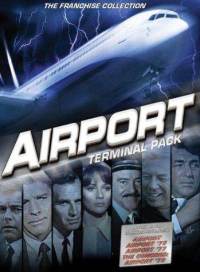
I was able to do this largely because I own the Airport Terminal Pack, a two-disk DVD collection that contains all four of the Airport films and nothing else.  There’s no special features or commentary tracks.  That’s probably a good thing because these films are so extremely mainstream that I doubt the commentary tracks would be all that interesting except to people who love “Me and Jennings Lang had the same lawyer…” style stories.

The movies are a mixed bag of ’70s sexism, mainstream greed, and casts that were described as being “all-star” despite the fact that they featured very few stars.  They’re all worth watching as time capsules of a past time.  Some of them are just more worthy than others.

Below are my thoughts on each individual film in the collection…

Airport (directed by George Seaton)

First released in 1970, Airport was nominated for 10 Academy Awards (including best picture), broke box office records, and started the whole 70s disaster movie trend.  It also has to be one of the most boring, borderline unwatchable movies ever made.  The fact that I managed to sit through the whole thing should be taken as proof that I’m either truly dedicated to watching movies or I’m just insane.  Take your pick.

Anyway, the film is painstakingly detailed account of the every day operations of an airport.  Yeah, sounds like a lot of fun, doesn’t it?  Burt Lancaster runs the airport.  His brother-in-law Dean Martin flies airplanes.  Both of them have mistresses but we’re told that’s okay because Lancaster’s wife expects him to talk to her and Martin’s wife is cool with him fucking around as long as he comes home at night.  I would be tempted to say that this is a result of the film having been made in 1969 and released in 1970 but actually, it’s just an introduction to the sexual politics of the typical disaster film.  Men save the day while women get in the way.  And if you think things have changed, I’d suggest you watch a little film calledf 2012

The only interesting thing about the film is that Lancaster’s mistress is played by Jean Seberg who, ten years earlier, had helped change film history by co-starring in Jean-Luc Godard’s classic film Breathless.  Nine years later, after years of being hounded by the American press and the FBI for her radical politics, Seberg committed suicide.

Airport 1975 (directed by Jack Smight)

As opposed to its predecessor, Airport 1975 is actually a lot of fun in its campy, silly way.  This is the one where a small private plane (flown by Dana Andrews, the star of the wonderful film noir Laura) collides with a commercial airliner.  The entire flight crew is taken out and head stewardess Karen Black has to pilot the plane despite the fact that she’s obviously cross-eyed.  Luckily, since Black is a stewardess, she has a pilot boyfriend who is played by Charlton Heston.  Heston talks her through the entire flight despite the fact that she was earlier seen trying to pressure him into not treating her like an idiot.  Anyway, Heston does his usual clench-jaw thing and if you need a drinking game to go with your bad movie, just take a shot every time Heston calls Black “honey.”  You’ll be drunk before the plane lands.

There’s some other stuff going on in this movie (for instance, Gloria Swanson appears as “herself” and doesn’t mention Sunset Boulevard or Joseph Kennedy once!) but really, all you need to know is that this is the film where Karen Black acts up a storm and random characters keep saying, “The stewardess is flying the plane!?”

Odd trivia fact: Airport 1975 was released in 1974.

Airport ’77 (directed by Jerry Jameson)

In Airport ’77, a group of art thieves attempt to hijack an airplane which, of course, leads to the airplane crashing into the ocean and somehow sinking down to the ocean’s floor without splitting apart.  The crash survivors have to try to figure out how to get to the surface of the water before they run out of oxygen. 

In this case, our resident sexist pilot is Jack Lemmon who has a really ugly mustache.  He wants to marry head stewardess Brenda Vaccarro.  Vaccarro doesn’t understand why they have to get married to which Lemmon responds, “Because I want a wife and kids!”  The film also gives us Lee Grant as a woman who is married to Christopher Lee but who is having an affair with another man.  She also drinks a lot and dares to get angry when she realizes that the airplane is underwater.  While this sort of behavior is acceptable from Dean Martin, Charlton Heston, and Jack Lemmon, the film punishes Lee Grant by drowning her in the final minutes.

Technically, Airport ’77 is probably the best of the Airport films.  The cast does a pretty good job with all the melodrama, the film doesn’t drag, and a few of the scenes manage to generate something resembling human emotion.  (For instance, when the blind piano player died, I had a tear in one of my freaky, mismatched eyes.)  Unfortunately, the movie’s almost too good.  It’s not a lot of fun.  Everyone plays their roles straight so the silly plot never quite descends into camp and the key to a good disaster film is always camp.  This film also has the largest body count of the series, with most of the cast dead by the end of the movie.  (And, incidentally, this film did nothing to help me with my fear of water…)

The Concorde: Airport ’79 (directed by David Lowell Rich)

The last Airport movie is also the strangest.  Some people have claimed that this film was meant to be a satire of the previous Airport films.  I can understand the argument because you look at film like Concorde and you say, “This must be a joke!”  However, the problem with this theory is that there are moments of obvious “intentional” humor in this film (i.e., J.J. from Good Times smokes weed in the plane’s bathroom, another passenger has to go to the bathroom whenever she gets nervous) and none of them show any evidence of the type of wit and outlook necessary to come up with anything this silly on purpose.  Add to that, the film’s story is credited to Jennings Lang, a studio executive.  Studio execs do not take chances.  (Plus, the actual script was written by Eric Roth, who went on to write the amazingly humorless The Curious Case of Benjamin Button).

No, this film is meant to be taken seriously and oh my God, where do I start?

Our pilots are George Kennedy and Alain Delon.  The head stewardess (and naturally, Delon’s girlfiend) is played by Sylvia “Emanuelle” Kristel who, at one point, says, “You pilots are such men!”  “Hey, they don’t call it a cockpit for nothing, honey,” Kennedy replies. 

Meanwhile, Robert Wagner is trying to destroy the Concorde because one of the passengers is his girlfriend who has proof that Wagner has been selling weapons to America’s enemies.  So, he attempts to blow the plane up with a guided missile and when that fails, he sends a couple of fighter planes after them.  Kennedy responds by opening up the cockpit window — while breaking the sound barrier mind you — and firing a flare gun at their pursuers.  

After this, there’s stop over in Paris where Delon arranges for Kennedy to sleep with a prostitute who assures Kennedy that he made love “just like a happy fish.”

The next day, everyone returns to the exact same Concorde — despite the fact that just a day earlier they’d nearly been blown up by a squadron of fighter planes — and take off on the second leg of the flight.  Let me repeat that just to make sure that we all understand what this film is asking us to believe.  After nearly getting blown up by a mysterious squad of fighter planes, everybody shows up the next morning to get on the exact same plane.

Oh, and it never occurs to Wagner’s ex-girlfriend that Wagner might have something to do with all of this.

Now sad to say, Concorde is the one of those films that’s a lot more fun to talk about than to actually watch.  It should be a lot more fun in its badness than it actually is.  Still, the movie has just enough camp appeal to make it fun in a “what the fuck…” sorta way.

And that’s how the Airport series comes to an end.

A Few Thoughts Before Actually Seeing The Social Network


Hi there.  Lisa Marie here.  I know that usually when I show up on this site, it’s too either toss up 6 more exploitation trailers or to present a review of a film that’s been unfairly dismissed (or foolishly overpraised) by the mainstream media.  It’s what I love doing and I hope everyone gets at least a little occasional pleasure out of it.  (If you don’t — well, please don’t tell me.  I’m surprisingly sensitive.)

Last week, I expected that, at this time, I would have posted a review (probably negative) of the mainstream’s latest attempt to make an art film — David Fincher’s The Social Network.

Unfortunately, life in general — and my body in specific — had other plans.  I’ve been sick since Wednesday and, for the first time in over a year, I did not spend my weekend at the movies.  It’s enough to make a girl cry.

(That said, I did spend most of the weekend lounging about in various states of undress so maybe concentrating on that image will help to lessen the sting of no Social Network review…)

However, while I may not be able to give you my Social Network review, I do feel that I can give you my Social Network pre-viewing review.

Just based on the evidence presented to me so far, the Social Network sucks.

Consider the evidence:

1) Peter Travers of Rolling Stone says that the Social Network will make me “believe in film again.”  Excuse me?  Francios Truffaut coming back from the dead — or at least Jean-Luc Godard making one more vaguely entertaining movie before dying– will make me believe in film again.  I refuse to join a religion based on a movie about fucking Facebook.  Sorry, Mr. Travers.

2) Andrew O’Heir at Salon.com has compared The Social Network to — wait for it — Citizen Kane.  Hopefully, when the zombie apocalypse comes, Zombie Orson Welles will eat Andrew O’Heir first.

3) According to Rotten Tomatoes — the web’s greatest resource of Mainstream Opinion — The Social Network is the best-reviewed film of 2010 so far.  For a film to be that loved, it must be really needy.  And what do needy things do?  They manipulate, they lie, and they go out of their way to beg you to like them.  A great film doesn’t give a fuck what you think.

4) The movie stars Jesse Eisenberg who has already been in 3 great movies — The Squid and the Whale, Adventureland, and Zombieland.  Sorry, Jesse but only Giovanni Lombardo Radice is allowed to appear in four great films in just four years.

5) The movie is written by Aaron Sorkin.  This movie is being advertised as the “defining” movie as my generation.  Sorry, but the defining movie of my generation isn’t going to be written by some smug, 50 year-old, male, sexist, crackhead.

6) The movie is directed by David Fincher which normally would be a good sign except all the reviews are concentrating on Aaron Sorkin.  So, is our Mr. Fincher so needy for an Oscar that he’s basically abandoned his own vision in the service of some smug, 50 year-old, male, sexist, crackhead?

7) Apparently, this movie celebrates rich kids getting richer.  Just what America needs right now.  Yes, let’s celebrate the dumbfug toadsuckers of the world while the guy flipping your burger over at McDonald’s loses his health insurance.

8 ) The Social Network is apparently number one at the box office after this weekend and apparently has gotten great word of mouth.  You know who else got great word of mouth at one time?  Adolf Hitler, that’s who.  Up until it was no longer socially acceptable, the mainstream loved him too.

9) The Social Network has a really crappy, first draft title.  Seriously, that’s the name of the movie? 

10) Sasha Stone, over at Awardsdaily.com, loves this fucking movie and to me, that’s reason enough to assume it’s going to be an overrated piece of foolishness.  Seriously, Awardsdaily.com is a great site if you want to keep up with all the Oscar buzz but — when it comes to reviews — Sasha Stone, Ryan Adams, and the rest of the site are all so middle class and predictable.  (Of course, what do you expect from a site that regularly quotes William Goldman?)

So, that’s my pre-viewing review of The Social Network.  Hopefully, I’ll see it next weekend and be able to post an actual review.  Then we’ll be able to see if the film simply conformed to my own biases or if it truly is worthy of all the hype.

Until then, I’d love to hear your thoughts on The Social Network and the growing chorus of mainstreamers who insist that this is the greatest film of all time.  Am I being too hard on it or is this yet another example of the mainstream emperor wearing no clothes?