Retro Television Review: City Guys 2.5 “The Divorce” and 2.6 “Bully, Bully”


Welcome to Retro Television Reviews, a feature where we review some of our favorite and least favorite shows of the past!  On Thursdays, I will be reviewing City Guys, which ran on NBC from 1997 to 2001.  The entire show is currently streaming on Tubi!

As season two of City Guys continues, Chris’s parents finally get a divorce and El-Train is tempted to return his old ways!

It’s all a part of rolling with the city guys….

Episode 2.5 “The Divorce”

(Directed by Frank Bonner, originally aired on October 10th, 1998)

After spending the first season constantly fighting, Chris’s parents are finally getting a divorce.  Chris has a hard time dealing with the divorce, so much so that it starts to interfere with Chris’s ability to work at the radio station.  “Show’s over, people!” Chris snaps at one point, “go play your own music!”  You tell them, Chris!

Last week, I wrote about what a good job Wesley Jonathan did in the “Jamal Got His Gun” episode.  This week, it’s time to praise Scott Whyte, who does a very good job capturing Chris’s emotional turmoil over his parents splitting up.  Both Jonathan and Whyte obviously developed quite a bit as actors before the start of City Guys‘s second season because it’s hard to imagine either one of them giving as good a performance during the first season.

Anyway, this episode was well-done but the main storyline brought back a lot of memories of how I felt when my parents got divorced so let’s talk about the B-storyline, in which Dawn struggled to keep her electronic pet from dying ….. awwwww!  That’s so sad.  Okay, let’s think about the C-storyline, where Al and El-Train both got jobs.  So far, Al has been a good deal less annoying during season 2 than he was during season 1.

Finally, I have to say that I really related to Cassidy in this episode.  When she dropped in to see how Chris was doing, she immediately started cleaning his bedroom.  I would have done the same because there’s no excuse for not picking up after yourself.  While Cassidy is cleaning, Chris makes a joke about all the time that he’s spent watching Judge Judy.  Seriously, Judge Judy has been around forever!

Episode 2.6 “Bully, Bully”

(Directed by Frank Bonner, originally aired on October 17th, 1998)

After the newest school bully steals Al’s basketball, El-Train takes care of the situation by punching out the bully.  El-Train finds himself tempted to return to his old violent ways and that’s not surprising when you consider how the audience cheered when he threw that punch.

Fortunately, Ms. Noble has more sense than the audience and she tells El-Train not to return to his old ways.  She also mentions that El-Train is the class president so at least that season one cliffhanger has finally been resolved.  Anyway, it all leads to a slow motion fight scene and El-Train announcing that he was no longer into senseless violence.

It’s all a bit heavy-handed but Steven Daniel’s performance as El-Train remains as strong as ever.  And how can you not enjoy an episode with this much slow motion?  Slow motion makes everything better!

Horror Film Review: The Lawnmower Man (dir by Brett Leonard)


The 1992 horror/sci-fi hybrid, The Lawnmower Man, tells the story of two men.

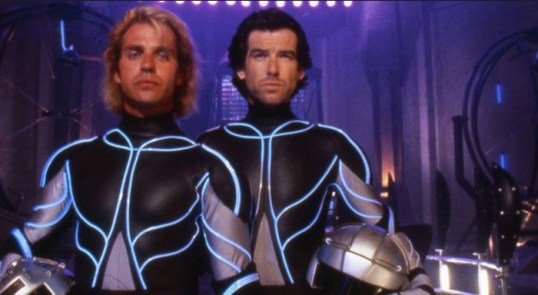
Dr. Lawrence Angelo (played by Pierce Brosnan) is a scientist who is experimenting with ways to make less intellectually inclined people smarter. Dr. Angelo is kind of a burn out. You can tell he has issues because he needs to shave, he’s always sitting in the dark, and he’s never without a cigarette. You look at Dr. Angelo and you just imagine that he smells like smoke, bourbon, and lost dreams.

Jobe (Jeff Fahey) is the kind-hearted but intellectually disabled man who lives in a shack and spends his time mowing everyone’s lawn. Hence, he’s known as the …. wait for it …. THE LAWNMOWER MAN!

Together, Dr. Angelo and Jobe solve crimes!

No, not really. Instead, Dr. Angelo decides to experiment on Jobe. This leads to Jobe not only becoming smarter but also quicker to anger. Soon, Jobe is developing psychic abilities. He can move things with his mind. He can magically set people on fire. Basically, he can do whatever the script needs for him to do at the moment. Jobe is soon tormenting everyone who once bullied him. Father McKeen, the pervy priest, gets set on fire. Jake, the gas station attendant, is put into a catatonic state. An abusive father get run over by a lawnmower.

Dr. Angelo knows that Jobe is out-of-control and that the experiment has to be reversed. However, the sinister group behind Angelo’s research wants to use Jobe as a weapon because …. well, because they’re evil and that’s what evil people did back in 1992. Jobe, however, has other plans. He wants to become pure energy so that he can rule over a virtual world….

Or something like that. To be honest, it’s kind of difficult to really figure out what’s going on in The Lawnmower Man. The movie shares its name with a Stephen King short story but it has so little in common with its source material that King reportedly sued to get his name taken out of the credits. (Considering some of the films that King has allowed himself to be associated with, this is kind of amazing.) The film tries to be a satire, a slasher film, a conspiracy film, and a technology-gone-crazy film all in one and the end result is one big mess.

Along with all of that, The Lawnmower Man is also a time capsule of when it was made. A good deal of the film takes place in Jobe’s virtual reality universe, which looks a lot like a mix of Doom and Second Life. I imagine the film’s special effects may have seen impressive way back in the 20th Century but, seen today, they’re rather cartoonish, if occasionally charmingly retro.

On the plus side, the film does have an interesting cast. Pierce Brosnan is never convincing as burn-out but he tries so hard that he’s still fun to watch. Underrated actors like Jenny Wright, Geoffrey Lewis, Dean Norris, and Troy Evans all get a chance to show what they can do in minor roles. Finally, you’ve got the great Jeff Fahey, giving a far better performance than the script perhaps deserves. Though the film may be a mess, there’s something undeniably fun watching Jeff Fahey’s Jobe go from being meek to being a megalomaniac.

It’s a silly film and not one that’s meant to be watched alone. This is a film that has to be watched with a group of your snarkiest friends. Watch it the next time you’re looking for an excuse to avoid doing the yard work.

Horror On The Lens: Messiah of Evil (dir by Willard Huyck)


MOE Mariana HillWith only five days left until Halloween, I wanted to make sure that I shared this film with our faithful and wonderful readers.  Messiah of Evil was first released in 1973 and, since it’s in the public domain, it has since been included in a countless number of bargain box sets from Mill Creek.

I can still remember the first time that I saw Messiah of Evil.  It was on a Monday night, many years ago.  I had recently picked up a 10-movie DVD box set called Tales of Terror and I was using the movies inside to try to deal with a bout of insomnia.  I had already watched The Hatchet Murders (a.k,a. Deep Red) and The House At The Edge of the Park and, at two in the morning, I was faced with a decision.  Should I try to sleep or should I watch one more movie?

Naturally, I chose to watch one more movie and the movie I chose was Messiah of Evil.  So, there I was at two in the morning, sitting at the edge of my bed in my underwear and watching an obscure horror movie while rain fell outside.

And, seriously — this movie totally FREAKED me out!

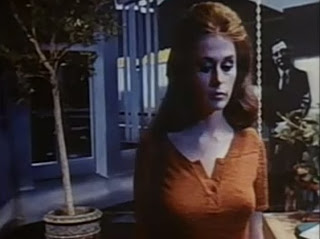
Messiah of Evil tells the story of Arletty (Marianna Hill), a neurotic woman who drives to an isolated California town in order to visit her father.  Her father is an artist who specializes in painting eerie pictures of large groups of black-clad people.  However, once she arrives at his home, Arletty discovers that her father has vanished and left behind a diary where he claims that a darkness has overtaken the town.

Meanwhile, a mysterious man named Thom (Michael Greer) is wandering about town with two groupies (played by Anita Ford and Joy Bang) and interviewing random townspeople.  One crazed man (Elisha Cook, Jr.) explains that “the dark stranger” is returning.  After meeting Arletty, they all end up moving into her father’s house.

But that’s not all.   There’s also an odd albino man who shows up driving truck and who eats mice….

Messiah of Evil is literally one of the strangest films that I’ve ever seen.  It’s shot in a dream-like fashion and the much of the film is left open to the viewer’s interpretation.  There are two classic scenes — one that takes place in a super market and one that takes place in a movie theater and the movie’s worth watching for these two scenes alone.

Messiah of Evil is a film that will be appreciated by all lovers of surrealism and intelligent horror and I’m happy to share it with you today.

October Positivity: The Secrets of Jonathan Sperry (dir by Rich Christiano)


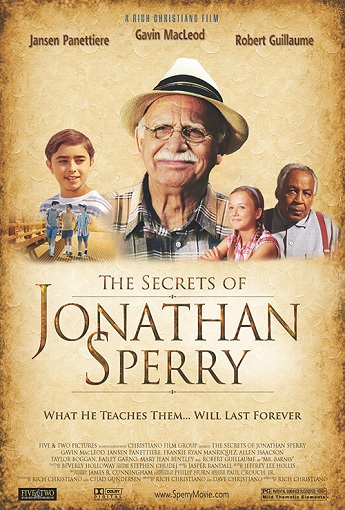
First released in 2008, The Secrets of Jonathan Sperry is a true rarity.  It’s a Christiano feature film that’s actually not that bad.

The film takes place in 1970, with the implication being that it’s based on a true story.  (The film ends with an epilogue, in which we learn what everyone did with their lives after the final scene.)  Three adolescent friends are trying to enjoy their summer.  One of them has a crush on the local waitress and is trying to figure out how to tell her.  All of them are trying to avoid getting on the bad side of Nick and his gang.  Nick is the type of bully who takes your last piece of pizza and then refuses to let you finish your game at the pinball machine.  He is one bad dude.

Jonathan Sperry (played by Gavin MacLeod) is a nice old man who needs his lawn mowed.  One of the three boys becomes his lawn guy and soon, all of them are hanging out at Mr. Sperry’s house.  Mr. Sperry gives them lemonade and encourages them to read the Bible.  At one point, he send the three of them on a race around the town, with the winner earning a piece of cake.  The catch is that he gives each of the boys different directions in order to highlight that you can only get what you want (in this case, the Cake) if you have the right directions.  Mr. Sperry explains that he’s teaching a lesson about how the only way to become a Christian is to read the Bible (i.e., only the Bible has the right directions).  Personally, I would think that the two boys who didn’t get cake because they were intentionally given bad directions would have every right to be extremely upset with Mr. Sperry but this is a movie so they’re not.

Eventually, Mr. Sperry sends one of the boys over to his neighbor’s house.  Even though his lawn looks awful, Mr. Barnes (Robert Guillaume) announces that he doesn’t want anyone to mow it for him.  Eventually, of course, Mr. Barnes relents and reveals that he’s not quite as fearsome as everyone thinks.  Meanwhile, Mr. Sperry takes it upon himself to minister Nick and Nick is also revealed to be not quite as fearsome as everyone thinks.

As I said, when compared to the other films that Rich Christiano’s been involved with, The Secrets of Jonathan Sperry isn’t that bad.  While the message is a bit heavy-handed and I doubt the film is going to change the mind of anyone who doesn’t already share the filmmaker’s beliefs, The Secrets of Jonathan Sperry is well-acted and good-natured.  (As opposed to other Christiano films, there’s very little talk of Hell or politics.)  The film makes good use of its two veteran performers, with both Gavin MacLeod and Robert Guillaume giving believable performances as two men who are dealing with their own mortality in very different ways.  In the end, the film may be about faith but it also celebrates friendship.  It’s all done surprisingly well.

Horror on TV: Tales From The Crypt 4.8 “Split Personality” (dir by Joel Silver)


In this episode of HBO’s horror anthology, Tales From The Crypt, Joe Pesci plays a con artist who tries to swindle twin sisters, just to discover that the sisters have a secret of their own.  Pesci is at his best here, poking fun at his own screen persona while playing a character who discovers that he’s not quite as clever as he thought he was.

The episode originally aired on August 26th, 1992.

The TSL’s Horror Grindhouse: I Was A Teenage Werewolf (dir by Gene Fowler, Jr.)


Tony Rivers (Michael Landon), the lead character in 1957’s I Was A Teenage Werewolf, is a teenager.  You probably already guessed that from the film’s title but, as we all know, titles can be misleading.  Teenagers were very popular in the 50s, after all.

But no, Tony is actually a teenager.  In fact, he’s one of those troubled teenagers that were all the rage in the late 50s.  He lives for kicks and spends too much combing his hair.  He skips school.  He stays out late.  He gets into fights with other teenagers.  He’s not dumb, mind you.  He has plenty of friends and a girlfriend (Yvonne Lime) who only wants the best for him.  He just has a hard time controlling his temper and his father (Malcolm Atterbury) isn’t sure what to do with him.

However, Detective Donavon (Barry Phillips) has a possible solution!  After the police are called to break up one of Tony’s fights, Donavon suggests that maybe Tony should seek professional counseling.  In fact, maybe he could go see Dr. Brandon (Whit Bissell)!  Dr. Brandon is a widely respected hypnotherapist and he has an office right next to the local airplane factory.  Only the best therapists are allowed to practice next to the airplane factory.  Everyone knows that.

Even though he doesn’t want to, Tony finally agrees to see Dr. Brandon.  Even if he doesn’t say it, you can tell that Tony is thinking, “This is totally squaresville.  Really melvin, maaaaaan….” the whole time.  But Brandon gets results!

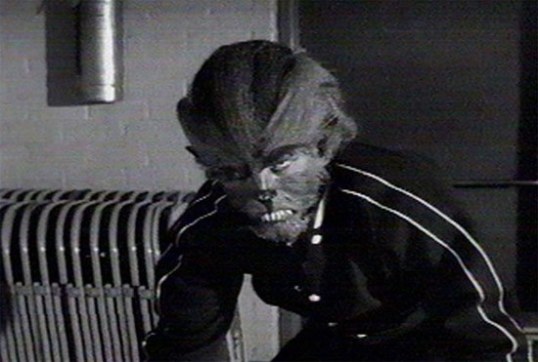
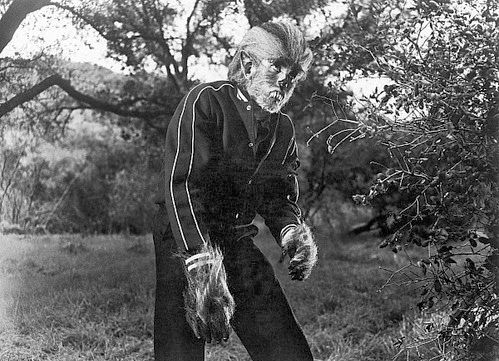
In fact, you could argue that he gets too many results.  After twice hypnotizing Tony and telling him to think of himself as being a wild animal, Tony becomes just that!  That’s right, Tony turns into a werewolf and he’s soon running around town — in his letterman jacket! — and killing anyone that he comes across.

Whenever Tony transforms back into a human, he regrets what he’s done.  Unfortunately, it turns out that almost anything can cause Tony to turn back into a wolfman.  Most werewolves need a full moon.  All Tony needs is to hear the sound of the school bell….

To be honest, I imagine that most people who watch this film do so because they want to see a werewolf creating chaos while wearing a high school letterman jacket.  Considering that this was a low-budget film made to play as half of a double feature, the werewolf makeup is actually fairly impressive and that letterman jacket adds just the right touch of weirdness to the whole affair.

Make no mistake, it’s an entertaining and deeply silly film but, at the same time, it does have an interesting subtext.  One could argue that Tony’s transformation into a werewolf serves as a metaphor for his struggle to grow up.  Neither werewolves nor juvenile delinquents can control themselves and Michael Landon gives a performance that’s just sensitive enough to justify calling this one Werewolf Without A Cause.

That said, the main appeal of this film is definitely the chance to see a werewolf in a letterman jacket.

Retro Television Reviews: The Love Boat 1.8 “Lost and Found / The Understudy / Married Singles”


Welcome to Retro Television Reviews, a feature where we review some of our favorite and least favorite shows of the past!  On Wednesdays, I will be reviewing the original Love Boat, which aired on ABC from 1977 to 1986!  The series can be streamed on Paramount Plus!

Love exciting and new….

Come aboard!  We’re expecting you!

Episode 1.8 “Lost and Found / The Understudy / Married Singles”

(Directed by Stuart Margolin, originally aired on November 19th, 1977)

This week’s cruise is all about secrets and lies.

For instance, Durwood Moss (Steve Allen) and Maisie Nolan (Polly Bergen) are currently separated and their therapist has suggested that they try taking separate vacations.  Maisie books a cabin on the cruise so Durwood books the cabin next door.  As Durwood explains it, being in separate cabins counts as being on separate vacations.  Not letting anyone know that they’re married (albeit unhappily so), Durwood pursues Barbie (Loni Anderson) and Maisie flirts with Jack (Joshua Plymouth).  Of course, Durwood and Maisie end up realizing that they’re still in love.  Fortunately, Jack and Barbie also fall in love with each other!

Meanwhile, 8 year-old Theodore Denison, Jr. (James Bond III) lies and says that he has his parents’ permission to be on the cruise by himself.  Of course, it turns out that he’s actually a runaway.  On the cruise, he meets Sharon and Richard Baker (Sandy Duncan and Jim Stafford), a married couple that is struggling to come to terms with the death of their son.  Sharon wants to adopt Theodore and Theodore wants to be adopted.  But then Theodore’s real parents show up and apologize for the fight that caused Theodore to run away in the first place.  Still, Sharon and Richard at least find the courage to try to move on from their tragedy.

Finally, Connie Evans (Jo Ann Harris) is an assistant cruise director who has been assigned to the ship.  Julie (Lauren Tewes) is supposed to be training Connie but it soon becomes clear that, in typical All About Eve fashion, Connie is plotting to steal Julie’s job.  Connie’s plan is … well, it’s interesting.  She continually screws up the simplest of duties and then claims that she was only doing what Julie trained her to do.  When she shows up for dinner in a skimpy outfit, she claims that it’s what Julie told her to wear.  I guess the plan is to make Julie look like she’s bad at training people but just because someone isn’t good at training, that doesn’t mean that they’re bad at their overall job.  In fact, it would seem that most people would look at Connie’s actions and say, “You should have had enough common sense to know better, even if that’s what Julie told you.”  Anyway, it all works out, albeit somewhat bizarrely.  The captain reprimands Connie.  The crew hates Connie and goes out of its way to humiliate her.  And yet, even after it become obvious that Connie has been trying to get her fired, Julie agrees to help Connie because she thinks Connie has the makings of being a great cruise director.  Just how painfully nice is Julie?

This was not a bad episode.  The stuff with Durwood and Maisie was a bit dull but the other two storylines worked.  Sandy Duncan brought a lot of emotional sincerity to her plotline and Jo Ann Harris was hilariously conniving in the role of Connie.  This episode was a cruise that I enjoyed.

Will I also enjoy the next cruise?  Find out next week!

Horror Film Review: Prophecy (dir by John Frankenheimer)


First released way back in 1979, Prophecy is one of those films where a big evil corporation is selfishly polluting the environment and a group of noble Native Americans is convinced that a vengeful spirit of the forest has been awakened as a result.

We’re told that the vengeful spirit is named Katahdin and that it’s “as large as a dragon and has the eyes of a cat.” We’re also told, by someone who claims to have actually seen it, that the Katahdin is a combination of several different creatures, “a part of everything that is God’s creation.”

Sound pretty scary, right?

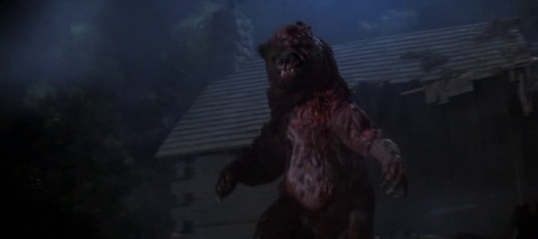
Well, it is until the bear itself actually shows up on screen. That’s when we find ourselves confronted with this:

I mean, don’t get me wrong. He certainly is ugly. But he just looks so silly and …. well, fake.

The lesson here, and it’s an important one, is that you should never put your monster onscreen unless it can actually live up to all the hype. Take a lesson from Spielberg. When it became obvious that the shark in Jaws looked like a tin model, Spielberg made the decision to not show the shark. Instead, he gave us a lot of point of view shots and, by the time the shark did appear, audiences were so frightened that it didn’t matter whether it looked convincing or not. Prophecy makes the mistake of having its monster all over the place and it just doesn’t work.

Of course, once the EPA’s Dr. Robert Verne (Robert Foxworth) shows up with his pregnant wife (Talia Shire, who somehow went from The Godfather and Rocky to this), he discovers that one reason why the Katahdinh doesn’t live up to all the hype is because it’s just a mutant bear. It turns out that all that pollution led to some crazy results and now every logger, Native American activist, and camper in the area is in danger! Can Dr. Verne and a team of disposable, forgettable characters end the threat of Katahdinh!?

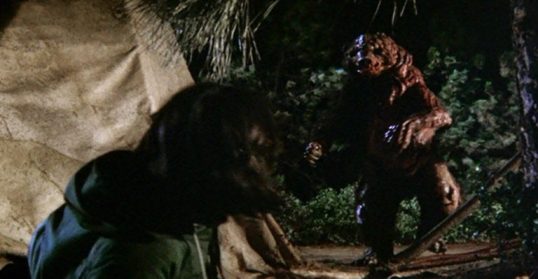
Prophecy is a big, dumb movie that’s never as much fun as you want it to be. There is one early scene that features a camper trying to hop away from Katahdinah while zipped up in a sleeping bag. That scene — which ends with one ruined sleeping back and lot of feathers floating around — is just demented enough to be kind of fun:

Otherwise, the entire film is slow-moving and rather dull. Part of the problem is that it was directed by John Frankenheimer, a major and important filmmaker who had entirely the wrong sensibility for this film. Frankenheimer was a legitimately great director (among his good credits: The Manchurian Candidate, Birdman of Alcatraz, Ronin, Seconds) but he takes the material too seriously. He spends so much time trying to sell the film’s environmental message that he forgets that the majority of the audience for a film like this isn’t watching because they want to become a better person. They’re watching for mutant bear mayhem! This is the type of film that needed to be directed by someone from the Roger Corman school of quick thrills and shameless shlock.

So, here are the twin lessons of Prophecy: know your audience and make sure your monster can live up to its reputation! Otherwise, you’ll just be known for that one scene with the exploding sleeping bag.

Horror on the Lens: Dementia 13 (dir by Francis Ford Coppola)


(I originally shared this film back in 2011 and 2019 — can you believe we’ve been doing this for that long? — but the YouTube vid was taken down both times!  So, I’m resharing it today!)

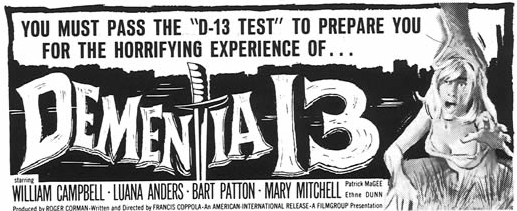
For today’s excursion into the world of public domain horror, I offer up the film debut of Francis Ford Coppola.  Before Coppola directed the Godfather and Apocalypse Now, he directed a low-budget, black-and-white thriller that was called Dementia 13.  (Though, in a sign of things to come, producer Roger Corman and Coppola ended up disagreeing on the film’s final cut and Corman reportedly brought in director Jack Hill to film and, in some cases, re-film additional scenes.)

Regardless of whether the credit should go to Coppola, Corman, or Hill, Dementia 13 is a brutally effective little film that is full of moody photography and which clearly served as an influence on the slasher films that would follow it in the future.  Speaking of influence,Dementia 13 itself is obviously influenced by the Italian giallo films that, in 1963, were just now starting to make their way into the drive-ins and grindhouses of America.

In the cast, keep an eye out for Patrick Magee, who later appeared as Mr. Alexander in A Clockwork Orange as well as giving a memorable performance in Lucio Fulci’s The Black Cat.  Luana Anders, who plays the duplicitous wife in this film, showed up in just about every other exploitation film made in the 60s and yes, the scene where she’s swimming freaks me out to no end.

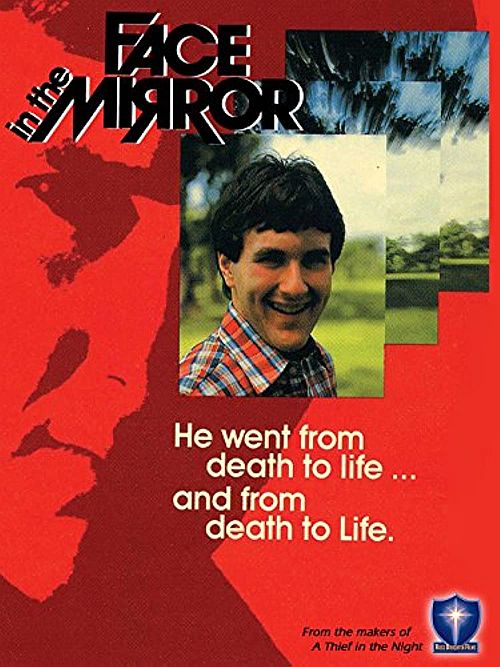
October Positivity: Face In The Mirror (dir by Russell S. Doughten Jr.)


The 1982 film, Face in the Mirror, opens with a community in crisis.

A teenager named Danny DeMarco (played by Michael Mitchell) has been shot and is being rushed to the hospital.  As we listen to the people who are following the ambulance to the hospital, it soon becomes clear that Danny shot himself and that the shooting occurred at a youth group meeting.  At the hospital, Danny is sent to the ICU.  He’s in a coma.  The doctors are not sure whether he’ll ever come out of that coma.

The first half of the 65-minute film is dominated by flashbacks as people try to figure out what could have led to Danny shooting himself.  Danny’s father remembers the time that he gave Danny a hard time for winning first place in a chess tournament.  Though I think most parents would be proud to have a son who was actually good at playing a game that required a certain amount of intelligence, Danny’s father is unimpressed.  Danny’s father was a jock in high school and he expects Danny to be the same.  Chess?  Why, that’s for wimpy youth group kids!

Speaking of wimpy youth group kids, the members of the youth group occasionally pause from the prayer to remember all of the times that they failed Danny.  They remember their own hypocritical behavior and how they would give Danny a hard time whenever he pointed it out.  They remember all of the times that Danny seemed to be confused about his faith and how they didn’t listen to his concerns.  They remember the youth group meeting in which Danny suddenly pulled out a gun and, after calling out everyone else on their hypocrisy and saying that he didn’t really believe in God, he pointed the gun at his head.  When another member of the group tried to grab the gun, it went off.  While their parents dismiss Danny as just being “a crazy kid,” the members of the youth group confront the role that they all played in Danny’s depression….

The first 30 minutes of this film is surprisingly well-acted and the theme of teen suicide is sensitively handled … up until the point that the film insinuates that Danny wouldn’t be depressed or suicidal if he was really a Christian.  I’ve known enough depressed but sincerely religious people to know that this is simply not the truth.  It’s actually a rather dangerous message to send out, as it suggests that depression is somehow a personal failing as opposed to something that everyone, to some degree, is going to have to deal with at some point in their life.

The second half of the film is all about the efforts of Danny’s friends to sneak into his hospital room so that they can pray for him and hopefully get through to him, even though he’s in a coma.  Again, the performances are sincere.  However, tonally, this half of the film is a mess.  There are some awkward moments of humor which really don’t seem like they belong in a movie about teen suicide.  The dialogue also get a bit cringey, as often happens when teenage characters are written by screenwriters who obviously were quite a bit older than the people they were writing for.

Face in the Mirror was directed by Russell Daughten, Jr.  Daughten also directed Nite Song and produced the Thief In The Night films.  Like those films, Face in the Mirror is a sincere but flawed time capsule.  The film’s tone is all over the place but I have to admit that I did kind of enjoy watching this grainy production with its amateur cast.  What can I say?  I have a weakness for low-budget indie films that feature a bunch of people who probably never made another film after this one.  Like Nite Song, watching this film is like stepping into a time machine and traveling to a simpler, if not quite innocent, past.  In the end, the film’s main message is that we should be aware that our words and our actions can hurt people without us even realizing it.  That’s not a bad one.