I kid you not when I say that this song was supposedly written after a viewing of the 1974 Best Picture nominee, The Towering Inferno.Now, of course, the song is also about the heat that rises from the dance floor while everyone’s out there moving and apparently, there are some who think that the song was meant to be a reference to the counter-culture’s cry of “burn, baby burn!” Myself, though, I will always assume that this song is all about Paul Newman, Faye Dunaway, William Holden, Steve McQueen, OJ Simpson, and a cast of thousands trying to survive that towering inferno.
“You keep building them,” McQueen said to Newman, “and I’ll keep putting them out.”
Disco Inferno became a hit when it was included on the Saturday Night Fever soundtrack. More recently, it’s become a hit-of-a-different-sort because of the Bernie Sanders presidential campaigns. It turns out that “Burn, Baby, Burn” can also be heard as “Bern, Baby, Bern.” I mean, no wonder he won Iowa.
(Did Bernie win Iowa? I can’t recall. Hey, remember when I said that I was going to vote for Marianne Williamson and everyone thought that I was being serious? What was that all about?)
Anyway, The Trammps is one of those bands that actually had a few hits in their heyday but will probably always be associated with just this one song. The Trammps are still performing, though they’ve split into two different groups, each one using the Trammps name. The fires of the disco inferno will never be extinguished.
That’s the question that is at the heart of the 1960 Italian-French film, Kapo.
The film opens in Nazi-occupied France, with 14 year-old Edith (played by 22 year-old Susan Strasberg) practicing the piano at her teacher’s house. Edith wears the yellow star on her dress and, as she finishes her lesson, her teacher instructs her to be careful returning home. Edith cheerfully states that she and her family have nothing to worry about. Edith walks home and, as the opening credits roll, we follow her as she walks through what appears to be a very robust and busy city. Other than the yellow star on Edith’s dress, there are no outward signs of the occupation in the city. However, when Edith finally reaches her neighborhood, she sees that her family and her neighbors are being rounded up the Germans.
Edith and her parents are sent to a concentration camp but get separated as soon as they arrive. Wandering around the camp, Edith meets another prisoner named Sofia (Didi Perago). Sofia takes Edith to the camp doctor. He arranges for Edith to switch identities with a non-Jewish prisoner who has just died. Edith’s new name is Nicole and her yellow star is removed and replaced by a black triangle, which designates Edith/Nicole as being “asocial.”
Edith is transferred to another concentration camp, this one in Poland. She comes to think of herself as being Nicole. When another prisoner, Terese (Emmanuelle Riva), asks her is she’s Jewish, Nicole replies that she’s not. Nicole quickly grows hardened to life in the camp and exchanges sex for food. She becomes the lover of a guard named Karl (played by future spaghetti western mainstay Gianni Garko) and is made a Kapo, a prisoner who also works as a guard. However, when Nicole then falls in love with a Russian prisoner-of-war and he asks her to help him and his comrades escape, she is forced to finally decide whether she is Nicole or whether she’s Edith.
To return to the question that started this review: What makes someone a collaborator? That’s the question that Kapo attempts to answer and it’s a question that was undoubtedly close to Director Gillo Pontecorvo’s heart. Pontecorvo was one of the most political of the post-World War II Italian filmmakers. He was born in 1919 and, as a child, saw firsthand the rise of Mussolini. As a Jew, he also experienced anti-Semitism firsthand and, in 1938, he left Italy for France. In France, he befriended Sartre and many other key members of the International Left. He was reportedly emotionally and politically moved by his friends who left France to fight on the Republican side during the Spanish Civil War. During World War II, he joined the Italian communist party and fought in the resistance. It’s perhaps not a surprise that, in Kapo, Nicole’s chance at redemption comes about as a result of falling in love with a communist soldier.
Unfortunately, Kapo struggles to answer the question of why one would collaborate with the enemy. The main problem is that Susan Strasberg is miscast of Edith/Nicole, never convincing us that she’s a naïve teenager or a hardened collaborator. She’s also not helped by a script that continually reduces everything down to who Edith/Nicole happens to be in love with at any given point of time. It also doesn’t help that Strasberg find herself acting opposite Emmuelle Riva, Gianni Garko, and other actors who all authentic in a way that she’s not.
Kapo is more valuable as an examination of the horrors of the camps than as a character study. The film’s most powerful moment comes early on, when Edith/Nicole learns that, in the eyes of the Nazis, it’s preferable that someone be a criminal to being a Jew. In that moment, the film captures both the brutal horror and the arbitrary absurdity of prejudice. The scene is followed by another harrowing moment, in which Edith can only helplessly watch as her parents are marched to gas chambers. In those brief moments, Kapo becomes an important film. You may not remember much about Edith/Nicole but you will remember those scenes.
I should also note that, regardless of its flaws, the film does end on a powerful note, one that will leave many viewers asking how much they would be willing to sacrifice to do the right thing. Would you sacrifice your life to save hundreds of others? It’s a question that Edith/Nicole has to answer, though the film leaves it ambiguous as to whether her final decision was made by her or if it was made for her. Still, the film’s final images do stay with you.
In America, Kapo received a nomination for what was then known as the Best Foreign Film Oscar. In Europe, though, many critics criticized Pontecorvo for making a film that they felt sentimentalized the Holocaust. Stung by their criticism, Pontecorvo’s next film, which would be considered by many critics to be his masterpiece, would be the documentary-style The Battle of Algiers, one of the most resolutely anti-sentimental political films ever made.
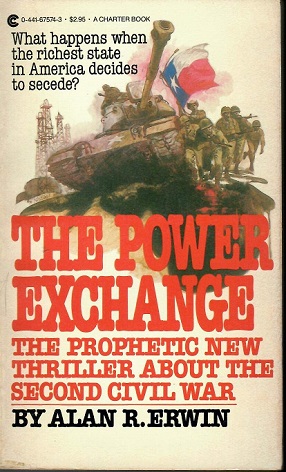
The Northern states are hit by a harsh and deadly winter, one that leads to a nation-wide blackout. The residents of a Buffalo nursing home die while waiting for help that never comes. Panics sets in across the nation as citizen realize that the federal government can’t solve all of their problems. The President, a craven politician, puts the blame on the state of Texas, saying that the state has been hoarding its energy resources and not contributing their fair share to keep the rest of the country running.
With the President determined to make Texas into a scapegoat and proposing a series of new regulations designed to take control of the state’s natural resources, the people of Texas rebel. The newly elected governor fights back, announcing that Texas is prepared to take advantage of the controversial clause in the article of annexation that he says gives the state the right to secede. China and OPEC are quick to offer aide to the new Republic of Texas. While the courts and Congress debate whether or not Texas has the right to leave the union, the CIA decides to take action into their own hands….
That may sound like a particularly paranoid take on today’s headlines but it’s actually the plot of a 1979 novel called The Power Exchange. As a Texan, what can I say? The idea of seceding from the Union has always been a popular one down here, even if it’s not something that we necessarily take seriously. After all, we know that the rest of the States don’t really like us and, for the most part, we don’t like them either. (Not me, though! I love every state in the Union.) So, why not secede and close the northern border and basically kick out anyone who complains about the weather or demands to know why we don’t have a Waa Waa on every street corner? It’s an enjoyable little fantasy, even if it’s probably for the best that it will never happen. For one thing, if Texas actually did secede, Austin would probably then want to secede from the Lone Star Republic and form the People’s Collective of Travis. And if Austin seceded, Dallas would definitely follow, just so we could brag about how much better The Free Republic of Dallas was when compared to all of the other new nations on the North American continent. Things would get messy.
The whole point of The Power Exchange is that it would be very difficult for Texas to secede. Not only would there by legal issues but there would also be military conflict. The new nation would have to make some deals with some less than savory characters. In the book, it may be Governor Jack Green who masterminds the secession but it falls to Lt. Gov. Margaret Coursey to actually pull it off and she quickly learns that there is no easy way to declare your independence. The book was written by political journalist so, needless to say, the sections about how secession actually works tend to get a bit overly technical. Fortunately, there are also secret agents, assassins, and one out of nowhere sex scene that is tossed in to keep things from getting too dry. One thing I’ve learned from reading old paperbacks is that every novel, regardless of the subject matter, had to have at least one sex scene randomly tossed in. It’s kind of like when a character in a movie suddenly curses just to make sure that the movie gets at least a P-13 rating.
The Power Exchange was among the many paperbacks that I inherited from my aunt. I read it the week after Christmas. It was a quick read and fun little “what if?” scenario.
I have long been of the opinion that everything that happened in the world of entertainment during the 70s was the result of cocaine. If you doubt me, then I dare you to explain this to me:
Now, I’m not making the argument that the song Disco Duck was necessarily written while anyone was high, though it probably was. However, I am arguing that a lot of people probably first heard the song while they were high and perhaps trying to talk to a duck and that explains why Disco Duck became a hit. Apparently, it also won the 1977 People’s Choice Award for Best New Song and again, everyone knows that the People’s Choice Awards were determined by people who spent most of their spare time with a credit card, a mirror, and rolled-up twenty. That’s just the truth of the matter.
Anyway, Rick Dees was a DJ and Disco Duck was a novelty record. The song is officially credited to Rick Dee and His Cast of Idiots but, personally, I think the band was being a bit too self-critical with that name. I mean, it takes a certain amount of intelligence to turn a song called Disco Duck into a number one hit. The song, itself, is not actually about a duck but about a man who dances like a duck …. wait a minute, what? How do you dance like a duck? (“With great difficulty! Ha ha ha!” Thank you, hack comedian.) It doesn’t matter. The song was a hit.
This performance was from a show called Midnight Special. It aired on October 29th, 1976, just a few days before Halloween. According to the imdb, ABBA, KC & The Sunshine Band, and the Bay City Rollers also appeared on this episode but none of them performed with a guy in a duck costume.
“American,” a young Vietnamese refugee says to Sgt. Mike Ransom, “tell me about Disneyland.”
Ransom tells him all about Disneyland, a magical place where, according to Rasom, the trees are made of ice cream and genies pop out of lamps. Ransom breaks down in tears, sobbing as he realizes that his friend will never get to experience Disneyland firsthand.
Years later, Ransom is in Manila, blowing up a former American military officer who gave aid to the communists. “DIE! DIE!” Ransom shrilly yells as the man literally explodes in front of him. And while the man may not have been one of the good guys and he did a lot of bad things during the Vietnam War, it’s hard not to feel that Ransom’s attitude would get him banned from Disneyland. Not even the ghost hitchhikers at the Haunted Mansion would want to accept a ride from the “Die! Die!” guy.
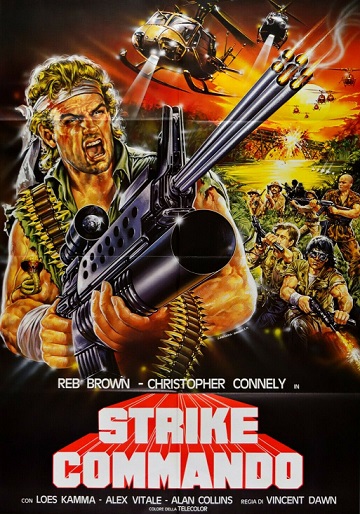
That Mike Ransom, he’s a complicated man. As played by Reb Brown, he’s also at the center of the 1987 Italian film, Strike Commando. As you can probably guess from the film’s title, he’s the leader of an elite squad of soldiers, a team of strike commandoes who are determined to lead America to victory during the Vietnam War. We’re continually told that Ransom is the best, though we don’t see much of evidence of it. He’s the type of commando who specializes in sneaking behind enemy lines and hitting the communists before they even realize he’s there but he’s so bulky and loud that it’s hard to imagine that he’s ever been able to successful sneak around anywhere. He has a particularly bad habit of shrilly screaming every word that he says. Even when he’s not telling people to die, he’s yelling. He’s like the athletic coach from Hell.
In fact, as I watched Strike Commando, I started to wonder what it would be like to live next door to someone like Mike Ransom.
“Hi, Mike, are you doing okay?”
“I’M DOING GREAT! GREAT! GREAT!”
“Any plans for the day?”
“I’M MOWING THE LAWN! MOWING! MOWING! MOWING!”
“I think I’ve got some mail for you that accidentally left in my mailbox….”
“THE POSTAL SERVICE LIED! LIED! LIED! LIED!”
At first, living next door to Mike Ransom would probably be entertaining but I imagine it would get kind of boring after a while. Yelling can be an effective way to express yourself but it loses its power if that’s the only thing you ever do. The same can be said for Strike Commando as a film. It gets off to a good start, with several extremely over-the-top action sequences and, of course, Mike telling a little refugee child about Disneyland. But the second half of the film, which involves Mike being held in a POW camp and meeting a fearsome Russian torturer named Jakoda, drags a bit because there’s only so much time you can listen to Ransom yell before you start to tune him out. It doesn’t help that the second half of the film features some particularly nasty torture scenes. Still, it is somewhat redeemed by a scene where the Viet Cong attempt to force Ransom to broadcast a propaganda message over their radio station. “KEEP FIGHTING!” Ransom yells into the microphone. Hell yeah! You tell ’em, Ransom!
Strike Commando was directed by Bruno Mattei, an Italian exploitation filmmaker who was never one to just turn things up to ten when he could turn them up to 11 instead. Strike Commando was obviously meant to capitalize on the success of the Rambo films. In typical Mattei fashion, the action is over-the-top, nonstop, and more than a little silly. Mattei was never shied away from embracing excess and Strike Commando has everything that you would expect from one of his war films: lots of stuff blowing up, heavy-handed use of slow motion, and plenty of grainy stock footage. You have to admire Mattei’s dedication to always finding something for Reb Brown to yell about.
He’s an actor, of course. He spent a lot of his early career playing bad guys. He was in a lot of biker films. He killed John Wayne in a western. Even Dern’s heroes were often unhinged in some way. As he aged, he made the transition to becoming a character actor. He still often plays characters who have their own individual way of looking at the world but now a Dern character is just as likely to be seen dispensing wisdom as he is to be seen killing people.
In real life, Bruce Dern was born into a socially prominent family. (When Dern was born, his grandfather was serving as Secretary of War in FDR’s presidential cabinet.) His godfather was Adlai Stevenson, who ran for president a handful of times. Dern was a championship runner in high school. When he was 20, he tried out for the Olympics. In Hollywood, he appeared in both studio productions and independent films. He was friends with everyone from Jack Nicholson and Dennis Hopper to John Wayne. He worked for both Robert Evans and Roger Corman. At the same time that Dern was playing drug-crazed bikers in Roger Corman movies, he was perhaps unique for being one of the few young actors in Hollywood who didn’t do drugs. As he has commented in several interviews, he played Peter Fonda’s acid guru in The Trip despite the fact that he had never so much as even held a joint.
Bruce Dern is one of those actors who tends to show up in a lot of documentaries about Hollywood in the 60s and 70s. If you read a book about that era, you can be sure that you’ll come across a lot of quotes from Dern. Usually, Dern comes across as being both witty and straight-forward. He’s an opinionated guy and he doesn’t hold much back. It’s not surprising that he would be someone who many would want to interview.
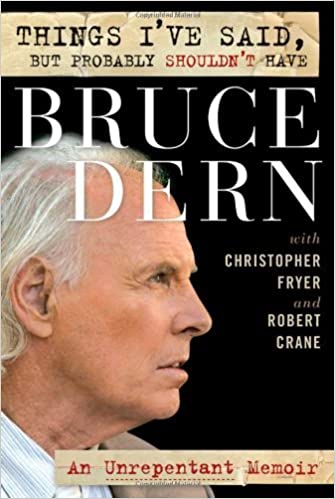
Things I’ve Said, But Probably Shouldn’t Have is Bruce Dern’s memoir and it’s just as quirky as you would expect it to be. Now, I should make cleat that the book was published in 2007, which was a a few years before Bruce Dern made his comeback with the Oscar-nominated Nebraska. It was also written before Dern became a member of the Quentin Tarantino stock company and was introduced to an entirely new generation of filmgoers. At the time this memoir was published, Dern was a part of the Big Love cast and his last “big” movie was Monster, in which he had a small but memorable role. Things I’ve Said…. was written before the “resurgence” of Dern’s career and, as such, there are certain parts of the book that almost feel like an elegy. At times, it’s almost as if Dern is saying, “Okay, I was never as big as I should have been but I still had fun.” Fortunately, films like Nebraska and others reminded people of just how good an actor Bruce Dern actually is and, even in his mid-80s, he’s a busy character actor.
As you would probably expect, Things I’ve Said is a bit of a quirky book. If anything, it reads as if Dern just sat down beside you and started talking about his career. It skips back and forth through time. Just because a chapter begins by discussing one subject, there’s no guarantee that it’ll stick with that topic. A chapter about his Oscar-nominated turn in Coming Home also contains his thoughts on Florence Henderson (“A Cloris Leachman type dame …. a real fox”) and the Lord of the Rings trilogy. Some of his best-known films are mentioned only in passing while others, like The The Incredible Two-Headed Transplant, get an entire chapter’s worth. He writes about how he came up with the perfect final line for Walter Hill’s The Driver and how he created his most memorable movie psycho, the blimp pilot in Black Sunday. He writes about turning down roles that were offered by everyone from Woody Allen to Francis Ford Coppola to Bernardo Bertolucci. (Coppola, Dern writes, offered him the role of Tom Hagen in The Godfather but just as a bargaining tactic to get Robert Duvall to reduce his salary demands.) Dern writes about his friendship with Jack Nicholson and the other members of the Hollywood counter culture and how he always found himself competing with people like Nicholson and Scott Wilson for roles. He also discusses how killing John Wayne in The Cowboys led to him receiving death threats and getting typecast as a villain. Dern seems to be more annoyed by the typecasting than the threats.
It’s an enjoyable read. Dern comes across as being a genuine eccentric but he’s the good type of eccentric as opposed to the type of eccentric who keeps dead animals in his basement. He also comes across as being very confident. He has no fear of saying that his performance saved certain movies. But you know what? Bruce Dern has saved a lot of movies. So, if he’s a little bit overly sure of himself …. well, he’s the earned the right.
I’ve read a lot of bad actor memoirs and a lot of good actor memoirs. Bruce Dern’s memoir is definitely one of the good ones.
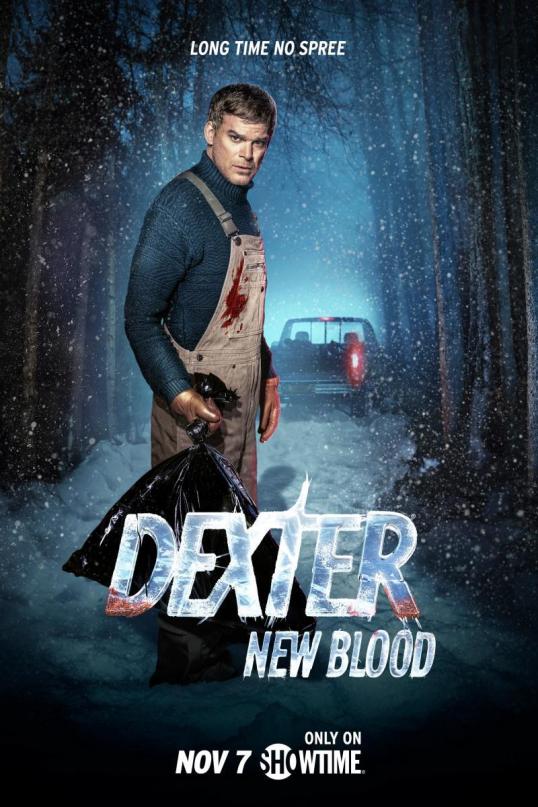
We all knew that, at some point, Dexter would have to welcome Harrison into the family business. It finally happened on this week’s episode of Dexter: New Blood.
Set on Christmas day (but, oddly enough, airing during the first week of January), the ninth episode of Dexter: New Blood found Dexter and Harrison finally bonding. Dexter told Harrison the story of Wiggles the Clown though, at the insistence of Ghost Deb, Dexter said that he just told Wiggles to stop doing what he was doing. Even when Dexter was telling the story, it was obvious that Harrison knew there was more to it than just Dexter giving a stern lecture.
Harrison also told Dexter that he had stabbed his friend and that he wasn’t the hero that everyone made him out to be. Yeah, we all figured that out a while ago, Harrison! Still, it was interesting to watch Harrison discover what the rest of us take for granted. We’re so used to the idea of Dexter tracking down serial killers and murdering them that it’s easy to forget just how weird and traumatic it would be for someone to learn about it or witness it for the first time. One of the big problems that I had with the final season of Dexter’s original run is that Deb never seemed to be truly shocked at the discovery that her brother was a serial killer. Fortunately, the reboot did a better job with Harrison than the original did with Deb.
And yes, Harrison did learn the truth. He and Dexter tracked down Kurt’s secret lair and saw Kurt’s “trophies.” And when Harrison announced that Kurt needed to die, just the slightest smile came to Dexter’s lips. Dexter managed to bring Harrison over to his side without actually having to confess to all of the people that he had killed. Only after Harrison had announced that he was on board with the idea that some people deserved to die, did Dexter admit to killing Wiggles the Clown and Arthur Mitchell.
Kurt met his end in this episode. Harrison watched as Dexter killed him and then, somewhat ominously, had a flashback to Rita’s murder. Is Harrison going to realize that, for all of Dexter’s rationalizations, his father is a serial killer as well? If Harrison truly buys into the code, then Dexter could be in some trouble.
Actually, Dexter might be in trouble regardless. Angela appears to have figured out that Dexter killed the drug dealer. And, at the end of this episode, she received a letter telling her that “Jim Lindsay Killed Matt Caldwell” and one of the titanium screws that was left behind after Dexter burned Matt’s body. If Angela learns the truth, will she arrest Dexter or will she let him and Harrison go free? Angela has sworn to uphold the law but Kurt also murdered Angela’s best friend. And, as we learned on Sunday, Kurt also murdered Molly. Angela might be tempted to let Dexter escape. I guess we’ll find out next week.
It was an excellent episode, though I have to admit that I was really disappointed when Molly showed up as one of Kurt’s trophies. When Molly first appeared, her character annoyed me but, as the season progressed, I came to appreciate both the character and Jamie Chung’s performance. In many ways, she was the stand-in for the viewers. It was hard not to feel that she deserved better than to be killed off-screen. Indeed, considering that she knew that Kurt was probably a killer, you have to wonder how he managed to ever get to her in the first place.
Still, that aside, The Family Business was Dexter at its best. The deliberate pace and the atmospheric direction all reminded of the classic early seasons of Dexter. Michael C. Hall perfectly captured Dexter’s love of his work while Jack Alcott played Harrison with the right mix of fascination and fear. Still, I have to wonder what the show’s end game is going to be. Ghost Deb was pretty adamant about Dexter not bringing Harrison into the family business and Ghost Deb usually know what she’s talking about.
Seeing as how I’ve spent the first few days of 2022 sharing music videos for danceable hits of the 70s, you had to know that I was eventually going to get to this one. The name of the song is Night Fever and not, as is often incorrectly assumed, Saturday Night Fever. Saturday Night Fever was the movie for which this song was recorded. Night Fever indicates that the fever can hit any night, not just on a Saturday.
This video was apparently shot in 1978 but the Bee Gees didn’t release it until 2004. I’m not sure why that is. Perhaps all of the seedy motels gave the wrong impression about what the band was singing about. Or maybe they just decided that John Travolta in that white suit was a better visual representation for what the Bee Gees were all about. I will note that the same year this video was produced, the Bee Gees appeared in Sgt. Pepper’s Lonely Hearts Club Band so, obviously, they weren’t too concerned with looking slightly silly.
The video was shot in Sunny Isles Beach, Florida. Supposedly, most of these motels have since been torn down. That’s a shame as I think every resort town needs to have at least one strong row of seedy motels. When my family lived in Colorado, we lived just a block away from some of the seediest motels known to man and whenever we would go back to visit our cousins in Colorado, I would always make it a point to see if the motels were still there. They were. They probably still are. It’s been a while since I’ve been to Colorado.
Anyway, it’s a good song. If it doesn’t make you want to dance, I don’t know what to say. You may just not be a dancer. But it’s never too late to learn!
If I may be allowed to open with a cliché: “You’ve seen the movie, now read the book!”
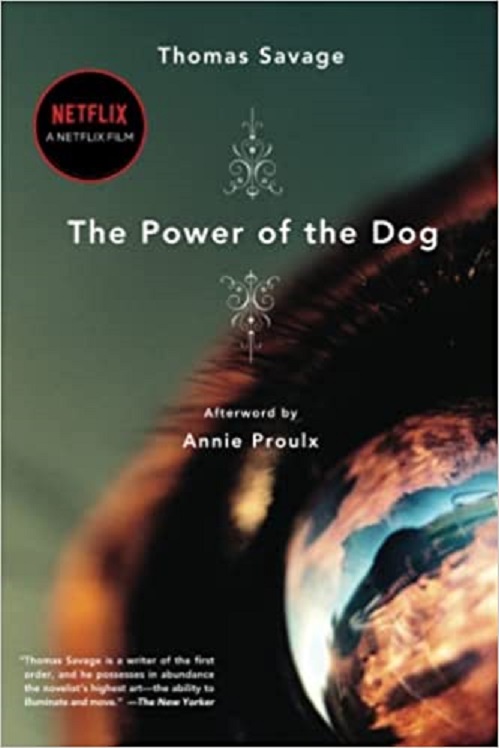
I ordered a copy of and read Thomas Savage’s 1967 novel, The Power of the Dog, before the release of Jane Campion’s film adaptation. Hence, when I watched Campion’s film, I already knew about the Burbank Brothers, Bronco Henry, Rose, and Peter Gordon. Neither the film’s big twist nor the diabolically clever ending were quite as much of a shock to me as they apparently were for others, though both were still undeniably effective in both the book and the movie. Campion’s film sticks close to the plot of the book and visually, it captures Thomas Savage’s simple but effective prose.
In case you’ve yet to see the film or read the book, The Power of the Dog takes place in Montana in the 1920s. Phil and George Burbank are brothers. Ever since their parents retired, Phil and George have owned and managed the family ranch. The gentle and kind-natured George has spent almost his entire life allowing himself to be led around by Phil. Phil, meanwhile, has fully embraced the identity of being a tough cowboy and all of the myths that go along with it. He rarely bathes. He makes it a point to castrate all of the cattle personally. He seldom wears gloves, believing the all work should be done bare-handed. He’s dismissive of anyone who he believes has shown any sign of weakness. He’s a bully and a sadist but he’s also an Ivy League graduate who takes pride in his ability to quote Ovid in the original Latin. Phil is brutally dismissive of almost everyone. He only seems to truly care about his brother and the memory of his mentor, the mysterious Bronco Henry. When George meets and marries a widow named Rose, Phil can’t handle it. George is breaking free of Phil’s influence and Phil seeks revenge against Rose, psychologically tormenting her and driving her to drink. When Rose’s son, Peter, arrives at the ranch, Phil initially dismisses Peter as being weak. But, to Rose’s horror, Phil soon starts to take an interest in Peter….
Author Thomas Savage was born in Montana and grew up on his stepfather’s ranch. Savage later said that, much like Peter, he always felt like a misfit on the ranch. His stepfather was a man who was much like Phil Burbank while Savage felt a lot like Peter Gordon. Despite never feeling like he belonged, Savage was still able to use his early experiences as a ranch hand as the inspiration for his first published short stories. Savage went on to write several western novels, many of which dealt with dysfunctional ranch families. Though well-reviewed, The Power of the Dog was not a best seller when it was originally published and even the positive reviews often seemed to wilfully miss the subtext behind Phil’s homophobia and his devotion to the memory of Bronco Henry. In 1967, The Power of the Dog was ahead of its time.
Hopefully, with the release of Campion’s adaptation, the original novel will be read by an entirely new audience. As I mentioned earlier, Campion remains faithful to the book’s plot but there are a few elements in the original novel that will add to one’s understanding of the film. For instance, the book goes into more detail about the history and the culture of the town and it also goes into more details about the ranch’s dealings with the local Native tribes. Whereas both the film and the book present Phil as being a wilfully malicious agent of chaos, the book makes clear that Phil is also a creation of the culture in which he was raised. The book makes clear that, for all of his overt macho energy, Phil still feels like an outsider among even the ranch hands who worship him and that adds an element to his relationship with Peter that is only suggested at in the film.
Perhaps most importantly, the book devotes a chapter to the life of Rose’s first husband and the circumstances that led to his suicide. Rose’s first husband is a doctor who comes to Montana to try to help people but who is slowly destroyed by the town’s apathy. We learn of the argument that led to his suicide and, again, it adds an entirely new element to Phil and Peter’s relationship.
So, if you’ve seen the movie, read the book. Or read the book and then see the movie. They’re both excellent deconstructions of the mythology of the American west.
That was certainly the case with me and East of the Mountains, an independent film which came out last September. I have to admit that the film completely slipped past me when it was initially released. In fact, I didn’t even know that the film existed until it was nominated for Best Motion Picture Drama by the Satellite Awards in December. I wasn’t alone in that. I remember when the Satellite nominations were announced, there were a lot of people who looked at the list of nominees and, upon seeing an unfamiliar title mixed in with West Side Story, The Power of the Dog, and Don’t Look Up, said, “East of what?”
Because I’m always on the lookout for an overlooked gem, I rented East of the Mountains on Prime. I watched it yesterday. My initial reaction was that it was a well-made film, featuring both pretty scenery and an excellent lead performance from veteran actor Tom Skerritt. (Skerritt is also credited as being an executive producer on the film.) I appreciated that, in a time when so many film feels as if they’re at least ten minutes too long, East of the Mountains was a remarkably short film. It only needed 79 minutes to tell its simple but effective story and it didn’t waste a single one of them. At the time, I also thought that the film’s direction was perhaps a bit too low-key for the film to really work. I thought it was a good film but I also thought it was one that I would probably forget about in a day or two.
Instead, the opposite has happened. East of the Mountains has stuck with me. Even as I sit here typing, I can still picture the film’s final few scenes in my head. That’s the type of film that East of the Mountains is. It’s a film that sneaks up on its audience, capturing their attention so subtly that it’s not until several hours later that they realize that they’re still thinking about the film.
Based on a novel by David Guterson, East of the Mountains is a character study. Tom Skerritt plays Ben Givens. Ben is a retired doctor and a veteran of the Korean War. He lives in Seattle. His wife has passed away. He’s estranged from his brother. His daughter is busy with a family of her own. Ben’s only companion is his dog, Rex. When he tells his daughter (played by Mira Sorvino) that he’s planning on going bird hunting for the weekend, she’s concerned. She knows that her father has been depressed. She also knows that Ben has recently been diagnosed with cancer. Ben assures her that he just wants to see his “old stomping grounds” one last time but his daughter worries that Ben may be planning on never coming back.
She’s not wrong. Since we’ve already seen Ben pressing the barrel of a rifle against his forehead, we know that she has every reason to be concerned about his plans. Ben is considering ending it all, east of the mountains where he grew up, fell in love, and experienced his happiest moment. However, from the minute that Ben sets off on what he plans to be his final hunting trip, fate seems to be determined to keep him alive. After his SUV breaks down, he’s given a ride by a mountain climbing couple and their love reminds Ben of when he first met the woman who he would eventually marry. After a run-in with a half-crazed mountain man, Ben loses his prized rifle, the one that was given to him by his father and which Ben planned to use to end his own life. After an unexpected dog fights leads to Ben taking Rex to the local animal hospital, he meets a young veterinarian who can tell that Ben needs someone to talk to.
The plot is rather simple but Tom Skerritt’s performance brings the story a certain depth that it might not otherwise possess. It would be easy to sentimentalize a character like Ben or to portray him as being flawless. Instead, Skerritt plays Ben as someone who is genuinely well-meaning and naturally kid but who also can occasionally be a bit self-absorbed. Watching Ben, one can understand why his brother is estranged from him, which makes their eventual, if rather prickly reunion all the more poignant. (Ben’s brother is well-played by an actor named Wally Dalton. He and Skerritt play off of each other with such skill that it’s hard to believe that they actually aren’t brothers.) The viewer hopes that Ben will find what he needs to find in order to achieve some sort of peace for himself, even if Ben himself doesn’t always seem to be quite sure what that possibly mythical thing would be.
Skerritt’s performance here is comparable to Robert Redford’s turn in All Is Lost, with the main difference being that Ben is far more lost than even Reford’s unnamed sailor. However, much like the sailor in All is Lost, it’s impossible to look away from Ben’s journey. It’s also tempting to compare Skerritt’s performance to Rchard Farnsworth’s Oscar-nominated turn in David Lynch’s The Straight Story. (Indeed, the scene between Skerritt and Dalton is comparable to the final scene between Farnsworth and Harry Dean Stanton.) Much like Farnsworth in Lynch’s film, Tom Skerritt may move slowly but the viewer is always aware of his mind working.
East of the Mountains may sound like a depressing or heavy-handed film but actually it’s not. If anything, it’s life-affirming. The audience is right alongside Ben, learning with him that the world is not as terrible a place as he had convinced himself it was. In the end, the viewer cares about Ben and worries about what his ultimate fate will be. The film’s ending sneaks up on you and it stays with you afterwards.
There is one scene involving a dog fight that is difficult to watch but otherwise, East of the Mountains is a simple but poignant film that deserves more attention than it’s received.


 Through the Shattered Lens