Retro Television Reviews: City Guys 4.14 “Shock Treatment” and 4.15 “Frisky Business”


Welcome to Retro Television Reviews, a feature where we review some of our favorite and least favorite shows of the past!  On Thursdays, I will be reviewing City Guys, which ran on NBC from 1997 to 2001.  The entire show is currently streaming on YouTube!

Hello, Manny High!

Episode 4.14 “Shock Treatment”

(Dir by Frank Bonner, originally aired on November 4th, 2000)

Oh, thank God.  Chris finally got a haircut.  I’m not sure how I feel about the sideburns but Chris still definitely looks so much better without all of that hair dragging his face down.
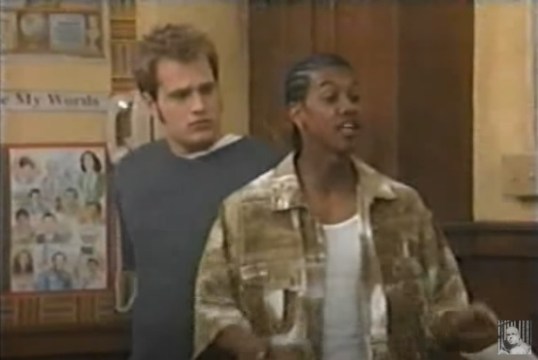
Mean Dean, New York’s top radio DJ, is scheduled to do his show from Manny High but, when he calls in sick, it appears that the show might have to be cancelled.  However, Ms. Noble approaches Dean’s producer and tells him that she knows two students who can fill in, Chris and Jamal!  Apparently, Ms. Noble has forgotten about all of the times that she’s suspended Chris and Jamal from doing their show as a result of their history of rampant stupidity.  The producer agrees to let Chris and Jamal fill in and loves listening to Chris and Jamal make jokes about their teachers.  Since Dean is going to be out for a week, Chris and Jamal are hired to serve as his replacements….

I’m starting to suspect this show is not a realistic portrayal of the radio world.

Though Chris and Jamal try to keep the show light with a really bad Regis Philbin impersonation, their producer tells them that listeners don’t want nice.  They want mean.  So, Chris and Jamal insult all of their friends on the show.  Apparently, the listeners love it and it looks like Chris and Jamal might get their own show!  I guess pre-911 New Yorkers loved to turn on the radio and hear insulting jokes about obscure high school students.  All of Chris and Jamal’s friends get angry and refuse to have anything to do with them so Ms. Noble decides to get involved.

“Is this the type of show you want to do?” Ms. Noble asks.

Considering that Chris and Jamal haven’t even graduated high school and they’re already the hosts of the top radio show in New York and they’re also getting paid a lot of money, I’d say that this is probably exactly the type of show that they want to do.  Still, no one on City Guys can ever say no to Ms. Noble so Chris and Jamal quit their show and probably sabotage whatever hopes they may have of ever having a career in broadcasting.  Instead of becoming the next Howard Stern, Jamal can look forward to inheriting the diner from his Dad and then, 20 years later, watching it go out of business due to the COVID lockdowns.  Meanwhile Chris will probably either end up in jail for insider trading or as an assistant to Bill de Blasio.  Either way, it’s not happy future.  Thanks, Ms. Noble!

Episode 4.15 “Frisky Business”

(Dir by Frank Bonner, originally aired on November 11th, 2000)

It’s the first day of school and everyone is shocked by Chris’s short hair.  When they ask him why he cut it, he says that, when he was backpacking through Europe over the summer, too many Italian men mistook him for being a girl and tried to hit on him….

Of course, Chris had short hair last episode and no one mentioned it.  On top of that, when did the previous school year end?  It’s pretty obvious that NBC showed the fourth season episodes out of their intended order because who cares about continuity, right?  It’s not like there are people hired for every movie and television series whose entire job is to keep track of continuity from shot-to-shot….

Actually, while we’re talking about things that don’t make sense, how did Chris backpack through Europe when he and Jamal were sent to summer school for cheating on that Chemistry midterm?  At one point, during this episode, L-Train mentions that summer school ended the day before the new school year began.  So, there’s really no way Chris could have done summer school and gone to Europe.  My theory is that Chris paid someone to attend summer school for him.  That was pretty smart of Chris.  I’m impressed.

Anyway, the kids are shocked to discover that Manny High now has metal detectors and they now have to line up to enter the school.  Dawn complains that nothing violent has ever happened on the Manny High campus.  That’s actually not true.  There’s been a lot of fights and near-fights on campus.  Just a few episodes ago, someone (probably Louis) wrote “Jerk” on Jamal’s locker.  Manny High is a dangerous place!

Not only do the students have to deal with the metal detectors but, after L-Train is caught with a switch-comb, the school board also decides to install transparent lockers and surveillance cameras on the roof.  The students are given a list of things that they can no longer wear or bring to school.  Ms. Noble tells the students that she has to enforce the rules.  (HA!  WHERE’S YOUR GOD NOW, STUDENTS!?)  But she encourages the students to come up with a “constructive” way to protest.

Chris and Jamal go on their stupid radio show and announce that Manny High has been turned into a prison and “Ms. Noble ain’t the principal no more, she’s the warden!” Chris and Jamal call on everyone to refuse to go to class until something is done about the metal detectors.  Ms. Noble responds by suspending Chris, Jamal, Al, L-Train, Dawn, and Cassidy.

Being suspended apparently means hanging out at the New York Diner.  Ms.  Noble, who I’m going to assume in now divorced since we haven’t heard or seen anything about her husband since she got married, shows up there as well and says, “Hey kids, how’s life in the suspended lane?”  Ms. Noble proceeds to scold them for not expressing their feelings in “a proper way.”

The kids decide that the best way to handle things is to set up a metal detector at the next school board meeting, which is being held at Manny High for some reason.  To me, that seems a lot more obnoxious than anything that was said on the radio but it works.  I guess the kids just needed Ms. Noble to talk down to them.  After being forced to walk through the detectors themselves, the school board agrees to compromise with the students, which is something that would never happen in real life.

(It especially wouldn’t happen today.  Nowadays, Americans love being bossed around.)

Anyway, these episode actually weren’t that bad, at least not when compared to some of the other episodes of City Guys.  Both Scott Whyte and Wesley Jonathan showed a noticeable improvement as actors in these two episodes.  It helps that Chris got his hair cut.  I really didn’t realize how much Chris’s long hair bugged me until I saw him with short hair.

Music Video of the Day: Answer The Phone by Sugar Ray (2001, dir by McG)


I have to admit that I’m always somewhat amused whenever I hear people talking about “McG,” just because it’s kind of a silly name.  The infamous Christian Bale rant from the set of Terminator: Salvation was made infinitely more humorous by Bale saying, “I mean, McG, are you going to talk to this guy?”  Like I would always assume that people would just call him “Joey” or something but instead, people are actually like, “Hey, McG, what do you need me to do?”

Anyway, McG directed this video for Sugar Ray.  Apparently, this song sounds more like a typical Sugar Ray song than that song about statues crumbling did.  Just as long as everyone’s happy and making money, it’s all good.

Enjoy!

Retro Television Reviews: The Love Boat 2.9 “Till Death Do Us Part–Maybe / Locked Away / Chubs”


Welcome to Retro Television Reviews, a feature where we review some of our favorite and least favorite shows of the past!  On Wednesdays, I will be reviewing the original Love Boat, which aired on ABC from 1977 to 1986!  The series can be streamed on Paramount Plus!

It’s time for another cruise!

Episode 2.9 “Till Death Do Us Part–Maybe / Locked Away / Chubs”

(Dir by Allen Baron, originally aired on November 11th, 1978)

The Love Boat is haunted!

Well, no, not really.  Instead, one of the passengers is haunted.  Ellen Garner (Vernee Watson) is having a difficult time getting over the death of her husband, Mickey (Jimmie Walker, who also appeared on the very first episode of The Love Boat, though as a different character).  It’s been two years since Mickey died and Ellen still has not been able to move on.  Some of that might be because Mickey’s ghost is still following Ellen around.  Only Ellen can see and hear Mickey.  This leads to a lot of scenes of her arguing with Mickey while everyone standing around her assumes that she’s talking to herself.

(To be honest, I think most people would be made nervous by a woman who spent the entire cruise loudly arguing with herself but the passengers and the crew of The Love Boat are oddly unconcerned.  It was the 70s so I assume everyone just assumed it was due to the cocaine.)

Mickey wants Ellen to move on and he pressures her to find a new husband on the cruise.  In fact, Mickey thinks that Ellen should spend some time with Greg Elkins (Greg Morris), who is handsome, polite and wealthy.  At first, Ellen resists Mickey’s attempts to push them together but finally, she gives in.  Suddenly, Mickey starts to get jealous.  By the end of the cruise, though, Mickey is at peace with Ellen moving on and Ellen accepts Greg’s marriage proposal.  Mickey tries to congratulate Ellen, just to discover that she can no longer see or hear him.  Mickey vanishes into thin air, giving this otherwise frothy story a somewhat bittersweet aftertaste.

Whether you were being haunted or not, would you get married after only knowing someone for a week?  I know that there are reality shows built around this very idea but still, I have to wonder how many of these spontaneous Love Boat marriages ended in divorce.  Speaking of divorce….

Also on the cruise is a young married couple, Linda (a young Jamie Lee Curtis, looking relieved to not have to deal with Michael Myers or any other knife-wielding madmen) and Wayne (Peter Coffield).  Linda and Wayne are on the verge of divorce.  Ever since her parents, Les and Gail (Conrad Bain and Curtis’s real-life mother, Janet Leigh), acrimoniously split up, Linda hasn’t believed in love.  Linda and Wayne spend most of the cruise fighting, though it’s never quite clear what they’re fighting about.  What they don’t know is that Les and Gail are on the cruise as well.  Les and Gail came to the ship to see their daughter off and then, as they tried to exit, they accidentally got locked in an unused cabin.  Trapped together and subsisting only on peanuts, water, and stowaway sex, Les and Gail discover that they are still in love and they agree to get married for a second time.  At the end of the cruise, everyone is reunited and, seeing that her parents are going to give marriage another shot, Linda agrees to give Wayne another shot. Awwwww!

(Again, it should be kept in mind that Les and Gail fell back in love because they literally didn’t have anything else to do.  They were trapped in cabin for several days!  Will their rekindled love continue once they have to deal with each other in the real world?  Considering how much they hated each other before getting trapped, it’s easy to be pessimistic.  Can you imagine how Linda will feel if her parents get married a second time just to then get a second divorce?  Then again, this is The Love Boat.  Perhaps the whole point is not to give it too much thought….)

Finally, Gopher is super excited that his sister will be celebrating her 18th birthday on the cruise!  However, Gopher is shocked and horrified to discover that Jennifer (Melissa Sue Anderson) has grown up and now has every guy on the ship hitting on her.  Gopher asks Doc Bricker to look after her, which is an odd request given that Doc is a walking HR nightmare.  That said, for once, Doc tries to do the right thing.  However, Jennifer is eager to lose her virginity and she’s decided that Doc would be the perfect man to which to lose it….

Really?  Out of all the guys on that cruise, you’re going to pick Doc?

Stories in which Doc is portrayed as being a legendary lover are always a bit strange because Doc was played be Bernie Kopell, a likable actor who gave off suburban Dad vibes as opposed to international playboy vibes.  Kopell, Anderson, and the usually underused Fred Grandy all give likable performances in this storyline but it’s still just odd to think that Jennifer has apparently spent years dreaming about Doc Bricker.

It’s also strange that Captain Stubing mentions that it’s been years since he last saw Gopher’s sister.  The previous season established that Captain Stubing had just recently been assigned to the boat and that he was still getting to know the crew.  So, either several years passed between the first and the second season or someone in the writer’s room wasn’t paying attention to continuity.  Then again, I imagine that continuity wasn’t as big a concern in the days before the Internet.  Even if someone did notice the mistake, who would they tell?

This episode was a fairly entertaining one.  Janet Leigh and Conrad Bain were definitely the highlight of this episode and it was fun to watch Leigh and Curtis acting opposite of each other.  (That said, you just know the show’s producers probably tried to convince Tony Curtis to play Janet Leigh’s ex-husband before they asked Bain.)  The ghost subplot had a few funny moments and Gopher finally got to do something.  All in all, it was a pleasant cruise on the Love Boat.

Music Video of the Day: All I Want by Maren Ord (2023, dir by Lisa Mann)


I can’t remember if this song was ever featured on Degrassi but you know what?  It should have been!

Speaking of Degrassi, Lisa Mann also directed videos for Jakalope, who performed the show’s opening theme song from season 4 to season 7!

Enjoy!

Film Review: My Cousin Vinny (dir by Jonathan Lynn)


In the 1992 film, My Cousin Vinny, two college students from New York City, Bill Gambini (Ralph Macchio) and Stan Rothstein (Mitchell Whitfield), make the mistake of driving through Alabama.  The two students stop off at a convenience store.  When the clerk is subsequently shot dead during a robbery, Bill and Stan are arrested for the crime.  The viewers know they’re innocent.  Bill and Stan know they’re innocent.  But the entire state of Alabama seems to be determined to send Bill and Stan to prison for life.

Fortunately, Bill’s cousin, Vinny (Joe Pesci, star of Half Nelson), is a lawyer.  Unfortunately, he just recently passed the bar exam and he has yet to actually try a case.  Still, Vinny and his fiancée, Mona Lisa Vito (Marisa Tomei), come down to Alabama.  Vinny takes the case, lying to the judge (Fred Gwynne) about his qualification as a trial attorney.  Vinny is momentarily impressed when the prosecutor (Lane Smith) shares with him all of the files about the case.  “It’s called disclosure, dickhead!” Lisa snaps at him, revealing that she actually has more common sense than Vinny.  That becomes increasingly important as Vinny tries to keep Bill and Stan from spending the rest of their lives in prison.

To be honest, considering how much I complain about stereotypical portrayals of the South, I really shouldn’t like My Cousin Vinny as much as I do.  Almost every character in the film is a stereotype to some extent or another, from the farmers and rednecks who take the witness stand to Fred Gwynne’s no-nonsense judge who rules that Vinny is in contempt of court because he’s wearing a leather jacket.  Fortunately, though, the Southern stereotypes don’t bother me because both Vinny and Lisa are New York stereotypes.  Just as the judge and the townspeople seem to confirm every prejudice that someone like Vinny would have against the South, Vinny seems to be the epitome of everything that people in the South dislike about the North.  When Vinny first shows up on the scene, he’s loud and brash and obnoxious.  But, as the film progresses, Vinny reveals himself to not only be a better attorney than anyone was expecting but he also calms down and adjusts to the more relaxed pace of life in the country.  Just as Vinny reveals himself to be not as bad as everyone originally assumed, both the Judge and the prosecutor are also allowed to reveal some hidden depths.  Neither one is the cardboard authority figure that viewers might expect.  The Judge does sincerely want justice to be done and the prosecutor sincerely wants to keep the county safe, even if he is prosecuting two innocent men.  Just as Vinny learns not to be too quick to judge them, they learn not to be too quick to judge Vinny.  The end message is that everyone is innocent until proven guilty and deserves a fair hearing, whether in a court of law or just in the courts of public and private opinion.  It’s not a bad message.  In fact, it’s one that more than a few people could still stand to learn today.

Of course, the best thing about the film is Marisa Tomei, who not brings a lot of energy to the film but whose hair is amazing and whose clothes are to die for.  Tomei won an Oscar for her performance in My Cousin Vinny, a victory that was so controversial that there were unfounded rumors that presenter Jack Palance had read the wrong name by mistake.  (As we all learned a few years ago when Warren Beatty and Faye Dunaway actually did read the wrong winner, the accountants aren’t going to let anyone get away with that.)  Watching the film last night, it was obvious to me that Tomei deserved that Oscar because Lisa is the heart of the film.  Pesci, Gwynne, and Lane Smith are all give good performances but, without Marisa Tomei’s performance, My Cousin Vinny would ultimately just be another culture clash comedy.  A lesser actress would have just played Lisa as being a stereotype.  But Tomei turned Lisa into the most believable and sincere character in the film.  While Lisa won the case, Tomei saved the movie.

(And needless to say, I’m a fan of any movie that features a Lisa saving the day.)

My Cousin Vinny holds up as an enjoyable film.  Watch it the next time you’re losing faith in humanity.

Retro Television Reviews: Fantasy Island 2.17 “The Stripper/The Boxer”


Welcome to Retro Television Reviews, a feature where we review some of our favorite and least favorite shows of the past!  On Tuesdays, I will be reviewing the original Fantasy Island, which ran on ABC from 1977 to 1986.  The entire show is currently streaming on Tubi!

Smiles, everyone, smiles!  This week, we’ve got stripping and boxing!

Episode 2.17 “The Stripper/The Boxer”

(Dir by Lawrence Dobkin, originally aired on February 10th, 1979)

This week, Tattoo is wearing a monocle because his cousin Igor has discovered that they are descended from royalty.  Roarke is not impressed.  Indeed, he seems to be genuinely angered by Tattoo’s suggestion that he’s somehow better than him.

As for the fantasies, first off the plane is Maureen Banning (Laraine Stephens).  Maureen is a runaway heiress.  Her father doesn’t want her to marry a poet named Barnaby (William Beckley) so she has snuck off to Fantasy Island so that she can get married over the weekend.  Unfortunately, her father’s private detectives have followed her to the island.  In a panic, Maureen hops onto the first bus that she sees.  It turns out the bus is the tour bus for a burlesque show and the show’s manager, Russ McCoy (Michael Callan), has a fantasy that concerns bringing the show to Broadway.  Maureen is mistaken for a famous burlesque dancer.  Fortunately, Sheba Palumbo (Mamie Van Doren) and Betty (Beverly Powers) are avid tabloid readers and they immediately recognize Maureen as the runaway heiress.  They agree to teach her how to dance so that she can stay on the island and marry Barnaby.  Except, of course, Maureen is now starting to feel more attracted to Russ….

This fantasy was okay.  I enjoyed the dancing and I also enjoyed thinking about how much Gary Loggins would have enjoyed watching his favorite actress, Mamie Van Doren, teach Maureen all the moves.  I think the main problem with this fantasy is that, even after she ran way, Maureen never seemed to be in control of her own fate.  The appeal of dancing on stage, whether you’re an old school burlesque performer or a modern-day stripper, is that it gives you all the power but, for Maureen, it just seemed like something to do until she finally got around to getting married.

The other fantasy involves Billy Blake (Ben Murphy), a boxer who only has three years to live.  He wants a chance to fight the other leading leading championship contender.  Even though the fight will be unofficial, Billy just wants a chance to show that, if not for his fatal disease, he could have been a champ.  Of course, if he takes too many hits to the head, Billy could die in the ring.  Billy is okay with that until he discovers that his former high school girlfriend, Jennie Collins (Maureen McCormick), is working on the Island.  Billy’s trainer (Forrest Tucker) tells Jennie to stay away from Billy and Jennie is ashamed of all of the “things” she did when she ran off to Hollywood to try to become a star.  (Like starring on The Brady Bunch Hour, perhaps….)  But, in the end, Billy realizes that his real fantasy is to spend his last remaining years with Jennie.  Personally, I found myself wondering why Billy didn’t consider a fantasy where he was cured of his terminal but unnamed disease.  Then he could both be champion and spend the rest of his life with Jennie.

There weren’t many surprises with this fantasy but Ben Murphy and Maureen McCormick were an undeniably cute couple.  I hope they had many good times before Billy’s agonizing and tragic death.

Next week …. John Saxon comes to Fantasy Island!

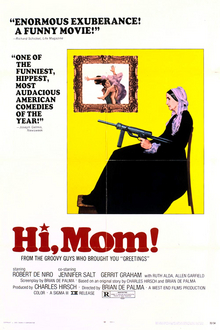
Film Review: Hi, Mom! (dir by Brian De Palma)


Released in 1970, Hi, Mom!, tells the story of Jon Rubin (played by a 26 year-old Robert De Niro).  The somewhat spacey and kind of creepy Jon has just returned to New York City from Vietnam.  After moving into a run-down apartment building and meeting the building’s superintendent (Charles Durning), Jon is hired to direct a pornographic film by producer Joe Banner (Allen Garfield).  Jon’s idea to simply point his camera at his building and to film his neighbors as they go about their day.  As quickly becomes apparent, Jon is mostly just looking for an excuse to watch and film Judy Bishop (Jennifer Salt).

Also living in the building is Gerrit Wood (Gerrit Graham), who is first seen triumphantly putting posters of Che Guevara and Malcolm X up in his apartment.  Gerrit is a freshly-minted political radical and the leader of a group of performance artists who put on a show called Be Black, Baby, in which the white audience members are forced to wear blackface and are then chased, attacked, and assaulted by black actors wearing whiteface.  (Gerrit himself is white.)  Jon is hired to play the police officer who beats and arrests the members of the audience at the end of the performance.  Of course, eventually, the real police show up….

An attempt at an episodic counter-culture comedy, Hi, Mom is definitely a product of the time in which it was made, both in its style and its thematic content.  Today, it’s best-known for being one of Brian De Palma’s early independent films and for featuring Robert De Niro in one of his first starring roles.  De Palma and De Niro aren’t exactly the first names that come to mind when one thinks about comedy and Hi, Mom shows that there’s a good reason for that.  As both a screenwriter who felt he had something important to say and a young director who was obviously eager to show off everything that he could do with a camera, Brian De Palma simply cannot get out of his own way.  Scenes are needlessly sped up.  Scenes are pointlessly slowed down.  The musical cues are obvious.  The dialogue is often so broad that it comes across as being cartoonish.  One gets the feeling that De Palma didn’t trust the audience to get the jokes so he went overboard to make sure everyone knew when to react.  All of the pointless camera trickery serves the same purpose that a laugh track would on an old sitcom.  Interestingly enough, the only sequence that really works as satire is the Be Black, Baby sequence and that’s because De Palma directs it in a semi-documentary fashion.  De Palma gets out of his own way and allow the sequence to develop a natural rhythm.  (Of course, seen today, the scene will bring to mind the upper class white liberals who pay money to have an activist lecture them about their privilege while having their friends over for dinner.)

As for Robert De Niro, he gives a typically nervy performance, one that feels like a dry run for his later work in Mean Streets, Taxi Driver, and King of Comedy.  Despite the reputation of those films, there are some genuinely funny moments to be found in all of them.  Most of them, like the classic Taxi Driver conversation between De Niro’s Travis and Peter Boyle’s Wizard, are funny because of how people react to De Niro’s obviously unhinged characters.  Both Taxi Driver and King of Comedy got mileage out of having normal people try to deal with De Niro’s unstable characters.  In Hi, Mom, everyone is equally wacky and, as such, De Niro doesn’t really have anyone to play off.  No one is really reacting to anything, De Niro-included.  (There is some spark to his scenes with Charles Durning and Allen Garfield but even those scenes seem to drag on forever.)

On the plus side, Hi, Mom! is was shot on the actual streets of New York City, guerilla-style.  (A “Re-Elect Mayor Lindsay” sign in the background confirms that the film was made on location in 1969.)  When De Palma isn’t getting in his own way with all of his fancy camera tricks, he manages to capture so memorably bleak images of New York City.  Hi, Mom! presents New York as being a dirty, crime-ridden, and menacing city but it also captures the odd grandeur of urban decay.  At its best, Hi, Mom! captures the love/hate relationship that many seem to have New York City.  The city feels both alive and dangerous at the same time.  Hi, Mom! is too uneven to work as a sustained satire but, as a documentary about New York at the end of the turbulent 60s, it’s worth watching.

I should mention that this was not the first time that De Palma and De Niro teamed up.  Indeed, De Niro was De Palma’s muse even before he met Martin Scorsese.  Hi, Mom! was a loose sequel to an earlier De Palma/De Niro film called Greetings.  (Like many of De Palma’s future films, both Greetings and Hi, Mom! were originally rated X but later re-rated R.)  De Palma and De Niro, of course, would both go onto have long Hollywood careers.  (They would later reunite for The Untouchables, a big-budget spectacle of a film that’s about as far from the grungy Hi, Mom! as one can get.)  De Palma’s career has had its ups and downs but, as of late, many of his films have been positively reevaluated.  As for De Niro, he can finally kind of play comedy.  That said, I’d rather watch Hi, Mom than Dirty Grandpa.

Retro Television Review: Hang Time 4.9 “Love Triangle” and 4.10 “Texas Rose”


Welcome to Retro Television Reviews, a feature where we review some of our favorite and least favorite shows of the past!  On Mondays, I will be reviewing Hang Time, which ran on NBC from 1995 to 2000.  The entire show is currently streaming on YouTube!

This week, we have one decent episode and one episode that …. well, just read the review.

Episode 4.9 “Love Triangle”

(Dir by Patrick Maloney, originally aired on October 10th, 1998)

Finally, a decent episode!

At the start of this episode, Kristy informs Mary Beth that she has a crush on Hammer but she’s too shy to talk to him.  Not surprisingly, Mary Beth takes it upon herself to set them up.  She tells Hammer to be at the Stadium at a certain time so that he can meet his blind date.  Hammer agrees but is shocked when the blind date turns out to be Kristy.  After the date, he approaches Mary Beth and tells her that, while he thinks Kristy is great, she’s not the girl that he’s interested in.  He’s interested in …. MARY BETH!

Now, you can probably guess that this leads to Mary Beth dating Hammer in secret.  And you can probably also guess that Kristy eventually figures out what’s happening while they’re all at the latest school dance.  Mary Beth and Kristy argue and then they make up and then everything’s fine.  Mary Beth has a boyfriend, Hammer has a girlfriend, and Kristy …. well, okay.  It kind of sucks for Kristy.  That said, Mary Beth and Hammer are a cute couple.

This was a pretty simple episode and it almost felt like a throwback to the type of episodes that dominated the show’s first season.  (Remember when Danny tried to date Julie before eventually realizing that Sam was perfect for him?)  But it was kind of nice to take a break from all the basketball stuff and Megan Parlen and Amber Barretto did a good job with both the dramatic and the comedic moments of the episode.  And, after a rough few episodes, Mark Famiglietti finally got to display some bad boy charm in the role of Hammer.

All in all, this wasn’t a bad episode.

Episode 4.10 “Texas Rose”

(Dir by Patrick Maloney, originally aired on October 10th, 1998)

*sigh*

This episode finds the team going to a basketball tournament in San Antonio, Texas so, of course, it opens up with stock footage of an oil derrick.  From the minute I saw that cliché, I knew this would be a difficult episode for me.  As a Texan, I’m very sensitive to all the silly stereotypes and clichés that television shows tend to fall back on whenever they try to tell a story about my part of the world.

The oil derricks were followed by a shot of the Alamo.  That was good.  The Alamo is a huge part of Texas culture.  This was followed by the Tornadoes checking into their San Antonio hotel and, of course, everyone in the lobby is wearing a cowboy hat.  I rolled my eyes so hard that I gave myself a headache.  “Is it me or does everyone around here look like Garth Brooks?” Mary Beth says.

Oh c’mon, I muttered for neither the first nor the last time.

“I can’t wait to get on the court and kick some cowboy butt!” Michael declares.

So, I guess the point of this episode was to make sure no one in Texas ever watched another episode of Hang Time.  I mean, we’ve got enough confidence down here to take a joke but that doesn’t mean we want to spend 30 minutes being made fun of by a bunch of people who think Indianapolis is a real city.

At the local restaurant, the boys go crazy watching some fat dude try to ride an electric bull while Kristy sees a handsome Latino and automatically assumes that he can’t speak English.  She speaks to him in Spanish and, as we can see from the subtitles, her Spanish sucks.  Still, Antonio (Jay Hernandez, of Crazy/Beautiful and Hostel fame) is so attracted to her that he doesn’t mention that he was born in America and he can speak English.  Myself, I just find it interesting that Kristy and her friends assume that just because someone has brown skin in San Antonio, they must have been born in Mexico or Latin America and that they must not be able to speak English.  I mean, did they not notice that the town itself is called San Antonio but it’s full of people who speak and understand both English and Spanish?  Did they somehow never learn that Texas has a strong and politically active Latino community?  Seriously, the whole world isn’t freaking Indiana.

(And they wonder why we dislike Yankee tourists down here….)

Meanwhile, Silk meets a girl named Rose and falls for her.  However, Silk thinks that Rose is rich so he pretends to be rich in order to impress her.  When Silk takes Rose to Coach K’s suite and tries to pretend that it’s actually his hotel room, it works until Coach K shows up.  Oh well, Silk — that’s what you get!

The next day, as the team gets ready for their first game, Kristy is shocked to discover that Antonio is on the rival team and he can speak English!  Kristy yells at him for not telling her that he could speak English.  You know, Kristy, maybe you should have given him a chance to speak English before assuming that he couldn’t.

Things work out in the end.  Silk discovers that Rose isn’t actually rich and then he commandeers the stage of the local country-western bar and sings her a country song.  Wow, that’s stupid.  The episode ends without any word as to whether or not The Tornadoes won their tournament.  I really hope this doesn’t mean that I’m going to have sit through four more episodes about the Tornadoes in San Antonio.

*shudder*

Music Video of the Day: Don’t Leave Me This Way, covered by The Communards and Sarah Jane Morris (1986, dir by ????)


I came across this band (and this cover) while watching an episode of an old television show called Night Flight last Friday.

It’s a good cover, one that pays tribute to the original while also establishing its own identity.  The video for this version adds a political element to the song by having the secret police show up to break up the performance.  Despite being named after a group of early communists, the Communards still took a stand against the secret police.  Good for them.  Of course, the secret police are still with us, in countries that are both left-wing and right-wing.  Unfortunately, modern people are a little bit less likely to take a stand against them than they once were.  Authoritarianism is today more popular than its ever been.

Enjoy!

Retro Television Reviews: International Airport (dir by Don Chaffey and Charles S. Dubin)


Welcome to Retro Television Reviews, a feature where we review some of our favorite and least favorite shows of the past!  On Sundays, I will be reviewing the made-for-television movies that used to be a primetime mainstay.  Today’s film is 1985’s International Airport!  It  can be viewed on YouTube!

It’s not easy working at an international airport!

At least, that’s the message of this made-for-television film.  Produced by Aaron Spelling and obviously designed to be a pilot for a weekly television series, International Airport details one day in the life of airport manager David Montgomery (Gil Gerard).  Everyone respects and admires David, from the recently graduated flight attendants who can’t wait for their first day on the job to the hard-working members of the airport security team.  The only person who really has a problem with David is Harvey Jameson (Bill Bixby), the old school flight controller who throws a fit when he learns that a woman, Dana Fredricks (Connie Sellecca), has been assigned to work in the tower.  Harvey claims that women can’t handle the pressure of working the tower and not having a personal life.  He demands to know what Dana’s going to do during that “one week of the month when you’re not feeling well!”  Harvey’s a jerk but, fortunately, he has a nervous breakdown early on in the film and Dana gets to take over the tower.

Meanwhile, David is trying to figure out why an old friend of his, Carl Roberts (played by Retro Television mainstay Robert Reed, with his bad perm and his retired porn star mustache), is at the airport without his wife (Susan Blakely).  David takes it upon himself to save Carl’s troubled marriage because it’s all in a day’s work for the world’s greatest airport manager!

While Carl is dealing with his mid-life crisis, someone else is sending threatening letters to the airport.  One of the letters declares that there’s a bomb on a flight that’s heading for Honolulu.  David and Dana must decide whether to allow Captain Powell (Robert Vaughn) to fly to Hawaii or to order him to return to California.  And Captain Powell must figure out which one of his passengers is the bomber.  Is it Martin Harris (George Grizzard), the sweaty alcoholic who want shut up about losing all of his friends in the war?  Or is it the woman sitting next to Martin Harris, the cool and aloof Elaine Corey (Vera Miles)?

Of course, there are other passengers on the plane.  Rudy (George Kennedy) is a veteran airline mechanic.  Rudy is hoping that he can talk his wife (Susan Oliver) into adopting Pepe (Danny Ponce), an orphan who secretly lives at the airport.  Unfortunately, when Pepe hears that Rudy’s plane might have a bomb on it, he spends so much time praying that he doesn’t realize he’s been spotted by airport security.  Pepe manages to outrun the security forces but he ends up hiding out in a meat freezer and, when the door is slammed shut, it appears that Pepe may no longer be available for adoption.  Will someone hear Pepe praying in time to let him out?  Or, like Frankie Carbone, will he end up frozen stiff?

International Airport was an attempt to reboot the Airport films for television, with the opening credits even mentioning that the film was inspired by the Arthur Hailey novel that started it all.  As well, Gil Gerard, Susan Blakely, and George Kennedy were all veterans of the original Airport franchise.  George Kennedy may be called Rudy in International Airport but it’s easy to see that he’s still supposed to be dependable old Joe Patroni.  Unfortunately, despite the familiar faces in the cast, International Airport itself is a bit bland.  It’s a disaster film on a budget.  While the viewers gets all of the expected melodrama, they don’t get anything as entertaining or amusing as Karen Black flying the plane in Airport 1975 or the scene in Concorde: Airport ’79 where George Kennedy leaned out the cockpit window (while in flight) and fired a gun at an enemy aircraft.  Probably the only thing that was really amusing (either intentionally or unintentionally) about International Airport was the character of Pepe and that was just because young Danny Ponce gave perhaps the worst performance in the history of television.

International Airport did not lead to a television series.  Watching it today, it’s a bit on the dull side but, at the same time, it is kind of nice to see what an airport was like in the days before the TSA.  If nothing else, it’s a time capsule that serves as a record of the days when the world was a bit more innocent.