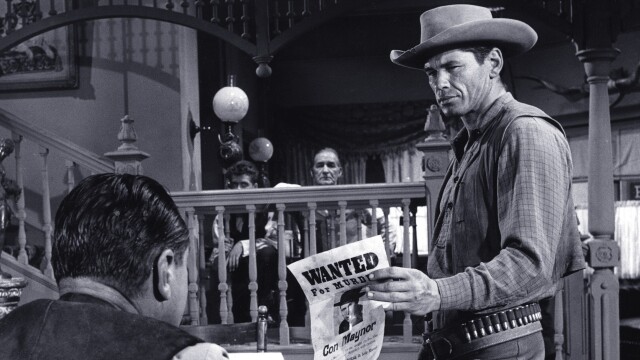
SHOWDOWN AT BOOT HILL (1958) – Charles Bronson headlines a classic Hollywood western for the first time in his career!


1958 was an interesting year for 36-year-old Charles Bronson. After mostly playing character parts on movies and TV for the first part of the decade, Bronson would star in four movies in 1958 and also headline his own TV show. On first glance, the western SHOWDOWN AT BOOT HILL would appear to fit nicely into the image that Bronson would project during the heights of his popularity in the 70’s and 80’s. But upon further inspection, this little gem shows us a side of Bronson we rarely would get to see in his heyday.

The story opens with Luke Welsh, played by Bronson, riding into a dusty western town. After dropping his horse off at the livery stable, Welsh strolls into the local restaurant and immediately confronts town citizen Con Maynor. It’s here that we learn that Welsh is a bounty hunter and Maynor is a wanted man. A gunfight ensues and Maynor is gunned down. All Welsh needs is the local authorities to confirm the identity of Maynor so Welsh can collect his bounty. Unfortunately for Welsh, it seems the townsfolk like Con Maynor so they refuse to confirm his identity. This leads to Welsh having to stay in town until he can get someone, anyone, to agree to the name of the dead man. 

All of this sounds pretty normal for a western headlined by Charles Bronson. He is a tough guy of action for sure, but there are several things in the film that are quite unique in the Bronson filmography. Let me explain. First, Bronson’s character, Luke Welsh, is extremely insecure about his height, and this turns out to be an ongoing plot device in the film. In the gunfight with Maynor that opens the film, the wanted man refers to Welsh as “pint-sized,” and after gunning him down, Welsh responds with “how tall are you now, big man?” Later in the film, the local storekeeper, Mrs. Bonaventura, notices Welsh looking up at a mannequin in the store that he is standing by. Being a wise lady, she immediately recognizes his insecurity and offers him kind words and encouragement multiple times throughout the film. Many people who have followed Bronson’s career know that the actor was, in fact, insecure about his height and would often insist that his co-stars be no taller than him. I think Bronson’s ability to sympathize with this element of the character would result in a very strong performance. When you think of the characters he played after he hit it big, this type of insecurity would not be featured again in his work.

Another thing that makes SHOWDOWN AT BOOT HILL unique is the fact that Charles Bronson’s character Luke Welsh shows more vulnerability in his relationships than what we would see later in his career. I’ll use his relationship with the lonely young woman, Sally Crane, to illustrate this point. After recognizing how rough her hands are from her work at the restaurant, Welsh goes out of his way to purchase her some hand cream at Mrs. Bonaventura’s shop. When he’s giving her the hand cream in her room, he notices just how plain the room is and begins to see that Sally is doing everything in her power to not be noticed and has shut herself off from the world. He recognizes that they’re both just a couple of misfits, with him hiding behind a gun and her hiding behind her apron. Welsh speaks so softly and sweetly to her at different times in the film. I think Bronson does a fine job with this side of his character and shows he could have played more roles with romantic overtones. Even in his films with his wife Jill Ireland, Bronson would rarely show such vulnerability with his female co-stars in future films. 

Finally, the actual showdown at Boot Hill that takes place at the end of the film plays out nothing like you would expect in later films like THE MECHANIC, MR. MAJESTYK or DEATH WISH 3. After getting to know many of the local people like Sally & Mrs. Bonaventura, and after having grown tired of never having a place to call home, Welsh makes the only decision that will allow him to stay. I won’t spoil it for you, but in my opinion, it’s an unexpected and wonderful ending for these characters who I had really grown to like throughout the course of this compact, 71 minute film. I highly recommend SHOWDOWN AT BOOT HILL!

We dedicated an episode of the THIS WEEK IN CHARLES BRONSON podcast to this solid western. I’ve attached the link below if you want to know even more about SHOWDOWN AT BOOT HILL.
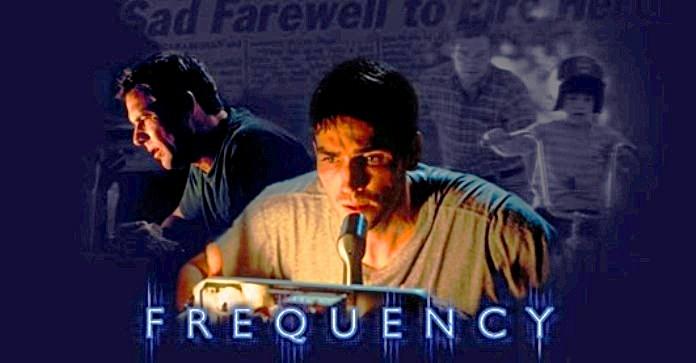

FREQUENCY (2000) – What would you give to talk to your dad or mom one more time?


I find it difficult to write about my favorite movies, because it can be hard to put into words why I love them so much. It seems that nothing I can say will do the movie justice. FREQUENCY is one of those movies that I abolutely love, and I’ll tell any person who will listen that it’s one of my all-time favorites. Sadly, I run into quite a few people who aren’t even aware of the almost 25 year old film at this point. That just doesn’t set right with me, so I’m here today to sing the praises of FREQUENCY!

FREQUENCY stars Jim Caviezel as homicide detective John Sullivan, a guy who lives in the same house he’s lived in his entire life. John is still dealing with emotional scars related to the death of his firefighter father Frank (Dennis Quaid), who died fighting a fire 30 years earlier. One night John’s hanging out with his buddy Gordo (Noah Emmerich), when they come across his dad’s old Ham radio. Some of John’s fondest memories of his dad include him speaking with people around the world on that old radio. They hook it up not even sure if it even works anymore. Sometime later that night when he’s there alone, a man’s voice comes across the airwaves. John starts talking back, and that’s when the greatness of this movie starts for me. The two guys start talking about baseball, and the voice on the other end of the line wants to know what John thinks about New York’s Amazin’ Mets chances to win the 1969 World Series. It seems that somehow through movie magic and the “mother sunspot of all time,” John is talking to his own father at the same location, separated by 30 years of space and time. John tells his dad about the specific fire that he dies in on that fateful day 30 years earlier. With John’s warning, Frank is able to survive the fire, and John gets a bunch of new memories that show him growing up with his dad in his life. Unfortunately, the changing of the past has real world consequences in the present. Now, John’s mom Julia (Elizabeth Mitchell) is gone, killed by a serial killer whose “Nightingale murders” had ended with 3 nurses in 1969, but has now ballooned to 10 in 1999. Separated by those 30 years, and not knowing when their connection on the radio might end, John and Frank work together to try to stop the Nightingale killer and save Julia, not knowing what other things they might change in the process.

FREQUENCY is a cross-genre concoction. It’s a fantasy film in the way that it brings people together from two different timeframes. The exact way this is done is never spelled out and shouldn’t be thought about too much. We just know that the phenomenon known as the aurora borealis, which is a natural light show that occurs when charged particles from the sun interact with Earth’s magnetic field, is going on in both 1969 and 1999. This natural phenomenon is somehow allowing John and Frank to talk to each other. It’s also a solid dramatic thriller as John is able to first save Frank’s life from the fire, and then as the two work together to catch a serial killer (Shawn Doyle) before he takes out Julia. This is put together extremely well by director Gregory Hoblit, who gets solid performances from Jim Caviezel, Dennis Quaid, and Elizabeth Mitchell as the Sullivan family. I also want to shout out Andre Braugher, who plays Frank’s best friend Satch in the 1969 timeframe, and who’s John’s cop partner in 1999. He’s so good in FREQUENCY. Despite winning two primetime Emmy awards, I still believe that Andre Braugher was an amazing actor who was underused during his lifetime. Sadly, he passed away in 2023 at just 61 years of age.

But the reason that I love FREQUENCY is the fantastic notion that a son who’s lost his father would somehow have the chance to talk to him again. Father-son relationships in movies affect me more than anything else, and I’m all in for the way it is addressed here. I cry like a baby every time I watch FIELD OF DREAMS with Kevin Costner, and I also cry like a baby every time I watch FREQUENCY. I mentioned earlier that John is dealing with emotional scars from not having his dad growing up. In this film, we get to hear their conversations and put ourselves in that same position. The film really leans into the joy of this unique opportunity to change the past and erase much of the pain that came with such deep emotional wounds. This shared desire to right past wrongs and erase past pain elevates the film even when logic fails. FREQUENCY got on my radar back at the turn of the century when I read articles about grown men crying in theaters as they watched. I remember telling a friend of mine, a friend whose father had died when he was young, about this film. He told me later of his own emotional experience watching it. There really is something universal about wanting to connect with our parents once they are no longer with us. As of this writing, my own father is still here, yet I am still emotionally overwhelmed every time I watch FREQUENCY. I can’t even begin to imagine what it will feel like if there’s a time that I’m still here, and he’s gone.     

RUTHLESS PEOPLE (1986) – In remembrance of Jim Abrahams


It made me sad when I saw that writer/director Jim Abrahams had passed away on November 26, 2024 at 80 years of age. Growing up in the 1980’s, Mr. Abrahams is responsible for some of my favorite comedies. AIRPLANE, TOP SECRET, and THE NAKED GUN would not exist without Jim Abrahams. As much as I love all of those movies, my personal favorite film that Jim Abrahams co-directed is RUTHLESS PEOPLE. I remember when our family rented this film and watched it in the ‘80’s. We thought it was so funny. I specifically remember my mom laughing out loud on multiple occasions as the ridiculous scenario played out. That was a fun movie night in the Crain household. 

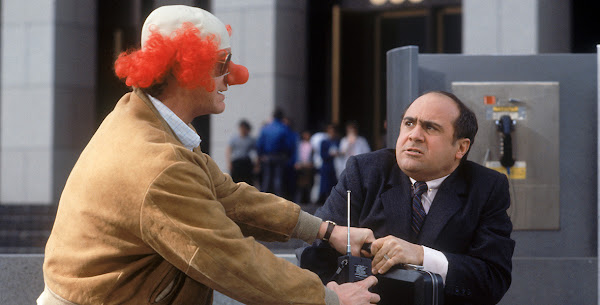
RUTHLESS PEOPLE is about a rich businessman named Sam Stone (Danny DeVito) who truly hates his wife Barbara (Bette Midler), and hatches a plan to kill her so he can inherit her money. Unfortunately he runs into a couple of problems. First, his mistress Carol (Anita Morris) knows about the plan, so she and her dimwitted boy toy Earl (Bill Pullman) want to film Sam dumping his wife’s body so they can blackmail him for millions. Second, before Sam can execute his plan, Barbara is kidnapped and held for a ransom of $500,000 by Ken and Sandy Kressler (Judge Reinhold and Helen Slater). It seems that Sam stole Sandy’s idea for the spandex miniskirt, screwed them out of millions with a handshake deal, and then kept the money for himself. This seems like an answer to prayer at first for Sam because they threaten to kill Barbara if he doesn’t meet their needs or if he calls the police or the media. After saying no to their demands, and then immediately calling the police and the news, Sam realizes that they don’t want to kill her when they keep coming back with lower demands. Sandy tells Barbara that Sam refuses to pay even $10,000 for her safe return. Eventually the kidnappers and Barbara join together to try to take the unfaithful and unethical Sam for everything he’s worth!! 

RUTHLESS PEOPLE is one of my favorite comedies of the 1980’s. It has such a great cast. Danny DeVito and Bill Pullman are especially hilarious and have some of the film’s best lines. At the time the movie came out in 1986, DeVito was already established as a master of comedy, so Pullman’s performance as Earl, the dumbass Sonny Crockett wannabe, was the real revelation to me. Pullman made his film debut in RUTHLESS PEOPLE, and I never see him to this day that I don’t think of his character Earl’s excitement over the prospect of his newfound blackmail money:

“And then we’re off, to Haiti!”

“It’s Tahiti, you moron!”

One of the most interesting things about RUTHLESS PEOPLE is just how different it is from the directing trio’s (Zucker / Abrahams / Zucker) other popular films like THE KENTUCKY FRIED MOVIE and AIRPLANE. Those films are based on non-stop visual and verbal gags. I love those films, but this is quite different. The comedy of RUTHLESS PEOPLE is based on the story itself, which is a comedy of confusion, coincidence, and character. I know it’s awesome because I still think of the film often. “Give the bag to bozo” and “a little poke in the whiskers” are phrases I’ll remember up to the point I go to my grave. 

Even though the film is almost 40 years old, if you’re looking for a laugh, I don’t think you can do much better than RUTHLESS PEOPLE. 

THE FAMILY MAN (2000) – Nicolas Cage gets a “glimpse” into a different life!


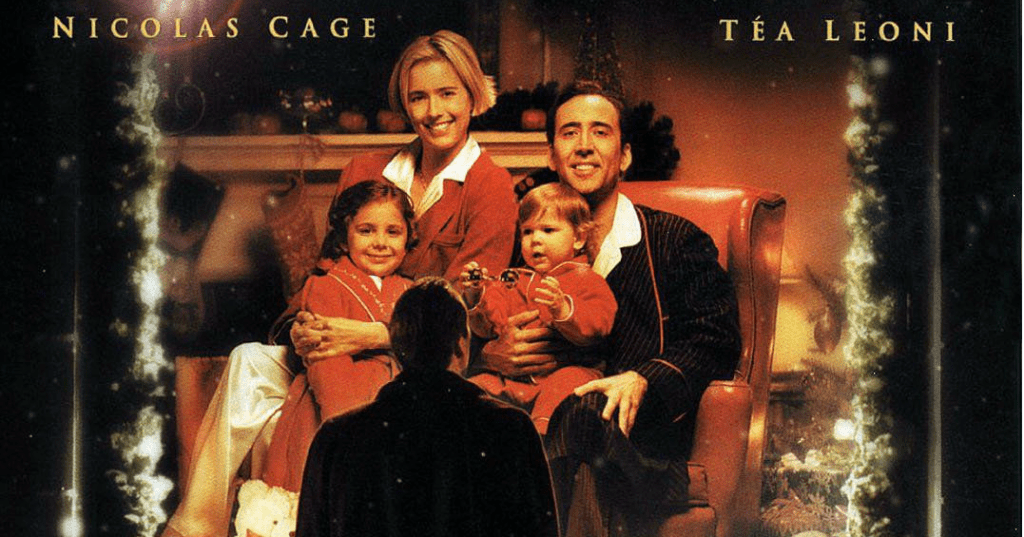
Nicolas Cage stars as Jack Campbell, a Wall Street hot shot, who puts his success in the business world above everything else in his life. We meet him on Christmas Eve as he’s trying to close a multi-billion dollar merger. He’s making everyone work late and even calls for a work session on Christmas Day. Jack’s administrative assistant gives him a phone message from his former girlfriend Kate (Tea Leoni), who he almost married about 15 years earlier. He’s surprised to hear from her, especially since he essentially chose his career over her all those years ago. That night as he stops at a grocery store on his way home, events transpire so that a desperate man named Cash (Dan Cheadle) pulls a gun on the clerk. Jack is able to use a calm demeanor and business sense to talk to Cash in a way that diffuses the situation and the two leave the store together. As they walk down the street, Jack tries to talk to Cash and help him. When Cash starts asking Jack about his life, Jack indicates that his life is great and he has everything he needs. Interestingly, this is where Cash mysteriously tells Jack that he’s going to do something for him, something he really needs…

The next morning, Christmas morning, Jack wakes up in a different home, he’s married to Kate, and they have two kids and a dog. He’s no longer an investment banker; now he’s a tire salesman. He no longer drives a Ferrari; now he’s drives a mini-van. In panic-mode, Jack runs out of the house as his in-laws arrive, fires up the mini-van, and drives to his office on Wall Street where nobody knows him, and they kick him out of the building. About that time, Cash pulls up in Jack’s Ferrari and tells him that he’s giving him the gift of a “glimpse” into what his life could have been if he had married Kate instead of focusing on himself and his career. So Jack heads back to try life in Jersey, wondering when the glimpse will come to an end. 

My wife and I are continuing to watch Christmas movies throughout the month of December to stay in the holiday spirit. THE FAMILY MAN is not necessarily a movie we watch every year, but I’m a fan of Nicolas Cage. I enjoy these types of films where a person sees what their lives could have been like if they had made different decisions at certain key points along the way. An easy comparison can be made to Frank Capra’s IT’S A WONDERFUL LIFE, which is my personal favorite Christmas movie, and it’s in my top 10 movies of all time. It’s not really an appropriate comparison though. These stories encounter their subjects in two very different places. In IT’S A WONDERFUL LIFE, George Bailey is at the end of his rope and thinking his family would have been better off if he had never been born. It takes Clarence to reveal just how important George has been to those he loves. In THE FAMILY MAN on the other hand, Jack Campbell is at the top of the world and standing at the precipice of his crowning achievement in his career. He believes his life is wonderful. Cash decides to teach him a lesson by offering a “glimpse” into a life that he could have had if he had chosen Kate and a family over his career. Would life with her be more fulfilling than all the money in the world? I think the sale is a lot easier for Clarence than Cash, and I also think that’s why I found the film to be less compelling. George Bailey’s decision was literally life with a family who dearly loves him, or death. Jack Campbell’s decision is if he wants a middle class life with a loving wife and two precious kids that he only just met, or if he wants to continue his prior life as the multi-millionaire mover and shaker with his pick of beautiful women.  It doesn’t help the film’s case either that Jack’s never really presented as being completely empty on the inside or unhappy, say, the way Bill Murray is in SCROOGED. While I personally enjoy the type of life that Jack is able to glimpse, his character’s specific choice is not as obvious, or earned, the way George Bailey’s is. 

Overall, as a man who wouldn’t trade my family for all the money in the world, I do appreciate what THE FAMILY MAN is going for. The execution doesn’t quite pull it off in a way that is completely satisfying, and ultimately explains why I don’t watch it every year as a holiday staple. 

CHRISTMAS LIST (2016) – One of our favorite Hallmark Christmas movies!


My wife Sierra loves Hallmark Christmas movies. She has Hallmark Christmas movie sweatshirts and coffee mugs. The TV at our house is filled with recordings of her very favorites. So many days when I get home from work, she’ll be watching one of them. They just make her feel better, and I understand that. I would go so far as to say that their shared love of Hallmark movies was a major bonding agent for my wife and mom. It’s fun when they get together and discuss them. Oftentimes they can’t remember the movies’ names, but one will start describing the plot, and the other will immediately say “I love that one!!” It’s amazing. In the spirit of Christmas, and a feeling of kinship with my wife, we watched the 2016 Hallmark movie CHRISTMAS LIST. 

CHRISTMAS LIST opens with a redheaded girl and her puppy making a list of the things she wants to do for Christmas. It’s simple stuff like decorating a real Christmas tree, making a gingerbread house, caroling, and taking a picture with Santa. Her mom walks in and tells her that real Christmas trees and gingerbread houses are way too messy, and she just cleaned the house. Cut to 25 years later and there’s mom straightening up the home of Isobel Gray (Alicia Witt), who’s now a successful fashion designer in San Diego, and whose boyfriend, Brett Bishop, is the owner of the company where she’s employed. Her mom surprises her by bringing her childhood “treasure box” that she had found while cleaning out the attic. Isobel sees her old Christmas list and decides right then and there that she wants to make this the year she fulfills her idea of a perfect Christmas. 

Isobel searches the internet and finds Fall River, Oregon, which advertises itself as “the perfect Christmas town.” She books a couple of flights and a cabin in Fall River for her and Brett to spend their Christmas holiday. He’d rather go to the beach and drink margaritas, but he does reluctantly agree. The day before the trip, a problem arises in the South American portion of the business operation, so Brett tells Isobel that he will fly down there for a few days and then meet her in Fall River before Christmas. She’s disappointed but heads out anyway. The first night she’s in Fall River, Isobel heads out to buy a real Christmas tree. She grabs the perfect tree at the exact same time as Jamie Houghton (Gabriel Hogan), a local guy who’s helping his sister and nephew find a tree. Through a variety of circumstances, Jamie ends up taking Isobel and the tree back to the cabin and even helping her put up the tree. The next day she’s trying to make a gingerbread house for a local contest and ends up smoking up the cabin. The fire department shows up and Jamie is a volunteer fireman. With Brett still in South America taking care of business, Jamie takes it upon himself to show Isobel more of the town. Will Brett ever make it to Fall River? Will Isobel and Jamie continue to spend time with each other? Will Brett ever put Isobel over himself and his work? Will Jamie and Isobel fall in love? If you’ve seen a few Hallmark Christmas movies, you already know the answers. 

In full disclosure, after many years of watching Hallmark movies with my wife, I’ve developed some favorites of my own. They usually involve Alicia Witt, but not always. We chose CHRISTMAS LIST because it is one we both like. I enjoy the traditional Hallmark formula at work here. Isobel is heavily involved with her work, but she longs for something more simple. Her boyfriend cares about her, but he cares more about himself and his career. She meets a man who is kind, thoughtful, hardworking and very content with his simple life. This is all set in a beautiful Christmas town where the hot chocolate is warm, the diner serves huge portions of good looking food, the carolers are in the town square, and the snow is gorgeous. One of the reasons that Hallmark movies work on me is that I too long for simpler times. As I’ve gotten older, my life has gotten more and more complicated, and I’m often too “busy” to really focus on the things that bring me the most joy. The Christmas season is a time when I really try to focus on my family and our blessings. It helps when we leave behind our stresses and our troubles and meet up at our family cabin (pictured below) for a couple of days. My favorite Hallmark movies are always about the main character getting his or her priorities in order. It may be oversimplified, but it’s something I have to work on constantly. The fact that the main character will also fall in love with someone who shares those values is secondary for me. That’s just the real whipping cream on the hot chocolate! 

Late Night Retro Television Review: Degrassi High 1.5 “Everybody Wants Something”


Welcome to Late Night Retro Television Reviews, a feature where we review some of our favorite and least favorite shows of the past!  On Sunday, I will be reviewing the Canadian series, Degrassi High, which aired on CBC and PBS from 1989 to 1991!  The series can be streamed on YouTube!

This week, the Zits finally film their music video!  Can super stardom be far behind?  Or will Joey just end up a middle-aged man who keeps his keyboard in the attic and who insists on making his stepson Craig listen to his one demo tape over and over again?  I guess it could go either way….

Episode 1.5 “Everybody Wants Something”

(Dir by Kit Hood, originally aired on November 27th, 1989)

This week’s episode of Degrassi High had a few dramatic moments.  Caitlin kissed Claude and then finally got around to breaking up with Joey.  Erica caught Liz taping a “Baby Killer” poster on her locker and the two of them got into a fight in the high school hallway.

However, for the most part, this episode was about one band and one music video.

After weeks of haggling, the Zits finally came up with a music video concept that Lucy was willing to film.  (Personally, I have to wonder why the band didn’t just offer to pay Lucy to let them borrow her camera, as opposed to giving her creative control over their music video.)  Instead of filming the band hanging out with “groupies,” Lucy filmed them lip-synching to their only song while either sitting in Clutch’s car or a dumpster.

As I watched this episode, it occurred to me that this was a story that really wouldn’t make sense today.  Apparently, when this episode aired, someone having their own video camera (as Lucy does) was considered to be exotic.  Today, the Zits would just film their video on Joey’s phone and post in online.  Or, somewhat distressingly, they would just use AI.  That said, there’s something actually kind of charming about the Zits pretending to sing in front of a video camera while their song plays on a tape player.  The video may look cheap and dorky but everyone involved seems to be having a blast filming it.  This episode definitely captured the fun of feeling like anything’s possible.  Joey may have gotten dumped by Caitlin in this episode but who knows?  Maybe this cheap music video will lead to future rock stardom!

(Actually, as those of us who were introduced to this show via Degrassi: The Next Generation can tell you, Joey is destined to end up selling used cars.  As for the other members of the Zits, Snake is going to become principal of Degrassi and Wheels is going to end up in prison after driving drunk and blinding the director of the band’s music video, Lucy.  Even the happier episodes of this show are very depressing when viewed with the benefit of hindsight.)

Due to the approaching holidays, this will be final Degrassi review for 2024!  My reviews of this show will return on January 5th!  Until then, remember …. in yourself, you must believe!

Retro Television Review: Homicide: Life On The Street 2.1 “Bop Gun”


Welcome to Retro Television Reviews, a feature where we review some of our favorite and least favorite shows of the past!  On Sundays, I will be reviewing Homicide: Life On The Street, which aired from 1993 to 1999, on NBC!  It  can be viewed on Peacock.

This week, the second season begins with a special guest star.

Episode 2.1 “Bop Gun”

(Dir by Stephen Gyllenhaal, originally aired on January 6th, 1994)

The 2nd season of Homicide opens with a murder.  That’s not surprising, considering the name of the show and the fact that it’s taking place in Baltimore, which had (and has) one of the highest murder rates in the country.  However, this time, the victim is an innocent tourist from Iowa, gunned down because she and her family took a wrong turn and ended up in a neighborhood that was far from the wharf.  With the press in a feeding frenzy over how unsafe Baltimore is, the bosses want the shooter to be caught and sentenced quickly.

Detective Beau Felton, the primary on the case, is overjoyed.  Sitting in the squad room and joking about how the victim’s husband didn’t even know what type of gun was used in the robbery-turned-murder, Felton brags that he is going to be making so much overtime off of this case.

Unfortunately, the victim’s husband happens to be in the squad room and he overhears Felton.  Angry, tired, and still wearing a shirt stained with his wife’s blood, Robert Ellison (played by special guest star Robin Williams) demands that Felton be taken off the case.

Giardello takes Ellison into his office and explains that Felton is the primary and he can’t be replaced.  Giardello also lists all of the other murders that Felton has recently worked.  Felton deals with violent death every day.  Giardello says that Felton is going to solve the case but he’s not going to “feel” Mrs. Ellison’s death the same way that her family does.

It’s an interesting scene and undoubtedly, a realistic one.  From the very first episode, Homicide has emphasized the gallows humor that goes along with being a homicide detective in a big city.  This episode, though, marks the first time that we get to see how an outsider would react to that attitude.  Significantly, Felton never apologizes and, even after the shooter is arrested, Ellison never forgives Felton for his comments.  Whenever the two interact, it’s obvious that they don’t like each other.  But they’re forever linked by one act of violence.

Felton ends up arresting three men.  Two of them are accused of robbing the Ellison family and being accessories to the murder.  They end up with 30 years in prison.  The accused shooter is Vaughn Perkins (Lloyd Goodman), a teenager who has never had any trouble with the police and who not only tries to write Ellison a note of apology but who also pleads guilty and accepts a life sentence.  (Ellison, in another example of this show choosing realism over sentimentality, refuses to read the note.)

Kay Howard is convinced that Vaughn is covering for the other two men, saying that Vaughn just seems too quiet and meek to be a cold-blooded murderer.  At the end of the episode, she goes down to the prison and meets with Vaughn, who now goes by the name Abu Aziz.  Though he initially tries to act hard, the former Vaughn Perkins finally admits that he was holding the gun during the robbery because he thought he could “control” the situation and keep anyone from getting hurt.  But when Mrs. Ellison refused to give up a locket, he panicked and shot her.  He lost control and, in a split second, he changed the lives of everyone involved.  Feeling defeated by the sad reality of Baltimore, Kay leaves the prison and heads back to work.

When Homicide returned for a second season, it was only given a four-episode order.  With the show on the cusp of cancellation, Homicide only had four hours in which to prove itself.  Originally, Bop Gun was scheduled to be the second season finale.  NBC, wanting to take advantage of having Robin Williams as a guest star, instead decided to move the episode to the start of the season.  That was probably a good idea.  Bop Gun is a good episode that reintroduces us to squad room and also features an excellent performance from Robin Williams.  Williams could, to be honest, be a bit hit-and-miss when it came to dramatic roles but he does wonderful work here, perfectly capturing Ellison’s anger, sadness, and desperation.  He starts the episode as a stunned innocent but, by the end of it, he’s become a much more hardened individual, one who has no interest in Vaughn’s heartfelt but too little and too late apology.  Just Vaughn now has to act hard to survive in a physical prison, Ellison has had to shut off his feelings so that he can survive in his emotional prison.

(As a sidenote, Ellison’s son is played by a very young Jake Gyllenhaal, whose real-life father directed this episode.)

If the first season occasionally felt a bit too much like an insider’s view of the Homicide Department, this episode gives us the point of view of an outsider.  Through Ellison’s eyes, we are reintroduced to the detectives.  Felton may not be a great cop or even a likable human being but he gets the job done in this episode.  And while Felton will now move on to the next case, Robert Ellison will spend the rest of his life thinking about that one day in Baltimore.

Because of the holidays, this is my final Homicide review of 2024!  These reviews will return on January 5th!


#SundayShorts with SURVIVING THE GAME!


Since Sunday is a day of rest for a lot of people, I present #SundayShorts, a weekly mini review of a movie I’ve recently watched.

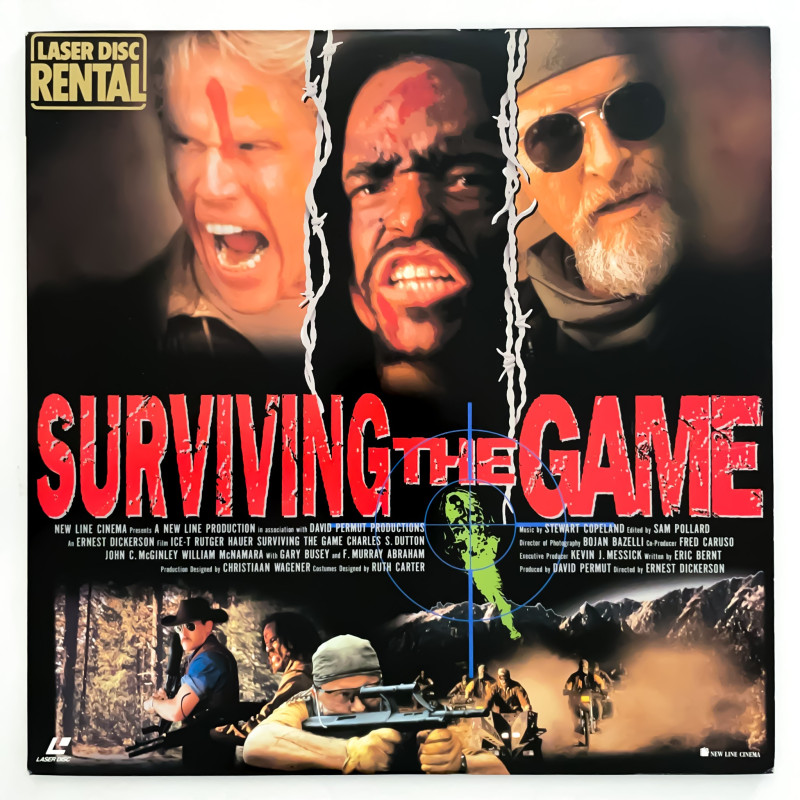
Jack Mason (Ice-T) is a homeless man who’s having a very bad day. His dog and best friend both die so he’s ready to give up on life. Just in the nick of time, a kind gentleman named Walter Cole (Charles S. Dutton), who works at the 7th Street mission, shows up, saves his life, and tells him about a potential job opportunity, even giving Jack his partner’s business card. The job would consist of helping out a group of hunters as a survival guide. Soon, Jack is meeting with rich businessman Thomas Burns (Rutger Hauer), who tells him all about the responsibilities of the job and hires him for the position. It looks like things are finally turning Jack’s way as he finds himself on a charter flight out into the mountains, where the hunters are waiting. The night he arrives, they have a huge feast as he gets to know the guys. It’s a strange lot, but hey, he’s got food in his belly and money in his pocket, so he can put up with some odd behavior for a few days. This very short period of happiness turns out to be fool’s gold as Jack is roused from his sleep early the next morning and told to run. They’re going to be playing a game, and the rules are simple… kill or be killed!

SURVIVING THE GAME was released to theaters on April 15th, 1994, when I was 20 years old. As one of Rutger Hauer’s biggest fans, I went to see it in the movie theater of course. As a fan of B-movies filled with action and violence, I had a good time with it. A big part of that fun came from it’s cast of interesting actors. I’d watch Hauer in any role, and I pretty much have. There’s not a lot asked of him in SURVIVING THE GAME in terms of heavy lifting, but I still enjoy watching him on screen. He looks pretty cool riding his motorcycle with his big goatee and ponytail. I just like Ice-T. There’s something I’ve always found appealing about him on screen, and the same can be said here. Charles S. Dutton is so capable of projecting good on screen. The fact that his character is working at a charity mission as a front to set up homeless men to be hunted and killed was a nice bit of casting. And finally, with other actors like Gary Busey, F. Murray Abraham and John C. McGinley playing the hunters, you just know you’re in for an over-the-top, scenery chewing good time. I also want to shout out one particularly disturbing and graphic scene that involves Charles S. Dutton and a blown up 4-wheeler. It’s the one scene from the film that I’ve remembered ever since saw it that first time at the theater.   

Five Fast Facts:

  1. SURVIVING THE GAME was released about eight months after John Woo’s HARD TARGET starring Jean-Claude Van Damme. Both films are re-tellings of THE MOST DANGEROUS GAME. Woo’s higher budgeted film did much better at the box office.
  2. It was Rutger Hauer’s idea that his character rides a motorcycle rather than a 4-wheeler, like the other hunters in the film. He felt the bike looked like an iron horse, giving him the appearance of a warrior knight!
  3. There’s not a single female character in the film.
  4. Near the end of the movie, there’s a shot of a cityscape with a caption on the screen that reads “Three Days Later in Seattle.” The cityscape is actually that of Philadelphia.
  5. Prior to directing his own films, director Ernest R. Dickerson had been the cinematographer for the Spike Lee joints SHE’S GOTTA HAVE IT, SCHOOL DAZE, DO THE RIGHT THING, MO’ BETTER BLUES, JUNGLE FEVER, and MALCOLM X.