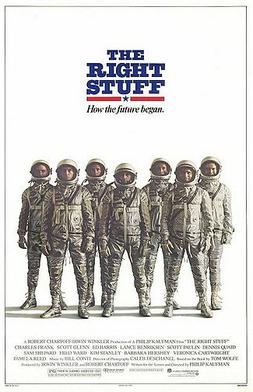
Lisa Marie Reviews An Oscar Nominee: The Right Stuff (dir by Philip Kaufman)


There’s a brilliant scene that occurs towards the end of 1983’s The Right Stuff.

It takes place in 1963.  The original Mercury astronauts, who have become a symbol of American ingenuity and optimism, are being cheered at a rally in Houston.  Vice President Lyndon Johnson (Donald Moffat) stands on a stage and brags about having brought the astronauts to his supporters.  One-by-one, the astronauts and their wives wave to the cheering crowd.  They’re all there: John Glenn (Ed Harris), Gus Grissom (Fred Ward), Alan Shephard (Scott Glenn), Wally Schirra (Lance Henrisken), Deke Slayton (Scott Paulin), Scott Carpenter (Charles Frank), and the always-smiling Gordon Cooper (Dennis Quaid).  The astronauts all look good and they know how to play to the crowd.  They were chosen to be and sold as heroes and all of them have delivered.

While the astronauts are celebrated, Chuck Yeager (Sam Shepard) is at Edwards Air Force Base.  Yeager is the pilot who broke the sound barrier and proved that the mythical “demon in the sky,” which was whispered about by pilots as a warning about taking unnecessary risks, was not waiting to destroy every pilot who tried to go too fast or too high.  Yeager is considered by many, including Gordon Cooper, to be the best pilot in America.  But, because Yeager didn’t have the right image and he had an independent streak, he was not ever considered to become a part of America’s young space program.  Yeager, who usually holds his emotions in check, gets in a jet and flies it straight up into the sky, taking the jet to the edge of space.  For a few briefs seconds, the blue sky becomes transparent and we can see the stars and the darkness behind the Earth’s atmosphere.  At that very moment, Yeager is at the barrier between reality and imagination, the past and the future, the planet and the universe.  And watching the film, the viewer is tempted to think that Yeager might actually make it into space finally.  It doesn’t happen, of course.  Yeager pushes the jet too far.  He manages to eject before his plane crashes.  He walks away from the cash with the stubborn strut of a western hero.  His expression remains stoic but we know he’s proven something to himself.  At that moment, the Mercury Astronauts might be the face of America but Yeager is the soul.  Both the astronauts and Yeager play an important role in taking America into space.  While the astronauts have learned how to take care of each other, even the face of government bureaucracy and a media that, initially, was eager to mock them and the idea of a man ever escaping the Earth’s atmosphere,  Chuck Yeager reminds us that America’s greatest strength has always been its independence.

Philip Kaufman’s film about the early days of the space program is full of moments like that.  The Right Stuff is a big film.  It’s a long film.  It’s a chaotic film, one that frequently switches tone from being a modern western to a media satire to reverent recreation of history.  Moments of high drama are mixed with often broad humor.  Much like Tom Wolfe’s book, on which Kaufman’s film is based, the sprawling story is often critical of the government and the press but it celebrates the people who set speed records and who first went into space.  The film opens with Yeager, proving that a man can break the sound barrier.  It goes on to the early days of NASA, ending with the final member of the Mercury Seven going into space.  In between, the film offers a portrait of America on the verge of the space age.  We watch as John Glenn goes from being a clean-cut and eager to please to standing up to both the press and LBJ.  Even later, Glenn sees fireflies in space while an aborigines in Australia performs a ceremony for his safety.  We watch as Gus Grissom barely survives a serious accident and is only rescued from drowning after this capsule has been secured.  The astronauts go from being ridiculed to celebrated and eventually respected, even by Chuck Yeager.

It’s a big film with a huge cast.  Along with Sam Shepherd and the actors who play the Mercury Seven, Barbara Hershey, Pamela Reed, Jeff Goldblum, Harry Shearer, Royal Dano, Kim Stanley, Scott Wilson, and William Russ show up in roles both small and large.  It can sometimes be a bit of an overwhelming film but it’s one that leaves you feeling proud of the pioneering pilots and the brave astronauts and it leaves you thinking about the wonder of the universe that surrounds our Earth.  It’s a strong tribute to the American spirit, the so-called right stuff of the title.

The Right Stuff was nominated for Best Picture but, in the end, it lost to a far more lowkey film, 1983’s Terms of Endearment.  Sam Shepard was nominated for Best Supporting Actor but lost to Jack Nicholson.  Nicolson played an astronaut.
The Eric Roberts Collection: The Elevator (dir by Jack Cook and Mukesh Modi)


In 2021’s The Elevator, Eric Roberts plays Roman Juniper, who is married and who has three kids but who also has a demanding job in a downtown office building.  Even though it’s both the weekend and his youngest daughter’s birthday, Roman still has to go into work for a few hours.  Unfortunately, just as Roman is looking forward to heading home and celebrating with his family, there’s an electrical short in the building and Roman finds himself trapped in the elevator!

His family starts to wonder where he is and, in another unfortunate coincidence, he is initially misidentified as having been involved in a freak accident that occurred outside of his building.  His family fears that Roman is dead but will they ever discover that he’s actually tapped in a dark elevator, where he’s yelling and losing his mind?

In many ways, this film is the ultimate latter day Eric Roberts movie.  Roberts is actually the lead in this movie.  The film centers around his character and, even when he’s not on-screen, everyone is talking about him.  For once, this is not a film where Roberts just shows up in some throw-away role and lends the production a few minutes of Eric Roberts star power.  The Elevator is a legitimate Eric Roberts films.  And yet, because of the film’s plot, Roberts still spends the majority of his screentime on only one set and, for the most part, he doesn’t really interact with the rest of the cast.  Everyone else is out looking for him but Eric Roberts is alone on that elevator.  He’s acting up a storm and Eric Roberts is always at his best when he’s playing an emotional character but it’s difficult not to notice that he was probably able to shoot his entire role in just a day or two.  You have to respect a man who can star in a movie and still manage to get it all done in just a handful of hours.

Eric Roberts is, not surprisingly, the main reason to see The Elevator.  The film itself is poorly paced and cheap-looking.  But Eric Roberts is always fun to watch.

Previous Eric Roberts Films That We Have Reviewed:

  1. Star 80 (1983)
  2. Blood Red (1989)
  3. The Ambulance (1990)
  4. The Lost Capone (1990)
  5. Love, Cheat, & Steal (1993)
  6. Voyage (1993)
  7. Love Is A Gun (1994)
  8. Sensation (1994)
  9. Dark Angel (1996)
  10. Doctor Who (1996)
  11. Most Wanted (1997)
  12. Mercy Streets (2000)
  13. Wolves of Wall Street (2002)
  14. Mr. Brightside (2004)
  15. Six: The Mark Unleased (2004)
  16. Hey You (2006)
  17. In The Blink of an Eye (2009)
  18. Enemies Among Us (2010)
  19. The Expendables (2010) 
  20. Sharktopus (2010)
  21. The Dead Want Women (2012)
  22. Deadline (2012)
  23. The Mark (2012)
  24. Miss Atomic Bomb (2012)
  25. Bonnie And Clyde: Justified (2013)
  26. Lovelace (2013)
  27. The Mark: Redemption (2013)
  28. Self-Storage (2013)
  29. This Is Our Time (2013)
  30. Inherent Vice (2014)
  31. Road to the Open (2014)
  32. Rumors of War (2014)
  33. Amityville Death House (2015)
  34. A Fatal Obsession (2015)
  35. Stalked By My Doctor (2015)
  36. Enemy Within (2016)
  37. Joker’s Poltergeist (2016)
  38. Prayer Never Fails (2016)
  39. Stalked By My Doctor: The Return (2016)
  40. The Wrong Roommate (2016)
  41. Dark Image (2017)
  42. Black Wake (2018)
  43. Stalked By My Doctor: Patient’s Revenge (2018)
  44. Clinton Island (2019)
  45. Monster Island (2019)
  46. The Savant (2019)
  47. Seven Deadly Sins (2019)
  48. Stalked By My Doctor: A Sleepwalker’s Nightmare (2019)
  49. The Wrong Mommy (2019)
  50. Exodus of a Prodigal Son (2020)
  51. Free Lunch Express (2020)
  52. Her Deadly Groom (2020)
  53. Top Gunner (2020)
  54. Deadly Nightshade (2021)
  55. Just What The Doctor Ordered (2021)
  56. Killer Advice (2021)
  57. The Poltergeist Diaries (2021)
  58. The Rebels of PT-218 (2021)
  59. A Town Called Parable (2021)
  60. Bleach (2022)
  61. My Dinner With Eric (2022)
  62. Aftermath (2024)
  63. The Wrong Life Coach (2024)

Song of the Day: To Sir With Love, covered by Tina Arena


I’ve always liked this song.  It’s one of the few songs that I can kind of decently sing and it describes my feelings towards a lot of people who were important to me in years past.  It also describes the way I feel about certain people now.  This song was originally recorded and made famous by Lulu but my favorite version is this cover by Tina Arena.

Those schoolgirl days
Of telling tales and biting nails are gone
But in my mind
I know they will still live on and on

But how do you thank someone
Who has taken you from crayons to perfume?
It isn’t easy, but I’ll try

If you wanted the sky
I would write across the sky in letters
That would soar a thousand feet high
“To sir, with love”

The time has come
For closing books and long last looks must end
And as I leave
I know that I am leaving my best friend

A friend who taught me right from wrong
And weak from strong
That’s a lot to learn
What, what can I give you in return?

If you wanted the moon
I would try to make a start
But I would rather you let me give my heart
“To sir, with love”

Songwriters: Don Black / Mark London

Scenes I Love: The Final Scene of David Lynch’s Twin Peaks: The Return


“What year is this?”

The final scene of Twin Peaks: The Return has haunted me ever since I first watched it 2017.  I’m still not sure what the ending meant or where Cooper and Laura were but somehow, as enigmatic as it all was, it felt like the only proper way to end the saga of Twin Peaks.

And really, this is a scene that only Lynch could have made work.  Another director would have tried too hard to tell the audience what to think or how to react.  Of course, many directors probably wouldn’t have had the guts to end things on such on open-ended note.  But Lynch not only had the courage to stick to his vision but he also had the faith to trust his audience to figure it out for themselves.  Courage and faith are two of the main reasons why David Lynch was one of the greatest directors of his time.

Film Review: Inchon (dir by Terence Young)


Inchon is an infamous film.

First released in 1982, this epic recreation of one key battles of the Korean War was an expensive film with a cast of well-known actors.  Jacqueline Bisset plays a wealthy army wife who tries to protect five South Korean children who have found themselves in the middle of the battle.  Ben Gazzara plays her husband, a major who is having an affair with the daughter of Toshiro Mifune.  David Janssen and real-life film critic Rex Reed wander through the film as journalist.  (Janssen growls like a man dealing with a serious hangover while Reed struggles to not look straight at the camera.)  Richard Roundtree plays a tough sergeant.  The great Italian actor Gabriele Ferzetti plays a Turkish officer.  And, finally, the role of legendary American general Douglas MacArthur — of “I will return” fame — is played by the very British Sir Laurence Olivier.  Olivier was apparently told that, in real life, MacArthur often sounded like the comedic actor W.C. Fields and Olivier often seems to be imitating Fields’s pinched style of speaking.  Olivier also wears almost as much makeup here as he did in his production of Othello.  MacArthur is portrayed as being almost a mystic warrior, a man who relies as much on his faith as his strategic genius to repel the communists.  (In victory, he recites The Lord’s Prayer.)  The film was directed by Terence Young, who previously brought James Bond to cinematic life.

Inchon is notorious for being a flop with both critics and audiences.  The film had a budget of $46,000,000 and reportedly made $5,000,000 at the box office before it was withdrawn.  The entirety of the budget was put up by the Unification Church, which is an organization that many people consider to be a cult.  (I like neither communists nor cultists so this film left me with no one to root for.)  The film proved to be such a flop at the box office that it has never been released on home video.  It did, however, air on television a few times and, in recent years, the television cut has been posted to YouTube.  That’s how I saw Inchon.

I watched Inchon because I’ve frequently seen it referred to as being one of the worst films ever made.  Watching the film, I have to say that I think the “worst film” label is a bit extreme.  For the most part, it’s just an extremely uneven and often rather boring film, one that mixed scenes of surprisingly brutal combat with dialogue-heavy scenes that just seem to drag on forever.  It’s a film that belongs as much in the disaster genre as the war genre as the film is full of rather shallowly-written characters who all have their own individual dramas to deal with.  Will Jacqueline Bisset save the children?  Who will sacrifice their lives to defeat the communists? Will Ben Gazzara, who often seems to be the sole member of the cast who is at least tying to give a credible performance, choose his wife or his mistress?  The film ultimately feels like a compressed miniseries.  Everyone has a story but hardly anyone makes an impression.

That said, Laurence Olivier’s performance as Douglas MacArthur …. agck!  Seriously, it’s hard to know where to even begin when it comes to talking about just how miscast Olivier is as the quintessential all-American general.  It’s been said that it takes a truly great actor to give a truly bad performance and Olivier certainly proves that to be true in this film.  Obviously frail and trying to sound like W.C. Fields, Olivier’s MacArthur is a general who would inspire zero confidence.  The film doesn’t help by portraying MacArthur as being an almost holy figure, one who is often framed to look like almost an angel descending from Heaven to lead the battle against America’s enemies.  The film is full of scenes of people discussing MacArthur’s genius just to be followed by a scene of Olivier looking old, tired, and rather grumpy.  There were a few times when I thought I could see Olivier’s hair dye running down the side of his face.  It may have been my imagination or just the graininess of the upload on YouTube but, given the quality of the film, I can’t really dismiss the possibility that it happened and no one felt like doing a second take.

As I said, Inchon can be found on YouTube.  It’s not the worst film ever made but that doesn’t mean it’s a good one.

Music Video of the Day: The Answers To The Questions by Chrystabell & David Lynch (2024, dir by David Lynch)


When Twin Peaks: The Return initially aired, Agent Tamara Preston was the character to whom I instantly related, for all sorts of reasons.  One of those reasons, of course, is that Agent Preston is the one who got to do all the research and write the book on life in Twin Peaks.  Another reason is because Agent Preston was both a competent professional and a self-amused femme fatale.  And finally, Agent Preston’s relationship with Gordon Cole reminded me of some of my most valued relationships.  Agent Preston was just one of the many pieces to the puzzle that was Twin Peaks: The Return but she was the one who I felt was standing in for me.

This wonderfully enigmatic music video would turn out to be one of David Lynch’s final short films.  Both the video and the song were made in collaboration with Crystabell, the Texan whose collaboration with Lynch began in 1999 and who, of course, played Agent Preston.

Enjoy!


Late Night Retro Television Review: Degrassi High 1.8 “Little White Lies”


Welcome to Late Night Retro Television Reviews, a feature where we review some of our favorite and least favorite shows of the past!  On Sunday, I will be reviewing the Canadian series, Degrassi High, which aired on CBC and PBS from 1989 to 1991!  The series can be streamed on YouTube!

This week, it’s time for another party!

Episode 1.8 “Little White Lies”

(Dir by John Bertram, originally aired on December 19th, 1989)

There’s yet another party being held and Diana (Chrisa Erodotu) desperately wants to attend!

Who?

Diana has been on the show for a while but this is the first episode to feature her at the center of a story.  She’s a friend of Kathleen’s and she wears glasses and …. well, that’s pretty much all we’ve learned about her in the past.  In this episode, it’s revealed that she’s Greek, her parents are dead, and she lives with her overprotective brother (Nick Stamiris).  Her brother doesn’t want Diana to go to a party.  In fact, when he catches her smoking, he throws a fit and he ground her.  He may seem a bit harsh but I had some sympathy for the character.  He’s barely an adult himself but he has to keep an eye on and take care of Diana.  I think he’s being too overprotective but I get where his mind is at.

Diana, however, decides to sneak out of the house and go the party on her own.  She has a crush on Yick and he might be there!  When she arrives, she has a drink and sits on the couch while holding a bottle of alcohol.  How could this go wrong …. oh wait, who just walked into the party and spotted Diana sitting there with the alcohol?  It’s her brother!  Diana gets dragged home and has a big fight with her brother.

Poor Diana!  That said, this is something that happened to a lot of Degrassi students over the course of the series, most of whom I felt I knew a lot better than Diana.  Diana’s just kind of been a nonentity up until this episode so it’s hard for me to get worked up, one way or another, over her situation.  It doesn’t help that Diana continually compares herself and her friends to The Outsiders and yes, I do mean the book about the juvenile delinquents in Oklahoma.  Degrassi High deserves some credit for giving the less-cool students just as much attention as Joey, Caitlin, and the main stars but the whole Outsiders is just a bridge too far for me.

Speaking of Joey, he, Snake, and Wheels decide to go a strip club!  It doesn’t work out, even with the use of fake IDs.  First off, when they arrive at the club, they discover that two of the fake IDs have Joey’s name on them.  Joey is sure the bouncer won’t notice.  Then, they discover that they’ll only have enough money to pay the cover charge if they pool all their money together.  Unfortunately, since they’ll also have to order drinks inside the club, they still only have enough money for two of them to go in.  Snake and Wheels head in to the club, deserting their friend Joey.  A prostitute approaches Joey and asks if he would like to have a good time but the clueless Joey says that he has to get home.  Meanwhile, Snake and Wheels pay $8 for two Cokes and are then kicked out when they say they can’t afford anything else.  Who would have guessed life in Canada could be so difficult!

This episode felt a bit too familiar for its own good.  Diana’s story is one that we’ve seen dozens of times on Degrassi.  And Snake, Joey, and Wheels are always doing something stupid and getting kicked out of places.  This episode wasn’t bad but it wasn’t particularly memorable either.

Lisa Marie Reviews An Oscar Winner: Nomadland (dir by Chloe Zhao)


In 2020’s Nomadland, Frances McDormand stars as Fern.

Fern had a job working in an U.S. Gypsum plant in Nevada but, after years of steady employment, she’s laid off.  Recently widowed and struggling to pay the bills, Fern sells almost everything that she owns and moves into a van.  She travels across the country, taking work where she can find it and hanging out at other camps with self-styled “nomads.”  She meets Bob Wells, the real-life guru of the van-dwelling, nomad lifestyle.  She forms cautious friendships with other people who have decided to spend their lives in their vans, traveling from one location to another.  Some of them are people who have fallen on hard times.  Some of them are just people who don’t want to be tied down.  One thing that becomes clear about Fern is that, while she’s a kind and caring soul, she’s also not one to allow people to get too close to her.  She values her independence.

The film becomes a portrait of people who have been largely forgotten by conventional society but who have created a society of their own.  (Fern may occasionally work at an Amazon warehouse but one gets the feeling that she would never order anything from there herself.)  The film centers on Frances McDormand’s performance as Fern but most of the people that she meets are played by actual nomads.  Director Chloe Zhao directs in documentary fashion, emphasizing the natural beauty of America and the lined but strong faces of people who are determined to live life their own way.

Nomadland can seem like a curious best picture winner.  It’s almost plotless and, at time, the film itself can seem a bit heavy-handed in its portrayal of the nomad lifestyle.  (I value my independence but I doubt that I could handle living in a van.  And, even if I could handle it, I wouldn’t want to.)  Even though it’s only been a few years since Nomadland won its Oscar, it sometimes seems as if it’s become one of the forgotten Best Picture winners.  Some of that is because Nomadland won during the COVID pandemic, at a time when the release a lot of the films that were expected to be big Oscar contenders (like West Side Story and Top Gun: Maverick) were moved back so they could be released in theaters.  While Nomadland did get a limited theatrical release, most people who watched it did so on Hulu.  The 2020 Best Picture nominees were films that probably would not have been nominated in a different year and Nomadland, with its cinema verité style, is far more lowkey than the typical dramatic Oscar winner.  Fairly or not, the film’s reputation has also suffered due to the failure of director Chloe Zhao’s The Eternals.  Nomadland is perhaps now best known as being a part of a cautionary tale about what happens when a director makes an acclaimed film and then gets hired to do a Marvel movie.

(You have to feel bad for Chloe Zhao, who was the second woman to win the Oscar for Best Director but who was given the award as a part of perhaps the worst ceremony in the history of the Oscars.  So determined were the producers to end on the triumphant note of Chadwick Boseman receiving a posthumous Oscar that both Zhao and Nomadland‘s victories were treated as distractions.  And then, of course, Boseman didn’t even win the Oscar.  It was an awkward night all around.)

That said, I can understand why Nomadland was embraced when it was released.  It came out at a time when people were not only scared of getting COVID but also having to deal with the government’s heavy-handed approach to dealing with the pandemic.  Living off the grid and away from society was something that looked very attractive to a lot of people back then.  Future film students may be confused as to why Nomadland was so honored but it was definitely a film of its time.  People forget (or willfully choose to ignore) how crazy things felt during the pandemic.  When Fran told the world to leave her alone, she spoke for many.


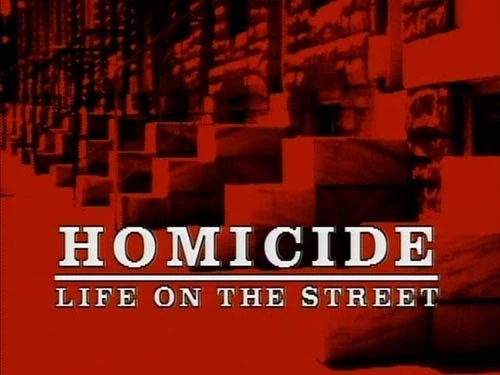
Retro Television Review: Homicide: Life On The Street 2.4 “A Many Splendored Thing”


Welcome to Retro Television Reviews, a feature where we review some of our favorite and least favorite shows of the past!  On Sundays, I will be reviewing Homicide: Life On The Street, which aired from 1993 to 1999, on NBC!  It  can be viewed on Peacock.

This week, season 2 of Homicide comes to a close with an episode directed by John McNaughton, of Henry: Portrait of A Serial Killer fame.

Episode 2.4 “A Many Splendored Thing”

(Dir by John McNaughton, originally aired on January 27th, 1994)

The second season finale of Homicide opens with Bolander in a good mood and Munch feeling that life is pretty much pointless.  It’s a reversal from what we’ve seen over the last few episodes of Homicide and, as annoyed as I got with all the storylines about Bolander’s private life, I was still happy to see Bolander happy in this episode.  As an actor, Ned Beatty’s performance is a lot interesting when Bolander is looking forward to the future.  By that same token, Richard Belzer always seemed to be trying to hard whenever it came to playing Munch’s happiness.  Belzer was born to play a cynic and, in this episode, he delivers his lines with a bitterness that is both funny and authentic.

Bolander is dating Linda and I have to admit that, despite my initial weariness, I really like Ned Beatty and Julianna Margulies as a couple.  Bolander and Linda go on a double date with Kay and Danvers.  Awwww, two couples in love and having dinner together!  How sweet!  Uh-oh, here comes Munch….

While Munch is ruining Bolander’s date, Bayliss is getting in touch with his own dark side.  An investigation into the S&M-related death of a young woman leads to Bayliss and Pembleton arresting a man who killed her during rough (but consensual) sex.  Bayliss and Pembleton spend their investigation in Baltimore’s red light district.  Bayliss claims to be disgusted by the whole scene, leading to Pembleton calling him out for being judgmental.  Pembleton tells Bayliss that he can’t be a good detective unless he’s really in touch with every aspect of his existence.  After the murder is solved, the woman’s co-worker, Tanya, gives Bayliss the gift of a leather jacket.  Tanya is played, in a very good performance, by the actress Adrienne Shelley.  Tragically, Shelley herself would, 12 years later, be murdered in her New York apartment.  And while it’s tempting to write about the irony of Shelley appearing on a show like Homicide, I’d rather recommend that everyone see Waitress instead.  It was the second feature film that Shelley directed and it is very good.

Finally, Lewis investigates a man who committed murder because he felt someone had taken his favorite pen.  Lewis searches for a deeper motive but in the end, it really was all about a pen.  Lewis, I’ve noticed, always seems to get the cases that show just how random life and death can truly be.

The second season of Homicide ends with Lewis giving Felton a pen, Bayliss putting on his new leather jacket and walking the streets of Baltimore, and Munch, Bolander, and Linda watching fireworks explode over the harbor.  It’s a good way to end a season.  As dark as the show was (and as dark as this particular episode was), the season ends on a note of hope.  There is happiness out there for those willing to look for it.


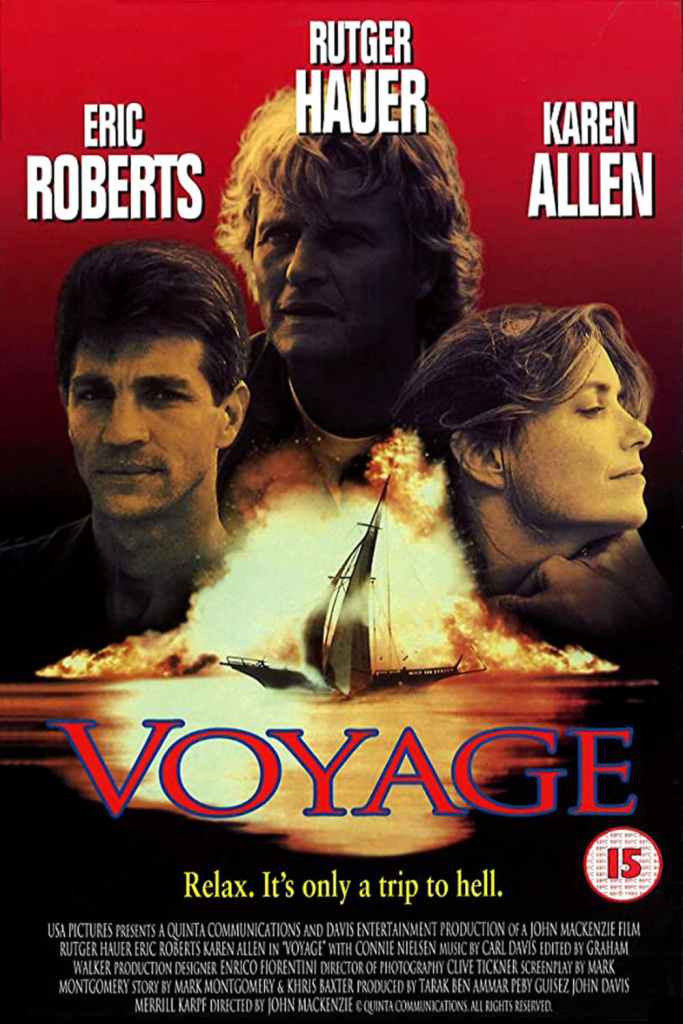
VOYAGE (1993) – Rutger Hauer and Eric Roberts battle it out on a boat!


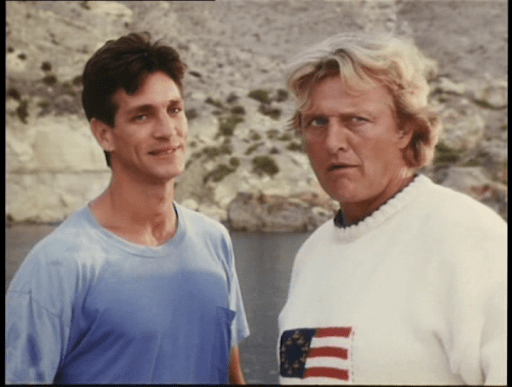
The 1993 made-for-cable television film VOYAGE opens with Morgan Norvell (Rutger Hauer) and his wife Kit (Karen Allen) headed to their 20-year class reunion. Morgan didn’t really want to go, but Kit talked him into it. It seems that Morgan was a champion diver back in high school. We know that because he’s looking at some pictures at the reunion that are meant to illustrate what a great athlete he once was. I say “meant to illustrate” because the man in the pictures looks absolutely nothing like a potentially younger Hauer would. Hauer is a big boned man, known for his blond hair. This guy in the pictures is scrawny with dark hair, but I’ll just move on, I guess. Morgan and Kit seem to be enjoying themselves, when they run into Kit’s old friend Gil Freeland (Eric Roberts) and his wife Ronnie (Connie Nielsen). It’s kind of awkward at first because Gil asks Morgan if he remembers him, and Morgan doesn’t, even though they were in the same class. Isn’t that the worst? I was recently at an Arkansas Razorbacks football game, and as I walked away from the concession area with my beverage, this lady’s voice said, “Well, if it isn’t Brad Crain.” I looked at the group of people standing in front of me, including the lady who said my name, and I immediately knew I was in trouble. They all looked kind of familiar, but a long time ago “kind of familiar,” and I knew none of their names. And then she asked that question I was hoping to avoid, “You don’t remember me, do you?” I had to admit I didn’t. We spoke for a few moments, and then I headed to my seat feeling a little embarrassed. I told my family about the exchange a few days later, and my sister Pam said that the lady was her best friend in school and that she used to spend the night at our house when we were kids. But the truth is that I still don’t really remember her, and now I’m starting to worry about how the hell I can’t remember her!

After that initially awkward moment, Morgan, Kit, Gil and Ronnie sit down together and start talking about their lives. We learn that Morgan is an architect (ala Paul Kersey), that Kit is an author, that Gil is a dentist, and that Ronnie just looks good. If she told her profession, I missed it. In a case of giving way too much information to people you haven’t seen in 20 years, Morgan and Kit tell the couple of their plans to go to Monte Carlo where they have a sailboat, which they plan to sail down the coast of Italy until they reach Malta. It seems that they purchased a hotel that is in much need of repair, and that they are going to live on the boat for a year, while Morgan puts his architect skills to good use and restores the property. The couple, who have had their share of struggles, are using this adventure as a fresh start in their marriage. Well Gil and Ronnie think this all sounds like a ball and even say that they’d love to join them for a few days if they could. No specific plans are discussed, and Morgan and Kit say that would be great, without expecting they’ll see them again after this night. Wrong! While Morgan is getting the boat ready in Monte Carlo, Gil and Ronnie show up. They have a good day on the ocean together and are enjoying some champagne that night when Gil proceeds to invite himself and Ronnie to go along with them on down the coast for a few days. She doesn’t want to be rude, but Kit is not for this idea so she kicks Morgan under the table. This is supposed to be their time to work on their relationship. Morgan should have known better than to say that Kit and Ronnie could join them for a few days, because any person who’s married or in a relationship should understand the under the table “kick to the shin.” But in a complete dumbass move, he invited them along anyway.

And this is where things really start going in a different direction. That first night, Ronnie makes a sexual move on Morgan, which he somehow has the strength to turn down, while Gil and Kit are downstairs reliving old times… Strike 1! That same night, Morgan is awakened to the sounds of a person on the deck and finds Gil up there. Gil says he was needing some fresh air and dropped his champagne, but Morgan finds the fuel cap is loose after Gil goes back downstairs… Strike 2! A couple of days later, Ronnie tries to kiss Kit, Gil catches a fish and bashes its head in instead of just throwing it back and then has the nerve to imply to Morgan that he had sex with Kit in high school… Strikes 3, 4, and 5! Morgan knocks the crap out of Gil and then makes them get off the boat when they get back to shore that day.

And from that point forward, Morgan and Kit sail on down the coast of Italy, making their way to Malta where they rebuild both their relationship and the Hotel Riviera, and live happily ever after! I’m just kidding, the rest of the movie consists of Gil and Ronnie terrorizing the couple, ultimately wanting to kill them for far more nefarious purposes than I’ll reveal here. I believe that most people in the world will fit into 2 categories: those who want to watch a movie where Eric Roberts terrorizes and tries to kill Rutger Hauer, and those who don’t want to watch such a movie. I’m really writing this up for those in the first camp, so I don’t want to spoil this movies surprises!

Back in 1993, Rutger Hauer’s run as a big-screen lead was nearing its end. With a couple exceptions, he would spend the rest of the decade appearing in made-for-cable TV films and other low budget direct-to-video type fare. Eric Roberts, who had received an Oscar nomination a decade earlier, was also mostly doing low budget direct-to-video fare, TV movies, and the occasional character part in a larger budget movie. This is an interesting time for both actors as their careers were transitioning. But we’re talking about two guys who know how to act, as evidenced by Hauer’s 174 acting credits on IMDB and Roberts’ 760 acting credits on IMDB (and counting as he has 4 credits in 2025 already). Both Hauer and Roberts are capable of playing complete psychos, so I’m not sure how they settled in on Roberts to play the psycho in this one. It may be because Hauer played a psycho stalker in his earlier movie from 1993, the made-for-HBO film BLIND SIDE, but that’s just a guess.

I enjoyed VOYAGE when I watched it the night of its premiere on the USA Network on June 2nd, 1993, and I enjoyed it when I watched it again this morning. I’m a huge fan of Rutger Hauer, and I’ve always appreciated Eric Roberts. For me, it’s a real treat seeing these two guys face off. I enjoy that Hauer gets to play the “hero” while Roberts is the dangerous creep, and Roberts is as creepy as it gets in this movie. Hauer’s role isn’t very flashy, as he’s a pretty normal guy who finds himself in a bad situation, but he is Rutger Hauer so it’s not a surprise that he’s able to summon the strength to fight for his and his wife’s lives. VOYAGE was directed by John Mackenzie. Mackenzie made some good films earlier in his career, including the phenomenal British crime film THE LONG GOOD FRIDAY (1980), the Charles Bronson corrupt union drama ACT OF VENGEANCE (1986), and the Michael Caine / Pierce Brosnan spy thriller THE FOURTH PROTOCOL (1987). While VOYAGE is certainly not his most accomplished work, Mackenzie knows how to make a film, and he does a fine job here. And finally, I always enjoy a movie filmed in beautiful locations, and Malta definitely makes for some beautiful views.

Ultimately, I think your enjoyment of VOYAGE will come down to whether or not you like the idea of Rutger Hauer and Eric Roberts fighting it out to the death. I personally like that idea.  

See the trailer for VOYAGE below: