Happy Groundhog Day!
Happy Groundhog Day!
Welcome to Late Night Retro Television Reviews, a feature where we review some of our favorite and least favorite shows of the past! On Saturdays, I will be reviewing the Canadian sitcom, Check it Out, which ran in syndication from 1985 to 1988. The entire show is currently streaming on Tubi!

This week, Howard’s dead! Or maybe not.
Episode 3.6 “Edna’s Choice”
(Dir by Alan Erlich, originally aired on October 24th, 1987)
This week’s episode opens with a rather odd scene in which Howard Bannister, who is still wearing his “Howie” manager uniform, showing up outside the gates of Heaven. He’s shocked to find that Edna is waiting for him. She has big wings on her back. She says that she was made an angel when she came to Heaven because she lived a perfect life after she broke up with Howard. Howard is surprised. Edna mentions that she broke up with Howard because he refused to recommend her for a promotion that would have given her a store of her own to manage. Howard refers to God as being a guy. Edna replies that God is a woman and then sends Howard to hell.
WHAT!?
With this scene, the show establishes that 1) Edna and Howard broke up, 2) Edna died before Howard, and 3) Howard went to Hell. That’s a lot to take in!
Of course, it all turns out to be a dream that Edna was having. Edna tells Marlene about her dream and then she doesn’t mention it again for the rest of the episode. This is despite the fact that Edna receives a chance to be promoted and Howard doesn’t recommend her for the job. You would think that Edna would link all of this to her dream and maybe warn Howard that he was condemning his soul to the fires of Hell. Maybe she forgot about her dream. These things happen occasionally. I sometimes forget about my dreams, too!
It’s between Jack Christian and Edna for the new store manager job and, in a very odd scene, Mrs. Schutlz (Barbara Gordon) interviews them both at the same time. (Oddly, everyone at the store acts as if they all know Mrs. Schultz, despite this being her first appearance on the show.) Edna notices that all of the questions appear to be biased against Christian. Mrs. Schultz asks what they would do if a customer came in the store wearing the same dress as them. Mrs. Schultz asks Christian what he would do if a customer was having PMS. (“What’s PMS?” Christian asks and sweetie, you don’t want to know.) Edna realizes that Gordon is only interested in giving the job to another woman so Edna turns down the promotion. She wants to earn the job on her merits and nothing else. And she doesn’t break up with Howard so I guess he still has a chance to getting into Heaven.
This episode was weird. The dream sequence was actually pretty funny and Gordon Clapp scored a few laughs as the store’s dim-witted electrician. That said, the whole job interview storyline felt strange. Admittedly, I’ve never had to actually interview for any of the jobs that I’ve had but still, I just imagine it’s handled a bit differently than in this episode. It was a weird episode. Edna should have taken that job and ran with it.
My sinuses were really bothering me this week so I didn’t watch much, other than the shows that I review for this site. I mean, it was literally a struggle for me to look at a screen, whether it my phone, a laptop, or a television for more than a few minutes without getting a headache.
I did watch two more episodes of Dark with Case. This intriguing German show gets more and more creepy with each episode.
On Sunday, Jeff and I watched a football game. It was Taylor Swift’s team vs someone else. Taylor Swift won.
I watched Kitchen Nightmares. This week’s restaurant was boring. I’m hoping for another Amy’s Baking Company style fiasco.
And I watched Hell’s Kitchen. Really? They eliminated Egypt? First Brandon and then Egypt? Weakest final two ever!
Finally, I watched and reviewed Miami Vice, CHiPs, Fantasy Island, Pacific Blue, The Love Boat, Monsters, Malibu CA, Highway to Heaven, St. Elsewhere, Friday the 13th, Welcome Back Kotter, and Check It Out!
And that’s it, thanks to my sinuses. Bleh!
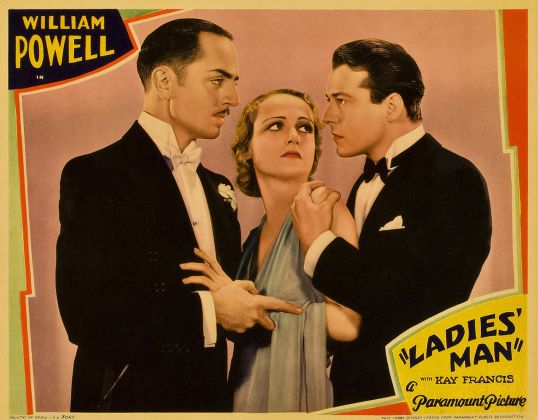
In the 1931 film Ladies’ Man, the always suave William Powell plays Jamie Darricott.
Jaimie may be suave but, when we first meet him, he’s faking it. He lives in a tiny broom closet in a grand hotel and he only has two suits to his name. The only thing that Jamie has going for him is that he’s charming and he’s handsome, in the way that only William Powell could be. He’s like a much sleazier and far less likable version of Nick Charles. Unfortunately, Jamie doesn’t have Nora Charles or Asta in his life. He just has one valet and a lot of ambition. It’s strange to see Powell play a bitter man but that’s what he does here.
Jamie starts spending time with the wealthy Mrs. Fendley (Olive Tell), despite the fact that she’s married to wealthy businessman Horace Fendley (Gilbert Emery). Jamie starts to move up in the world. He gets a much better room. He gets a few more suits of clothes. Soon, Jamie is also spending time with Mrs. Fendley’s daughter, the wild Rachel (Carole Lombard). Rachel doesn’t care if prohibition is the law of the land. She’s going to get as drunk as she wants every night. And Rachel doesn’t care if society judges her for sleeping over in another man’s room despite not being married to him. Rachel does what she wants! And I have to admit that, at first, I liked Rachel. She was a rebel and she made no apologies for her behavior and good for her! (It helped she was also played by Carole Lombard, who was just starting her career but already had a lively screen presence.) What’s interesting is that both Mrs. Fendley and Rachel seem to know that the other is seeing Jamie and they’re both pretty much okay with that. And since Jamie is getting paid by both of them, he’s okay with it too.
This might sound a bit racy for a 1931 film and I suppose it is. However, this is also a pre-code film. Before the Production Code was instituted, films always portrayed New York society as being filled with gigolos and people who got drunk at nightclubs. Pre-code films had the advantage of not only knowing what people wanted to see but also the freedom to give it to them. Ladies’ Man is pretty open, if not particularly explicit, in detailing how Jamie makes his money. And the message seems to be that no one can blame him. There’s a depression going on! Jamie has to do something to survive! At least he’s not killing people Jimmy Cagney or Paul Muni!
However, when Jamie meets and falls for the kindly Norma Page (Kay Francis), he starts to reconsider his lifestyle. And when Rachel finds out that Jamie is actually falling in love with Norma, she lets her father know about what’s going on. It all leads to a rather sudden and surprisingly dark ending. The film may have been pre-code but it was still a film from the era of DeMille and hence, all sinners had to be punished.
Seen today, Ladies’ Man is definitely a relic of a previous time. It was made early enough in the sound era that it’s obvious that some members of the cast were still learning how to act with sound. For a film with a 70-minute run time, it has a surprisingly large numbers of slow spots. This is not the film to use if you want to introduce someone to the wonders of the pre-code era. That said, I love William Powell and I love Carole Lombard. This film was made before their brief marriage and it’s nowhere near as fun as their later collaboration, My Man Godfrey. But it’s still enjoyable to see them together, bringing some much needed life to this scandalous tale.
Welcome to Retro Television Reviews, a feature where we review some of our favorite and least favorite shows of the past! On Saturdays, I will be reviewing Welcome Back Kotter, which ran on ABC from 1975 to 1979. The entire show can be purchased on Prime.
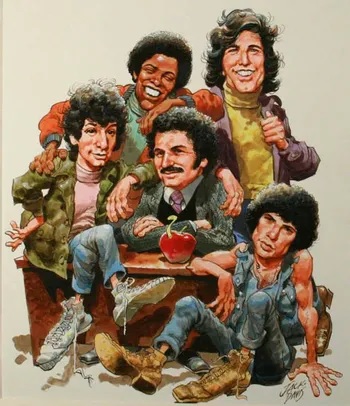
This week, Epstein gets a story of his very own.
Episode 4.16 “The Goodbye Guy”
(Dir by Norman Abbott, originally aired on February 1oth, 1979)
Barbarino is gone. Gabe is gone. It’s Epstein’s turn to step up and become the center of the show.
Epstein is upset because he has wrestling tickets but the other Sweathogs all have dates for the evening, For some reason, Epstein decides to go the Kotter apartment even though Gabe is — *ahem* — out of town. Was Epstein planning on asking Julie to go see a wrestling match with him? We’ll never know because Julie is not at the apartment. She’s at the faculty dance with Mr. Woodman.
Mr. Woodman’s niece, Kelly (Georganne LaPiere), is at the apartment, babysitting the rarely-seen Kotter twins. (I was actually starting to think that Gabe might have abducted the twins and moved to Long Island with them, it’s been so long since we’ve seen or heard from any of them.) Kelly is a college student but she looks considerably younger than Epstein, who is supposedly just a high school senior. That said, it’s love at first sight between Kelly and Epstein. Mr. Woodman’s not happy about that and orders Kelly to stay away from the Sweathog. So, of course, Kelly moves in with Epstein.
It’s as culture clash, of course. Kelly is smart and sophisticated. Epstein has been in high school for ten years and says that his dream is to own a fleet of dump trucks. After Kelly laughs at his dream and Epstein makes a scene at a vegetarian restaurant, it looks like their love might be doomed!
Well, that happens when you move in with someone after knowing them for two hours….
“I’m going to miss you, Fido,” Epstein says after they have one final conversation in the high school courtyard. The audience says “Awwwww!” but I think Kelly made the right decision to walk way because Epstein is never going to graduate high school. The show’s producers obviously intended to keep the Sweathogs in that school forever. Add to that, how can you love a guy who nicknames you after a dog?
Speaking of nicknames, why does Epstein tolerate being called “Little Juan” by Horshack? When this show began, Epstein was the most dangerous and unstable of the Sweathogs. He was the one who was voted most likely to take a life. I remember at least a few episodes where he brought a knife to school. Epstein was always on the verge of exploding, which made his character an interesting one. If Kotter could reach Epstein, he could reach anyone. But now, Epstein is just as bland and well-behaved as everyone else in the show. It’s a shame.
Oh well. At least Woodman was happy by the end of this episode.
We’re nearly done with this show! Only a few more episodes to go. Will Gabe ever return? We’ll find out.
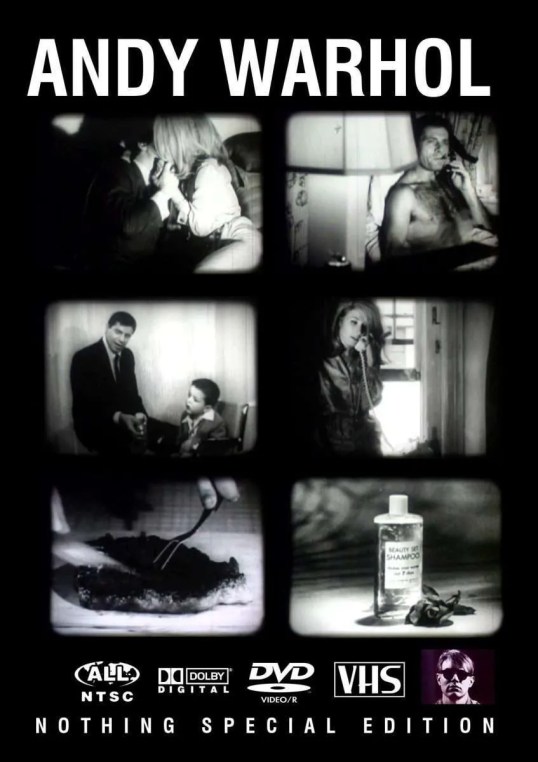
Directed by Andy Warhol, 1964’s Soap Opera features a plot that largely plays out in silence.
The silent, grainy black-and-white footage depicts what appears to be a love triangle between Warhol associate Rufus Collins, Sam Green, Ivy Nicholson, Gerard Malanga, and “Baby Jane” Holzer. There’s a lot of kissing. There’s a lot of slapping. There’s a lot of scenes of our nameless characters giving each other suspicious and meaningful looks. At one point, Jane Holzer makes what appears to be a very important phone call. We don’t know who these people are or how they’re related but they certainly do seem to be intensely obsessed with each other. The situations grow progressively more and more sexual and one gets the feeling that, if we could only hear the dialogue, we would have a chance to vicariously take part in a great melodrama. Of course, the footage itself is so grainy that it’s sometimes hard to tell who is who. Indeed, the characters often seem to be interchangeable. That’s certainly true of real soap operas as well. With new actors regularly stepping into old roles and one story’s hero becoming the next story’s villain, soap operas were all about accepting whatever was presented on the screen. In real life, drama has real consequences. In Warhol’s film and on television, melodrama is just something that happens without any real repercussions.
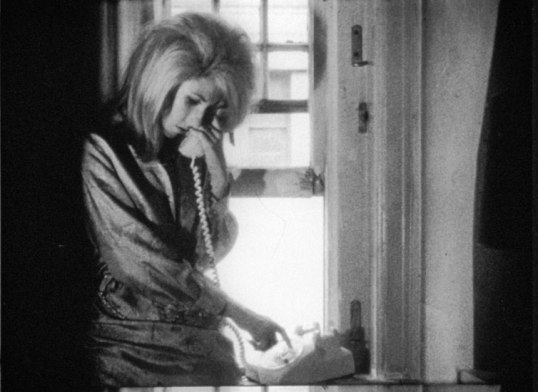
Janes Holzer in Soap Opera
Fortunately, the film provides a few breaks from the repetitive cycle of nonstop, grainy drama. Sprinkled throughout the film are commercials breaks, featuring actual commercials that were supplied to Warhol by Lester Persky, an advertising executive who later found greater fame as a Broadway producer. (He produced Hair, amongst other productions.) In between scenes of Ivy Nicholson kissing Sam Green and Rufus Collins looking shocked, we get a serious of very happy and very loud commercials. Indeed, after watching the silent and grainy soap opera footage, it’s a bit jarring to have an expertly staged commercial suddenly blare forth in crisp black-and-white. An obnoxious salesman tries to sell us things to make our home better and our meals tastier. Jerry Lewis shows up with a child and tells us to be sure to contribute money to his telethon. Model Rosemary Kelly is introduced by an announcer who tells us that Rosemary is going to tell us about the greatest adventure of her life. That adventure? Not conditioning her hair for five days. Amazingly, her hair is still full and lustrous! Even after swimming and sleeping on it! Not even a broken steam valve can make her hair look bad! This commercial is so effective that it’s actually featured twice and why not? Even I want to know Rosemary’s secrets and my hair always looks good!

Rosemary Kelly in Soap Opera
Warhol subtitled this film The Lester Persky Story, both to thank Persky for supplying the commercials but also to point out that the commercials were really the whole point of the show. The plot of any show, whether it’s a real one or the one in Warhol’s film, really only exists to keep you watching long enough to see the commercials. And it must be said that the commercials are the most interesting part of this film. After watching the Soap Opera actors for ten minutes, it’s a relief when Rosemary Kelly appears and, with a big smile on her face, starts enthusiastically talking about her hair. We all complain about commercials but we still accept them as a fact of life and, in the end, it’s usually the commercials that people remember and try to pattern their lives after. I mean, there’s a reason why I’m still singing that “Nothing is everything” song from the Skyrizi commercials.
And now, let’s check out how Rosemary Kelly’s hair is doing in hurricane winds!
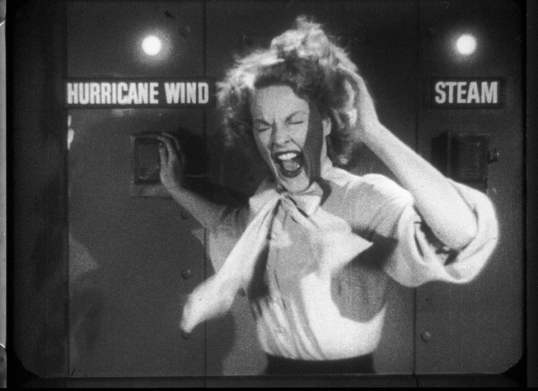
Rosemary Kelly in Soap Opera
Since I already shared a scene from my favorite John Ford film, it seems only right that today’s song of the day should pay some respect to Mr. Ford as well. Here is the theme song from 1962’s The Man Who Shot Liberty Valance, performed by Gene Pitney.
When Liberty Valance rode to town
The womenfolk would hide, they’d hide
When Liberty Valance walked around
The men would step aside
‘Cause the point of a gun was the only law
That Liberty understood
When it came to shooting straight and fast
He was mighty good
From out of the East a stranger came
A law book in his hand, a man
The kind of a man the West would need
To tame a troubled land
‘Cause the point of a gun was the only law
That Liberty understood
When it came to shooting straight and fast
He was mighty good
Many a man would face his gun
And many a man would fall
The man who shot Liberty Valance
He shot Liberty Valance
He was the bravest of them all
The love of a girl can make a man stay on
When he should go, stay on
Just trying to build a peaceful life
Where love is free to grow
But the point of a gun was the only law
That Liberty understood
When the final showdown came at last
A law book was no good
Alone and afraid, she prayed that he’d
Return that fateful night, oh that night
When nothing she said could keep her man
From going out to fight
From the moment a girl gets to be full grown
The very first thing she learns
When two men go out to face each other
Only one returns
Everyone heard two shots ring out
One shot made Liberty fall
The man who shot Liberty Valence
He shot Liberty Valance
He was the bravest of them all
The man who shot Liberty Valance
He shot Liberty Valance
He was the bravest of them all
Songwriters: Burt F. Bacharach / Hal David
A new month and that roulette wheels keeps on turning!
Such are the ways of fate.
Enjoy!
Welcome to Late Night Retro Television Reviews, a feature where we review some of our favorite and least favorite shows of the past! On Fridays, I will be reviewing Friday the 13th: The Series, a show which ran in syndication from 1987 to 1990. The entire series can be found on YouTube!

This week, the second season comes to an end.
Episode 2.26 “Coven of Darkness”
(Dir by George Bloomfield, originally aired on June 12th, 1989)
Jack and Ryan have recovered a “witch’s ladder,” and they’ve put it in the vault. However, Lysa Redding (Maria Ricossa) is a witch who wants the ladder back. Lysa (and I do always enjoy hearing my name, even if it is misspelled) is the head of a coven that was connected to evil old Uncle Lewis. Lysa performs a ceremony that causes Ryan to become possessed so Micki has to become a white witch so that she can battle the dark witches.
Now, I should mention that Micki has never had magical powers before. In the past, she’s usually been the down-to-Earth skeptic of the group so Jack suddenly announcing that Micki is actually a powerful witch took me by surprise. But anyway, Micki is able to use her powers to break Lysa’s spell. It’s such a grueling experience that Jack says its possible that she’s used up all of her magic powers. What? Really? I guess …. okay, I don’t know what to say about that. They suddenly gave Micki magic powers and then took them away.
This was a weird episode. Based on this episode and Prisoner, I’m going to guess the production was nearly out of money at the end of season two. Coven of Darkness takes place over three different locations and it’s mostly just continual jump cuts between Lysa spellcasting and Ryan freaking out and Micki looking intense. It all feels very cheap and basic and not at all like a typical episode of Friday the 13th. Instead of using their wits to defeat evil, Chris and Micki use magic. It just doesn’t feel right.
I’m going to guess, though, that this was an attempt to reboot the show for the third season. I’ve seen enough of the third season to know that the reboot didn’t stick around but I can kind of see what they were going for. With John D. LeMay not planning on being a part of the third season, it perhaps seemed like it would be a good idea to turn the show into the Micki Witchcraft Hour. And it probably would have been interesting but it definitely wouldn’t have had the same feel as classic Friday the 13th.
This brings season two to an end. It was, overall, a good season, though I think the show lost its way a little towards the end. The introduction of Johnny Ventura was rather clumsily handled and a few too many episodes seemed to forget that the show was supposed to center on finding Lewis’s cursed antiques. The highlight of the show was the chemistry between the three leads. I’m curious to see how the upcoming season will play without Ryan.
We’ll find out starting next week!
Welcome to Retro Television Reviews, a feature where we review some of our favorite and least favorite shows of the past! On Fridays, I will be reviewing St. Elsewhere, a medical show which ran on NBC from 1982 to 1988. The show can be found on Hulu and, for purchase, on Prime!
This week, Dr. Ehrlich faints!
Episode 1.9 “Hearts”
(Dir by Mark Tinker, originally aired on January 11th, 1983)
Ralph, the guy who thinks that he’s a bird, is now running around the hospital and checking in on patients and signing his name as “Dr. Bullfinch.” I guess it says something about how big St. Elgius is that Dr. Chandler spends most of this episode asking people if they’ve ever heard of or met Dr. Bullfinch. The show plays this for humor. There’s only two problems.
First off, we’ve already done the fake doctor thing. Dr. Craig spent three episodes searching for Dr. Barnum, the fictional doctor who Mark thought was interested in buying his car. Since Chandler was a part of that whole practical joke, it surprised me that it didn’t occur to him that maybe Dr. Bullfinch also didn’t exist.
Secondly, Ralph is one of those character who was amusing at first but, after episode-after-episode of him disrupting the hospital and making the patients uncomfortable, I can’t help but feel that it’s time for Ralph to at least try to fly off into the sunset, even if it leads to him crashing to the pavement below. Dr. Westphall tells Dr. Beale to keep Ralph locked up in the psych ward or else Westphall will send Ralph to a mental hospital. I think Westphall should have just gone for it. I mean, does Westphall not realize the legal jeopardy that the hospital is now in because of Ralph’s continued presence?
While that was going on, an overweight woman (Conchata Ferrell) checked into the hospital with stomach pains and was shocked to discover that she was pregnant and going into labor. This was a heartbreaking story, largely due to the wonderful performance of Conchata Ferrell. No one — from her father to the nurses at the hospital — has ever treated her with any sort of compassion. In the end, she checks out of the hospital and abandons her baby in the maternity ward.
A new doctor (Dorothy Fielding) came to work at St. Eligius and — hey! — she has a romantic history with Dr. Samuels. *Yawn* Samuels is the most boring character on the show and I tuned out this storyline as soon as I realized he was going to be at the center of it.
Newly separated from his wife, Dr. White is having a nervous breakdown and has to abandon a patient so that he can cry in the stairwell. Dr. Westphall offers him some heartfelt advice but you can tell that Westphall thinks that White doesn’t have what it takes to be a doctor. I think Westphall is right.
Finally, an ill Dr. Erhlich tries to get out of assisting Dr. Craig with an operation. Craig tells Erhlich to man up. Erhlich faints during the operation. Surprisingly, Dr. Craig is not angry with Ehrlich because, as he explains it, the important thing is that the operation was a success. Seeing how sick Ehrlich has become, Craig tells Ehrlich to go home and get some rest.
“Do you have a car?” Dr. Craig asks.
“No, I usually ride the bus,” Ehrlich replies.
“Good,” Craig says, “you shouldn’t be driving in your condition.”
And I have to admit that exchange made me laugh. William Daniels gives such a good performance as the arrogant yet talented Dr. Craig that you can’t help but love the guy, no matter how much of a jerk he is. After knowing him best as the always compassionate Mr. Feeney on Boy Meets World, it’s been interesting to watch William Daniels play a character as thoroughly self-centered and vain as Dr. Craig. On the drama St. Elsewhere, William Daniels often provides some much-needed comedic relief. On the (very silly) sitcom Boy Meets World, Daniels was the dramatic relief. It’s a strange world.
This episode had a few too many plotlines that I either didn’t care about or which felt a bit played out (like Ralph the Birdman). It wasn’t St. Elsewhere at its best but William Daniels and Conchata Ferrell still saved the episode.
 Through the Shattered Lens