Happy Twin Peaks Day! 37 years ago today, FBI Agent Dale Cooper arrived in the town of Twin Peaks to investigate a heinous crime. Things would never be the same.
Sometimes, only the singer at the local roadhouse seemed to truly understand.
Don’t let yourself be hurt this time Don’t let yourself be hurt this time
Then I saw your face Then I saw your smile
The sky is still blue The clouds come and go Yet something is different Are we falling in love?
Don’t let yourself be hurt this time Don’t let yourself be hurt this time
Then your kiss so soft Then your touch so warm
The stars still shine bright The mountains still high Yet something is different Are we falling in love?
Falling Falling Are we falling in love?
Falling Falling Are we falling in love?
For the record, it’s tempting to credit David Lynch as director of this video, especially since it utilizes scenes from Twin Peaks. That said, he’s never been officially credited as director and, given how documented his career became online, I have a feeling that, if he was the director, he would have been credited as such. As an artist and a filmmaker, Lynch understood the importance of being credited for one’s work. So, for now, this video’s director is listed as unknown.
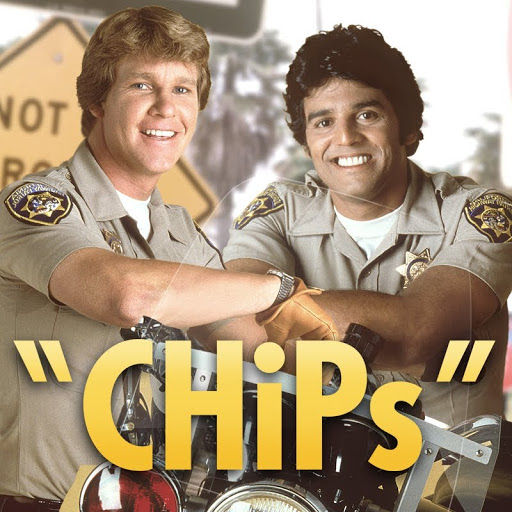
Welcome to Late Night Retro Television Reviews, a feature where we review some of our favorite and least favorite shows of the past! On Mondays, I will be reviewing CHiPs, which ran on NBC from 1977 to 1983. The entire show is currently streaming on Prime!
This week, Ponch is back!
Episode 5.10 “Fast Money”
(Dir by Leslie H. Martinson, originally aired on December 5th, 1981)
This is getting weird.
After being either absent or only appearing in one or two scenes over the past few episodes, Ponch returns this week. He’s once again on active duty, patrolling the California highways with Baker. As much as I notice and joke about the obvious disdain that Erik Estrada and Larry Wilcox held for each other, they do make a surprisingly good team. They just seem to belong together. If I’ve learned anything over the past few weeks, it’s that Larry Wilcox needed Estrada’s flamboyance and that Erik Estrada needed Wilcox’s cool professionalism. They balanced each other out.
With Ponch (and Estrada) back, there’s really no reason for Steve McLeish to stick around. And yet, during this episode — there he was!
He didn’t really have anything to do. Ponch and Baker were after some van-driving engineers who were using a hydraulic lift to hijack other cars. When they figured out which company had developed the hydraulics being used in the crime wave, Steve called the company’s chairman. (Steve says the chairman of the board is an old friend and no one acts surprise. I’m guessing maybe that was an inside joke or some sort of reference to the Olympics.) Later, Steve showed them a mansion that was fixing up so he could flip it. The scenes felt awkward and not just because of the Caitlyn Jenner’s total lack of acting ability. There really wasn’t any reason for them to be in the episode. There was no reason for Steve to be around. Ponch and Baker should have been out there, taking down those nerdy engineers and warning people about the dangers of technology. Instead, they were having to make time to hang out with Steve.
As I watched this episode, it occurred to me that maybe Caitlyn Jenner just refused to go home. Maybe Jenner showed up on set and wouldn’t leave until the writers wrote Steve a few scenes. That theory is really the only one that makes sense.
Anyway, this episode had a few good car crashes. The hydraulic lift was incredibly silly and so was Harlan’s suggestion that they could catch the thieves by tricking them into trying to lift a car that was weighted down with rocks. There was also a big subplot that was centered around Ponch trying to get the shower fixed in his apartment. I always like it whenever the show finds an excuse to show us either Ponch or Jon’s apartment. The wood paneling and the shag carpeting amuses me. They should have called this show Disco Cops.
According to the imdb, next week will be Jenner’s final episode. So, we’ll see how the saga of Steve McLeish comes to an end. I think he’s going to get arrested for taking payoffs from the mob. We’ll see if I’m right!
Welcome to Retro Television Reviews, a feature where we review some of our favorite and least favorite shows of the past! On Mondays, I will be reviewing Miami Vice, which ran on NBC from 1984 to 1989. The entire show can be purchased on Prime!
This week, Crockett goes undercover as a Neo-Nazi.
Episode 5.16 “Victim of Circumstances”
(Dir by Colin Bucksey, originally aired on May 5th, 1989)
When a Miami coffeeshop is the scene of a violent shooting that leaves several dealers and the coffeeshop’s owner dead, Crockett and Tubbs assume that it’s just another part of an ongoing drug war. However, when it’s discovered that the owner of the coffeeshop was a Holocaust survivor who was scheduled to testify against a former guard named Hans Kozak (William Hickey), Crockett comes to suspect that the hit was ordered by a Neo-Nazi group. Crockett and Switek go undercover to infiltrate the group but it turns out that the killer was actually Helen Jackson (Karen Black), a reporter who is the daughter of Hans Kozak and who is trying to kill everyone who can testify against her father. Crockett and Tubbs manage to capture Helen but Helen is subsequently gunned down by Angelo Alvarez (John Leguizamo), the brother of one the dealers who was killed at the coffeeshop.
This was an interesting episode. On the one hand, it was based in reality. In the days following World War II, several concentration camp commandants were put on trial and executed for war crimes but the Allies were so busy going after the people in charge that there were several guards, doctors, and other personnel who were able to escape justice and who immigrated elsewhere. Quite a few went to South America. Several turned up in the Middle East. And there were many who ended up in America. It wasn’t until decades after the war that people started to get serious about tracking down and putting on trial the camp personnel who were often as brutal as the people giving the orders. By the time many of them started going on trial, they were elderly and often frail, like Hans Kozak. And, just as in this episode, there were many Neo-Nazi groups who protested the trials and sometimes tried to help the accused escape justice.
On the other hand, this episode played out in such a surreal manner that it often felt rather dream-like, with Hans Kozak being haunted by nightmares and the Neo-Nazis themselves meeting in ceremonies that felt as if they could have been lifted from one of Fritz Lang’s Dr. Mabuse films. Karen Black plays her role with such wild-eyed intensity that the revelation that she was the killer isn’t really that much of a surprise. As for William Hickey, he doesn’t so much chew the scenery as he treats it like a buffet. This was one of those episodes that felt like it could spin off into space at any given moment. If James Brown had returned as the alien who abducted Trudy, I would not have been surprised.
This episode was definitely watchable and Stefan Gierasch gave a strong performance as the Nazi hunter who was determined to track down Hans Kozak. There was nothing subtle about it but it’s still one of the more memorable episodes of the show’s final season.
Speaking of final season, next week will feature Crockett and Tubbs in their final adventure. And then, we’ll look at the four “lost” episodes, which aired in syndication after the show’s network run ended. And then, we’ll done with Miami …. for now.
I’m not even a hockey fan and I’m cheering right now! 3 Days ago, the U.S. women’s hockey team defeated Canada and won a gold medal at the Winter Olympics. Today, the men’s hockey team did the same thing.
I have tears in my eyes and you better believe I have a song of the day.
If I leave here tomorrow Would you still remember me? For I must be traveling on, now ‘Cause there’s too many places I’ve got to see
But, if I stayed here with you, girl Things just couldn’t be the same ‘Cause I’m as free as a bird now And this bird, you’ll can not change Oh, oh, oh, oh, oh
And the bird you cannot change And this bird you cannot change Lord knows, I can’t change Bye, bye, baby it’s been a sweet love
Yeah, yeah Though this feeling I can’t change But please don’t take it so badly ‘Cause the Lord knows I’m to blame
But, if I stayed here with you girl Things just couldn’t be the same ‘Cause I’m as free as a bird now And this bird, you’ll can not change Oh, oh, oh, oh, oh
And this bird you cannot change And this bird you cannot change Lord knows, I can’t change Lord help me, I can’t change Lord I can’t change
Today, as we celebrate America’s success in the Winter Games and as we get ready for what will hopefully be a big 250th birthday celebration in July, a song about trucks just feels appropriate.
Welcome to Late Night Retro Television Reviews, a feature where we review some of our favorite and least favorite shows of the past! On Saturdays, I will be reviewing Saved By The Bell, which ran on NBC from 1989 to 1993. The entire show is currently streaming on Prime and Tubi!
This week, Kelly is irresponsible.
Episode 1.13 “The Babysitters”
(Dir by Don Barnhart, originally aired on December 1st, 1990)
This episode stresses me out.
Kelly’s parents go off on a ski vacation and leave Kelly with the responsibility of taking care of her infant brother. (Really?) When they get stranded at the lodge, Kelly has to bring the baby to school. She asks her idiot friends to help look after him.
Of course, Zack loses the baby. Fortunately, Mr. Belding finds him but still…
Seriously, I hate this episode. I hate that Kelly’s parents are irresponsible enough to abandon their baby so that they can go skiing. I hate that Kelly has to find someone to take care of the baby while she goes to cheerleader practice. I hate that Zack is dumb enough to lose the baby. I hate that no one ever says, “Wow, this whole situation is really messed up.” This is the one episode that I always turned off whenever I came across it on TV.


 Through the Shattered Lens