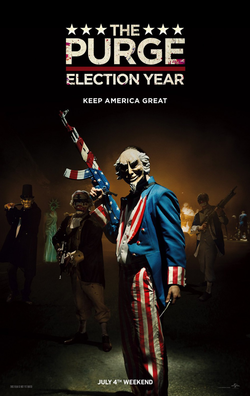
Film Review: The Purge: Election Year (dir by James DeMonaco)


The_Purge_Election_Year

I had really high hopes for The Purge: Election Year.

While the first Purge film was definitely flawed, it still had an interesting and thought-provoking premise behind it.  What would we do, the film forced us to ask, if we could do anything we wanted to for one night out of the year?  Would you hide in your house or would you go out and randomly kill people?  Yes, The Purge had its flaws but it was an interesting film.

And then, in 2014, The Purge: Anarchy was released.  Anarchy was one of the best films of 2014 (a film that saw no shortage of great films).  It was a big, loud, and over-the-top masterpiece of the pulp imagination, one that managed to be as thought-provoking as the first film while also keeping audiences entertained.  It was a political movie, perhaps one of the most overtly political to be released over the past ten years.  And yet, it was also amazingly entertaining.  By further exploring the type of society that would come up with something like an annual Purge, Anarchy forced audiences to think even as it gave them reasons to cheer and hiss.  For many viewers, it also served as an introduction to a tough and grizzled actor named Frank Grillo.  In the role of the enigmatic but ultimately good-hearted Leo Barnes, Frank Grillo gave an outstanding performance.

Well, The Purge: Election Year continues its exploration of the culture behind the Purge.  And Frank Grillo is back as Leo.  It should be said that, just as he did in Anarchy, Grillo supplies Election Year with some of its best moments.  Much like Clint Eastwood, Grillo can communicate an entire backstory just be squinting his eyes.

But overall, Election Year is a disappointment.  As I watched it, I found myself wondering if maybe director James DeMonaco should have quit when he was ahead and ended the series with Anarchy.  Anarchy pushed the idea behind The Purge about as far as it could go and it is perhaps not surprising that Election Year often feels like a rehash that was constructed out of leftovers.

Election Year finds Leo working as head of security for U.S. Sen. Charlie Roan (Elizabeth Mitchell).  Charlie, who saw her family massacred during an earlier purge, is running for President on an anti-Purge platform and it appears that she’s about to overtake the candidate of the New Founding Fathers, the Rev. Edwidge Owens (Kyle Secor).  The New Founding Fathers decide that the best way to take care of Charlie would be to assassinate her on Purge Night.  They announce that, for the first time since the Purge began, government leaders will no longer be granted immunity.

In short, anyone can be killed!

Leo’s idea is for Charlie to stay inside during Purge Night but, if that happened, there wouldn’t be a movie.  Naturally, Leo and Charlie eventually end up on the streets and they get to witness a few surreal and violent moments, none of which have quite the impact of anything we previously saw in Anarchy.  They are given some assistance by a deli owner (Mykleti Williamson) and, naturally, they meet up with rebel leader Dante Bishop (Edwin Hodge).  Just like in the previous film, Leo is eventually forced to decide between purging and showing mercy.

And it’s really never that interesting.  The whole film just falls flat.  The first two Purge film worked because they convinced you that something like The Purge could actually happen.  When, at the end of Anarchy, Leo chose not to murder someone, it felt like a great moment because you truly believed that Leo could have gotten away with murder if he wanted to.  But Election Day is never convinces you that you’re watching anything more than a standard issue sequel.  With the exception of Frank Grillo and Kyle Secor (more about him in a moment), none of the actors are particularly memorable or believable.  In fact, Mykelti Williamson gives a performance that is almost amazingly bad.

I think a huge part of the problem is that the character of Charlie is never credible.  Elizabeth Mitchell is a good actress and has appeared in some of my favorite TV shows (she was Juliet on Lost, for instance) but you never believe that she’s a dynamic senator who is destined to save America from itself.  Every character in the film has at least one moment in which he or she is required to talk about how much they love Charlie.  The film spends so much time worshipping her that it apparently forgot to make her believable.

(It’s hard not to compare Election Year to Anarchy.  Anarchy advocated revolution.  Election Year argues that the system will eventually correct itself, going so far as to present the revolutionaries as almost being villains because they’re not properly deferential to a wealthy white liberal.)

However, I do have to say that Election Year is occasionally elevated by the thoroughly over-the-top performance of an actor named Kyle Secor.  It’s almost as if Secor alone understood that Election Year needed a jolt of pure adrenaline and, at the end of the film, he goes out of his way to provide it.  He bulges his eyes.  He shrieks out his lines.  His entire body shakes and it’s damn near brilliant.  He’s a lot of fun and his performance is probably the most entertaining thing about Election Year.

Undoubtedly, there will eventually be a sequel to Election Year.  Hopefully, it’ll be an improvement.

the-purge-ey-pstr01

Embracing the Melodrama Part II #58: An Unmarried Woman (dir by Paul Mazursky)


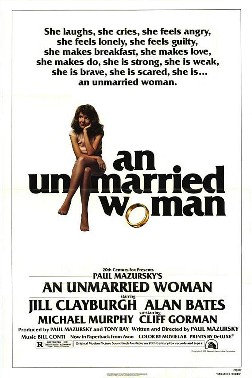
Unmarried_womanI have mixed feelings about the 1978 best picture nominee An Unmarried Woman and I really wish I didn’t because this is one of those films that I really want to love.

Erica (Jill Clayburgh, who did not win the Oscar that she deserved for this film) appears to have the perfect life.  She works at an art gallery in New York.  She has smart, sophisticated friends.  She has an accomplished teenager daughter (Lisa Lucas).  She has a beautiful apartment.  Early on in the film, she wakes up and literally dances from her bedroom to the living room and back again.

And, of course, she has a husband.  His name is Martin and he’s a successful stock broker.  Of course, there are hints that everything might not be perfect.  She and Martin are a cute couple but they’re not exactly passionate.  One need only watch Erica carefully wash dogshit off of Martin’s expensive running shoes to tell who is getting the most out of the marriage.  Add to that, Martin is played by Michael Murphy and, as anyone familiar with 70s cinema knows, Murphy specialized in playing well-dressed, outwardly friendly heels.  And, of course, the film is called An Unmarried Woman and the title can’t be true as long as Erica’s married.

So, you’re not exactly surprised when Martin suddenly breaks down in tears and tells Erica that he’s fallen in love with a younger woman and that he’s leaving her.

The rest of the film deals with Erica’s attempts to adjust to suddenly being an unmarried woman and a single mom.  We follow as she struggles to get back her confidence.  The scenes of Erica dealing with her suddenly rebellious daughter really struck home to me, largely because I’m a rebellious daughter of divorce myself.  There’s a few great scenes of Erica turning to her girlfriends for support.  (Importantly, one of Erica’s friends is happily married, as if the film wants to make sure that we understand that not all marriages are as bad as Erica and Martin’s.)  We watch as Erica starts dating again, having a memorable one-night stand with the obnoxious but oddly likable Charlie (Cliff Gorman).  Finally, she ends up dating a rugged, bearded artist (Alan Bates) and she has to decide whether she wants to remain independent or not.

And it’s all amazingly well-acted and fun to watch but I have to admit that I was a little bit disappointed the first time that I saw An Unmarried Woman.  For some reason, I couldn’t bring myself to like it as much as I wanted.  The more I thought about it, the more clear my issue with it became.

As a character, Eric was simply too wealthy.

As I watched Erica struggle with being an unmarried woman, it was hard for me not to compare her struggles with the struggles that my own mom had to deal with after her divorce.  The film, and specifically Clayburgh’s lead performance, got so much right.  But there’s a difference — a huge difference — between an unmarried woman who has an apartment in Manhattan and a dream job at an art gallery and a woman like my mom who worked multiple jobs, spent hours worrying about how to pay the bills, and who had to do all of this while dealing with four stubborn daughters.  And so, whenever I saw Erica talking to her therapist about how upset she was over suddenly being single, there was a part of me that wanted to say, “Try doing it while living in South Dallas and having to deal with a brat like me.”

The second time that I watched An Unmarried Woman, I was able to better appreciate the film.  Now that I knew that Erica’s experiences were not going to be universal, I could focus on Jill Clayburgh’s great performance in the lead role.  I could marvel at how marvelously wimpy Michael Murphy was in the role of Martin.  I could laugh at Cliff Gorman’s comedic performance.  As for Alan Bates as that bearded artist — well, sorry, that still didn’t work for me.  Eventually, I could accept Erica’s perfect apartment and her perfect job but suddenly introducing a perfect boyfriend who also happened to be a passionate and financially successful painter; it all felt like a bit too much.

But, in the end, An Unmarried Woman is a good film and a valuable historical document of its time.  If for no other reason, see it for Jill Clayburgh’s lead performance.

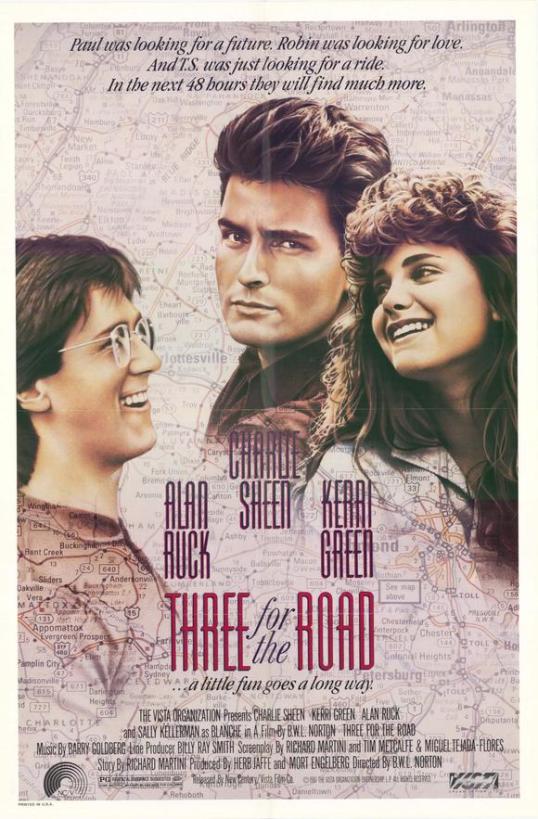
Shattered Politics #51: Three For The Road (dir by B.W.L. Norton)


three-for-the-road-movie-poster-1987-1020243960It’s a little bit strange to go from watching and reviewing a film like Once Upon A Time In America to watching and reviewing a film like 1987’s Three For The Road.  But that’s one reason that I like doing things like Shattered Politics.  It’s always interesting to see how many different films can all be linked together by common elements.  In the case of Shattered Politics, those shared elements are politics and politicians.

Three For The Road is an 80s comedy.  In fact, it’s one of the most stereotypically 80s films ever made.  Senator Kitteride (Raymond J. Barry) may very well be the next President of the United States but first he has to do something about his rebellious teenage daughter (Kerri Green).  He has arranged for her to be shipped down to a reform school down South.

But who can he trust to drive her down there?  How about the newest member of his staff, Paul Tracy?  Paul looks up to Sen. Kitteridge and has political ambitions himself.  He’s such a responsible guy that, while all of his roommates are busy getting drunk and having sex, Paul locks himself away in his bedroom and studies.  So, naturally, who is cast as this straight-laced, ultra-responsible, uptight guy?  Why Charlie Sheen, of course!

Now, Paul has a roommate who comes along on the road trip with him and Robin.  T.S. is an aspiring writer.  (His actual name is Tommy but he demands to be known as T.S., in honor of T.S. Eliot.)  T.S. is an intellectual.  T.S. is a serial womanizer who is hit on by nearly every woman he meets.  (T.S. always asks them to name their favorite author as a test.)  So, of course, T.S. is played Alan Ruck, who is better known for playing Cameron in Ferris Bueller’s Day Off.

Now, to be honest, I’m being a bit snarky here and that’s not really fair to either Sheen or Ruck.  Yes, they’re both miscast but that doesn’t mean that they don’t give good performances.  They both do as well as they can with the material that they’ve been given.  It’s just that the material itself… well, I’ll get to that in a minute.

Three For The Road is not a bad film as much as it’s just an extremely forgettable one.  From the minute it opens with the predictable shots of D.C. landmarks to Paul and Robin falling in love to the eventual revelation that Sen. Kitteridge isn’t the great man that Paul thinks that he is, it all just feels extremely generic.  The film probably works best as a time capsule, a portrait of when it was made.

If you go to Three For The Road‘s imdb page, you can find a comment that was left by film director Richard Martini.  Martini wrote the original script for what would eventually develop into Three For The Road.  I say “develop” because, as Martini explains it, his script was apparently changed and rewritten on a daily basis.  While that’s certainly not a surprising thing to hear, it does sound like Martini’s original version would have made for a more interesting film.

In Martini’s original script, Sen. Kitteridge’s motivation for sending Robin to the institution was that Robin was embarrassing him with her own left-wing political activism.  That would have certainly brought a much needed edge to the film’s politics because, in the film that was eventually made, there’s really no point to Kitteridge being a senator.  He could just as easily have been a wealthy businessman or maybe a college president.  But apparently, once filming started, it appears that the filmmakers went for the least edgy approach possible.

(Martini also commented that, as a result of the actual film being so different from his original script, that he hates to read reviews of the film.  And, needless to say, I don’t blame him.  If Richard Martini is reading this review, please accept my apologies for any bad memories this review may have brought up.)

Three For The Road has never been released on DVD or Blu-ray but you can watch it on YouTube.