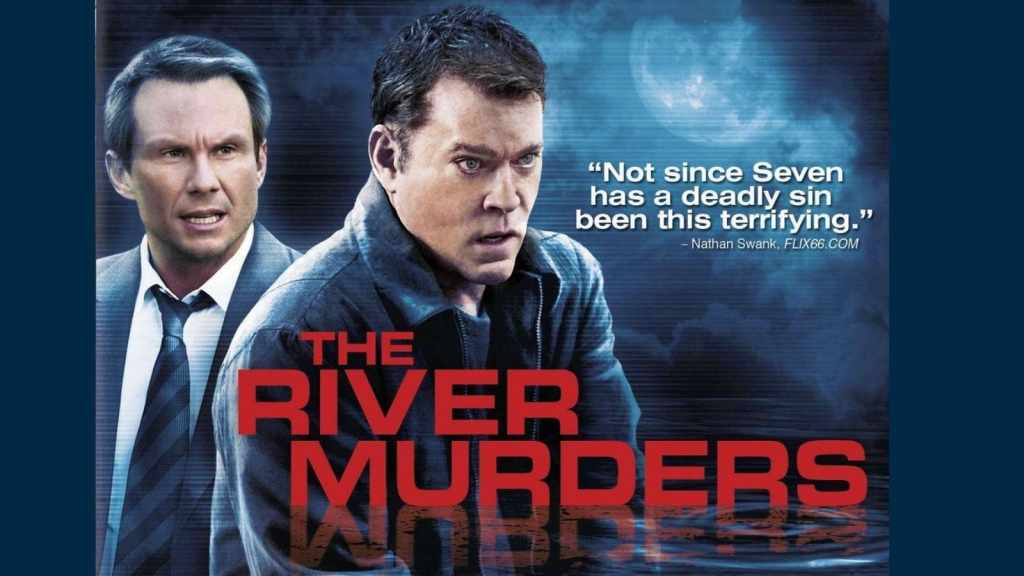
#MondayMuggers presents THE RIVER MURDERS (2011) starring Ray Liotta, Ving Rhames & Christian Slater!


Every Monday night at 9:00 Central Time, my wife Sierra and I host a “Live Movie Tweet” event on X using the hashtag #MondayMuggers. We rotate movie picks each week, and our tastes are quite different. Tonight, Monday April 28th, Sierra has chosen THE RIVER MURDERS (2011) starring Ray Liotta, Ving Rhames, Christian Slater, and Raymond J. Barry. 

The plot revolves around a homicide detective (Liotta) who becomes the prime suspect in a series of murders when the FBI uncovers his close personal ties to all of the victims.

This sounds pretty good to me, so join us tonight for #MondayMuggers and watch THE RIVER MURDERS! It’s on Amazon Prime. The trailer is included below:

Lisa Marie Reviews An Oscar Nominee: Born On The Fourth of July (dir by Oliver Stone)


In 1989, having already won an Oscar for recreating his Vietnam experiences in Platoon, director Oliver Stone returned to the war with Born On The Fourth Of July.

Based on the memoir of anti-war activist Ron Kovic, Born on the Fourth of July stars Tom Cruise as Kovic.  When we first meet Kovic, he’s growing up on Long Island in the 50s and 60s.  He’s a clean-cut kid from a nice family.  He’s on the school wrestling team and he’s got a lot of friends.  When he was just 15, he heard John F. Kennedy telling people to ask what they can do for their country and he was inspired.  He decided he wanted to join the Marines, despite the fact that his father (Raymond J. Barry) was still haunted by the combat that he saw in World War II.  (In one of the film’s better scenes, a young Kovic notices that the elderly veterans marching in the Independence Day parade still flinch whenever they hear a firecracker.)  He enlists in the Marines after listening to a patriotic speech from a recruiter (played by Tom Berenger).  Ron runs through the rain to attend his prom and has one dance with Donna (Kyra Sedgwick), on whom he’s always had a crush.  There’s nothing subtle about the way that Stone portrays Kovic’s childhood.  In fact, one might argue that it’s a bit too idealized.  But Stone knows what he’s doing.  The wholesomenss of Kovic’s childhood leaves neither him nor the viewer prepared for what’s going to happen in Vietnam.

Vietnam turns out not to be the grand and patriotic adventure that Kovic thought it would be.  After Sgt. Kovic accidentally shoots one of his own men in a firefight, he is ordered to keep quiet about the incident.  After he is wounded and paralyzed in another firefight, Kovic ends up in a Hellish VA hospital, surrounded by men who will never fully recover from their mental and physical wounds.  Kovic is eventually returns home in wheelchair.  The film then follows Kovic as he goes from defending the war in Vietnam to eventually turning against both the war and the government.  At one point, he ends up with a group of disabled vets in Mexico and there’s a memorable scene where he and another paraplegic (Willem Dafoe) attempt to fight despite having fallen out of their chairs.  Eventually, Kovic returns to America and turns his anger into activism.

There’s nothing subtle about Born On The Fourth Of July.  It’s a loud and angry film and Oliver Stone directs with a heavy-hand.  Like a lot of Stone’s films, it overwhelms the viewer on a first viewing and it’s only during subsequent viewings that one becomes aware of just how manipulative the film is.  Tom Cruise gives a good performance as Ron Kovic but his transformation into a long-haired, profane drunk still feels as if it happens a bit too abruptly.  A good deal of the film centers on Kovic’s guilt about accidentally killing one of his men but the scene where he goes to the soldier’s family and asks them for forgiveness didn’t quite work for me.  If anything, Kovic came across as being rather self-centered as he robs the man’s mother and father of the belief that their son had at least died heroically in combat as opposed to having been shot by his own sergeant.  Did Kovic’s need to absolve himself really give him the right to cause this family more pain?  Born on the Fourth Of July is an effective work of agitprop.  On the first viewing, you’ll want to join Kovic in denouncing the military and demanding peace.  On the second viewing, you’ll still sympathize with Kovic while also realizing that he really owes both his mother and father an apology for taking out his anger on them.  By the third viewing, you’ll be kind of like, “Wow, I feel bad for this guy but he’s still kind of a jerk.”  That said, when it comes to making an effective political film, Adam McKay could definitely take some lessons from Oliver Stone.  Born On The Fourth of July is at its best when it simply captures the feeling of living in turmoil and discovering that the world is not as simple a place as you once believed.  As idealized as the film’s presentation of Kovic’s childhood may be, anyone who has ever felt nostalgia for an earlier and simpler world will be able to relate.

Oliver Stone won his second Best Director Oscar for Born On The Fourth Of July.  The film itself lost Best Picture to far more genteel version of the past, Driving Miss Daisy.


Flight of the Living Dead: Outbreak On A Plane (2007, directed by Scott Thomas)


Bad news!  There’s a zombie outbreak on a 747 jumbo jet!  That’s what you get for trying to transport a scientist who has been infected with a “super warrior” virus on a commercial flight.  It’s fine as long as she’s in her container but it just takes a little turbulence for her to get free and start infecting everyone.

This movie was advertised as being the first movie about a zombie outbreak on a plane and yes, it came out the same time as Snakes on a PlaneFlight of the Living Dead makes good use of its limited setting.  Not only do the handful of uninfected passengers have to maneuver around the undead in a tight space but they have to figure out how to get off the plane before it either runs out of fuel or gets blown up by the fighter jets that are following it.  The plane setting also reveals a new way to dispose of zombies, though it also means disposing of many of the living as well.

Flight of the Living Dead was better than I expected.  The characters are all cardboard but the action is fast and furious and that it was all happening the air did bring a new element of suspense to the familiar story.  Zombie movies are dime a dozen but this one’s not bad.  The next time I have to fly anywhere, I’m going to make sure I’m seated as far to the back of the plane as possible.

Film Review: Cop (dir by James B. Harris)


First released in 1988, Cop stars James Woods as Lloyd Hopkins, a homicide detective who does not …. wait for it …. GO BY THE BOOK!

Actually, has there ever been a movie about a homicide detective who always made sure to go by the book?  I’m sure there has been but I really can’t think of any off the top of my head.  Whenever a homicide detective shows up as the main character of a movie, you can be sure that he’s going to drink too much, carouse too much, and get yelled at by his superiors.  If the movie involves a serial killer, you can be sure that the detective and the killer are going to be mirror images of each other, two renegades who have found differing ways to work out their issues with the world.

As much as we talk about the cliché of the cop who does it his way, would we really want to see a movie about a cop who plays by the rules?  I mean, most people dread having to deal with cops.  It’s not just that cops usually bring bad news.  It’s also that dealing with a cop means having to spend a lot of time while they slowly and methodically go through all of their procedures.  There have been so many times that I’ve been pulled over speeding and I’ve just wanted to yell, “Just write the ticket!”  Most people agree that we need some sort of police force, regardless of what the Defund folks say.  But most people also hate following the rules, especially when those rules feel rather arbitrary.  That’s the appeal of the renegade cop.  The renegade cop fills a purpose in society but, at the same time, he dislikes dealing with all of the usual cop nonsense as much as the rest of us.

As for Lloyd Hopkins, he’s hyperactive, jittery, sleazy, and a terrible father and husband.  He cheats on his wife.  He tells his daughter all about the gory details of his job.  (His daughter, it should be noted, seems to enjoy hearing them.)  He obsesses on the crimes that he investigates and he pursues murderers with a fanaticism that suggests that Lloyd knows that he’s just one bad life choice away from becoming one of them himself.  (And, indeed, Lloyd kills quite a few people over the course of Cop, even allowing one person to get into another room and get a shotgun just so Lloyd will have an excuse to shoot him.)  Lloyd is someone who is dangerous to know but, at the same time, he’s also probably the only person who can stop the killer who is seemingly committing random murders in Los Angeles.

The plot is typical of films about obsessive detectives pursuing faceless killers but Cop stands out due to the director of James B. Harris and the lead performance of James Woods.  Harris creates an atmosphere of continual unease, one in which the viewers gets the feeling that anyone could become the killer’s next victim at any moment.  James Woods, meanwhile, plays Lloyd as being a live wire, someone who simply cannot stop thinking and talking because he knows that the minute he does, he’s going to have to take a serious look at the wreck of his life and his own less-than-stable behavior.  Lloyd may be a self-destructive bastard but he’s a compelling self-destructive bastard and, in this film’s version of Los Angeles, he’s about as close as one can get to avenging angel.  The film is full of good actors, like Charles Durning, Lesley Ann Warren, and Raymond J. Barry, but it is ultimately James Woods’s show.  Lloyd gets the film’s final line and it’s a killer but it works because, by the time he utters it, the viewer feels as if they have gotten to know Lloyd.

Cop is based on Blood on the Moon, a novel by James Ellroy.  I have not read that novel so I don’t know how closely Cop sticks to Ellroy’s original plot.  Nor do I know how James Ellroy felt about Cop, which was the first movie to be based on his work.  That said, Ellroy’s writing and Harris’s film share a dark vision of humanity and a subversive sense of humor.  Ellroy has often declared himself to be the world’s great crime novelist and, from what I’ve read of his work, I would tend to agree.  Cop is certainly not the greatest crime movie ever made (nor is it the best film to ever be adapted from Ellroy’s writing) but it’s still pretty damn good.

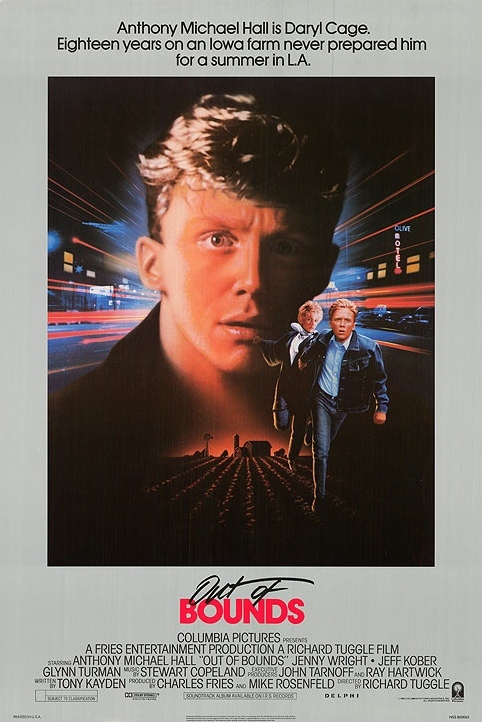
Film Review: Out of Bounds (dir by Richard Tuggle)


Just a country boy

Born and raised in South Des Moines

He took the midnight bus to anywhere….

That’s the story of Darryl Cage, the protagonist of the 1986 film, Out of Bounds.  Played by Anthony Michael Hall, Darryl is an Iowa farm boy who goes to Los Angeles to live with his brother.  Unfortunately, when his flight lands, Darryl’s suitcase is switched with another one that’s full of cocaine!  Darryl becomes an accidental drug mule and end up getting his brother killed!  WHAT A DUMBASS!

So now, Darryl is on the run.  He’s a small town farmer in the big city, trying to avoid bad guy Roy (Jeff Kober) and the police, led by Lt. Delgado (Glynn Turman).  Fortunately, Darryl meets an aspiring actress named Dizz (Jenny Wright).  Dizz gives him a makeover and introduces him to the Los Angeles club scene.  Siouxsie and the Banshees make a cameo appearance at one club.  They perform one song and fortunately, it’s Cities in the Dust.  Unfortunately, they don’t actually get involved in the plot of the film.  I would have liked to have seen Siouxsie beat up Jeff Kober.  But it doesn’t happen.

Out of Bounds is one of the many films that came out in the mid-to-late-80s in which the actors who were (somewhat unfairly) considered to be Brat Packers attempted to prove that they were capable of doing more than just projecting teen angst.  Judd Nelson and Ally Sheedy, for instance, starred in a forgettable neo-noir called Blue City.  Andrew McCarthy starred in an interesting but ultimately uneven film called Kansas.  Emilio Estevez not only starred in Wisdom but he directed it too.  And Anthony Michael Hall starred in Out of Bounds.

Anthony Michael Hall was best-known for playing nerdy characters in Sixteen Candles and The Breakfast Club and it’s probable that he was attempting to escape being typecast when he took his role in Out of Bounds.  This was Anthony Michael Hall’s chance to play an action hero!  Unfortunately, Anthony Michael Hall made the same mistake that many of his peers made while trying to give the performance that would allow them to break free of the Brat Pack label.  He tried too hard.  While Glynn Turman, Jeff Kober and Jenny Wright obviously understood the type of  rather silly movie that Out of Bounds was going to be and they modified their performances accordingly, Anthony Michael Hall apparently tried to duplicate the method intensity of Marlon Brando or James Dean.  In other words, Hall took the film far more seriously than it deserved to be taken.

Out of Bounds get off to a bad start as soon as it opens with Anthony Michael Hall on the farm in Iowa.  There’s absolutely nothing about the young Anthony Michael Hall that leaves on with the impression that he’s ever spent any time on a farm.  Everything about him screams Hollywood before he even lands in Los Angeles.  Hence, it gets difficult to really buy him as being the wide-eyed innocent that everyone else views him as being.  Since a good deal of the film’s plot is dependent upon Hall being naïve, that’s a problem.  He may be a farm boy but he certainly doesn’t freak out after shooting someone.  He’s also somehow learned how to throw a knife straight into someone’s gut.  Out of Bound‘s director, Richard Tuggle, directed two films for Clint Eastwood so he obviously knew how to frame a fight scene but Hall is so miscast that it’s impossible to really get into the movie.

The film is pretty much stolen by Jenny Wright and Jeff Kober.  Kober is properly menacing and, just as she did in Near Dark and I, Madman, Jenny Wright works wonders with a role that could have just been formulaic.  Jenny Wright has apparently retired from acting.  Jeff Kober still shows up in movies and on television, usually playing villains.  (Earlier this year, he played yet another drug trafficker on General Hospital.)  Watching them give compelling performance in a film like Out of Bounds, it’s hard not to feel that both of them deserved bigger career than they had (or, in Kober’s case, still have).

The film is also stolen by its soundtrack, which is very 80s but in the best possible way.  Adam Ant, The Smiths, the aforementioned Souixsie and the Banshees, they all make an appearance and provide the film with a bit of narrative momentum that it would otherwise lack.  Watching the film, 80s Los Angeles comes across like a fun place.  No wonder Darryl Cage wanted to stay even though everyone was trying to kill him.

Out of Bounds is ultimately pretty forgettable and it didn’t make Anthony Michael Hall into an action star.  But, that’s okay.  Like a lot of former Brat Packers, he’s proven himself to be a reliable character actor.  There is life after high school.  Even more importantly, there’s also life after Iowa.

An Olympic Film Review: Cool Runnings (dir by Jon Turtletaub)


Like all good people, I am currently obsessed with the Winter Olympics.  Earlier this week, I asked some of my closest friends if they could recommend some good films about the Winter Games.  Almost everyone who replied recommended that I check out Cool Runnings, a film from 1993.

So, I did.

And I’m glad that I did.

Cool Runnings is one of those sports movies that’s based on a true story, though I imagine it’s probably a very loose adaptation.  Jamaica is a country with a long and proud Olympic history.  Since the 1948 Summer Olympics, Jamaican athletes have won a total of 77 medals, the majority of them in individual and relay sprinting events.  However, Jamaica didn’t compete in the Winter Olympics until 1988, when the Jamaican Bobsled Team made their debut.  According to contemporary news reports, the Jamaicans were folk heroes at the ’88 Winter Games and other teams would frequently help them out by lending them equipment.  Though the Jamaicans were never really a medal contender, they were personally popular and everyone was upset when their bobsled crashed during one of their qualifying runs.

That, of course, isn’t exactly the story that’s told in Cool Runnings.  In Cool Runnings, the Jamaican bobsled team is ridiculed by all of the snobs on the other teams, with the Germans especially going out of their way to be condescending.  Their first run is a disaster but their second run puts them into medal contention and causes people all over the world to spontaneously break into applause.  It’s a sports film, after all.  For a sports film to work, there has to be adversity before there can be victory.  Cool Runnings does stick close enough to the real story that the Jamaicans do end up crashing their sled.  However, in the film version, the team proudly carries their bobsled over the finish line while, again, people all around the world applaud.  Even a woman with a Russian flag claps.  And yes, it’s all pretty hokey but who cares?  It made me cry.

It’s a well-done film, one that is unapologetically sentimental and all the better for it.  Before I watched the film, I didn’t know anything about how the bobsled worked, beyond the fact that it involved four people and that everyone had to jump into the sled after launching it.  But, ultimately, it didn’t matter that I didn’t know much about bobsledding.  From the moment that film started, with scenes of aspiring Olympians running across sunny Jamaica, it had my attention.

When the film starts, Derice Bannock (Leon Robinson) is hoping to compete in the Summer Olympics but, at the qualifying trial, Derice and another runner, Yul Brenner (Malik Yorba), end up tripping over yet another runner, the likable and enthusiastic Junior Bevil (Rawle D. Lewis).  Out of contention for the Summer Olympics, Derice decides to try to find a way to go to the Winter Olympics.  Fortunately, there’s a former Olympic bobsledder, Irv Blitzer (John Candy), living nearby and Derice’s best friend, Sanka (Doug E. Doug) is a champion push cart racer.

The film follows Irv and the four Jamaicans on their unlikely journey to Canada.  It’s a comedy with a dramatic heart.  Yes, Sanka may need help getting his helmet over his hair (“Thanks, coach,” he says whenever Irv pounds down the helmet) but the film also takes the time to explore why it’s so important for these four to compete in the first place.  It might be tempting to make fun of Yul Brenner when he talks about how he wants to live in Buckingham Palace but the film makes clear just how important this improbable dream is for Yul and everyone else.  No one may give the Jamaican bobsled team a chance but Jamaica never stops believing in them.

It’s an incredibly sweet little movie, featuring likable performances and a heart-warming story.  I highly recommend it to anyone looking for a good sports story.

2016 In Review: The Best of SyFy


Well, here we are!  We have reached the end of the first week of January, 2017 and that means that it is time for me to start listing my favorite movies, books, songs, and TV shows of the previous year!  Let’s start things off by taking a look at the best that the SyFy network had to offer in 2016!

Below, you will find my nominees for the best SyFy films and performances of the previous year.  The winners are listed in bold and starred.  As you’ll quickly notice, it was a good year for films about zombies, spiders, and sharks!

(Please note: When it comes to determining the nominees, I have used the credits for each film as listed on the Internet Movie Database.  If anyone feels that they have been miscredited, feel free to let me know and I’ll correct the mistake.  Thanks!)

nightbeforehalloween4

Best Picture

2 Lava 2 Lantula, produced by Neil Elman, Anthony Frankhauser, Lisa M. Hansen, Paul Hertzber

Atomic Shark, produced by Tanya Bellamy, Diane Boone, Matt Chiasson, Angela Meredith Furst, Griff Furst, Stephen Furst, M. Juan Gonzalez, Ross Herbert, Howie Klein, Som Kohanzadeh, Yoram Kohanzadeh, Isiah LaBorde, Kevin Lamb, Daniel March, Will Matherne, David Poughatsch, Lee C. Rogers, Miguel Sandoval, Arthur Scanlan, Ben Yimlimai

Dead 7, produced by Paul Bales, Nick Carter, David L. Garber, David Michael Latt, David Rimawi, Micho Rutare, Dylan Vox

Isle of the Dead, produced by Paul Bales, Lauren Elizabeth Hood, David Michael Latt, David Rimawi

*The Night Before Halloween, produced by Blake Corbet, Priscilla Galvez, Christina O’Shea-Daly, Marek Povisal, Lance Samuels, Mary Anne Waterhouse

Ozark Sharks, produced by Kenneth M. Badish, Sam Claitor, Eric Davies, Daniel Lewis, Jordan Lewis, Pierre-Andre Rochat, Tommy Talley

Best Director

Nick Lyons for Isle of the Dead

Nick Simon for 2 Lava 2 Lantula

Misty Talley for Ozark Sharks

*Sheldon Wilson for The Night Before Halloween

nick-carter

Best Actor

*Nick Carter in Dead 7

Steve Guttenberg in 2 Lava 2 Lantula

Justin Kelly in The Night Before Halloween

Michael Papajohn in Ozark Sharks

bailee

Best Actress

Jessica Blackmore in Dam Sharks

Laura Cayouette in Ozark Sharks

*Bailee Madison in The Night Before Halloween

Maryse Mizanin in Isle of the Dead

dc

Best Supporting Actor

Raymond J. Barry in Day of Reckoning

*D.C. Douglas in Isle of the Dead

Alex Harrouch in The Night Before Halloween

Thomas Francis Murphy in Ozark Sharks

ozark_sharks_2016_13_molly_woolf

Best Supporting Actress

*Allisyn Ashley Arm in Ozark Sharks

Barbara Crampton in Day of Reckoning

Kristina Hughes in Stakeland 2: The Stakelander

Kiana Madiera in The Night Before Halloween

2-lava-2-lantula

Best Screenplay

*2 Lava 2 Lantula, Neil Elman, Ashley O’Neil

Isle of the DeadJacob Cooney, Brandon Trenz

The Night Before HalloweenSheldon Wilson

Ozark Sharks, Marcy Holland, Greg Mitchell

Best Cinematography

Atomic Shark, Don E. FauntLeRoy

*The Night Before Halloween, Daniel Grant

Planet of the Sharks, Mark Atkins

Stakeland 2: The Stakelander, Matt Mitchell

Best Costumes

*Dead 7Sarah Sharp

Isle of the Dead, Cailan Calandro

Planet of the Sharks, Mary-Sue Morris

Stakeland 2: The Stakelander, Brenda Shenher

ozark-sharks

Best Editing

Atomic Shark, Stephen Pfeil

Isle of the Dead, Rob Pallatina

The Night Before Halloween

*Ozark SharksMisty Talley

Best Makeup

The Crooked Man, Laurie Hallack, Laura Morton, Hannah Schenck, Eric S. Wilson

*Isle of the Dead, Leslie Burdick, Dennis M. Chavez, Michael Robert Cypher, Lleva Radina

Sharknado 4Krystal Bagorio, Stacy Bisel, Haley Coats, Rebeca Ovadia, Magali Serrano, Melissa K. Webb

Stakeland 2: The Stakelander, Raven Dee, Jill Demaer, Lindi Edge, Pete Gerner, Nina McArthur, Brian Spears, Krista Stevenson

Best Score

*Dead 7Drew Lerdal, Bryan Shackle

Isle of the Dead, Chris Cano, Chris Ridenhour

Ozark SharksAndrew Morgan Smith

Sharknado 4Christopher Cano, Chris Ridenhour

getimage

Best Production Design

2 Lava 2 Lantula, Yana Veselova, Megan Sunzeri

Dead 7, Caitlin Langen, Mikki Mamaril

*Isle of the Dead, Kalise Wallace, Taylor Jean

Sharknado 4Kalise Wallace

Best Sound

Atomic Shark

Isle of the Dead

The Night Before Halloween

*Sharknado 4

2lava-2lantula

Best Visual Effects

Atomic Shark

*2 Lava 2 Lantula

The Night Before Halloween

Shadows of the Dead


Congratulations to all the nominees!  Thank you for keeping us entertained in 2016!

Want to see my picks for last year?  Click here!

Click here for my picks from 2014!

And here for my picks from 2013!

Tomorrow, we’ll take a look at the best from Lifetime!

Previous Entries In The Best of 2016:

  1. TFG’s 2016 Comics Year In Review : Top Tens, Worsts, And Everything In Between
  2. Anime of the Year: 2016
  3. 25 Best, Worst, and Gems I Saw In 2016


Cleaning Out The DVR Yet Again #12: Day of Reckoning (dir by Joel Novoa)


(Lisa recently discovered that she only has about 8 hours of space left on her DVR!  It turns out that she’s been recording movies from July and she just hasn’t gotten around to watching and reviewing them yet.  So, once again, Lisa is cleaning out her DVR!  She is going to try to watch and review 52 movies by Wednesday, November 30th!  Will she make it?  Keep checking the site to find out!)

the-day-of-reckoning

The next film that I watched off of the DVR was Day of Reckoning, a film that premiered on the SyFy network on October 8th.

Day of Reckoning was one of the handful of films that premiered as a part of SyFy’s 31 Days of Halloween.  There was a time when the SyFy network used to air a new film every week.  That was a golden age for those of us who enjoy live tweeting and snarking online.  Unfortunately, it would appear that the network made a change in their business model and SyFy drastically cut back on the number of original films that they produced and/or bought each year.  Now, if you want to see an original film premiere on SyFy, you either have to wait for Shark Week or October.  It’s unfortunate but that’s the way things are.

This year, it seemed as if almost all of SyFy’s October premieres were essentially remakes of It Follows.  Day of Reckoning is unique because it went the opposite route.  In no way is this film a rip-off of It Follows.

Instead, it’s more of a rip-off of The Purge: Anarchy.

16 years ago, during an eclipse, Earth was attacked by a pack of dogs from Hell.  That’s not just me being overdramatic.  Fissures literally formed in the ground and these dogs sprang out from the depths of Hell.  For 24 hours, the hellhounds terrorized and killed.  And then, much like a wealthy, mask-wearing murderer at the end of the annual Purge, they just vanished.  Naturally, the survivors built barriers over the fissures and hoped that the dogs would never return.  But now, another eclipse is approaching and some people are terrified that it’s going to happen again.

And you know what?

Those people are right.

Day of Reckoning follows one family and their effort to get to safety during the canine apocalypse.  The father (Jackson Hurst) is still feeling guilty for not being home when the dogs first showed up.  He’s determined not to fail his family for a second time.  His wife (Heather McComb), meanwhile, just wants a divorce and his teenage son (Jay Jay Warren) just wants to hang out with his girlfriend.

Fortunately, a crazy uncle is coming to the rescue!  Crazy Uncle Ted (Raymond J. Barry) has built an underground bunker and he’s invited the family to come join him and his wife (Barbara Crampton).  However, the family first has to reach the shelter and that’s going to mean dealing with not only dogs but a lot of stupid people as well.  You know how that goes.  Can the family survive 24 hours of hellhound purging?

Crazy Uncles have been getting blamed for a lot lately.  As of right now, you can go to about a hundred different sites and find all sorts of guides for how to talk to your crazy uncle during Thanksgiving.  Apparently, the solution is to repeat tired soundbites.  Personally, I would think a better solution would be not to worry about it and just enjoy your holiday but what the Hell do I know?  With the character of Ted, Day of Reckoning pays tribute to the occasional wisdom of the crazy uncle and therefore, it’s essential Thanksgiving viewing.

Beyond that, Day of Reckoning is pretty much a typical SyFy film.  It’s a bit more serious than most but, ultimately, it follows the same pattern.  A group of characters have to get from one location to another without getting killed by a paranormal threat.  It won’t take you by surprise but Raymond J. Barry and Barbara Crampton are both well-cast and, if you’re a fan of SyFy movies, you’ll probably enjoy Day of Reckoning.

Film Review: The Purge: Election Year (dir by James DeMonaco)


The_Purge_Election_Year

I had really high hopes for The Purge: Election Year.

While the first Purge film was definitely flawed, it still had an interesting and thought-provoking premise behind it.  What would we do, the film forced us to ask, if we could do anything we wanted to for one night out of the year?  Would you hide in your house or would you go out and randomly kill people?  Yes, The Purge had its flaws but it was an interesting film.

And then, in 2014, The Purge: Anarchy was released.  Anarchy was one of the best films of 2014 (a film that saw no shortage of great films).  It was a big, loud, and over-the-top masterpiece of the pulp imagination, one that managed to be as thought-provoking as the first film while also keeping audiences entertained.  It was a political movie, perhaps one of the most overtly political to be released over the past ten years.  And yet, it was also amazingly entertaining.  By further exploring the type of society that would come up with something like an annual Purge, Anarchy forced audiences to think even as it gave them reasons to cheer and hiss.  For many viewers, it also served as an introduction to a tough and grizzled actor named Frank Grillo.  In the role of the enigmatic but ultimately good-hearted Leo Barnes, Frank Grillo gave an outstanding performance.

Well, The Purge: Election Year continues its exploration of the culture behind the Purge.  And Frank Grillo is back as Leo.  It should be said that, just as he did in Anarchy, Grillo supplies Election Year with some of its best moments.  Much like Clint Eastwood, Grillo can communicate an entire backstory just be squinting his eyes.

But overall, Election Year is a disappointment.  As I watched it, I found myself wondering if maybe director James DeMonaco should have quit when he was ahead and ended the series with Anarchy.  Anarchy pushed the idea behind The Purge about as far as it could go and it is perhaps not surprising that Election Year often feels like a rehash that was constructed out of leftovers.

Election Year finds Leo working as head of security for U.S. Sen. Charlie Roan (Elizabeth Mitchell).  Charlie, who saw her family massacred during an earlier purge, is running for President on an anti-Purge platform and it appears that she’s about to overtake the candidate of the New Founding Fathers, the Rev. Edwidge Owens (Kyle Secor).  The New Founding Fathers decide that the best way to take care of Charlie would be to assassinate her on Purge Night.  They announce that, for the first time since the Purge began, government leaders will no longer be granted immunity.

In short, anyone can be killed!

Leo’s idea is for Charlie to stay inside during Purge Night but, if that happened, there wouldn’t be a movie.  Naturally, Leo and Charlie eventually end up on the streets and they get to witness a few surreal and violent moments, none of which have quite the impact of anything we previously saw in Anarchy.  They are given some assistance by a deli owner (Mykleti Williamson) and, naturally, they meet up with rebel leader Dante Bishop (Edwin Hodge).  Just like in the previous film, Leo is eventually forced to decide between purging and showing mercy.

And it’s really never that interesting.  The whole film just falls flat.  The first two Purge film worked because they convinced you that something like The Purge could actually happen.  When, at the end of Anarchy, Leo chose not to murder someone, it felt like a great moment because you truly believed that Leo could have gotten away with murder if he wanted to.  But Election Day is never convinces you that you’re watching anything more than a standard issue sequel.  With the exception of Frank Grillo and Kyle Secor (more about him in a moment), none of the actors are particularly memorable or believable.  In fact, Mykelti Williamson gives a performance that is almost amazingly bad.

I think a huge part of the problem is that the character of Charlie is never credible.  Elizabeth Mitchell is a good actress and has appeared in some of my favorite TV shows (she was Juliet on Lost, for instance) but you never believe that she’s a dynamic senator who is destined to save America from itself.  Every character in the film has at least one moment in which he or she is required to talk about how much they love Charlie.  The film spends so much time worshipping her that it apparently forgot to make her believable.

(It’s hard not to compare Election Year to Anarchy.  Anarchy advocated revolution.  Election Year argues that the system will eventually correct itself, going so far as to present the revolutionaries as almost being villains because they’re not properly deferential to a wealthy white liberal.)

However, I do have to say that Election Year is occasionally elevated by the thoroughly over-the-top performance of an actor named Kyle Secor.  It’s almost as if Secor alone understood that Election Year needed a jolt of pure adrenaline and, at the end of the film, he goes out of his way to provide it.  He bulges his eyes.  He shrieks out his lines.  His entire body shakes and it’s damn near brilliant.  He’s a lot of fun and his performance is probably the most entertaining thing about Election Year.

Undoubtedly, there will eventually be a sequel to Election Year.  Hopefully, it’ll be an improvement.

the-purge-ey-pstr01

Embracing the Melodrama Part II #58: An Unmarried Woman (dir by Paul Mazursky)


Unmarried_womanI have mixed feelings about the 1978 best picture nominee An Unmarried Woman and I really wish I didn’t because this is one of those films that I really want to love.

Erica (Jill Clayburgh, who did not win the Oscar that she deserved for this film) appears to have the perfect life.  She works at an art gallery in New York.  She has smart, sophisticated friends.  She has an accomplished teenager daughter (Lisa Lucas).  She has a beautiful apartment.  Early on in the film, she wakes up and literally dances from her bedroom to the living room and back again.

And, of course, she has a husband.  His name is Martin and he’s a successful stock broker.  Of course, there are hints that everything might not be perfect.  She and Martin are a cute couple but they’re not exactly passionate.  One need only watch Erica carefully wash dogshit off of Martin’s expensive running shoes to tell who is getting the most out of the marriage.  Add to that, Martin is played by Michael Murphy and, as anyone familiar with 70s cinema knows, Murphy specialized in playing well-dressed, outwardly friendly heels.  And, of course, the film is called An Unmarried Woman and the title can’t be true as long as Erica’s married.

So, you’re not exactly surprised when Martin suddenly breaks down in tears and tells Erica that he’s fallen in love with a younger woman and that he’s leaving her.

The rest of the film deals with Erica’s attempts to adjust to suddenly being an unmarried woman and a single mom.  We follow as she struggles to get back her confidence.  The scenes of Erica dealing with her suddenly rebellious daughter really struck home to me, largely because I’m a rebellious daughter of divorce myself.  There’s a few great scenes of Erica turning to her girlfriends for support.  (Importantly, one of Erica’s friends is happily married, as if the film wants to make sure that we understand that not all marriages are as bad as Erica and Martin’s.)  We watch as Erica starts dating again, having a memorable one-night stand with the obnoxious but oddly likable Charlie (Cliff Gorman).  Finally, she ends up dating a rugged, bearded artist (Alan Bates) and she has to decide whether she wants to remain independent or not.

And it’s all amazingly well-acted and fun to watch but I have to admit that I was a little bit disappointed the first time that I saw An Unmarried Woman.  For some reason, I couldn’t bring myself to like it as much as I wanted.  The more I thought about it, the more clear my issue with it became.

As a character, Eric was simply too wealthy.

As I watched Erica struggle with being an unmarried woman, it was hard for me not to compare her struggles with the struggles that my own mom had to deal with after her divorce.  The film, and specifically Clayburgh’s lead performance, got so much right.  But there’s a difference — a huge difference — between an unmarried woman who has an apartment in Manhattan and a dream job at an art gallery and a woman like my mom who worked multiple jobs, spent hours worrying about how to pay the bills, and who had to do all of this while dealing with four stubborn daughters.  And so, whenever I saw Erica talking to her therapist about how upset she was over suddenly being single, there was a part of me that wanted to say, “Try doing it while living in South Dallas and having to deal with a brat like me.”

The second time that I watched An Unmarried Woman, I was able to better appreciate the film.  Now that I knew that Erica’s experiences were not going to be universal, I could focus on Jill Clayburgh’s great performance in the lead role.  I could marvel at how marvelously wimpy Michael Murphy was in the role of Martin.  I could laugh at Cliff Gorman’s comedic performance.  As for Alan Bates as that bearded artist — well, sorry, that still didn’t work for me.  Eventually, I could accept Erica’s perfect apartment and her perfect job but suddenly introducing a perfect boyfriend who also happened to be a passionate and financially successful painter; it all felt like a bit too much.

But, in the end, An Unmarried Woman is a good film and a valuable historical document of its time.  If for no other reason, see it for Jill Clayburgh’s lead performance.