Retro Music Review: It’s Dark and Hell Is Hot (by DMX)


DMX’s debut album, It’s Dark and Hell Is Hot, is a raw, unfiltered masterpiece that announced Earl Simmons as a force to be reckoned with in the late 90s hip-hop scene. Released in 1998, the album didn’t just introduce DMX to the world—it thrust him into the spotlight as one of the most compelling and uncompromising voices in rap. At a time when hip-hop was oscillating between commercial polish and underground grit, DMX’s voice cut through with a raw intensity that felt both primal and poetic. His aggressive, dark lyricism and unfiltered delivery, often compared to the ferocity of a junkyard dog, drew immediate comparisons to Tupac Shakur. But DMX wasn’t just following in Pac’s footsteps; he was forging his own path, one that was as spiritually conflicted as it was street-savvy.

The undeniable centerpiece of It’s Dark and Hell Is Hot is Damien, a track that transcends the typical album intro. More than just a skit, Damien is a chilling, theatrical exploration of DMX’s internal struggles. From the moment the track begins, you’re pulled into a world where the line between reality and the supernatural blurs. DMX plays both himself and the demonic voice taunting him, creating a dialogue that feels as real as it is haunting. The track sets the tone for the entire album, framing DMX as a man at war with his own demons, his past, and forces beyond his control. It’s not just an introduction—it’s the emotional and thematic foundation of the album, a raw, unfiltered look into the mind of an artist who refuses to sugarcoat his pain. Damien isn’t just a highlight; it’s the heart of It’s Dark and Hell Is Hot, the moment where DMX’s genius for blending street narratives with deep introspection is on full display.

From the shadow of Damien emerges Ruff Ryders’ Anthem, the album’s lead single and a track that solidified DMX’s place in hip-hop history. Produced by Swizz Beatz, the beat is minimal but devastatingly effective, providing the perfect backdrop for DMX’s gravelly, commanding voice. Lines like “Stop being selfish / It’s dark and hell is hot” aren’t just catchy—they’re a mission statement, echoing the themes of struggle and redemption introduced in Damien. The song became an instant anthem, a rallying cry for the Ruff Ryders collective and a declaration to the hip-hop world that DMX was here to stay. But what makes Ruff Ryders’ Anthem truly special is how it balances raw aggression with moments of vulnerability. DMX isn’t just flexing; he’s baring his soul, and that duality is what makes the track resonate so deeply.

Get At Me Dog takes the energy of Ruff Ryders’ Anthem and amplifies it, doubling down on DMX’s signature aggression. The beat is menacing, and DMX’s flow is relentless, with every line delivered like a punch to the chest. Yet, beneath the bravado, there’s an undercurrent of pain, a reminder that DMX’s music is as much about survival as it is about dominance. The track’s hook, “You can’t get at me, dog,” is as much a defiant taunt as it is a declaration of resilience. It’s a perfect example of how DMX could blend street toughness with emotional depth, a theme that Damien introduces so powerfully.

Stop Being Greedy offers a moment of reflection amidst the album’s intensity. Over a hypnotic, bass-heavy beat, DMX delivers a sermon on loyalty and the dangers of avarice. The track feels like a street-level public service announcement, with DMX playing the role of both the sinner and the preacher. It’s a testament to his ability to weave moral lessons into his music without ever sounding preachy. Instead, he sounds like a man who’s lived through the fire and emerged with hard-earned wisdom, much like the lessons learned in the spiritual battle depicted in Damien.

The album’s introspective side shines on tracks like How’s It Goin’ Down and Look Thru My Eyes. These songs slow the tempo, allowing DMX to flex his melodic muscles and showcase his range as an artist. How’s It Goin’ Down is a masterclass in storytelling, with DMX painting vivid pictures of street life with a smooth yet raw delivery. It’s a reminder that DMX wasn’t just a one-dimensional artist; he could navigate different emotional landscapes while staying true to the dark, introspective themes that define It’s Dark and Hell Is Hot. These tracks feel like natural extensions of the internal conflict introduced in Damien, further solidifying the album’s emotional depth.

For My Dogs is another standout, blending street narratives with themes of brotherhood and survival. The beat is somber, almost mournful, and DMX’s lyrics match the mood, rapping about loss, betrayal, and the unbreakable bonds of loyalty. The track feels both personal and universal, a tribute to the crew that stood by him through the darkest times. It’s a theme that ties back to Damien, where the struggle for redemption and connection is so central.

No discussion of It’s Dark and Hell Is Hot would be complete without diving into The Convo and I Can Feel It. These tracks take the spiritual and psychological themes introduced in Damien even further. The Convo is a chilling depiction of a dialogue with the devil, with DMX playing both roles in a performance that’s as theatrical as it is raw. It’s a bold, unflinching look at the battle between good and evil within himself. I Can Feel It, on the other hand, is a haunting, introspective cut where DMX grapples with his own mortality and the weight of his sins. The vulnerability here is staggering, and it’s a testament to DMX’s fearlessness as an artist. He wasn’t afraid to show his scars, and that honesty is what made him so relatable to fans.

The production on It’s Dark and Hell Is Hot is another key element of its success. DMX worked with producers like Swizz Beatz, Dame Grease, and PK, who crafted beats that complemented his dark, atmospheric style. The production is stripped-down but hard-hitting, with heavy basslines and eerie melodies that enhance the album’s mood. There’s a rawness to the sound that mirrors DMX’s own approach to rapping, resulting in an album that feels cohesive and immersive. The beats serve as the perfect backdrop for DMX’s lyrics, amplifying the themes of struggle and redemption that Damien introduces so powerfully.

Lyrically, DMX was in a league of his own. His ability to weave complex themes into his verses without sacrificing his signature aggression was unmatched. He could go from barking like a madman to delivering a poignant one-liner in the span of a few bars, and it never felt forced. His wordplay was sharp, his metaphors vivid, and his delivery so full of emotion that it was impossible not to be drawn in. Whether he was rapping about street life, spiritual struggles, or personal demons, DMX had a way of making you feel like you were right there with him, experiencing every high and low. This is never more evident than in Damien, where his internal conflict is laid bare with a rawness that’s as captivating as it is unsettling.

The impact of It’s Dark and Hell Is Hot on the hip-hop landscape cannot be overstated. In an era dominated by polished, commercial sounds, DMX’s debut was a breath of fresh air—raw, unfiltered, and unapologetically real. The album not only put DMX on the map as one of the rising stars of hip-hop, but it also cemented his place as one of the greats. His ability to blend street narratives with deep introspection set him apart from his peers and earned him a dedicated fanbase that would follow him throughout his career. The comparisons to Tupac were inevitable, as both artists had a rare ability to convey emotion in their music and tackle dark, complex themes. But where Pac was often seen as a revolutionary, DMX was more like a prophet of the streets, a man who had seen the worst of life and was determined to share his story, no matter how ugly. His music was a reflection of his own struggles, and that authenticity resonated with listeners in a way that few artists could match. Damien embodies this authenticity, standing as the emotional core of the album and a testament to DMX’s uncompromising vision.

It’s Dark and Hell Is Hot wasn’t just an album; it was a movement. It gave a voice to the voiceless and provided a soundtrack for those who felt like they were fighting their own personal battles. DMX’s debut was a statement of intent, a declaration that he was here to stay and that he wasn’t going to compromise his vision for anyone. The album’s success—both critically and commercially—proved that there was a hunger for real, unfiltered hip-hop, and DMX was more than happy to feed that hunger. Damien symbolizes this uncompromising vision, standing as a testament to the album’s enduring power.

In the years since its release, It’s Dark and Hell Is Hot has only grown in stature. It’s now widely regarded as one of the greatest debut albums in hip-hop history, and for good reason. From start to finish, the album is a masterclass in storytelling, lyricism, and raw emotion. DMX’s performance is electrifying, and the production provides the perfect backdrop for his dark, introspective lyrics. But more than that, the album is a testament to the power of authenticity. DMX didn’t try to be anyone else; he was unapologetically himself, and that’s what made It’s Dark and Hell Is Hot so special. Damien remains the highlight, a track that encapsulates everything that makes the album great—its rawness, its honesty, and its unflinching look at the darker side of the human experience.

Even now, more than two decades after its release, the album still feels fresh and relevant. Its themes of struggle, redemption, and survival are timeless, and DMX’s delivery ensures that every word hits with the same force it did back in 1998. It’s Dark and Hell Is Hot isn’t just a classic; it’s a blueprint for how to make an album that’s both commercially successful and artistically daring. DMX set the bar high with his debut, and he spent the rest of his career trying to live up to it—a testament to the enduring power of this remarkable record. For fans of hip-hop, It’s Dark and Hell Is Hot is essential listening, with Damien standing as its crowning achievement, the track that defines the album’s legacy.

My Top 10 Albums of 2016


*taps the mic*

This thing still work?

Hi! Yeah, I exist. It’s been a busy year.

For one thing, the lovely Ms. Phoebe Lucille was born on June 29th. 🙂

A two year old and a six month old do not make for many leisurely afternoons exploring new music, and besides that, my competing addictions to Forum Mafia and Overwatch have consumed virtually all of what little free time I have. Suffice to say, I’m not exactly well informed on music in 2016. In fact, I can’t name 10 metal albums that came out last year off the top of my head, so my traditional top metal list just isn’t going to happen.

But I’ve been posting some sort of year-end music list every year since 2002, and I’ll be damned if I let ignorance stop me. So here goes nothing:

10. Krallice – Prelapsarian

Prelapsarian was released on December 21st. I didn’t find out about its existence until quite recently, and like every Krallice albums, it’s going to take a good 30 listens to fully appreciate. But after a few early spins I can confidently say that it’s good, and because it’s Krallice, that probably means I’ll be kicking myself half a year from now for not giving it my #1 slot. My initial take-away is that the band has continued to pursue the more mathy/avant-garde approach they took on Ygg Huur in place of the progressive opuses of their first four albums, and while that might not make for the same degree of eternal replay value, they’re still the best in the business at what they do. I could argue that I liked the Hyperion EP released earlier this year more, but that’s hardly fair given the amount of time I’ve had to listen to Prelapsarian. I’m going to err on the side of reason here and say this album will be firmly cemented in my top 10 of 2016 a month from now.

9. Martröð – Transmutation of Wounds

Is it another cop out to include a 16 minute EP in my year end list? Maybe. Whatever the play time limits, Transmutation of Wounds takes me on a pretty diverse and chaotic ride. In a lot of ways it felt like a more complete work to me than many full length black metal albums I heard this year, because it’s always going somewhere. The destinations aren’t particularly inviting, but they’re consistently fascinating. A solid debut from a band that could really kill it if they put together a full length album.

8. Skáphe – Skáphe²

This one is a brilliantly discordant and meandering take on black metal. It borders on unlistenable for all the right reasons, and leaves me feeling a little sick to my stomach every time I give it a spin. I suppose that doesn’t sound like a compliment, but it’s an artistic accomplishment that really very few bands out there can pull off. I mutually adore and abhor it. On an amusing note, I just realized as I was writing this that the line-up includes members of Misþyrming and Martröð. Misþyrming’s Söngvar elds og óreiðu would have easily made my 2015 list if I hadn’t only discovered it this past January, and I placed Martröð one slot up, so at least my tastes are consistent. <_<

7. Sumac – What One Becomes

I need to get off my ass and buy a physical copy of this album. Post-metal god Aaron Turner finally found a worthy follow-up to Isis when he joined forces in 2015 with Nick Yacyshyn and Brian Cook to create The Deal, a sludgy masterpiece that might be what Isis would have sounded like had they tied a brick to every guitar string. The Deal has been my go-to album for car rides for quite a while now, and it’s hard for me to compare its quality to What One Becomes because I’ve only ever listened to the latter at home. But I’ve heard it enough to know it’s excellent, and it’s only going to keep on growing on me in years to come.

6. Radiohead – A Moon Shaped Pool

I don’t suppose this needs much explanation. Half a year ago, I might have considered it for my top choice of the year. Sitting here right now, I can’t honest remember any of the songs besides “Burn the Witch” and the absolutely beautiful revision of “True Love Waits” without putting the album on to remind myself. That’s been the simple difference for me between post-Hail to the Thief Radiohead and all that came before. I love it when I’m experiencing it; I can’t really remember it a few weeks removed. But it’s more a testimony to Thom and company’s longevity that the music they released in 2016 still earns an easy placement in my top 10 of the year.

5. Run the Jewels – 3

This is where my list is going to start getting a little unconventional to people who’ve known me for a long time. I was really into Anticon back in the early 2000s (I gave Buck 65’s Secret House Against the World my #1 slot in 2005), but by and large hip hop has remained one of those genres I massively respected but never really got around to expansively engaging. Kendrick Lamar’s To Pimp a Butterfly in 2015 hit me hard enough to affect a more lasting change in my listening habits. I listened to more hip hop than metal in 2016. So there’s the preface.

When I say I don’t know hip hop though, I mean it. El-P and Killer Mike were nothing to me but names I’d heard people mention a million times before I picked up this album. I can’t compare this to their past albums. I can’t speak from experience. I can’t even talk about its appeal over time, because this album just dropped on Christmas Eve. But it hit me for all the reasons I was digging Aesop Rock this time 15 years ago, and in a year when hip hop was my go-to genre it was the perfect album to close things out.

4. Danny Brown – Atrocity Exhibition

That was the easy part. Now it gets hard. The rest of these could go in any order. They’re so mutually different that I don’t really know where to begin in ranking them. So I’m going to do the stupid thing and put the album I’m most likely to love longest at the bottom of the pile.

Is this the most intelligent album of 2016? Probably. I don’t have to be well versed in a genre to recognize a piece of art when I see it. Atrocity Exhibition shows extreme attention to lyrical and musical detail in crafting its grim cautionary descent into drug abuse and street violence. Brown pulled together a collection of sounds that projected his vision in astoundingly visual ways. No one should ever realistically be able to rap to this, but he managed to lay his eccentric and expressive voice over top of it anyway. It’s one of those packages that takes extreme care to ensure that it’s barely holding itself together at any given moment. If I was strictly picking the “best” album of 2016, Brown would be my boy, but what good is a year end list if I can’t kick myself for how stupid my ordering was afterwards?

3. Deathspell Omega – The Synarchy of Molten Bones

Besides, metal has always hit closest to home for me. It’s the sound I find easiest to embrace, whatever its abrasiveness, and once again France has served as the source of its finest cuts. For better than a decade, friends whose tastes I trust have been praising Deathspell Omega, but I could never quite catch the hype. That changed this year. Far and away my favorite metal album of 2016, The Synarchy of Molten Bones is a complex and captivating black metal masterpiece that’s really perfectly mixed to bring out the robustness of their sound in a full and fleshy way. The song progression is delightfully abstract without ever teetering into the abyss of wankery. A lot of its success stands on their ability to remain relentlessly aggressive no matter how far they delve into experimentation. Too obscure for me to ever fully wrap my head around, I’ve put it on more than 50 times expecting the sort of bore that excessively abstract metal tends to convey on me, and every time I’m just immediately swept away, not fully cognizant of what my ears are hearing but thoroughly in love. These guys crafted an exceptional album on their own, but they owe their studio staff a lot of respect for delicious production too.

2. Bon Iver – 22, A Million

From here I’ve got to vote with my heart, and that begins with the 34 minute heartbreak that is 22, A Million. This album reminds me more of Lost in Translation than of any particular album. It’s packed with disjointed vignettes that don’t serve an apparent purpose towards progressing the album. They often start or end abruptly. It almost comes off as a compilation of half-finished works that got mashed together in an abbreviated 34 minute package with all the meat left behind, but I think it works well that way. Fleeting moments of digital indie folk that always manage to feel simultaneously depressed and comforting–the end result is something beautiful. I put my kids to sleep with it at night.

1. Chance the Rapper – Coloring Book

I’ve been trying my hardest to overplay this album for ten months now, but it just won’t grow old. I don’t know if past artists have incorporated gospel into hip hop to this extent or not, but if they’re half as effective at it, lead the way. I don’t have to share Chance’s religious beliefs to find this album entirely uplifting from start to finish. It beams positivity from end to end without any of the pop sunshine and flowers that turn me off to the vast majority of “happy” music. Chance is at his best when he’s passionately and arrogantly busting out religious lines (and he kills it just as hard on Kanye’s “Ultralight Beam”, whatever I think of the rest of that album). That’s the focus for the grand bulk of this work. It’s not perfect by a long shot. Where he diverts to more worldly themes, he’s often shallow and cliche. “All Night” for instance is really fun to jam along to but leaves me feeling more than modestly cheated on the lyrical front.

But I don’t really care. I fell in love with the spirituality of this album right from the get-go, and close to a year later it still brightens me up every time I put it on. It won’t go down among my top albums of all time, but it earned its place as my favorite of 2016.

Previous years on Shattered Lens:

2011 / 2012 / 2013 / 2014 / 2015

Previous Entries In The Best of 2016:

  1. TFG’s 2016 Comics Year In Review : Top Tens, Worsts, And Everything In Between
  2. Anime of the Year: 2016
  3. 25 Best, Worst, and Gems I Saw In 2016
  4. 2016 in Review: The Best of SyFy
  5. 2016 in Review: The Best of Lifetime
  6. 2016 in Review: Lisa Picks the 16 Worst Films of 2016!

Review: Liturgy – The Ark Work


You know those last thirty seconds or so of a rock concert, when the guitarists start grinding tremolo on the final note while the drummer pummels out a solo? Then the instruments all coalesce and everyone hits two triplets together, declaring “the end” triumphant into your ears? Yeah, then you have a basic idea of what Liturgy sounded like four years ago. Aesthethica reveled defiant on the brink of collapse, a Dionysian exploration of adrenaline that twitched and sputtered in vibrant light. We may still be a long ways from “black metal” conjuring to mind anything but corpse paint and Satan to the average music fan, but the gales of a paradigm shift have tossed this genre into such a frenzy that even the novelties of 2011 can seem ancient today.

(Liturgy’s record label, Thrill Jockey, has rather bizarrely opted to remove all but two tracks from Youtube, as if silence sells an album. You can still listen to The Ark Work on NPR at this link, thankfully, and I recommend checking out the first three tracks/13 minutes–Fanfare, Follow, and Kel Valhaal–followed by Reign Array to get a good feel of the album.)

An assessment of this album could go off on a hundred tangents, and I don’t think that the band would be averse to discussing any one of them. The most standard response seems to be instant revulsion. A lot of big name critics have given it abysmal ratings of 2 or 3 out of 10–slightly lower than Morbid Angel’s Illud Divinum Insanus–following a brief write-off of the album as an attempt to troll us. A few others will point out how the band’s music has managed to ruffle a lot of feathers, and then leave it to the listener to hash out. Both are valid cop-outs that don’t really provide the slightest bit of context for the oddity before your ears.

In a review a few years ago, I wrote off L’Ordure à l’état Pur by Peste Noire as a “troll” album. With its chicken clucks, farts, belch beats, and sound samples of scat pornography, I was not completely off the mark. But I missed the context: a critique of modern-day France that was at once scathing and brimming over with nationalism, embracing and mocking the same things from subtly different angles. The music was actually quite excellent, as Famine’s compositions always are, and it took a special sort of intelligence to bring together revolting sounds into an appealing musical narrative. But the quality was not spoon fed to you. You had to want to find it.

There is nothing quite so blunt in The Ark Work, but the album definitely produces sounds that your ear will not initially be prepared to assimilate. “Fanfare” leads up to “Follow” in a development similar to the introduction to “High Gold” on Aesthethica, but here the sound of a guitar pick scratching above the fretboard has been replaced by an unorthodox merger of MIDI and real trumpets. Visions of Godspeed You! Black Emperor lifting skinny fists like antennas to heaven break to bells, and an electronic power surge suddenly propels you into a brainfuck of noise that seems to streak through your head in a ball of flame, the tremolo guitar and blast beat drums pulsating at light speed as the bells and glitch tones dissolve into nonsense all around you. The drum machine hangs in space above the dashing guitar, accelerating to drive itself back into Greg Fox’s real drums to a roar like a Roman coliseum. The cavalcade of sound is, for better or worse, something you have never heard the likes of before. And as the spectators cull blood into “Kel Valhaal”, the album moves from its raucous birth to the trance of combat. Arguably my favorite song on the album, “Kel Valhaal” is cryptic in its brutality. The perpetually repeating drum and trumpet beat crush you on every note without the slightest sign of distortion, while entrancing you in a wash of bells and glitches and folk instrumentation that I can’t put a finger on–surely that I am not supposed to be able to put a finger on. When Hunter’s vocals come in, trading off “Follow”‘s croons for rap, the album reaches a height of command you won’t hear again until “Reign Array” towards the end. I don’t understand half of what he’s saying, but my brain tricks me into thinking it is surely paramount–some threshold of enlightenment I must reach for with all of my might.

Or you might just hear noise. I did, the first time I listened to it. Jaded is the listener who can take all of The Ark Work in on first encounter. But I wanted to hear it again, and mull it over. What I had that I think a lot of reviewers lacked was proper context. Hunter Hunt-Hendrix earned a world of derision following Aesthethica when he proceeded to discuss his ideas behind the album. The guy appeared to most of the world as a sort of fascinating clown–a feminine child so high on his own farts that he would presume to declare his music its own unique style worthy of genrefication: “transcendental black metal”. He published a brief philosophical treatise on how transcendental black metal offered a higher state of music than its predecessors, and well, you get the idea. Did I mention he looks kind of like a girl? The alternative label of “trap metal” has been thrown around, and his previous band’s name was Birthday Boyz. Liturgy is a metal band, mind you. Their default audience has never been particularly noted for tolerance.

So most people reviewing The Ark Work probably either never heard Liturgy previously or thought of Hunter as an accident waiting to happen. Or maybe a troll. His pre-existing image was pretty hard to swallow. The Ark Work, moreover, claims to enhance “transcendental black metal” with “cross-fertilized hardstyle beats, glitched re-sampling of IDM, and occult-orientated rap”. …yeah… You can imagine why people have struggled on many levels to take The Ark Work seriously. People who aren’t familiar with the band turn to reviews for an explanation of what their ears fail at first to compute, and they’re told “troll” at best, given some metal meathead’s rant about insults to manliness just as likely.

But Aesthethica was not inaccessible in the sense of The Ark Work, and no amount of self-mockery negated the fact that tracks like “Harmonia”, “Sun of Light”, and “High Gold” were delightful on first listen. If you actually bother to read what Hunter wrote about “transcendental” black metal, moreover, you can see a clear connection to the music. It roughly paralleled a lot of thoughts that had been floating around in my own head since at least Alcest’s Le Secret in 2005, and the fact that Hunter Hunt-Hendrix was willing to discuss metal’s new frontier while actually pioneering its exploration told me, if anything, that he had a lot more potential than even Aesthethica let on. That album was a sort of burst of passion. I would wager that the band did not devote particularly excruciating time to its finer details, and the result was still one of my favorite albums of 2011. Through separate mediums, Hunter showed the raw capacity for great song writing and the level of reflection necessary for fine-tuning an album to perfection. Merge the two, and you have, well, The Ark Work.

Within the first few seconds of “Follow”, I was pretty convinced that The Ark Work had the potential to be breathtaking. My context for this album placed Liturgy near the top of a wealth of new bands committed to employing black metal towards post-rock ends. I expected that Hunter had crafted every last second of it with painstaking care to achieve his visions. When you listen to something in that light, it’s a totally different experience. Take the vocals. Hunter delved very little into clean vocals on Aesthethica, and where he did–“Glass Earth” for instance–the results were weak. His voice, like his appearance, came off a bit childish, and I think he just ignored that fact rather than putting it to work for him. In the spirit of that album, I can picture a rebellious attitude of affirmation: “This is what I sound like.” On The Ark Work, there’s a more intelligent design. Hunter commits to not screaming once from start to finish, and the voice he’s left to work with is in not at all appealing in any conventional sort of way. But if a central idea behind the album is to barely yet perpetually hold cohesive on the cusp of nonsense, his voice naturally caters to it. He seems to intentionally integrate that notion, controlling in each instance the extent to which we hear his voice exposed. He employs a lot of rap, and the rhythmic flow of his lyrics provide the glue around which his marshmallow mouth forms another tipping point into that abyss of absurdity. On “Kel Valhaal” he manages to project the rhythm with such force that he sounds downright commanding. On “Reign Array” he starts out reminiscent of Thom Yorke (many elements of that song inexplicably remind me of Radiohead), while as the vocal style changes in the triumphal conclusion he remains careful to continue to layer his voice just enough to avoid spoiling the exhilaration.

On “Vitriol”, easily the most divisive track on the album, Hunter exposes everything. The song merges the Aesthethica style of “Glass Earth” with a chanting rap and a fascinating combination of minimalistic percussion and sub-bass. You can understand every word he says, and a lot of the lines are so awkwardly groomed to feed the trolls that you can’t help but think he’s doing it intentionally. “Soon the ADHD kids will quiet down respectfully,” “All the girls will get into art school,” a reference to “primordial gender”… In a way, the song is a caricature of everything critics have accused Hunter of being, followed by the refrain “I turn your ashes to gold, you repay me with vitriol,” as if to say “look how much I’ve entertained you, and you have the nerve to criticize me. Psssh.” I would really like to think the idea crossed Hunter’s mind with a bit of a devilish grin while he wrote it. Yet that, if intended at all, is only a bit of an Easter egg in a song that has nothing to do with it. “Vitriol” is actually pretty cryptic and compelling. I can’t piece it together into a cohesive whole, yet each individual line seems to find a fitting notch in the puzzle. A part of me wants to believe that that is the extent of it, and the accomplishment is to leave you with this unstable understanding that feels like a cohesive message yet contradicts itself. For me at least, “Vitriol” accomplishes lyrically what the rest of the album does musically.

The attention to detail extends beyond vocals and lyrics, of course. The instrumentation is vast, delving into dozens of different sources effectively. Hunter’s electronic repertoire both destabilizes and enhances the real instruments that it frequently parallels. Greg Fox, one of the greatest drummers of this era, returns to the band to offer his brilliance, and the drum machine ties together with him nicely. I wish Thrill Jockey had not made it so difficult to share tracks, but suffice to say I highly recommend this album. It is easily the most intelligent and compelling collection of songs I have heard since Peste Noire’s 2013 self-titled, and most of the reviewers shitting all over it fully intended to before they ever heard it. Its apparent madness only strengthened their resolve. But if ever you begin to have doubts, switch to “Reign Array” and ask yourself whether a song like this can arise by accident. On The Ark Work, Hunter Hunt-Hendrix proves himself to be the musical genius that Aesthethica hinted at. And like Jimmy Chamberlin to Billy Corgan, Greg Fox completes him. So long as those two stick together, Liturgy will remain among the most elite bands in metal for a long time to come.

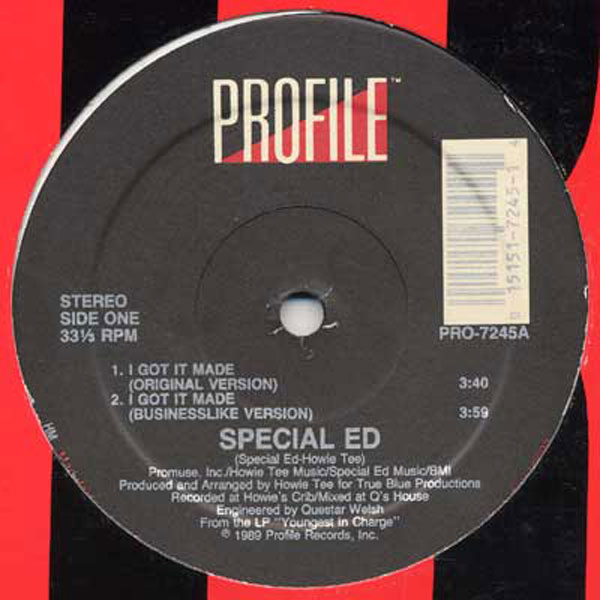
27 Days of Old School: #9 “I Got It Made” (by Special Ed)


Special_Ed_I_Got_It_Made

“I talk sense condensed into the form of a poem
Full of knowledge from my toes to the top of my dome”

It was 1989 and MTV was already something I was watching on a daily basis, but there was something missing from their daily music video rotation. They were criminally lacking with hip-hop videos. So, into the void was BET.

Where MTV was more about dance, pop and rock music videos, BET was all about R&B and hip-hop videos.

I will get all “grumpy old man” and say that I definitely enjoyed hip-hop the way it was during the 80’s and as late as the mid-90’s. For me things in that music scene just ended up becoming too commercialized. Not saying there’s no gems and gold in the trash I here now, but the hip-hop artists back in the my day were pure lyricists. Sure, their rhymes were still all about machismo and bragging about how they’re the best, but they had skill in doing so. I will put it up there that No. 9 on the 27 Days was one hell of a lyricist and he did so at the age of 16 (15 depending on when one thought the track was recorded).

I am talking about Special Ed and his hit track “I Got It Made”.

Song of the Day: I Against I (by Massive Attack feat. Mos Def)


Here I sit in my room watching on Encore HD a running of Guillermo Del Toro’s sequel to Blade. As awesome as this film was it was the soundtrack to Blade II that continues to impress. It’s from this soundtrack that I picked the latest “Song of the Day”. That choice happens to be the collaboration between electronica/trip-hop duo Massive Attack with hip-hop artist Mos Def.

“I Against I” is the latest song of the day and I consider the best song in the Blade II soundtrack which was all about electronica artists and band collaborating with hip-hop artists. This song occurs early in the film where Blade and his crew joined by a vampire kill-team called the Bloodpack does their slo-mo march towardsa a vampire underground club. It’s a scene that needs to be seen to be appreciated. The massive and clear bass beat by Massive Attack lends itself well to Mos Def’s smooth lyrical flow even as electronic melodies and beats accompanies the rest.

This song could be listened to in it’s instrumental version and it would sound very good. Mos Def could rap it’s lyrics accapella style and he would also sound good, but it’s when the two combines that the song becomes great. It’s one of a few reasons why I consider Blade II the best in the trilogy and why I continue to watch it whenever it comes on cable.

I Against I

I-ya,
I against I,
Flesh of my flesh,
And mind of my mind,
Two of a kind but one won’t survive,
My images reflect in the enemies eye,
And his images reflect in mine the same time,

I-ya, I-ya,
I against I,
Flesh of my flesh,
And mind of my mind,
Two of a kind but one won’t survive,

Right here is where the end gon’ start at,
Conflict, contact ‘n’ combat,
Fighters stand where the land is marked at,
Settle the dispute about who the livest,
3 word answer,
Whoever survive this,
Only one of us can ride forever,
So you and I cant ride together,
Can’t live or cant die together,
All we can do is collide together,
So I skillfully apply the pressure,
Won’t stop until I’m forever… One!

A door step where death never come,
Spread across time til my time never done,
And I’m never done,
Walk tall, why ever run?
When they move if I ever come?
Bad man never fret the war, tell’em come
General we have the stock, the mad fire burn

I-ya,
I against I,
Flesh of my flesh,
And mind of my mind,
Two of a kind but one won’t survive,
My images reflect in the enemies eye,
And his images reflect in mine the same time,

I-ya, I-ya,
I against I,
Flesh of my flesh,
And mind of my mind,
Two of a kind but one won’t survive,
Survive (x16)

Reign supreme in your U-N-I,
V-E-R-S-E with the sharpness,
Narrow row building no space for partners,
No space for drivers, no space for walkers,
No space regardless,
Your on my path then get off it,
Hardheaded and unresponsive,
Get they lives put on target with harshness,
Come with the canons sparkin’ they darken,
Who am i? One man squadron,
Ma stir the fire this time that’d snatch your tomorrow,
The thousand yard spear that’ll pierce through your armor,
You can get it on right now if you want to,
But when ya front 9 get marched through,
I warned you,
You know who forever belong to,

I-ya, I-ya
I against I,
Flesh of my flesh,
And mind of my mind,
Two of a kind but one won’t survive,
My images reflect in the enemies eye,
And his images reflect in mine the same time,

I-ya, I-ya,
I against I,
Flesh of my flesh,
And mind of my mind,
Two of a kind but one won’t survive,
My images reflect in the enemies eye,
And his images reflect in mine, survive
Survive (x16)