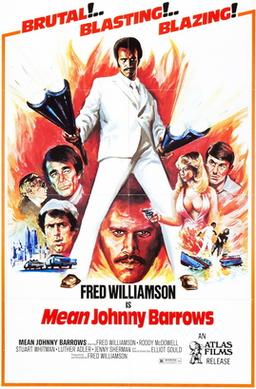
Film Review: Mean Johnny Barrows (dir by Fred Williamson)


“Dedicated to the veteran who traded his place on the front line for a place on the unemployment line. Peace is Hell.”

— the end credits of Mean Johnny Barrows (1976)

“He’s not that mean.”

— Me, while watch Mean Johnny Barrows

Who is Johnny Barrows?  As played by blaxploitation star Fred Williamson, Johnny Barrows is a former football great who later served in Vietnam and won several silver stars.  As a soldier, he killed an untold number of people but he is always quick to explain that he wouldn’t do the same thing as a civilian.  Even after the war ended, Johnny remained in the army, teaching new recruits.  He was good at his job but, one day, a racist officer decided to play a stupid trick on Johnny.  During a training exercise, that officer put a live landmine out on the training grounds.  After defusing the mine, Johnny promptly punched the officer.  The result?  A dishonorable discharge and the lesson that peace is Hell.

Johnny returns to Los Angeles and discovers that the country he fought for isn’t willing to fight for him.  Because of his dishonorable discharge, Johnny can’t find a good job.  Because he can’t find a job, he can’t afford a place to live.  Johnny stays on the streets.  His only friend is a self-described philosophy professor (Elliott Gould, in an amusing cameo) who teaches Johnny all about soup kitchens.

When Johnny steps into an Italian restaurant and asks for food, he is shocked to discover that the owner, Mario Racconi (Stuart Whitman), knows who he is.  Mario says that he played against Johnny in a high school football game.  (Perhaps Johnny’s shock is due to the fact that Mario appears to be at least ten years older than him.)  Mario gives Johnny something to eat and even offers him a job.  Realizing that the work is mob-related, Johnny says that he’s not interested.  He’s not going to break the law…

And here’s where we run into a problem with the film’s title.  The film is entitled Mean Johnny Barrows but, so far, he’s been almost painfully nice.  Then again, Mild Johnny Barrows doesn’t have much of a ring to it.

Anyway, Johnny does try to stay out of trouble.  He even manages to land a demeaning job cleaning the toilets at a gas station.  But his boss (R.G. Armstrong) is a real jerk and Johnny has his dignity, no matter how much the world wants to take it away from him.  Finally, Johnny agrees to work with the Racconi Family.  Not only does he become friends with Mario but he also falls for Mario’s girlfriend, Nancy (Jenny Sherman).

Unfortunately, not all Mafia families are as kind-hearted and generous as the Racconi Family.  The Da Vinci family wants to flood Los Angles with drugs.  It’s all the master plan of Tony Da Vinci (Roddy McDowall).  Tony is eager to prove himself to his father and what better way to do that than to smuggle heroin?  Tony also loves flowers because … well, why not?  Anyway, when the Racconis object to Tony’s scheme, a mob war erupts.  Nearly all of the Racconis are killed.  It looks like it’s time for Johnny Barrows to put on his white suit, pick up a gun, and get vengeance for his surrogate family.

There are some pretty obvious problems with Mean Johnny Barrows, not the least of which is the casting of Roddy McDowall — perhaps the least Italian actor in the history of cinema — as a ruthless mafioso.  After having starred in several successful blaxploitation films, Fred Williamson made his directorial debut with Mean Johnny Barrows.  Williamson’s inexperience as director shines through almost every minute of Mean Johnny Barrows.  Though he does well with the action scenes, there are other parts of the film where Williamson doesn’t even seem to be sure where he should point the camera.  With almost every role miscast, the performances are pretty inconsistent but Williamson gives a good performance (it’s obvious that he understood his strengths and weaknesses as an actor) and Elliott Gould is an entertaining oddity as the Professor.

If anything saves the film, it’s that Williamson’s anger at the way America treats its veterans feels sincere.  The heart of the film is in the first half, which details Johnny’s struggle to simply survive from one day to the next.  Even if Williamson’s direction is often shaky, the film’s rage is so authentic that you do get caught up in Johnny’s story.  The film ends on a properly down note, suggesting that, for men like Johnny Barrows, there is no hope to be found in America.

To quote the film’s theme song: Peace is Hell.

http://www.youtube.com/watch?v=54GPAQxTwo4

A Movie A Day #313: Lone Wolf McQuade (1983, directed by Steve Carver)


Chuck Norris is J.J. McQuade, Texas Ranger!

J.J. McQuade is a former Marine who keeps the peace in El Paso through a combination of karate and machine guns.  McQuade lives in a house in the desert, with only a wolf and refrigerator full of beer to provide companionship.  He prefers to work alone, even though his captain (R.G. Armstrong) insists that McQuade partner up with a rookie named Kayo Ramos (Robert Beltran).  Ramos is eager to prove himself but Lone Wolf McQuade has to work alone.  Otherwise, his nickname would not make any sense.

Things change when McQuade’s teenage daughter (Dana Kimmel) is put in the hospital by an arrogant and sleazy arms dealer named Rawley Wilkes (David Carradine).  McQuade is out for both justice and revenge and Ramos’s knowledge of how to turn on a computer proves to be helpful.  Also teaming up with McQuade: an FBI agent (Leon Isaac Kennedy), a retired Ranger named Dakota (L.Q. Jones), and Rawley’s former lover (Barbara Carrera), who now happens to be McQuade’s current lover.

The predictable storyline is not what makes Lone Wolf McQuade a classic. Instead, it’s that this movie features both Chuck Norris and David Carradine at the height of their abilities.    The whole film is directed like a grand western, with Norris and Carradine taking the roles that would usually go to Clint Eastwood and Lee Van Cleef.  The plot may be full of holes but when these two face off, none of that matters.  Neither Carradine nor Norris used stunt doubles for their fight scenes and it makes all the difference.

This was one of the first movies to feature Chuck Norris with the beard that’s become his trademark.  Wisely, Chuck doesn’t say much in the movie and leaves most of the heavy-duty acting to his co-stars.  (Though he may be an icon of cool, Chuck has never been anyone’s idea of a great actor.)  Carradine’s performance as Rawley feels like an early version of his best known role, Bill in Kill Bill.  L.Q. Jones and R.G. Armstrong both bring their own history as members of the Sam Peckinpah stock company to the film while Barbara Carrera livens up her part with a sultry spark.  Keep an eye out for both William Sanderson and Sharon Farrell in small roles.  Speaking of small roles, Daniel Frishman almost steals the entire damn movie as a rival arms dealer.

Though it wasn’t produced by Cannon, Lone Wolf McQuade is an essential for fans of Chuck Norris.

A Movie A Day #55: Where The Buffalo Roam (1980, directed by Art Linson)


where_the_buffalo_roam_ver3At his Colorado ranch, journalist Hunter S. Thompson (Bill Murray) is up against a deadline.  He has to finish his story about his friendship with the radical lawyer and activist, Carlo Lazlo (Peter Boyle).  Thompson flashes back to the time that he covered a trial in which Lazlo defended a group of young men charged with possession of marijuana.  When the men are sent to prison, Lazlo snaps and physically attacks the prosecutor.  Later, Lazlo resurfaces during the Super Bowl and tries to convince Thompson to join him in fighting a revolution in Latin America.  And finally, in 1972, Lazlo tracks Thompson down while Thompson is traveling with the Nixon campaign.

Bill Murray as the legendary gonzo journalist, Dr. Hunter S. Thompson?

It sounds like a great idea, it’s just too bad that the movie’s not any good.  Where The Buffalo Roam may be based on three of Thompson’s best known articles but it never feels gonzo.  It never comes close to capturing Thompson’s anarchistic spirit.  The real Thompson did drugs by the handful, was fascinated by guns, and always seemed to be on the verge of plunging into the abyss.  Where The Buffalo Roam’s Thompson is a mild prankster and an ironically detached hipster, the type who the real Dr. Thompson probably would have kicked out of a moving car.  As for Carlo Lazlo, the character is based on Oscar Zeta Acosta, the infamous “Samoan attorney” that Thompson renamed “Dr. Gonzo” in Fear and Loathing In Las Vegas.  The movie never figures out what to do with the character or Peter Boyle.

While preparing for the role, Bill Murray spent months hanging out with Thompson and, according to the book, Saturday Night: A Backstage History of Saturday Night Live by Doug Weingard and Jeff Hill, literally became Hunter Thompson for not only the duration of the filming but for several months afterward:

“In a classic case of the role overtaking the actor, Billy returned that fall to Saturday Night so immersed in playing Hunter Thompson he had virtually become Hunter Thompson, complete with long black cigarette holder, dark glasses, and nasty habits. ‘Billy,’ said one of the writers, echoing several others, ‘was not Bill Murray, he was Hunter Thompson. You couldn’t talk to him without talking to Hunter Thompson.'”

Neither Thompson nor Bill Murray were happy with Where The Buffalo Roam‘s neutered version of gonzo and the film is really for Murray completists only.  The closest that Hollywood had gotten to getting Thompson right remains Terry Gilliam’s adaptation of Fear and Loathing in Las Vegas.

A Movie A Day #8: White Lightning (1973, directed by Joseph Sargent)


white-lightning-02

A year after co-starring in Deliverance, Burt Reynolds and Ned Beatty reunited for another movie about life in the backwoods, White Lightning.

White Lightning starts with two hippies, bound and gagged and floating in a canoe.  While a banjo plays in the background, two rednecks use a shotgun to blow the canoe into pieces.  They watch as the hippies drown in the swamp.  It turns out that one of those hippies was the brother of legendary moonshiner and expert driver, Gator McCluskey (Reynolds).  Gator is doing time but when he hears that his brother has been murdered, he immediately realizes that he was probably killed on the orders of corrupt Sheriff J. C. Connors (Ned Beatty).  The Feds arrange for Gator to be released from prison, on the condition that he work undercover and bring them enough evidence that they can take Connors down.

Back home, Gator works with a fellow informant, Dude Watson (Matt Clark), teams up with local moonshiner, Roy Boone (Bo Hopkins), and has an affair with Roy’s girl, Lou (Jennifer Billingsley).   Connors and his main henchman, Big Bear (R.G. Armstrong) both suspect that Gator and Dude are working for the government.  Since this is a Burt Reynolds movie, it all ends with a car chase.

A classic of its kind and a huge box office success, White Lightning set the template for almost every other film that Burt Reynolds made in the 1970s and 80s.  There is not much to the movie beyond Burt’s good old boy charm and Ned Beatty’s blustering villainy but if you’re in the mood for car chases and Southern scenery, White Lightning might be the movie for you.   Joseph Sargent also directed the New York crime classic, The Taking of Pelham One Two Three, and he gives White Lightning an edginess that would be lacking from many of Burt Reynolds’s later movies.

For tomorrow’s movie a day, it’s the sequel to White Lightning (and Burt Reynolds’s directorial debut), Gator.

white-lightning-05

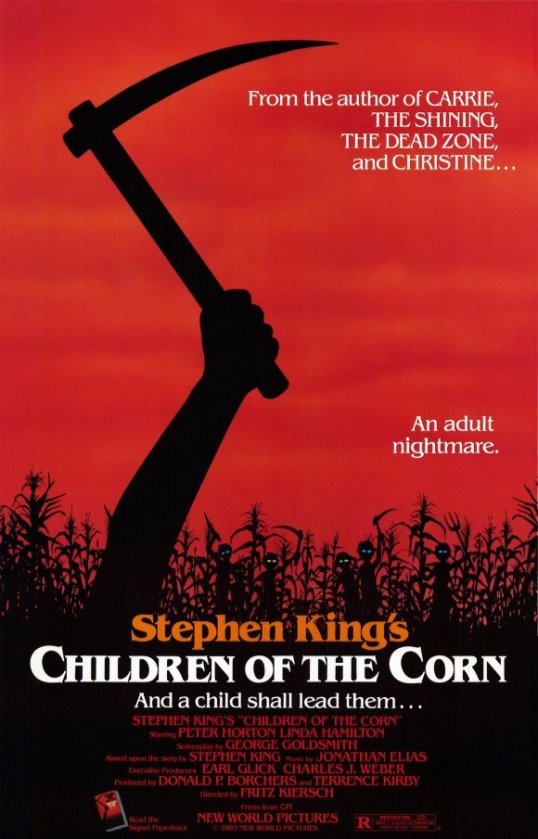
Horror on the Lens: Children of the Corn (dir by Fritz Kiersch)


ChildrenoftheCorn

Today’s horror on the lens is the 1984 film that TSL editor-in-chief Arleigh Sandoc has called the worst Stephen King adaptation of all time.  For the record, I tend to agree with that judgment but, for some reason, a lot of people seem to like Children of the Corn.

And I will admit — the kids are creepy.  Especially that little Isaac guy with the shrill voice.  Whenever Isaac starts screaming, “MALACHI!!!!,” — well, it’s like nails on a chalkboard, to be honest.

Anyway, in case you’d forgotten, this is the movie where all the little kids hang out in a cornfield and kill adults.  It attempts to say something about religion but I’m not sure what it’s trying to say.  It’s all kind of silly but, as I said, some people seem to like it.

(Personally, I prefer that old episode of South Park where they keep declaring shenanigans on the carnival, all the cows jump off a cliff, and the visiting yankee tourists end up getting devoured by rats in jail.)

In order to help you decide for yourself whether or not this is a decent film, here is Stephen King’s Children of the Corn!  Enjoy it while you can because you just know that YouTube is going to eventually yank it down for copyright reasons.

Thank You, Mr. Peckinpah: Ride the High Country (1962, directed by Sam Peckinpah)


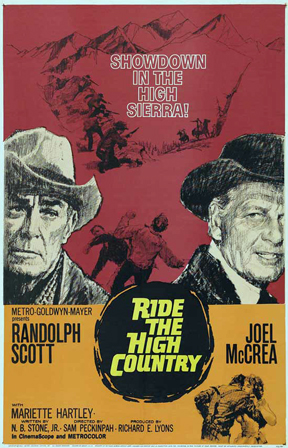
rideIt’s the turn of the 20th century and the Old West is fading into legend.  When they were younger, Steve Judd (Joel McCrea) and Gil Westrum (Randolph Scott) were tough and respect lawmen but now, time has passed them by.  Judd now provides security for shady mining companies while Gil performs at county fairs under the name The Oregon Kid.  When Judd is hired to guard a shipment of gold, he enlists his former partner, Gil, to help.  Gil brings along his current protegé, Heck Longtree (Ron Starr).
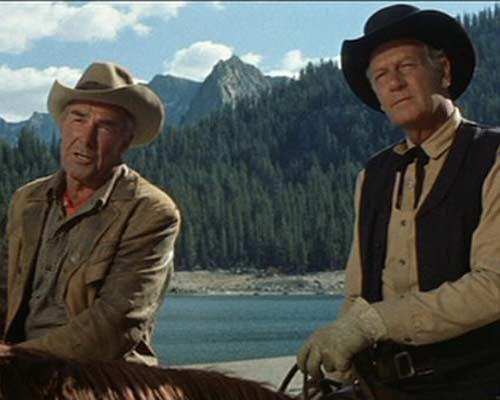
On their way to the mining camp, they spend the night at the farm of Joshua Knudsen (R.G. Armstrong) and his daughter, Elsa (Mariette Hartley).  Elsa is eager to escape her domineering father and flirts with Heck.  When they leave the next morning, Elsa accompanies them, planning on meeting her fiancée, Billy Hammond (James Drury), at the mining camp.

When they reach the camp, they meet Bill and his four brothers (John Anderson, L.Q. Jones, John Davis Chandler, and the great Warren Oates).  Billy is a drunk who is planning on “sharing” Elsa with his brothers.  Gil, Judd, and Heck rescue Elsa and prepare for a final confrontation with the Hammond Brothers.  At the same time, Gil and Heck are planning on stealing the gold, with or without Judd’s help.

Ride the High Country was actually Sam Peckinpah’s second film but it’s the first of his films to truly feel like a Sam Peckinpah film.  (For his first film, The Deadly Companions, Peckinpah was largely a director-for-hire and had no say over the script or the final edit.)  Peckinpah rewrote N.B. Stone’s original script and reportedly based the noble Steve Judd on his own father.  All of Peckinpah’s usual themes are present in Ride the High Country, with Judd and, eventually, Gil representing the dying nobility of the old west and the Hammond brothers and the greedy mining companies representing the coming of the “modern” age.  Ride The High Country‘s final shoot-out and bittersweet ending even serve as a template for Peckinpah’s later work in The Wild Bunch.

Much like the characters they were playing, Randolph Scott and Joel McCrea were two aging veterans on the verge of retirement.  For these two aging stars, who had starred in countless westerns before this one, Ride The High Country would provide both fitting farewell and moving tribute.  This would be the last chance that either of them would have to appear in a great movie and both of them obviously relish the opportunity.  The best moments in the film are the ones where Judd and Gil just talk with the majestic mountains of California in the background.

Among the supporting cast, Ron Starr and Mariette Hartley are well-cast as the young lovers but are never as compelling as Gil or Judd.  Future Peckinpah regulars R.G. Armstrong, L.Q. Jones, and Warren Oates all make early appearances.  Seven years after playing brothers in Ride the High Country, L.Q. Jones and Warren Oates would both appear in Peckinpah’s most celebrated film, The Wild Bunch.

The elegiac and beautifully-shot Ride The High Country was Sam Peckinpah’s first great film and it might be his best.

Randolph Scott and Joel McCrea in Ride The High Country

Randolph Scott and Joel McCrea in Ride The High Country

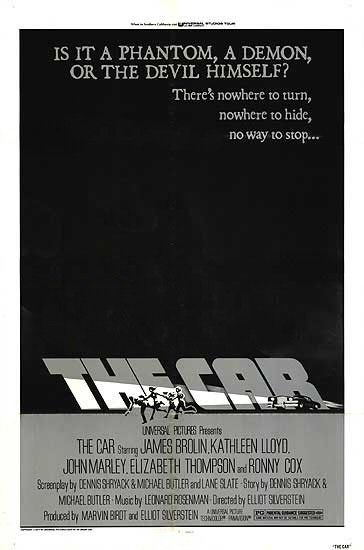
Horror Film Review: The Car (dir by Elliot Silverstein)


The_Car_movie_poster

“THE CAR IS IN THE GARAGE” 

— Captain Wade Parent (James Brolin) in The Car (1977)

Yes, that’s right!  The car is in the garage and it’s hunting for blood!

The Car is a pretty stupid movie that doesn’t really work but at least it’s enjoyably stupid.  From the minute I started watching this movie, I knew that the only way I could recommend it would be if James Brolin shouted, “The car is in the garage!” at some point.  When he did, I had to cheer a little.  I love being able to recommend a movie.

The Car takes place in the small desert town of Santa Ynez.  Nothing much ever seems to happen in Santa Ynez, which perhaps explains why the police force is so large.  (Why wouldn’t you want to be a police officer in a town with no crime?  It wouldn’t be a very demanding job.)  Sheriff Everett Peck (John Marley) keeps the peace and sends his time talking about how much he hates bullies.  Wade Parent (James Brolin) is his second-in-command and has a 70s pornstache.  Wade’s best friend is Deputy Luke Johnson (Ronny Cox), a recovering alcoholic with impressive sideburns.  And then there’s a few dozen other cops.  Seriously, this tiny town has a HUGE police force.

One day, however, the police finally get something to do.  A black Lincoln Continental has suddenly appeared, stalking the roads around the town.  It doesn’t have a licence plate and the windows are tinted a dark red so it’s impossible to see who — if anyone — is driving.  Stranger still, the car’s doors have no handles.  When the car does show up, it seems to appear out of nowhere and once it’s run someone over, it seems to vanish just as quickly.

When the car first appears, it runs down two cyclists.  A few hours later, it kills an obnoxious hippie hitchhiker (John Rubinstein).  The only witness was alcoholic wife beater Amos Clements (R.G. Armstrong).  When Amos goes to the police, the car tries to run him over as well but instead, it ends up killing Sheriff Peck.

Now, Wade is in charge and he has to do something about the car.  Unfortunately, Wade’s girlfriend, Lauren (Kathleen Lloyd), made the mistake of screaming insults at the car when the car attempted to run down the school marching band.  Now, the car is stalking her.  Meanwhile, Luke is convinced that the car is being driven by none other than devil.  Wade says that’s impossible.  Luke points out that the car refuses to drive through consecrated ground.

And eventually, the car does show up in the garage…

The Car is one of the stupider of the many Jaws ripoffs that I’ve seen.  You’ll be rooting for the car through the entire film, which is good since the car kills nearly everyone in Santa Ynez.  (If any of them were likable, The Car wouldn’t as much fun to watch.)  It’s dumb but the film does have an appropriately silly ending and James Brolin does get to yell, “The car is in the garage!”

So, there is that.

Horror on TV: Twilight Zone 3.16 “Nothing in the Dark”


TheTwilightZoneLogo

In this episode of The Twilight Zone, Gladys Cooper plays an elderly woman who lives in such fear of death that she refuses to even open the door of her apartment. Then, one day, a young policeman (Robert Redford) is shot outside of her apartment and Cooper is forced to finally confront the world.

This episode was directed by Lamont Johnson and written by George Clayton Johnson. It originally aired on January 5th, 1962.

Film Review: Race With The Devil (1975, directed by Jack Starrett)


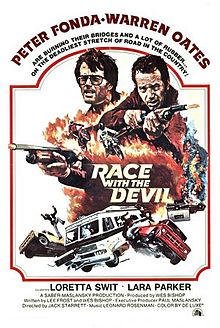
220px-RaceWithTheDevilWarren Oates and Peter Fonda versus …. SATAN!

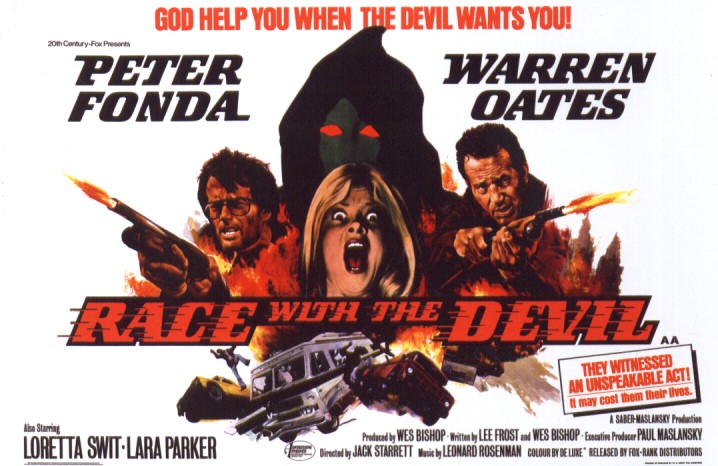
Roger (Peter Fonda) and Frank (Warren Oates) are lifelong friends and business partners who, along with their wives Kelly (Lara Parker) and Alice (Loretts Swit), are planning on taking the “best damn vacation we ever had.”  Traveling to Colorado in Frank’s RV, they decide to camp for a night next to a river.  Not only do Frank and Roger witness what appears to be a human sacrifice but they also have to run for their lives when they are spotted.  The local sheriff (R.G. Armstrong) tells them that they probably just saw a bunch of hippies killing an animal but Peter Fonda knows hippies and those were not hippies.  Taking some blood-stained dirt so it can be analyzed by the authorities, Roger and Frank try to drive on but find themselves being pursued by Satanists.

A relentless and entertaining B-movie, Race With The Devil is a hybrid of Rosemary’s Baby, Smokey and the Bandit, and Easy Rider, with some Parallax View-style paranoia mixed in as well.  Eventually, it seems as if everyone in rural Texas — from the sheriff to the gas station attendant to the residents of an RV park where our heroes try to spend the night — is a Satanist.  (Even a wrecked school bus turns out to just be an excuse to get the RV to slow down so the Satanic rednecks can attack, leading to Warren Oates’s classic line, “I don’t believe in a school bus on Sunday.”)

A big part of the fun of Race With The Devil is getting to watch Peter Fonda and Warren Oates acting opposite each other.  (A lot of drive-in patrons probably left Race With The Devil with a crush on the lovely Lara Parker as well.)  Friends both on and off-screen (Oates previously co-starred in Fonda’s directorial debut, The Hired Hand), Fonda and Oates are a lot of fun to watch playing off of each other in Race With The Devil, with Warren Oates’s natural intensity providing a good contrast to Fonda’s laid back style.

It may not rank up there with the movies that he appeared in for Sam Peckinpah and Monte Hellman but Race With The Devil is still one of Warren Oates’s most entertaining films.

race-with-the-devil-1

Lisa Goes Back To College: Jocks (dir by Steve Carver)


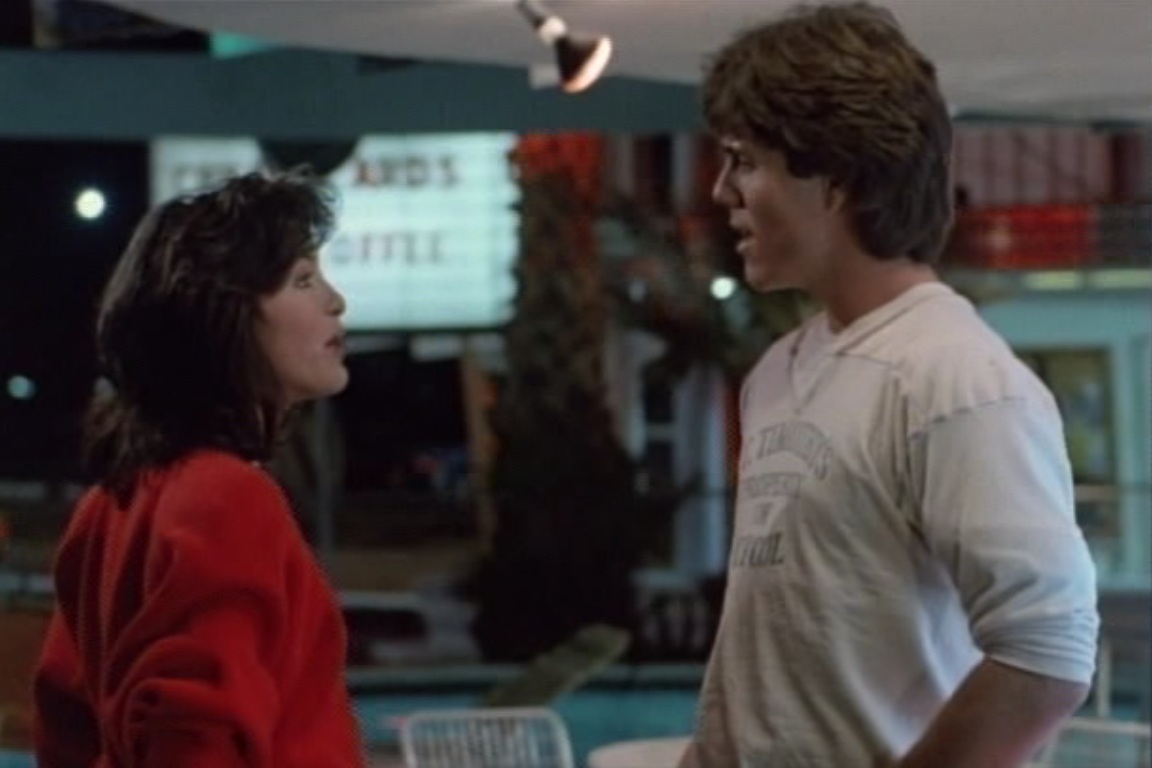
A typically exciting scene from Jocks

A typically exciting scene from Jocks

Having already watched 3 campus protests from 1970, I decided that maybe I should watch something a little bit less heavy-handed for my next college film.  But I knew that, in order to find a college film that would have nothing serious on its mind, I would have to find a film that was made after the 70s.

That’s what led to me getting out my Too Cool For School DVD boxset and watching Jocks, a “comedy” from 1987.  As you can probably guess from the sarcastic use of quotation marks, I probably would have been better off staying in the 70s.

Christopher Lee (!) plays the President White, the strict president of L.A. College.  President White is upset because the athletic department has failed to win a championship in over ten years so he gives Coach Bettlebom (played by veteran character actor R. G. Armstrong) an ultimatum: win a championship or lose his job.  Bettlebom argues that the rest of the athletic department would be able to win if it wasn’t for the financial obligation of supporting the school’s tennis team.  Bettlebom then tells tennis Coach Williams (played by Shaft himself, Richard Roundtree) that he’s canceling the tennis program and all of the tennis players are going to lose their scholarships.  Williams responds by making a bet.  If the tennis team wins the national championship, the tennis program will continue.  And if they don’t, the team will cease to exist, Williams will be out of a job, and the members of the tennis team will all be forced to drop out of college and have their lives totally ruined…

Wait a minute.

That makes absolutely no sense.

What the Hell is Coach Williams thinking!?

That’s the sort of thinking that leads students to protest and occupy buildings and basically act like they’re extras in Getting Straight, Zabriskie Point, and R.P.M.

But anyway, let’s just move on and not worry about things like logic and narrative sense.  It’s time to meet the tennis team!

There’s Tex (Adam Mills), who doesn’t have a Texas accent.  Tex doesn’t really do much but he’s certainly in a lot of scenes.

There’s Andy (Stoney Jackson), the flamboyant black guy who freaks out his opponents by pretending to be gay, because this film was made in the 20th Century.

There’s Chito (Trinidad Silva), who speaks Spanish and dramatically crosses himself before playing each set.

There’s Ripper (Donald Gibb), who has a thick beard, growls a lot, and appears to be in his 40s.

There’s Jeff (Perry Lang), the nice guy.  In a film full of unlikable characters, Jeff seems to be, at the very least, a decent guy.  Plus, he has a fairly funny drunk scene and, when you’re watching a film like Jocks, you come to appreciate fairly funny.

And then there’s The Kid (Scott Strader), who apparently doesn’t have a name.  Seriously, even President White calls him “The Kid.”  As you might guess about someone with a permanent nickname, The Kid is a master tennis player.

Anyway, the team goes to the championships in Las Vegas where they engage in the usual drunken hijinks and basically act like a bunch of jerks.  They also play some rather boring tennis games.  The Kid falls for a tennis groupie played by future Law & Order: SVU star Mariska Hargitay.  Eventually, it all comes down to whether or not the team can beat Dallas Tech and, as a proud Texas girl, I’m not ashamed to admit that I was saying, “Go Dallas!” the entire time.

So, is Jocks worth watching?

If you’re a Christopher Lee fan, maybe.  But, honestly, I think Sir Christopher would forgive you if you skipped this one.

But if you really want to, check out Jocks below!