Retro Television Review: Fantasy Island 7.14 “Lady of the house/Mrs. Brandell’s Favorites”


Welcome to Retro Television Reviews, a feature where we review some of our favorite and least favorite shows of the past!  On Tuesdays, I will be reviewing the original Fantasy Island, which ran on ABC from 1977 to 1984.  The show is once again on Tubi!

Justice for Tattoo!

Episode 7.14 “Lady of the House/Mrs. Brandell’s Favorites”

(Dir by Bob Sweeney, originally aired on February 25th, 1984)

This was one of the Fantasy Island episode that was not on my DVR.  However, now that the show is once again streaming in its entirety on Tubi, I was still able to watch it. Lucky me.

This is probably the worst episode of Fantasy Island that I’ve ever seen.

This episode gets off to a bad start with Mr. Roarke informing Lawrence that there will only be one guest with a fantasy this week.  That guest is Esther Brandell (Polly Bergen).  Whenever there’s only one guest and that guest is played by a middle-aged actress who was big in the 50s and the 60s, you know you’re about to spend an hour watching an hour of awkward melodrama that you’re supposed to excuse by saying, “She was great in Kisses For My President!”

Mrs. Brandell says that she’s a former sorority house mother who wants her three favorite sorority girls to be her bridesmaids at her wedding.  Actually, Mrs. Brandell was a former madam and the three “sorority girls” all worked for her.  Bebe (Lauren Tewes), Coleen (Randi Oakes), and Lynn (Shelley Smith) have all moved on and want to keep their past a secret.  Over the course of the episode, each will admit the truth to their current partner and each will realize that Mrs. Brandell really did protect and care about them.

This episode basically features the same scene over and over again.  Each of the girls works up the courage (or the anger) to admit that they were once a prostitute.  Their significant other reacts.  One guy tries to blackmail Mrs. Brandell.  Another reveals that he knew all along because “I’m an investigative reporter.”  Bebe’s idiot boyfriend (Dick Gautier) refuses to believe Bebe and insists that she sleep with another man for money so that he’ll be convinced.  What?  Bebe realizes that’s not her lifestyle anymore and she really does love her idiot boyfriend, the same one who pimped her out to some random guy on the Island.

And, through the whole thing, Polly Bergen delivers her lines in a voice that sounds like she just finished smoking a pack of cigarettes.  The truth of the matter is that Bergen is absolutely lousy in the role but the script is probably as much to blame as Bergen herself.  Every scene feels like it’s been cribbed from an old Barbra Stanwyck melodrama.  At the end of the episode, the vice cop (Robert Brown) who used to bust her shows up at the wedding.  “Everybody freeze!” he says.  Oh, thank God, everyone’s getting busted for overacting.  Oh wait — Mrs. Brandell (a widow) is marrying him!

The episode ends with the wedding, which would be touching if any of these characters were actually interesting.  Lawrence gives away the bride because I guess they had do something to justify paying Christopher Hewett’s salary.

This was not a good trip to the Island.  Is this season over yet?

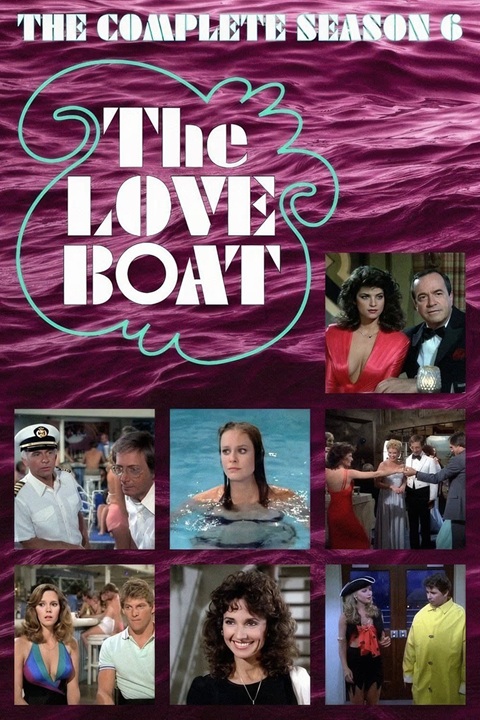
Retro Television Review: The Love Boat 6.7 and 6.8 “The Spoonmaker Diamond/Papa Doc/The Role Model/Julie’s Tycoon”


Welcome to Retro Television Reviews, a feature where we review some of our favorite and least favorite shows of the past!  On Wednesdays, I will be reviewing the original Love Boat, which aired on ABC from 1977 to 1986!  The series can be streamed on Paramount Plus!

Come aboard, we’re expecting you….

Episodes 6.7 and 6.8 “The Spoonmaker Diamond/Papa Doc/The Role Model/Julie’s Tycoon”

(Dir by Robert Scheerer, originally aired on November 13th, 1982)

The Love Boat is going to Greece and Turkey!

Well, actually, it’s the Love Boat crew that is going to Greece and Turkey.  They’ve been asked to temporarily take over another ship and, of course, Captain Stubing said yes.  This is one of those two-hour Love Boat episodes where the action was actually shot on location and on a real cruise ship.  As such, it’s more of a travelogue that anything.  We get to see the sights of both Greece and Turkey and no one makes any jokes about Midnight Express.

The majority of the storylines revolve around the Spoonmaker Diamond, a very valuable diamond that has been stolen by someone on the ship.  Was the diamond stolen by Emmett and Ellen Stokes (Harvey Korman and Nancy Dussault)?  Was the diamond stolen by Mark Hayward (Mike Connors)?  That’s what Inspector Sadu (Jamie Farr) is trying to figure out!  Of course, regardless of who stole it, it ultimately ends up in the unknowing possession of travel agent Dana Pierce (Polly Bergen).  Will Mark steal the diamond or will he fall in love with Dana?  Why can’t he do both?  This was an odd story because you had the goofiness of Harvey Korman and Jamie Farr and then you had the grouchy intensity of Mike Connors.  Connors seemed to be under the impression that he was appearing on a hard-boiled crime show as opposed to an enjoyably silly comedy about a cruise ship.

Meanwhile, Sabrina Drake (Jan Smithers) is a young heiress who is traveling with her mother, Amanda (Alexis Smith).  Amanda is not happy when she sees that tabloid reporter Joe Novak (Kiel Martin) is also on the cruise.  She’ll probably be even less happy when she discovers that Amanda is 1) secretly seeing Joe and 2) is pregnant.  When Doc finds out that Sabrina is pregnant, he offers to marry her.  Why not?  He’s known her for two days and he’s in love.  Fortunately, Joe talks to Amanda and wins Amanda’s blessing for his relationship with Sabrina.  Doc remains single.

Speaking of marriage, Greek tycoon Gregori Pananopolis (Lorenzo Lamas) asks Julie to marry him.  Julie is stunned and says she needs some time to think it over.  She tells Captain Stubing that she’s not sure if she’s ready to get married.  Uhmm …. Julie, this like the third or fourth guy who had asked you to marry him on this show.  You’ve nearly gotten married twice.  It’s odd how the show always acts as if marriage proposals aren’t a recurring theme when it comes to Julie.  Fortunately, Julie stays single because we all know she’s destined to eventually marry Doc.  Or Gopher, maybe.

Fashion photographer Cliff Jacobs (David Hedison) runs into his ex-wife, model Monica Brandon (Linda Evans).  He lies about having landed a job with a magazine in order to get her to pose for him.  He also takes some pictures of Vicki posing amongst the ruins of Greece.  Later, a magazine contacts him and offers to make Vicki into a star but he and Monica decide not to tell Vicki because they don’t want her to have to deal with pressure of being a model.  Hey Cliff and Monica, that’s really not your decision to make.  I’m sure being a model would be no less detrimental to Vicki than spending her entire youth on a cruise ship with people who are several decades older than her.

As I said at the start of the review, this episode worked best as a travelogue.  None of the stories were particularly intriguing but the scenery was lovely.  Even Turkey looked like a nice place to visit!

Retro Television Reviews: Death Cruise (dir by Ralph Senesky)


Welcome to Retro Television Reviews, a feature where we review some of our favorite and least favorite shows of the past!  On Sundays, I will be reviewing the made-for-television movies that used to be a primetime mainstay.  Today’s film is 1977’s Death Cruise!  It  can be viewed on Tubi and YouTube.

The thing with the Love Boat is that it promises something for everyone.  It’s a place where you set a course for adventure and put your mind on a new romance.

The same cannot be said of the Death Cruise.

Death Cruise opens with three couples winning an all-expenses paid trip on a luxury liner.  None of the couples are in a happy marriage.  Sylvia Carter (Polly Bergen) is tired of her husband, Jerry (Richard Long), and his philandering ways.  Elizabeth Mason (Celeste Holm) is frustrated with David Mason (Tom Bosley) and his loud dinner jackets.  Mary Frances Radney (Kate Jackson) is fed up with James (Edward Albert) and his smug refusal to start a family.  Of course, it’s not just martial problems that connects these passengers.  It’s also the fact that someone on the boat is stalking and killing them, one-by-one.  Can Dr. Burke (Michael Constantine) and Captain Vettori (Cesare Danova) track down the killer before it’s too late?

Death Cruise is an enjoyably twisty little murder mystery.  It aired in 1974, a good two years before the first Love Boat pilot film appeared on television.  However, both Death Cruise and The Love Boat were produced by Aaron Spelling so the two productions definitely have a shared DNA.  The Love Boat is basically Death Cruise with the addition of a laugh track and considerably less murder.  That said, I have my doubts as to whether Doc Bricker would have been as effective a detective as Dr. Burke.

One of the most interesting things about Death Cruise is how little anyone on the boat really seems to care about the fact that the passengers are turning up dead.  In fact, one widower is asking a widow to be his date to dinner within a few hours of the deaths of their spouses.  Of course, the murderer makes sure that dinner date is canceled but it’s still hard not to wonder whatever happened to an appropriate time of grieving.  Then again, I guess if you’re on a boat for a weekend, you just do whatever feels right at the moment.

(And certainly, if they were on The Love Boat, the walking HR nightmares that was Doc Bricker wouldn’t have wasted any time asking the widows to come by his office for a examination.)

Of the victims and suspects, Richard Long and Edward Albert are memorably sleazy while Tom Bosley plays up just how annoyed he is with the whole situation.  Michael Constantine is a good detective and the movie’s final twist is nicely executed.  Personally, when it comes to cruises, I will always prefer the safety and romance of The Love Boat but Death Cruise was an entertaining nautical diversion.

Retro Television Reviews: The Love Boat 1.8 “Lost and Found / The Understudy / Married Singles”


Welcome to Retro Television Reviews, a feature where we review some of our favorite and least favorite shows of the past!  On Wednesdays, I will be reviewing the original Love Boat, which aired on ABC from 1977 to 1986!  The series can be streamed on Paramount Plus!

Love exciting and new….

Come aboard!  We’re expecting you!

Episode 1.8 “Lost and Found / The Understudy / Married Singles”

(Directed by Stuart Margolin, originally aired on November 19th, 1977)

This week’s cruise is all about secrets and lies.

For instance, Durwood Moss (Steve Allen) and Maisie Nolan (Polly Bergen) are currently separated and their therapist has suggested that they try taking separate vacations.  Maisie books a cabin on the cruise so Durwood books the cabin next door.  As Durwood explains it, being in separate cabins counts as being on separate vacations.  Not letting anyone know that they’re married (albeit unhappily so), Durwood pursues Barbie (Loni Anderson) and Maisie flirts with Jack (Joshua Plymouth).  Of course, Durwood and Maisie end up realizing that they’re still in love.  Fortunately, Jack and Barbie also fall in love with each other!

Meanwhile, 8 year-old Theodore Denison, Jr. (James Bond III) lies and says that he has his parents’ permission to be on the cruise by himself.  Of course, it turns out that he’s actually a runaway.  On the cruise, he meets Sharon and Richard Baker (Sandy Duncan and Jim Stafford), a married couple that is struggling to come to terms with the death of their son.  Sharon wants to adopt Theodore and Theodore wants to be adopted.  But then Theodore’s real parents show up and apologize for the fight that caused Theodore to run away in the first place.  Still, Sharon and Richard at least find the courage to try to move on from their tragedy.

Finally, Connie Evans (Jo Ann Harris) is an assistant cruise director who has been assigned to the ship.  Julie (Lauren Tewes) is supposed to be training Connie but it soon becomes clear that, in typical All About Eve fashion, Connie is plotting to steal Julie’s job.  Connie’s plan is … well, it’s interesting.  She continually screws up the simplest of duties and then claims that she was only doing what Julie trained her to do.  When she shows up for dinner in a skimpy outfit, she claims that it’s what Julie told her to wear.  I guess the plan is to make Julie look like she’s bad at training people but just because someone isn’t good at training, that doesn’t mean that they’re bad at their overall job.  In fact, it would seem that most people would look at Connie’s actions and say, “You should have had enough common sense to know better, even if that’s what Julie told you.”  Anyway, it all works out, albeit somewhat bizarrely.  The captain reprimands Connie.  The crew hates Connie and goes out of its way to humiliate her.  And yet, even after it become obvious that Connie has been trying to get her fired, Julie agrees to help Connie because she thinks Connie has the makings of being a great cruise director.  Just how painfully nice is Julie?

This was not a bad episode.  The stuff with Durwood and Maisie was a bit dull but the other two storylines worked.  Sandy Duncan brought a lot of emotional sincerity to her plotline and Jo Ann Harris was hilariously conniving in the role of Connie.  This episode was a cruise that I enjoyed.

Will I also enjoy the next cruise?  Find out next week!

A Herman Wouk Double Feature: The Winds of War (1983, directed by Dan Curtis) and War and Remembrance (1988, directed by Dan Curtis)


When the great American novelist Herman Wouk passed away earlier this month at the age of 103, he left behind a rich and varied literary legacy.  From 1947, the year that his first novel was published to 2016, the year that he published his memoirs, Wouk wrote about religion, history, science, and even the movies.  However, Wouk will probably always be best remembered for the three novels that he wrote about World War II.

Based on his own Naval service during World War II, The Caine Mutiny was published in 1951 and was later adapted into both a successful stage play and an Oscar-nominated film.  It also won Wouk a Pulitzer Prize and established him as a major American writer.  Nearly 20 years later, Wouk would return to the history of the Second World War with two of his greatest literary works, The Winds of War and War and Remembrance.  (Originally, Wouk was only planning on writing one book about the entire war but when it took him nearly a thousand pages to reach Pearl Harbor, he decided to split the story in two.)  Beginning in 1939 and proceeding all the way through to the end of the war, the two books followed two families, the Henrys and the Jastrows, as they watched the world descend into war. Along the way, the book’s fictional characters rub shoulders with historical characters like Hitler, Churchill, FDR, and even Stalin.  Carefully researched and meticulously detailed, the books were both critically acclaimed and popular with readers and, despite some soapy elements, they both hold up well today.

Given their success, it’s not a surprise that both The Winds of War and War and Remembrance were adapted for television.  Today, HBO would probably give the books the Game of Thrones treatment, with 8 seasons of war, tragedy, romance, and Emmys.  However, this was the 1980s.  This was the age of of the big-budget, all-star cast network miniseries.  Wouk’s epic history of World War II was coming to prime time.
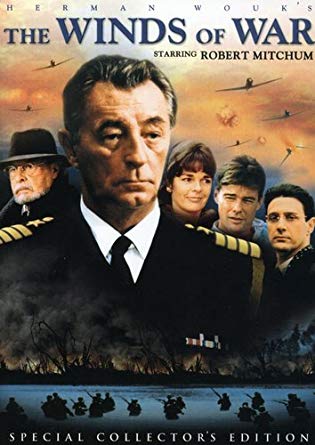
With a total running times of 15 hours, The Winds of War originally aired over seven evenings in 1983.  Produced and directed for ABC by Dan Curtis, The Winds of War had a 962-page script, a 200-day shooting schedule, 285 speaking parts, and a then-record budget of $35,000,000.  It also had Robert Mitchum, starring as Victor “Pug” Henry, an ambitious naval officer who somehow always managed to be in the right place to witness almost all of the events leading up to America’s entry into World War II.  Jan-Michael Vincent played Pug’s son, Byron, while John Houseman took on the pivotal role Aaron Jastrow, a Jewish scholar though whose eyes the home audience would witness the rise of fascism in Europe.  Terribly miscast as Natalie, Aaron’s niece and Byron’s lover, was 44 year-old Ali MacGraw.  Among those playing historical figures were Ralph Bellamy as FDR, Howard Lang as Churchill, and Gunter Meisner as Hitler.

I recently watched The Winds of War on DVD and, despite some glaring flaws that I’ll get to later, it holds up well as both a history of World War II and a tribute to those who battled Hitler’s evil.  Like Wouk’s novels, the miniseries does a good job of breaking down not only how Hitler came to power but also why the rest of the world was often in denial about what was happening.  Watching the entire miniseries in one setting can be overwhelming.  It’s a big production and it is also unmistakably a product of a time when the major networks didn’t have to worry about competition from cable.  It takes its time but, in the end, you’re glad that it did.  All of the little details can get exhausting but they’re important to understanding just how Hitler was able to catch the world off-guard.
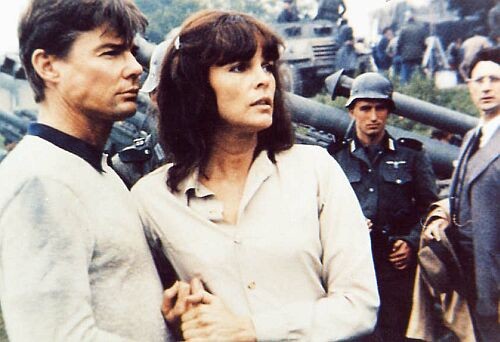
Jan-Michael Vincent and Ali MacGraw in The Winds of War

The miniseries does suffer due to the miscasting of some key roles.  Both Jan-Michael Vincent and Ali MacGraw were far too old for their roles.  Vincent was 38 and MacGraw was 44 when they were cast as naive and idealistic lovers trying to find themselves in Europe.  It’s perhaps less of a problem for Vincent, who had yet to lose his looks to alcoholism and who looked enough like Robert Mitchum that he could pass as Mitchum’s son.  But MacGraw is simply terrible in her role, flatly delivering her lines and looking more like Vincent’s mother than his lover.  It’s particularly jarring when she mockingly calls diplomat Leslie Sloat “Old Sloat,” because Sloat was played by David Dukes, who was six years younger than MacGraw.
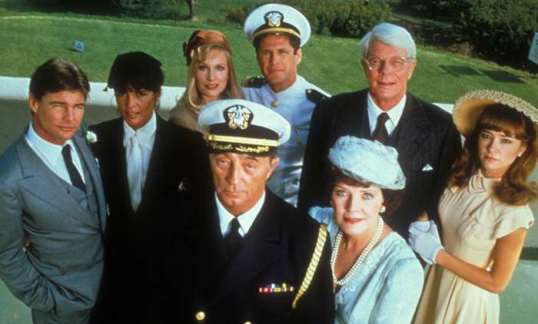
67 year-old Robert Mitchum was also much too old to play an ambitious junior officer, one whose main goal in life is still to ultimately become an admiral.  When he ends up having an affair with a younger British journalist played by 30ish Victoria Tennant, the difference in their ages is even more pronounced than in Wouk’s novel.  (Pug was in his 40s in The Winds of War.)  However, Mitchum overcomes his miscasting by virtue of his natural gravitas.  With his weary presence and authoritative voice, Mitchum simply is Pug.
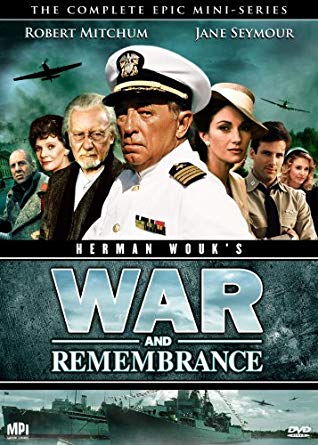
A ratings hit and a multiple Emmy nominee, The Winds of War was followed up five years later by War and Remembrance.  Like its predecessor, War and Remembrance set records.  The script ran 1,492 pages and featured 356 speaking parts.  The production employed 44,000 extras and filming took nearly two years, from January of 1986 to September of 1987.  With a budget of $104 million, it was the most expensive television production to date.  The final miniseries had a 30-hour running time, which was divided over 12 nights.  War and Remembrance not only made history because of its cost and length but also as the first major production to be allowed to film on location at the Auschwitz concentration camp.  For many members of the generation born after the end of World War II, War and Remembrance would serve as their first introduction to the horrors of the Holocaust.

Director Dan Curtis returned and with him came Robert Mitchum, now in his 70s and still playing a junior naval officer.  David Dukes once again played the hapless diplomat, Leslie Sloat.  Ralph Bellamy also returned as FDR as did Victoria Tennant as Mitchum’s lover, Polly Bergen as Mitchum’s wife, and Peter Graves as Bergen’s lover.  However, they were the exception.  The majority of the original cast was replaced for the sequel, in most cases for the better.  With John Houseman too ill to reprise his role, John Gielgud took over the role of Aaron Jastrow while Hart Bochner replaced the famously troubled Jan-Michael Vincent.  Robert Hardy took over the role of Churchill while Hitler was recast with Steven Berkoff.  Best of all, Jane Seymour replaced Ali MacGraw in the role of Natalie and gave the best performance of her career.  Other characters were played by a mix of up-and-comers to tv veterans, with the cast eventually including everyone from Barry Bostwick and Sharon Stone to E.G. Marshall and Ian McShane.
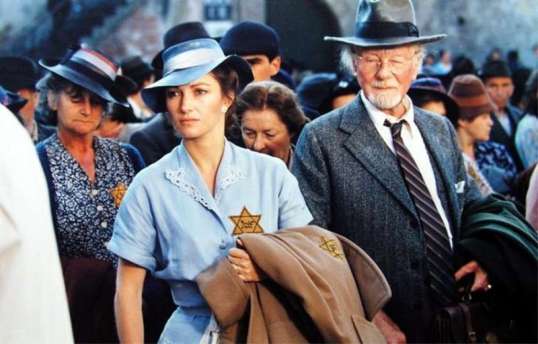
Jane Seymour and John Gielgud

With a stronger cast and (ironically, considering the running length) a more focused storyline, War and Remembrance is superior to The Winds of War in every way.  That doesn’t mean that it’s perfect, of course.  The scenes featuring Barry Bostwick as a submarine commander feel as if they go on forever and Robert Mitchum still seems like he should be preparing for retirement instead of angling for a promotion.  But none of that matters when the miniseries focuses on Aaron and Natalie Jastrow and their struggle to survive life in the Theresienstadt Ghetto and eventually Auschwitz.  At the time that War and Remembrance was initially broadcast, the concentration camp scenes were considered to be highly controversial and many viewers complained that they were so disturbing that they should not have been aired during prime time.  (This was four years before Schindler’s List.)  Seen today, those scenes are the most important part of the film.  Not only do they show why the war had to be fought but they also demand that the world never allow such a thing to happen again.

Though it was considered by a rating disappointment when compared to its predecessor, War and Remembrance was still a multiple-Emmy nominee.  Controversially, it defeated Lonesome Dove for Best Miniseries.  Both Winds of War and War and Remembrance have been released on DVD and, like the books that inspired them, they both hold up well.  They pay tribute to not only those who fought the Nazis but also to the humanistic vision of Herman Wouk.
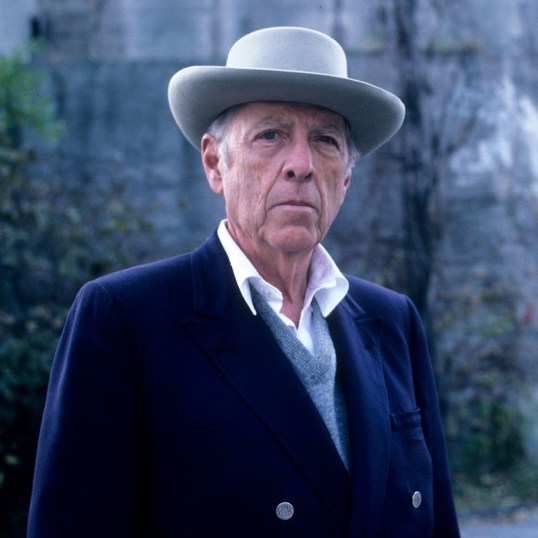
Herman Wouk (1915-2019)
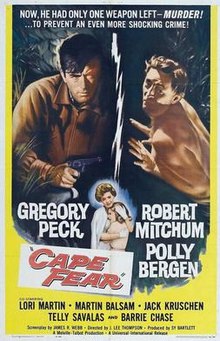
Horror Film Review: Cape Fear (dir by J. Lee Thompson)


There are two versions of Cape Fear out there.

The one that most people seem to know and which regularly shows up on cable is the 1991 version.  This version was directed by Martin Scorsese and features Oscar-nominated performances from Robert De Niro and Juliette Lewis.  This is the version that has De Niro speaking in a broad Southern accent and attacking people while speaking in tongues.  If you’ve ever watched a rerun of an old sitcom and wondered why the laugh track was going wild at the sight of a tattooed prisoner lifting weights in a cell while portentous music boomed in the background, it’s because you were watching a parody of Scorsese’s Cape Fear.

That, however, is not the first version of Cape Fear.

The first version of Cape Fear came out in 1962.  It was a black-and-white film that was directed by J. Lee Thompson.  In this version, the recently released rapist, Max Cady, is played by Robert Mitchum.  Sam Bowden, the attorney that Cady blames for his incarceration, is played by Gregory Peck.  Whereas the Scorsese version was highly stylized, the original Cape Fear is brutally straight forward.  (While Scorsese’s Cape Fear goes on for over two hours, the original Cape Fear tells its story in a brisk 100 minutes.)  While I think that Scorsese’s Cape Fear has its strong points, the original Cape Fear is superior in almost every way.

The original is certainly far more frightening than the remake.  What the original may lack in stylization, it makes up for in plausibility.  It’s scary because you can imagine everything in the film actually happening.  Robert Mitchum and Gregory Peck may both be iconic film stars but they’re also believable as human beings.

For modern audiences, it’s easy to smirk at Peck with his upright image and his sonorous voice but what made Peck a great actor was his ability to make it all seem natural.  Peck never seemed like he was acting like an honest man who always tried to do the right thing.  Instead, he simply was that man.  It’s perhaps significant that Peck played Sam Bowden the same year that he played another honest lawyer, Atticus Finch, in To Kill A Mockingbird.  The only real difference between them is that, whereas Atticus was always confident and sure of himself, Sam is frequently helpless.  He knows that Max is stalking him and his family and he’s just as aware that there’s nothing he can do about it.  When Max rapes a woman (Barrie Chase) that he meets at a bar, she refuses to testify against him.  When Sam’s dog turns up dead, everyone knows that Max killed him but there’s no way to prove it.  When Sam hires three men to intimidate Max, Max beats them up and promptly tries to get Sam disbarred.  When Sam finally resorts to plotting Max’s murder, we’re seeing Atticus Finch pushed beyond his limit.

As for Robert Mitchum, his animalistic performance is frightening precisely because it feels very real.  Everyone has known a Max Cady, even if they didn’t realize it at the time.  Max gives a fiercely physical performance, often appearing shirtless and strutting through his scenes with a sexual arrogance that’s both frightening and, at times, far more tempting than anyone would want to admit.  The scenes in which Max attacks Barrie Chase and Polly Bergen (who plays Peck’s wife) are absolutely terrifying but, for me, the most disturbing moments in Cape Fear are the moments when Max is silent.  Even when he’s not speaking, Mitchum allows you to see every depraved thought going through is head.

What’s the scariest moment for me?  When the camera catches Max watching Sam’s teenage daughter (Lori Martin).  It’s not just that I know what’s going on in Mitchum’s mind as he stares at her.  It’s because I know what it’s like to be watched.  It’s a scene that’s unsettling because it makes me consider just how many Max Cadys are out there right now.

The battle between Max and Sam is a fascinating one.  In prison, Max studied enough law to become as knowledgeable about how to manipulate it as Sam.  Under pressure, Sam grows more violent and more willing to circumvent his oath to uphold the same law that Max is now using against him.  It makes for a frightening  film, one that will stick with you long after you watch it.

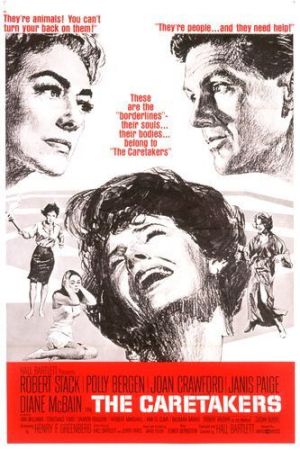
Embracing the Melodrama Part II #27: The Caretakers (dir by Hall Bartlett)


The_Caretakers_(1963_movie_poster)Whenever I go to Half-Price Books, I always seem to end up spending most of my time browsing the “nostalgia” section.  This is where they keep all of the old paperbacks that were published long before I was born.  This is where you can find old romance novels, “for adults only” novels, detective novels, and occasionally you’ll even find mainstream novels that were apparently considered to be quite daring when they were originally released.  These novels usually carry cover blurbs that brag about how controversial they are and how they deal with the “real issues of today.”

Usually, these novels are pretty silly and over-the-top which is why I always seem to end up buying a lot of them.  About a year ago, I bought a novel from 1959.  It was by Dariel Telfer and it was called The Caretakers.  The cover features a naked woman standing in front of several nurses and doctors.  The cover blurb announces that The Caretakers is “A shattering novel about nurses, doctors, and patients in a state hospital where emotions readily explode!”  The back cover features a pull quote from Time: “Will shock as well as arouse compassion.”

Now, I have to admit that I have yet to get around to actually reading The Caretakers.  However, thanks to TCM, I recently saw the 1963 film version and it’s a film that definitely embraces the melodrama.

How melodramatic is The Caretakers?  It’s melodramatic enough that it opens with Lorna Medford (Polly Bergen) stumbling into a movie theater and having a nervous breakdown.  Since this film was made in 1963, her mental breakdown is represented by spinning the camera around and getting hyperactive with the zoom lens, all while Bergen shrieks and tears at her hair.

Lorna is sent to a mental hospital, where she meets several other patients and is treated by Dr. MacLeod (Robert Stack), who is a rebel.  We know that he’s a rebel because everyone else at the hospital keeps telling him that he’s a rebel and complaining about his use of radical use of group therapy.  Under Dr. MacLeod’s guidance, Lorna reveals that she hasn’t gotten over the tragic death of her child.

As the film progresses, Lorna gets to know the rest of the patients.  They’re a mixed bunch, all played by actresses who clearly saw this as their chance to pick up an Oscar for Best Supporting Actress and were determined to make as big an impression as possible.  For instance, Barbara Barrie plays Edna, who never speaks but who does enjoy setting fires and who, whenever she’s feeling persecuted, poses as if she’s hanging from a cross.  And then there’s grandmotherly Irene (Ellen Corby), who is supposed to be the nice one but always looks like she’s on the verge of very sweetly shoving a pair of knitting needles into someone’s eyes.

However, my favorite patient was the cynical Marion (Janis Paige), precisely because she was so cynical and, as a result, she got all the best lines.  Marion is a former prostitute who now hates all men and Paige has a lot of fun playing the role.  Whenever Paige is giving one of her long, angry monologues, she practically grabs the film and refuses to let it go.

And then, of course, there’s Joan Crawford.  Crawford doesn’t play a patient.  Instead, she’s the head nurse and she doesn’t approve of Dr. MacLeod’s methods.  Crawford announces early on that she’s been attacked by a patient in the past and her main concern is protecting her staff.  She teaches a self-defense class.  If you’ve ever wanted to see a middle-aged Joan Crawford flip someone over, The Caretakers is a film to watch.

And that’s The Caretakers for you.  It’s one of those films that takes itself so seriously that it becomes humorous despite itself.  As a result, the film is a lot of unintentional fun.

And who knows?

Maybe someday, I’ll get around to reading the book!


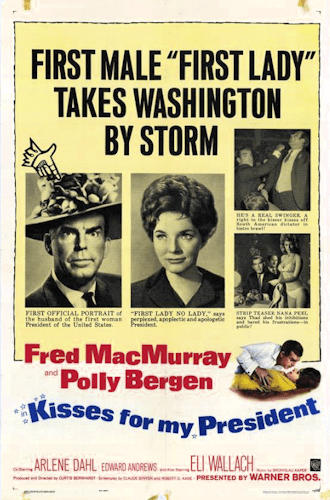
Shattered Politics #21: Kisses For My President (dir by Curtis Bernhardt)


Kisses_for_My_President_-_1964_-_Poster

If there’s anyone who deserves to be the subject of a big budget biopic, it’s Victoria C. Woodhull.  Back in the 19th century, at a time when women were not even allowed to vote, Victoria C. Woodhull was not only the first woman to ever work as a stockbroker but also the first to ever found her own newspaper.  A fierce advocate for women’s right and free love, Victoria Woodhull was also the first woman to ever run for President.  She was nominated in 1872 by the Equal Rights Party and, for the crime of trying to cast a vote for herself, she spent election day in jail.

Since that day, many more women have run for President but none have been elected.  Since 1984, two women have received major party nominations for vice president but neither came close to being elected.  Since 1964, Margaret Chase Smith, Shirley Chisholm, Patsy Mink, Ellen McCormack, Patricia Schroeder, Elizabeth Dole, Carol Mosely-Braun, Michele Bachman, and Hillary Rodham Clinton have all campaigned for the presidential nomination of one of the two major political parties but none of them have been nominated.

I do believe that a woman will be elected President within my lifetime.  In fact, it could even happen in 2016.  But until then, the only place where you can find a female President is on TV and in the movies.

Take, for instance, today’s final entry in Shattered Politics, the 1964 film Kisses For My President.  This may very well have been the very first movie to feature a woman as President.  Needless to say, in 1964, this idea was considered so outrageous that it had to be played for laughs.

Kisses For My President starts with an image of hundreds of women chanting “We want Leslie!”  We get a shot of Fred MacMurray looking out over the crowd.  The next scene, the new President is being sworn in.  We start with a close-up of the chief justice reciting the oath of office to “Leslie Harrison McCloud.”  The camera pans over to Fred MacMurray, listening intently.  However, just when 1964 audiences were expecting MacMurray to swear to uphold the constitution, the camera pans yet again, over to …. Polly Bergen!

“OH MY GOD!” audiences in 1964 gasped, “LESLIE McCLOUD IS A WOMAN!”

That’s right.  Polly Bergen is playing President Leslie McCloud and Fred MacMurray is playing her husband, Thad.  As the film makes apparent in its opening scenes, Thad is not quite sure what his role is supposed to be.  He has an office in the White House but it’s just so … feminine!  And it’s full of painting of previous first ladies who were all ladies!  And, at one point, Thad even imagines a picture of himself wearing a lady’s hat!

Oh my God!

Now, to be fair to the movie, Polly Bergen does get a few scenes where she shows herself to be a strong President.  There’s a great scene where she coolly dismisses a condescending senator (Edward Andrews) who suggests that, as a woman, Leslie might not be up to the task of standing up to America’s enemies.  It’s a brief scene but it’s a good one.

But, ultimately, it’s impossible to ignore the fact that Kisses For My President, a film about the first female President, is mostly interested in how Thad handles being “first gentleman.”  It’s a film that imagines a historic moment for women and then focuses on what it would mean for one man.

How 1964!

On the one hand, Kisses For My President is a dated comedy that runs way too long and tries to get too much mileage out of one joke (i.e., Fred MacMurray looking confused).  However, the film also features a great performance from Eli Wallach.  Playing a strutting dictator named Vasquez, Wallach is a lot of fun and the scenes where MacMurray shows him around Washington are the best in the film.  I also appreciated the fact that the President’s daughter reacts to the restrictions of living in the White House by dating a guy that she knows her parents will hate, largely because I would have done the same thing in her situation.

I’m a little bit torn on the ending of Kisses For My President.  (Should I spoil it?  No, I don’t think I will.)  On the one hand, it’s outrageously sexist and seems to suggests that Leslie — despite being a strong President during the few times we actually get to see her doing the job — should have been content to just be a wife and mother.  On the other hand, it’s one of those endings that would seem to perfectly capture the dominant culture of the time when the film was made.  So, it has some worth from a historical point of view.

When last I checked, Kisses For My President is currently available for free on YouTube. The film is interesting as a historical document if nothing else.