Retro Television Review: St. Elsewhere 3.2 “Playing God: Part Two”


Welcome to Retro Television Reviews, a feature where we review some of our favorite and least favorite shows of the past! On Fridays, I will be reviewing St. Elsewhere, a medical show which ran on NBC from 1982 to 1988.  The show can be found on Daily Motion.
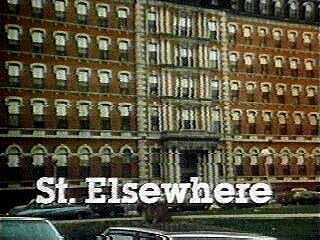
This week, the hospital is a depressing place.

Episode 3.2 “Playing God: Part Two”

(Dir by Bruce Paltrow, originally aired on September 26th, 1984)

There was a lot going on in this episode.

Sister Domenica demanded that Sister Theresa be taken off of life support and she threatened to sue the hospital if it didn’t happen.  This led to Dr. Westphall telling another long and depressing story about his dead wife.  I don’t mean to be flippant about anyone’s tragedies but it’s hard not to notice that almost everything seems to lead to Westphall telling a depressing story.  Westphall is one of the most saddest television characters that I’ve ever come across.

The nurses are closer to striking.  A labor negotiator named Richard Clarendon (Herb Edelman) is brought in by the nurses and it’s hard not to notice that he looks a lot like Helen Rosenthal’s ex-husband.  I think I can already guess where this is heading.

A sick child was brought in by a woman (Tammy Grimes) who claimed to be his fairy godmother.  This gave Fiscus an excuse to get a consultation from Kathy Martin, who has abandoned the morgue for psychiatry and who is no longer dressing exclusively in black.

At home, Dr. Craig struggled with impotence.  At the hospital, Dr. Ehrlich gave an awkward lecture about whether or not one can have sex after heart surgery.

The firefighters are still recovering from their burns.

Clancy got an abortion, despite Morrison’s objections.

And yet, all that drama was overshadowed by the fact that the Dr. Peter White — the drug-addicted rapist who nearly killed more than a few patients due to his own incompetence — is once again walking the halls of St. Eligius.  White won his lawsuit.  I’m not really sure that I understand what the basis of his lawsuit was.  St. Eligius could only ask a select number of residents to return and, even if you overlook the fact that White was accused of rape, it’s not as if Dr. White was ever an especially competent doctor.  It would seem that just his struggle with drug addiction would be enough to justify not asking him to return.  And yet, somehow, Dr. Peter White is once again a resident at St. Eligius.  (The ruling was probably handed down by a Carter judge.)

“You just can’t admit that you were wrong about me!” White snaps at Westphall.

Westphall replies that White is a terrible human being and not worthy of being a doctor and that he will not be allowed to work with any patients at the hospital.  And, for once, I wanted to cheer Dr. Westphall.  He may be depressing but he understands exactly who and what Peter White is.

Whatever the future may hold for the hospital, I have a feeling that it’s not going to be happy.  Two episodes in and the third season has already settled into a pit of melancholy.  That said, melancholy is perhaps the right mood for a medical show.  When it comes to hospitals, there aren’t many happy endings.
October Hacks: Silent Night, Bloody Night (dir by Theodore Gershuny)


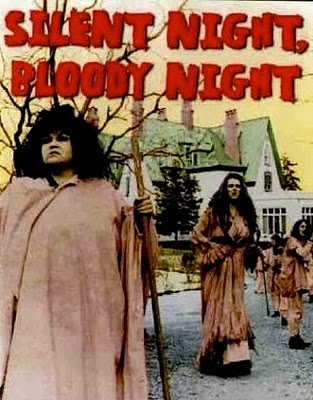
Filmed in 1972 and subsequently released in 1974, Silent Night Bloody Night is a real treat, an atmospheric thriller that has a wonderfully complicated plot that will keep you guessing.

Silent Night Bloody Night opens with attorney John Carter (Patrick O’Neal) arriving in a small town on Christmas Eve.  He’s traveling with his assistant and mistress, Ingrid (Astrid Heeren).  He’s been hired by Jeff Butler (James Patterson) to oversee the sell of his grandfather’s home.  When Carter arrives, he finds that the town is run by a group of elderly eccentrics, including the mute Charlie Towman (John Carradine).  Charlie communicates by ringing a bell and he’s the editor of the town newspaper.  Carter convinces the town council to buy the Butler mansion.  Then, Carter and Ingrid go to the mansion, make love, and are promptly brutally hacked to death by an unseen assailant with an axe.  It’s a shocking moment because, up until their death scene, Carter and Ingrid seemed to be our main characters.  Much as with Marion Crane’s shower in Psycho, their murder leaves an absence at the heart of the film.

That night, our new hero, Jeff Butler (James Patterson) comes to the isolated town to check on how the sale is going.  He finds the mansion locked up and no one willing to talk about John Carter.  With the help of local girl Diane (Mary Woronov), Jeff investigates his grandfather’s death and discovers that the town is full of secrets and people who are willing to kill to maintain them.  As we discover through some wonderfully dream-like flashbacks, Jeff’s grandfather died nearly 40 years ago when he was set on fire in his own home.  Those aren’t the only flashbacks to the film.  In an extended sepia-toned flashback, we learn about the previous inhabitants of the house.  They are all played by former Warhol superstars, including Candy Darling, Ondine, Tally Brown, Charlotte Fairchild, Lewis Love, Harvey Cohen, George Trakas, Susan Rothenberg, and Jack Smith.  (Mary Woronov was, herself, a former member of Warhol’s entourage.)

Silent Night Bloody Night has a terrible reputation.  Mary Woronov, who was married to director Theodore Gershuny at the time she made the film, later described it as being “lousy.”  Personally, I think the film’s reputation has more to do with all of the grainy, bad copies of the film that have turned up in various Mill Creek box sets over the years than the quality of the film itself.  (Silent Night Bloody Night is in public domain.)  The film itself is atmospheric, memorably bloody, and — for those who have the patience to deal with the occasional slow spot — effectively creepy.  Mary Woronov is a likable lead and the Warhol superstars definitely make an impression.  The film plays out at its own deliberate pace and, at its best, it duplicates the feeling of a particularly macabre holiday dream.

Director Theodore Gershuny uses the low budget to his advantage and the sepia-toned flashbacks are truly disturbing and haunting.  Ultimately, Silent Night Bloody Night feels like a dream itself and the mystery’s solution is less important than the journey taken to reach it.

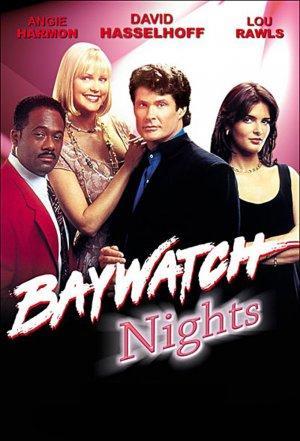
Late Night Retro Television Reviews: Baywatch Nights 1.8 “Balancing Act”


Welcome to Late Night Retro Television Reviews, a feature where we review some of our favorite and least favorite shows of the past!  On Tuesdays, I will be reviewing Baywatch Nights, an detective show that ran in Syndication from 1995 to 1997.  The entire show is currently streaming on Youtube!

This week, we discover how it all began!

Episode 1.8 “Balancing Act”

(Dir by Gus Trikonis, originally aired on November 18th, 1995)

The eighth episode of Baywatch Nights opens with Ryan and Garner on a stakeout.  It’s the middle of the day and they’re waiting for someone carrying an envelope full of evidence.  Mitch is nowhere to be seen, which actually makes sense.  I mean, Mitch is still working as a lifeguard.  Over the past seven episodes, I’ve often wondered how Mitch can work full-time as both a detective and a lifeguard captain.  This episode finally acknowledges that Mitch actually does have another job.

Garner and Ryan start talking about the first that they met and how they came to be partners in a detective firm.  It’s flashback time!  The flashbacks are to the show’s previously unaired pilot.  What’s funny is that, even though Garner is the one who is telling the story, the flashbacks are all narrated by Mitch.  I know that Garner and Mitch were extremely close friends during the early seasons of Baywatch but I didn’t realize they could actually hear each other’s thoughts.

Flashback Mitch explains that both he and Garner were wondering if there was anything more to life than their jobs.  Garner wanted to be more than just a beach cop.  Mitch was wondering if maybe there was something more out there than just being a lifeguard.  One day, when Mitch on vacation from his lifeguarding job, Mitch decided to accompany Garner to investigate a mysterious boat that had been showing up around the marina.  It was during the investigation that Mitch and Garner first met Ryan.  Ryan had paid $25,000 for a private detective agency in California, just to discover that the agency was not the high class operation that the previous owner, Nicky Pine (Philip Bruns), claimed it was.  However, before Ryan could confront him, Nicky was apparently killed by a group of criminals who wanted a valuable bracelet that Nicky owned.  Except the bracelet, which he gave to Ryan, was actually a fake and Nicky wasn’t actually dead and….

Ugh, this is complicated.  Seriously. I hate to admit that I couldn’t follow the plot of an episode of Baywatch Nights but this plot had so many nonsensical twists and turns that I pretty much gave up on trying to make sense of it all.  The important thing is that Garner got fed up with the police and quit, Mitch realized that he wanted to be a private eye, and Ryan got to be totally awesome as usual.  At one point, Ryan explained to Mitch that she was tough because she was from Dallas.  Woo hoo!  You tell him, Ryan!

Because this was a pilot, there were a few examples of early installment weirdness.  Troy Evans showed up as a police detective and one got the feeling that he was originally envisioned as being a recurring character.  Lisa Stahl’s Destiny was nowhere to be seen but there was a character named Andy (Linda Hoffman) was acted quite similarly to Destiny.  Even Nicky and his girlfriend, Rose (Jeanette O’Connor), seemed to be set up to become semi-regular characters.  Obviously, there was some retooling done after this pilot was produced.

Anyway, this episode’s plot is impossible to follow but the California scenery is lovely, which I think is the most that anyone could realistically demand from any show from the Baywatch universe.  Having now watched the pilot, I’m glad that the show went forward with just Mitch, Garner, and Ryan as regulars.  They’re a good team.

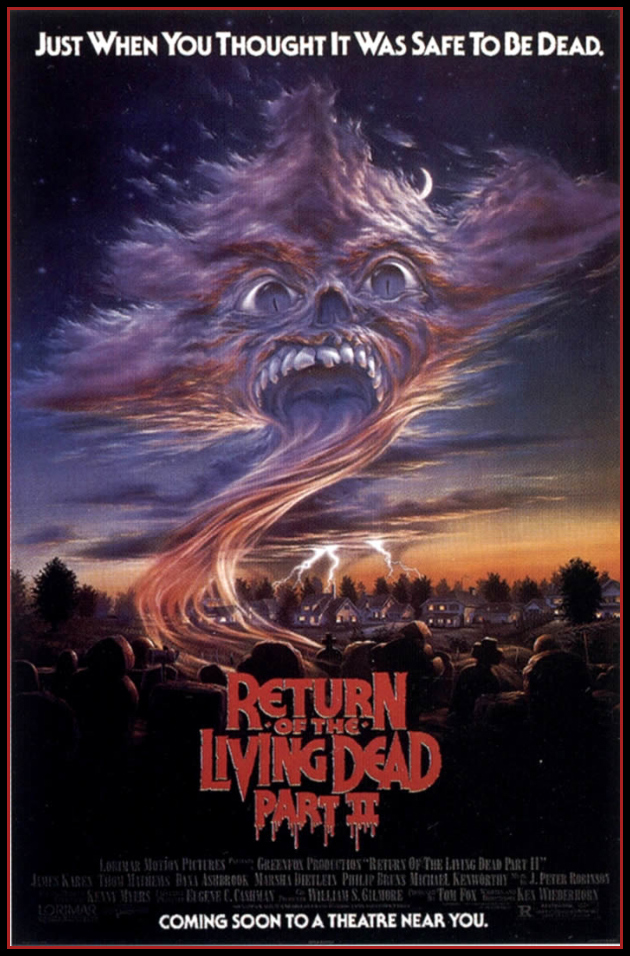
Quickie Review: Return of the Living Dead Part II (dir. by Ken Weiderhorn)


1988 saw the release of Return of the Living Dead Part II. This film is a sort of sequel/reboot of the first film in that the story and even some of the characters bear too much of a similarity to the original film. Ken Weiderhorn both writes and directs this “sequel” and it shows. The film reuses alot of what made the first film a cult-classic amongst horror fans. Weiderhorn seems to be of the philosophy that if something ain’t broke then don’t fix it. What this does is make the film feel like a deja vu and maybe that was his intent since two of the main characters in the film say pretty much the same thing. Despite all this the film itself is pretty good and stays true to the original, albeit with abit more humor and better effects work.

Reprising similar roles they had in the first film are James Karen as Ed and Thom Mathews as Joey. Both work as in the post-burial industry and moonlight stealing valuables from the privates crypts and mausoleum in the cemetery they’re working in. Their characters act and almost have similar lines from Karen and Mathews’ characters of Frank and Freddy in the first film. Karen as Ed goes over-the-top once the 2-4-5 Trioxin gas is let loose and the dead bodies in the cemetery begin to come back to life seeking live brains. It’s these two characters who really keep the film from spiraling down to awful status. Even though their characters are similar to the original film, Karen and Mathews still bring a dose of great comedic timing and horror to the situation.

This time around the town has been safely evacuated by the military except for a few people who lived on the newly-built suburban housing area in the outskirt of town. It’s these survivors who must try and find a way to defeat the zombies and at the same time convince the military blockading the town that they’re not infected. There’s more action and comedy in this sequel. I think the comedy part of the film got way too much attention, but as I said earlier, Weiderhorn seems to think that if it worked in the original then it should work with more in this film. The effects work looks a bit better and probably due to an increase in the budget.

In the end, Return of the Living Dead Part II never brought anything new to the original it was following-up. The film pretty much reuses the same characters and situations. Weiderhorn does this to good effect and the finished product was an entertaining enough horror-comedy. Who knows how this sequel would’ve turned out if Russo had written it and O’Bannon back directing.