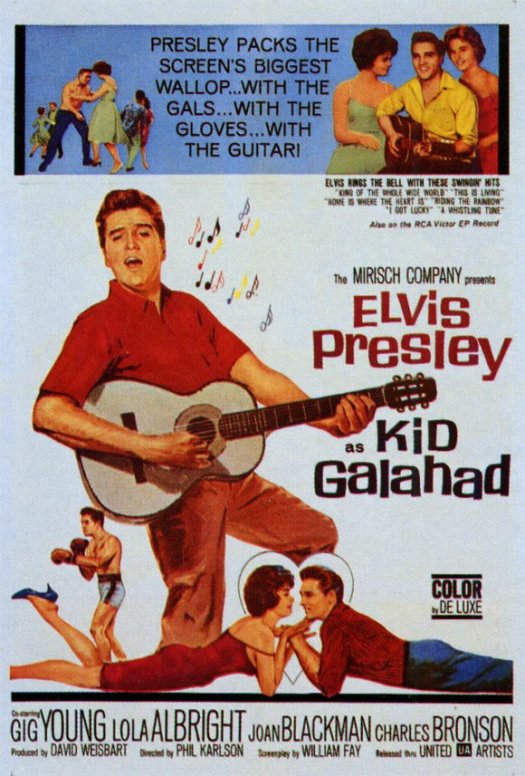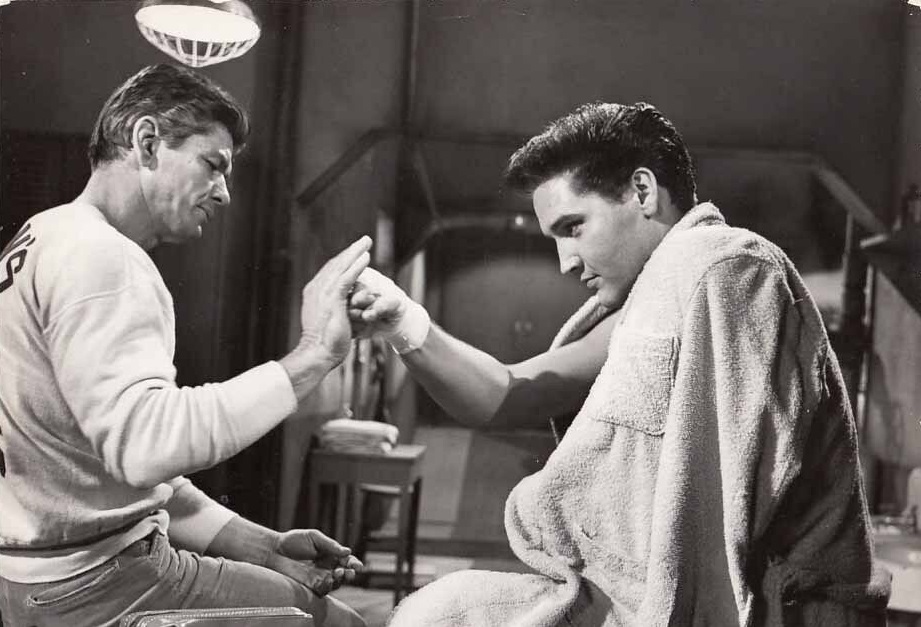
KID GALAHAD (1962) – Charles Bronson teaches Elvis how to box! Happy Birthday to the King!


In celebration of the January 8th birthday of the great Elvis Presley, I decided to watch his 1962 film KID GALAHAD, the only film where he co-stars with my movie hero Charles Bronson. I’ve always been a fan of Elvis Presley and seeing him on-screen with Bronson is a real treat for me.

KID GALAHAD opens with Walter Gulick (Elvis Presley) returning to his hometown in upstate New York. Recently discharged from the army, and in the need of money, the aspiring mechanic finds his way to Willy Grogan’s (Gig Young) boxing camp and agrees to spar with one of his up-and-coming young boxers. Walter doesn’t have much boxing skill, but he ends up having one hell of a right hook and knocks the young boxer flat on his ass. Seeing this, Willy Grogan, who has all sorts of personal and financial problems, thinks Walter might be the answer to getting out of debt to his bookie. Willy asks his trainer Lew (Charles Bronson) to work with the young, strong Walter, who’s now been dubbed “Galahad” by Willy’s girlfriend Dolly (Lola Albright) after he had protected her honor from a “man who doesn’t know how to behave around a lady.” Pretty soon, Willy has fights arranged for Walter under the name of “Kid Galahad.” The first fight begins with Galahad getting his faced being punched repeatedly until he gets one opening and then knocks the other fighter out with one punch. After that, with Lew’s help, Galahad’s skills start showing definite improvement. When he’s not working with Lew at the gym, Galahad finds time to romance and propose to Willy’s sister, Rose (Joan Blackman). This causes problems with the troubled Willy who doesn’t want his sister married to some “meatball” or “grease monkey.” Even worse, smelling money, gangster Otto Danzig (David Lewis) and his henchmen start putting pressure on the financially troubled Willy to force Galahad to take a dive in his big fight with “Sugar Boy” Romero so they can clean up on the fix, going so far as breaking Lew’s hands. Will Willy get the balls to say no to the gangsters? Will Galahad be able to beat Sugar Boy Romero and then retire to open his garage with Rose by his side? You probably already know, but you’ll just have to watch and see!

1962’s KID GALAHAD is a remake of a 1937 movie of the same name directed by Michael Curtiz, and starring cinematic legends Edward G. Robinson, Bette Davis, and Humphrey Bogart. I’ve never seen the earlier version, so I will not compare the two in any way. And to be completely honest, I haven’t watched very many Elvis Presley movies either. As I type this, I can’t think of a single moment I remember in his filmography not included in KID GALAHAD, and I wouldn’t have watched this one without the presence of Charles Bronson. With that said, I think Elvis gives a good performance in KID GALAHAD. He’s very likable, with his character having an old-fashioned chivalry towards women, a friendly, open way with men, and an appreciation for a strong work ethic. I think Elvis handles each of these parts of his character in a way to that makes me want to root for him. As good as Elvis is as Kid Galahad, Gig Young does most of the heavy lifting as the story really revolves around his character’s troubles even more than it does around Galahad. I think he does a pretty good job of taking a character who’s a pretty sorry guy, and by the end of the movie we actually find ourselves starting to like him. Even though he’s in a true supporting role, Charles Bronson is excellent as the trainer who teaches Galahad how to box. Every scene Bronson’s in is elevated by his enormous screen presence and authority. With Bronson in his corner, you feel Galahad is capable of anything. The most powerful scene in the entire film is when the gangsters try to buy his character off under the threat of violence, and he refuses, leading to his hands being broken. After becoming one of the biggest stars on the planet a number of years later, it’s easy to look back at these moments and wonder how in the hell was he not already a huge star in 1962.

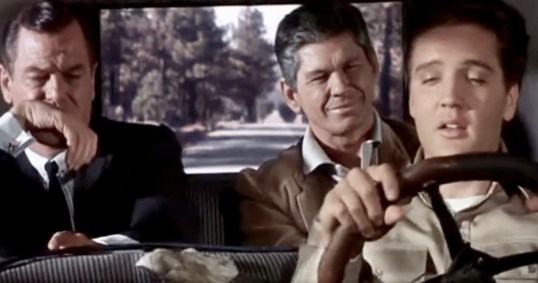
Of course, this being an Elvis Presley movie, there are several musical numbers spread throughout the movie. While I don’t remember too much about the songs themselves, they didn’t really take me out of the drama of the movie either. I actually enjoyed seeing Elvis perform, with the people around him clapping along and enjoying themselves. I do remember a specific scene where Elvis is singing as he’s driving down the road, and Bronson’s sitting in the back seat with a big smile on his face like he’s having a great time. That’s my favorite moment of all the songs.  

Although I haven’t watched many of his movies, I’ve been an appreciative fan of Elvis Presley all my life. I can’t tell you how many times I heard his Christmas album in my younger years, as my mom would play it almost on repeat once we got to November. He was a talented, versatile singer whose charisma and stage presence have never been matched, and whose influence on music and entertainment is immeasurable. The fact that Elvis Presley and Charles Bronson made KID GALAHAD together means something to me, and I had a great time revisiting the film on his birthday!

See the Original Trailer for KID GALAHAD below.
4 Shots From 4 Films: Special Phil Karlson Edition


4 Or More Shots From 4 Or More Films is just what it says it is, 4 shots from 4 of our favorite films. As opposed to the reviews and recaps that we usually post, 4 Shots From 4 Films lets the visuals do the talking!

Today, the Shattered Lens pays tribute to director Phil Karlson, who was one of those great directors who never quite got the credit he deserved when he was alive but whose work continues to be rediscovered.  Phil Karlson was born 116 years ago today so it’s time for….

4 Shots From 4 Phil Karlson Films

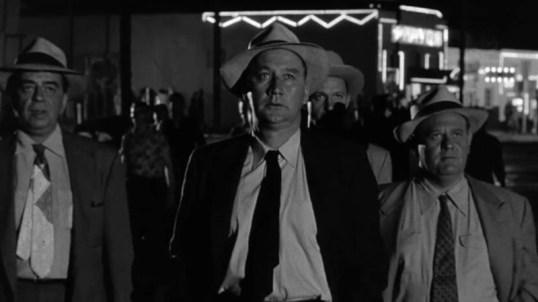
The Phenix City Story (dir by Phil Karlson, DP: Harry Neumann)

Kid Galahad (1962, dir by Phil Karlson, DP: Burnett Guffey)

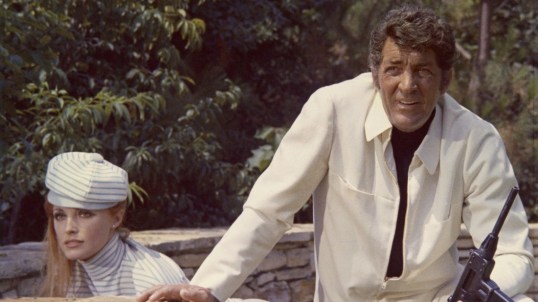
The Wrecking Crew (1968, dir by Phil Karlson, DP: Sam Leavitt)

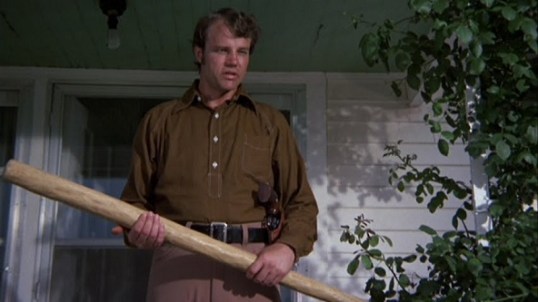
Walking Tall (1973, dir by Phil Karlson, DP: Jack A. Marta)

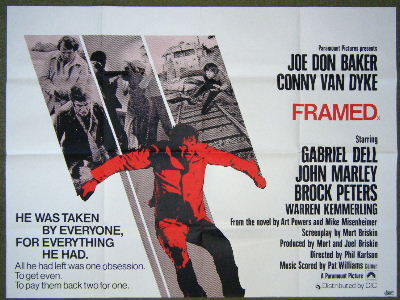
Framed (1975, directed by Phil Karlson)


Revenge can be brutal, especially when you’ve been framed.

Joe Don Baker plays Ron Lewis, a surly nightclub owner and gambler who wins a small fortune, witnesses a crime, and nearly gets shot all in the same night.  When he reaches his house, he’s planning on calling the police but he’s confronted in his own garage by a sheriff’s deputy who tries to kill him!  In a lengthy and brutal scene, Ron beats the deputy to death and gouges out his eyes.  Even though Ron was only acting in self-defense, he’s charged with murder.  Told that there is no way that he’ll be able to win an acquittal, Ron pleads guilty to a lesser charge and is sent to prison for four years.

While he’s in prison, Ron befriends a mob boss (John Marley, who famously woke up with a horse’s head in his bed in The Godfather) and the boss’s number one hitman, Vince (Gabriel Dell).  While Ron is in prison, a group of men assault his girlfriend (country singer Conny Van Dyke) and tell her not to ask any questions about the events that led to Ron being framed.

After serving his sentence and getting into numerous fights with the guards, Ron is finally released.  When Vince shows up and tells Ron that he’s been hired to kill him, the two of them team up with an honest deputy (Brock Peters) and set out to find out why Ron was set up and to get revenge.

Framed is a brutal movie, Ron and his friends hold nothing back in their quest to get revenge.  Whether he’s shooting a man in cold blood or hooking someone up to a car battery in order to get information out of him, there’s little that Ron won’t do and the movie lingers over every act of violence.  Several pounds overweight and snarling out of his lines, Joe Don Baker may not be a conventional action hero but he’s believable in his rage.  He’s the ultimate country boy who has been pushed too far and now he doesn’t care how much blood he has to get on his hands.  However, because Baker does seem more like an ordinary person than a Clint Eastwood or a Charles Bronson-type, he retains the audience’s sympathy even as he splashes blood all over the screen.  As violent as his action may be, they always feel justified.

Baker’s performance and the believable violence are the film’s biggest strengths.  It’s biggest weakness is a plot that revolves around an elaborate conspiracy that doesn’t always make sense and some notably weak supporting performances.  Ron’s revenge may be brutal but it takes a while to get there and the first hour gets bogged down with Ron’s struggle to adjust to life in prison.  John Marley does a good job as Ron’s prison mentor but then he abruptly disappears from the movie.

Before making Framed, Baker and director Phil Karlson previously collaborated on Walking Tall.  Framed is far more violent than that film was but its plot doesn’t hold together as well.  However, if you’re just looking for a violent action film that features Joe Don Baker doing what he does best, Framed delivers.

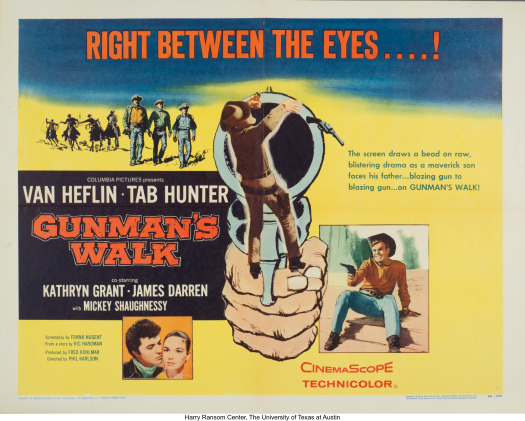
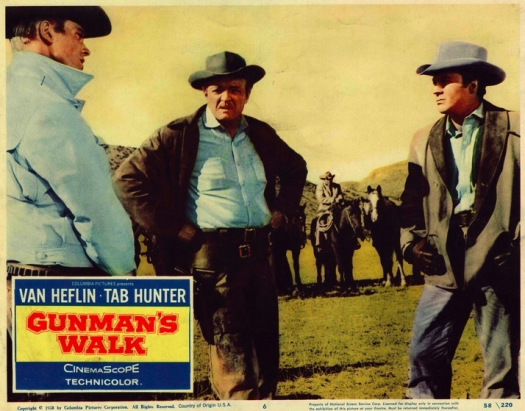
West-Teen Angst: GUNMAN’S WALK (Columbia 1958)


gary loggins's avatarcracked rear viewer

GUNMAN’S WALK may not be a classic Western like THE SEARCHERS or HIGH NOON, but it was entertaining enough to hold my interest. That’s due in large part to a change of pace performance by All-American 50’s Teen Idol Tab Hunter as a sort-of Rebel Without A Cause On The Range, an unlikable sociopath with daddy issues, aided and abetted by Phil Karlson’s taut direction and some gorgeous panoramic Cinemascope shots by DP Charles Lawton Jr.

Boisterous cattle rancher Lee Hackett (Van Heflin) is one of those Men-Who-Tamed-The-West types, a widower with two sons. Eldest Ed (Hunter) is a privileged, racist creep who’s obsessed with guns, while younger Davy (played by another 50’s Teen Idol, James Darren) is more reserved. The Hacketts are about to embark on a wild horse round-up, and enlist two half-breed Sioux, the brothers of pretty young Clee (Kathryn Grant,  young wife of crooner Bing Crosby).

View original post 404 more words

New York After Midnight: 99 RIVER STREET (United Artists 1953)


gary loggins's avatarcracked rear viewer

The trio that brought you KANSAS CITY CONFIDENTIAL – star John Payne, director Phil Karlson, and producer Edward Small – teamed again for 99 RIVER STREET, and while it’s not quite on a par with their film noir classic, it’s crammed with enough sex’n’violence to hold your interest for an hour and a half. Karlson’s direction is solid, as is the cast (including a knockout performance by Evelyn Keyes), and the camerawork of the great Austrian cinematographer Franz Planer gives it a wonderfully brooding touch of darkness.

The story itself is highly improbable yet highly entertaining: ex-boxer Ernie Driscoll (Payne), once a heavyweight contender now reduced to driving a cab, is married to ex-showgirl Pauline (the delectable Peggie Castle), who’s two-timing him with crook Victor Rawlins (slimebag Brad Dexter ). Ernie catches them making out through the window of the flower shop Pauline works at, and his PTSD is triggered…

View original post 506 more words

Rockin’ in the Film World #13: Elvis Presley in KID GALAHAD (United Artists 1962)


gary loggins's avatarcracked rear viewer

Let’s face it – with a handful of exceptions, most of Elvis Presley’s  post-Army 1960’s movies are awful. They follow a tried-and-true formula that has The King in some colorful location torn between two (or more!) girls, some kind of vocational gimmick (race car driver, scuba diver), and a handful of forgettable songs. KID GALAHAD is one of those exceptions; although it does follow the formula, it’s redeemed by a stellar supporting cast, a fair plot lifted from an old Warner Brothers film, and a well choreographed and edited final boxing match.

The movie’s very loosely based on 1937’s KID GALAHAD, a boxing/gangster yarn that starred Edward G. Robinson, Bette Davis, Humphrey Bogart, and Wayne Morris in the role now played by and tailored for Presley. He’s a young man fresh out of the Army (how’s that for typecasting?) who returns to his upstate New York hometown of Cream Valley…

View original post 557 more words

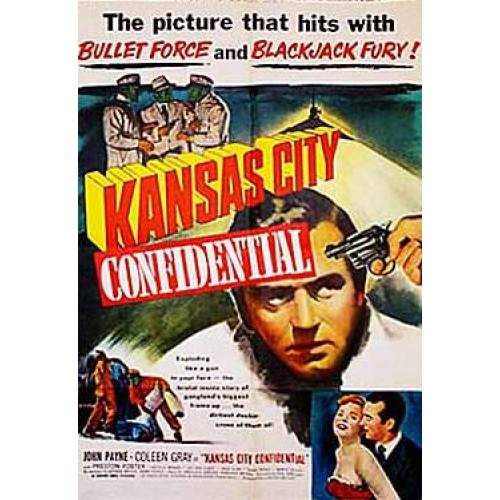
The Perfect Crime Film: KANSAS CITY CONFIDENTIAL (United Artists 1952)


gary loggins's avatarcracked rear viewer

kc1

My friend Rob suggested I review KANSAS CITY CONFIDENTIAL awhile back, and I’m sorry I waited so long. This is a film noir lover’s delight, packed with tension, violence, double-crosses, and a head-turning performance by John Payne in the lead. Made on an economical budget like the same year’s THE NARROW MARGIN , director Phil Karlson and George Diskant create a shadowy, claustrophobic atmosphere brimming with danger at every turn.

I knew Payne mainly from his 40’s musicals and his idealistic lawyer opposite Maureen O’Hara in MIRACLE ON 34TH STREET, but he’s a revelation here as Joe Rolfe, a florist truck driver who’s set up as a patsy by a gang of armored car robbers. He can dish out (and take) beatings with the best them, and delivers the tough-talking dialog with aplomb. KANSAS CITY CONFIDENTIAL helped Payne shed his lightweight image, and he went on to do other dark crime films and rugged…

View original post 468 more words

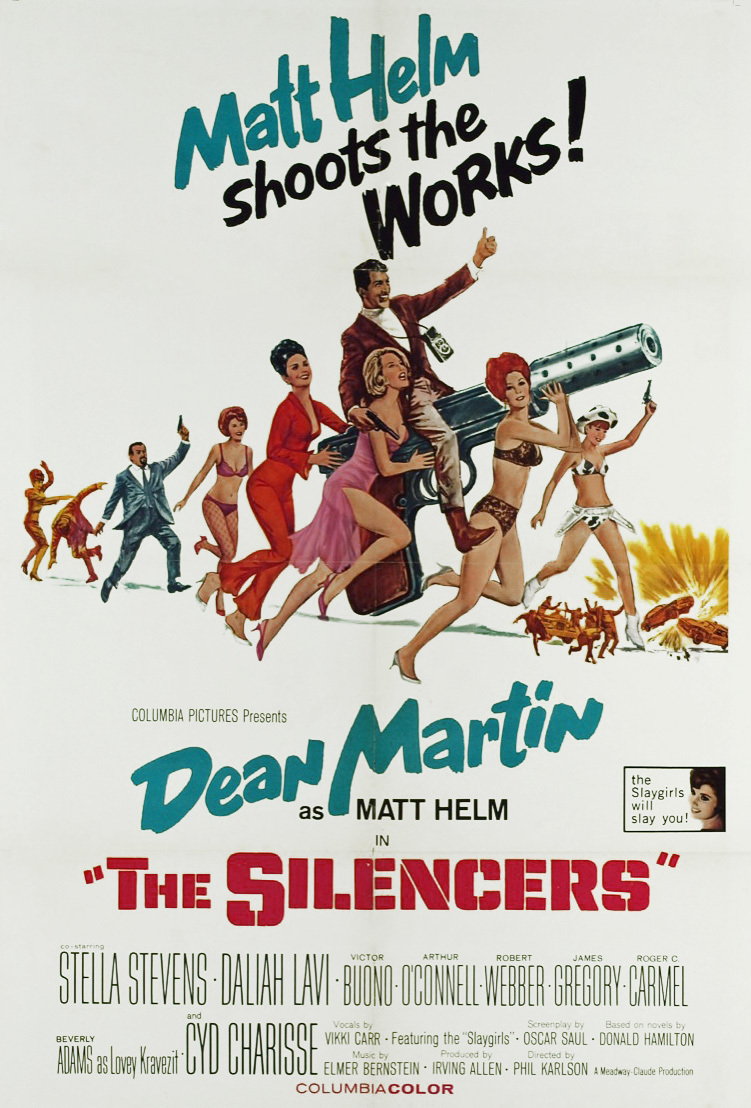
Secret Agent Double-O Dino: THE SILENCERS (Columbia 1966)


gary loggins's avatarcracked rear viewer

silence1

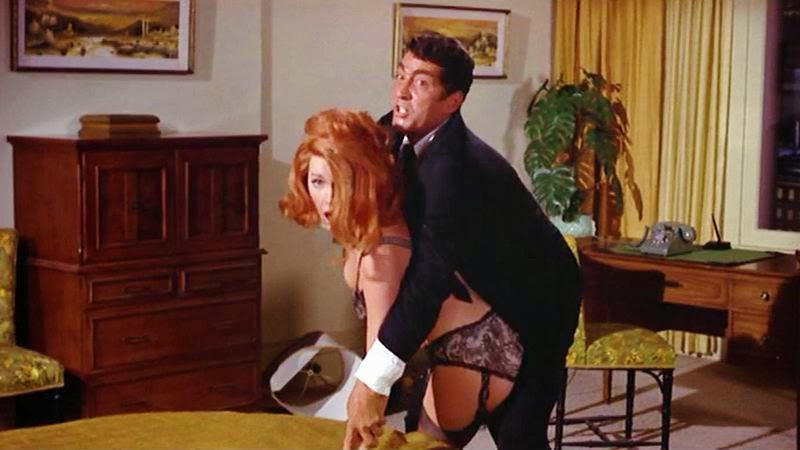
Out of all the James Bond-inspired spy spoofs made in the Swingin’ 60’s, one of the most popular was Dean Martin’s Matt Helm series. Based on the novels of Donald Hamilton, the films bore little resemblance to their literary counterparts, instead relying on Dino’s Booze & Girlies Rat Pack Vegas persona. First up was 1966’s THE SILENCERS, chock full of gadgets, karate chops, and beautiful babes, with sexual innuendoes by the truckload.

lovey

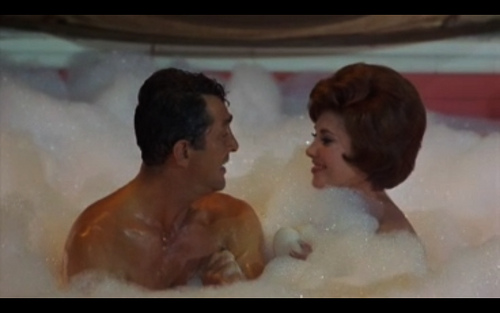
Our Man Matt is a semi-retired agent of ICE (Intelligence and Counter-Espionage) living in a Playboy Mansion-style pad, and working as a globe-trotting photographer. He’s luxuriating in his bubble bath pool with sexy secretary Lovey Kravezit (“Lovey Kravezit? Oh that’s some kinda name!”) when former boss Mac Donald calls. Evil spy organization Big O (Bureau for International Government and Order) is once again plotting world domination, and the reluctant Helm is pulled back into service.

silence3

Matt is teamed with his former partner Tina…

View original post 747 more words

Cleaning Out the DVR Pt 9: Film Noir Festival Redux


gary loggins's avatarcracked rear viewer

prev

Welcome back to the decadently dark world of film noir, where crime, corruption, lust, and murder await. Let’s step out of the light and deep into the shadows with these five fateful tales:

redux1

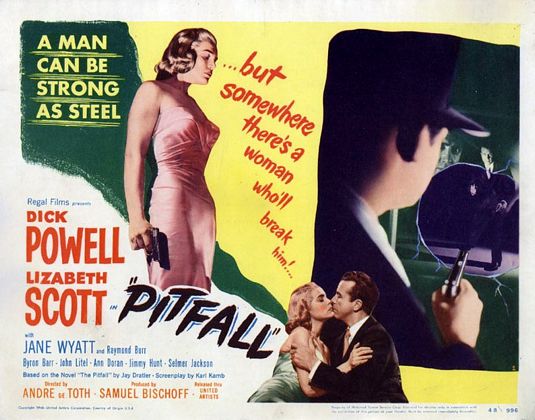
PITFALL (United Artists 1948, D: Andre DeToth) Dick Powell is an insurance man who feels he’s stuck in a rut, living in safe suburbia with his wife and kid (Jane Wyatt, Jimmy Hunt). Then he meets hot model Lizabeth Scott on a case and falls into a web of lies, deceit, and ultimately murder. Raymond Burr  costars as a creepy PI who has designs on Scott himself. A good cast in a good (not great) drama with a disappointing ending. Fun Fact: The part of Scott’s embezzler boyfriend is played by one Byron Barr, who is not the Byron Barr that later changed his name to Gig Young.  

redux2

THE BRIBE (MGM 1949, D:Robert Z. Leonard) Despite an…

View original post 759 more words

Embracing the Melodrama Part II #46: Walking Tall (dir by Phil Karlson)


Walking_Tall_(1973_film)About 50 minutes into the 1973 film Walking Tall (not to be confused with the 2005 version that starred Dwayne Johnson), there’s a scene in which newly elected sheriff Buford Pusser (Joe Don Baker) gives a speech to his deputies.  As the deputies stand at attention and as Pusser announces that he’s not going to tolerate any of his men taking bribes from the Dixie Mafia, the observant viewer will notice something out-of-place about the scene.

Hovering directly above Baker’s head is a big, black, almost phallic boom mic.  It stays up there throughout the entire scene, a sudden and unexpected reminder that — though the film opens with a message that we’re about to see the true story of “an American hero” and though it was filmed on location in rural Tennessee — Walking Tall is ultimately a movie.

And yet, somehow, that phallic boom mic feels oddly appropriate.  First off, Walking Tall is an almost deliberately messy film.  That boom mic tells us that Walking Tall was not a slick studio production.  Instead, much like Phil Karlson’s previous The Phenix City Story, it was a low-budget and violent film that was filmed on location in the south, miles away from the corrupting influence of mainstream, yankee-dominated Hollywood.  Secondly, the phallic implications of the boom mic erases any doubt that Walking Tall is a film about men doing manly things, like shooting each other and beating people up.  Buford does have a wife (Elizabeth Hartman) who begs him to avoid violence and set a good example of his children.  However, she eventually gets shot in the back of the head, which frees Buford up to kill.

As I said earlier, Walking Tall opens with a message telling us that we’re about to watch a true story.  Buford Pusser is a former football player and professional wrestler who, after retiring, returns to his hometown in Tennessee.  He quickly discovers that his town is controlled by criminals and moonshiners.  When he goes to a local bar called The Lucky Spot, he is unlucky enough to discover that the bar’s patrons cheat at cards.  Buford is nearly beaten to death and dumped on the side of the road.  As Buford begs for help, several motorists slow down to stare at him before then driving on.

Obviously, if anyone’s going to change this town, it’s going to have to be Buford Pusser.

Once he recovers from his beating, Buford makes himself a wooden club and then goes back to the Lucky Spot.  After beating everyone up with his club, Buford takes back the money that he lost while playing cards and $50.00 to cover his medical bills.  When Buford is put on trial for armed robbery, he takes the stand, rips off his shirt, and shows the jury his scars.  Buford is acquitted.

Over his wife’s objections, Buford decides to run for sheriff.  The old sheriff, not appreciating the competition, attempts to assassinate Buford but, instead, ends up dying himself.  Buford is charged with murder.  Buford is acquitted.  Buford is elected sheriff.  Buford sets out to clean up his little section of Tennessee.  Violence follows…

On the one hand, it’s easy to be snarky about a film like Walking Tall.  This is one of those films that operates on a strictly black-and-white world view.  Anyone who supports Buford is good.  Anyone who opposes Buford is totally evil.  Buford is a redneck saint.  It’s a film fueled by testosterone and it’s not at all subtle…

But dangit, I liked Walking Tall.  It’s a bit like a right-wing version of Billy Jack, in that it’s so sincere that you can forgive the film’s technical faults and frequent lapses in logic.  Walking Tall was filmed on location in Tennessee and director Phil Karlson makes good use of the rural locations.  And, most importantly, Joe Don Baker was the perfect actor to play Buford Pusser.  As played by Baker, Pusser is something of renaissance redneck.  He’s a smart family man who knows how to kick ass and how to make his own weapons.  What more could you ask for out of a small town sheriff?

In real life, Buford Pusser died in a mysterious car accident shortly after the release of Walking Tall.  Cinematically, the character of Buford Pusser went on to star in two more films.