
You know what? I’m going to start this review with the assumption that you’ve already seen the classic 1978 college comedy, National Lampoon’s Animal House. At the very least, I’m going to assume that you’ve heard of it and that you know the general details. Animal House was not only a huge box office success but it’s also one of the most influential films ever made. Almost every comedy released since 1978 owes a debt to the success of Animal House. Just as every subsequent high school film was directly descended from American Graffiti, every college film features at least a little Animal House in its DNA.
So, with that in mind, who is your favorite member of Delta House?

Most people, I think, would automatically say Bluto (played by John Belushi) and certainly, Bluto is the best known and perhaps best-remembered member of the cast. As played by Belushi, Bluto is the film’s rampaging ID and he’s such a force of nature that, whenever I rewatch Animal House, I’m surprised to be reminded of the fact that he’s not really in the film that much. He’s present for the parties, of course. He imitates a zit and starts a food fight. He gives a rousing speech, in which he reminds the members of the Delta House that America didn’t give up after “the Germans bombed Pearl Harbor!” He destroys a folk singer’s guitar and I personally love the scene where he tries to cheer up a despondent pledge by smashing a beer bottle over his head. But really, Bluto is used very sparingly and he’s one of the few members of the ensemble not to get his own subplot. Bluto’s great but he’s not my favorite member of Delta House.

Believe it or not, my favorite member of Delta House is Robert Hoover (James Widdoes). Hoover is the president of Delta House and, when we first meet him, he seems like he’s way too clean-cut to be in charge of the “worst house” on campus. But then, as the film progresses, we discover that Hoover may not be as openly crazy as everyone else but he’s definitely a Delta. Just watch him in the Toga party scene. Just look at him in the picture that shows up during the closing credits. It took me a while to realize that Hoover, the future public defender, was giving the camera the finger. Hoover may look uptight but he’s secretly a wild man!

One of the things that I love about Animal House is that it truly is an ensemble film. There’s not a weak performance to be found in the entire movie. No matter how wild or over-the-top the humor gets, the entire cast commits to their roles and, as a result, they keep this movie grounded. You actually find yourself caring about whether or not they get kicked off campus. You truly believe that the members of Delta House have been friends for years but, even more importantly, you believe the same thing about their rivals at Omega House. For that matter, it may be easy to make fun of Dean Wormer (John Vernon, setting the template for all evil deans to come) but you never doubt that he’s been in charge of Faber College for years and that he’s planning on being in charge for years to come. As played by the deep-voiced and sinister-looking Vernon, Wormer becomes every unreasonable authority figure. When he explains the concept of super secret probation, he does so with a smug pleasure that is practically chilling. When he mentions that the members of Delta House can now be drafted, the smile on his face is terrifying.

You know who else gives a really good performance in Animal House? Donald Sutherland. At the time, Sutherland was the biggest star in the film. He was offered either a percentage of the grosses or a flat fee. Sutherland thought the film would flop, took the flat fee, and missed out on millions as a result. Sutherland plays Prof. Jennings, an English teacher who, in the only scene actually set in a classroom, desperately tries to get his bored students to pay attention to him. There’s something so poignant about the way Jennings begs his students to turn in their papers. “I’m not joking,” he sputters, “this is my job!”

Jennings turns out to be free thinker. He turns Boone (Peter Riefert), Katie (Karen Allen), and Pinto (Tom Hulce) onto marijuana. There’s an anachronistic peace sign hanging in his apartment (Animal House takes place in 1963) but no matter. Far worse is the fact that he temporarily breaks up Boone and Katie! Everyone knows those two belong together!

You know who else doesn’t get enough credit for his performance in Animal House? Stephen Furst. He plays Flounder, a new pledge. Flounder is just so enthusiastic about everything and he doesn’t even seem to be upset when Wormer tells him, “Fat, drunk, and stupid is no way to go through life.” I love the enthusiastic way that Furst delivers simple lines like, “What’s my Delta Chi name?” and “Brother Bluto! Brother D-Day! What are you doing here!?” My favorite Flounder moment comes when he accidentally gives a horse a heart attack. Technically, it shouldn’t be funny but it is because Furst, Belushi, and Bruce McGill (playing the role of D-Day) so thoroughly throw themselves into their roles. For that matter, the horse did a pretty good job too.

But that’s not all! How can I praise the ensemble of Animal House without mention Tim Matheson, who plays Otter, the future Beverly Hills gynecologist? Or what about Kevin Bacon, playing Omega pledge Chip Diller? This was Bacon’s first role and who can forget him shouting, “Thank you, sir, may I have another!” while being initiated into Omega House? Or how about James Daughton and Mark Metcalf, as the two leaders of Omega House? They were villains truly worth hissing!

And yes, I know that a lot of the humor in Animal House is not politically correct but who cares? It’s a hilarious movie, one that is full of good actors at their absolute best. Yes, they’re all a bunch of privileged sexists blah blah blah, but I’d still party with the Delta House. They know how to have fun and, even if they did wreck the Homecoming Parade, they had a good reason!

And so is the movie. Every time I see Animal House, I feel good about the world. In 1978, The Deer Hunter was named best picture by the Academy. Well, you know what? With all due respect to that long epic about the tragedy of America’s involvement in the Vietnam War, all the Oscars should have gone to Animal House!

In conclusion … SING IT!
Let me t-t-tell you ’bout some friends I know
They’re kinda crazy but you’ll dig the show
They can party ’till the break of dawn
at Delta Chi you can’t go wrong
Otter, he’s the ladies man
Every girl falls into his hands
Boon and Katy playing “Cat and Mouse”
and Mrs. Wormer, she’s the queen of the
ANIMAL HOUSE
ANIMAL HOUSE
ANIMAL HOUSE
That Pinto he’s a real swell guy
Clorette was jailbait but he gave her a try
Chip, Doug, and Greg, they’re second to none
They studied under Attila the Hun
Mr. Jennings has got his wig on tight
Flouder’s left shoe’s always on his right
Babs and Mandy are having a pillow fight
With D-Day, Hoover, Otis Day and the Knights
DO THE BLUTO
Come on baby, dance with me
Maybe if we do the Bluto
We will get an “A” in lobotomy
DO THE BLUTO
DO THE BLUTO
DO THE BLUTO
DO THE BLUTO
Aw, come on!
Let me tell ya
Dean Wormer tried to shut us down
But he fell and he broke his crown
He didn’t know about the Delta spunk
He came in handy when we were short a skunk
At the
ANIMAL HOUSE

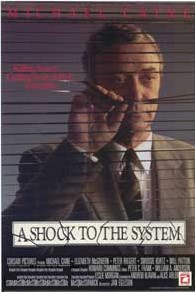 Graham Marshall (Michael Caine) has spent years toiling away as an executive at an advertising firm and being nagged by his wife (Swoosie Kurtz), who claims that Graham doesn’t have enough of a killer instinct to get ahead. When Graham is passed over for a promotion that he felt was promised to him, Graham starts to reconsider everything that he once believed. While Graham is waiting for the train to take him home, he is approached by an obnoxious panhandler who always asks him for money. That night, instead of ignoring the panhandler, Graham shoves him in front of the train. When no one notices that Graham has murdered the panhandler, Graham decides to get revenge on everyone who he blames for the sorry state of his life.
 The year is 1998 and America is flat broke. Paper currency is now worthless and, to the joy of Ron Paul supporters everywhere, all transactions are done in gold. After the country ran out of oil, people started using skateboards and bicycles for transportation and many turned their cars into homes. While the citizenry spends their time consuming a steady diet of sitcoms and reality television, the government tries to figure out how to pay back the loan that it took from Sam Birdwater (Chief Dan George), a Native American who made billions after buying Nike. Birdwater wants his money back and he is prepared to foreclose on the entire country.
 Through the Shattered Lens