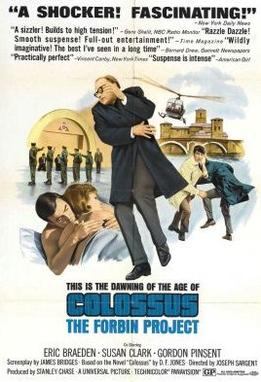
Colossus: The Forbin Project (1970, directed by Joseph Sargent)


Deep in a complex that is hidden away in the Rocky Mountains, Dr. Charles Forbin (Eric Braeden) has put together and programmed a computer called Colossus.  A super computer, Colossus has been designed to control the nuclear arsenal of the United States and its allies.  Colossus will not only keep America safe but it was also remove the chance of human error or human hesitation.  No longer will two men sitting in a silo with a key have to make the decision whether to obey the orders coming from the commander in chief.  No longer will people have to make the split-second decision that could plunge the world into war.

To Forbin’s surprise, the Soviet Union has developed their own super computer, called Guardian.  Colossus asks to be “linked” to Guardian and the Russians agree to allow it as a gesture of good will.  What no one realizes is that both computer systems have become sentient and that they soon decide that humans cannot be trusted to not destroy themselves and the planet.  To Forbin’s horror, Colossus starts to take over the world.

Based on a novel by Dennis Feltham Jones, Colossus was originally filmed in 1968 but it wasn’t released until 1970.  The film looks dated with its gigantic computer but it feels prophetic with its storyline about an AI taking over the world and deciding that it knows better than its makers.  Director Joseph Sargent adroitly mixes science fiction with Bond-style intrigue as Charles Forbin tries to reason with his creation and both the CIA and the KGB try to take down the computers.  The film even tosses a bit of 70s-style paranoia, with both the American and the Soviet governments trying to keep the public from discovering that the supercomputers are trying to take over the world.

Colossus: The Forbin Project is an intelligently written and thought-provoking science fiction film.  Eric Braeden does a great job as Charles Forbin, the engineer who goes from being arrogant and cocky to desperate to finally defiant as his creation slips out of his control.  William Schallert, so often cast as a nice father figure, turns in a good performance as the head of the CIA as does Susan Clark, cast as a colleague who has to pretend to be Forbin’s mistress just so she and Forbin can talk and plot without being monitored by Colossus.

Colossus is a smart sci-fi film that is more relevant than ever.
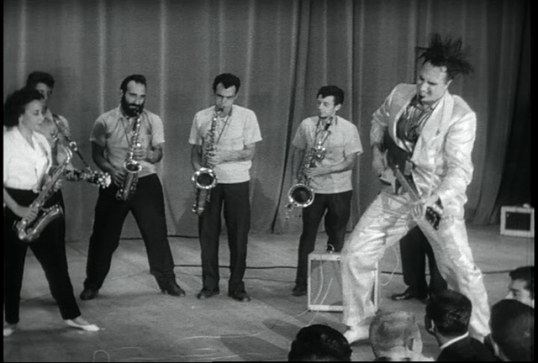
Horror Film Review: Tormented (dir by Bert I. Gordon)


“Tom Stewart killed me!” shouts the spirit of Vi Mason (Juli Reding).

Technically, it’s debatable whether or not Tom Stewart (Richard Carlson) actually killed Vi.  As is seen during the opening moments of 1960’s Tormented, Vi actually slipped and was clinging onto the lighthouse’s balcony for dear life before she fell to her death on the rocks below.  Tom didn’t push her and he didn’t force her to fall.  However, Tom did refuse to pull her up.  After she fell, he ran into the ocean and thought he had dragged back to safety.  But then it turned out that he was just dragging around a bunch of seaweed.

To a certain extent, Tom is glad to be done with Vi.  Vi was his ex-girlfriend and she was determined to keep Tom from marrying the rich and innocent, Meg (Lugene Sanders).  Meg’s father (Harry Fleer) already hates Tom because he’s not only a pianist but he’s also a jazz pianist!  Still, Meg loves Tom and, in a somewhat disturbing way, Meg’s little sister, Sandy (Susan Gordon), seems to be kind of obsessed with Tom as well.  “Why can’t I get married!?” Sandy demands.  BECAUSE YOU’RE LIKE TEN, YOU LITTLE BRAT!

Still, it’s not helping Tom that he keeps hearing Vi’s voice and seeing her ghost.  Everyone in the village think that Tom is acting strangely but they dismiss it as pre-wedding jitters.  (And, of course, his future father-in-law just assumes that Tom is being weird because he’s one of those jazz pianists.)   If it wasn’t bad enough that Tom is having to deal with Vi’s ghost, he’s also got a hepcat blackmailer named Nick (Joe Turkel).  Nick was hired to take Vi out to the island where Tom lives.  When Vi doesn’t return to pay him, Nick goes to Tom for the money.  When Nick overhears that Tom is about to marry a rich woman, Nick decides that he needs even more money.

Joe Turkel was one of the great character actors.  A favorite of Stanley Kubrick’s, he appeared in Paths of Glory and later played Lloyd the Bartender in The Shining,  Turkel also played Eldon Tyrrell in Blade Runner, in which he made the mistake of talking down to Rutger Hauer’s Roy.  In the role of Nick, Tukel is the best thing to be found in Tormented.  Turkel delivers all of his dialogue with a wonderfully insolent attitude.  He’s the type of character who, in the style of Robert Mitchum in Cape Fear, refers to everyone he meets as “Dad.”  He’s a lowlife and criminal but he’s got the spirit of Kerouac and Cassady in him and it doesn’t take him long to see straight through Tom.

Tormented was directed by Bert I. Gordon, who was best-known for his movies about giant monsters.  There aren’t any monsters in Tormented but there is a really shrill ghost and a truly unlikable protagonist.  There’s a lot flaws to be found in this film but Joe Turkel makes up for a lot of them.  And the scene where Vi’s ghost objects to Tom’s wedding is a lot creepier than it really has any right to be.  This is probably the best film that Bert I. Gordon ever directed, which does not necessarily mean its a good film.  Bert I. Gordon was still Bert I. Gordon.  But Tormented is definitely entertaining.

An Offer You Can’t Refuse #18: The St. Valentine’s Day Massacre (dir by Roger Corman)


On February 14th, 1929, seven men were murdered in a garage in Chicago, Illinois.  Five of the seven men were known to be associates of gangster George “Bugs” Moran.  The other two men were considered to be innocent bystanders, a mechanic and a dry cleaner who just happened to enjoy hanging out with gangsters.  Though no one was ever convicted of the crime, it was well-known that the murders were carried out on the orders of Al Capone.

In many ways, the St. Valentine’s Day Massacre was a turning point in America’s relationship with organized crime.  Before the massacre, Capone had become a bit of a folk hero.  He knew how to talk to the press and he was viewed as merely breaking a law (in this case, prohibition) that most people opposed in the first place.  However, after the murders, public opinion soured on Capone.

Some of it was the brutality of the crime.  It’s been said that over five hundred bullets were fired in that garage, all to kill seven defenseless men who were lined up against a wall.  Grisly pictures of the victims were released to the press.  Perhaps if the seven men had been carrying weapons and had been involved in a shootout with their murderers, the public’s reaction would have been different.  But this was a cold-blooded execution.

Personally, I think the fact that the killers disguised themselves as cops also played a role in the public’s outrage.  It was a very calculated move on the part of the killers and it highlighted just how much planning went into the St. Valentine’s Day Massacre.  As well, it undoubtedly made people paranoid.  If a bunch of killer could dress up like cops, who knew who else they could dress up as?

Finally, I think that Capone’s biggest mistake was carrying out the crime on Valentine’s Day.  You don’t murder people on a holiday.  Anyone should know that.  If Capone had waited until February 20th, he probably could have gotten away with it.

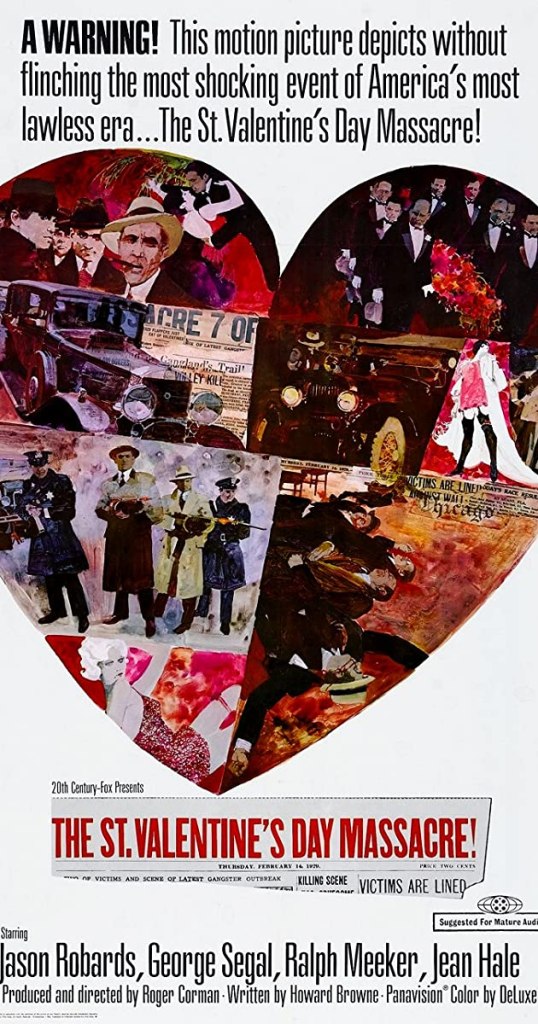
The 1967 film, The St. Valentine’s Day Massacre, details the rivalry between Capone and Moran, starting with them fighting for control over the Chicago rackets and ending with the title event.  Moran is played by Ralph Meeker while Jason Robards plays Capone.

Now I know what you’re probably thinking.  Perennial WASP Jason Robards as Al Capone?  That may sound like odd casting and, let’s just be honest here, it is.  However, it actually kind of works.  Robards may not be convincingly Italian but he is convincingly ruthless.  Add to that, one of the major subplots of the St. Valentine’s Day Massacre is that, even as the head of the Chicago Outfit, Capone still feels like an outsider in the world of organized crime because, while he is Italian, he isn’t Sicilian.  Capone feels as if Lucky Luciano and all of the major New York crime bosses look down on him and one reason why he’s so ruthless about taking over Chicago is that wants to show Luciano that he can be just as effective a crime lord as any Sicilian.  Capone feeling out of place in the Mafia is reflected by Robards initially seeming to be out of place in a gangster film.  By the end of the movie, of course, Capone has proven himself and so has Jason Robards.

Robards isn’t the only familiar face to be found in The St. Valentine’s Day Massacre.  Though this film was released by 20th Century Fox, it was directed by Roger Corman and Corman fills the production with members of his stock company.  Dick Miller, Jonathan Haze, and Jack Nicholson all have small roles as gunmen.  Bruce Dern plays the unlucky mechanic who enjoys hanging out with gangsters.  Buck Taylor, Leo Gordon, and Joe Turkel all have small roles.  John Agar plays Dion O’Bannon and is gunned down in his flower store.  Though not members of the Corman stock company, George Segal and David Canary plays brothers who work for Moran.  There’s a lot of characters wandering through this film but Corman makes sure that everyone gets a chance to make an impression.

It’s a good gangster film.  Though he was working with a larger budget than usual, Corman still brought his exploitation film aesthetic to the material and the end result is a violent, melodramatic gangster film that looks really impressive.  The film’s recreation of 1920s Chicago is a visual delight and looking at the well-dressed and stylish gangsters walking and driving down the vibrant city streets, you can understand why organized crime would have such a draw for some people.

The St. Valentine’s Day Massacre is a classic gangster film and a classic Corman film.  It’s an offer you can’t refuse.

Previous Offers You Can’t (or Can) Refuse:

  1. The Public Enemy
  2. Scarface
  3. The Purple Gang
  4. The Gang That Could’t Shoot Straight
  5. The Happening
  6. King of the Roaring Twenties: The Story of Arnold Rothstein 
  7. The Roaring Twenties
  8. Force of Evil
  9. Rob the Mob
  10. Gambling House
  11. Race Street
  12. Racket Girls
  13. Hoffa
  14. Contraband
  15. Bugsy Malone
  16. Love Me or Leave Me
  17. Murder, Inc.


Cleaning Out The DVR Yet Again #10: The World’s Greatest Sinner (dir by Timothy Carey)


(Lisa recently discovered that she only has about 8 hours of space left on her DVR!  It turns out that she’s been recording movies from July and she just hasn’t gotten around to watching and reviewing them yet.  So, once again, Lisa is cleaning out her DVR!  She is going to try to watch and review 52 movies by Wednesday, November 30th!  Will she make it?  Keep checking the site to find out!)

the-worlds-greatest-sinner-2

As I continued to clean out my DVR, I decided to take a break from watching Lifetime films and, instead, I watched a movie that I recorded off of TCM on October 30th.

Filmed in 1962 but apparently never given an official theatrical release, The World’s Greatest Sinner is a genuine oddity and one that everyone should see at least once.  The infamously eccentric character actor Timothy Carey wrote, directed, and starred as Clarence Hilliard, a small-town insurance salesman who, one day, decides to quit his job and … well, your guess is as good as mine as to what he’s doing or why he’s doing it.  Here’s what I can tell you for sure: after stumbling across a concert and seeing how excited everyone is over rock and roll music, Clarence decides to become a street preacher.  While standing on bags of fertilizer, Clarence preaches that everyone is God and that everyone can live forever.

At first, Clarence faces persecution for his beliefs but soon, he has a loyal cult following.  He funds his new church by seducing elderly widows and he even becomes a rock star himself.  At first, he’s held back by his lack of facial hair but then he starts to wear a fake goatee.  He even changes his name to God Hilliard and, while he may have alienated his family, he is now loved by young people everywhere.  In fact, in a remarkably icky scene, we find out that the 40-something God now has a 14 year-old girlfriend.

God Hilliard is so popular that he’s approached by a shadowy figure who suggests that maybe he should run for President.  As the candidate for the Eternal Man Party, God gives ranting speeches that are listening to by his rabid fans, the majority of whom are now wearing arm bands with the letter “F” on them.  (F for Faust, perhaps?  Or F for Fake, as Orson Welles might argue.)  At first, the press ignores God but God runs as an outsider, giving speeches in which he promises to do away with the establishment and return the government to the people and … well, let’s just say that this film, which was obviously designed to be an over the top satire, now feels more than a little prophetic.

It looks like God Hilliard is about to become the most powerful man in the free world but the other God — the one who is vengeful and jealous and capable of throwing lightning bolts and all that — might have other plans….

(Incidentally, this entire story is told in 77 minutes, which should give you some clue of just how frantically paced The World’s Greatest Sinner is.)

Oh my God (not, not you Clarence), this is a weird film.  It’s shocking today so I can only imagine how it must have looked to audiences in 1962.  (Or, I should say, how it would have looked if it had actually been given a theatrical release.)  Admittedly, The World’s Greatest Sinner is a ragged film, full of haphazard editing and occasionally inconsistent sound.  Made for just $90,000, its low budget is obvious in almost every scene.  And yet, all of this works to the film’s advantage.  The World’s Greater Sinner literally feels like a cinematic dream, with its inconsistencies contributing to its otherworldly feel.  This is one of those films that you need to see at least once because you’ll probably never see another one like it.

The entire film is a Timothy Carey production.  He wrote, produced, directed, and starred, creating an indie film at a time when being independent was something more than just a trendy buzzword. If you’re into classic films — and particularly if you’re a fan of Stanley Kubrick’s early work — you might recognize Carey.  He was one of those legendary character actors who was always called upon whenever a movie needed a memorable crazy or an intimidating henchman.  From what I’ve read, Carey was reportedly as eccentric as the characters that he played.  His performance in The World’s Great Sinner swings back and forth between being histrionic and being surprisingly subtle, often in the same scene.  The same can be said of his direction.  For every uneven or poorly lit scene, there’s another that’s artfully composed and full of surprising detail.

The World’s Greatest Sinner is simply something that has to be seen to believed.

the-worlds-greatest-sinner


Move over Keanu, it’s GAY PURR-EE (Warner Brothers 1962)


gary loggins's avatarcracked rear viewer

gay1

Where else can you see Parisian pussycats dancing the Can-Can at the Mewlon Rouge but in GAY PURR-EE? This animated musical feature from UPA Studios was a bit more adult themed than it’s Disney counterparts, at least by 1962 standards. It’s the story of Mewsette, a country cat in 1890’s Provincial France who dreams of living the life of a big city kitty in Paris. One day she decides to chuck it all and hops on her mistress’s sister’s coach to head for the City of Lights. Her boyfriend, the mouse-catching Jaune-Tom, and his amusing little pal Robespierre, set out to find her and rescue her from the clutches of the scoundrel Meowrice, who together with Madame Rubens-Chatte plan to train Mewsette in the ways of the world and sell her off to a fat American cat.

gay2

The vocal stars of GAY PURR-EE are Robert Goulet, fresh off his Broadway success in CAMELOT, and the…

View original post 448 more words

Shattered Politics #26: Wild In The Streets (dir by Barry Shear)


Wild_in_the_streets_dvd_cover

I am really not looking forward to turning 30.

Seriously, the great thing about being in your 20s is that everything is set up to specifically appeal to you.  Everyone wants your attention, your money, your tweets, your ideas, you love, and everything else.  And, yes, I understand that most people neither like nor respect my generation but oh well and whatever.  Trust me, the generation coming up behind mine is a hundred times worse.

2008 was a great time to be a politically knowledgeable millennial.  Everyone running for President was desperate to get our vote and they were willing to promise us anything.  And, since my age group voted overwhelmingly for Obama, all of the old elitists in the national media briefly fell in love with us.  (The genius of Obama’s 2008 campaign was to tell us that we were the people that we were waiting for.  Technically, it’s a bit nonsensical but never doubt what you can accomplish by appealing to the ego of the electorate.)

Of course, over the past few years, my generation has essentially been fucked over by both political parties and, since we dared to complain about it, nobody likes us anymore.  But, oh well and whatever.  American culture is basically built around our whims so we really don’t need anyone else’s love.

And, if all this sounds a little bitter or angry, I would point that young people and old people have been at war since time began.  Generational conflict is nothing new.  And if you need proof of that, I suggest watching a film from 1968 called Wild In The Streets.

Wild in the Streets tells the story of Max Frost (Christopher Jones), a rock star who lives in a gigantic mansion with his band and his groupies.   When Max is asked to perform at a campaign appearance for senate candidate Johnny Fergus (Hal Holbrook), he agrees to do so because Fergus supports lowering the voting age.  (When Wild In The Streets was made, you had to be 21 to vote.  So, if your birthday fell on election day, you could cast your first vote and then go have your first legal drink.)  However, at the rally, Max announces that he wants 14 year-olds to have the vote and then performs a song called “14 or fight!”

Max’s song is such a sensation and leads to so many protests that, in a compromise, the voting age is lowered to 15.  Johnny Fergus is elected to the Senate and, before you can say “Blue dog,” promptly starts to ignore the will of the people who supported him.  So, Max arranges for his girlfriend Sally (Diane Varsi) to be elected to the U.S. House.  After spiking the water supply of Washington D.C. with LSD, Sally gets a bill passed and the age requirement for holding political office is lowered to 14!

Of course, in the next election, 24 year-old Max Frost is elected President of the United States.  Soon, anyone over the age of 35 is being sent to re-education camps where they are force-fed LSD.  Max is so ruthless that he even sends his own mother (Shelley Winters) off to re-education.

And, with all the old people gone, everything is perfect for Max.  Except for that fact that 10 year-olds are now demanding the vote…

In many ways, Wild in the Streets feels like a film that could have only been made in 1968.  From the psychedelic direction to the costumes to the hair to music, everything about this movie screams late 60s.  But, at the same time, it’s still a genuinely amusing satire, largely because generational conflict is timeless.  We all think that those older than us are clueless and that those younger are spoiled.  There’s a lot of things in your life that can control.  Sadly enough, getting older is not one of them.

Wild in the Streets is a fun and amusing time capsule.  See it now before the younger generation comes of age and totally fucks up the world.

http://www.youtube.com/watch?v=gs-xc1CKnzY