Welcome to Retro Television Reviews, a feature where we review some of our favorite and least favorite shows of the past! On Tuesdays, I will be reviewing the original Fantasy Island, which ran on ABC from 1977 to 1984. Unfortunately, the show has been removed from most streaming sites. Fortunately, I’ve got nearly every episode on my DVR.
This week, we have two fantasies that seem very familiar.
Episode 7.9 “Fantasy Island Girl/Saturday’s Child”
(Dir by Leslie H. Martinson, originally aired on December 10th, 1983)
Actress Marion Sommers (Stella Stevens) comes to the Island. Lawrence is a huge fan and can’t imagine what fantasy she could possibly have. Roarke explains that Marion wants to be reunited with her children. The twist is that her children don’t know that Marion is their mother. They think that their mother died and that they were adopted by Fran Woods (Diane Baker).
Marion is told that, because of the way she phrased her fantasy, she’ll get to meet her children on the island but she can’t tell them that she’s their mother. The children have spent the last few years with Ms. Woods as their mother. Marion agrees but she doesn’t keep her word and, by the end of her fantasy, she’s told both Bill (David Kaufman) and Ellie (Amy Linker) that she is their mother and that she wants them to come with her. Bill and Ellie reject her, saying that Ms. Woods will always be their mother. However, they would like it if Marion would be their friend.
Lawrence asks Marion to give him her autograph so he can give it to his niece. Then, after Marion leaves, Lawrence tells Roarke that he doesn’t have a niece….
This fantasy seemed awfully familiar. I don’t really have the time to go back and reread every FantasyIsland review that I’ve written but I’m pretty sure that this show has already gone to the “I’m a famous actress who wants to meet the children that I gave up” well more than a few times. In this case, it just felt like everyone was going through the motions.
As for the other fantasy, it involved the Fantasy Island Girl Beauty Pageant and, again, I’m pretty sure I’ve seen several versions of this pageant fantasy in the past. This time, it’s the pageant’s producer, Nick Gleason (Paul Burke), who has a fantasy. It seems that Nick has a reputation for fixing his pageants so his fantasy is to run a totally “clean” and honest pageant. It seems like he could have just done that on his own without even having to go to Fantasy Island. Since when have fantasies become about doing things that most people would just do naturally?
Nick’s daughter, Tina (Audrey Landers), enters the pageant and suddenly, Nick finds himself tempted to fix the pageant for her. When Roarke explains this to Tina, Tina withdraws from the pageant and Nick doesn’t fix the pageant. Nick is so happy that he finally put on a honest pageant but the only reason he didn’t fix the pageant was because Tina dropped out. If she hadn’t dropped out, he totally would have rigged it. So, I’m not really sure that Nick has anything to brag about. It’s kind of like bragging about not robbing a bank because it was closed on Sunday.
Lawrence is appointed as one of the judges for the beauty pageant. You know who really enjoyed beauty pageants? Tattoo. This would have been a fun fantasy for Tattoo. Instead, we just get Lawrence looking all huffy and puffy.
In 1955’s Francis In The Navy, Donald O’Connor plays Lt. Peter Sterling, an officer in the U.S. Army who gets word that his best friend, a talking mule named Francis (voice of Chill Wills), is about to be auctioned off by the U.S. Navy. Sterling rushes to the Naval base but, along the way, his wallet gets stolen, he gets mistaken for an AWOL soldier, and Francis gets sold to a laboratory.
Hold on, I’m re-reading that last paragraph to make sure that I didn’t hallucinating typing all that…
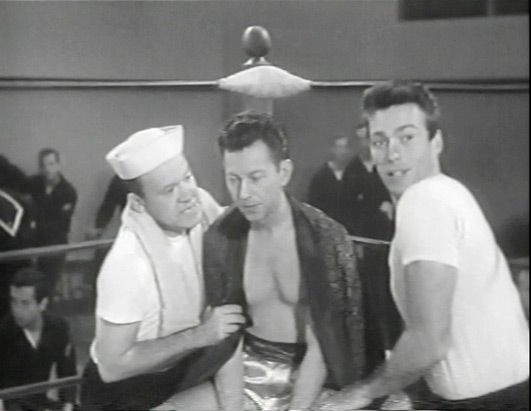
Peter argues that he’s not the AWOL soldier, he’s just someone who looks just like him. Peter gets tossed into the psychiatric ward. Francis advices Peter …. yes, the mule that can talk gives Peter advice on how to get out of the mental ward …. to pretend to be the AWOL sailor. Unfortunately, the sailor is a champion boxer so that means Peter will have to enter the ring. Peter, needless to say, is not a boxer. Peter also falls for a nurse (Martha Hyer) but — uh oh! — she’s the sister of the AWOL soldier. Well, that’s kind of awkward. I don’t have a brother but if I did, I doubt I would ever want to make out with anyone who looked like him. Like seriously….
Hold on, I’m re-reading that last paragraph to see if there’s anything that I need to add.
Like, seriously, what the Hell? This movie has a talking mule, an oddly incestuous subtext, and Donald O’Connor playing two roles. Doing some research, I discovered that this was the sixth film to deal with the adventures of Peter Sterling and Francis. This was the last one of them to star Donald O’Connor, who apparently resented getting upstaged by a mule. There was one more Francis movie after this one and it starred Mickey Rooney. It was called Francis In The Haunted House so who knows? Maybe I’ll review it for our October horrorthon. (Don’t count on it.)
As weird as this film is, it’s kind of likable. Donald O’Connor is a favorite of mine and this one featured O’Connor in two roles, as both the hapless Peter and also the sailor who goes AWOL and repeatedly refuses to help Peter out. And, while I’m not really sure why he’s talking, Francis was actually cute. I enjoyed the boxing scene where he attempted to help Peter out. Unfortunately, there’s only so much a mule can do.
As for why I’m reviewing this movie, it’s because Clint Eastwood is in the cast. He plays Jonesy, a friend of the AWOL sailor who becomes a friend of Peter’s. Now, to be clear, Clint doesn’t do a lot in the movie. He works Peter’s corner during the boxing match. Otherwise, he spends most of the time in the background and he has a few scenes where he hangs out with the rest of the AWOL sailor’s friends. That said, Clint does make an impression. Even in this very early role, he had an impressive screen presence. He’s the tallest guy there and he’s got the best hair. Once you spot him in a scene, it’s hard to look away.
Francis In The Navy is historically significant because it’s the first film for which Clint Eastwood received on-screen credit. (Eastwood previously appeared in films like Revenge of the Creature and Tarantula but his name wasn’t included in the credits.) It’s an odd film, one that’s likable if you’re in an undemanding mood and you enjoy goof — extremely goofy — humor. It would be forgotten if not for Eastwood’s appearance. Seen today, this film, like Eastwood’s other early appearances, reminds us that everyone started somewhere.
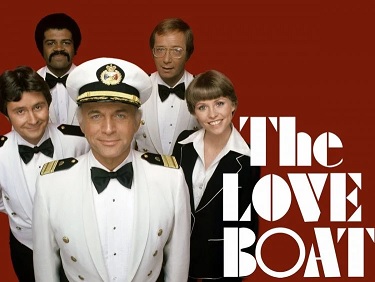
Welcome to Retro Television Reviews, a feature where we review some of our favorite and least favorite shows of the past! On Wednesdays, I will be reviewing the original Love Boat, which aired on ABC from 1977 to 1986! The series can be streamed on Paramount Plus!
This week’s cruise did not make me want to set course for adventure.
Episode 4.16 “Gopher’s Bride/Love with a Married Man/Not Tonight, Jack!”
(Dir by Richard Kinon, originally aired on January 24th, 1981)
This week’s episode is all about cabins.
For instance, Jack Clayton (Patrick Wayne) invited his girlfriend of four weeks, Helen Mann (Trish Stewart), to join him on the cruise without telling her that they would be sharing a cabin. Sorry, Jack — Helen doesn’t go for that sort of thing! Jack is kicked out and spends most of the cruise trying to find some place else to sleep. (He also ends up awkwardly lugging his suitcase around with him.) Eventually, Helen gets some romantic advice from Julie (always a mistake) and decides that it’s not fair to kick Jack out of the cabin that he paid for. She tells him that he can stay in the cabin. Jack’s like, “Finally, let’s get it on!” No, Jack, Helen doesn’t go for that. Instead, she plans on sleeping outdoors for the rest of the cruise!
The two of them work it out eventually. When Jack objects to Helen sleeping outside, even if it means Jack would again have to find someplace else to go, Helen realizes that he actually does care about her and he’s not just interested in sex. They leave the boat together, with Helen promising that she and Jack will always sleep in the same bed from now on. I give their relationship another two weeks or so.
Meanwhile, Kay Tindal (Susan Oliver) wants Ned Beacham (Paul Burke) to come visit her cabin and Ned is sorely tempted because his wife, Margo (Dana Wynter), is such a workaholic. Fortunately, Ned and Margo’s 24th anniversary falls right in the middle of the cruise and it causes Ned to realize that he still loves Margo and it causes Margo to realize that she spends too much time worrying about her career. Ned and Margo leave the ship together while Kay can only watch from the staircase. Ha! Take that, homewrecker!
Finally, Gopher risks his job so that Nicole (Marie Laurin) can stay in his cabin. Nicole is Gopher’s pen pal from Quebec. (Actually, she was writing to Doc and Isaac who, for reasons that are never made clear, signed Gopher’s name to all of the letters.) When Nicole shows up on the boat, Gopher takes one look at her and says that she can stay with him. Of course, it’s against ship regulations for passengers to stay with crewmembers so, in order to keep Captain Stubing from finding out, Gopher tells him that Nicole is a new maid. Gopher ends up doing all of Nicole’s work and Nicole ends up meeting and getting engaged to a passenger named Frank (Paul Gale). Sorry, Gopher!
This was a pretty forgettable episode and it was a bit hard to sympathize with any of the passengers. Jack was a cad. Helen was a prude. Kay was a homewrecker. Ned was a wimp. Margo was cold. Nicole was so self-centered that she didn’t even notice that Gopher was killing himself with extra work to keep her from getting kicked off the boat. I wouldn’t want to be on a cruise with any of these people.
On a slightly positive note, Captain Stubing did ask Vicki if she had done her homework so I now definitely know that Vicki has a tutor and is getting an education while living on the boat. At least I don’t have to worry about that anymore!
Welcome to Retro Television Reviews, a feature where we review some of our favorite and least favorite shows of the past! On Tuesdays, I will be reviewing the original Fantasy Island, which ran on ABC from 1977 to 1984. Almost the entire show is currently streaming on Daily Motion.
Oh my God, this week’s episode….
Episode 4.18 “The Searcher/The Way We Weren’t”
(Dir by Leslie H. Martinson, originally aired on March 7th, 1981)
This week’s episode was just silly and it’s going to be a struggle to even come up with the usual 500 words to say about it.
Fred Cooper (Jerry Van Dyke) is worried that married life is losing its spark so he wants to relive the early days of his marriage to Dottie (Laraine Stephens). After going through a magic time travel cloud, Fred and Dottie find themselves living in their old house, which they share with Fred’s aunt. Their neighbors are Vic (Jack Carter) and Myra Fletcher (Dawn Wells). Vic is Fred’s boss. He and Myra are also swingers! Apparently, Fred forgot about that but I have to wonder how anyone would forget that? Anyway, Vic offers Fred a promotion but only if Fred will allow Vic to sleep with Dottie. Fred responds by punching Vic out while Vic is hosting a Swingers Convention on Fantasy Island. (Tattoo must have been very happy this week.) Vic realizes that he was in the wrong and Fred still gets his promotion. But is it a real promotion or just a fantasy promotion? Seriously, what the Hell is going on here?
Meanwhile, young heiress Karen Saunders-Holmes (Laurette Spang) comes to the island with her husband, Brian (James Darren). Brian thinks that they’re just on their honeymoon but Karen actually has a fantasy. She wants to be reunited with her father, a man named Noah who supposedly abandoned her when she was an infant and whom she has never met. Mr. Roarke arranges for Noah (Paul Burke) to be released from prison for the weekend and….
PRISON!? Yep, Noah is a convicted murderer and has spent the last two decades in a prison camp. Noah claims that he was innocent of the crime. Anyway, Mr. Roarke introduces Noah to Karen and Brian and says that Noah will be their guide on the Island….
Brian freaks out! It turns out that Brian is actually the man who Noah was framed for murdering. Brian went off and got plastic surgery after faking his own murder, which is why Noah doesn’t recognize him. But Noah soon learns the truth when Brian tricks him into entering a bog of quicksand!
Does Noah survive the quicksand? He does but we’re never told how. Does Brian then freak out and run into the quicksand as well? Of course. Fantasy Island is such a dangerous place!
This was a silly episode. Brian apparently not only had plastic surgery to change his face but also to reduce his age because there was no way he was old enough to a contemporary of Noah’s. And for the swinger’s convention on Fantasy Island …. I mean, what? Mr. Roarke is suddenly okay with a big key party on his Island? How do you forget that you used to live next door to a swinging couple? Like I said, this was just silly. One fantasy features Jerry Van Dyke being way too goofy and the other features James Darren being way to obviously sinister. Neither worked.
So far, the fourth season has really been a mixed bag, hasn’t it? Hopefully, things will improve next week.
Welcome to Retro Television Reviews, a feature where we review some of our favorite and least favorite shows of the past! On Wednesdays, I will be reviewing the original Love Boat, which aired on ABC from 1977 to 1986! The series can be streamed on Paramount Plus!
This week, the Captain needs a new watch but his crew is determined to give him a bunch of toothpicks instead.
Episode 2.24 “Ages of Man/Bo and Sam/Familes”
(Dir by Richard Kinon, originally aired on March 10th, 1979)
This week’s cruise gets off to a bizarre start with Captain Stubing reminding the members of the crew that he will soon be hitting his 5-year anniversary mark as their captain. Doc, Julie, Gopher, and Isaac are planning to throw him a huge surprise party and they’ve even gotten him a gift, a replica of the Love Boat made out of toothpicks!
Now, it’s not just the gift that feels strange about this scenario. There’s also the fact that Stubing claims that he’s been captain of the Pacific Princess for five years even though the show is only in its second season. As you may remember, the very first episode of The Love Boatfeatured the crew still talking about how they couldn’t figure out the proper way to approach their new captain and how they didn’t know anything about his background. So, unless three years passed without anyone noticing, the Captain has only been on the ship for two years.
Add to that, Captain Stubing keeps telling anyone who will listen that he needs a new watch. So why is the crew dumb enough to give him a boat made out of toothpicks for his anniversary gift? The toothpick boat itself is constructed by two close friends, Bo (Philip Charles MacKenzie) and Sam (Michael Tucci). Of course, when Bo and Sam deliver the gift to the cruise, they end up breaking it in half. As a result, they stowaway on the ship so that they can rebuild the toothpick boat. And they do rebuild it! But then they break it again so, with hours to go until the Captain’s party, they again have to rebuild it. When they deliver the boat the captain’s party, they discover that every member of the crew has given Stubing some sort of miniature boat. Stubing is not particularly excited about the toothpick boat until he hears the sound of something ticking inside of it. Yes, that’s right, Sam’s watch fell off while they were rebuilding the boat. Stubing smashes the toothpick boat and is overjoyed to discover a watch, one that is inscribed with a touching message about friendship. Bo promises to get Sam a new watch.
This storyline was …. well, to say it was frustrating is perhaps putting it a little bit too lightly. Seriously, it never made any sense. Why, if the Captain keeps telling you that he desperately needs a new watch, would you buy him a toothpick boat instead? And why, with something that fragile, would you not wrap it up or find some other way to protect it before trying to carry it onto the cruise? Every time that fake boat got destroyed, I wanted to throw something at the TV.
As for the other storylines….
Julie develops a crush on an older passenger named Walter (Paul Burke) while a younger passenger named Bobby Trymon (Patrick Labyorteaux) develops a crush on Julie. Julie wants to spend all of her time dancing with Walter but she also has to try to let teenage Bobby down gently. Eventually, Julie tells Bobby that he’s too young for her and then Walter explains that he’s too old for Julie. So, everyone ends up miserable.
While that’s going on, publisher Hank Hardaway (Leslie Nielsen) is shocked to discover that his arch nemesis, union leader Monica Cross (Arlene Dahl) is on the cruise! Hank’s daughter, Diana (Ellen Bry), thinks that Monica has a point about protecting the working man while Monica’s son, Jeff (Mark Shera), thinks that Hank has a point about working hard and pulling yourself up by your own bootstraps. Eventually, Diana falls for Jeff and Hank falls for Monica and the four of them prove that you can love someone even if you disagree with their politics. This storyline was simple and silly but, to be honest, kind of charming. Nielsen, who still in the “serious actor” phase of his career when he did this episode, seemed a bit more relaxed than usual and Ellen Bry and Mark Shera had a likable chemistry. Simple as this story may have been, it was kind of what the episode needed to counterbalance all the toothpick boat nonsense.
This cruise was a mixed bag. At least the Captain got a watch.
Welcome to Retro Television Reviews, a feature where we review some of our favorite and least favorite shows of the past! On Wednesdays, I will be reviewing the original Love Boat, which aired on ABC from 1977 to 1986! The series can be streamed on Paramount Plus!
Beware the Inspector! Read on and find out more about this week’s cruise of the Pacific Princess….
Episode 1.19 “A Very Special Girl / Until the Last Goodbye / The Inspector”
(Dir by Roger Duchovny, originally aired on February 11th, 1978)
Captain Stubing starts the cruise by giving the crew some potentially frightening news. The company has sent an inspector to take the cruise and observe how everyone is doing their job. The catch is that the inspector is disguised as a passenger and the crew now has to figure out who it could be!
Marvin Waterman (Jim Backus) seems like a good suspect. He’s stuffy. He always wears a suit. He carries around a notepad. He’s always asking questions about the ship. It must be Marvin! Nope, sorry. It turns out that Marvin is just a children’s book author and he’s doing research.
Could it be eccentric Mrs. Corwin (played by Gavin MacLeod’s wife, Patti MacLeod)? She acts like she’s spacey and not always sure where she is but maybe that’s just a cover! She does make a lot of calls back to the mainland! Nope, it’s not Mrs. Corwin. It turns out that she’s just an eccentric widow who likes to call her daughter and let her know what’s going on in her life. Fortunately, Mrs. Corwin meets and inspires Marvin and they fall in love. Unfortunately, that doesn’t bring the crew any closer to finding the inspector.
Surprise! The inspector wasn’t actually on the ship. He arrived late and wasn’t able to board. However, his father (Jack Bernardi) did get on board and he spend the entire cruise wandering about and asking people questions in Russian. As far as I could tell, none of the crew made much of an effort to help the confused old man out so I’m guessing they’re all out of a job now. I wonder what next week’s episode will be like….
While the crew was looking for the inspector, Mike Andrews (Bob Seagren) was looking for Melanie Taylor (Laurette Sprang). Mike arranged for his goofy sidekick, Doug (Sal Viscuso), to spend all of his time with Melanie’s best friend, Jane (Debralee Scott). Fortunately, Doug and Jane fell in love. Meanwhile, Mike abandoned Melanie as soon as the cruise ended. Booooooo!
Finally, the crew was fascinated by an older man (Paul Burke) who was traveling with a younger woman (Susan Blanchard). For the majority of the episode, everyone assumed the man and the woman were lovers. But then the man collapsed and it turned out that he was the woman’s father and he also terminally ill. This cruise was their long goodbye. This was a sweet story, even if it was kind of icky that everyone assumed that the father was carrying on an affair with his daughter. But, really, that mistaken assumption is the fault of the crew. I’m surprised they didn’t mistake the older man for being the Inspector.
Anyway, this was a fairly typical episode of The Love Boat. It got the job done with a minimum of complications and, if nothing else, it looked like a fun vacation. The Love Boat always works best as wish-fulfillment. It’s the type of show you watch and think, “What would I do if I was on that cruise?” I enjoyed this episode. The whole thing with the inspector was silly but the other two stories were well-handled. I hope things worked out for Doug and Jane!
Welcome to Retro Television Reviews, a feature where we review some of our favorite and least favorite shows of the past! On Tuesdays, I will be reviewing the original Fantasy Island, which ran on ABC from 1977 to 1996. The entire show is currently streaming on Tubi!
Smiles, everyone, smiles! It’s time for another trip to Fantasy Island, the most dramatic mystical island this side of Lost! This week, we have three fantasies and Tattoo tries to grow mustache.
Episode 1.5 “Lady of the Evening/The Racer”
(Directed by Don Weis, originally aired on February 25th, 1978)
This episode begins with the bell ringing and Tattoo yelling that the plane is arriving. Before Mr. Roarke and Tattoo drive off to greet the plane, Mr. Roarke tells Tattoo to wash his face because he has what appears to be a smudge on his upper lip. Tattoo explains that he’s growing a mustache because all of the world’s great lovers (including, Tattoo says, Burt Reynolds) have mustaches. Tattoo’s effort to grow a mustache is a running joke through this episode of Fantasy Island. Needless to say, it doesn’t go well for him. Eventually, he resorts to using shoe polish. By the end of the episode, Tattoo finally washes his face and presumably returns to doing whatever it is that he actually does on the island.
As for the fantasies….
Renee Lansing (Carol Lynley) is a high-priced New York “call girl” who just wants to take a vacation some place where no one knows what she does for a living. At first, the fantasy seems to be going well. She even meets a nice guy named Bill (Paul Burke). But then, on the tennis court — OH MY GOD, IT’S ONE OF HER CUSTOMERS! Renee runs off to Mr. Roarke’s office and demands her money back. Mr. Roarke tells her that she’s not being honest with herself about what her fantasy actually is. At this point, I was really wondering what one goes through when one signs up to Fantasy Island. I assume some sort of agreement has to be signed. Does the agreement actually state that Mr. Roarke gets to decide what your fantasy actually is? Renee’s fantasy was to not be recognized. She’s been recognized. GIVE HER BACK HER MONEY, ROARKE!
Anyway, it all turns out for the best. Bill reveals that he also knows who Renee is (GIVE HER BACK HER MONEY!) but he doesn’t care because he’s secretly been in love with her for years and apparently, it was his fantasy to be reunited with her. Good for Bill but Renee still didn’t get her fantasy. Someone needs to introduce her to a good lawyer.
Meanwhile, Jack Kincaid (played by the master of overacting, Christopher George) is a race car driver who has never mentally recovered from a serious crash. His fantasy is to reexperience the crash so that he can get back his confidence. Mr. Roarke goes through a lot of trouble to build an exact replica of the race track on which Jack crashed. He even brings Jack’s mechanic, Corky (Alan Hale, Jr.), to the island. Fortunately, Jack’s wife (Carol Lawrence) convinces Jack that he has nothing to prove. So, Jack doesn’t get his fantasy but he does become a better person.
Did anyone get their fantasy this week!? Actually, Mr. Brennan (Jerry Van Dyke) did. Mr. Brennan shows up in one scene and tells Roarke that he loved his fantasy, which was apparently to play tennis without having to deal with his wife nagging him …. wait, what? That’s the fantasy that Roarke actually honors?
I’m starting to think Fantasy Island might be a scam! We’ll find out more next week, I guess.
Sure, inheriting an old New England farm might sound like a fun idea but what are you going to do if it turns out that the farm is haunted by the spirits of a coven of witches?
That’s the question that Hope Lange and Paul Burke have to find an answer for in this enjoyably spooky 1970 made-for-TV horror film! Lange and Burke both give good performances, generating a lot of sympathy for their unhappily married couple while director John McGreevey does a commendable job of creating and maintaining a nicely ominous atmosphere.
And, of course, John Carradine’s in it! It’s simply not a rural horror film from the 70s without John Carradine!
(Warning: This review contains spoilers. A lot of them.)
Last week, I posted a poll and I asked you, the Shattered Lens readers, which film I should watch on March 20th and then subsequently review. You voted and the winner was the classic 1967 trashfest, Valley of the Dolls.
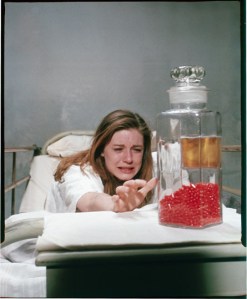
Based on a best-selling (and trend-setting) novel by Jacqueline Susann, Valley of the Dolls starts out with a disclaimer that informs us that the story we’re about to see is totally fictional and purely imaginative. That disclaimer is probably the funniest part of the entire film as Valley of the Dolls is notorious for being one of the first films dedicated to showing middle America just how miserable and screwed up those famous show business types truly are. As such, the main reason for watching a movie like this is so you can sit there and compare the cinematic troubles of a character like Neely O’Hara to the true-life troubles of an actress like Lindsay Lohan. Valley of the Dolls tells the story of three aspiring stars who, as they find fame, also find themselves dealing with heartbreak, insanity, and dolls. No, not the type of dolls that my mom used to collect. These “dolls” are a bunch of red pills that do everything from keeping you thin to keeping you awake and focused. (Though the pills are never actually called anything other than “dolls,” they appear to be the same pills that I take for my ADD.)
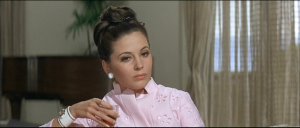
The least interesting of our three heroines is Anne Welles (Barbara Parkins). Unfortunately, Anne is also pretty much the center of the rather draggy first hour of the film. Anne is a walking cliché, a naive girl from a small town in New England who moves to New York, gets a room at the Martha Washington Hotel for Women, and a job at a local theatrical agency. “I want to have a marriage like mom and dad…but not yet!” Anne breathlessly tells us. Anne eventually ends up as the mistress of Lyon Burke (played by Paul Burke), a writer-turned-theatrical-agent who you know has to be a cad because his name is Lyon Burke and he takes Anne’s virginity but then refuses to marry her afterward. Anne eventually becomes a model and finds fame as the face of Gilligan Hairspray but she soon finds herself forced to watch as her two best friends travel down a path of self-destruction.
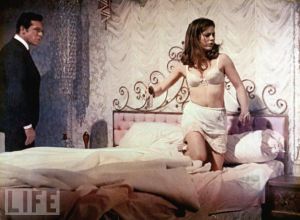
Anne is the film’s token “good girl” and, as such, she’s rather bland and boring. However, her character is interesting when considered as a symbol for the confused sexual politics of the time. Valley of the Dolls was made in 1967, at a time when Hollywood was still trying to figure out how to deal with the emerging counter-culture. The end result? A lot of rather old-fashioned films that were full of jarringly out-of-place counter-culture moments. By the time Valley of the Dolls came out, it was allowable to acknowledge that a single girl might actually have sex but she still had to, at the very least, feel an unbelievable amount of angst about it. That certainly is the case with Anne. Watching the film today, it’s hard to understand just what exactly Anne’s feeling guilty about. Lyon isn’t married. Anne finds success even as she pursues her relationship with him. Up until the final half of the film (at which point the morality of the time demands that both Anne and Lyon suddenly start acting totally out-of-character), Lyon treats her with about as much respect as you could probably expect to get from a man in the 1960s. And yet, Anne can’t feel complete simply because Lyon is hesitant about marrying her. When she and Lyon finally do make love, they do it with the lights off so the only thing the viewer sees are two shadowy figures holding each other. Following the film’s logic, if the lights had been left on, the character of Anne would have had to have been punished later in the film for allowing the audience to see too much of her.
When Anne first comes to New York, she befriends two actresses. The more tragic of the two is Jennifer North (played by Sharon Tate, who would be tragically murdered two years after this film came out), an insecure blonde who is valued more for her body than her talent. Jennifer spends her spare time doing bust exercises (“To hell with them!” she declares at one point as she glares down at her chest, “Let ’em droop!”) and dealing with phone calls from her mother, demanding that Jennifer send her money. Jennifer eventually ends up marrying a singer named Tony (played by Tony Scotti). Tony is a well-meaning if simple-minded guy who is married to a creepily overprotective sister (played by Lee Grant). Eventually, it turns out that Tony has a neurological disease and he’s eventually checked into a sanitorium. Penniless, Jennifer goes France and makes “art films.” (In one of Valley of the Dolls’ better moments, we’re shown a clip of this “art film” and it turns out to be a pitch perfect satire of every single pretentious soft-core film to ever come out of Europe.) Upon returning to America, Jennifer discovers that she has breast cancer and, declaring “All I’ve got is my body,” she commits suicide.
Though Sharon Tate gets considerably less screen time than her co-stars, she probably gives the strongest performance in this film. Certainly, her story is the most emotionally effective (even if it’s hard not to feel that, as is typical of the films of both the 60s and today, Jennifer is being punished for taking off her clothes on camera). Tate perfectly captures the insecurity that comes from being continually told that you have nothing more to offer beyond how you look. In her first appearance, she’s wearing an outrageously large headdress. “I feel a little top-heavy,” she says. “You are a little top-heavy,” some guy replies while leering at her breasts. If you doubt that Sharon Tate was a good actress, just watch her reaction. She perfectly captures a pain that I personally know far too well. Her subsequent suicide scene, which has the potential to be the most tasteless part of this film, is actually the most powerful and again, it’s because Tate plays the role perfectly.
(It’s been nearly four years since I lost my mom to breast cancer and I have to admit, I had a hard time watching the scenes where Jennifer discusses her diagnosis. Tate gave a great performance here and it’s a shame that she’s been permanently linked in the public imagination with Charles Manson and the later accusations against her husband, Roman Polanski. She had real talent.)
As poignant of Sharon Tate was in her role, the film’s fame (and infamy) ultimately rests with our third heroine, Neely O’Hara (played by Patty Duke in a performance that suggests that she was literally possessed during the filming). Neely is a scrappy, aspiring singer who is fired from a broadway show when her singing threatens to upstage aging star Helen Lawson (played by Susan Hayward, who was brought in to replace Judy Garland). Neely, however, refuses to let anything keep her down and soon, she’s singing at a Cystic Fibrosis telethon and becoming a big star. She marries her boyfriend Mel (played by Martin Milner, who grits his teeth and spits out every line) and moves to California where she soon becomes a big star and then finds herself hooked on “booze and dolls.” (“I need a doll!” she insists on several occasions.)
One reason the film’s 2nd hour is so much more fun than the first is because the film’s focus shifts from boring Anne to out-of-control Neely. Increasingly temperamental and unstable, Neely soon starts to spend all of her time with dress designer Ted Casablanca (a great name, if nothing else.) “You’re spending more time than necessary with that fag Ted Casablanca,” Mel tells her to which Neely replies, “Ted Casablanca’s no fag and I’m the dame who can prove it.” This, of course, leads to a divorce and soon Neely is living with Mr. Casablanca who informs her, after he gets caught cheating, “You made me feel as if I was queer…that little whore makes me feel 9 feet tall.”
When Lyon and Anne attempt to force Neely to enter a sanitorium, she responds to running off to San Francisco where she enters a bar and shouts, “I’M NEELY O’HARA!” before then wandering down a sleazy street and ranting, “Boobies, boobies! Nothing but boobies! Who needs them!?” Needless to say, this leads to her eventually overdosing and ending up in that sanitorium where she has a huge freak-out before singing a duet with Tony and resolving to get her life back in order. This, naturally, leads to her getting released, having an affair with Lyon, and then returning to Broadway where, in the film’s most deliriously odd moment, she steals Helen Lawson’s wig and flushes it down a toilet.
Valley of the Dolls is, admittedly, a terrible film but it’s also a lot of fun and that’s largely because of Patty Duke’s berserk performance as Neely O’Hara. Earlier, I said that Duke’s performance appears to suggest that she may have been possessed but, honestly, that barely begins to describe it. Whereas Tate managed to find some truth in the film’s melodrama and Parkins gives a performance that suggests that the script put her in a coma, Duke attacks every inch of melodramatic dialogue, barking out her dialogue with all the ferocity of a yapping little chiuaua. Duke gives a performance that is so completely and totally over-the-top that it’s hard not to respect her commitment to capturing every overheated, melodramatic moment.
I have to admit that one reason why I love this film is because I’m hoping that someday some enterprising director will remake it and cast me as Neely O’Hara. Everytime I watch this film, I find myself thinking about how much it would be to respond to every petty annoyance by screeching out, “I’m NEELY O’HARA!” Seriously, just think about it. As a character, Neely is a talented, ambitious, emotional, unstable, immature, demanding, bratty, spoiled, and determined. Sound like anyone whose film reviews you might have been reading recently? From my previous experience as a community theater ingenue, I can assure you that I can deliver melodramatic dialogue with the best of them and, unlike Patty Duke in this film, I can actually dance. Unfortunately, I can’t carry a tune to save my life but I’m thinking maybe they could bring in Kelly Clarkson to serve as my singing voice. (Or maybe Jessica Simpson. Did I ever mention that we both went to the same high school? Though not at the same time, of course.) After all, if Patty Duke could be obviously dubbed, why not me? I can just see myself now, wandering down some sleazy city street, singing to myself and declaring at the top of my lungs, “Ted Casablanca’s no fag and I’m the dame who can prove it!” I know that Lindsay Lohan will probably insist that this is the role she was born to play, but seriously, who needs Linsday when you’ve got a Lisa?
Beyond the so-bad-that-its-good appeal of the film, Valley of the Dolls is a fascinating cultural artifact for the reasons that I previously hinted at while talking about the character of Anne Welles. Valley of the Dolls was made in 1967 and, as such, it’s a perfect exhibit of an unstable time when Hollywood was unsure about whether it should embrace the “new morality” or if it should continue to recycle the same sort of old-fashioned filmmaking that had nearly bankrupted the big studios. The result was several films that felt oddly schizophrenic in their approach and that is certainly the case with Mark Robson’s direction of Valley of the Dolls. Whether it’s the way the film continually hints at nudity and sex while carefully not revealing too much or the way that random psychedelic sequences seem to suddenly appear on-screen, this is a movie that perfectly captures an uncertain film industry trying to figure out where it stands in a scary new world.
As always, I enjoyed watching this undeniably bad but just as undeniably compelling film. Our readers chose well! Thank you to everyone who voted and I hope you’ve enjoyed reading this review almost as much I enjoyed writing it.

 Through the Shattered Lens